Windscale nuclear disaster at Sellafield 69 years ago today
10th October, By Ewan Wishart, https://www.whitehavennews.co.uk/news/26623785.windscale-nuclear-disaster-sellafield-69-years-ago-today/
TODAY, 69 years ago, a fire broke out on the Cumbrian coast which would become the worst nuclear accident in British history.
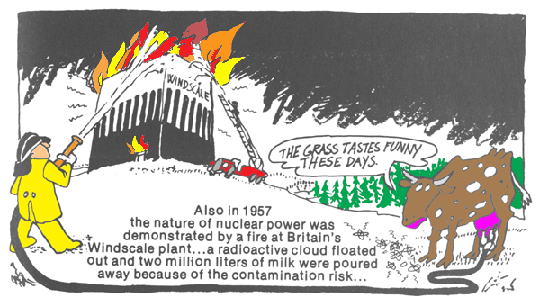
On October 10, 1957, workers at Windscale, the site now known as Sellafield, discovered that Pile No. 1, one of two reactors built as part of Britain’s post-war nuclear weapons programme, was on fire.
The reactors had been producing plutonium for Britain’s atomic weapons programme, with the Number One Pile having become operational in 1950.
On October 10, 1957, workers at Windscale, the site now known as Sellafield, discovered that Pile No. 1, one of two reactors built as part of Britain’s post-war nuclear weapons programme, was on fire.
The reactors had been producing plutonium for Britain’s atomic weapons programme, with the Number One Pile having become operational in 1950 10 operators realised something was seriously wrong.
Increasing the airflow in an attempt to cool the reactor instead helped fan the flames, while radioactive material began escaping through its chimney.
Workers eventually saw fuel channels glowing red inside the reactor and battled to bring the unprecedented fire under control.
Former Windscale worker David Staton, who later recalled his role in the emergency to the News & Star, was just 27 when he was summoned to the scene with the message: “Come at once. Pile One is on fire.”
Attempts using carbon dioxide and water were unsuccessful before the shutdown fans were switched off, starving the blaze of oxygen and allowing the water to extinguish it, Mr Staton recalled.
The consequences extended far beyond the site.
Radioactive fallout spread across Britain and Europe, while the distribution of milk from around 200 square miles of surrounding countryside was stopped because of contamination by radioactive iodine. No evacuation of the surrounding population took place.
The accident was subsequently rated Level 5 on the seven-point International Nuclear Event Scale and remains the UK’s most serious nuclear accident.
The disaster also became entwined with the secrecy of Britain’s Cold War nuclear programme.
The government under Harold Macmillan heavily censored information surrounding the accident, with concerns that disclosure could damage Britain’s nuclear relationship with the United States. The inquiry into the accident was not released in full until 1988.
The contemporary reaction in West Cumbria can still be traced through the Whitehaven News archives.
A week after the disaster, on October 17, 1957, the paper reported that local people would take a long time to regard the atomic plants with the same “complacency” they had before the fire.
The archive also records monitoring vans travelling through the area testing vegetation and air, while farmers were woken during the night and instructed not to sell, drink or feed contaminated milk to their animals.
Later scientific
research has complicated estimates of the disaster’s health impact. Historical estimates based on the radiation released suggested there could have been around 190 additional cancers, about 100 fatal, but subsequent epidemiological studies have not found the predicted increase.
Almost seven decades later, the Windscale Fire remains one of the defining events in the history of Britain’s nuclear industry.
No comments yet.
-
Archives
- October 2026 (92)
- September 2026 (339)
- August 2026 (330)
- July 2026 (355)
- June 2026 (287)
- May 2026 (306)
- April 2026 (356)
- March 2026 (251)
- February 2026 (267)
- January 2026 (308)
- December 2025 (358)
- November 2025 (359)
-
Categories
- 1
- 1 NUCLEAR ISSUES
- business and costs
- climate change
- culture and arts
- ENERGY
- environment
- health
- history
- indigenous issues
- Legal
- marketing of nuclear
- media
- opposition to nuclear
- PERSONAL STORIES
- politics
- politics international
- Religion and ethics
- safety
- secrets,lies and civil liberties
- spinbuster
- technology
- Uranium
- wastes
- weapons and war
- Women
- 2 WORLD
- ACTION
- AFRICA
- Atrocities
- AUSTRALIA
- Christina's notes
- Christina's themes
- culture and arts
- Events
- Fuk 2022
- Fuk 2023
- Fukushima 2017
- Fukushima 2018
- fukushima 2019
- Fukushima 2020
- Fukushima 2021
- general
- global warming
- Humour (God we need it)
- Nuclear
- RARE EARTHS
- Reference
- resources – print
- Resources -audiovicual
- Weekly Newsletter
- World
- World Nuclear
- YouTube
-
RSS
Entries RSS
Comments RSS


Leave a Reply