Growing U.S. military Footprint In Guam Intensifies Concerns Over Environmental Damage And Sovereignty
SCHEERPOST,August 15, 2026, Gaea Cabico Prism
In Yigo, the northernmost village in Guam, there is a well that cannot be shut down.
Known as Y-15, the well sits atop the island’s northern aquifer, which supplies around 80% of the island’s drinking water. Even if contaminants are detected, Y-15 has to keep pumping. There is simply no alternative.
The well also sits just below a hill near Upi Elementary School—attended by around 400 children—and just outside the back gates of Andersen Air Force Base, which hangs over the community like a permanent shadow. Generations of Indigenous CHamoru families have called Yigo home, relying on these waters for drinking, cooking, and other daily activities.
But in September 2025, one such family learned that the well supplying their home of 17 years was contaminated with high levels of dieldrin, a pesticide once widely used on crops and for termite control beginning in the 1950s. The Environmental Protection Agency (EPA), which classifies dieldrin as a probable human carcinogen, banned all uses of the pesticide in 1987 over concerns about its damage to the environment and links to serious health effects, including cancer, Parkinson’s disease, and reproductive issues such as decreased fertility and increased numbers of stillbirths. Because dieldrin accumulates in the body, long-term exposure—even in small amounts—can cause serious harm, according to the EPA.
More than 1,200 residents of Yigo were told not to drink water from Y-15 because of dieldrin contamination……………………………………..
Dieldrin is just one piece of a much larger and troubling environmental legacy in Guam.
Per- and polyfluoroalkyl substances (PFAS)—better known as “forever chemicals”—have also been detected across the island’s water systems. These compounds can persist in soil and groundwater for decades, and they have been linked to a range of health effects, including cancer, immune and thyroid dysfunction, liver and kidney disease, and serious reproductive issues.
For Monaeka Flores, an advocate with the grassroots environmental organization Prutehi Guåhan, the island’s environmental problems are inseparable from the military buildup that has reshaped the island. From hazardous waste dumping, base construction, and open-air detonations of munitions to live-fire exercises in sensitive habitats, advocates say that Guam’s land and water bear the toxic legacy of the U.S. military………………………………………………………………………………………………………………………………………………………………………………
The long arc of colonization
While Guam is only 30 miles long and nine miles wide, the U.S. Defense Department controls roughly a quarter of its land—and military expansion is accelerating. Much of the military buildup on the island is justified on the grounds of national security as the U.S. seeks to strengthen its position in the Pacific amid tensions with China and North Korea.
A missile defense system designed to protect the territory from potential outside threats, live-firing range complex, and new Marine Corps base are currently in the works. The buildup could also expose more people to potential environmental contamination. Roughly 10,000 active-duty personnel, their dependents, and government civilians are expected to arrive by 2036. ………………………………………………………….
What is unfolding in Guam is not happening in isolation.
From Okinawa, Japan to the Marshall Islands and the Diego Garcia military base in the Chagos Archipelago, communities living near U.S. military bases have documented patterns of environmental harm, including contamination linked to toxic chemicals and hazardous waste.
There is “very significant environmental damage” due to leaks and the military’s accidental—or sometimes intentional—dumping of hazardous, toxic materials, said David Vine, a political anthropologist and author of “Base Nation: How U.S. Military Bases Abroad Harm America and the World.” “It’s a clear pattern across the network of bases in the Pacific and around the world, including the 50 states,” he told Prism
Guam’s many environmental problems are concentrated around military bases, the island’s airport, and sites where firefighting occurred. As just one example: A major source of PFAS contamination on the island is the powerful fire suppressant known as Aqueous Film Forming Foam, which is used to extinguish jet fuel fires……………………………………………………………………………………………………
Activists, community leaders, and CHamoru families increasingly frame their struggle against the military’s pollution and contamination not only as an effort to protect fragile ecosystems, but also as a broader fight for demilitarization and decolonization. They are demanding both the removal of militarized infrastructure and the restoration of sovereignty over their ancestral lands………………………………………………………………………………………………………………….. https://scheerpost.com/2026/08/15/growing-u-s-military-footprint-in-guam-intensifies-concerns-over-environmental-damage-and-sovereignty/
US Military Morale In The Middle East In The Overflowing Toilet

By Colonel (Ret) Ann Wright, Popular Resistance., August 13, 2026
Military Families Speak Out For Their Loved Ones….Again and Again and Again.
Rotten food, no room in the incoming missile shelters, confiscation of alert notification devices for incoming missiles (cellphones), infrequent mail, jumping off aircraft carriers, overflowing toilets.
Rotten food, overflowing toilets into bunking areas, no room in the incoming missile shelters, confiscated cellphones that are the notification devices for incoming missiles, infrequent mail, social media closed down, were some of the issues that military families identified at the national conference of Veterans For Peace.
Spouses and parents of Air Force, Army, Marine and Navy, members of Military Families Speak Out, told of plummeting morale, lack of basic supplies and attacks on U.S. military bases that are not reported in the U.S. media.
The frustration of the military families at the VFP conference echoed the descriptions of life on U.S. military bases in the Middle East under attack by the Iranian response to the brutal U.S.-Israeli 5-month attack on Iran made by military families who met with the Acting Assistant Secretary of the Navy and the Commander of the U.S. Pacific Fleet in San Diego on August 6, 2026.
Big Problems on Long Deployments for U.S. Naval vessels, Ships’ Infrastructure and Sailor’s Physical and Mental Health
On August 6, 2026, the Navy’s senior leadership held listening sessions with the families of aircraft carrier USS Abraham Lincoln’s sailors – one in-person session in San Diego, and a second online session later the same evening. Family members leaked recordings of those sessions that described conditions aboard the aircraft carrier USS Abraham Lincoln: showers plagued with stubborn mildew, flagging morale, heavy fatigue, shortages of supplies and food, contaminated water supplies and lost mail.
Since departing from departing Naval Base San Diego on November 21, 2025, the USS Abraham Lincoln and its crew of 5,000 sailors and Marines has been deployed more than 250 days, with only a stop in Guam in December and a brief visit in Oman in June after 208 days at sea.
A second aircraft carrier USS Gerald R. Ford had similar problems when it sailed from the Caribbean to the Middle East after being off Venezuela in the kidnapping of Venezuelan President Nicolas Maduro and his wife in January 2026. During that deployment, the ship’s toilets kept failing, with sewage often overflowing and spilling onto the floor. Additionally, a fire broke out in the laundry room, causing enough damage that the Ford went into a port on the Greek island of Crete for repairs.
More than 200 sailors were treated for smoke inhalation, with one sailor medically evacuated from the carrier, after being injured in the damage control effort. Two others were treated for lacerations.
The smoke damage from the laundry room fire extended to the berthing. More than 100 bunks and personal gear were destroyed in the fire.
Articles in Stars and Stripes and the Navy Times detail at least six attempts by crew members to jump overboard from the USS Abraham Lincoln, with interviews conducted with sailors and families of those on board who described the impacts of the lengthy deployment.
USS Abraham Lincoln Sailor’s Father Proposes ‘Parent Swap’ To Replace His Son……………………..
Army and Marine Ground Forces Under Missile Attacks
Families of U.S. ground forces on the U.S. military bases scattered all over the Middle East describe overcrowding to no room in shelters against incoming missile and commands’ confiscating cellphones that are the notification devices for incoming missiles.
The U.S. military says that Iran watches social media postings of attacks and to prevent such postings, cellphones may be taken away, but families respond that notification of incoming missile attacks is by cellphone.
According to the news outlet War Horse, the only public source for injuries during the U.S. attack on Iran is the Defense Casualty Analysis System, which provides monthly totals for the War on Iran with limited demographic data…………………………….
Hundreds of Troops Suffering From Head Trauma
A large portion of the wounded suffering from head trauma has led some military health experts to worry that traumatic brain injuries—caused by damage to the brain that can impact thinking, movement, and emotion—could become the signature injury of this war, as in the U.S. wars in Iraq and Afghanistan.
18 US troops have been killed and 624 wounded Since February 28
The Pentagon has attempted to reduce the accounting on the number of US military killed in wounded in the war on Iran by separating those killed/wounded before the May 1 ceasefire and after. The total killed and wounded before and after the ceasefire are 18 US troops have been killed and 624 wounded since the US began its war against Iran on 28 February……………………
Senate Armed Services Committee Finally Getting Involved
The U.S. Congress is finally getting involved. On August 12, 2026, Senator Richard Blumenthal, a member of the Armed Services Committee, wrote a letter to Defense Secretary Pete Hegseth and the Acting Secretary of the Navy to express “serious concern” about the increasing length of deployments and demand answers about living conditions aboard the carrier…………………………………..https://popularresistance.org/us-military-morale-in-the-middle-east-in-the-overflowing-toilet/
Ann Wright served 29 years in the U.S. Army/Army Reserves and retired as a Colonel. She was also a U.S. diplomat for 16 years. She resigned from the U.S. Department of State in March 2003 in opposition to the U.S. war on Iraq. She is a member of Veterans For Peace, CODEPINK: Women for Peace, World Beyond War and many other organizations. She is the co-author of “Dissent: Voices of Conscience.” She lives in Honolulu, Hawaii.
Romania relies on Bulgaria and the wind after shutting down Cernavodanuclear plant
Strong wind, the prosumers shifting their input during peak
hours, and the imports from Bulgaria helped Romania’s power system on the
first day after Nuclearelectrica shut down its last reactor on August 13,
leaving the country without nearly 20% of its electricity production.
Romania Insider 14th Aug 2026,
https://www.romania-insider.com/ro-relies-bulgaria-wind-cernavoda-aug-2026
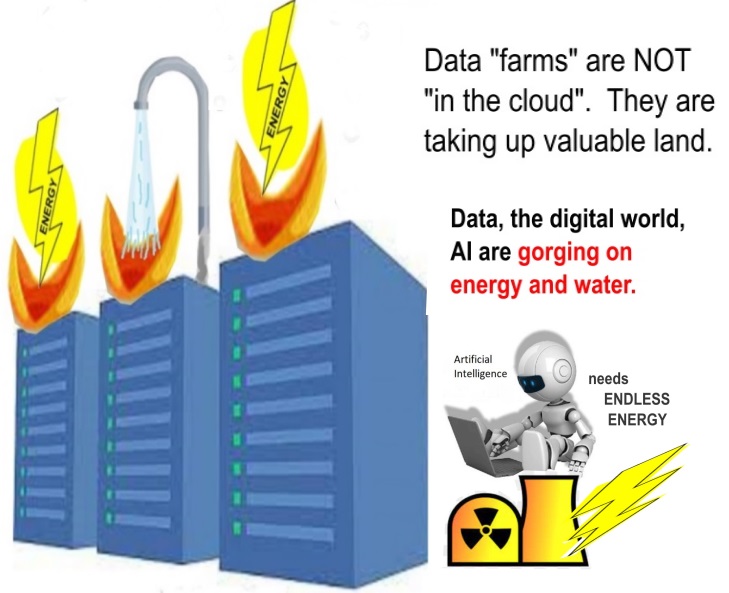
More Than Two-Thirds Of The Power Sought For US Data Centers Will Never Materialize
Zero Hedge, by Tyler Durden, Aug 14, 2026
It was almost a year ago, in November 2025, when we first calculated that the AI supercycle was facing a huge problem: namely, a power shortfall of (at least) 44 nuclear power plants, or GW or energy, by 2028.
Fast forward to last week when we made another stunning discovery: the reason why Texas Gov Abbott froze the rollout of new data centers in his state is because the number of interconnection requests facing ERCOT had risen to a mindblowing 474 GW (of which 90% were data centers), when the state’s highest ever power demand just hit 91GW. Needless to say, this will never happen in (maybe) a hundred years, but it does prompt the question we have been asking for years: where will the energy come from.
Well, as it turns out, the answer is nowhere. According to new projections from Wood Mackenzie, zmore than two-thirds of the electricity sought for the artificial intelligence boom in the US isn’t likely to materialize due to “phantom” projects and long-shot pitches.
The consultancy, which was inspired by not only our recent use of the term “bragawatts”, but the Bernstein report it came from (link here for pro subs) which reached the same conclusion…
… said it sees US grid operators and utilities likely committing to about 28% of the 1,066 gigawatts requested for data center projects (as most know by now, a gigawatt is the equivalent generating capacity of a traditional nuclear reactor: enough energy to power about 750,000 households for a year, or about 10-30 data centers).
While certainly no one expects every proposed project to be built, Bloomberg notes that the data reveals how inflated projections of future power demand complicate planning and budgeting by utilities and grid operators. That can translate into higher utility bills, since capital costs for upgrading infrastructure are typically covered through rate hikes.
“Everyone’s trying to figure out the rules of the road in order to make this the most efficient process without increasing grid prices,” said Alex Klaessig, co-founder of energy market intelligence firm Halcyon.
Developers have been taking a shotgun approach to pitching projects to utilities, seeking to get ahead in the AI build-out. That’s overwhelming US grids and creating even more data center bottlenecks. The explosion of requests is stretching approval timelines, forcing more applications to be vetted than ever before, and threatening to undermine US efforts to compete in the global AI race. It’s what prompted Texas to put a pause on all data center construction.
Of course, the counterfactual by the pro-AI lobby immediately emerged, to wit: “If we don’t allow these data centers to come online as fast as we can, then we might lose the future benefits of AI,” Klaessig said, …………………………………………………………………….
Of course, the 1,066 gigawatts of applications cited by Wood Mackenzie would require a staggering jump in US electric capacity. The amount represents 83% of the nation’s total utility-scale generation capacity at the end of last year, according to the US Energy Information Administration.
Making matters worse and adding to the chaos, many applications are from firms with no prior experience building facilities with energy needs that can rival mid-sized cities. The projects of those first-time developers are often disproportionately large, though generally less likely to come to fruition than those from well-established big technology firms, said Wood Mackenzie analyst Caitlin Connelly……………………………….
As we reported previously, Texas Governor Greg Abbott ordered regulators on Aug. 3 to audit every data center seeking access to the state’s main grid, effectively pausing those projects’ approvals until reviews are complete. His surprise call puts $13 billion in industry revenues at risk and threatens to delay almost a fifth of America’s data center pipeline in the medium term, according to BloombergNEF……………………………………………………..
Bottom line: very little of the bombastic projections you see and hear every single day about the pace and size of the AI rollout will ever materialize. That also means that so much of the capital already invested in said rollout will be wasted. The question is how big the negative impact on stocks will be when people finally do the math. https://www.zerohedge.com/energy/most-two-thirds-power-sought-us-data-centers-will-never-materialize
The invisible geography of Israeli power
Real power belongs to whoever is able to access, process, transfer, restrict, or legally compel the disclosure of the information.
Countries that are rapidly building their own digital systems are entering a market already structured around dependency. A government may require that citizens’ data remain within national borders while simultaneously entrusting a foreign company with managing the platform, updating the software, providing the AI model, or controlling critical layers of the system. This creates the appearance of sovereignty without its substance.
Nowhere are the consequences of this hidden geography more evident than in occupied Palestine.
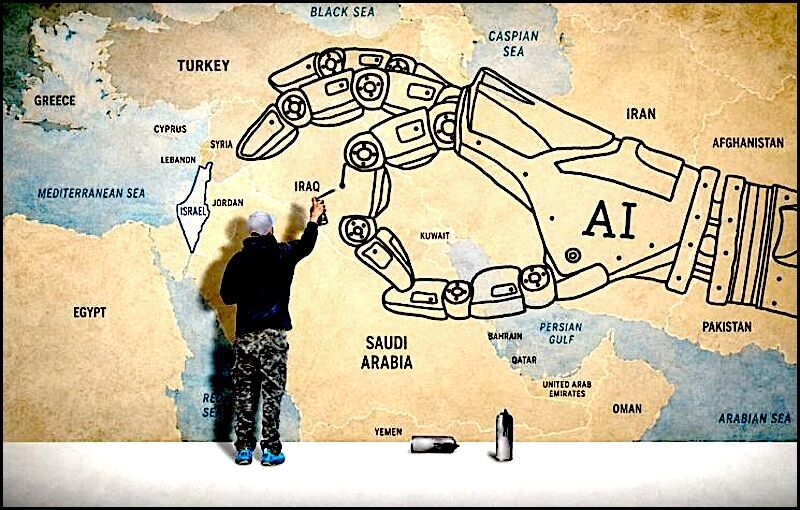
Data sovereignty is the new oil – but West Asia is pumping raw material while foreign tech giants refine it.
Strategic Culture Foundation, Lorenzo Maria Pacini, August 13, 2026, https://strategic-culture.su/news/2026/08/13/the-invisible-geography-of-israeli-power/
On June 10, 2025, two executives from Microsoft France appeared before a French Senate investigative committee tasked with examining public procurement and digital sovereignty. The hearing proceeded in the usual reassuring tone until a question that completely shifted the mood: Could the company guarantee that the data of French citizens – even if hosted on servers located in France – would never be transferred to a foreign authority without the consent of the French government? Anton Carniaux, the subsidiary’s director of public and legal affairs, responded under oath with six words: “No, I cannot guarantee that.”
That statement cut through years of corporate rhetoric built around phrases such as “local cloud regions”, “reliable infrastructure”, and “data residency”. France could host the servers, French citizens could generate the data, and French institutions could pay for the service – yet ultimate authority could still reside elsewhere. The commission drew a clear conclusion. Microsoft was unable to guarantee sovereignty over the data it hosted. That exchange reveals a reality with specific consequences, including – and perhaps above all – for West Asia: the physical location of data no longer coincides with its political location.
Classical power geography teaches that sovereignty occupies territory. Oil belongs to the state beneath whose soil it lies; ports fall under the authority of the country on whose shores they stand; oil pipelines follow the borders they cross. In this tradition, power is read on the surface of the earth. Data follows a different geography.
A medical record can be created in Riyadh, stored in Bahrain, processed by an algorithm trained in the United States, and managed through a European subsidiary. Which state truly controls it? The conventional answer attributes the data to the individual, company, or government that generated it. In practice, ownership matters less than control. Real power belongs to whoever is able to access, process, transfer, restrict, or legally compel the disclosure of the information.
This principle is stated unambiguously by the U.S. Department of Justice itself. Under the CLOUD Act, providers subject to U.S. jurisdiction can be compelled to hand over data through valid legal proceedings, “regardless of where the company stores it”. Washington presents the law as a legitimate tool for obtaining electronic evidence. On a geopolitical level, it allows U.S. jurisdiction to extend through corporate control, reaching information stored far beyond U.S. territory. The new map of power is drawn not only by borders, cables, and data centers, but by registered offices, encryption keys, legal obligations, system administrators, and the states capable of compelling them to cooperate.
Across Western Asia, governments are investing heavily in cloud computing, artificial intelligence, digital identity, smart cities, and data-driven public services. Saudi Arabia aims to become a leading data economy; the United Arab Emirates, Qatar, Bahrain, Oman, and Turkey are expanding their information management and governance capabilities. Physical capacity is also concentrated in a few regional hubs: a 2025 assessment by the World Bank counted thirty-nine data centers in the UAE and thirty-three in Saudi Arabia – figures lower than the average for high-income countries (eighty-one) but significantly higher than the rest of the region.
The transition is measurable. According to the International Telecommunication Union, in 2024, 70 percent of the population of Arab states used the Internet, compared to 68 percent globally. The regional average, however, masks an 82-percentage-point gap between the least-connected and most-connected economies, while fixed broadband subscriptions remain less than half the global figure. Digital expansion is rapid and, at the same time, deeply unequal.
The provider landscape, on the other hand, is highly concentrated. According to Synergy Research Group, in the third quarter of 2025, Amazon, Microsoft, and Google accounted for 63 percent of global enterprise spending on cloud infrastructure, in a quarterly market that had grown to $107 billion from $68 billion just two years earlier. Countries that are rapidly building their own digital systems are entering a market already structured around dependency. A government may require that citizens’ data remain within national borders while simultaneously entrusting a foreign company with managing the platform, updating the software, providing the AI model, or controlling critical layers of the system. This creates the appearance of sovereignty without its substance.
Data localization answers only one question: where is the information stored? It leaves the crucial questions open. Who controls the encryption keys? Who updates the software? Who can suspend the service? Which country’s laws govern the provider? Who can compel its disclosure, and who possesses the computing power necessary to extract strategic value from it? Keeping servers within national borders does not place them under national control.
Palestine and data as a weapon
Nowhere are the consequences of this hidden geography more evident than in occupied Palestine. Modern warfare increasingly depends on the collection, cross-referencing, and interpretation of enormous amounts of information. Phone records, biometric identifiers, intercepted communications, location histories, and aerial imagery can be transformed into military intelligence through cloud computing and artificial intelligence.
The combined use of Microsoft and OpenAI products by the Israeli military in March 2024 had reached a level nearly two hundred times higher than that of the week preceding October 7, 2023. The data stored on Microsoft servers had more than doubled, exceeding 13.6 petabytes by July 2024, while server usage grew by nearly two-thirds during the first two months of the war. The Azure platform was reportedly used to compile, transcribe, and translate information obtained through mass surveillance, with some of the intelligence cross-referenced with target-acquisition systems.
In September 2025, Microsoft deactivated certain cloud and AI services provided to an Israeli military unit after an internal audit confirmed that its products were being used for mass surveillance of Palestinians; the data in question was stored in the company’s cloud facilities located in Europe. This chain of events is revealing: information collected in Palestine, processed by an Israeli military unit, hosted in Europe, and ultimately subject to a decision made by a U.S. company. The limitation of this measure is equally telling. As Hossam Nasr, a former Microsoft employee and advocate for the No Azure for Apartheid campaign, noted, the bulk of the contract with the Israeli military apparatus remained intact. Big tech companies now occupy positions once reserved almost exclusively for states: they provide capabilities used in intelligence operations, decide whether a customer retains access, investigate alleged abuse, and impose restrictions across borders.
Israel itself recognizes the strategic importance of control over the cloud. The Nimbus project, awarded to Google and Amazon Web Services, was designed to provide Israeli ministries and related public agencies with a comprehensive cloud infrastructure. The contract, worth $1.2 billion, required local infrastructure and was presented as a means of keeping government information within the country’s borders. The main providers, however, remain U.S. companies, embedded in American legal and technological systems.
Nimbus embodies the central paradox of data sovereignty: a government can demand that information remain within its territory while entrusting the storage, computing, and platform management to companies headquartered elsewhere. Israel negotiated hard to reduce this vulnerability. Most countries in West Asia lack Israel’s bargaining power, its technological integration with Washington, or its ability to exert pressure on major American corporations. Here, sovereignty is also a function of negotiating power.
The dispute over data is ultimately a struggle over three strategic rights. The first is the right to collect: governments, digital platforms, telecommunications operators, banks, and security services accumulate information on identity, movements, communications, health, consumption, and behavior. The second is the right to process: raw data acquires strategic value only if the actor possesses the chips, algorithms, cloud platforms, and qualified personnel necessary to process it. The third is the right to compel: the authority, claimed by governments and courts, to force providers to disclose, retain, remove, or restrict information.
The economic concentration behind these three rights is intensifying. UNCTAD reports that the five largest digital multinationals have increased their combined share of industry sales from 21 percent in 2017 to 48 percent in 2025, while their share of assets rose from 17 to 35 percent. Control over data and computing is accumulating faster than infrastructure is spreading. A country that controls only the first right is a supplier of digital raw materials; one that controls data collection and computing can become a digital power; an actor capable of exercising all three possesses something close to digital sovereignty.
The economic stakes are rising rapidly. UNCTAD estimates that the global artificial intelligence market will grow from $189 billion in 2023 to $4,800 billion in 2033 – a twenty-five-fold increase over a decade. Regions that supply data but lack the computing infrastructure and intellectual property necessary to process it risk retaining only a minimal portion of that value. In the 20th century, strategic value lay not only in extracting oil, but in refining it, transporting it, pricing it, and financing it. In the 21st century, the same distinction applies to data: West Asia can generate the raw material, but the decisive power lies in the “data refineries” – that is, in the cloud platforms, AI models, and computing systems that convert information into profit, intelligence, and geopolitical leverage.
Beyond digital colonialism
The solution is not technological isolation. No single West Asian state can reproduce every layer of the global technology stack on its own, and replacing dependence on U.S. suppliers with total reliance on Chinese or other platforms would merely shift the external center of gravity. The risk to avoid is that breaking free from oil dependence could turn into digital colonialism: a scenario in which companies in the region generate the data while foreign platforms own the infrastructure, extract its value, and retain control over access. What is needed is distributed technological autonomy.
On this basis, a concrete order of priorities can be established. The procurement of cloud services must be treated as a national security decision, not as routine IT business: contracts must specify who controls the encryption keys, how foreign legal requests will be handled, and whether data and applications can be migrated to another provider. Health, defense, biometric, judicial, and civil registry data require stricter protection than ordinary commercial information. Governments must invest in interoperable regional cloud capabilities, open standards, independent auditing, and the ability to maintain essential services should a foreign provider revoke access. Above all, data sovereignty must extend beyond storage to encompass the entire chain: collection, classification, computation, access, sharing, and deletion.
For over a century, the geopolitical importance of West Asia has been mapped through oil fields, pipelines, ports, straits, and military bases. Those structures remain central, but another strategic network has spread over them – one made up of databases, cloud contracts, legal jurisdictions, identity systems, AI models, and invisible authorizations. Control over data gives states and corporations the power to map societies, interpret their behaviors, anticipate their political and economic shifts, and translate that knowledge into action.
The states of Western Asia are rapidly building the digital infrastructure upon which their economies and public institutions will rest. Much of the authority governing those systems, however, remains outside the region. In the 21st century, control over a territory will increasingly depend on control over the data that reveals its people, institutions, and resources.
The question posed to the French Senate in June 2025 clearly extends far beyond France: those who cannot guarantee where their data will end up do not fully govern their own territory. And with that data, literally anything can be done.
The big catch with small modular nuclear reactors

Those advantages are also shared by renewable energy sources like solar panels and wind turbines — without the risks that come with nuclear power.
Tim Schauenberg, 08/05/2026August 5, 2026 https://www.dw.com/en/small-reactors-big-promises-what-the-nuclear-trend-can-really-deliver/a-77491854
Mini nuclear reactors are seen as a flexible energy source. Their promise: abundant energy, cheap, clean and climate-friendly with lower water use. But do the numbers add up? We look at what’s behind the SMR hype.
Many politicians and tech companies are now pushing to build new nuclear power plants to meet the world’s rapidly growing energy demands. Small reactors — known as Small Modular Reactors, or SMRs — are gaining momentum.
They could be built in less time and come online faster than conventional nuclear power plants. Originally developed to power submarines and aircraft carriers, SMRs largely work the same way as larger reactors.
They contain a nuclear reactor fueled by uranium, which releases enormous amounts of heat through nuclear fission. That heat turns water into steam, and the steam pressure drives turbines that generate electricity.
Companies and startups are working on a wide variety of SMR designs and concepts, but the underlying principle is similar across all of them.
One advantage over conventional nuclear stations is that mini reactors require a maximum of two hectares (around five acres) of land — roughly the size of two soccer fields. By comparison, conventional plants require up to 280 soccer fields, according to the industry.
Why use a modular design for mini nuclear plants?
What makes SMRs particularly attractive is their modular construction. Individual components can be mass-produced as prefabricated modules and pre-assembled off-site — much like a prefab house that simply needs to be put together once it arrives at its location.
Manufacturers promise an extremely short construction time of between one and a half to six years. Large reactors in the US can take anywhere from seven to 10 years to build.
Proponents also argue that modular units could deliver low-emission power to remote regions, where grid infrastructure is often not developed enough to handle the enormous energy output of a large conventional plant.
Those advantages are also shared by renewable energy sources like solar panels and wind turbines — without the risks that come with nuclear power.
Why less radiation can mean greater risk
The output of mini nuclear reactors is significantly lower than that of conventional nuclear power plants. Depending on the design, SMRs can deliver between 10 and around 200 megawatts of power, while a conventional plant generates between 1,000 and 1,600 MW.
To produce the same amount of energy as the roughly 400 high-capacity reactors currently operating worldwide, tens of thousands of small reactors would need to be built.
SMRs could offer some safety advantages: they contain less radioactive material than large reactors and would be distributed across multiple sites. This means that an accident or military strike resulting in a meltdown would not be as catastrophic as a worst-case scenario at a large reactor. Nevertheless, the consequences of an SMR accident could still be severe.
Germany’s Federal Office for Radiation Protection points out that despite lower radiation levels per reactor, the overall risk posed by mini reactors could be many times higher. Replacing the output of existing nuclear plants with large numbers of smaller ones would require an enormous number of reactors worldwide — and that increases the likelihood that at least one of them will eventually suffer a serious incident.
Nuclear accidents and radiation leaks are extremely rare — but the consequences can be catastrophic. The last major nuclear accident occurred in 2011 at the Fukushima power plant in Japan, following a tsunami. Parts of the region have been contaminated for generations to come, and nearly 170,000 people were forced to flee their homes.
Extreme efficiency and the dream of radioactive recycling
Part of the hype around some new mini reactors rests on the hope of extracting significantly more energy from the same amount of uranium. Some SMR models — known as “fast reactors” — could theoretically yield 60 to 70 times more energy from uranium than conventional technology, according to the International Atomic Energy Agency (IAEA).
But the technology is still in the early stages of development and has so far played only a limited role in IAEA projections. In practice, it has barely been proven in SMRs at all. Only two SMR facilities are currently in operation worldwide — one in China and one in Russia.
Work is also underway on recycling SMR fuel rods, but that process remains largely untested. Most SMR projects continue to rely on the same conventional technology used in traditional reactors.
And the problem of radioactive waste remains unsolved — for both conventional and fast reactors. The risks this poses are already visible: at the Asse facility in Lower Saxony, Germany, a temporary storage site built in the 1970s, hundreds of barrels of intermediate-level radioactive waste are now rusting and beginning to leak. Germany has yet to establish a permanent disposal site.
In fact, no permanent repository for spent fuel or highly radioactive reactor waste is currently in operation anywhere in the world. After 20 years of construction, the Onkalo facility in Finland is set to become the first when it opens in 2026.
Another problem for nuclear power is growing water scarcity. Recent heat and drought have already forced European nations to curb nuclear output due to for cooling due to low river levels.
Because SMRs are mainly just smaller, simplified versions conventional reactors, they still use water to run and for cooling. While individual units use less water than traditional plants, clustering units could increase overall use, warn experts. Researchers are investigating the use of alternative coolants like molten salts and helium gas for newer designs.
When would SMRs make a climate impact — and at what cost?
Enthusiasm for small reactors runs high in the nuclear community. But what may look promising at first glance is, in many respects, difficult or impossible to back up with solid evidence.
Calculating the costs of a technology still in development is no easy task. Nevertheless, the German Institute for Economic Research estimates that electricity from new mini nuclear plants — even accounting for economies of scale, including construction and manufacturing — will cost at least twice as much per megawatt-hour as the already very affordable electricity generated by solar or wind power. In a worst-case scenario, the cost could be nearly eight times higher.
Adding up all the announcements, plans and strategies of major nations, a few hundred SMRs could come online in China, the US, Europe and India by 2050. But according to Germany’s Federal Office for Nuclear Safety and Radiation Protection, citing figures from the nuclear industry, production would only become economically viable at a threshold of 3,000 reactors.
The international community has committed to limiting global warmingto well below 2 degrees Celsius (3.6 degrees Fahrenheit) by the end of the century. Meeting that target requires large parts of the global economy to become climate-neutral by 2050. The EU aims to reach zero emissions by then; Germany is even targeting net negative CO2 emissions by 2050.
That means climate-friendly nuclear technology would arrive too late to meaningfully limit global warming — and its advantages would be significantly diminished as a result.
What would remain: the radiation risk, and the question of what to do with the radioactive waste.
Zelensky Must Go Before Real Peace Talks Can Begin

Zelensky, he argues, has come to equate Ukraine’s survival with his own continued leadership. That belief has justified the suspension of elections, the refusal to pursue realistic diplomacy, and a strategy that has steadily worsened Ukraine’s negotiating position, its economy, and its military situation.
We also discussed the deeper problem. Western policy has become trapped in a form of moralism that treats any contact with Russia as contamination. This makes genuine diplomacy almost impossible and prepares the ground for permanent confrontation long after the fighting stops.
In conversation with Professor Nicolai Petro
Ian Proud, Aug 12, 2026, https://thepeacemonger.substack.com/p/zelensky-must-go-before-real-peace?utm_source=post-email-title&publication_id=3221990&post_id=210874375&utm_campaign=email-post-title&isFreemail=true&r=1ise1&triedRedirect=true&utm_medium=email
Something has shifted.
For the first time in years, serious people in European capitals are quietly exploring track-two contacts with Moscow. My old boss, Tim Barrow, was recently dispatched to Vienna for meetings that were supposedly secret — until the newspapers reported them. At the same time, Ukraine’s military, economic and demographic position continues to deteriorate in ways that no amount of Western propaganda can disguise.
I sat down with Professor Nicolai Petro of the University of Rhode Island to discuss what this means. Petro is one of the most thoughtful and independent analysts of Russia and Ukraine writing today. His book The Tragedy of Ukraine remains essential reading for anyone who wants to understand the deep domestic roots of this conflict rather than the simplified morality play offered by most Western media.
Our conversation was frank. Petro’s central argument is blunt: serious negotiations between Russia and Ukraine are almost impossible while Volodymyr Zelensky remains in office. Zelensky, he argues, has come to equate Ukraine’s survival with his own continued leadership. That belief has justified the suspension of elections, the refusal to pursue realistic diplomacy, and a strategy that has steadily worsened Ukraine’s negotiating position, its economy, and its military situation.
The observable realities are hard to ignore. The average age of Ukrainian soldiers is now over forty. The pool of viable recruits is shrinking fast. Casualty rates in the specialised assault battalions remain extremely high. Winter is approaching, and with it the near-certainty of another Russian campaign against energy infrastructure. Ukraine’s finance ministry will shortly return to Western capitals asking for yet more money. And the political mood inside Ukraine itself is shifting — recent polling shows Zelensky’s trust ratings underwater, even in Kyiv.
Petro believes Russia’s military objective remains the consolidation of the four regions plus Crimea. Once those administrative borders are secured, Moscow will be in a position to declare its goals achieved and place a clear choice before Kyiv: negotiate now on the basis of current realities, or face further losses. In his view, that moment is approaching.
We also discussed the deeper problem. Western policy has become trapped in a form of moralism that treats any contact with Russia as contamination. This makes genuine diplomacy almost impossible and prepares the ground for permanent confrontation long after the fighting stops.
The EU’s own statements about retaining and even expanding sanctions after the war reveal the logic: there is to be no real peace, only a frozen conflict managed under permanent pressure.
There are faint signs of movement. Serbia’s potential role as a mediator is intriguing. Subtle shifts in London and elsewhere suggest some officials are beginning to grasp that the current course is unsustainable. But without a change of leadership in Kyiv, Petro sees little prospect of meaningful talks.
This was one of the most clear-eyed conversations I’ve had on the war. Petro does not deal in wishful thinking or propaganda. He deals in political and military reality.
You can watch the full interview here.
Takaichi, the Three Non-Nuclear Principles, and a Strained US Nuclear Umbrella

Takaichi herself raised the underlying issue well before becoming prime minister. In a 2024 book, she revealed that, as a Cabinet minister in 2022, she had objected to language in the National Security Strategy stating that Japan’s basic policy of adhering to the Three Non-Nuclear Principles would remain unchanged
For Japan, the most immediate question is not whether to pursue nuclear weapons itself, but whether to allow its ally’s nuclear-capable assets on Japanese soil.
By Takahashi Kosuke, August 12, 2026
Eighty-one years after the atomic bombings of Hiroshima on August 6, 1945, and Nagasaki on August 9, Japan is confronting an increasingly difficult contradiction: how to uphold its identity as the only country to have suffered atomic attack in wartime while strengthening deterrence against an increasingly formidable group of nuclear-armed neighbors.
The dilemma came into sharper focus during this year’s Hiroshima and Nagasaki commemorations. Prime Minister Takaichi Sanae stated that Japan “maintains” its Three Non-Nuclear Principles and reaffirmed Tokyo’s commitment to pursuing a world free of nuclear weapons. Yet when asked whether the principles would continue to be explicitly affirmed in the three strategic documents her government plans to revise by the end of the year, Takaichi declined to prejudge the wording.
That ambiguity matters. Japan’s Three Non-Nuclear Principles – not possessing, not producing, and not permitting the introduction of nuclear weapons into Japanese territory – trace back to former Prime Minister Sato Eisaku’s 1967 declaration and have long stood as a symbol of Japan’s postwar identity.
The tension was particularly visible in Nagasaki on August 9. Mayor Suzuki Shiro described nuclear weapons as an “absolute evil,” warned of the dangers of relying on nuclear deterrence, and urged the government to uphold the Three Non-Nuclear Principles. Takaichi, by contrast, reiterated Japan’s current adherence to the principles while emphasizing a “realistic and practical” approach toward achieving a world without nuclear weapons…………………………………………………………………………………………………
Takaichi herself raised the underlying issue well before becoming prime minister. In a 2024 book, she revealed that, as a Cabinet minister in 2022, she had objected to language in the National Security Strategy stating that Japan’s basic policy of adhering to the Three Non-Nuclear Principles would remain unchanged…………………………………………………………..
Abandoning the Three Non-Nuclear Principles hastily would carry substantial political and diplomatic costs. They remain closely tied to Hiroshima and Nagasaki and underpin Japan’s credibility in advocating global nuclear disarmament…………………….
For Japan, the choice is not simply whether to pursue nuclear armament or nuclear pacifism. The more immediate question is whether the third principle specifically – “not permitting the introduction” of nuclear weapons – can remain unchanged while Japan simultaneously asks the United States to strengthen extended nuclear deterrence. https://thediplomat.com/2026/08/takaichi-the-three-non-nuclear-principles-and-a-strained-us-nuclear-umbrella/
Hungary’s government plans interventions on Danube River to keep nuclear plant running
By ASSOCIATED PRESS, 13 August 2026 ,
https://www.dailymail.com/wires/ap/article-16047513/Hungarys-government-plans-interventions-Danube-River-nuclear-plant-running.html
BUDAPEST, Hungary (AP) – Authorities in Hungary will begin taking steps to raise the level of the Danube River this week in order to ensure the country’s only nuclear power plant can continue operating, Prime Minister Péter Magyar said on Wednesday.
Persistent drought and successive extreme heat waves in recent months have deprived one of Europe´s largest rivers of water, bringing Danube levels to record lows and pushing the Paks nuclear power plant to the brink of shutting down for the first time in its 44-year history.
The Soviet-built plant, which uses water from the Danube to cool its four reactors, is currently operating at little more than 10% of its 2,000 megawatt capacity due to low water levels. It supplies Hungary with around a third of its electricity.
In a video posted to Facebook on Wednesday, Magyar said authorities would begin building a bed sill – a low concrete or stone structure built into the riverbed to slow the current and raise upstream water levels – on Thursday on a section of the Danube just upriver from the plant.
Delivery of some 145,000 cubic meters of rocks used in its construction would begin on Wednesday evening, Magyar said, adding that the intervention could raise the level of the Danube by up to a meter (3 feet).
Meanwhile, two 80-meter (262-foot) barges will be transported to the site near Paks and may be sunk in order to raise the Danube up to a further 20 centimeters (8 inches) at the plant’s cooling pumps. A decision on whether to sink them will be made on Friday, Magyar said.
“We can no longer consider this extraordinary situation as a one-time natural extreme,” he said, adding that the work must be carried out quickly to avoid a full Paks shutdown.
Magyar referred to the construction of the bed sill as a “long-term” solution which could ensure that water levels never fall below the threshold at which reactors at Paks must be powered down.
He said that after a recent temporary rise in water levels, they were expected to begin falling again in coming days which, without external intervention, could lead to the complete shutdown of the Paks plant.
“The Danube has given us days, not months,” he said.
Similar measures were taken in Romania last week when authorities sank four barges laden with rock into the Danube in an attempt to redirect water downstream toward the Cernavoda nuclear plant, which had already shut down one of its two reactors due to low water levels.
On Wednesday, Magyar said the Paks plant operating at its current output is costing Hungary’s economy up to 50 billion forints ($158 million) per month. By contrast, he said the planned interventions on the Danube will cost around 6 billion forints ($19 million).
Trump: Iran is broke (or is the U.S. the broken nation?)
August 14, 2026, https://space4peace.blogspot.com/2026/08/trump-iran-is-broke-or-is-it-us-is.html
Former Mossad chief was just handed full control of one of the biggest U.S. defense tech companies. David Barnea completed his term as Mossad director on June 2, 2026. On August 3 he was appointed Global President and Chairman of Ondas Defense Ltd., the defense division of Nasdaq-listed U.S. firm Ondas Inc., which develops autonomous systems, drones, counter-UAS, and AI-enabled multi-domain defense platforms.
The U.S. military has lost at least 45 MQ-9 Reaper reconnaissance-strike drones since the start of the war with Yemen and Iran. The cost of the lost aircraft may exceed $1.3 billion. Before the conflict began, the U.S. Armed Forces had approximately 185 such drones.
Yemen military: Yemen appreciates Russia’s stance in the UN Security Council in condemning the strikes on Sanaa Airport by Saudi Arabia, as it called for lifting the complete siege on Yemen by Al Saud.
By Jonathan Cook @ Consortium News: We are on the brink of a series of catastrophes of our own making that humankind will be exceptionally lucky to survive. There is a path ahead, but being able to see it and where it leads will require — at least from most Westerners — a difficult feat of imagination. We will need to cast aside many of the things we have been taught to most closely identify with. It will demand of us a realisation that our most cherished values are actually harmful. The West has only been superficially democratic — in the sense that everyone gets a vote — for the last century or so. Even then, democracy has been highly restricted and controlled: the public usually gets a choice between two capitalist parties, one more extreme than the other, following a lifetime of exposure to opinions crafted for them by the ultimate beneficiaries of capitalism — the billionaires who own the mass media. The ruling class understands the tide is turning. The world’s resources are finite and running out. Capitalism’s model of mass consumption can only hasten the end. Consumption pollutes the planet. It fuels climate chaos. It decimates other species that sustain a living planet. If individualism is shown to bring only ruin, we are likely to prefer collective ideologies. If greed brings only death, we are likely to prefer cooperation and solidarity. Hope of salvation resides not in iPhones and jeans but in the resurrection of the commons — of public good, of shared wealth.
By Nate Bear The Elaborate Fairy-Tales Justifying The War In Ukraine: It appears that a significant number of people who support the Ukraine war understand that in every other part of the world the US is a self-interested empire using its military power and hegemonic status to assert its influence for geostrategic and political ends. But in Ukraine, apparently, this isn’t the case. In Ukraine the US has shed its imperial ambitions and is merely helping a scrappy little upstart in a fight against its big bully neighbour. In this telling of events, it is Russia which is the imperial power, with the US playing the role of good global citizen. This to me is incomprehensibly fractured logic resting on a seemingly sincere belief that the US can pursue selfless policy in one part of the world because it is a benign empire, but pursues selfish war in another part of the world because it is a malign empire. A truly baffling and incoherent analysis. In 2008, in a conversation with John McCain, Joe Lieberman and Lindsey Graham, Tony Blair said western strategy “should be to make Russia a little desperate with our activities in areas bordering on what Russia considers its sphere of interest and along its actual borders.” This meeting came just 10 days before the 2008 Budapest summit where the west affirmed that Ukraine and Georgia “will become” NATO members. Those who support this war until the last Ukrainian are the elites in Ukraine, Europe and the US whose husbands, fathers, sons and brothers are not being sent to die an ignominious death. Those who indulge in double-standards, false equivalences and fairy-tale narratives do so to avoid the painful unravelling of their cognitive dissonance. And those who make peace impossible make war inevitable.
SpaceNews: The Pentagon’s push to replenish missile inventories is creating an opening for a new class of manufacturers that say the problem isn’t simply a shortage of factory space. It is how those factories are built. Startups such as Machina, Hadrian and Freeform are applying software, robotics and highly automated production techniques to aerospace and defense manufacturing, challenging a model that has long relied on dedicated machinery, specialized tooling and skilled labor to make relatively small numbers of complex parts. Lockheed is also an investor in Machina through Lockheed Martin Ventures.
- It would be wise to recall that during the 2003 ‘Shock & Awe’ US attack on Iraq, then Naval War College instructor Thomas Barnett’s new book ‘Pentagon’s New Map’ was published stating that ‘America’s role in the world will be security export’. He said we won’t make cars, TVs, shoes, etc. Our role will be to make weapons and wage endless war to secure the parts of the world not yet under US-NATO control. He called it the ‘non-integrating gap’. Iran, Yemen, Palestine, Iraq, Southern Lebanon, Venezuela, Cuba, Russia, China and the African continent all fit these days into that plan. He stated these wars would enable corporate globalization of the world economy. We are still in that place today.
- Historic Foreign Policy Speech at American University in Washington DC on June 10, 1963 by President John F. Kennedy: JFK was killed in Dallas, Texas on November 22, 1963. Compare JFK’s words with those of Donald Trump these days.
Britain races against the world to unlock energy’s holy grail

“Most British people don’t know that their Government has started a
Manhattan Project,” says Michael Cole, a plasma physicist and author of a
history of fusion energy. “It is an engineering project on the same
scale.
” I’ve come to see it for myself, but as my train slows to a halt
at what feels like a branch-line station that Richard Beeching forgot to
close, it’s hard to believe. Culham railway station is as quiet as the
Adlestrop of Edward Thomas’s melancholy poem, in which there’s nothing
but “willow-herb … and all the birds of Oxfordshire”.
But just behind
the hedges is Britain’s Los Alamos: the Centre for Fusion Energy. Spread
across a sprawling industrial park more than 160 acres, it is home to some
2,600 scientists and engineers busy trying to tame atoms. The project, some
believe, is as ambitious as Robert Oppenheimer’s in New Mexico.
“There’s enough energy potential in a glass of seawater to light up a
city,” says Mark Thomas, the chief executive of First Light Fusion.
But unlocking it requires a dramatic, violent process called nuclear fusion.
Every star, including our own sun, is a giant natural fusion reactor, and
here in the Oxfordshire countryside, they are making machines that operate
on the same principles of physics. Temperatures inside the machines have
reached 10 times hotter than the sun’s core, easily the hottest ever
recorded in the solar system.
After decades of demonstrations and
experiments, the UK has decided it’s time to commit to building the
world’s first commercial prototype fusion power plant. The programme is
known as Spherical Tokamak for Energy Production, or Step.
Telegraph 14th Aug 2026,
https://www.telegraph.co.uk/business/2026/08/14/britain-races-against-the-world-to-unlock-energy-holy-grail/
Sizewell no-show halts holiday park expansion bid
Joao Santos, Local Democracy Reporting Service, 14 Aug 26, https://www.bbc.co.uk/news/articles/cre4pnd179xo
A decision whether a holiday park can be expanded to house workers for Sizewell C has been delayed after no-one from the project showed up to a planning meeting.
Britannia Jinkey Jersey Ltd, which owns Pontins Pakefield, near Lowestoft, wants to develop an additional 340 caravan pitches at the site.
At an East Suffolk Council planning meeting, Conservative councillor Paul Ashdown criticised Sizewell C for not being “bothered to come and sit with us” and moved to defer the decision to allow for a site visit.
A Sizewell C spokesperson said: “We worked closely with local partners to help develop and submit this application. We will continue to work with all parties involved to support the next steps.”
The proposals sought permission for the new pitches alongside amenity buildings, including toilets, 36 communal showers, laundry and dishwashing facilities.
Members of the planning committee urged for a representative from Sizewell C to be present when the authority meets again.
The plans were recommended for approval by officers, but councillors said questions remained unanswered.
Gisleham and Kessingland parish councils both agreed with the officer’s recommendation of approval but raised concerns, particularly around the impact on traffic and road safety.
Lowestoft Town Council recommended “total refusal” over concerns around infrastructure capacity and the long-term sustainability of public transport.
The planning application will now be heard at a meeting in the future.
Major nuclear power station shut down by millions of invading jellyfish

The massive Gravelines nuclear power plant just 30 miles from Britain has been forced to close down in order to avoid disaster after a swarm of jellyfish got sucked into the cooling system on Monday
Joe Smith News Reporter, 11 Aug 2026, https://www.mirror.co.uk/news/uk-news/nuclear-plant-millions-invading-jellyfish-37540444
Western Europe’s biggest nuclear power station has been shut down after it was invaded by millions of jellyfish.
EDF’s Gravelines plant near Dunkirk, just 30 miles from Britain, was forced to shut down in order to avoid disaster on Monday as the sea creatures swarmed into the plant.
EDF revealed how the jellyfish had been filter drums at the seawater pumping stations, used to cool the giant nuclear reactors at the heart of the plant.
The company was forced to take emergency measures, with reactors two, three and four taken offline, while output from reactor one was halved.
“This situation has no impact on the safety of the facilities, the safety of our personnel, or the environment,” a statement from EDF said.
Only reactor six was operating at full power on Tuesday, with reactor five previously taken offline for scheduled works.
The jellyfish invasion comes exactly a year after another swarm of the creatures took the French nuclear site offline for two days.
An invasive species of jellyfish, called the Asian Moon Jellyfish, have been making themselves at home in the English Channel and North Sea in 2020.
The species, usually native to the Pacific, is thought to have been brought here in the ballast tanks of supertankers and dumped into the seas around France and Britain.
Nuclear plants in China, Japan and India, which also rely of seawater for cooling, have previously been thrown into chaos by the slimy sea creatures. And last year power production at Gravelines came to a standstill after the jellies caused chaos.
The plant installed cameras monitoring the seawater intake and filters after last year’s fiasco and set up a warning system to give advanced notice of swarms heading their way.
The system saw fishing boats sent out of saturday with trawler nets in an attempt to thin the numbers of the invasive jellyfish. This helped to limit the latest invasion, the engineer said.
Meanwhile vacuum trucks are sucking out the jellyfish already trapped inside the plant. The engineer said that since no new jellies are arriving the plant will hopefully be back on line soon.
Reactors shut down in Romania were of the Candu design, already notorious for high tritium release when in operation.
Susan O’Donnell. 16 Aug 26
The reactor shutdown in Romania has been reported clearly identifiying the reactors as CANDU design. They are similar or identical to the Point Lepreau reactor operating in New Brunswick and the Gentilly2 reactor in Quebec that was shut down in 2012. Two years ago the Canadian government provided a $3 billion export financing loan to build two more CANDU reactors at the same nuclear site in Romania.
That work has been ongoing with most of the funding coming back to AtkinsRealis. The Canadian government has been pointing to the new build in Romania in its ongoing efforts to sell more CANDU reactors abroad. CANDU exports are central to Canada‘s new nuclear energy strategy. It will be very interesting to see how this latest development impacts rolling out the strategy.

David Geary, – Canada has had trouble marketing CANDUs in Europe (and in the U.S) because these reactors emit way more tritium during routine operations than other reactor designs … and the E.U. has a much stricter regulatory body than Canada has in that regard.
Whereas former Soviet republics, like Romania, have more lax regulatory standards, as well as more shady / sketchy / bribery-driven business practices. .
A quote from a CleanGreenSask factsheet: ” …the E.U. allows up to 100 Bq/L of tritium in drinking water, the U.S. allows 740 Bq/L, but the Canadian Nuclear Safety Commission (CNSC) allows up to 7,000 Bq/L ” This is but one example showing how the CNSC is clearly compromised by the Canadian CANDU reactor
1 This Month



Shut down the radiation-damaged Heysham nuclear reactors now
To see nuclear-related stories in greater depth and intensity – go to https://nuclearinformation.wordpress.com

Say No to NASA’s Reckless Nuclear Reactor on the Moon
Say No to NASA’s Reckless Nuclear Reactor on the Moon
-
Archives
- October 2026 (247)
- September 2026 (339)
- August 2026 (330)
- July 2026 (355)
- June 2026 (287)
- May 2026 (306)
- April 2026 (356)
- March 2026 (251)
- February 2026 (267)
- January 2026 (308)
- December 2025 (358)
- November 2025 (359)
-
Categories
- 1
- 1 NUCLEAR ISSUES
- business and costs
- climate change
- culture and arts
- ENERGY
- environment
- health
- history
- indigenous issues
- Legal
- marketing of nuclear
- media
- opposition to nuclear
- PERSONAL STORIES
- politics
- politics international
- Religion and ethics
- safety
- secrets,lies and civil liberties
- spinbuster
- technology
- Uranium
- wastes
- weapons and war
- Women
- 2 WORLD
- ACTION
- AFRICA
- Atrocities
- AUSTRALIA
- Christina's notes
- Christina's themes
- culture and arts
- Events
- Fuk 2022
- Fuk 2023
- Fukushima 2017
- Fukushima 2018
- fukushima 2019
- Fukushima 2020
- Fukushima 2021
- general
- global warming
- Humour (God we need it)
- Nuclear
- RARE EARTHS
- Reference
- resources – print
- Resources -audiovicual
- Weekly Newsletter
- World
- World Nuclear
- YouTube
-
RSS
Entries RSS
Comments RSS

