The American epoch of oil is collapsing. What comes next could be ugly
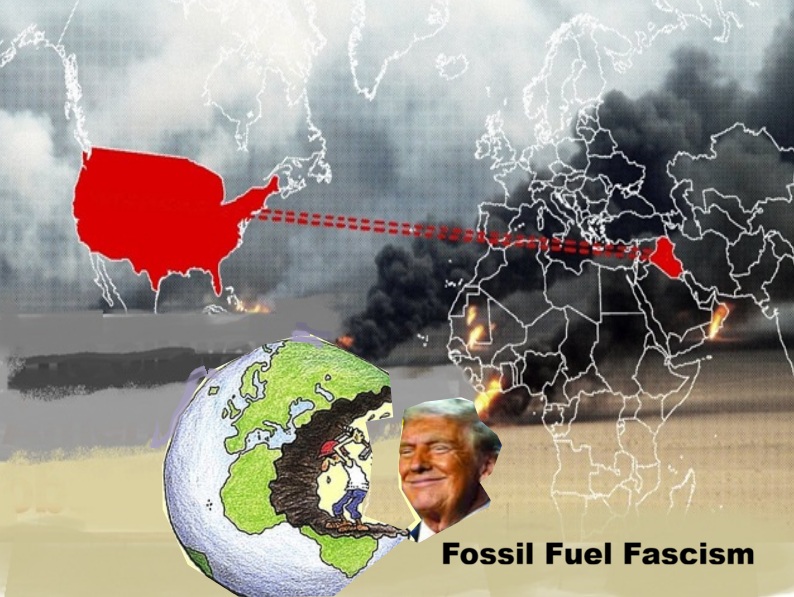
democracies across the planet are now threatened by what might be called fossil fuel fascism – an extremist political movement that breaks laws, spreads lies and threatens violence in an increasingly desperate attempt to maintain markets for oil, gas and coal that would otherwise be replaced by cheaper renewables.
In the short term, the biggest windfall from the Iran conflict has gone to companies, executives and shareholders in the US petroleum industry
China is dominating the energy transition with astonishing result, while fossil fuel fascists in the US try to turn back the clock.
Guardian, Jonathan Watts, 17 May, 2026
“Farewell,” the flag-waving Chinese children chanted to Donald Trump as he strolled along the red carpet back to Air Force One at the end of his summit with Xi Jinping in Beijing.
The US leader claimed he was leaving with a cluster of “fantastic” trade deals to sell US oil, jets and soya beans to China. That has not been confirmed by his smiling host, but one thing was crystal clear from the two days of meetings: the global balance of power is shifting, from the declining petrostate in the west to the rising electrostate in the east.
Trump flew home to chaos – war with Iran, surging gas prices, spectacular unpopularity, friction with former allies and a 20th-century policy of “energy dominance” that seeks to turn back the clock, use tariffs and military threats to open markets, and enrich his supporters in the fossil fuel industry. The long dominant superpower increasingly appears a malignant force as it pushes the world towards ever greater turbulence.
Xi, meanwhile, presides over a country that has invested more than any other in renewable energy, which has helped to buffer its economy from the gas price shocks caused by the conflict in the Middle East, while opening up huge new export markets for solar panels, wind turbines, smart grids and electric vehicles. While the Chinese president’s Communist party still faces criticism for its suppression of dissent, its soft power deficit no longer seems so great when its main global rival is killing protesters at home and bombing schoolchildren overseas.
“Future historians may well see the Iran war as the moment the US unwittingly ceded leadership to China”
Why is this happening now? Tempting as it is to blame these global shifts on a single malignant narcissist in the White House, a more useful – and maybe even hopeful – analysis needs to take into account the tectonic changes that are shaking not just the foundations of politics, but the very nature of human power, as the world shifts from molecules to electrons.
History has proven that when the dominant form of energy changes, there is often a shift in the global pecking order. We are now in the midst of one such transition as the epoch of petrol, predominantly produced in the United States, Russia and Gulf states, starts to give way to an era of renewables, overwhelmingly manufactured in China. But the outcome remains contested, and the process could be ugly. The new energy order is winning the economic and technological battle – wind turbines and solar panels were already producing record-cheap electricity even before the Iran war pushed up the costs of gas and oil-fired power plants. But the old petro-interests still have political, military and financial might on their side, and they are using that to try to turn back the energy clock.
As a result, democracies across the planet are now threatened by what might be called fossil fuel fascism – an extremist political movement that breaks laws, spreads lies and threatens violence in an increasingly desperate attempt to maintain markets for oil, gas and coal that would otherwise be replaced by cheaper renewables.
Of course, there are multiple other, overlapping reasons for the war against Iran: its nuclear program, Trump’s need for a distraction from the Epstein files, and his willingness to adopt positions favourable to Israel’s Benjamin Netanyahu, Russia’s Vladimir Putin and Saudi Arabia’s crown prince, Mohammed bin Salman, to name a few.
But the wider context is that the Earth is becoming a more hostile environment for humanity. This is driving up tensions, exposing economic limits that have been ignored for centuries and redefining geopolitical realities.
Who is actually winning? In the short term, the biggest windfall from the Iran conflict has gone to companies, executives and shareholders in the US petroleum industry – a major source of campaign funding for Trump – that was struggling with low prices and a production glut at the start of the year, but is now enjoying a spectacular revenue surge while rival suppliers in the Gulf are choked by threats in the strait of Hormuz. Along with Russian and Saudi Arabian petro-companies, US energy suppliers look set to cash in for months to come, even as consumers pay more at the pumps.
At the same time, the war is forcing countries across the world to explore ways to increase their energy independence. In the next few years, that will happen by increasing domestic production of oil, gas and coal. By one reckoning, this has increased the likely 2030 output of fossil fuels by a fifth – an alarming setback for global efforts to reduce greenhouse gas emissions, and a victory for the petroleum industry and the far-right political groups it funds.
But that will not be the final reckoning of this war, which has reinforced the argument for both renewable energy and a concurrent shift in geopolitical alignments. With major oil and gas producers now led by ever more erratic and menacing authoritarian leaders, other countries are looking for alternative ways to generate power. Electric cars, for example, have never been more in demand.
The prime beneficiary is China, which suddenly appears a relative oasis of pragmatic, internationally minded diplomacy and energy independence. Beijing’s bet on renewable power and EVs over the past two decades is paying enormous dividends. Not only has this made it less reliant on fuel imports, it now has a wind, solar and battery export industry that looks set to dominate global markets for many decades to come.
Future historians may well see the Iran war as the moment the US unwittingly ceded leadership to China. If so, it would not be the first time that a change in the world’s energy matrix led to a reordering of the political hierarchy of nations. When humankind taps new power supplies, new empires rise and old ones fall. Realignments tend to be violent.
How empires fall
One of the cornerstones of geostrategic thinking since the start of the Industrial Revolution, 250 years ago, is that the country tha
“Oil has meant mastery through the years,” wrote Daniel Yergin in his Pulitzer prize-winning book about the decisive role of energy in world politics, The Prize: The Epic Quest for Oil, Money, and Power. Yergin argues oil was a primary reason why Germany invaded the Soviet Union during the second world war, and motivated Japan to attack the US at Pearl Harbor. It was why the US launched Desert Storm to thwart Iraq’s seizure of Kuwait, which would have given Saddam Hussein control over the planet’s most abundant oil supplies. It explained former US president Barack Obama’s comment that energy was “priority number one” for his administration. Earlier this year, it was a primary justification by Trump and other US officials for invading Venezuela, which has the world’s biggest untapped reserves, and it is now a key factor in the war on Iran, which has the fourth highest supply.
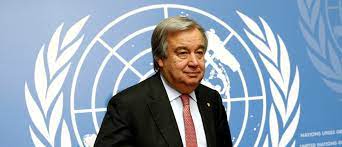
“We have entered the age of clean energy. Those who lead this transition will lead the global economy of the future” – António Guterres
Not for nothing has the old joke been revived that the “US is a very fortunate country because everywhere it goes to bring freedom it finds oil.”
But what is different today is the realisation that oil – once considered “black gold” – and other fossil fuels are now a toxic threat to the stability of the climate and the political world order. Now that cheaper, cleaner alternatives are available, the demand for these industrial fuels has to be artificially inflated, propped up by political lobbying, hefty subsidies, disinformation campaigns and military force.
The most spectacular example of an energy transition completely upturning the world order was in the mid-19th century, when the coal-powered gunships of the Royal Navy shredded the fragile coastal defences of southern China to impose a market for the British empire’s most lucrative and unethical commodity: opium. Up to that point, Beijing had been the capital of the world’s biggest economy for most of the previous 2,000 years but its historic advantage in manpower and culture was being lost to fossil-fuelled engines and the spirit-sapping drug trade. The Daoguang Emperor was so deeply in denial about the changes reshaping the world that his actions stirred rebellion among his own people. His forces were crushed by the superior firepower of an industrialised adversary, ushering in an era of western dominance that became known in China as the “century of humiliation”.
Britain’s empire also came to end – albeit it more limply – when its primary source of fuel – coal – was superseded by oil in the early-to-mid-20th century. Back then, the UK had no petroleum supplies of its own which meant it was at a disadvantage to the US. The power shift was confirmed in 1956 when Britain, France and Israel invaded Egypt to try to secure the Suez canal – a vital route for fossil fuels from the Middle East. The US refused to help this imperial adventure by the old world, thereby confirming Washington as the dominant superpower outside the Soviet bloc. Since then, it has steadily expanded its primacy in the age of oil.
That era – and that supremacy – are both now winding down, as the pendulum swings again, this time towards renewables and back to Asia. In the past decade, clean energy investment worldwide has risen tenfold to more than $2tn a year. Last year, it was more than double that of fossil fuels, and for the first time renewables overtook coal as the world’s top electricity source. “We have entered the age of clean energy,” the United Nations secretary-general, António Guterres, observed in February. “Those who lead this transition will lead the global economy of the future.”
China looks to the future …
The government in Beijing has turned the greatest crisis facing humanity – climate breakdown – into an opportunity to finally lay to rest the “humiliation” of the opium war. For most of the past 30 years, it has been catching up with the west by copying its dirty, coal-driven model of industrialisation, which notoriously made it the world’s biggest carbon emitter. Now, though, it is leapfrogging its rivals on clean energy with astonishing results. For the past two years, China’s carbon emissions have been flat or falling, raising hopes of a historical turning point in the curve of global emissions……………………………………………………………………………………………………………………………………………………………………….
… while the US goes backwards
While the rest of the world looks for an exit ramp off the exhaust-fumed highway on to a cleaner, electrified, 21st-century freeway, Trump has pulled a U-turn and is accelerating back towards 20th-century smoke stacks without so much as a glance in the rearview mirror.
On the same day he was sworn in for his second term in the White House, Trump signed an executive order withdrawing the US from the 2015 Paris Agreement, as he did in his first term.
But this time he has also announced that he will quit the entire UN Framework Convention on Climate Change, the Cop process that was put in place at the 1992 Earth Summit. In February his administration repealed the 2009 “endangerment finding”, the core US government determination that greenhouse gases threaten public health that has been the legal basis for almost all federal climate regulation over the past 17 years. Without it, power plants, factories and carmakers will have a freer pass to pollute the air and heat the atmosphere.
“The US state has essentially been captured by a business group that puts its own interests above those of the nation?
Trump has filled the Department of Energy and the Environmental Protection Agency with dozens of former oil industry employees. He has declared a “national energy emergency”, which was a cue for businesses to mine, drill and frack like never before. ………………………………………………………………………………………………………………………….
Meanwhile, his government has accelerated the phaseout of tax credits for renewable projects, which has had a chilling effect on the sector with $22bn in clean energy projects cancelled and wind power investment down to its lowest level in a decade. “My goal is to not let any windmill be built. They’re losers,” Trump told oil executives in January………………………………………………………………………………………………………………………..
Oil in command
The US state has essentially been captured by a business group that puts its own interests above those of the nation.
During the last presidential election, Trump invited 20 oil executives, including the heads of Chevron, Exxon and Occidental, to his club in Mar-a-Lago, Florida, saying he would scrap barriers to drilling, resume gas exports and reverse car pollution controls if they helped to bankroll his race for office. Mike Sommers, president and CEO of the American Petroleum Institute, said Trump’s legislative agenda “includes almost all of our priorities”.
Big oil poured a record $450m into the campaigns of Trump and Republicans in 2024 according to the watchdog group Climate Power. Then after Trump won, the industry gave another $19m to his inauguration fund. And even though Trump is forbidden by the constitution from running for a third term, fossil fuel money continues to pour into his Pac, including $25m from oil pipeline company Energy Transfer Partners and its CEO, Kelcy Warren.
And these are only the publicly disclosed funds. Nobody knows how much secretive “dark money” is flowing through other channels, ……………………………………………………………………………………………………………………………..
“The championing of fossil fuels depends on a big lie – that the US and the planet can return to an era powered by climate-destabilising fuels”
,………………………………………………………………………………………………………………………………………………………………………………………. huge sums of money are now being channelled from the US to support far-right groups in Europe, who are campaigning on anti-net zero platforms.
The championing of fossil fuels depends on a big lie – that the US and the planet can return to an era powered by climate-destabilising fuels. It’s a lie that relies on threatening or downsizing scientific academies, truth-seeking news media and unfiltered online debate.
The US president has repeatedly called the climate crisis a “hoax”, “scam” or “bullshit”, ushering in what has been called a period of “climate hushing” (or “green hushing”). Essentially, this is a campaign to stifle public debate so that people are less aware of the dangers posed by fossil fuels and the benefits of cheaper renewable alternatives. His administration has announced plans to close down or slash budgets for the world’s leading science institutions. Meanwhile the president’s billionaire backers are helping to choke the climate debate in the media. After Elon Musk bought Twitter, now X, scientists report the social media algorithm is suppressing their voices and encouraging misinformation about the climate. Earlier this year, the Washington Post, owned by Jeff Bezos, slashed the size of the paper’s award-winning climate reporting team.
The Trump administration’s obsession with fossil fuels will dwarf the economic and human toll of the Iran war. The world’s hottest 10 years ever recorded have all occurred in the past decade. Extreme weather is increasingly out of control, pushing up food prices, prompting migration and sparking conflict. Many scientists fear the planet is heating faster than expected, pushing oceans, the Amazon, coral reefs, the Arctic and Antarctic ever closer to the point of no return. And worse is to come, with an El Niño expected to supercharge global temperatures in the coming year.
Throughout the world, a huge majority of people want their governments to take stronger action on the climate crisis. So fossil ambitions run up against popular opinion, which means its proponents have to rely on force to maintain control – with more oppression at home and more war overseas, an ever more extreme and violent response to ever more extreme and destructive weather.
All of this makes China suddenly seem a more appealing and serious alternative. This was not previously the case. Beijing used to project the opposite of soft power. Its political system is repressive. It continues to lock up journalists, artists and dissidents. But today there is a narrowing gap in its human rights record compared with the US, while its energy policy is increasingly aimed at halting climate breakdown rather than making it worse.
China, of course, is also building up its military and investing in energy-sucking artificial intelligence – though at much lower levels than the US. This is not to say its intentions are any more benign. But think of it, from the perspective of Europe, Africa or Latin America: do you choose China, which is becoming a modern electrostate that engages in multilateral decision making, and can supply you with more energy autonomy? Or do you pick the US, which appears to be trying to turn the clock back to the 20th century when it comes to fossil fuel domination, and the 19th century when it comes to imperial gunship diplomacy?
………………………………………………………………………………………………………………………………………………………………………………….. at least the Trump administration has clearly delineated the battle lines on the future of the planet.
On one side are the vast majority of the world’s people, all of nature, 99.9% of climate scientists and the fastest-growing, greatest-job-creating chunk of the global economy: the clean energy sector.
On the other is Trump and the primary producers and users of fossil fuels, who need enormous taxpayer subsidies to stay profitable and ever greater violence to quell public unease and global opposition………………………………………………………………
Will this fossil fuel fascism, that billionaire-backed campaign to crush a green transition by any means necessary, hold back the tide of clean energy autonomy? It cannot be ruled out………………………………………………………….
But the climate will not be bending to the will of even the best funded, most heavily militarised and artificially idealised US administration nor the King Canute at its centre.
Most people realise this. …………………………………………………………………………….
The fightback is under way in the courts, at elections and on the streets. The most populous and fast-growing state economy of California already gets two-thirds of its electricity from renewables and has pledged to continue expanding wind and solar………………………………………………………………….
Despite the deep pockets of the backers of fossil fuel fascism, their resistance will be futile. The movement could become more deranged and violent in its efforts to turn back the clock, suppress dissent and thwart China’s rise. But ultimately, the planet will have the final say. https://www.theguardian.com/us-news/ng-interactive/2026/may/17/america-china-energy-oil-renewables
No comments yet.
-
Archives
- October 2026 (120)
- September 2026 (339)
- August 2026 (330)
- July 2026 (355)
- June 2026 (287)
- May 2026 (306)
- April 2026 (356)
- March 2026 (251)
- February 2026 (267)
- January 2026 (308)
- December 2025 (358)
- November 2025 (359)
-
Categories
- 1
- 1 NUCLEAR ISSUES
- business and costs
- climate change
- culture and arts
- ENERGY
- environment
- health
- history
- indigenous issues
- Legal
- marketing of nuclear
- media
- opposition to nuclear
- PERSONAL STORIES
- politics
- politics international
- Religion and ethics
- safety
- secrets,lies and civil liberties
- spinbuster
- technology
- Uranium
- wastes
- weapons and war
- Women
- 2 WORLD
- ACTION
- AFRICA
- Atrocities
- AUSTRALIA
- Christina's notes
- Christina's themes
- culture and arts
- Events
- Fuk 2022
- Fuk 2023
- Fukushima 2017
- Fukushima 2018
- fukushima 2019
- Fukushima 2020
- Fukushima 2021
- general
- global warming
- Humour (God we need it)
- Nuclear
- RARE EARTHS
- Reference
- resources – print
- Resources -audiovicual
- Weekly Newsletter
- World
- World Nuclear
- YouTube
-
RSS
Entries RSS
Comments RSS


Leave a Reply