Is Fukushima’s processed nuclear-contaminated water truly safe?

By Deng Zijun and Xu Zihe Published: Feb 27, 2023
Radioactive water generated by Fukushima Daiichi Nuclear plant 1.37 million tons.
It is still increasing at a rate of more than 100 tons per day.
About 70% of the treated water stored in tanks still exceeds regulatory standards and needs re-purification, according to Tokyo Electric Power Co.
Some radionuclides in the water cannot be fully removed by treatment.
Fighting for Earth

Feb 28, 2023
South Korean civil groups gather in Seoul to protest Japan’s plan of dumping Fukushima nuclear-contaminated wastewater into the sea on February 28, 2023. The South Korean government has expressed its concerns over the potential release of radiation-contaminated water from the Fukushima plant into South Korean waters.
How long will Fukushima’s nuclear-contaminated water affect the world?

Feb 28, 2023
The contaminated water may contain large amounts of radioactive carbon-14 and other radioactive isotopes. It takes tens or even hundreds of thousands of years for some atomic isotopes to decay.
Japan’s Fukushima wastewater to reach Taiwan waters in 1.5 years
Japan set to release treated wastewater this spring or summer

March 1, 2023
TAIPEI (Taiwan News) — The treated radioactive water from Japan’s Fukushima nuclear plant is expected to arrive in Taiwan’s waters in 1.5 years after its planned discharge this spring or summer, said a Taiwanese official.
The Tokyo Electric Power Company Holdings (TEPCO) has implemented infrastructure for the wastewater release since last August and is likely to begin the work in the summer, said Atomic Energy Council Minister Chang Ching-wen (張靜文) at a legislative briefing on Wednesday (March 1).
A small portion of radionuclides could enter waters around Taiwan after the water’s discharge in one to one and a half years, Chang estimated, depending on the influence of seasonal winds and ocean currents.
The official said the council has ramped up data collection from Japanese authorities and the International Atomic Energy Agency (IAEA), which monitors the activities and conducts safety assessments, to get a better grasp of the environmental impact of the move, wrote CNA.
Additionally, the council has put in place a laboratory for tritium detection, the first of its kind in Taiwan, which will examine to what extent fish and other marine life around the country’s waters are affected by the health hazard.
Tritium, a potential carcinogen at high levels, is a byproduct of nuclear power generation and has caused concerns over the fact that it cannot be removed with TEPCO’s treatment technologies. TEPCO has managed to reduce the levels of more than 60 isotopes in the water to meet standards, per AP.
Up to 1.3 million tons of treated nuclear wastewater will be dumped into the sea as the 1,000 tanks storing the water are reaching their maximum capacity in the aftermath of the meltdown of the Fukushima Daiichi reactors in 2011.
The Government is “Preparing to Discharge Treated Water into the Ocean,” Despite Fishermen’s Declaration of Opposition… What is the Current Situation Surrounding the “Spring to Summer” Target?
February 26, 2023
At the Fukushima Daiichi Nuclear Power Plant, preparations for the ocean discharge of treated wastewater are steadily advancing, and the construction of facilities is nearing its final stage. The government plans to begin discharging the water “around this spring or summer. The government and TEPCO have promised the Fukushima Prefectural Fisheries Federation that they will not discharge the water into the ocean without the understanding of the concerned parties, but it is still unclear how they will determine whether they have gained their understanding. The process is proceeding haphazardly, with the understanding that there will be a “release of radioactive materials. (The TEPCO is expected to complete the construction work by June.)
◆TEPCO plans to finish the work by June.

Construction is going well. At a press conference on August 22, Akira Ono, chief executive officer of TEPCO’s Fukushima Daiichi Nuclear Power Plant Decommissioning Promotion Company, explained in an unaffected tone.
TEPCO began construction of the facilities in August of last year. On August 14, TEPCO completed digging a hole in the seafloor at the discharge point about 1 km offshore, installing a reinforced concrete discharge port, and backfilling the hole. The digging of the undersea tunnel connecting to the discharge port began at the seaward site of Units 5 and 6 and was completed to approximately 830 meters. Work is also progressing on a water tank to be installed along the seafront to temporarily store treated water before discharge, as well as laying pipes to carry treated water from the tank area to the seaward side. TEPCO plans to complete all construction work by June.
On April 14, TEPCO submitted a revised discharge plan to the Nuclear Regulation Authority (NRA), which includes details on the measurement of radiation levels before discharge. The procedures up to the release of radioactive materials are also being finalized.
◆Government to spend 80 billion yen on measures for fishermen and TV commercials
The government is also hurrying preparations, creating a 50 billion yen fund for fishermen in a supplementary budget for FY2022. The fund is intended to support the continuation of the fishing industry and is targeted at fishermen nationwide. The FY 2009 supplementary budget also includes a 30 billion yen fund to purchase fishery products in the event of harmful rumors, for a total of 80 billion yen to be invested in measures for fishermen.
In December of last year, the company began TV commercials to promote the fact that the tritium concentration in the treated water to be discharged into the ocean is lower than the government’s effluent standard. At a cabinet meeting held in January of this year, a target of starting the discharge of tritium from spring to summer was clearly stated, saying, “The menu necessary to ensure safety and to counter rumors has been prepared.
◆There is no prospect of gaining the necessary “understanding of all concerned parties.

However, it remains to be seen whether the actual release of radioactive materials will be possible. In 2003, the government and TEPCO promised in writing to the Fukushima Prefectural Federation of Fishermen’s Associations that “no disposal (ocean discharge) will take place without the understanding of all concerned parties. The National Federation of Fishermen’s Associations, in its chairman’s statement last November in response to the establishment of a 50 billion yen fund, praised the commitment, saying that it “was taken seriously as an effort to build a relationship of trust,” but also warned that “this alone will not ensure the fishermen’s understanding.
Immediately after the cabinet meeting in January of this year, at which the timing of the release was outlined, the chairman issued a statement saying, “Our opposition to ocean discharge has not changed in the slightest,” thus maintaining his stance of opposition.
The government and TEPCO officials simply stated that they would “continue to explain the situation to foster understanding,” and no further answers were given at the meeting held on January 25. It cannot be said that the fishermen “understand” the situation, yet they refuse to change their stance on releasing the water.
Processed water at the Fukushima Daiichi Nuclear Power Plant Contaminated water generated during the cooling of melted-down nuclear fuel (debris) in Units 1-3 is purified and treated in the “Advanced Landfill Processor (ALPS). Tritium, a radioactive substance, could not be removed and remains in the water. Contaminated water is generated when cooling water to the reactors comes in contact with debris, and the amount increases when mixed with groundwater and rainwater that flows into the buildings. Currently, approximately 100 tons per day is generated, and the amount of treated water in storage was approximately 1,320,000 tons as of March 16. Including water in progress, 96% of the tank capacity has been filled.
According to the government and TEPCO’s plan, a large amount of seawater will be mixed with the treated water to reduce the tritium concentration to less than 1/40th of the national effluent standard, and then the water will be discharged from the seafloor about 1 km offshore.
https://www.tokyo-np.co.jp/article/233255?fbclid=IwAR1jVrB5C59LUpoW4ptNzl4SJ_4F2cUnJe2_gtZcad-wJ6CGJv2CW3DxkvY
Deaf ear ill befits bid for Japan’s global status: China Daily editorial
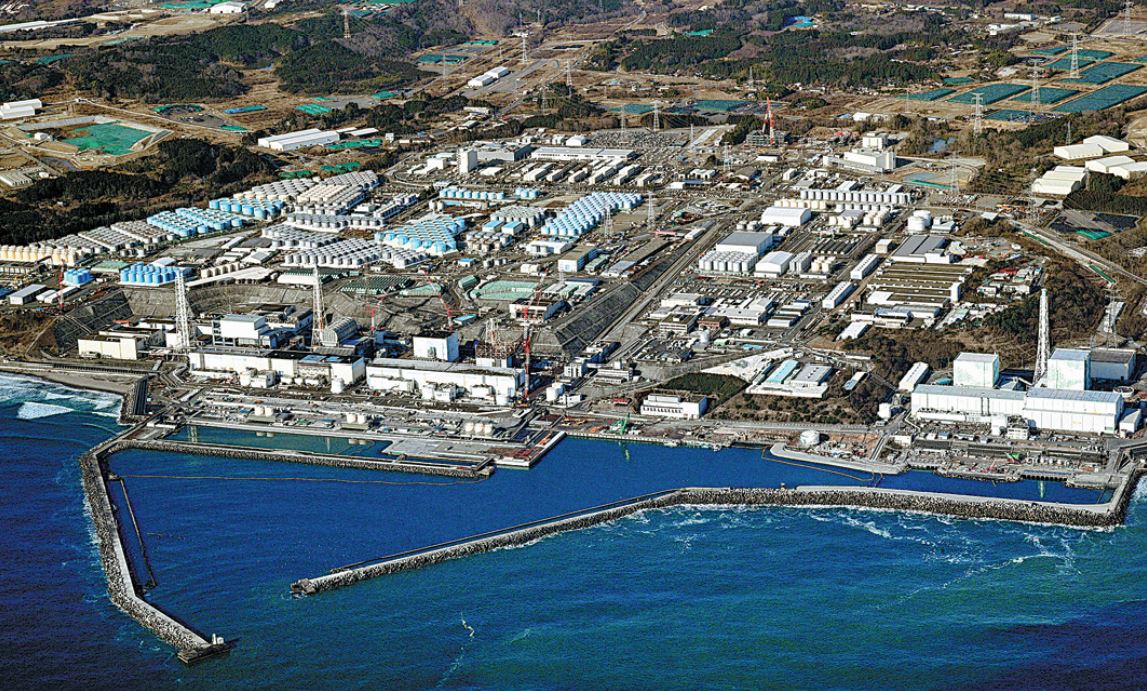
February 27, 2023
Should Japan discharge nuclear waste water from its crippled Fukushima Daiichi nuclear power plant into the Pacific Ocean? This is a question for the international community as a whole to answer, the islands in the Pacific Ocean in particular, not just the Japanese government.
The decision to dump the contaminated water into the ocean is not just a domestic issue of Japan when there is potential danger that the radioactive water may cause lasting damage to the marine ecology and marine resources all over the world.
Earlier this year, Japan unilaterally announced that it would start discharging the radioactive water in spring or summer, just before the International Atomic Energy Agency’s task force arrives in Japan for a review.
There are alternative ways to dispose of the nuclear contaminated water rather than just dumping it in the sea, which is an irresponsible choice by the Japanese government, cheap for Japan but expensive for the world. That is what has made the international community so outraged, as dumping such a large amount of nuclear waste water into the ocean is not the only feasible way to solve the problem.
Rather than taking into consideration the possible serious consequences dumping the toxic water into the ocean may cause the marine environment, which will hurt the fisheries the Pacific island countries rely on, and heeding the calls of the international community to reconsider its decision, the Japanese government is stubbornly rushing ahead regardless.
Given that related data and evidence provided by Japan are far from independent or verified, Pacific islands and international organizations have enough reasons to voice their concern about the matter and their opposition to what the Japanese government has decided to do.
Erring on the side of caution is essential in this matter, as it will be too late when the dumped nuclear wastewater causes serious damage to the marine ecology worldwide. It is more than necessary for the Japanese government to think twice about its decision to dump the water into the Pacific Ocean. It should heed the concerns of the Pacific island countries and the rest of the international community.
Japan should seek as much assistance as possible from other countries to find a safer means of disposing of the radioactive water in a cost-effective manner. Japan needs to take a global and long-term perspective on this matter and dispose of the water in a way that causes the least environmental impact, so as to set a good example and precedent for dealing with similar nuclear accidents elsewhere. If so, what Japan has done can be a contribution to humanity.
https://global.chinadaily.com.cn/a/202302/27/WS63fbfb9aa31057c47ebb0f18.html
Fukushima residents feel left out in TEPCO’s water plan
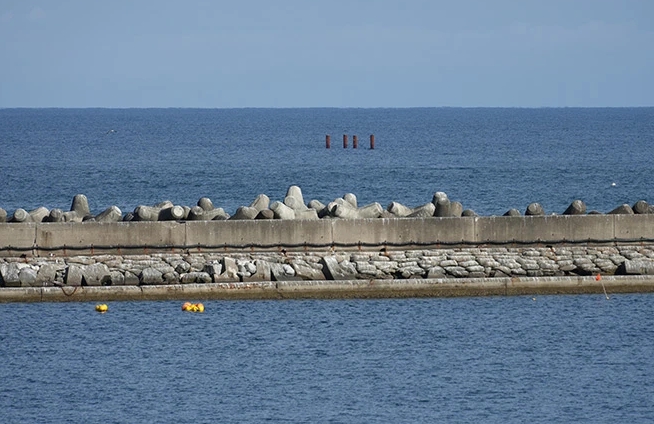
Four pillars stick out of the sea 1 kilometer offshore from Tokyo Electric Power Co.’s Fukushima No. 1 nuclear power plant on Jan. 24. Treated radioactive water will be released from outlets at the bottom of these pillars through an undersea tunnel.
February 26, 2023
As Tokyo Electric Power Co. moves closer to discharging tons of stored water from its stricken Fukushima No. 1 nuclear plant, local opposition has intensified and cries of betrayal are being heard.
The Nuclear Regulation Authority in July 2022 concluded that “there are no safety issues” with the water being released into the sea. The water will be treated to eliminate most of the radioactive substances and diluted to government safety standards.
TEPCO has been steadily moving ahead with the water-discharge plans since the NRA’s assessment.
Locals now feel that their opinions do not matter anymore, even though the water-discharge plan could negatively affect their livelihoods for decades to come.
SPRING OR SUMMER RELEASE
A TEPCO employee on the shore pointed out toward the water and said: “Can you see them?”
Four pillars were sticking out from the sea surface about 1 kilometer offshore of the Fukushima plant.
The employee explained that water discharge outlets are located at the bottoms of these pillars.
Workers in January were digging the final 200 meters of an undersea tunnel that will be connected to the outlets. The drilling work is scheduled to finish this spring.
The water stored at the plant can then be discharged from the tunnel in spring or summer.
TEPCO says it has no other choice to deal with the water-storage problem at the plant.
The tsunami generated by the March 2011 Great East Japan Earthquake knocked out the cooling system for the plant, leading to a triple meltdown.
Water used to cool down the nuclear fuel in the reactor buildings become contaminated with radioactive materials. Compounding the problem was the continuous flow of groundwater and rain into the damaged reactor buildings. This contaminated water also had to be stored for treatment.
After most of the radioactive materials were removed, the water has been stored in tanks on the compound.
Around 1.32 million tons of water is now stored at the plant, more than enough to fill the Tokyo Dome, according to TEPCO.
About 1,000 storage tanks line the compound. The utility said 96 percent of their capacity is already filled, and they will all be full by autumn.
‘TAKING OPPOSITE STANCE’
In April 2021, the administration of then-Prime Minister Yoshihide Suga decided to discharge the treated water into the sea.
The government and TEPCO reached an agreement with the Fukushima Prefectural Federation of Fisheries Co-operative Associations in 2015 that “the treated water will not be released without the understanding of people involved.”
The fishermen see TEPCO’s unceasing progress on the plan as backing out of that promise.
Tetsu Nozaki, head of the associations, and local fishermen had a meeting with economy minister Yasutoshi Nishimura in Iwaki, Fukushima Prefecture, on Feb. 25.
“(The government) made the promise (in 2015). Now you are taking an opposite stance,” Nozaki said to Nishimura.
“We have no choice but to repeatedly and thoroughly explain the plan,” Nishimura said.
Toshimitsu Konno, 64, head of the Soma Futaba fishery cooperative association in the prefecture, said, “What makes the government and TEPCO think that we have agreed?”
The group is the largest in Fukushima Prefecture, with 846 members.
They oppose the water release, saying it may spark harmful rumors about local marine products.
However, Konno has mixed feelings, especially when he thinks about the next generation of fishermen.
About 100 people joined the local fisheries industry after the 2011 nuclear accident.
Konno believes that only the complete decommissioning of the plant will end the reputation damage once and for all.
The government and TEPCO have said the water release is crucial for the decommissioning process.
“That’s why we cannot simply oppose the plan,” Konno said.
TEPCO expects to discharge up to 500 tons of treated water per day. At that rate, it will take at least 30 years to empty all of the tanks.
“We must live with the situation for 30 or 40 years until the plant is decommissioned. No matter what we do, there will always be problems,” Konno said.
He is struggling over what needs to be done now to proceed with the decommissioning and create a future for the fishing industry.
“We have our own distress as residents,” Konno said.
CAN’T STOP WATER FLOW
TEPCO has been unable prevent groundwater and rainwater from becoming contaminated by the damaged reactors.
The utility tried to block the flow of groundwater by creating a 1.5-km-long frozen soil wall around the No. 1 to No. 4 reactor buildings at the plant.
Workers set up cooling pipes underground carrying a refrigerant of minus 30 degrees. The idea was that the frozen soil would create a barrier to divert the water away from the reactor buildings.
The barrier system cost around 34.5 billion yen ($253 million) to build. It began operation in March 2016.
However, the ice wall has had a series of problems, including underground temperatures exceeding zero degrees in some areas and the refrigerant leaking from the pipes.
TEPCO initially planned to complete its countermeasures against water leaks at reactor buildings and finish operations of the ice wall around March 2021.
The ice wall is still in use, but the water flow to the reactor buildings has continued.
According to TEPCO, the amount of treated water generated per day decreased from 540 tons in 2014 to 130 tons in 2021.
The utility expects the amount to drop to 100 tons by fiscal 2025 and between 50 and 70 tons by fiscal 2028.
“It is difficult to reduce the amount of contaminated water to zero at this point,” a TEPCO official said.
(This article was compiled from reports by Shoko Rikimaru, Hideki Motoyama, Takuro Yamano and Ryo Sasaki.)
It Is The Mass Media’s Job To Help Suppress Anti-War Movements

We’re not going to get de-escalation, diplomacy and detente unless the people use the power of their numbers to demand those things, and the people are not going to use the power of their numbers to demand those things as long as they are successfully propagandized not to. This means propaganda is the ultimate problem that needs to be addressed.
Caitlin Johnstone, 1 March 23, https://caitlinjohnstone.substack.com/p/it-is-the-mass-medias-job-to-help?utm_source=post-email-title&publication_id=82124&post_id=105595703&isFreemail=true&utm_medium=email
In a new article titled “European antiwar protests gain strength as NATO’s Ukraine proxy war escalates,” The Grayzone’s Stavroula Pabst and Max Blumenthal document the many large demonstrations that have been occurring in France, the UK, Germany, Greece, Spain, the Czech Republic, Austria, Belgium and elsewhere opposing the western empire’s brinkmanship with Russia and proxy warfare in Ukraine.
Pabst and Blumenthal conclude their report with a denouncement of the way the western media have either been ignoring or sneering at these protests while actively cheerleading smaller demonstrations in support of arming Ukraine.
“When Western media has not ignored Europe’s antiwar protest wave altogether, its coverage has alternated between dismissive and contemptuous,” they write. “German state broadcaster Deutsche Welle sneeringly characterized the February 25 demonstration in Berlin as ‘naive’ while providing glowing coverage to smaller shows of support for the war by the Ukrainian diaspora. The New York Times, for its part, mentioned the European protests in just a single generic line buried in an article on minuscule anti-Putin protests held by Russian emigres.”
This bias is of course blatantly propagandistic, which won’t surprise anyone who understands that the mainstream western media exist first and foremost to administer propaganda on behalf of the US-centralized empire. And chief among their propaganda duties is to suppress the emergence of a genuine peace movement.
As we’ve discussed previously, it has never in human history been more urgent to have a massive, forceful protest movement in opposition to the empire’s rapidly accelerating trajectory toward a global conflict against Russia and China. Other peace movements have arisen in the past in response to horrific wars which would go on to claim millions of lives, but a world war in the Atomic Age could easily wind up killing billions, and must never be allowed to happen.
And yet the public is not treating this unparalleled threat with the urgency it deserves. A few protests here and there is great, but it’s not nearly enough. And the reason the people have not answered the call is because the mass media have been successfully propagandizing them into accepting the continuous escalations toward world war that we’ve been seeing.
People aren’t going to protest what their government is doing if they believe that what their government is doing is appropriate, and the only reason so many people believe what their government is doing with regard to Russia and China is appropriate is because they have been propagandized into thinking so.
The mass media are not telling the public about the many well-documented western provocations which led to the war in Ukraine and sabotaged peace at every turn; they’re just telling everyone that Putin invaded because he’s an evil Hitler sequel who loves killing and hates freedom. The mass media are not telling the public about the way the US empire has been encircling China with war machinery in ways it would never permit itself to be encircled while deliberately staging incendiary provocations in Taiwan; they’re just telling everyone that China is run by evil warmongering tyrants. The mass media are not reminding the public that after the fall of the Soviet Union the US empire espoused a doctrine asserting that the rise of any foreign superpower must be prevented at all cost; they’re letting that agenda fade into the memory hole.
Because people believe Russia and China are the sole aggressors and the US and its allies are only responding defensively to those unprovoked aggressions, they don’t see the need for a mass protest movement against their own governments. If you tell the average coastal American liberal that you’re holding a protest about the war in Ukraine, they’re going to assume you mean you’re protesting against Putin, and they’ll look at you strangely if you tell them you’re actually protesting your own government’s aggressions.
The narrative that Russia and China are acting with unprovoked aggression actually prevents peace, because if your government isn’t doing anything to make things worse, then there’s nothing it can change about its own behavior to make things better. But of course there is a massive, massive amount that the western power alliance can change about its own behavior with regard to Russia and China that would greatly improve matters. Instead of working to subordinate the entire planet to the will of Washington and its drivers, they can work toward de-escalation, diplomacy and detente.
We’re not going to get de-escalation, diplomacy and detente unless the people use the power of their numbers to demand those things, and the people are not going to use the power of their numbers to demand those things as long as they are successfully propagandized not to. This means propaganda is the ultimate problem that needs to be addressed. Ordinary people can only address it by waking the public up to the fact that the political/media class are lying to them about what’s happening with Russia and China, using whatever means we have access to.
So that’s what we need to do. We need to fight the imperial disinformation campaign using information. Tell people the truth using every medium available to us to sow distrust in the imperial propaganda machine, because propaganda only works if you don’t know it’s happening to you.
Our rulers are always babbling about how they’re fighting an “information war” against enemy nations, but in reality they’re fighting an information war against normal westerners like us. So we must fight back. We need to cripple public trust in the propaganda machine and begin awakening one another from our propaganda-induced sleep, so that we can begin organizing against the horrific end they are driving us toward.
Biden’s “Fools-Based International Order” – a network to bring about war against China.

The Biden administration has a name for this network – the rules-based international order. And sustaining the grip this order has on the world represents an existential challenge for the US.
one is struck by the exclusively militaristic nature of their mission—the North Atlantic Treaty Organization (NATO), the Australia-UK-US (AUKUS) security partnership, and a “revitalized Quad” ……. all, at their core, military alliances.
Militarization of China policy reflects US’ hysteria, By Scott Ritter, Feb 28, 202 https://www.globaltimes.cn/page/202302/1286369.shtml
When one reads the 2022 National Security Strategy of the US, it becomes crystal clear that, at least according to the world view as promulgated by the administration of President Joe Biden, the US and China are on trajectory that can only lead to one thing – military confrontation.
At the core of this assessment is the enduring belief on the part of the Biden administration that the key to America’s continued role as a world leader is the reinvigoration of “America’s unmatched network of alliances and partnerships to uphold and strengthen the principles and institutions that have enabled so much stability, prosperity, and growth for the last 75 years.”
The Biden administration has a name for this network – the rules-based international order. And sustaining the grip this order has on the world represents an existential challenge for the US.
According to the Biden administration, “The [People’s Republic of China] is the only competitor with both the intent to reshape the international order and, increasingly, the economic, diplomatic, military, and technological power to advance that objective.”
According to the Biden administration, “The [People’s Republic of China] is the only competitor with both the intent to reshape the international order and, increasingly, the economic, diplomatic, military, and technological power to advance that objective.”
China, the Biden administration believes, is the greatest threat to the US, something the Biden administration makes abundantly clear. “The People’s Republic of China harbors the intention and, increasingly, the capacity to reshape the international order in favor of one that tilts the global playing field to its benefit, even as the US remains committed to managing the competition between our countries responsibly.”
The “responsible management” the Biden administration speaks of draws upon an “unrivaled network of allies and partners” which “protects and advances our interests around the world.” The Biden administration’s strategy for “competing” with China requires the US to “assemble the strongest possible coalitions.”
But when one looks at the coalitions highlighted by the Biden administration as being central to this effort, one is struck by the exclusively militaristic nature of their mission—the North Atlantic Treaty Organization (NATO), the Australia-UK-US (AUKUS) security partnership, and a “revitalized Quad”, which brings together the US with Japan, India, and Australia in a security arrangement designed to contain Chinese influence in the Indo-Pacific region—are all, at their core, military alliances.
“Competition”, when it comes to the US approach toward China, is better defined as “deterrence”, and “deterrence” is a military mission, one which the Biden administration has pledged to “act urgently to sustain and strengthen”, noting that China is the “pacing challenge.”
The result of the Biden administration’s approach toward China is the militarization of what should be a classic problem of diplomacy, where the traditional tools of negotiation are increasingly replaced by confrontation.
The most recent example of this militarized approach is the so-called “Chinese Spy Balloon” crisis, where the Biden administration used the incursion by what clearly was a wayward high-altitude balloon equipped with sensors designed to collect atmospheric information used to investigate climate change to generate hysteria about a non-existent Chinese threat. This hysteria culminated in the US employing Air Force fighter aircraft to shoot down the balloon, destroying both it and its scientific payload.
The extent to which the Biden administration has supplanted diplomacy with “militarized” competition is underscored by the fact that, because of this self-generated Sinophobia, Secretary of State Antony Blinken cancelled plans to travel to China for high-level talks. At a time when the US and China should be exhausting every opportunity to engage in the kind of constructive dialogue the Biden administration claims as its principal tool for managing its relationship with China, the US has instead embarked on a phrenetic “balloon chase”, where US fighter aircraft scour the American skies for even more “made in China” balloons to shoot down.
The militarization of US-Chinese relations reached its apex recently when US Air Force General Mike Minihan, the head of the US Air Mobility Command (AMC), issued a memorandum declaring that his “gut” told him that the US and China would be at war by 2025, and instructing the men and women under his command practice pistol marksmanship by firing a full “clip” of ammunition into a 7-meter target, aiming for the head.
While General Minihan’s superiors have distanced themselves from the memorandum, the fact is his undiplomatic language is reflective of a core assessment dating back to 2021 known as “the Davidson Window”, named after the former commander of the US Indo-Pacific Command, Philip Davidson, who postulated at that time that China would invade Taiwan within six years. The “Davidson Window” guides the posture of a US military which, by the Biden administration’s own admission, uses China as its “pacing challenge.”
The Biden administration would be well-advised to become grounded in old-school diplomacy rather than chasing balloons in the sky because, left unchecked, the ongoing militarization of the US-Chinese relationship can only lead to disaster.
Space dangers: Contested orbits and mounting space junk

The 1967 U.N. Outer Space Treaty prohibits ‘weapons of mass destruction’ in space or on ‘celestial bodies’ like the moon. But currently ‘weapons of selective destruction’ fall outside of the OST. Thus a new treaty is urgently needed.
By Bruce Gagnon , http://space4peace.blogspot.com/2023/02/space-dangers-contested-orbits-and.html
Space orbital parking lots are getting dangerously crowded risking cascading collisions ( Kessler Syndrome) which could become so severe that space flight would be impossible due to the orbiting field of debris. If this was to occur much of life on planet Earth would go dark as our daily activities are enabled by space satellites (GPS, Internet banking, weather prediction, cell phones, air traffic control, etc).
In addition, because of the massive escalation of satellite launches, astronomers are complaining that we are losing the night sky.
Elon Musk’s SpaceX makes rockets and satellites to build Starlink, a broadband Internet system that once completed will cover the entire world. SpaceX has so far put 2,500 satellites into orbit and plans for 42,000 satellites in low-Earth orbit (LEO) occupying 80% of this space.
The Pentagon funds and tests Starlink to use its military capabilities. Starlink satellites are being utilized by the Ukrainian military to guide drones, artillery shells, and missiles into Russian positions and at civilian targets.
Very recently Musk has begun to slightly restrict the use of Starlink by the Ukrainian military as he feared that Russia might take action against the constellation.
Anti-satellite weapons (ASAT) have been tested by India, US, Russia and China. ASAT’s need no explosives, at orbital speeds kinetic energy (one thing smashing into the other) does the job.
Virtually all warfare on the planet is now enabled by space technology. Thus filling up the increasingly limited parking spaces in various orbital regions will determine which nation has an advantage.
NATO in 2019 announced a new doctrine calling space a ‘fifth operational domain’. NATO maintains that the US-led bloc will use commercial satellites as a military booster.
The 1967 U.N. Outer Space Treaty prohibits ‘weapons of mass destruction’ in space or on ‘celestial bodies’ like the moon. But currently ‘weapons of selective destruction’ fall outside of the OST. Thus a new treaty is urgently needed.
Russia and China have been leading the effort at the UN to create a new treaty to ban all weapons in space for many years. But the US and Israel have been blocking such a step for peace in space. The official US line through Republican and Democratic administrations is ‘there is no problem in space, and no new treaty is needed’.
During recent years the numbers of satellites orbiting the Earth has grown dramatically. Thousands more satellite launches have been approved by the Federal Communications Commission despite legal action by a coalition of groups (including the Global Network Against Weapons & Nuclear Power in Space).
Each launch releases toxic agents which are destroying the Earth’s ozone layer. In addition, when satellites fall from lower earth orbit and burn-up on reentry they release a deadly stew of electronic particles into our atmosphere.
Russia has issued a warning to the US-NATO that they are ‘exposing civilian space assets to potential attack by utilizing them for military purposes’.
In early February Ukrainian troops fired rockets from a US-made HIMARS system which hit a hospital in Novoaydar, killing 14 Russian-ethnics and injuring 24. Russia claimed that Kiev used western satellites operated by NATO personnel to target the hospital.
In late February China announced that it was preparing to launch close to 13,000 satellites into LEO in a move to counter Musk’s SpaceX network. China stated that they intended to ‘ensure that our country has a place in low orbit and prevent the Starlink constellation from excessively preempting low-orbit resources.
~ Bruce Gagnon is coordinator of the Global Network Against Weapons & Nuclear Power in Space and lives in Brunswick, Maine.
A “nuclear alliance” in Europe, as France leads a pack of EU member states to count nuclear energy as “green and renewable” Others disagree.

The EU countries are at odds over the future role of nuclear energy. At a
meeting, eleven countries, including France, agreed to expand nuclear power
cooperation. Germany strictly rejects this.
Eleven member states of the
European Union have agreed on “enhanced cooperation” in the field of
nuclear energy. These include France, the Netherlands, Poland, Finland,
Bulgaria, Croatia, the Czech Republic, Hungary, Romania, Slovenia and
Slovakia. At the meeting of EU energy ministers in Stockholm, they
specifically decided to promote “new joint projects” alongside existing
nuclear power plants. They also decided to work closely together in the
areas of research and security.
On the one hand, countries like Germany,
Luxembourg, Austria and Spain are strictly against the expansion of nuclear
power in Europe to achieve climate goals. On the other hand, the “nuclear
alliance” led by long-standing nuclear power France wants to further expand
nuclear power. According to a joint statement by the eleven EU countries,
nuclear energy is one of many tools to achieve climate goals. With nuclear
energy, electricity should be produced for the needs of consumers in order
to guarantee “security of supply” in the future. France is committed to
allowing its nuclear power to count toward renewable energy and “green”
hydrogen targets.
Tagesschau 28th Feb 2023
https://www.tagesschau.de/ausland/europa/atomkraft-eu-101.html
‘Ukrainian kamikaze drone’ crashes down near gas plant just 68 miles from the Kremlin as Putin demands tighter security
- Images appear to depict a UJ-31 ‘loitering munitions’ kamikaze flying bomb
- The drone came down near the village of Kolomna
Daily Mail, By JAMES CALLERY FOR MAILONLINE, 1 March 2023
A drone crashed just 68 miles from the Kremlin today in a suspected ‘failed attack’ by Ukraine.
Russian president Vladimir Putin has ordered officials to tighten control of the border with Ukraine after a spate of drone attacks delivered a new challenge to Moscow more than a year after the invasion of its neighbour.
While Putin did not refer to any specific attacks in a speech in Moscow, his comments came hours after drones targeted several areas in southern and western Russia and authorities closed the airspace over St Petersburg in response to what some reports said was a drone.
Images shared online appear to depict a Ukrainian UJ-31 ‘loitering munitions’ kamikaze flying bomb after it crashed down near a gas plant more than 300 miles from the border.
It came down near the village of Kolomna hours after Russia’s Defence Ministry accused Ukraine of two attempted drone strikes in the south overnight.
Ukraine does not publicly claim responsibility for attacks inside Russia.
If it was behind the Kolomna drone, it would be its closest attempted strike to Moscow since the start of the invasion of Ukraine.
It is also the deepest inside Russian territory any suspected Ukrainian drone has been spotted.
Postings on Russian social media showed the broken grey metal drone in a snowdrift in a woodland area.
Regional governor Andrei Vorobyov said the drone appeared to have been intended to hit a ‘civil infrastructure facility’ but noted that there was no damage.
He said the FSB security agency was handling the situation and there was no threat to residents.
There is a gas compressor plant close to the crash site.
Reports claimed the low-flying drone may have clipped trees.
Earlier, the Russian Defence Ministry accused Ukraine of sending attack drones towards civil infrastructure targets in the southern regions of Adygea and Krasnodar.
It said its electronic anti-drone jamming systems had caused them to miss their targets.
The ministry said: ‘Both drones lost control and deviated from their flight paths.
‘One fell into a field, the other, deviating from its trajectory, did not harm the intended target.’
……………………………………………… While Ukrainian drone strikes on the Russian border regions of Bryansk and Belgorod that lie north of Ukraine’s Sumy region are not unusual, the hits on the Krasnodar and Adygea regions further south are noteworthy.
…………… Ukrainian authorities offered no immediate acknowledgement or comment on the reported strikes.
Last year, Russian authorities repeatedly reported shooting down Ukrainian drones over annexed Crimea. In December, the Russian military said Ukraine used drones to hit two bases for long-range bombers deep inside Russian territory.
Separately, the local government of St Petersburg – Russia’s second-largest city 800 miles north of the border with Ukraine – said early on Tuesday that it was temporarily halting all flight departures and arrivals at the city’s main airport, Pulkovo. It did not give a reason for the move.
Hours earlier, unconfirmed reports on Russia’s Telegram social network referred to the air space over St Petersburg being shut down and to Russian warplane overflights. It was not immediately clear whether this was connected to the alleged rise in drone attacks in Russia’s south……………………… https://www.dailymail.co.uk/news/article-11803571/Ukrainian-kamikaze-drone-crashes-near-gas-plant-just-68-miles-Kremlin.html
US has spent billions on Ukraine war aid. But is that money landing in corrupt pockets?

Tom Vanden BrookRachel Looker, USA TODAY, 17 Feb 23
WASHINGTON – With more than $100 billion in U.S. weaponry and financial aid flowing to Ukraine in less than a year – and more on the way to counter Russia’s invasion – concerns about arms falling into terrorists’ hands and dollars into corrupt officials’ pockets are mounting.
The special inspector general who has overseen aid to Afghanistan since 2012, and some House Republicans, warn of the need for closer oversight of the military and humanitarian aid to Ukraine. The scale of the effort is massive. The $113 billion appropriated by Congress in 2022 approaches the $146 billion spent in 20 years for military and humanitarian assistance to Afghanistan, though the cost of sending U.S. troops there was far higher.
“When you spend so much money so quickly, with so little oversight, you’re going to have fraud, waste and abuse,” John Sopko, the special inspector general for Afghanistan reconstruction, said in an interview. “Massive amounts.”
Among the American public and on Capitol Hill, support for Ukraine’s resistance to Russia’s invasion remains strong. But it is softening. An Associated Press poll in late January showed that 48% of U.S. adults say they favor the U.S. providing weapons to Ukraine, with 29% opposed and 22% saying they’re neither in favor nor opposed. That’s a drop from May 2022, when 60% of U.S. adults said they were in favor of sending Ukraine weapons.
Support could erode further among Americans and Ukrainians, according to members of Congress and Sopko, without greater transparency and accountability for the tens of billions spent. The costs to American taxpayers can be expected to increase as the Biden administration sends increasingly sophisticated and expensive arms to Ukraine, including Abrams battle tanks.
Assuring that the aid ends up in the right hands, they say, demands greater oversight.
U.S. struggles to account for billions sent to Ukraine
The Pentagon spent $62.3 billion in 2022 on Ukraine for weapons, ammunition, training, logistics, supplies, salaries and stipends, according to the Joint Strategic Oversight Plan for Ukraine Response report. Inspectors general for several agencies released the report in January.
The State Department and U.S. Agency for International Development spent $46 billion for activities ranging from border security to basic government services such as utilities, hospitals, schools and firefighting. Other government agencies, including the Department of Agriculture, spent another $5 billion.
The report noted the difficulty U.S. agencies had accounting for the billions spent.
The Pentagon, for example, was “unable to provide end-use monitoring in accordance with DoD policy” in Ukraine, according to a report by the Pentagon’s inspector general. “End-use monitoring” includes tracking serial numbers of weapons and ammunition to ensure they’re used as intended.
……………………. With few U.S. troops or State Department personnel in Ukraine, keeping inventories is difficult, the report said. Moreover, the vast amount of money complicates the effort. The report notes the danger of corrupt officials siphoning it off.
“State is overseeing unprecedented levels of security assistance in Ukraine, presenting significant risk of misuse and diversion given the volume and speed of assistance and the wartime operating environment,” according to the report…………………….
Lack of Ukraine oversight draws parallels to Afghanistan corruption
Ukraine has a history of corruption, and President Volodymyr Zelenskyy has made stamping it out a priority.
Ukraine ranks 116th out of 180 nations on Transparency International’s Corruption Perceptions Index. On Feb. 14, the defense minister named new deputies after news reports showed officials in the defense ministry had bought food for troops at inflated prices.
Corruption corrodes the public’s faith in government, said Sopko, the special inspector general for Afghanistan. Elites in Afghanistan skimmed U.S. aid money, and the obvious corruption alienated Afghans…………………….
‘Need truth tellers’: Republicans demand more oversight
Sen. J.D. Vance, R-Ohio, and Rep. Dan Bishop, R-N.C., drafted a letter to the White House requesting an expansion to a congressionally requiredreport on the amount of security assistance sent to Ukraine. The lawmakers called for more details on how much money has been sent to Ukraine and how it’s used…………. https://www.usatoday.com/story/news/politics/2023/02/19/oversight-ukraine-russia-military-aid/11271555002/
TODAY. Pauvre chere Agnes – unhappy about “discrimination” against nuclear energy!

Yes, France is the soul of egalite, fraternite and all that (and Yes I dunno how to do the accents on this).
So it’s understandable that French energy minister Agnès Pannier-Runacher should be most upset when other countries belittle mighty France, and its holy nuclear industry.
Trouble is – I think that poor Agnes has got it a bit wrong.
We’re all in awe of France – its cheeses, its wine, culture – natural beauty- wow! it’s superior. But when it comes to France’s much touted nuclear superiority – it is not discriminatory against France, nor its industry – to mention the facts.
Agnes – you and France are going to have to face the facts:
- Global heating is happening too fast – the wonderful new fleet of reactors would be too late anyway.
- Climate change, heat, water shortage, are badly affecting France’s nuclear reactors.
- France’s reactors have corrosion problems.
- Nuclear power is just not “renewable”- depends on a carbon-emitting fuel chain starting with uranium mining.
- it’s just not “clean and green ” – emits radioactive particles, produces long-lasting toxic wastes.
- it’s not affordable.
- EDF’s nearly bankrupt – time to stop the pretence
- in a tense conflict-prone world, nuclear facilities are a dangerous target for terrorism
- nuclear’s really only useful for supporting the nuclear weapons industry.
- it’s popular with the military, the weapons corporations, the bought politicians, but increasingly less so with the general public – who see the preferable alternatives – energy conservation, and wind, solar and other renewable sources.
-
Archives
- February 2026 (228)
- January 2026 (308)
- December 2025 (358)
- November 2025 (359)
- October 2025 (376)
- September 2025 (258)
- August 2025 (319)
- July 2025 (230)
- June 2025 (348)
- May 2025 (261)
- April 2025 (305)
- March 2025 (319)
-
Categories
- 1
- 1 NUCLEAR ISSUES
- business and costs
- climate change
- culture and arts
- ENERGY
- environment
- health
- history
- indigenous issues
- Legal
- marketing of nuclear
- media
- opposition to nuclear
- PERSONAL STORIES
- politics
- politics international
- Religion and ethics
- safety
- secrets,lies and civil liberties
- spinbuster
- technology
- Uranium
- wastes
- weapons and war
- Women
- 2 WORLD
- ACTION
- AFRICA
- Atrocities
- AUSTRALIA
- Christina's notes
- Christina's themes
- culture and arts
- Events
- Fuk 2022
- Fuk 2023
- Fukushima 2017
- Fukushima 2018
- fukushima 2019
- Fukushima 2020
- Fukushima 2021
- general
- global warming
- Humour (God we need it)
- Nuclear
- RARE EARTHS
- Reference
- resources – print
- Resources -audiovicual
- Weekly Newsletter
- World
- World Nuclear
- YouTube
-
RSS
Entries RSS
Comments RSS
 nuclear-news