Fukushima water to be released into ocean in next few months, says Japan
Authorities to begin release of a million tonnes of water from stricken nuclear plant after treatment to remove most radioactive material

A worker stands near tanks used to store treated radioactive water used to cool the Fukushima Daiichi nuclear power plant. The water is soon to be released into the ocean.
January 13, 2023
The controversial release of more than a million tonnes of water from the wrecked Fukushima Daiichi nuclear plant will begin in the northern spring or summer, Japan’s government has said – a move that has sparked anger among local fishing communities and countries in the region.
The decision comes more than two years after the government approved the release of the water, which will be treated to remove most radioactive materials but will still contain tritium, a naturally occurring radioactive form of hydrogen that is technically difficult to separate from water.
Japanese officials insist the “treated” water will not pose a threat to human health or the marine environment, but the plans face opposition from fishermen who say it risks destroying their livelihoods, almost 12 years after a magnitude-9.0 earthquake triggered a huge tsunami that killed more than 18,000 people along Japan’s north-east coast.
Tsunami waves crashed into Fukushima Daiichi, knocking out its backup electricity supply, triggering meltdowns in three of its reactors and sending large quantities of radiation into the atmosphere in the most serious nuclear accident since Chornobyl a quarter of a century earlier.
The wastewater in Fukushima is being stored in more than 1,000 tanks that officials say need to be removed so the plant can be decommissioned – a process expected to take 30 to 40 years.
Japan’s foreign ministry said in July that regulators had deemed it safe to release the water, which will be gradually discharged into the Pacific ocean via a tunnel after being treated and diluted.
The plan’s operator, Tokyo Electric Power (Tepco), has said its water treatment technology – known as Alps – can remove all radioactive materials from water except tritium, which it says is harmless in small amounts.
The International Atomic Energy Agency (IAEA) has also pointed out that nuclear plants around the world use a similar process to dispose of wastewater containing low-level concentrations of tritium and other radionuclides.
South Korea and China have voiced concern about the discharge, while the Pacific Islands Forum said recently it had “grave concerns” about the proposed release.
Writing in the Guardian, the forum’s secretary general, Henry Puna, said Japan “should hold off on any such release until we are certain about the implications of this proposal on the environment and on human health, especially recognising that the majority of our Pacific peoples are coastal peoples, and that the ocean continues to be an integral part of their subsistence living”.
The South Korean government, which has yet to lift its ban on Fukushima seafood, has said that releasing the water would pose a “grave threat” to marine life. Fishing unions in the area oppose the release, warning it would cause alarm among consumers and derail more than a decade of efforts to reassure the public that Fukushima seafood is safe to eat.
Under the plan approved by Japan’s cabinet on Friday, fishermen who fear that the release will impact their livelihoods will be able to access a new ¥50bn ($385m) fund, the Kyodo news agency said.
“We would like to thoroughly explain these measures to fishing communities and other relevant parties while listening to their concerns,” the chief cabinet secretary, Hirokazu Matsuno, said at the meeting, according to Kyodo.
The liquid, which Japanese officials claim is “treated” rather than “contaminated”, comprises water used to cool the damaged reactors, and rain and groundwater that seeps into the area.
Kyodo said the IAEA had conducted several safety reviews of the plan and would issue a report based on its findings, as well as providing support before, during and after the discharge.
Fishermen are angry and give up on the policy of discharging treated wastewater into the ocean

January 14, 2023
On January 13, people involved in the fishing industry in Fukushima Prefecture and the surrounding area voiced their anger and resignation over the government’s plan to begin discharging treated water from TEPCO’s Fukushima Daiichi Nuclear Power Plant into the ocean “around this spring or summer.
In the afternoon of the same day, the fishing port of Kakedo (Namie-cho, Fukushima Prefecture), located about 6 km north of the Fukushima Daiichi Nuclear Power Plant, was deserted after the landing had already finished, but several fishermen were working on their fishing nets and boats.
A young fisherman who had started fishing for baby sardines looked resigned: “The government will force me to release the treated water even if I scream,” he said. But I am still afraid of the reputational damage it will cause.
In Fukushima Prefecture, a test fishery that has been in operation since the nuclear accident ended in March 2021. The catch is about one-fifth of what it was before the accident, but it is gradually recovering. The owner of a fresh fish store in Minamisoma City, which mainly handles fish from the Hiketo fishing port, said angrily, “The fishing season is finally picking up, but if the fish are affected by the release, it will be the end of the season.
◆The government and TEPCO “have done nothing but lie…keep your promises.
The fishermen’s wish is to continue the fishing industry. Satoshi Nozaki, chairman of the Fukushima Prefectural Fisheries Federation, has appealed to the government and TEPCO, saying, “We want to continue fishing in Fukushima so that we can hand on to our successors” and “We cannot consent to the discharge into the ocean. The prefectural fisheries federation said it has not been contacted by the government and cannot make any formal comment, but a representative stressed, “We will remain resolutely opposed to this.
We want them to stop discharging into the ocean. I am just disappointed,” said Tsuneko Nemoto, 66, who runs a trawl fishing business based in the Nakaminato fishing port in Hitachinaka City, Ibaraki Prefecture. She is mindful of the government’s and TEPCO’s promise not to discharge the waste into the ocean without the understanding of those involved. “I don’t trust them because they have lied to us so many times, but they must keep their promise,” she said.
A representative of the Miyagi Prefectural Fisheries Federation also stated clearly that they were opposed to ocean discharge. He also said that he doubted whether the government’s dissemination of information about the treated water was reassuring to consumers. (Takeshi Yamakawa, Natsuko Katayama, Nozomi Masui, Nagasaki University of Technology)
Fukushima nuclear disaster: Japan to release radioactive water into sea this year

January 13, 2023
Japan says it will release more than a million tonnes of water into the sea from the destroyed Fukushima nuclear power plant this year.
After treatment the levels of most radioactive particles meet the national standard, the operator said.
The International Atomic Energy Agency (IAEA) says the proposal is safe, but neighbouring countries have voiced concern.
The 2011 Fukushima disaster was the worst nuclear accident since Chernobyl.
Decommissioning has already started but could take four decades.
“We expect the timing of the release would be sometime during this spring or summer,” said chief cabinet secretary Hirokazu Matsuno on Friday, adding that the government will wait for a “comprehensive report” from IAEA before the release.
Every day, the plant produces 100 cubic metres of contaminated water, which is a mixture of groundwater, seawater and water used to keep the reactors cool. It is then filtered and stored in tanks.
With more than 1.3 million cubic metres on site, space is running out.
The water is filtered for most radioactive isotopes, but the level of tritium is above the national standard, operator Tepco said. Experts say tritium is very difficult to remove from water and is only harmful to humans in large doses.
However, neighbouring countries and local fishermen oppose the proposal, which was approved by the Japanese government in 2021.
The Pacific Islands Forum has criticised Japan for the lack of transparency.
“Pacific peoples are coastal peoples, and the ocean continues to be an integral part of their subsistence living,” Forum Secretary General Henry Puna told news website Stuff.
“Japan is breaking the commitment that their leaders have arrived at when we held our high level summit in 2021.
“It was agreed that we would have access to all independent scientific and verifiable scientific evidence before this discharge takes place. Unfortunately, Japan has not been co-operating.”
North-eastern Japan was rocked by a magnitude 9.0 earthquake on 11 March 2011, which then triggered a giant tsunami.
The waves hit the Fukushima Daiichi Nuclear Power Plant, flooding three reactors and sparking a major disaster.
Authorities set up an exclusion zone which grew larger and larger as radiation leaked from the plant, forcing more than 150,000 people to evacuate from the area. The zone remains in place.
“Treated water” from Fukushima Daiichi Nuclear Power Plant to be discharged into the ocean around this spring or summer

January 13, 2023
The government has decided to discharge “treated water” from the TEPCO’s Fukushima Daiichi Nuclear Power Plant into the ocean in spring or summer of this year.
At a recently held cabinet meeting, the government decided to begin discharging “treated water” from the Fukushima Daiichi Nuclear Power Plant into the ocean “in the spring or summer of this year” after the completion of construction of discharge facilities and inspections by the Nuclear Regulation Authority.
In April of last year, the government decided on a basic policy of starting ocean discharge “in about two years,” and this decision is a more concrete formulation of that timing.
The government has also included a new 50 billion yen fund to be used to assist fishermen throughout Japan who are concerned about reputational damage caused by the discharge of treated wastewater, including the cost of developing new fishing grounds and fuel costs.
Mr. Kobayakawa, president of TEPCO Holdings, said, “For us, risk and safety are our top priorities, and we will carry out our role with the utmost care. (Regarding the understanding of local residents) I don’t think we are in a situation where the understanding of local residents has progressed well yet, so we would like to make every effort to address the various concerns and anxieties of people in various positions, explain them in detail, and foster the understanding of as many people as possible. We will do our best to explain the situation to as many people as possible and to foster their understanding.
Recycling decontaminated soil from the nuclear power plant accident is “no one’s business” Residents of Shinjuku, which has an unexpected connection with TEPCO, have stood up to stand up for the issue

Gen Hirai (second from right) and others protest the demonstration project to reuse decontaminated soil in Kabukicho, Tokyo, on December 12.
January 13, 2023
One month has passed since the announcement of a demonstration project to reuse so-called “decontaminated soil” collected during decontamination work after the accident at TEPCO’s Fukushima Daiichi Nuclear Power Plant in the Tokyo metropolitan area. People who live near Shinjuku Gyoen (Shinjuku-ku, Tokyo), one of the planned sites, have joined forces and established a group to oppose the reuse of the soil. Shinjuku has an unexpected connection with TEPCO. What do the locals think? Can other areas be left to their own devices? We took another look at the situation. (Takeshi Nakayama and Yoshiko Nakazawa)
◆No attempt has been made to reach a consensus among the residents.
The local people are trying to push the project forward without the knowledge of many of them,” said one angry writer.
Gen Hirai, 70, a writer, is angry. Gen Hirai, 70, is the chairman of the “Association Opposing the Introduction of Radioactively Contaminated Soil into Shinjuku Gyoen,” which lodged a complaint with the Shinjuku City government on March 12, claiming that there had been insufficient explanation of the demonstration project.
On September 9, the Ministry of the Environment announced a demonstration project using Shinjuku Gyoen as a candidate site. The project will use the flower beds behind the office building, which are normally closed to the general public, and plant them by covering them with decontaminated soil.
On the 21st, an explanatory meeting was held for residents of Shinjuku 1 and 2 chome facing the Gyoen. However, only 28 people attended the meeting, and Ms. Hirai, who lives in 1-chome, was unaware of it until she learned about it through the media.
It cannot be said that we are trying to build consensus among the residents of the city,” said Hirai. Mr. Hirai felt a growing sense of crisis and held a study session on the issue of decontaminated soil on the 28th. On the 7th of this month, he established a group to oppose the project with other ward residents.
◆University professors, lawyers, theater performers, and restaurant owners in the Golden district

Gen Hirai speaks about his proposal for a demonstration project to reuse decontaminated soil at the Shinjuku City Office in Kabukicho, Tokyo, on December 12.
During his visit to the Shinjuku City Office on January 12, Gen Hirai submitted a written request to the city officials to inform the residents of the demonstration project and to stop bringing decontaminated soil into the city unless its safety is guaranteed.
The 20 people who accompanied him were a diverse group, including not only local residents but also university professors, lawyers, theater people, and restaurant owners from the Golden Gaien district near the Gyoen. The participants questioned whether the law had been properly established for the reuse of decontaminated soil, and whether this would lead to the spread of contamination rather than alleviate the burden on Fukushima.
Although Shinjuku has a strong impression of an entertainment district such as Kabukicho, there are many condominiums in the Shinjuku Gyoen area, and some people have lived in the area for three generations. Mr. Hirai used to play in Shinjuku Gyoen when he was in elementary school, and even now he takes a walk there once every three days. Many kindergarteners also visit the park, and there is a promenade where many people come and go. Why are they trying to conduct a demonstration project in such a park?
◆Shinjuku Metropolitan High School, which has produced successive generations of TEPCO executives
Shinjuku is also characterized by its close ties to TEPCO.
Graduates of Shinjuku Metropolitan High School, located near the Gyoen Garden, have produced successive generations of TEPCO executives. According to the “Choyo Alumni Association,” a group of graduates, Tsunehisa Katsumata, who was chairman at the time of the Fukushima nuclear accident, and Naomi Hirose, who served as president after the accident, are among the names on the list. In addition, the TEPCO Hospital was located in Shinanomachi near the Gyoen until February 2014. I would like to ask Katsumata and others what they think about bringing (decontaminated soil) so close to their alma mater,” he said.
What stands out above all else is the Ministry of the Environment’s forward-looking attitude. This can be seen in a video shown at the briefing in Shinjuku, titled “Fukushima and the Environment Beyond. The video, “Fukushima and Beyond: Toward the Environment,” which was shown at the briefing in Shinjuku, also gives some indication.
The decontaminated soil is described as “an issue that remains in the land of Fukushima, which continues to recover. The video shows images of temporary storage sites in Fukushima Prefecture lined with flexible container bags filled with decontaminated soil, and asks the question, “Is this really a problem only in Fukushima? Is this really only a problem in Fukushima?
It seems as if he is trying to say that a demonstration project is needed to accept decontaminated soil outside of Fukushima Prefecture, but it is not clear that he is seriously trying to answer the questions of the local residents. The call center, which was listed in the briefing materials, is open only on weekdays, but the staff is curt: “We will use the ‘opinions’ we receive as reference in our future studies.

A park with a signboard showing underground storage of decontaminated soil in Funabashi City, Chiba Prefecture, in December 2022.
◆”Shinjuku City also believes what the government says.
Mr. Hirai said that the government seems to be leaving residents behind.
He points out that the Shinjuku City government is also accepting the government’s position that the decontaminated soil is safe, even though it cannot be scientifically proven that it is safe. The opposition group will hold an inaugural meeting on March 24, and will continue to raise the issue widely.
The demonstration project is currently announced for Shinjuku City and Tokorozawa City in Saitama Prefecture, and Tsukuba City in Ibaraki Prefecture is also being discussed, but the cleanup of decontaminated soil is not limited to these areas.
According to the Ministry of the Environment, decontaminated soil from Fukushima Prefecture will be collected at an interim storage facility near the Daiichi Nuclear Power Plant and then transported out of the prefecture for final disposal by 2045. As of the end of last year, about 13.38 million cubic meters of decontaminated soil had been collected. The company advocates the reuse of the soil to reduce the amount for final disposal and to make it easier to transport the soil out of the prefecture.
◆Decontaminated soil is becoming more and more familiar to people…
The problem is the radioactive concentration of the decontaminated soil to be reused.
According to the Ministry of Agriculture, Forestry and Fisheries, for about 50 years before the nuclear accident, the average radioactive concentration of farmland in Japan was about 20 becquerels per kilogram. On the other hand, the Ministry of the Environment has set a recycling standard for decontaminated soil of 8,000 becquerels or less, about 400 times higher. This is 80 times lower than the recycling standard of 100 becquerels or less for materials from decommissioned nuclear power plants.
Yayoi Isono, professor emeritus of environmental law at Tokyo Keizai University, commented, “Under these standards, a considerable amount of waste is reused. If soil with a low concentration of radioactive materials is mixed with the soil, it can be diluted to the standard level. If the amount of soil to be reused increases, the number of areas subject to reuse could also increase. If more soil is reused, the number of areas where it will be reused could increase.

Workers seal and bury soil contaminated with radioactive materials in Seya Ward, Yokohama, March 2012.
There are other troubling issues. As a result of the widespread release of radioactive materials from the Fukushima Daiichi Nuclear Power Plant, decontamination was widely implemented in the Tohoku and Tokyo metropolitan areas. Decontaminated soil is stored at a total of 29,000 locations in seven prefectures outside of Fukushima Prefecture, including Iwate, Ibaraki, Gunma, and Chiba. The Ministry of the Environment is urging measures such as sealing the soil in bags or containers, covering them with tarps to shield them from water, and covering them with fill.
However, the measures to be taken after storage differ between Fukushima Prefecture and other prefectures. The basic policy approved by the Cabinet in November 2011 stipulates that the government is responsible for securing interim storage facilities in prefectures where “a significant amount” of contaminated soil and other materials are generated. Fukushima Prefecture falls under this category, while other prefectures are to dispose of contaminated soil onsite.
◆Ministry of the Environment embarking on a demonstration project based on the idea that there is reuse of soil
However, municipalities outside of Fukushima Prefecture that have decontaminated soil are facing a complicated situation. Marumori Town in Miyagi Prefecture, which is storing decontaminated soil at 44 locations including schools, has approached the Ministry of the Environment, saying, “The government and TEPCO are responsible for transporting the soil out of the town for disposal.
An official from the town’s general affairs division said, “Some people in the town say, ‘It is not right that the people who dumped the waste did not clean it up, and that the people in the area where the waste was dumped are responsible for disposing of it. The government has not agreed to remove the waste from the town, but we are asking the government to do so, even if it means amending the law,” he said.
The cleanup of decontaminated soil cannot be a personal matter. However, the grounds for the cleanup methods are not clear, and in some cases, the methods are not clear.
Reuse of decontaminated soil within Fukushima Prefecture and on-site disposal of decontaminated soil outside of Fukushima Prefecture are merely policies approved by the Cabinet of the time. The question remains as to whether consensus building is sufficient. As for the final disposal of decontaminated soil in Fukushima Prefecture, the ministry official said, “We are currently discussing this at an experts’ meeting.
In spite of this situation, the Ministry of the Environment is embarking on a demonstration project with the idea that the soil can be reused.
Journalist Junko Masano criticized the Ministry, saying, “There is little legal basis for reusing the soil, and the push to do so is ridiculous. If the land is actually to be reused for road construction and other purposes, it will be necessary to verify protective measures.
The aforementioned Mr. Isono also commented, “The response to the Fukushima accident will be the foundation for the future. We should have careful discussions on whether we should reuse the waste in the first place and, if so, how we should proceed.
◆Desk Memo
Radioactive contamination caused by TEPCO’s nuclear power plants. TEPCO is supposed to be in charge of cleaning up the mess, but it is now forcing each region to accept the contaminated soil. The company is now pressuring each region to accept the contaminated soil, as if it were a natural disaster, saying that it is not someone’s fault and that everyone should cooperate for the recovery. This is the premise that makes us feel uncomfortable. This is where the question should be asked again. (Sakaki)
Pacific Island Forum could sideline Japan over nuclear waste plan

The Tokyo Electric Power Company’s Fukushima Daiichi nuclear power plant is seen from Futaba Town, Fukushima prefecture on March 11, 2020.
12 January 2023
Japan is at risk of losing its status as a Pacific Islands Forum Dialogue Partner over Tokyo’s nuclear waste dumping plan.
Japan is due to start dumping one million tonnes of nuclear waste from the damaged Fukushima Daiichi nuclear power plant into the Pacific Ocean in only a few months.
According to Japan’s government, the wastewater is to be treated by an Advanced Liquid Processing System, which will remove nuclides from the water.
It says the water to be discharged into the ocean is not contaminated.
Last year, the Pacific Islands Forum demanded Japan share pivotal information about the plan.
Secretary General Henry Puna said this month that, in order to keep its status, Japan needs to ramp up communication and transparency over the issue.
The message to Japan is, “hey look, has there been a change in your attitude to the Pacific?” he told RNZ Pacific.
“It’s a bit daunting, talking to a big sovereign country like Japan, and also a good, long-standing friend of the Pacific,” Puna said.
The “preferred course of action” is to engage in a “friendly manner” with Japan.
“We’re long-standing friends, and Japan is a very important partner for us in the Pacific,” he said.
“This issue strikes at the very heart of our being as Pacific people. We will not let it go.
“In fact, we are very serious and we will take all options to get Japan to at least cooperate with us by releasing the information that our technical experts are asking of them.
“Because all we want is to be in a position where our experts can say, ‘okay, look, the release is harmless, you can go ahead’, or ‘there are some issues that we need further discussion and further scientific research with Japan’,” he said.
Anger at lack of cooperation
“They’re breaking the commitment that their Prime Minister and our leaders have arrived at when we had our high level summit in 2021,” Puna said.
“It was agreed during that summit that we would have access to all independent scientific and verifiable scientific evidence before this discharge can take place.
“So far, unfortunately, Japan has not been cooperating,” Puna said.
His last conversation with Tokyo was just before Christmas with their ambassador in Suva.
“Japan has come back since then, to indicate that they are amenable to a meeting with our panel of experts in Tokyo sometime early next month.
“But it’s important for us to avoid the frustrations that have been happening to date.
“I have made it clear to Japan that we will not agree to such a meeting unless Japan gives us an undertaking now or before the meeting that they will provide all information that our experts will request of them and provide them in a timely manner because time is of the essence,” Puna said.
What is a ‘Forum Dialogue Partner’?
There are 21 partners, with Japan joining in 1989.
The purpose of the Forum Dialogue Partner mechanism (formally known as the Post Forum Dialogue mechanism), established by Forum Leaders in 1989, is to invite selected countries outside of the Pacific Islands region with significant cooperation and engagement and political or economic interests, to participate in a dialogue with Forum Leaders, according to the Forum website
Other partners include the United States, China, the UK, France, and the European Union.
There are six criteria which must be met to maintain the status.
When questioned on whether or not the government of Japan meets all of them, Puna provided some insight into where Forum leaders are sitting.
Q. Would you say Japan’s actions so far throughout this nuclear issue, and the conversations that have been happening, show that they have dedicated support for the sustainable and resilient development of the Pacific region?
A. One could say that what they’re proposing to do is at total odds with that commitment, or undertaking.
Q. Is Japan’s position on the release date of treated nuclear waste a shared interest and common position that supports foreign priorities?
A. You’re asking some very difficult questions. That really is a decision that our leaders take, we can only advise leaders, but any ultimate decision is to be made at the leaders level.
Q. Is Japan on the brink of being pushed off the table?
A. Of course, you know, that is an option that’s open to the leaders to take. It has happened before, for example, France was continuing with their nuclear testing in Mururoa atoll, they were actually suspended as dialogue partners. But let me emphasise again, that that is a decision that only our leaders can take.
Q. What must Japan do to keep their seat, to give the leaders confidence?
A. This is a good test of Japan’s sincerity and commitment to the Pacific. We’re not stopping, we’re not asking for the discharge not to take place. All we’re asking is for it to be deferred until such time as all relevant information and data is provided to our panel of experts. So they can be in a position to advise our leaders that the discharge is safe or not safe. And if it’s not safe, then also to pull it out and identify areas where it’s not safe, so that we can work with Japan, you know, to resolve those issues.
Q. Is this issue going to be raised at the next Pacific Islands Forum meeting?
A. Well, depending on how it plays out over the next couple of months, it will definitely be raised.
Tokyo Electric Power Company has confirmed it will speak with RNZ Pacific on January 18.

Hiroshima survivor Toshiko Tanaka and her daughter Reiko Tashiro at the ‘Nuclear Connections Across Oceania’ conference.
US marine laboratories opposed to Japan’s plan.
The US National Association of Marine Laboratories, an organisation of more than 100 member laboratories, expressed its opposition in a new paper.
They say there is a lack of adequate and accurate scientific data supporting Japan’s assertion of safety, and an abundance of data demonstrating serious concerns about releasing radioactively contaminated water.
They called on the Government of Japan and International Atomic Energy Agency scientists to more fully and adequately consider the options recommended by the Pacific Islands Forum’s Expert Panel.
‘Please stop’ – Pacific pleads with Japan over nuclear waste release

Pacific Islands Forum Secretary-General Henry Puna says Japan is breaking its commitment to people of the Blue Continent and the world.
Jan 12 2023
Japan must work with the Pacific to find a solution to its nuclear waste plan or we face disaster, the Pacific Islands Forum has warned. In a few months, Japan will start dumping one million tonnes of treated wastewater from the damaged Fukushima Daiichi power plant into the Pacific Ocean. Forum Secretary-General Henry Puna said Tokyo has failed to communicate and be transparent over the release. He said they were concerned because the matter “strikes at the very heart of our Pacific people, and we will not let it go”
This treated water was used to clean up the Fukushima plant after the nuclear accident that followed the earthquake and tsunami on March 11, 2011.
Puna said that over the past 20 months, forum members have been in dialogue with the Japanese government over its April 2021 decision to release the contaminated nuclear wastewater into the Pacific from this year.
“PIF members took the strong position from the outset that Japan should hold off on any such release until we are certain about the implications on the environment and on human health,” Puna told Stuff.
“Pacific peoples are coastal peoples, and the ocean continues to be an integral part of their subsistence living.”
Puna said while Japan is a Forum Dialogue Partner, it risks losing this status over the discharge plan.
Other dialogue partners include the United States, China, United Kingdom, France and the European Union who have significant co-operation, engagement and political or economic interests to participate in a dialogue with Pacific Forum leaders, Puna said.
“Japan is breaking the commitment that their leaders have arrived at when we held our high level summit in 2021,” Puna said.
“It was agreed that we would have access to all independent scientific and verifiable scientific evidence before this discharge takes place. Unfortunately, Japan has not been co-operating.”
Japan said the wastewater was treated by an Advanced Liquid Processing System, which could remove nuclides from the water.
In a statement, a government official maintained the water to be discharged into the ocean was not contaminated.
“This is a good test of Japan’s sincerity and commitment to the Pacific,” Puna said. “Just stop and listen to us. Hear what we have to say.
“All we’re asking is for the release to be deferred until all relevant information and data is provided to our panel of experts, so they can be in a position to advise our leaders that the discharge is safe or not safe.
“If it’s not safe, pull it out and identify areas that are unsafe.”

Storage tanks for radioactive water at Tokyo Electric Power Co’s (Tepco) Fukushima Dai-ichi nuclear power plant
Puna said the decision for any ocean release should not be a domestic matter for Japan, but a global and transnational one.
“It should give rise to the need to examine the issue in the context of obligations under international law.”
The US National Association of Marine Laboratories said there was a lack of adequate and accurate scientific data supporting Japan’s assertion of safety.
In a statement, the organisation of more than 100-member laboratories said there was an abundance of data showing serious concerns about releasing radioactively contaminated water.
The group called on Japan and the International Atomic Energy Agency (IAEA) to consider the options recommended by the Pacific forum’s expert panel.
The IAEA’s third report on the Fukushima water treatment was published on December 29, urging Japan to adopt an open, transparent, science-based and safe approach in disposing the water, under strict supervision by the IAEA.
The IAEA Task Force visited Japan in February and March last year and released inconclusive reports on their findings.
In July last year, the Tokyo Electric Power Company was given the green light by the government to carry out the discharge expected to start in April.
The company has been approached for comment.
Pacific states entitled to claims against Japan for discharge of radioactive nuclear wastewater

2023-01-06
“We must remind Japan that if the radioactive nuclear wastewater is safe, just dump it in Tokyo, test it in Paris and store it in Washington, but keep our Pacific nuclear-free.” Vanuatu’s famous politician Motarilavoa Hilda Lini spoke for all people living in the Pacific region when making this statement.
The Japanese government announced in April 2021 that it will begin dumping the nuclear wastewater stored at Fukushima into the ocean from the spring of 2023. As that day is approaching, the international community is voicing waves of objection, and people living in the Pacific region have consistently expressed their strong protest. Analysts said if Japan did discharge the wastewater into the Pacific Ocean as planned, the Pacific countries would have the right to claim damages.
Japan decided to just dump the wastewater into the ocean in order to save trouble and money, at the price of transferring nuclear contamination to the whole world, which is extremely irresponsible and selfish. South Pacific countries have suffered enough from nuclear contamination. From 1946 to 1958, the US conducted 67 nuclear weapon tests on the Marshall Islands, the aftermaths of which are still haunting the local residents in the form of radioactive poisoning, contamination of marine species, and leak from radwaste landfill.
The Fukushima nuclear station had the highest-level nuclear accident that produced an enormous amount of nuclear wastewater – more than 1.3 million tons in storage right now. Even though Japanese politicians claimed that the wastewater is safe enough for drinking after being treated with the Advanced Liquid Processing System (ALPS), that’s simply not true.
A Japanese NGO recently released an article saying that treated nuclear wastewater still contains 64 kinds of radioactive substances, including tritium, which, once released into the ocean, will contaminate the marine environment and spread through the food chain, till eventually taking a toll on human health and the ecological environment. A report released by Greenpeace, an international environmental protection organization, showed that the technology currently adopted by Japan cannot get rid of the Sr90 and C14 in the wastewater, which are even more damaging than tritium with their half-life of 50 years and 5,730 years respectively.
It’s foreseeable that dumping Fukushima’s more than 1.3 million tons of nuclear wastewater into the ocean is a murderous move for people living along the ocean and will put the marine ecology at stake with irreversible outcomes. A renowned environmental protection organization of Pacific island countries said that such an irresponsible move of transboundary pollution is no different from waging a nuclear war against the people and the islands in the Pacific region.
As a contracting party to the United Nations Convention on the Law of the Sea, the Convention on Early Notification of a Nuclear Accident, and the Convention on Nuclear Safety, Japan has knowingly violated them all by making such a dangerous decision. Without exhausting all safe means of disposal, disclosing all information, or fully consulting with surrounding countries and international organizations, the Japanese government went ahead and unilaterally decided to dump its wastewater into the ocean in a flagrant attempt to pass on the disastrous consequences to other Pacific countries. Those countries have every right to defend their rights and interests through legal means.
In fact, there are already precedents for claims of this kind. For instance, the International Arbitration Tribunal ruled in 1938 and 1941 that Canada’s Trail Smelter should compensate America’s State of Washington for the damages caused by the SO2 it emitted. The “Trail Smelter case” is generally considered the basis for holding countries committing transboundary pollution accountable. Countries along the Pacific Ocean can totally refer to it and pursue claims against Japan after scientifically measuring the damages imposed upon them.
The ocean is the common wealth and symbiotic home for humanity. Dumping nuclear wastewater into it is not Japan’s internal affair. Right now the IAEA is still conducting a comprehensive evaluation of the wastewater at Fukushima, and Japan’s pushing for the dumping plan reveals its intention to make it a fait accompli regardless of the concerns of other parties. Japan’s egregious atrocities in history have already caused horrendous miseries to the surrounding countries. Does it plan to add another entry to its infamous track record now?
Editor’s note: Originally published on news.cri.cn, this article is translated from Chinese into English and edited by the China Military Online.
http://eng.chinamil.com.cn/view/2023-01/06/content_10210311.htm
Japan, US to team up on next-generation nuclear reactors

Jan. 10, 2023
Japan and the United States have agreed to start work on developing next-generation nuclear reactors as part of joint efforts to strengthen energy security and promote decarbonization.
Japan’s Industry Minister Nishimura Yasutoshi met US Energy Secretary Jennifer Granholm in Washington on Monday.
Nishimura said, “With this agreement, the two countries will explore opportunities for cooperation in the development and construction of next-generation reactors, making the most of existing reactors, and building strong supply chains.”
The two sides said in a joint statement their efforts will include building advanced light water reactors.
They also agreed to try to maximize the use of existing reactors, and establish robust supply chains for uranium fuel and nuclear components.
Japan approved a new policy on nuclear power in December. It includes the development of next-generation reactors to replace decommissioned ones.
Shinsuke Tobita continues to photograph Fukushima after the nuclear accident.

Shinsuke Tobita, holding a dosimeter, walks in front of JR Ono Station, where demolition work continues, in Okuma Town, Fukushima Prefect
December 29, 2022
It has been more than a decade since photographer Shinshu Tobita, 75, of Miharu-cho, Fukushima Prefecture, began taking photographs in earnest of the areas affected by the Great East Japan Earthquake and the TEPCO Fukushima Daiichi nuclear power plant accident. While many residents of the prefecture have given up on returning to their homes and continue to live in evacuation centers, the government announced in August a policy of rebuilding and extending the operation of the nuclear power plant. The government has been asking itself, “Are we going to pretend that the accident at Fukushima never happened? We accompanied Mr. Tobita, who is still photographing the disaster-stricken area, while feeling anger. (Hiromi Nagakubo)
It’s this way, this way,” he said in mid-October. In mid-October, in front of JR Koriyama Station in Koriyama City, Fukushima Prefecture. Mr. Tobita was waving to us at the rotary in front of the station. It has been almost two years since we last saw each other. He seemed to be in good health.
The location of the photo shoot that day was in the eastern part of the prefecture. Okuma Town and Futaba Town facing the Pacific Ocean. We immediately spoke with him in the car on the way to the destination.
First of all, why does he continue to photograph the disaster-stricken areas? Mr. Tobita gripped the steering wheel and began with a stern expression on his face.
I give lectures across the country, showing my photos, and after the lectures, people in the audience say to me, ‘I thought the nuclear accident in Fukushima was over, but it is not. Eleven and a half years have passed since the accident, and I feel that many people have forgotten that there are many people in the prefecture who have given up on returning to their homes and are living outside the prefecture. That is why we are documenting it.”

Mr. Tobita holding up his camera in Futaba Town
Our car arrived in front of Ono Station on the JR Joban Line. The shopping district at the west exit of the station had high radiation levels since the accident, and was off limits to visitors without permission. Looking around the area, we saw that the shopping area had been cleared and some of the remaining buildings were being demolished.
The radiation levels near the station have gone down, but there are still some areas where radiation levels are high,” Tobita said. By the way, some prefectural residents are not pleased with Mr. Tobita’s activities.
Some people say that it will damage the image of reconstruction. Some people say that it damages the image of reconstruction and is a source of harmful rumors. The reality is as we saw today: a shiny new town hall building has been built in front of JR Futaba Station, and residents have begun to live in the west exit of the station. However, in the shopping district in front of the station, you can see houses with roofs about to collapse and vacant lots, and walking around are workers and police officers. This is the current situation.
What do the locals think? A self-employed man, 46, whose former home was near the station and who now returns from his home in Ibaraki Prefecture from time to time to check on things, said, “This is the situation because the residents have died or the landlord did not decide to demolish the house. It is pitch black at night and there are foxes. It will take a long time before we can live normally,” he said.
◆Next year will be the 13th 3/11 “I want to interview the people who are coming back.

Photographs taken in Miharu-cho will be edited and printed on a computer at home.
On the other hand, the coastal area in the eastern part of Futaba Town was so clean and well maintained that it was hard to believe that it had been hit by the tsunami. Modern factories and even fashionable business hotels have been built. I asked Mr. Tobita while looking at the raised embankment in the distance.
By the way, does aging affect your photography?
Mr. Tobita takes pictures with a digital SLR camera and organizes and saves them on his computer. He has already taken more than 10,000 pictures. Although he was not familiar with computers, “I receive requests over the phone from the organizers of photo exhibitions, and we communicate with them via e-mail,” he said. He edits and prints the images himself at home.
I try not to drive at night, but I’m getting by, both shooting and driving,” he laughs. When asked what he would like to do next year, he replied, “I would like to cover residents who have made the decision to return to their hometowns with a variety of thoughts and feelings.
Next year, Fukushima Prefecture will mark the 13th anniversary of the nuclear accident, “3.11.
Born in 1947 in Miharu-cho, Fukushima Prefecture, Hida is a professional photographer. His main subjects are Japanese craftsmen, and since around 1996 he has held solo exhibitions with the town of Miharu as his theme. After the Great East Japan Earthquake and the accident at TEPCO’s Fukushima Daiichi Nuclear Power Plant, he has continued to photograph the disaster-stricken areas in Fukushima Prefecture, and has held 360 photo exhibitions and lectures in Japan and abroad.

<On August 30 of this year, the evacuation order was lifted for a part of the difficult-to-return zone in Futaba Town, where reactors No. 5 and 6 of the Fukushima Daiichi Nuclear Power Plant are located and where the entire population had been evacuated due to radioactive contamination caused by the nuclear accident. For the first time in 11 years and 5 months since the accident, people are now able to live in the town. However, in a survey of residents’ intentions last year, 60.5% of the respondents answered that they had decided not to return. The reasons given included “purchased or built a home in the evacuation area.
https://www.tokyo-np.co.jp/article/222681?fbclid=IwAR1khMr89YOYNuhwQKMIOjTALMbkOq6H-2rCinQ-T8DM3UyzL_4E04brAI4
Our contaminated future
In Fukushima, communities are adapting to life in a time of permanent pollution: a glimpse of what’s to come for us all
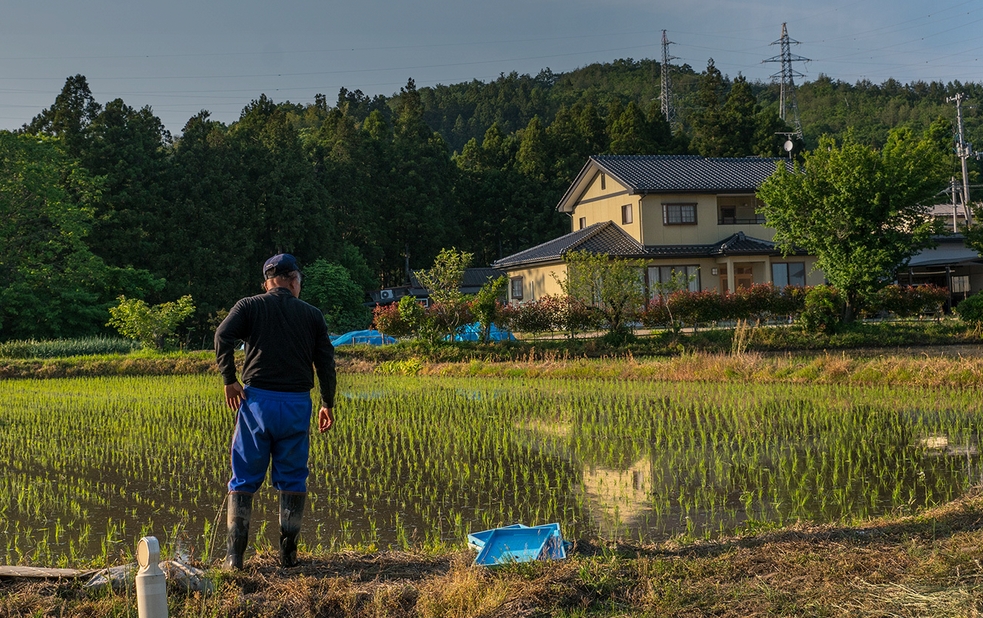
As a farmer, Atsuo Tanizaki did not care much for the state’s maps of radioactive contamination. Colour-coded zoning restrictions might make sense for government workers, he told me, but ‘real’ people did not experience their environment through shades of red, orange and green. Instead, they navigated the landscape one field, one tree, one measurement at a time. ‘Case by case,’ he said, grimly, as he guided me along the narrow paths that separated his rice fields, on the outskirts of a small village in Japan’s Fukushima prefecture.

The author examines maps of radioactive contamination in Fukushima.
It was spring in 2016 when I first visited Tanizaki’s farm. The air was warm. The nearby mountains were thick with emerald forests of Japanese cedar, konara oak and hinoki cypress. A troop of wild red-faced monkeys stopped foraging to watch us as we walked by. And woven through it all – air, water, land, plants, and living bodies – were unseen radioactive pollutants. Almost everything now carried invisible traces of the 2011 meltdown at the Fukushima Daiichi nuclear power plant.
Tanizaki began taking measurements. With his Geiger counter, he showed me how radioactive elements were indifferent to the cartographic logic of the state. In some places, the radiation level dropped low, becoming almost insignificant. But here and there, beside a ditch or near a pond, the level was elevated dangerously high. Tanizaki called these areas ‘hot spots’ and they were scattered across the landscape, even within supposedly ‘safe’ zones on government maps. Contamination in Fukushima, he believed, was structured in a way that no state was prepared to solve.
A decade after the 2011 meltdown, the region remains contaminated by industrial pollution. Though attempts at removing pollutants continue, a new realisation has taken hold among many of Fukushima’s farmers: there’s no going back to an uncontaminated way of life.
Watching Tanizaki measuring industrial pollution in a toxic landscape neglected by the state, I began to wonder: is this a future that awaits us all?
As an anthropologist interested in contamination, Fukushima throws into sharp relief the question of what it means to live in a permanently polluted world. That is why I began coming to Japan, and spending time with farmers such as Tanizaki. I wanted to understand the social dynamics of this new world: to understand how radioactivity is governed after a nuclear disaster, and how different groups clash and collaborate as they attempt to navigate the road to recovery.
I expected to find social bonds pushed to breaking point. Stories of post-disaster collapse circulate in our collective consciousness – tales of mistrust, fear and isolation, accompanied by images of abandoned homes and towns reclaimed by plants and wildlife. And I found plenty of that. A sense of unravelling has indeed taken hold in rural Fukushima. Residents remain uncertain about the adverse health effects of living in the region. Village life has been transformed by forced evacuations and ongoing relocations. And state-sponsored attempts at revitalisation have been ineffective, or complete failures. Many communities remain fragmented. Some villages are still abandoned.
Farmers took matters into their own hands, embracing novel practices for living with toxic pollution
In Fukushima, I found a society collapsing under the weight of industrial pollution. But that’s only part of the story. I also found toxic solidarity.
Rather than giving up, Tanizaki and other farmers have taken matters into their own hands, embracing novel practices for living alongside toxic pollution. These practices go far beyond traditional ‘farming’. They involve weaving relationships with scientists, starting independent decontamination experiments, piloting projects to create food security, and developing new ways to monitor a changing environment. Among rice fields, orchards and flower beds, novel modes of social organisation are emerging – new ways of living from a future we will one day all reckon with.
But the story of toxic solidarity in Fukushima doesn’t begin among rice fields and farms. It begins under the Pacific Ocean, at 2:46pm on 11 March 2011. At that moment, a magnitude 9.0-9.1 earthquake off the coast of northeastern Japan caused a devastating tsunami that set in motion a chain of events leading to the meltdown of three reactors at the Fukushima Daiichi nuclear power plant. Soon, Fukushima would find its place alongside Three Mile Island and Chernobyl as an icon of nuclear disaster – and an emblem of the Anthropocene, the period when human activity has become the dominant influence on environmental change. As the reactors began to meltdown, pressure mounted in the power station’s facilities, leading to explosions that released dangerous radionuclides into the air, including caesium-134, caesium-137, strontium-90 and iodine-131. These isotopes, with lifespans ranging from days to centuries, blew across Fukushima and northeastern Japan. And as they accumulated, health risks increased – risks of cancers and ailments affecting the immune system. To protect the population, the Japanese state forced tens of thousands of citizens living near the reactors to evacuate.

Furekonbaggu, bags of contaminated soil, piled neatly in the Fukushima countryside.
At first, Tanizaki believed he had escaped the worst of the radiation because his village was not in the mandatory evacuation area. But when the wind carried radionuclides – invisible, tasteless, odourless – far beyond the government models, his village became one of the most contaminated areas in Fukushima. He learned he had been exposed to harmful radiation only when the government forced him to leave.
Tanizaki and other evacuated villagers were relocated to ‘temporary’ housing. As the months became years, Tanizaki longed to return to his life as a farmer. But what would he farm? His land had been irradiated, and no one wanted to eat food grown in radioactive topsoil. To help Fukushima’s rural citizens retrieve their farms, the Japanese government launched an official politics of revitalisation in Fukushima, investing trillions of yen to clean and decontaminate the region before repatriating evacuees. Part of the cleanup involved storing tainted topsoil in large black plastic bags known as furekonbaggu (literally ‘flexible container bags’), which were then stacked in piles throughout the countryside. To keep residents safe, the government also promised to track contamination through a monitoring system. At the time, the possibility of a pristine Fukushima seemed within reach.
In June 2015, after four years of forced evacuation, Tanizaki was finally allowed to return to his farm. But the decontamination efforts had failed. He and many others felt they had been returned to a region abandoned by the government. The landscape was now covered in millions of bags of radioactive topsoil – black pyramids of the Anthropocene – while the government waited for a permanent disposal site. Also, the plastic in some furekonbaggu had already broken down, spilling radioactive soil over freshly decontaminated land. The state’s monitoring efforts were equally inadequate. In Tanizaki’s village, the monitoring of airborne radiation produced measurements that were rarely precise enough to give a complete picture of shifting contamination. Villagers lived with constant uncertainty: is the garden contaminated? Are the trees behind the house safe? Are mushrooms in the forest still edible?
I saw dead sunflowers rooted in irradiated fields – withered emblems of dreams to retrieve Fukushima
For some, the uncertainty was too much. Tens of thousands relocated to other parts of Japan rather than returning. In 2010, the region registered 82,000 people whose main income came from farming. But by 2020, that number had fallen to around 50,000. Abandoned greenhouses and fields can still be found dotted across the landscape.

Withered sunflowers in irradiated fields.
Knowing that government efforts weren’t going to help, some returnees began to decontaminate their own villages and farms. There was hope that the region could be returned to its former uncontaminated glory. One proposed method involved planting sunflowers, which were believed to absorb radiation as they grew. Yellow flowers bloomed across the farmlands of Fukushima. However, the results were unsatisfactory. Even during my time in Japan, years after the disaster, I saw dead sunflowers still rooted in irradiated fields – withered emblems of early dreams to retrieve a pre-disaster Fukushima. I also witnessed decontamination experiments in rice paddies: farmers would flood their fields, and then use tools to mix the water with the irradiated topsoil below, stirring up and dislodging radioactive pollutants such as caesium. The muddy water was then pushed out of the field using large stiff-bristled brushes. This project also failed. Some paddy fields are still so contaminated they can’t grow rice that’s safe for human consumption.
These failures significantly affected the morale of Fukushima’s farmers, especially considering the importance of the region as a rice-growing capital. Once easy decontamination efforts failed, returnees were forced to ask themselves difficult questions about their homes, livelihoods and identities: what will happen if farming is impossible? What does it mean to be a rice farmer when you can’t grow rice? What if life has been irrevocably altered?
Even the mushrooms tasted different. One farmer, Takeshi Mito, told me he had learned to grow shiitake mushrooms on artificial tree trunks, since real trees were too contaminated to produce edible fungi. ‘Now the taste of the shiitake has changed,’ he mumbled, a strange sadness filling his voice. The ‘real’ trees had given the mushrooms a special flavour, just like ageing a whisky in a sherry cask. ‘Yeah,’ he said, pausing to remember. ‘They were good.’
A new reality was emerging. Farmers were learning to accept that life in Fukushima would never be the same. Small details are constant reminders of that transformation, like the taste of mushrooms, or the library in Tanizaki’s home, which is now filled with books on Chernobyl, nuclear power, radioactive contamination, and food safety. This is new terrain, in which everyone carries a monitoring device, and in which everyone must learn to live with contamination. A former way of life may be impossible to retrieve, and attempts at decontamination may have failed, but farmers such as Tanizaki are learning to form new relationships to their irradiated environment. They’re forging new communities, reshaping notions of recovery, and reimagining their shared identities and values. Contamination may appear to have divided Fukushima’s farmers, but it has also united them in strange and unexpected ways.
By the time the evacuees were allowed to return to their homes, government mistrust had become widespread. Official promises were made to Fukushima residents that a nuclear disaster was impossible. These promises were spectacularly broken when radiation spread across the region. A lack of information from state sources made things only worse, leading to a growing sense that the government was unable to provide any real solutions. Not trusting state scientists, but still wanting to know more about the invisible harm in their villages, farmers reached out to academics, nongovernmental organisations and independent scientists in the hope of better understanding radioactivity.
These new relationships quickly changed social life in rural communities, and brought an influx of radiation monitoring devices. Rather than asking for additional state resources (or waiting endlessly for official responses to questions), farmers worked with their new networks to track radiation, measuring roads, houses, crop fields, forest areas and wildlife. Everyone learned to use radiation monitoring devices, which quickly became essential bodily extensions to navigate a changed Fukushima. Many rural communities even began to use them to develop their own maps. I remember the walls of Tanizaki’s home being covered in printed images showing the topography of the local landscape, with up-to-date information about radiation often provided by farmers. Local knowledge of the environment, combined with the technical savoir faire of independent scientists, produced far more accurate representations of contamination than the state maps made by government experts.
Sharing the work of living with contamination provided a feeling of communal life that returnees had so missed
Thanks to these maps, Tanizaki now knew that radiation doses were higher at the bottom of a slope or in ditches (where radionuclides could accumulate, forming ‘hot spots’). He also knew that the trees outside someone’s home increased the radiation levels inside. Through this mapping work, many farmers developed a kind of tacit knowledge of radiation, intuitively understanding how it moved through the landscape. In some cases, it moved far beyond the colour-coded zones around the reactors, or even the boundaries of Fukushima itself. A major culprit of this spread has been inoshishi (wild boar), who eat contaminated mushrooms before migrating outside irradiated areas, where their highly contaminated flesh can be eaten by unsuspecting hunters. To address this problem, monitoring programmes were developed based on the knowledge of farmers, who were familiar with the feeding and migration patterns of wild boar. Once a delicacy, inoshishi have become what the anthropologist Joseph Masco calls ‘environmental sentinels’: a new way to visualise and track an invisible harm.
But monitoring is more than a pragmatic tool for avoiding harm. In many instances, it also became a means of forging new communities. After returning, farmers began to share their knowledge and data with scientists, gathering to talk about areas that need to be avoided, or holding workshops on radiation remediation. Ironically, sharing the work of living with contamination provided a feeling of communal life that returnees had so missed. Ionising radiation can ‘cut’ the chemical bonds of a cell. Based on the experiences of Tanizaki and other farmers, it can also create novel connections.
Many farmers told me of their amazement at the sheer diversity of people who had come to support the revitalisation efforts. And it wasn’t only former evacuees who were drawn into these new communities. It was also the volunteers who came to help from other parts of Japan. One scientist I spoke with, who specialised in radiation monitoring, ended up permanently moving to a village in Fukushima, which he now considers his hometown. There are many similar cases, and they’re especially welcome in the aftermath of a disaster that has deeply fragmented Fukushima’s rural community. Some farmers told me there were times when they would go weeks without speaking to anyone. Life in a polluted, post-disaster landscape can be lonely.
Monitoring might have helped residents avoid harmful radiation, but it didn’t necessarily help with farming. Often, the new maps revealed that crops grown in certain areas would fall beyond the official permissible thresholds for radiation in food. And so, farmers who could no longer farm were forced to develop alternatives. In collaboration with university scientists, some former rice farmers began growing silver grass as a potential source of biofuel that would provide energy for their region. ‘If we can’t grow food, we can at least make energy!’ one scientist told me.

Other farmers now use their irradiated fields to grow ornamental flowers. In the solarium of an elderly man named Noriko Atsumi, I saw rows of beautiful Alstroemeria flowers that are native to South America. When I visited in 2017, Atsumi was happy to talk about his flowers with me, and eager to show his solarium. ‘At the beginning,’ he told me, ‘it was really hard to try to grow flowers all alone, especially in these horrible conditions, but now I’m happy I did.’ Another elderly Fukushima farmer, Masao Tanaka, who lives alone on his farm, also dreamt of having a personal flower garden. I saw hundreds of narcissus flower bulbs he’d planted in a small field once used to grow commercial crops.
The flower gardens of Fukushima are an attempt to forge new relationships
For farmers such as Atsumi and Tanaka, growing flowers has become a new hobby. But ‘hobby’ is the key word here: Japan remains anxious about radiation in Fukushima produce, so most flowers are simply given away rather than sold. Though these ornamental flowers are not commodities like rice, they fall within an aesthetic of revitalisation. They’re little sprouts of precarious hope – the dream of a Fukushima that a new generation of farmers might one day call home. One village official explained this hope (and its complexities) to me like this:
I don’t know what kind of impression you have of our village. It used to be one of the top 10 prettiest villages in Japan. Now, there are 1.5 millionfurekonbaggu across it. They are left right next to paddy fields. Citizens are seeing these bags every day and asking themselves: ‘Can we really go back?’ They are being told that everything is safe, but when they see those bags, how can they be sure?
In a landscape of black bags, the flower gardens of Fukushima are an attempt to forge new relationships – an attempt to bring colours back to a post-disaster landscape and to the lives of those who live in it. Flowers represent a communal attempt to reshape the narrative of village life, which has been shadowed by tragedy. Flowers have allowed communities to make their villages beautiful again, and allowed farmers to take some pride in their decision to return to what many believed was a ‘ruined’ agricultural region.
On one trip to Fukushima, I visited a long plastic greenhouse where fire-red strawberries were being cultivated by a group of farmers and scientists. Inside, I saw rows of strawberries growing on the ground, fed by filtered water from a system of tubes. This watering system ran in and out of soil that was thick with pebbles, which a scientist told me were ‘volcanic gravels from Kagoshima’ on the other side of Japan, hundreds of kilometres away. They were using these gravels, he said, because the soil in Fukushima was ‘too contaminated to harvest safe products’. In fact, almost everything that the strawberries needed to grow, from the plastic greenhouse to the filtered water, had come from elsewhere. I couldn’t help asking: ‘Can you really say these strawberries came from Fukushima?’
One scientist working in the greenhouse seemed offended by my question. ‘We are using the safest technology in the world!’ he said. ‘It cannot be safer than that. The bad part is that people don’t write about this. All they write about are the plastic bags that you see everywhere!’
I was confused. I’d asked a question about provenance but was given an answer about safety. In the post-disaster landscape, safety had paradoxically become an integrated component of the products of Fukushima. The new agricultural products of Fukushima have become known not merely by the environment they grew in, but by the technologies that have allowed them to resist that environment. The scientist’s response showed some of the ways that Fukushima is embodying new values after the disaster. New products, like little red strawberries grown with imported soil, are becoming symbols of resilience, adaptation and recovery – part of the fabric of solidarity in a new Fukushima.
Toxic solidarity has been encouraged by the same organisations responsible for the disaster
But not everyone can share the embrace of toxic solidarity. In Tanizaki’s village, many young people have permanently left, wary of the health risks of residual radiation. These risks are especially concerning to new parents. During my fieldwork, I heard mothers complain about strange ailments their children experienced right after the disaster: chronic diarrhoea, tiredness, and recurrent nosebleeds that were ‘a very dark and unusual colour’. Concerns are not only anecdotal. After the disaster, thyroid cancers among children increased in Fukushima, which some believe was caused by exposure to iodine-131 from the meltdown. For some parents, leaving has been the only way to protect themselves and their children.
Complicating the binary between those working with or against contamination, toxic solidarity has been encouraged by the same organisations responsible for the disaster. For example, Japanese state ministries and nuclear-related organisations have increasingly encouraged returnees such as Tanizaki to become responsible for keeping their dose of radiation exposure as low as possible. In this way, safe living conditions become the responsibility of citizens themselves, as tropes of resilience are conveniently deployed by the state, and financial supports for disaster victims are gradually cut off. Those who refuse to participate in these projects have been labelled hikokumin (unpatriotic citizens), who hamper the revitalisation of Japan. What we find in this co-option is an unreflexive celebration of farmers’ resilience – a celebration that serves the status quo and the vested interests of state agencies, corporate polluters and nuclear lobbies. Through this logic, disaster can be mitigated, free of charge, by the victims themselves.
These blind celebrations of toxic solidarity only legitimise further polluting practices and further delegations by polluters. In a way, it is no different to the strategies of tobacco lobbies in the mid-20th century, who tried to market smoking as a form of group bonding, a personal choice or an act of freedom (represented by those many Marlboro Men who would eventually die from smoking-related diseases). While toxic solidarity can be applauded as a grassroots act of survival and creativity, it is also the direct result of broader structural patterns: the fact that polluting industries are often installed in peripheral, poor and depopulated regions; the repeated claims of government that toxic disasters can never happen; and the over-reliance on technological fixes that rarely solve social problems. When all else fails, it is always up to the ‘small’ people to pick up the pieces as best they can.
Contamination isn’t going away. Radiation will continue to travel through the landscape, pooling in rice paddies, accumulating in mushrooms and forests, and travelling in the bodies of migrating boar. Some areas remain so irradiated that they’re still bright red on the government maps. These are the prohibited ‘exclusion zones’, known in Japanese as kikan konnan kuiki (literally, ‘difficult-to-return zones’). They may not be reopened in our lifetimes.
One afternoon, someone from Tanizaki’s village took me to see the entrance to the nearby exclusion zone, which is blocked by a wide three-metre-long metal gate, barricades, and a guard. By the gate, in a small wooden cabin, a lonely policeman acted as a watchman. The gate, painted bright green, is supposed to separate people from an environment that is considered dangerous, but almost anybody can easily cross into the forbidden zone. Some farmers even have official access to the kikan konnan kuiki, so that they can check on the condition of their homes in the red zone. Cars and small pickup trucks go in and out, without any form of decontamination.
As I took a picture of the gate, the guard looked over and a farmer, perhaps worried I would get in trouble, came to explain: ‘He’s a foreigner you know, he just wants to see.’ It was forbidden for a non-Japanese person like me to enter the area. The same interdiction did not apply to locals. One Japanese citizen who had come with us was critical of this double standard: ‘The people of Fukushima are no longer normal people.’
In the post-disaster landscape, we can begin to see novel forms of community, resistance, agency and innovation
In the years since that day at the edge of the red zone, I have pondered this phrase many times. In the Anthropocene, when Earth has become permanently polluted – with microplastics, ‘forever chemicals’ and other traces of toxicity accumulating in our bodies – are any of us still ‘normal people’? The problems of Tanizaki and other Fukushima farmers will soon become everybody’s concern, if they haven’t already. How might we respond to this new reality?
The current mode of governing life in an age of contamination is built on a promise that we can isolate ourselves from pollution. This is a false promise. So-called decontamination measures in Fukushima are a crystal-clear example that this doesn’t work. There’s no simple way to ‘decontaminate’ our world from ubiquitous pollution: from mercury in sea life, endocrine disruptors in furniture, pesticide in breast milk, heavy metals in clothing, alongside an almost neverending list of other toxicants.
The experiences of Fukushima’s farmers show us how to navigate the uncharted, polluted seas of our age. Their stories show how new communities might express agency and creativity, even in toxic conditions. They also show how that agency and creativity can be co-opted and exploited by dubious actors. In the post-disaster landscape of rural Fukushima, we can begin to see the outlines of novel forms of community, resistance, agency and innovation that might shape our own future – a future that will hopefully be better, in which economic prosperity is not pitched against environmental wellbeing. In the end, these stories allow us to think about the kinds of toxic solidarity that we can nurture, as opposed to those that have historically been imposed on the wretched.
Someday, when we acknowledge we are no longer ‘normal’, Tanizaki’s story is one we must all learn to tell.
Maxime Polleri is an assistant professor in the department of anthropology at Université Laval, in Quebec City, Canada. He is working on a book about the 2011 Fukushima nuclear disaster, ‘Radioactive Governance: The Politics of Revitalization after Fukushima’.
Edited byCameron Allan McKean
Credible nuclear regulation needs independence, transparency
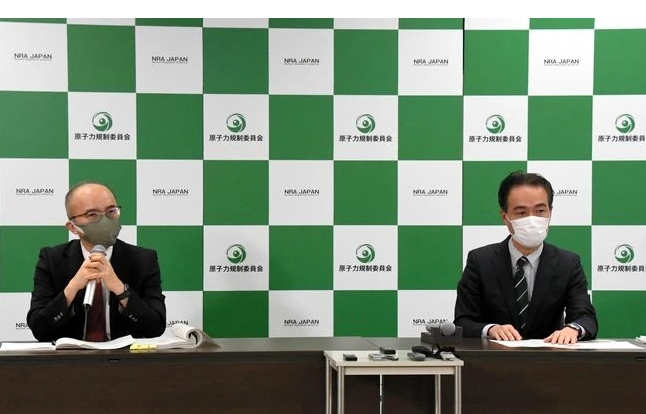
Officials of the Secretariat of the Nuclear Regulation Authority meet reporters in Tokyo on Dec. 27 to explain about closed-door meetings of the secretariat and the Agency for Natural Resources and Energy regarding extending the life span of aging nuclear reactors.
January 6, 2023
Nuclear regulation should place importance on “independent decision-making” and “ensure total disclosure of information,” including facts concerning the decision-making process.
This principle was established in line with the bitter lessons learned from the dreadful calamity that occurred at the Fukushima No. 1 nuclear power plant in 2011. The pledge must not be taken lightly.
Recent revelations have raised serious questions about the nuclear regulator’s commitment to the principle.
The Secretariat of the Nuclear Regulation Authority (NRA) held seven closed-door meetings with the Agency for Natural Resources and Energy, an agency under the Ministry of Economy, Trade and Industry (METI), over Prime Minister Fumio Kishida’s initiative to extend the life span of aging nuclear reactors.
The two organizations also held dozens of telephone conversations over the matter.
After the Fukushima disaster, the jurisdiction of regulating nuclear power generation was transferred from the pro-industry METI to the newly created Nuclear Regulation Authority. The NRA is an external organ of the Environment Ministry.
In early October, the NRA instructed its secretariat to review regulations related to the proposal to extend the legal life of reactors. But the secretariat and the agency had begun holding talks over the matter at the end of July. The secretariat did not report these early meetings to the NRA or keep records of the sessions.
When these facts came to light in December, the secretariat categorically denied discussing, coordinating or adjusting nuclear safety regulations during these talks. It contended there was no problem with the “independence and transparency” of the NRA.
During these meetings, however, the energy agency told the NRA secretariat that revisions to laws including those under the NRA jurisdiction were being considered. The secretariat called for the deletion of certain provisions concerning nuclear safety regulations from the envisioned bill while beginning to consider its own bill.
It is difficult to believe that these meetings were not for advance policy coordination or discussions.
Generally speaking, exchanges of information between government organizations are necessary for smooth administrative functioning. But the NRA was separated from the METI, the leading champion of nuclear power generation, to ensure its independence.
It should not be viewed or treated similarly to other ministries and agencies.
NRA Chairman Shinsuke Yamanaka has argued that there is nothing wrong with staff members of the secretariat discussing related issues since the final decisions are made by the NRA.
But the NRA’s code of conduct, which stresses the importance of independence and transparency, states that the NRA performs its duties “together with” the NRA secretariat. The principle should also be applied to the secretariat.
The NRA’s failure to keep track of what was going on within the secretariat raises questions about its governance.
Especially serious is the secretariat’s disregard for the importance of information disclosure, which is vital for assessing and securing the independence of nuclear regulation.
The secretariat has said meetings and discussions with other ministries and agencies are not subject to the rules concerning record-keeping. But the NRA has told the secretariat to keep records of future meetings with other government departments related to nuclear power generation and make public the records.
But telephone conversations will not be covered by this rule. Is this sufficiently effective?
The top three positions at the NRA secretariat have been held by former METI officials since last summer. The NRA’s responses to the proposal to extend the life span of reactors since October have been criticized as “premature” actions even by some NRA members.
If the NRA fails to forthrightly address the suspicions raised by the latest revelations, the credibility of nuclear regulation will be undermined. The NRA should undertake a serious probe into what transpired and publish the findings.
1 This Month

of the week – Shut Down Drone Warfare!


Tell the Ukrainian Government to Drop Prosecution of Peace Activist Yurii Sheliazhenko

Petition to revoke the licensing of the Near Surface Nuclear Disposal Facility (NSDF) at Chalk River. https://www.ourcommons.ca/petitions/en/Petition/Details?Petition=e-7247
To see nuclear-related stories in greater depth and intensity – go to https://nuclearinformation.wordpress.com
-
Archives
- March 2026 (251)
- February 2026 (268)
- January 2026 (308)
- December 2025 (358)
- November 2025 (359)
- October 2025 (376)
- September 2025 (257)
- August 2025 (319)
- July 2025 (230)
- June 2025 (348)
- May 2025 (261)
- April 2025 (305)
-
Categories
- 1
- 1 NUCLEAR ISSUES
- business and costs
- climate change
- culture and arts
- ENERGY
- environment
- health
- history
- indigenous issues
- Legal
- marketing of nuclear
- media
- opposition to nuclear
- PERSONAL STORIES
- politics
- politics international
- Religion and ethics
- safety
- secrets,lies and civil liberties
- spinbuster
- technology
- Uranium
- wastes
- weapons and war
- Women
- 2 WORLD
- ACTION
- AFRICA
- Atrocities
- AUSTRALIA
- Christina's notes
- Christina's themes
- culture and arts
- Events
- Fuk 2022
- Fuk 2023
- Fukushima 2017
- Fukushima 2018
- fukushima 2019
- Fukushima 2020
- Fukushima 2021
- general
- global warming
- Humour (God we need it)
- Nuclear
- RARE EARTHS
- Reference
- resources – print
- Resources -audiovicual
- Weekly Newsletter
- World
- World Nuclear
- YouTube
-
RSS
Entries RSS
Comments RSS
 nuclear-news