Criminals in Finland obtain weapons from Ukraine – police
Arms supplied to Kiev have also allegedly been found in Sweden, Denmark and the Netherlands
https://www.rt.com/news/565616-finland-ukraine-weapons-gangs/ 30 Oct 22,
Criminals in Finland have got hold of some of the weapons that were sent to Ukraine by its Western backers amid the conflict with Russia, the Finnish National Bureau of Investigation (NBI) has said.
“We’ve seen signs of these weapons already finding their way to Finland,” NBI detective superintendent Christer Ahlgren told the news outlet Yle on Sunday.
Assault rifles were among the weaponry, Ahlgren said, but declined to provide further details, as the investigation is still ongoing.
Arms trafficking routes from Ukraine to Finland have already been set up, according to the investigator.
“Three of the world’s largest motorcycle gangs — that are part of larger international organizations — are active in Finland. One of these is Bandidos MC, which has a unit in every major Ukrainian city,” he said.
“Criminal organizations have their networks in Finnish commercial ports,” Ahlgren pointed out, adding that security checks that are mandatory for airport staff do not apply to port workers.
Finland is not the only EU country with such problems, as “weapons shipped to Ukraine have also been found in Sweden, Denmark and the Netherlands,” he said.
“Ukraine has received a large volume of weapons and that’s good, but we’re going to be dealing with these arms for decades and pay the price here,” Ahlgren pointed out.
As early as May, US Defense Secretary Lloyd Austin stressed the need for accountability for American arms supplied to Ukraine. Back then, Austin said he had discussed the issue with the Kiev authorities, who gave assurances on accountability.
In June, the EU’s law enforcement agency Europol warned that the Ukraine conflict could lead to a spike in arms and ammo being smuggled into the bloc.
Around the same time, an investigation by RT Russian revealed that various weapons supplied to Kiev by the West were being sold on the dark net.
Moscow has long criticized weapons deliveries to Kiev by the US, EU, UK and some other nations, arguing that they only prolong the conflict and increase the risk of a direct confrontation between Russia and NATO.
Sizewell C nuclear station to be funded 20% by French taxpayers, and 20% by British taxpayers.
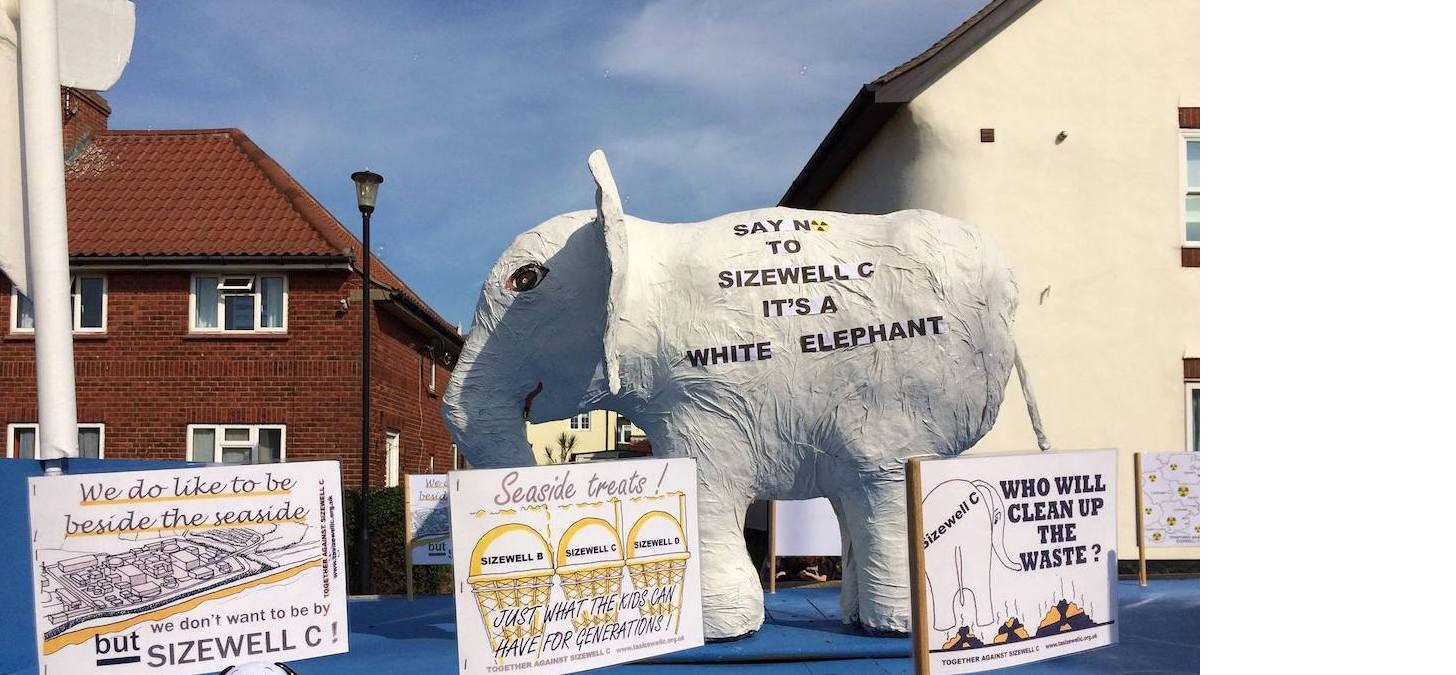
French government officials have officially approved the involvement of
state-owned company EDF in the development of Britain’s Sizewell C nuclear
power plant, Boris Johnson’s last flagship program as Prime Minister. I can
reveal. In his last keynote address as Prime Minister, Mr Johnson had urged
his successors to “go nuclear and go big and go with Sizewell C”.
While questions remain about how the project will be funded, with I After
previously revealing how it has approached investors in the UAE, Australia
and Saudi Arabia for financial backing, the UK has now secured the full
backing of French officials – a big step forward for the plant. The UK is
expected to plan a 20 per cent stake in Sizewell C, with EDF taking a
further 20 per cent – leaving 60 per cent of the project dependent on
investors.
UK Daily News 28th Oct 2022
Dounreay nuclear plant radiation scare over high numbers of ‘harmful’ radioactive particles.

Highest number of nuclear particles found in 26
years and ‘they may pose risk’. A public health warning has been issued
after harmful radioactive particles were discovered to have leaked out in
the area surrounding Dounreay nuclear plant, in Caithness. Fragments of
irradiated nuclear fuel have been detected at the shoreline near the power
plant and nuclear testing facility, with experts from independent Dounreay
Particles Advisory Group saying they “pose a realistic potential to cause
harm to members of the public”.
The radioactive material is said to be the
at the highest levels almost three decades – with 73 per cent of the
particles found deemed “significant”, according to a report. A survey found
15 particles on the shoreline, the most since 1996 when 17 were found, The
Daily Mail reported.
It comes after research suggested the leaks occurred
sometime between 1958 and 1984. In response to ongoing concerns, Dounreay
Site Restoration Ltd, which is in charge of the plant’s clean-up, said it
was closely monitoring the situation.
It comes as Shaun Burnie of
Greenpeace Asia, a nuclear specialist who formerly worked at Dounreay, also
warns of the risk to public health. He said: “The scale of the radiological
hazard from the Dounreay particles is enormous, with hundreds of thousands
and more highly radioactive nuclear fuel particles on the sea bed.
Express 29th Oct 2022
French nuclear power group EDF to have a bigger loss than previously expected
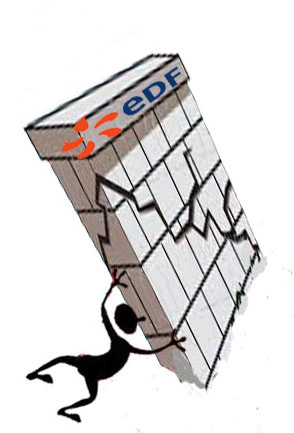
French nuclear power group EDF is expecting a hit of around 32 billion
euro ($32.18 billion) to its full-year core earnings from lower nuclear
production, a bigger loss than previously forecast and its sixth profit
warning this year.
The French government, which already owns 84% of EDF, is
in the process of fully re-nationalising the company, the debt-laden
operator of Europe’s largest fleet of nuclear power plants.
Reuters 27th Oct 2022
https://www.reuters.com/business/energy/french-utility-giant-edfs-history-2022-07-08/
Russia suspends participation in grain deal after Ukrainian attack
The decision was made following a Ukrainian assault on Moscow’s Black Sea fleet. Rt.com 28 Oct 22
Russia announced on Saturday that it has halted its compliance with a grain deal, brokered by the UN and Türkiye earlier his year. The move came after Ukraine launched a major drone attack on ships involved in securing safe passage for agricultural cargo, the Russian Defense Ministry explained.
In a post on its Telegram channel, the ministry said Russia “is suspending its participation in the implementation of agreements on the export of agricultural products from Ukrainian ports”.
It explained that the move was prompted by “a terror attack” against the ships of the Black Sea Fleet and civilian vessels involved in ensuring the security of the grain corridor. The ministry also alleged that the bombing was organized with the involvement of British military………………………………..
Earlier on Saturday, Russia’s Agriculture Minister Dmitry Patrushev signaled that Moscow is ready, with Türkiye’s help, to send the world’s poorest countries up to 500,000 tons of grain within the next four next months.
He noted that considering this year’s harvest, Russia “is fully ready to replace Ukrainian grain” and arrange deliveries to “all interested countries” at a reasonable price.
……………………… following the blast on the strategic Crimean Bridge, Russian President Vladimir Putin said that if turns out that Ukraine – the country that Moscow accused of carrying out the attack – used grain corridors to transport explosives, “it would put the very existence of these corridors in question”.
The breakthrough deal between Moscow and Kiev was reached in Istanbul in July with mediation by the UN and Türkiye. It aimed to unlock agricultural exports via the Black Sea from Russia and Ukraine – two of the world’s leading grain exporters – which had ground to halt due to the conflict between the two nations. https://www.rt.com/russia/565588-russia-suspends-grain-deal/
Government Confirms No Nuclear for Australia, At Least Any Time Soon
https://www.gizmodo.com.au/2022/10/australia-nuclear-energy/ Asha Barbaschow, October 31, 2022 “……………………………… Addressing Senate Estimates on Friday, representatives from the Department of Prime Minister and Cabinet put this to bed.
Summarising the government’s position, the department’s acting deputy secretary for the economy, industry and G20, James Chisholm, said the cheapest form of new energy for investment is renewable energy. We’ve got too much sun and wind to not make the most of it.
That is because it has zero marginal cost,” he said.
“By that I mean there’s a cost associated with building it, seeking approval for it and its initial construction, but once that happens it doesn’t have the same costs associated with it that traditional base-load generation, whether it’s coal-fired or nuclear, has.”
There are a lot of costs associated with those forms of energy, with the CSIRO forecasting that small nuclear modular reactors would have a levelized cost of energy of between $136 and $326 per megawatt hour in 2030. Whereas the levelized cost of energy such as renewable energy is a lot lower.
“It would be estimated to cost between something like $53 to $82 per megawatt hour,” Chisolm explained.
“Really importantly, that includes firming costs.
“Often what happens is people look at these figures and say, ‘Yes, but with renewables you’re not factoring in firming and integration costs.’ But the CSIRO work does factor that in. According to CSIRO, and this is consistent with other analyses, it comes in way cheaper. And that flows through to bills.”
Although this report was published a few months ago, Chisholm said as time goes on, that cost comparison becomes more stark.
“We’re seeing it play out in other markets. If you look at those markets where nuclear power is a significant proportion of the generation mix, nuclear is experiencing the same challenges that coal-fired generation has experienced, simply because of how high the cost is. When it comes to competitive markets for energy, it is difficult for those forms of energy to compete with renewables, particularly for firmed renewables,” he said.
Well, there you have it.
The Fukushima Area Has Seen Better Days as Nobuhiko Ito Shows

October 30, 2022
“The level of the contamination is too high to be inhabitable,” says photographer Nobuhiko Ito about the ever-present danger around the vicinity of the former Fukushima nuclear plant. A decade-old event that Japan is still recovering from, the impact of the accident there and resulting economic fallout was felt around the world for quite some time. As with all nuclear plant incidents, questions remain over whether life will ever return to normal in the surrounding areas.
Dominating the news for many weeks that year, the Fukushima Daiichi Accident, as it’s officially known, occurred at the city’s nuclear plant following a tsunami caused by a major earthquake in March, 2011. Almost 14-meter-high waves lashed the plant, flooding and severe damaging its reactors. It was classified as the most severe nuclear accident since Chernobyl, and over 150,000 people were evacuated from the city. Radiation-contaminated water seep into the Pacific Ocean for many days after the incident, even as late as 2013. It was estimated then that decontamination efforts could last up to 40 years. Almost a decade from later, Japanese photographer Nobuhiko Ito has begun a project to safely photograph the areas surrounding Fukushima. Large parts of it are still off-limits to the public.
The Phoblographer: Hi Nobuhiko. Please tell us about yourself and how you got into photography.
Nobuhiko Ito: I was born in 1970 in Kanagawa prefecture, Japan. I started taking pictures when I was 15 years old and have been involved in photography ever since. In 1998, I studied under photographer Hiromi Tsuchida. I became an independent photographer in 2003, and since then, I have been an active freelancer. Although I was not aware of it when I was young, the fact that seeing things through a camera is an objective and critical act is the most important reason why I continue to express myself through photography.
Photography is basically a solo activity, and I think I have been able to continue to do it because I am suited to this kind of work.

The Phoblographer: Where were you when the Fukushima Daiichi Accident occured? What was the general feeling for the next few days in your vicinity?
Nobuhiko Ito: The earthquake occurred at 14:46 on March 11, 2011, and approximately one hour later, the nuclear reactor meltdown caused by the loss of power due to tsunami damage was a direct cause of the Fukushima Daiichi nuclear accident. This was followed by three hydrogen explosions on March 12, 14, and 15, resulting in a serious situation in which a wide area of more than 30 km radius was contaminated by radioactive materials. I was in Tokyo when the earthquake hit, and I was scheduled to have a work meeting with a client at 3:00 p.m. I felt kind of silly because I was still meeting at the client’s office as scheduled, even with the numerous aftershocks that hit afterward. I drove myself home to my house in Yokohama, about 30 kilometers away, at around 5:00 p.m. All public transportation was stopped, the roads were jammed badly, and the sidewalks were full of people walking home, which was an unusual situation. It took me about 8 hours to get home, where it usually takes me about 45 minutes. It took me twice as long as it would have taken me to walk home.
I was in a car stuck in traffic, checking with relatives on my cell phone to make sure they were safe and listening to the news bulletins that came in one after another, but I was already worried about the meltdown at the Fukushima Daiichi Nuclear Power Plant at that point. I spent the next week or so at home. I heard that some people were buying up water, food, and stockpiles, but I did not act rashly and stayed put.

The Phoblographer: How long have you been working on your book, A Decade of Fukushima? Typically how many images do you photograph of the surrounding areas of the nuclear plant site each year?
Nobuhiko Ito: I started taking pictures in April 2020, so as of now it has only been 2 years and 6 months. When I started filming, it had been 9 years since the Great East Japan Earthquake and the Fukushima Daiichi Nuclear Power Plant accident and the people of this country were beginning to have fading memories of it. I may be one of them, but one thing that sets me apart from the rest of the survivors is that I have been visiting companies based around the hard-to-return zone in Fukushima Prefecture several times a year for commercial photography assignments since 2009, before the accident.

During those nine years, I watched the transition of the area from a moving car window. Buildings destroyed by the tsunami and left abandoned, cars washed away and rusting in the middle of fields, natural scenery where the topsoil is being gouged away by the large-scale decontamination work started by the government sometime after the accident… As a person involved in photography, I felt frustrated that I could do nothing in the face of this serious problem.

What prompted me to start taking photos of the hard-to-return zones in Fukushima was the fact that the 2020 Olympics would be held in Tokyo, the capital of this country. The government had billed it as a “reconstruction Olympics,” but this was not accompanied by any substance. The Olympics were postponed for a year due to the coronavirus, but I decided to document the hard-to-return areas of Fukushima, which have been neglected as time passed. The number of photos I take in a year is between 1,000 and 2,000, but in my case, I combine three shots into one, so the actual number would be one-third of that number. As you can see, the number of locations I photograph from a fixed point has been increasing, and the more times I go to Fukushima to take photographs, the more I move from searching for shooting locations to aiming for locations where I have already taken photographs one after another.

The Phoblographer: With so much happening in the world, people tend to forget the recent past. Is this like a documentation project so that the memory of the Fukushima Daiichi Accident doesn’t fade too soon?
Nobuhiko Ito: Yes, it is.

The Phoblographer: What were some of the challenges you faced in order to gain access to the surrounding areas? What safety measures did you take while doing this project?
Nobuhiko Ito: In my case, I do not go into areas that are forbidden to enter, and most of the time, I stay within their boundaries. However, the difficult-to-return zone does not mean that the entire area is sealed off. The roads that pass through the zone have gradually been open to anyone without permission since about the third year after the accident, and the area continues to expand. However, perhaps due to concerns about radiation exposure, in many cases, passage by car is permitted, but passage by foot or motorcycle is prohibited. Therefore, it is common to be questioned by police officers when you get out of your car and take pictures, as I did.

The Phoblographer: When visiting an area like this, which has been fenced off so much, how do you get images that are visually distinct from each other?
Nobuhiko Ito: Fences essentially restrict vehicular access, so it is easily possible to enter on foot. Some of the fences are such that the meaning of their installation is not clear. It may have been necessary to draw a line somewhere due to high or low radiation levels. However, considering what happened before the accident, we must be well aware of what this unusual view that is now spreading before our eyes means.

The Phoblographer: You’ve added the radiation level (μsv/h) alongside each photograph. Were there any sites where you noticed a dangerous level of radiation after arriving there?
Nobuhiko Ito: I try to record them at the same time because, unlike photographs, radiation levels are invisible. Most of the photo sites are on paved roads, and the measurements were taken at 1 meter above the ground.

Although there are regional differences, the mountains, forests, and former farmland on either side of the road have been left undisturbed since the accident and have not been decontaminated, so if you go into the area and take measurements, the radiation levels jump. The level of contamination is too high to be inhabitable.

The Phoblographer: why was panorama format chosen for this project?
Nobuhiko Ito: It is obvious, but we felt that the usual one shot was not enough to show the left and right sides of the area. When shooting with a fence in the center, it was necessary to capture a wide area in order to grasp the landscape at that point.

The Phoblographer: How long do you think it will take for life to return to normal in these areas (if ever)?
Nobuhiko Ito: Although it may not be well known internationally, government-led efforts are underway to intensively decontaminate parts of the hard-to-return zones to improve living infrastructure and promote re-housing there, and some people have returned this year. However, that is really a very small number.

Most of the areas within the zone are mountain forests, and it is practically impossible to remove the radioactive materials that have fallen on them to a complete level, let alone to make them safe, and it is meaningless to decontaminate only the areas with villages surrounded by these forests. Although it is very unfortunate, we have to assume that it is impossible for people to be able to live a normal life in these areas.

All images by Nobuhiko Ito. Used with permission. Visit his website as well as his Instagram and Facebook pages to stay up to date on this project. Want to be featured? Click here to find out how.
Minister Vows Response to Fukushima Reputational Damage
https://www.nippon.com/en/news/yjj2022103000407/ Soma, Fukushima Pref., Oct. 30 (Jiji Press)–Japanese industry minister Yasutoshi Nishimura said Sunday the government will face and surely respond to local people’s concerns about reputational damage related to the planned release of treated radioactive water into the ocean from the disaster-crippled Fukushima No. 1 nuclear power plant.
The minister made the remark when he visited a fishing port in Soma, Fukushima Prefecture, northeastern Japan, and exchanged opinions with local fishery workers, who voiced such concerns.
Aiming to start the release of the treated water containing radioactive tritium around spring next year, the Japanese government and Tokyo Electric Power Company Holdings Inc. <9501>, the operator of the Fukushima No. 1 plant, have been giving explanations about the move to local people and proceeding with the construction of related facilities.
At the day’s meeting with Nishimura, the fishery workers called for measures that would allow Fukushima fishery products to be sold at fair prices. They also asked the central and Fukushima governments to work in closer cooperation so that local opinions can be taken in swiftly.
After the meeting, Nishimura told reporters, “We’ll launch the work to establish a new framework for communicating the attractiveness of Fukushima’s fishery products and boosting their consumption through cooperation with businesses and local governments across Japan.” He added that the government will give details of the plan possibly by the end of the year.
Bulgarian nuclear reactor shut down after technical glitch
Tsvetelia Tsolova Reuters, OCT 30, 2022, SOFIA, Oct 30 (Reuters) – Bulgarian nuclear power plant Kozloduy has shut down its 1,000 megawatt Unit 6 late on Saturday following a technical problem in with the cooling system of the unit’s power generator, its spokesperson said on Sunday………………. more https://www.nasdaq.com/articles/bulgarian-nuclear-reactor-shut-down-after-technical-glitch
Kremlin reveals possible basis for Putin-Biden talks
https://www.rt.com/news/565611-russia-talks-biden-putin/ 28 Oct 22, Russia’s proposals on security guarantees could serve as a springboard for re-engagement, Dmitry Peskov says
Potential talks between Russian President Vladimir Putin and his US counterpart Joe Biden would depend on Washington’s willingness to hear Moscow’s security concerns, the Kremlin press secretary said on Sunday.
Speaking to the Rossiya-1 TV channel, Dmitry Peskov said high-level re-engagement could happen if the United States “pays heed to our concerns.”
It would be contingent on “the US desire to go back to the state of things as of December-January and ask the question: what the Russians are offering may not suit all of us, but maybe we should still sit down with them at the negotiating table?”
The spokesman explained that he was referring to the draft documents on security guarantees that Moscow submitted to both Brussels and Washington before the Ukraine conflict broke out in late February.
In mid-December last year, the Russian Foreign Ministry published the drafts of two treaties – one with the US and one with NATO – with a list of Moscow’s security demands, in a bid to lower tensions in Europe.
At the time, Russia wanted the West to ban Ukraine from entering NATO and limit the deployment of troops and weapons on the bloc’s eastern flank. It also insisted that the military alliance retreat to its borders as of 1997, before it expanded eastwards.
While neither the US nor NATO gave written responses to Russia’s proposals, they both rebuffed Moscow’s demand that Ukraine should be barred from the bloc.
Earlier this month, Putin said he saw no need for talks with his US counterpart, explaining that “there is no platform for any negotiations yet.” The statement was echoed by the White House, which stated that Joe Biden does not plan to meet with the Russian leader at the G20 summit next month, despite earlier refusing to rule out the possibility.
The last time the two leaders met in person was in June 2021 in Geneva, Switzerland. The talks were followed up by a virtual summit in December, with Ukraine being one of the topics on the agenda.
Academics and industry questioned on UK nuclear power supply.

The Science and Technology Committee begin its Delivering Nuclear Power evidence
sessions on National Engineering Day in the UK. This session examines how
UK nuclear energy production will be maintained and increased. The
Government has said nuclear power will play a key part in the UK’s energy
security and goal of reaching Net Zero emissions by 2050, setting the
intention to triple the current electricity output by 2050.
However, all but one civil nuclear reactor in the UK will be decommissioned by 2028
under current plans. And only one new reactor, Hinkley point C in Somerset,
is currently expected to be operational before 2030. In the final panel,
the Committee will question EDF executives on the four-year delay in the
construction of Hinkley Point C, completion of which is expected in 2027.
The progress in plans for a new reactor in Sizewell C in Suffolk will also
be discussed.
UK Parliament 28th Oct 2022
Sizewell C nuclear could become low on the priority list of UK government projects
Therese Coffey’s appointment as the new Environment Secretary came as a
surprise to those who expected her to return to the backbenches after the
departure of her close friend Liz Truss from Downing Street.
But actually it looks like quite an astute move by new Prime Minister Rishi Sunak if he
wants to keep all wings of his party onside.
What it also does is throw up
a very real challenge for her – the Environment Secretary has one of the
most controversial green issues in the country sitting in the middle of her
constituency and an electorate divided about what the government could do.
Dr Coffey is now in charge of the Department for the Environment, Food and
Rural Affairs – it’s effectively the old Min of Ag with environmental
issues tagged on.
What happens at Sizewell is not up to the Environment
Secretary, but the department has a very big input into the decision. It
would probably have to be one of her more junior ministers who actually
makes its case in the Sizewell debate – but as Secretary of State she will
always be closely identified with that by the public.
Of course, it remains
to be seen how much of an issue Sizewell C is likely to be for the Sunak
government. It is a very expensive project and would require a great deal
of government capital expenditure to get it under way. Given that we’re
facing a second era of austerity in 15 years and that any investment now
will not pay off for a decade, I can’t help feeling that any moves towards
progressing Sizewell C are likely to proceed in first gear (or even be left
in neutral) for the next two or three years.
East Anglian Daily Times 27th Oct 2022
https://www.eadt.co.uk/news/23080960.will-coffeys-new-job-mean-sizewell-suffolk-coast/
India headed towards 100% renewables power by 2050
A new optimistic Nature paper from the LUT University in Finland looks to a
key role being played by renewables for rapid transitioning of the power
sector across states in India. Progress has been uneven at times, but LUT
says that a renewables-based power system by 2050 could be ‘lower in cost
than the current coal dominated system’ and have ‘zero greenhouse gas
emissions’ while providing ‘reliable electricity to around 1.7 billion
people’.
Renew Extra 29th Oct 2022
https://renewextraweekly.blogspot.com/2022/10/india-towards-100-renewable-power-by.html
USA’s Westingouse likely to build and fund 49% of Poland’s first nuclear power station
Poland is likely to choose the United States engineering firm Westinghouse
Electric to build its first nuclear power plant and provide 49% equity
financing for the project. State-owned Korea Hydro Nuclear Power (KHNP) may
also be involved in a separate and parallel private nuclear project, Polish
Deputy Prime Minister Jacek Sasin said earlier this week. Warsaw has also
been talking to France’s state-owned EdF utility which has built and
operates the country’s nuclear power plants. After years of shelved plans
to build a civil nuclear capacity in Poland from scratch, the energy crunch
caused by the war in Ukraine, lower gas supplies from Russia and lack of
immediate renewable substitutes, have kicked the issue back up the
political agenda.
Deutsche Welle 28th Oct 2022
https://www.dw.com/en/us-south-korean-firms-to-operate-nuclear-plants-in-poland/a-63576093
Bring voices from the coast into the Fukushima treated water debate

October 28, 2022
More than a decade has passed since the accident at the Fukushima Dai’ichi nuclear power plant in Japan—but the most contentious aspect of bringing the site under control is only just beginning. The Japanese Government has approved plant operator TEPCO’s plan to release treated water into the Pacific Ocean. That water is currently being stored onsite and retains some radioactive substances after treatment. The decision to release this water has provoked political contention and societal concern. South Korea, China, and Taiwan, as well as international environmental nongovernmental organizations, have expressed strong concern; and fisheries cooperatives in Japan remain opposed to the releases for fear of possible reputational impacts on Fukushima seafood. TEPCO are confirming specific details of the release process, and an International Atomic Energy Agency (IAEA) task force has made multiple visits to the Fukushima Dai’ichi site at the behest of the Japanese Government and TEPCO. The releases are scheduled to start in 2023 and run for many years.
A technical committee within Japan, formed by the Ministry of Economy, Trade, and Industry, made the recommendation to release the treated water; it’s unlikely that the Japanese Government or TEPCO will revisit their decision. And so, a key role for technical and policy communities, both within Japan and internationally, is to ensure that the concerns of affected stakeholders are identified and addressed as the releases proceed. However, despite significant global science–policy interest in the treated water situation at Fukushima Dai’ichi (1, 2), the concerns of local fishers and coastal communities in Fukushima, key stakeholders living in the shadow of the nuclear site who will live with the consequences of the releases on a daily basis, have had only limited visibility in the science–policy discourse surrounding the aftermath of the Fukushima disaster.
Even if TEPCO and the government minimize environmental impacts through careful management of the process, as some international experts believe possible (3), the indirect socioeconomic impacts of the treated water releases on Fukushima’s coastal fishing communities are likely to be experienced over the long term. Proposals made by the community of researchers and institutions working at the science–policy interface for Fukushima treated water must be informed by a deep understanding of the local community context—and they must be responsive to the concerns of local stakeholders. We believe local community concerns can be more fully incorporated into decision making for treated water at Fukushima Dai’ichi.
Local Influence
Within Japan, the government expert committees advising the management of treated water are dominated largely—albeit not exclusively—by engineering and physical science expertise (4). Despite fisheries cooperatives’ long-standing and vocal opposition to the releases, plant operator TEPCO explained in August 2021 that they had not at that point had direct consultations with fisheries representatives regarding the discharges (5). Formal dialogue between the operator and the fisheries sector in Fukushima on the topic of releases did not start until TEPCO and the Japanese Government had determined most of the technical details. This left little room for the plans to be adjusted in response to any concerns from Fukushima’s fishers or coastal residents.
Decisions over treated water at Fukushima Dai’ichi rest with the Japanese authorities and plant operator. However, the global community of researchers and organizations working at the interface of science and policy can influence local community engagement at Fukushima in at least three ways. The first is participation as experts in intergovernmental forums, such as the IAEA and United Nations Scientific Committee on the Effects of Atomic Radiation (UNSCEAR), which provide actors such as the Japanese Government with evidence-based guidelines and oversight on the management of environmental radioactivity. The second is peer-reviewed research into the marine environment in Fukushima and potential impacts of treated water releases (e.g., 6, 7), which often contains policy recommendations and forms part of the scientific record that’s drawn on to justify decisions taken about management of treated water. The third is reports and opinion pieces, grounded in scholarly evidence, on an individual or organizational basis with the intention of influencing government actions within Japan or initiating broader civil society action towards specific outcomes for the management of treated water (e.g., 8).
Both within Japan and internationally, Fukushima’s fishers and coastal residents, although not completely absent, have received limited consideration as stakeholders. Fishers and residents tend to be caricatured as being concerned over rumors and reputational damage to Fukushima seafood owing to the treated water releases (9, 10)—or as harboring “irrational” safety fears over the relatively small amounts of radioactivity from pollutants such as tritium that are contained in the tanks currently storing treated water onsite (e.g., 3). Many suggest that fishers and coastal residents can eventually be appeased with the right compensation strategies along with judicious use of language. This, they argue, would promote a precise understanding of the science behind the releases and avoid potentially stigmatizing or misleading language around radioactivity.
Missing Local Context
The Japanese Government is unlikely to reverse their decision to release treated water. Even so, it’s important to recognize that fishing is both an economic activity and the subject of deep emotional investment on the Fukushima coast. When issues of value are at stake, the social sciences have long argued (11) that providing “more and better” technical information or economic compensation alone is unlikely to be an effective risk governance approach. The resilience of Fukushima’s fishing communities during the treated water releases depends on careful engagement with and deep understanding of fishers’ and residents’ concerns.
One aspect is the significant effort that has gone into revitalizing fisheries to date and concerns over these revitalization efforts being jeopardized by the treated water releases. Trial fishing operations commenced off the Fukushima coast in 2012, with the aim of restarting fisheries on a smaller-scale basis (about 10% of pre-disaster levels) once government fisheries scientists failed to detect radioactive cesium in different species.
In spring 2021, the trial phase ended and coastal fisheries moved to a new “expansion” phase, with an aspiration to return to pre-disaster capacity. Fishers have responded positively to the gradual recovery and expansion of fisheries in Fukushima, citing factors such as renewed opportunity for interaction with and mutual support from their peers, a chance to reduce down time spent in the family home with associated tensions, and the return of a sense of pride and purpose in being out fishing and doing “their” work (12).
The revitalization of fisheries has hence brought significant benefit to the Fukushima coast, both for sales of seafood and also fishers’ wellbeing, which cannot be offset through economic compensation alone. Moreover, the amount of effort that has gone into this revitalization, through re-engaging fishers and building trust with consumers and brokers, should not be underestimated, nor should the time taken to reach a stage where local seafood is once again part of daily life (13). When viewed through this lens, any actions that may jeopardize this recovery—such as releases of water perceived as “tainted” into the marine environment—are likely to be met with concern or opposition.
A second aspect receiving little explicit attention in the debates over Fukushima treated water centers around the social and cultural significance of fisheries to the Fukushima coast. The distinctive environmental characteristics of Fukushima waters—where the warm Kuroshio and cold Oyashio currents meet—have led to particular pride in the uniqueness and quality of Fukushima’s fish (14). Consumers and Fukushima residents have responded positively to the return of Fukushima seafood to menus and supermarket shelves, with events celebrating locally landed and seasonally caught fish. If Fukushima’s waters are again perceived as being degraded, fishers’ and residents’ attitudes towards the releases may stem at least in part from concerns over the implications for their livelihoods and sense of belonging and identity—it’s not simply about their incomes.
There are actions that can be taken to more fully understand coastal communities’ concerns and hence mitigate societal impacts in Fukushima. These action have implications both within Japan and internationally.
We recommend the establishment of a body to independently evaluate the effects of treated water releases on the marine environment and fish stocks. Right now, there are good indications that the Japanese public questions the competence of government and regulatory agencies to manage radioactive waste (15). To ensure that claims of Fukushima seafood remain credible, we must create institutions viewed as trustworthy and independent assessors of marine environmental quality.
A good model may be the Environmental Evaluation Group established to monitor the Waste Isolation Pilot Plant in New Mexico from 1978 to 2004. The group was federally funded, but the state did not control the issues the group researched, the staff it hired, or the reports it published (16). There are already independent groups in Fukushima that invite citizens to collaborate with researchers to assess marine and land-based environmental quality. It’s important that such groups receive long-term core funding to undertake environmental monitoring perceived as independent and trustworthy, while, at the same time, retaining a regulatory firewall to prevent government influence. This will help maintain societal trust in the quality of Fukushima waters and seafood during the releases.
We also recommend that there be a greater diversity of experiences and stakeholders participating in committees responsible for designing and implementing the treated water releases. As outlined earlier, local and experiential knowledge, and to a lesser extent social science and humanities expertise, are under-represented on the technical committees advising the Japanese Government on treated water.
A possible template is the partnership approach adopted as part of low- and intermediate waste management in Belgium in the late 1990s. Sundqvist (17) explains partnerships involving site operators, local governments, and potentially affected stakeholders were established in candidate host communities. The Belgian national waste agency handed the partnerships power to decide on all aspects of the project (with the operator retaining a veto on proposals that were technically unfeasible) and granted budget to commission additional studies or ask for second opinions on proposals. Social science researchers were embedded and tasked with developing ground rules for fair and equitable formation and operation of the partnerships.
Stakeholder engagement exercises can sometimes be more contentious than harmonious, and there is no guarantee that collaborative models of decision making will lead to more satisfactory outcomes. Fukushima represents an extreme case, but also one where there is opportunity for innovation and setting precedents. Fishers, citizens, and local governments could work with marine scientists and plant engineers to decide on timing, locations, and monitoring strategies for releases, by drawing on fishers’ and coastal dwellers’ own knowledge of how fish move around the coastal environment. Partnerships could collate anecdotal and narrative accounts from restaurants, fishmongers, and brokers of how consumers’ perceptions of Fukushima seafood change after the releases, and they can use these accounts in combination with market data to determine compensation levels and additional support requirements for fishing communities. Funding from the national government is needed to sustain these partnerships long-term. Periodic reviews every six months, led by partnership representatives, would give an opportunity for technical details of the releases or communication and compensation strategies to be altered in response to emerging concerns.
However, we need to ensure that committees and partnerships can initiate tangible change rather than “rubber stamping” predetermined recommendations. It is also important that the technical experts who advise on releases have a diversity of opinion among themselves and are able to participate in healthy and constructive disagreement on how the releases ought to proceed. To reduce the risk of “groupthink,” technical committees should also include overseas experts as advisors or observers, individuals who may have relevant experience effectively engaging stakeholders on radioactivity. This could involve government officials who have set up and run stakeholder partnerships for radioactive waste management, scientists who have engaged publics and stakeholders in the aftermath of nuclear accidents such as Chernobyl, or even citizens from other places globally who can share first-hand experience of living with environmental radioactivity.
Last, we believe that international institutions and the science-policy community have an important role to play in informing best practice within Japan. We challenge this community to expand their remits to more explicitly incorporate the societal dimensions of treated water and to engage more fully with local researchers within Japan. At present, social science perspectives have only a marginal role within the IAEA’s work on Fukushima and the sea (18, 19) and indeed lie largely outside the remit of UNSCEAR (20).
From a natural and physical science standpoint, research into the marine environment in the wake of the Fukushima disaster stands as a good example of international collaboration on a complex scientific issue, a collaboration whose activities are meant to inform decision making. This ethos of cooperation in Fukushima’s seas could be further enhanced by more international collaboration with the social sciences, especially with researchers based in Japan who have rich contextual knowledge, spanning research and practice, into how fishers and communities on the Fukushima coast have engaged with the treated water problem (see, e.g., 21, 22).
The treated water issue at Fukushima is a cautionary tale. Investigations into environmental controversies that have international implications and require global scientific cooperation can overlook impacts on local communities. The management of the treated water releases could prove to be an important case study for how local stakeholders, such as fishers, can be embedded into the decision-making for complex marine environmental issues with long-term implications. Yet, for this learning to be realized, local community “on the ground” experiences in Fukushima, related to treated water, need to be better connected to a national and global audience.
References
1 K.O. Buesseler, Opening the floodgates at Fukushima. Science369(6504), 621–622 (2020).
2 D. Normile, Japan plans to release Fukushima’s wastewater into the ocean. Sciencehttps://doi.org/10.1126/SCIENCE.ABI9880 (2021).
3 B. Nogrady, Scientists OK plan to release one million tonnes of waste water from Fukushima. Naturehttps://doi.org/10.1038/D41586-021-01225-2 (2021)
4 METI, Measures against decommissioning, contaminated water, and treated water: Portal site (2021). https://www.meti.go.jp/earthquake/nuclear/hairo_osensui/index.html.
5 Reuters, Tepco to consult fishing communities over water release plan-official (2021, August 26). https://www.reuters.com/business/environment/tepco-consult-fishing-communities-over-water-release-plan-official-2021-08-26/. Accessed 21 October 2022.
6 R. Bezhenar, H. Takata, G. de With, V. Maderich, Planned release of contaminated water from the Fukushima storage tanks into the ocean: Simulation scenarios of radiological impact for aquatic biota and human from seafood consumption. Mar. Pollut. Bull.173 (Pt B), 112969 (2021).
7 Z. Xixi, Q. Tongkun, W. Yecheng, Optimal strategies for stakeholders of Fukushima nuclear waste water discharge in Japan. Mar. Policy135, 104881 (2022).
8 National Bureau of Asian Research, Japan’s role in the Indo-Pacific following the Fukushima nuclear disaster: Through the Pacific Islands’ lens (2022, February 8). https://www.nbr.org/publication/japans-role-in-the-indo-pacific-following-the-fukushima-nuclear-disaster-through-the-pacific-islands-lens/. Accessed 21 October 2022.
9 OECD-NEA, Fukushima Daiichi Nuclear Power Plant Accident, Ten Years On Progress, Lessons and Challenges (OECD-NEA, 2021).
10 R. Rao, Will Fukushima’s Water Dump Set a Risky Precedent? – IEEE Spectrum. IEEE Spectrum. (2021, September 24). https://spectrum.ieee.org/fukushima-wastewater-cleanup-questions#toggle-gdpr.
11 R. Kasperson, Four questions for risk communication. J. Risk Res.17, 1233–1239 (2014).
12 L. Mabon et al., Inherent resilience, major marine environmental change and revitalisation of coastal communities in Soma, Fukushima Prefecture, Japan. Int. J. Disaster Risk Reduct.51, 101852 (2020).
13 T. Morita, D. Ambe, S. Miki, H. Kaeriyama, Y. Shigenobu, “Impacts of the Fukushima Nuclear Accident on Fishery Products and Fishing Industry” in Low-Dose Radiation Effects on Animals and Ecosystems: Long-Term Study on the Fukushima Nuclear Accident, M. Fukumoto, Ed. (Springer Singapore, 2020), pp. 31–41.
14 L. Mabon, M. Kawabe, “Fighting against harmful rumours, or for fisheries? : Evaluating framings and narrations of risk governance in marine radiation after the Fukushima nuclear accident” in Split Waters: The Idea of Water Conflicts, L. Cortesi, K. Joy, Eds. (Routledge India, 2021), pp. 51–68.
15 M. Aoyagi, The impact of the Fukushima accident on nuclear power policy in Japan. Nat. Energy6, 326–328 (2021).
16 Southwest Research and Information Center, Environmental Evaluation Group Archives (2022). http://www.sric.org/nuclear/eeg.php. Accessed 21 October 2022.
17 G. Sundqvist, ‘Heating up’ or ‘cooling down’? Analysing and performing broadened participation in technoscientific conflicts. Environ. Plann. A46, 2065–2079 (2014).
18 IAEA. Review Report: IAEA Follow-up Review of Progress Made on Management of ALPS Treated Water and the Report of the Subcommittee on Handling of ALPS treated water at TEPCO’s Fukushima Daiichi Nuclear Power Station. (IAEA, 2020).
19 IAEA, International Conference on a Decade of Progress after Fukushima-Daiichi: Building on the Lessons Learned to Further Strengthen Nuclear Safety (IAEA, 2021).
20 UNSCEAR. UNSCEAR 2020 Report SCIENTIFIC ANNEX B: Levels and effects of radiation exposure due to the accident at the Fukushima Daiichi Nuclear Power Station: implications of information published since the UNSCEAR 2013 Report (UNSCEAR, 2020).
21 Y. Igarashi, H. Kainuma, Jobancentrism (Kawade, 2015) (in Japanese).
22 Y. Igarashi, Nuclear Accidents and Food: Market, Communication, Discrimination (Chuokoron-Shinsha, 2018) (in Japanese).
1 This Month

of the week – Shut Down Drone Warfare!


Tell the Ukrainian Government to Drop Prosecution of Peace Activist Yurii Sheliazhenko

Petition to revoke the licensing of the Near Surface Nuclear Disposal Facility (NSDF) at Chalk River. https://www.ourcommons.ca/petitions/en/Petition/Details?Petition=e-7247
To see nuclear-related stories in greater depth and intensity – go to https://nuclearinformation.wordpress.com
-
Archives
- March 2026 (251)
- February 2026 (268)
- January 2026 (308)
- December 2025 (358)
- November 2025 (359)
- October 2025 (376)
- September 2025 (257)
- August 2025 (319)
- July 2025 (230)
- June 2025 (348)
- May 2025 (261)
- April 2025 (305)
-
Categories
- 1
- 1 NUCLEAR ISSUES
- business and costs
- climate change
- culture and arts
- ENERGY
- environment
- health
- history
- indigenous issues
- Legal
- marketing of nuclear
- media
- opposition to nuclear
- PERSONAL STORIES
- politics
- politics international
- Religion and ethics
- safety
- secrets,lies and civil liberties
- spinbuster
- technology
- Uranium
- wastes
- weapons and war
- Women
- 2 WORLD
- ACTION
- AFRICA
- Atrocities
- AUSTRALIA
- Christina's notes
- Christina's themes
- culture and arts
- Events
- Fuk 2022
- Fuk 2023
- Fukushima 2017
- Fukushima 2018
- fukushima 2019
- Fukushima 2020
- Fukushima 2021
- general
- global warming
- Humour (God we need it)
- Nuclear
- RARE EARTHS
- Reference
- resources – print
- Resources -audiovicual
- Weekly Newsletter
- World
- World Nuclear
- YouTube
-
RSS
Entries RSS
Comments RSS
 nuclear-news