River fishing limits remain 11 years after nuclear disaster

March 7, 2022
FUKUSHIMA–A sign along the Manogawa river that runs through Minami-Soma, Fukushima Prefecture, is faded, but the message is clear–and perhaps unnecessary.
“Regulations have yet to be lifted,” it says. “Please do not conduct fishing activities.”
The sign is located on a riverbank about 30 kilometers north of the stricken Fukushima No. 1 nuclear power plant run by Tokyo Electric Power Co.
The area used to be crowded with people trying to catch “ayu” (sweetfish). But anglers from near and far stopped visiting the area long ago, and now, hardly anyone is around to see the sign.
After the 2011 nuclear disaster, a local association of fisheries cooperative set up the “no fishing” signs at about 50 locations along the river.
Calls to suspend shipments of river fish and to refrain from fishing have continued since the nuclear disaster started 11 years ago, even for rivers outside the Tohoku region.
In the Manogawa river, ayu, “ugui” (Japanese dace) and “yamame” (masu trout) were found with concentrations of radioactive substances that exceeded the national safety standard.
“There are people who say, ‘I don’t think I can go fishing again in my lifetime,” said Yukiharu Mori, 60, who owns a fishing goods store in Minami-Soma.
His shop’s sales have plummeted, and many other fishing goods shops in the city’s area have gone out of business, he said.
RESTRICTIONS LIFTED FOR SEAFOOD
The nuclear disaster led to restrictions on shipments of seafood products in five prefectures, stretching from Aomori to Ibaraki.
These restrictions have been lifted in stages because radioactive substances more easily diffuse in the sea, and fish species have been confirmed safe to eat.
Currently, the shipment restrictions apply only to “kurosoi” (black rockfish) caught off Fukushima Prefecture.
But all restrictions remain for catches from 25 rivers and lakes in five prefectures–Fukushima, Miyagi, Ibaraki, Gunma and Chiba.
In some areas along the Agatsumagawa river in western Gunma Prefecture, shipments of “iwana” (char) and yamame are still restricted.
According to Gunma prefectural officials, radiation doses were relatively high in certain areas around the Agatsumagawa river immediately after the nuclear disaster due to the wind direction and geographical features. That has led in part to the prolonged restrictions.
In a 2020 prefectural survey, the radioactivity concentration level in iwana was 140 becquerels per kilogram. In a 2019 survey, the level for yamame was 120 becquerels per kilogram.
The national standard for both fish is 100 becquerels per kilogram.
“Even when the figure goes down and we think it is safe, we find fish with high figures every few years,” a Gunma prefectural official said. “That makes it difficult for us to take a step toward lifting the restrictions.”
Toshihiro Wada, an associate professor of fish biology at Fukushima University, said river fish “have continued to consume radioactive materials from food” provided through forests that have yet to be decontaminated.
The central government has conducted decontamination work mainly in residential areas of Fukushima Prefecture and surrounding prefectures.
But such work has not been done in most parts of large forested areas. Insects and other critters ingest still-contaminated tree leaves or algae at river bottoms. The river fish then consume the creatures, which has kept radioactive concentrations high in the fish.
A team of researchers from Fukushima University, the Fukushima prefectural government and the National Institute for Environmental Studies has surveyed areas along the Otagawa river that stretches from Namie to Minami-Soma in Fukushima Prefecture since 2018.
The study includes checking radioactivity levels in the river fish and insects.
The upper part of the Otagawa river is located in a “difficult-to-return” zone because of still-high radiation levels.
In an on-site survey in December, the researchers found the radiation dose rate in the air of an upstream forested area within the difficult-to-return zone was 2 to 3 microsieverts per hour. That level was 20 to 30 times higher than the dose rate in the city of Fukushima.
The researchers also found up to 9,000 becquerels of radioactive materials per kilogram in yamame caught in the upper portion of the river in 2018, and up to 12,000 becquerels per kilogram in iwana.
The radioactivity concentrations in tree leaves and river algae were several thousand to tens of thousands of becquerels. Crickets, bees and other land and aquatic creatures found in the yamame’s stomachs are believed to have eaten the contaminated leaves and algae.
Insects in the area contained radioactivity levels of several hundred to several thousand becquerels, the researchers said.
Yumiko Ishii, a team member and a chief researcher at the NIES, said that larger yamame had radioactivity concentration levels that were higher than those in the food that the fish ate.
“Unless you do something about the radioactive materials in forests, the radioactivity concentration levels in fish will not go down,” she said. “But decontaminating forests is not realistic, either.”
(This article was written by Keitaro Fukuchi and Nobuyuki Takiguchi.)
Booklets touting Fukushima plant water discharge angers schools

March 7, 2022
Complaints from educators have prompted some municipalities in coastal areas of the Tohoku region to stop schools from handing out government fliers to students or retrieve distributed ones that tout the safety of releasing treated water from a crippled nuclear plant into the ocean.
The government sent a total of 2.3 million booklets directly to elementary, junior and senior high schools across the nation in December in an effort to prevent reputational damage caused by the planned water discharge.
The school staffers say the leaflets are unilaterally imposing the central government’s views on children.
“There are both arguments for and against the processed water discharge program, but the materials impose the thought that it is safe on naive children in a one-sided manner,” said a principal of an elementary school in Miyagi Prefecture who described the fliers as “totally unacceptable” in the disaster-ravaged region.
The processed water at the Fukushima No. 1 nuclear power plant is scheduled to be released into the sea in spring next year, but the plan is facing strong local opposition.
One of the two booklets in question targets elementary school students with the aim of promoting recovery from the nuclear crisis by instructing them on the disaster triggered by the 2011 Great East Japan Earthquake and tsunami.
It was developed by the economy ministry’s Agency for Natural Resources and Energy.
The other was worked out by the Reconstruction Agency to educate junior and senior high school students on the three topics over contaminated water treated with the Advanced Liquid Processing System (ALPS).
They arrived directly in schools along with supplementary textbooks of the education ministry on radiation.
The handbook for elementary school pupils describes the processed water as “so safe that people’s eating or drinking it would pose no health problems.”
Referring to a radioactive substance called tritium in the treated water, the leaflet for high schools states there “would be no health effects” and that kind of water “has already been discharged in oceans all over the world.”
A representative of the Reconstruction Agency said its material was distributed as “supplementary data to provide scientific explanations to prevent the spread of groundless rumors that cause reputational damage.”
Mitsunori Fukuda, a senior economy ministry official, said the leaflets are aimed at providing accurate information about the water discharge based on scientific evidence to minimize possible reputational damage.
“The ministry has no intention of requiring using the leaflets (at schools) and it is up to local governments to decide how to use them,” said Fukuda, director of the Nuclear Accident Response Office.
The central government in April last year announced a plan to release water contaminated in the Fukushima nuclear crisis into the sea in spring 2023 after removing most radioactive substances in it and diluting it with seawater.
Suffering negative effects of groundless rumors of contaminated products in the aftermath of the 2011 tremor, local fisheries associations are resolutely opposing the program. Miyagi Prefecture in November demanded the state “research disposal options other than oceanic discharge.”
On Feb. 21, four opposition parliamentary groups in the prefectural assembly submitted a request to the prefecture’s educational board to stop the fliers from reaching students.
“Though the issue is still being discussed, the materials convey information directly to children while presupposing the sea release,” said Miyuki Yusa, chair of the Constitutional Democratic Party of Japan’s caucus in the assembly.
Yusa insisted that concerns about the safety of treated contaminated water have yet to be dispelled.
Akiyo Ito, head of the secretariat of the prefectural education board, said the board is not planning to retrieve all the distributed leaflets, but acknowledged that the documents have been “sent directly to schools and have resulted in a mess, posing a problem.”
Many municipalities are embarrassed about the booklets.
In Miyako, Iwate Prefecture, the city education board instructed 23 elementary and junior high schools, except for two schools, to refrain from distributing the leaflets and keep them at the schools. The two schools had already handed out the fliers to students.
An education board official said the leaflets include contents sensitive to the city where the fisheries industry is essential to the local economy.
“We need more time to deliberate on how to deal with the issue,” the official said.
Kamaishi and Ofunato cities in the same prefecture issued similar instructions.
In Okuma, which co-hosts the Fukushima No. 1 plant in Fukushima Prefecture, officials distributed the fliers at junior high schools but decided not to do so in elementary schools.
In Iwaki in the same prefecture, the city education board sent a written notice to all elementary and junior high schools on Feb. 4, calling on them to refrain from using them in classes and store them at schools.
A junior high school teacher said the timing was inappropriate.
“It is important for children to know the actual situation but it is too early to distribute the leaflets when there are strong criticisms about the planned water discharge,” the teacher said.
Ishinomaki city in Miyagi Prefecture called on school operators to “cease handing the leaflets to students” because it has not examined the contents thoroughly.
As many people in the fisheries circle in Shichigahama are worried about the water release plan, the town has decided to retrieve booklets already distributed to first-graders at elementary and junior high schools.
“The materials were distributed at a significantly insensitive time in a terribly thoughtless manner,” said a member of the town’s education board. “It can’t be helped that people suspect they were sent out behind the backs of municipalities.”
Nobuo Takizawa, head of the secretariat for Natori city’s education board, pointed out the central government should have notified municipalities in advance.
“The documents were distributed to schools without the education boards being notified,” said Takizawa.
Yoshinori Hakui, a senior education ministry official, showed signs of remorse about the direct distribution of the leaflets to schools during a session of the Lower House Committee on Education, Culture, Sports, Science and Technology on March 2.
“We regret that we delivered the leaflets in a manner that was not careful enough. We could have made better coordination with the economy ministry and others,” said Hakui, director-general of the Elementary and Secondary Education Bureau.
Children face “discrimination because of Fukushima,” the discovery of thyroid cancer, and bullying

22, 2022 issue
Eleven years will soon have passed since the Great East Japan Earthquake and the Fukushima Daiichi Nuclear Power Plant accident. Many residents have yet to regain their normal lives. In particular, what have the children who have been at the mercy of the nuclear accident been thinking and how have they survived the past 11 years? What did the unprecedented accident bring about? Through the experiences and words of these three grown-up adults, we will consider these questions now.
Nine-Year-Old Wishes to Go to Heaven
I was glad to hear that (my son) talked about the future. Because a few years ago, that boy couldn’t even think about that.”
That’s what his mother, Miwa, said as she watched Zensei Kamoshita (Matsuki), 19, walk in front of her. After the nuclear accident, he evacuated to Tokyo, where he was bullied and had a tough childhood.
His nature-rich life, where he would eat Tsukushi (tsukudani) boiled in soy sauce from vacant lots and help lost Karugamo children, changed drastically on March 11, 2011. The accident at TEPCO’s Fukushima Daiichi Nuclear Power Plant shattered them.
At the time, Zensei was 8 years old and living in Iwaki City, Fukushima Prefecture. He was about to go out with his mother to learn when the earthquake struck. He was held by his mother in front of their house and waited for the long tremors to subside.
My mother and I immediately went to pick up my younger brother from daycare, and then went out to look for my grandfather, who had gone to Iwaki Station.
Expecting that the area in front of the station was in chaos due to the earthquake, my mother left Zenjo and his younger brother in a parking lot a short distance away, telling them that she would be back and that they must never leave the car, and then ran to the station.
However, no matter how long he waited, his mother did not return. The aftershocks continued. Eventually, my brother asked to use the restroom, and Mr. Zensho broke his promise to my mother and took my brother to the restroom at a nearby gas station.
After about an hour and a half, when his mother returned, Mr. Zengsheng and his younger brother were wailing.
My brother may have been crying because he was inconsolable, but I was crying because I felt like I had broken my promise,” she said.
Zensei said. As an 8-year-old at the time, the idea that people would die in an earthquake or tsunami “didn’t really sink in,” he said.

The next morning around 5:00 a.m., my parents told me that they were going to evacuate the building and that I could pick out three toys. His younger brother wanted to take four, so Mr. Zensho gave his brother the right to one and got into the car.
During the trip, I don’t remember when I went to bed and woke up, but I do remember that my mother was concerned about the release of radioactive iodine from the nuclear power plant, and she made me eat a large amount of seaweed. This was to avoid exposure to the thyroid gland. There was no evacuation order from the government; it was a so-called “voluntary evacuation. At that time, many people in Fukushima Prefecture were concerned about the situation at the nuclear power plants, which were exploding one after another, and were evacuating outside the prefecture.
After 19 and a half hours of evacuation, Mr. Zensho was surprised to find himself at a relative’s house in Yokohama. It was dark outside, but the clock read one o’clock.
One o’clock should have been light!”
But it was eerie that it was night. He could not stay long at his relative’s house, so he took shelter with another relative for a few days. While moving from one evacuation site to another, Zensho’s school life also began. There, he began to be bullied.
He was bullied, he says, “I was bullied by my parents, and I was bullied by my parents.
The truth is, if I don’t have to remember, I don’t want to remember.
It was naturally painful to be graffiti on personal belongings, to be subjected to one-sided violence, and to be treated like a “fungus,” but the most difficult part was not being treated like a human being.
As I was bullied, I was made to believe that it was my fault,” he said.
I was a very good student,” Zensei recalls.
The 9-year-old’s wish was “I want to go to heaven.
He described the structure of the bullying in this way.
In the beginning, there was no bullying. In the beginning, there was no bullying because I was the “poor evacuee. But gradually, as I started to live like the other children, for example, I was receiving relief supplies, and when I was able to live the same way, I felt that I should have been lower in the social ladder.
At the time, he endured the hardship, but gradually he began to wonder why discrimination and bullying occurred.
In order to escape the intense bullying, he took the entrance examination for junior high school. After entering junior high school, Mr. Zensei lived his life hiding the fact that he was an evacuee. Since then, he has made many friends and enjoyed his life. That is why it was hard for him to hide it.
Mr. Zensho said.
Posters and other materials say that bullying should be eliminated with words like “be considerate and get along with others. But that is not true.
Bullying for any reason is a no-no,” is all we need to say. I think it is necessary to think that any human being, even the worst of us, can be protected. So I think it’s a question of human rights.”
https://www.jprime.jp/articles/-/23427?fbclid=IwAR29dlKQlgK3u7MkriO16Apjj1Ux01k3CF7-6Pxw246WIA1uEttxFocGBGk
Los Alamos Study Group outlines a clear solution to the Ukraine war

Understanding why Russia invaded is not condoning the invasion. Russia’s view is that of existential dangers to its very existence. …… Russia’s view has to be respected, whether or not we agree with it. Failure by the U.S. and NATO over the course of decades to respect Russia’s position, and to provide a humane and reasonable provision for Russia’s security needs is the main if not the only material cause of the present conflict.
An end to the invasion and war in Ukraine can only be guaranteed if Russia’s security is itself guaranteed. …… The fundamental cause of the current conflict is the desire of the U.S. to weaken or “break”Russia.
A Proposed Solution to the Ukraine War
An end to the invasion and war in Ukraine can only be guaranteed if Russia’s security is itself guaranteed. Security is largely indivisible. Security for one state requires security for others, says the Los Alamos Study Group.
Consortium News By Greg Mello, March 7, 2022
Los Alamos Study Group Since the Russian invasion of Ukraine began, what was a regional conflict has become a global hybrid war with ever-greater stakes, not least the risk of nuclear war.
Perhaps the greatest danger lies in the difference of motives between parties, which is also the fundamental cause of this war: Russia seeks security, while the U.S. and its NATO allies have been using Ukraine to deny that security — to “break Russia,” in Henry Kissinger’s 2015 phrase. The U.S. does not want peace, unless it be the peace of a conquered Russia. That is why there is no obvious end to the escalations and counter-escalations. The U.S. and NATO see opportunity in the war they have been trying so hard to provoke.
The tragedy is that few people seem to understand that at the root of the Ukraine crisis is a specific strategy known as the Wolfowitz Doctrine, named after Paul Wolfowitz who, as under secretary of defense in the administration of George H. W. Bush, was one of the authors of a 1992 document that laid out a neo-conservative manifesto aimed at ensuring American dominance of world affairs following the collapse of the Soviet Union………….
The Wolfowitz Doctrine triggered the post-Cold War use of NATO as an instrument of bloody aggression against Yugoslavia, Afghanistan, Iraq and Libya. It declared, in effect, that diplomacy was dead and that American power ruled by violence if necessary. A resurgent Russia led by Vladimir Putin was next, and on the horizon, a risen China.
The 2014 Washington-engineered coup in Ukraine that removed an elected leader who sought to reinforce his country’s relationship with neighboring Russia, was a product of the 1992 Doctrine and the extremism it represented. Victoria Nuland, a neo-conservative ideologue and President Barack Obama’s “point person” in Ukraine, has played the same role in President Joe Biden’s State Department.
The 1992 Doctrine is elaborated in an infamous RAND study on how to overextend and, in Kissinger’s words, “break Russia.” This is U.S. foreign policy today: a fact well understood by the Russian leadership who regard their country as effectively under siege by the United States.
The potential of American missiles pointed at Moscow from former Soviet satellite countries, together with NATO troop deployments, is the reality they see. A militarized and virulently anti-Russian Ukraine being used as a tool by the U.S., with an expressed wish for nuclear weapons, on the brink of invading Russian-sympathizing provinces on the Russian border — all that was too much for Russia. What, do you suppose, the U.S. would do if such a situation arose in Mexico or Canada?The potential of American missiles pointed at Moscow from former Soviet satellite countries, together with NATO troop deployments, is the reality they see. A militarized and virulently anti-Russian Ukraine being used as a tool by the U.S., with an expressed wish for nuclear weapons, on the brink of invading Russian-sympathizing provinces on the Russian border — all that was too much for Russia. What, do you suppose, the U.S. would do if such a situation arose in Mexico or Canada?
Since 2014, the Las Alamos Study Group has made it part of our business to understand the conflict in Ukraine and its significance for the world. In that year we held public meetings and teach-ins discussing it and since then have tried to examine developments as we could. In the Obama Administration, we took our concerns to the offices of the National Security Council — and were appalled by the lack of knowledge and understanding we found there.
Many non-governmental organizations (NGOs) have taken positions on this conflict. In our view, most (not all) of their statements are superficial, and/or omit the causes of the invasion as Russia understands them, or are in lock-step with U.S. and NATO propaganda.
The Study Group’s Basic Conclusions
- Understanding why Russia invaded is not condoning the invasion. Russia’s view is that of existential dangers to its very existence. The sincerity of that view is evident in the grave risks Russia is taking in this invasion which, again, we need neither justify nor condemn. Russia’s view has to be respected, whether or not we agree with it. Failure by the U.S. and NATO over the course of decades to respect Russia’s position, and to provide a humane and reasonable provision for Russia’s security needs is the main if not the only material cause of the present conflict.
- Telling Russia what to do is the problem, not the solution. We in NATO countries and in the West more broadly, and in peace-oriented groups, should confine our imperatives and judgments to what we ourselves can do, in our own countries and in relation to NATO. It is imperative to bring peace to Ukraine as best we can and to not inflame or broaden this conflict further. Our words can kill, or heal.
- An end to the invasion and war in Ukraine can only be guaranteed if Russia’s security is itself guaranteed. Security is largely indivisible. Security for one state requires security for others. This is a core principle of European security which Russia rightly insists upon. The U.S. should honor that. The fundamental cause of the current conflict is the desire of the U.S. to weaken or “break”Russia.
- Human rights, including the right of political self-determination, are pillars of Western values and institutions. The government of Ukraine has denied human rights and political self-determination to the peoples of the Donbass. Some 13,000 people have died during the eight years since the 2014 coup, according to the United Nations. The Ukrainian government has overtly genocidal policies toward Russian minorities. Since the 2014 U.S. sponsored coup, the U.S. and its European allies have used Ukraine to undermine Russian security.
- Nazi and neo-Nazi formations and ideologies in Ukraine present a clear danger to human rights and human life everywhere.
- Peace and nuclear disarmament organizations should be alarmed by NGO support for U.S. efforts to demonize and destabilize Russia.
What the Study Group Wants
1. We want a negotiated peace at the earliest possible time. In our own countries, every effort should be made to achieve this. We do not see those efforts.
2. We want an end to further escalation and broadening of the conflict, which threatens the well-being and security of the whole world. None of our countries should be introducing or transporting arms or conducting military activities or providing training or support of any kind in Ukraine. Peace groups should oppose all such escalation. “Helping Ukraine” with military “aid” is just a way of getting more people killed in the service of long-term U.S. aims to destroy the Russia.
3. Weapons should not be provided to civilian individuals, gangs, criminals, children, and “stay-behind,” guerrilla, or Volkssturmgroups. This only inflicts needless suffering and damages prospects for peace now and in the long run. There is no honor or legitimacy in such tactics in the present circumstances.
4. All economic sanctions – which hurt ordinary citizens more than elites – should be lifted. Economic sanctions are weapons of mass destruction, with global effects.
5. We want measured, just, de jure de-nazification of the Ukrainian government and laws.
6. The independence of the Donbass region within pre-conflict administrative boundaries should be accepted by all peace organizations and states.
7. The democratic decision of Crimea to rejoin Russia should be accepted by all peace organizations and states.
8. Peace groups should support a neutral, demilitarized (i.e. without heavy weapons or force projection capability) Ukraine, which is similar if not identical to the outcome sought by Russia.
9. Civilian areas must not be used as military staging or artillery bases. This is illegal, in fact. There is evidence that the Ukrainian Armed Forces are engaging in this odious practice.
10. Ukraine should not be allowed to join NATO. That was a capital demand of Russia and one that we should all support.
11. NATO should disband. The largest military alliance in the world, NATO consumes more resources than all the world’s militaries combined, and has conducted multiple wars of aggression, in violation of the U.N. Charter and Nuremberg principles. NATO is also a nuclear weapons alliance.
12. The U.S. and the five states that host U.S. nuclear weapons should, jointly or individually, end nuclear hosting arrangements, as well as end the training of non-U.S. pilots in nuclear weapons use and the prospective use of non-U.S. dual-capable aircraft for nuclear missions.
13. Clearly, all of the above is urgent if the killing is to end, and there is to be a lasting peace in Europe.
Greg Mello is the executive director of the Los Alamos Study Group in Albuquerque, New Mexico. https://consortiumnews.com/2022/03/07/a-proposed-solution-to-the-ukraine-war/
Lies leave the Assange case exposed – this is a political persecution
Lies leave the Assange case exposed – this is a political persecution, https://www.counterfire.org/articles/opinion/22480-lies-leave-the-assange-case-exposed-this-is-a-political-persecution
John Rees on how a false testimony has further confirmed that the Assange case is a political attack against critical journalists
Watching the US government’s case against Julian Assange is like watching a levitation act at the music hall. You can see that the object floats, but you’ve no idea how. If normal gravitational laws applied, the Assange case would have crashed to the ground already.
After all, a leading prosecution witness has admitted lying in his evidence to the court and the defendant and his lawyers have been spied on by the intelligence agency of the government attempting to extradite him. In any other case, the mere facts of these revelations would be enough to halt court proceedings, but the detail makes the case for abandonment of the extradition even more compelling.
The most recent bombshell is that Sigurdur ‘Siggi’ Thordarson has admitted to Icelandic journalists at Stundin that he lied when he gave evidence alleging that Julian Assange had instructed him to hack US government accounts. Thordarson’s evidence is not marginal to the US case: it’s woven all through the prosecution’s argument, and it is specifically referred to by the judge in the Westminster Magistrates’ Court in those parts of her judgement which are hostile to Assange.
Indeed, when the Trump administration realised that their case was weak, they specifically sought out Thordarson in Iceland and reissued their charges against Assange so that it would be, they imagined, strengthened by his evidence. They should have known better.
To say that Thordarson is an unreliable witness is a very considerable understatement. His allegations had been reviewed by the Obama administration and found too problematic to be taken seriously. Trump’s administration re-animated Thordarson in an attempt to breathe life into their flagging case.
Thordason had been a volunteer for WikiLeaks, working to raise funds. He stole some $50,000 from WikiLeaks and he misrepresented himself to the outside world in order to embezzle money. He was also convicted of sexual abuse of children. On both counts, Julian Assange helped put him in jail. His motive for lying once again for the Trump administration is plain: revenge. And his false evidence is meant to bolster a central contention of the US case: that Julian Assange is a hacker, not a journalist.
Quite what has now convinced this serial liar to admit that he invented the material on which the US case so heavily relies we cannot know. But his decision to do so blows a hole through the centre of the case for extradition.
Thordarson admitted to the Stundin investigative team that Assange never asked him to hack anything. In fact, he now says that his previous claim that Assange had instructed or asked him to access computers is false.
Yet this is precisely the evidence on which the US prosecution relies. Indeed, it was so important to them that they tore up their original indictment of Assange on the very eve of the extradition hearing so that they could reissue a second indictment specifically including Thordarson’s evidence – evidence now admitted to be a total fiction.
At this point most cases which had been exposed as relying on perjured testimony would collapse. Not so the Assange case, which is now heading to the Appeal Court where the US will try to overturn the decision of the Magistrates’ Court at the start of this year, which found that the US prison system is so ‘oppressive’ that Assange would be a suicide risk were he committed to it.
It’s not even as if the Thordarson revelations are the first time that evidence has emerged which would normally halt court proceedings in their tracks. It is already a matter of record that Assange and his legal team were spied on by a Spanish security firm reporting to the CIA. The firm, UC Global, were employed by the Ecuadorean embassy to protect Assange when he was granted asylum. They were suborned by the CIA and then supplied them with both audio and video recordings of Assange and his legal team in the embassy. All this has been revealed in an ongoing court case in Spain.
Again, in any normal trial, the revelation that attorney-client privilege had been abused in this way would have been grounds for dismissal. But not in the Assange case. The court seems content to accept the US government’s argument that the CIA would respect departmental boundaries and never tell the Department of Justice any information obtained from the spying operation on Assange. This excuse beggars belief, since the exact function of the CIA is to tell the US government about the threats to national security, as they see it.
And there is the whole core of the problem: the US government under Trump allowed the fiction to develop that the fundamental business of investigative journalism is a threat to national security. Accordingly, Julian Assange became reclassified as a ‘cyber-terrorist’, not a journalist.
In pursuit of this dangerous fantasy, the US government is keeping a multiple award-winning journalist banged-up in a high security jail specifically used for terrorists, in spite of the Magistrates’ Court decision against them.
It’s time that both the US government and the British government brought this embarrassing farce to an end. Every major human rights organisation on the planet has said it is wrong. Journalists’ unions across the globe say its wrong. Parliamentarians in Italy are protesting in their legislature to says its wrong. German MPs are demanding Angela Merkel tells Joe Biden its wrong. Australian MPs are campaigning for Assange’s release in unprecedented numbers. British MPs have been protesting outside Belmarsh because they are not even being allowed a briefing with Assange.
As the Assange case goes to the High Court, we are reaching a critical moment. This is the crucial freedom of the press case of the twenty-first century. If it is lost, the shadow of authoritarian government will be cast longer and darker over the body politic. We should not allow that to happen.
Russia’s disinformation machine, (and Trump’s, in USA)

Russia’s Disinformation Machine Runs So Deep, Some Don’t Know War Is Happening, William Rivers Pitt, Truthout , March 7, 2022
Imagine that you, as a refugee from extreme violence in Ukraine, called your family across the border for help — and were flatly told they did not believe you, that there was no war. You’ve witnessed the indiscriminate shelling of your city, including your own apartment building. You have been hiding in a train station with a thousand others as the crash and smash of an artillery bombardment shakes the rubble from the cracked ceiling. You’ve seen dead people, soldiers and civilians, left in the street. If this is not real, “real” does not exist. How can your relatives in Russia not know this is happening?
The Washington Post explains:
As Ukrainians deal with the devastation of the Russian attacks in their homeland, many are also encountering a confounding and almost surreal backlash from family members in Russia, who refuse to believe that Russian soldiers could bomb innocent people, or even that a war is taking place at all.
These relatives have essentially bought into the official Kremlin position: that President Vladimir V. Putin’s army is conducting a limited “special military operation” with the honorable mission of “de-Nazifying” Ukraine. Mr. Putin has referred to the Ukrainian president, Volodymyr Zelensky, a native Russian speaker with a Jewish background, as a “drug-addled Nazi” in his attempts to justify the invasion.
Those narratives are emerging amid a wave of disinformation emanating from the Russian state as the Kremlin moves to clamp down on independent news reporting while shaping the messages most Russians are receiving.
It is estimated that there are approximately 11 million people in Russia with relatives in Ukraine. It would be an act of stupendous hubris for Russian President Vladimir Putin to believe he could keep so many in the dark about the reality of Ukraine, but this is exactly what he has endeavored to do. Most of what passed for an independent press in Russia has been swept away, and overwhelmingly, the information being provided comes from Russian state media. There is no war, they preach, no mass civilian displacement. This is a limited act of liberation to free Ukraine from Nazi control by way of precision strikes on military targets only, they say, with Russian soldiers bringing food and warm clothes to all affected civilians.
It is an absolute wonder, however thoroughly horrifying, that Putin is attempting to pull off a gaslighting of such magnitude. ………….
However, Russia’s disinformation campaign should not look entirely unfamiliar to us in the United States. Let us not forget that, not so long ago, we were led into a long and bloody war under the false pretenses of “weapons of mass destruction,” which reverberated across mainstream media. In certain media sectors, those official lies echo strongly to this day.
And then, there is the lie-based future Donald Trump and his allies have been striving to construct for the U.S. for the last seven years. Any story not in praise of Trumpism is immediately labeled false, backed by an anti-logic that mangles civic discourse beyond recognition. Even trying to deconstruct a Trumpist’s “fake news” charge is a victory for the one leveling it, because it means you have accepted the premise that it could be fake news, thus giving partisans just enough of a peg to hang their hat on.
With a tight enough media bubble, reinforced by the long-espoused idea that other viewpoints stem from evil sources and must be shunned as a moral imperative, a segment of any population can be manipulated and even controlled in ways that leave those outside looking in astonished and stunned. While Trump likely would not have been able to hide a whole war with a neighbor, he has painted a masterwork of disinformation about COVID-19, masks, vaccines and basic safety measures. Tens of millions have bought what he is peddling, to the ongoing detriment of the COVID fight, leaving the country badly fractured and unable to escape the gravity well of the pandemic.
Yet, we in the U.S. independent media know well that state attempts to manipulate public opinion cannot easily quell grassroots movements. Where there is war and repression, there is resistance, and the same is true in Russia in this moment. More than 13,000 antiwar protesters have been arrested in Russia, and still they come.
And resistance to the tyranny of the outside invaders is a touchstone of the Ukrainian ethos. They will not surrender it lightly.
Meanwhile, those of us in the United States, confronting Putin’s disinformation machine, must not assume that it can be torn down by sanctions, our own military and state mechanisms of information warfare. Rather, we must take note of the fact that if many thousands of Russians are protesting in the face of massive state repression, grassroots channels of information are being used and new ones created. We must work our hardest to amplify our own channels for truth, particularly those that lift up grassroots resistance movements. As Khury Petersen-Smith writes in Truthout, “Our challenge is to build protest across borders that stands in solidarity with those facing the violence of war, and is independent — and defiant of — the governments where we reside.” https://truthout.org/articles/russias-disinformation-machine-runs-so-deep-some-dont-know-war-is-happening/?eType=EmailBlastContent&eId=fcdefd4d-3561-4da4-9d86-8e4a6ec8a93a
New IPCC Report Calls for Adapting Today to Ensure Tomorrow’s Climate Security

By Brigitte Hugh and Sofie Bliemel “The future depends on us, not the climate,” said Dr. Helen Adams from King’s College London, a lead author of the Working Group II (WGII) contribution to the Intergovernmental Panel on Climate Change’s (IPCC) Sixth Assessment Report (AR6), published on February 28, 2022. In this article we discuss its…
New IPCC Report Calls for Adapting Today to Ensure Tomorrow’s Climate Security — The Center for Climate & Security
Chernobyl’s radiation monitoring system has stopped sending readings to IAEA
Systems that broadcast radiation levels from Chernobyl stop sending
signals: Atomic energy chiefs issue warning over site seized by Russian
troops two weeks ago as Ukraine says staff trapped there need to be allowed
out. The International Atomic Energy Agency said the safeguards system shut
down. The safeguarding system keeps track of nuclear material and waste
products. But it the system today stopped sending readings to the UNs
nuclear watchdog. The IAEA also urged Russian forces to allow 210 staff
trapped at the site to leave.
Daily Mail 9th March 2022
Chernobyl nuclear workers ”exhausted and desperate”
Chernobyl workers are reportedly “exhausted and desperate” and surviving
on one meal of bread and porridge a day, sparking fears over their ability
to look after the nuclear plant safely.
The plant, where the world’s worst nuclear disaster happened in 1986, was taken by Russian forces at the start of the invasion of Ukraine. Hundreds of workers and guards have been
trapped for nearly two weeks, having not been able to leave since Feb 23.
The plant is not configured for workers living there, and they are sleeping
on floors, tables and camp beds. Communication with the Chernobyl workers
is currently limited to emails. Rafael Grossi, director general of the
International Atomic Energy Agency (IAEA), called on Russia to allow
Chernobyl staff to be relieved by colleagues. Mr Grossi has offered to
travel to the Chernobyl plant where 200-plus staff have been on-site for 12
days straight.
Telegraph 8th March 2022
”Save the Severn Estuary” fights to stop EDF dumping Hinkley Point’s nuclear mud into this Marine Protected Area.

oinPlans by energy firm EDF to dump hundreds of thousands of tons of sediment
from the Hinkley Point nuclear power station in the Severn Estuary are
facing a backlash. A campaign group called Save the Severn Estuary,
supported by a Welsh pop star, has launched a crowdfunding site to finance
a legal challenge.
The estuary is a designated Marine Protected Area and
campaigners, including Cian Ciaran of rock band Super Furry Animals, fear
the dumped waste, including chemical and radioactive materials, will spread
on the strong tidal currents all around the Estuary, depositing on its mud
banks and beaches. EDF, with its UK base in Gloucester, is planning to
start its second phase of sediment dumping at Portishead, near Bristol.
Punchline Gloucester 8th March 2022
Plans by energy firm EDF to dump hundreds of thousands of tons of sediment
from the Hinkley Point nuclear power station in the Severn Estuary are
facing a backlash. A campaign group called Save the Severn Estuary,
supported by a Welsh pop star, has launched a crowdfunding site to finance
a legal challenge.
The estuary is a designated Marine Protected Area and
campaigners, including Cian Ciaran of rock band Super Furry Animals, fear
the dumped waste, including chemical and radioactive materials, will spread
on the strong tidal currents all around the Estuary, depositing on its mud
banks and beaches. EDF, with its UK base in Gloucester, is planning to
start its second phase of sediment dumping at Portishead, near Bristol.
Punchline Gloucester 8th March 2022
Research reactor in Kharkiv has been completely destroyed
| A Ukrainian nuclear facility and research reactor in Kharkiv that was reportedly damaged by Russian shelling has, in fact, been completely destroyed, the International Atomic Energy Agency said in a briefing late Monday. IAEA head Rafael Grossi said that the relatively new the Kharkiv Institute of Physics and Technology, which had been built with the help of the United States, was considered “subcritical” and had “a very small inventory of material ,” and added that there had been no release of radiation. Bellona 8th March 2022 https://bellona.org/news/nuclear-issues/2022-03-ukrainian-research-reactor-reported-as-damaged-actually-destroyed-iaea-says |
USA cheers Ukrainian fighters on, makes sure to keep Americans out of it.
US Policy: Cheer Ukrainians On – and Keep Us Out! Anti War.com by Patrick J. Buchanan March 08, 2022
After Friday’s NATO summit refused to establish a no-fly zone over Ukraine, President Volodymyr Zelensky said the allies’ failure to “close the skies” to Russian military aircraft gives “a green light for further bombing of Ukrainian cities.”
“All the people who will die starting from this day will … die because of you,” said Zelensky to NATO, “because of your weakness.”
Zelensky’s indictment of NATO for cowardice came after NATO Secretary General Jens Stoltenberg ruled out a no-fly zone:
“NATO is not party to the conflict. NATO is a defensive alliance. … We don’t seek war, conflict with Russia. … We should not have NATO planes operating over Ukrainian airspace or NATO troops on Ukrainian territory.”
Secretary of State Antony Blinken echoed Stoltenberg:
“Ours is a defensive alliance. We seek no conflict. … President Biden has been clear that we are not going to get into a war with Russia.”
Sunday, Blinken expanded:
President Joe Biden has “a responsibility to not get us into a direct conflict, a direct war with Russia, a nuclear power, and risk a war that expands even beyond Ukraine to Europe. … What we’re trying to do is end this war in Ukraine, not start a larger one.”
U.S. policy in summary: Ukrainians should keep fighting and dying, killing Russians, while we stay out – and cheer them on.
In the greatest European military crisis since NATO was founded, U.S. actions and inaction speak louder than its words.
Simply put, establishing a no-fly zone over Ukraine would entail U.S. planes and pilots shooting down Russia’s planes and pilots. This would mean war between Russia and America. Given Russian military doctrine, such a war could swiftly escalate to the use of tactical nuclear weapons.
Bottom line: We are not willing to risk war with Russia over Ukraine, as that nation of 44 million is not a vital interest nor a member of NATO.
We will not establish a no-fly zone over Ukraine, as that would mean war with Russia. But had Russia attacked Estonia, not Ukraine, we would be at war with Russia, because Estonia is a member of NATO……………….
Russian President Vladimir Putin has been clear and convincing.
Any attempt to establish a no-fly zone over Ukraine will be treated as an act of war. And Russia reserves the right to attack any nation whose planes are enforcing this no-fly zone.
As for the transfer from former Warsaw Pact countries like Poland of older MiGs to Ukraine, for use against Russian troops, says Putin, this would be an act of war, and Russia would retaliate against the nations putting the MiGs into the fight.
Biden also met last week with President Sauli Niinisto of Finland, a neutral nation that shares an 833-mile border with Russia. Niinisto may be considering membership in NATO.
Yet, this presents problems, among them the warning Friday from the Russian Foreign Ministry’s Maria Zakharova:
“We regard the Finnish government’s commitment to a military non-alignment policy as an important factor in ensuring security and stability in northern Europe. … Finland’s accession to NATO would have serious military and political repercussions.”……………….
Did Ukraine’s trolling for membership in NATO trigger Putin’s war?
Friday’s Wall Street Journal writes:
“The Russian invasion of Ukraine resulted from two immense strategic blunders, (Russian historian) Robert Service says. The first came on Nov. 10, when the U.S. and Ukraine signed a Charter on Strategic Partnership, which asserted America’s support for Kyiv’s right to pursue membership in the North Atlantic Treaty Organization. The pact made it likelier than ever that Ukraine would eventually join NATO – an intolerable prospect for Vladimir Putin. ‘It was the last straw,’ Mr. Service says. Preparations immediately began for Russia’s so-called special military operation in Ukraine.”
An alliance established to prevent war may have just ignited one. https://original.antiwar.com/buchanan/2022/03/07/us-policy-cheer-ukrainians-on-and-keep-us-out/
European countries report a rush in sales of iodine tablets, in fear of nuclear war.
Iodine Demand Surges Across EU Due To Nuclear Fear, Forbes, Alex Ledsom, 9 Mar 22,
”……………………………………………………… Tensions have been heightened so much that many European countries are reporting a huge increase in the number of people asking pharmacists for iodine tablets, for fear of a nuclear disaster.
Euronews reported that at least nine EU countries had reported a sharp increase in demand across their pharmacies. And France Inter reported this phenomenon was happening from Romania to Croatia, Poland to Belgium.
In Belgium, for instance, the pharmacists union reported that over 30,000 boxes of iodine were distributed last Monday alone–they are free to anyone with a Belgian identity card.
Bulgaria has also seen a surge in demand. On Wednesday, the chair of the country’s pharmacies union reported that “in the past six days Bulgarian pharmacies have sold as much [iodine] as they sell for a year.”
In France, the production of iodine tablets is are controlled by the army and the stock and sale of them are heavily protected by the government. The French authorities were quick to point out this week that there is enough stock in France for the entire population and plans were in place to supply every resident with enough tablets required, should the need arise.
………….. Anyone living within 20 kms (13 miles) from a nuclear facility in France can ask for iodine tablets at their local pharmacy, with identification and proof of address.
The French government also pointed out that the tablets that could be bought over the counter have a very weak dosage of potassium iodide and would, therefore, not be as effective against a radioactive leak……….
However, the U.S. Nuclear Regulatory Commission confirms that the best form of protection from radioactivity is evacuation–the use of potassium iodide should only be seen as a supplementary measure. https://www.forbes.com/sites/alexledsom/2022/03/09/iodine-demand-surges-across-eu-due-to-nuclear-fear/?sh=4f78586f5f80
European Union won’t be including nuclear power in its plan to get off Russian gas
Why the EU didn’t include nuclear energy in its plan to get off Russian gas
CNBC, MAR 9 2022 ” ………………………………….Nuclear power is a polarized source of energy in the EU…………………. Public sentiment around nuclear power affects local politics and in the EU, those sentiments change country by country. When the European Commission suggested in February that nuclear and coal could play a role in the transition to clean energy, it drew ire from many European leaders…………….
nuclear has always been a difficult topic for the EU as certain countries, like France and Finland, are pro-nuclear and other countries, like Germany and Sweden, are against nuclear,” explained Kim Talus, a professor of energy law at Tulane University.
Public sentiment aside, ramping up nuclear power takes time, which Europe does not have in its plan to lessen its dependence on Russian gas.
Cumbrian campaigners’ strong opposition to nuclear waste dump in the Lake District
Campaigners will be holding a demonstration outside the Geological
Disposal Community Partnership “Drop In” at Drigg and Carleton Village
Hall this Friday from 11am to 12pm. Lakes Against Nuclear Dump say “The
Nuclear Industry are looking for somewhere to dump their hot wastes in deep
and not so deep silo’s.
The West Cumbrian Coastal Plain on the edge of
the Lake District is squarely in the frame once again. On Friday we will be
showing opposition to this plan and handing out information exposing the
fact that 16 boreholes 120 metres deep have already been drilled at the Low
Level Waste Repository to look at the possibility of Near Surface Disposal
of Intermediate Level Wastes. The Near Surface Disposal Plan for
Intermediate Level wastes is say the industry being looked at in order to
“co-locate” with the Geological Disposal plan for High Level wastes.
Near Surface Disposal would be delivered far faster – within 10 years
according to the nuclear industry.
Twenty five years ago the rejected plan
for geological disposal was limited to low and intermediate level wastes,
now it is for High Level Nuclear wastes. Its fairly obvious that nuclear
wastes would migrate even faster from a shallower grave. The Community
Partnership is a farce.”
Radiation Free Lakeland 9th March 2022
1 This Month
26 April – Chernobyl: Inside the Meltdown airs on National Geographic on Sunday 26th April from 4pm

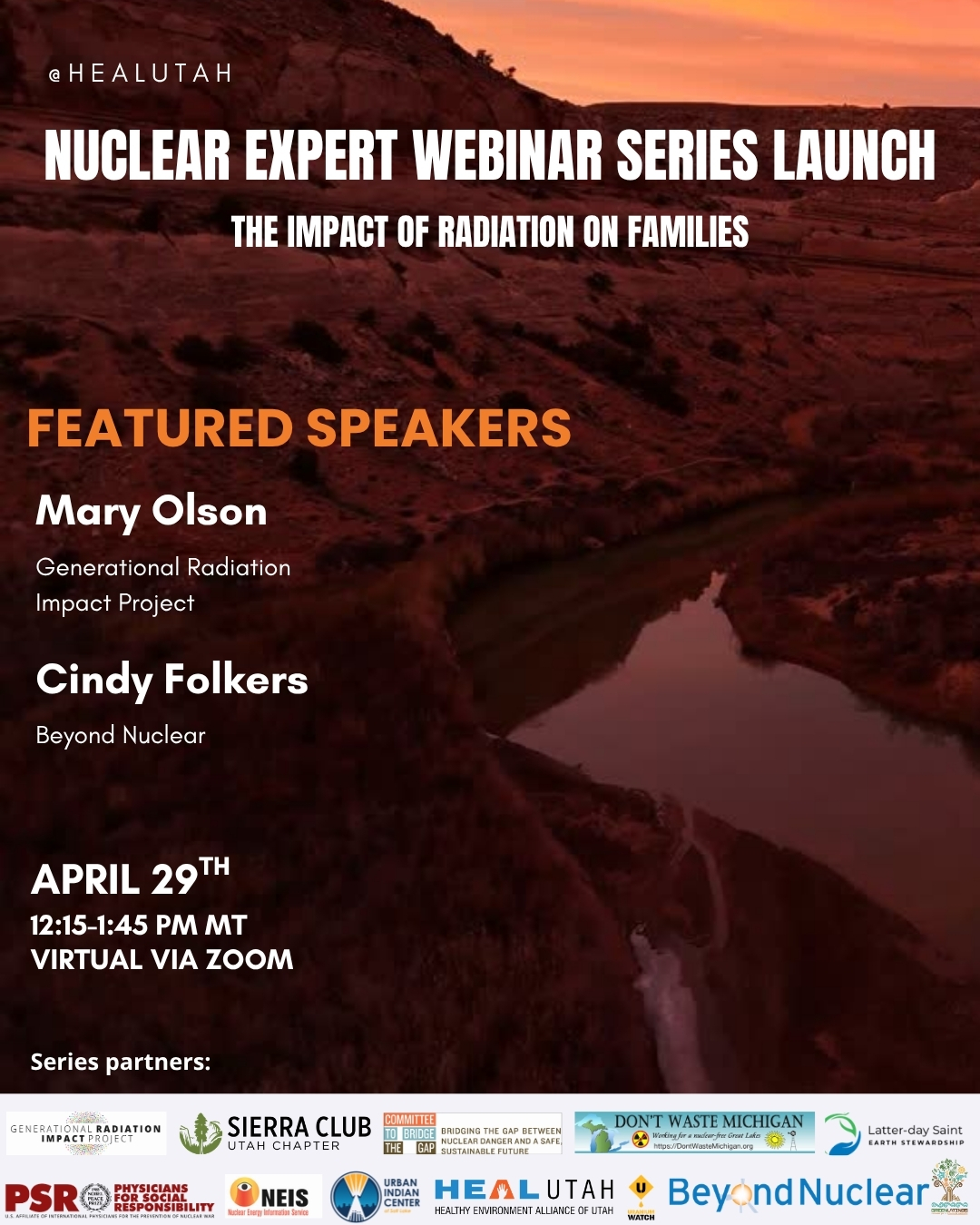
29 April – Nuclear Expert Webinar #1 – Radiation Impacts on Families with Mary Olson and Cindy Folkers
- 12:15 PM MT – 1:45 PM MT
- Location: Virtual – REGISTER TODAY

4 May -West Suburban Peace Coalition to discuss Iran war at May Educational Forum
Monday, May 4, 7:00 – 8:00 PM Central Standard Time
Title: : How Trump’s Narrative Tries to Shape the Reality of the War on Iran.
Contact Walt Zlotow, zlotow@hotmail.com 630 442 3045 for further information
14 May – online event From Bombs to Data Centres: the Face of Nuclear Colonialism

Pine Ridge Uranium is the real threat, not Tehran- Tell Burgum: Stop the Extraction.
Chernobyl: The Lost Tapes – A good documentary on Chernobyl on SBS available On Demand for the next 3 weeks– https://www.sbs.com.au/ondemand/tv-program/chernobyl-the-lost-tapes/2352741955560
To see nuclear-related stories in greater depth and intensity – go to https://nuclearinformation.wordpress.com
-
Archives
- April 2026 (327)
- March 2026 (251)
- February 2026 (268)
- January 2026 (308)
- December 2025 (358)
- November 2025 (359)
- October 2025 (376)
- September 2025 (257)
- August 2025 (319)
- July 2025 (230)
- June 2025 (348)
- May 2025 (261)
-
Categories
- 1
- 1 NUCLEAR ISSUES
- business and costs
- climate change
- culture and arts
- ENERGY
- environment
- health
- history
- indigenous issues
- Legal
- marketing of nuclear
- media
- opposition to nuclear
- PERSONAL STORIES
- politics
- politics international
- Religion and ethics
- safety
- secrets,lies and civil liberties
- spinbuster
- technology
- Uranium
- wastes
- weapons and war
- Women
- 2 WORLD
- ACTION
- AFRICA
- Atrocities
- AUSTRALIA
- Christina's notes
- Christina's themes
- culture and arts
- Events
- Fuk 2022
- Fuk 2023
- Fukushima 2017
- Fukushima 2018
- fukushima 2019
- Fukushima 2020
- Fukushima 2021
- general
- global warming
- Humour (God we need it)
- Nuclear
- RARE EARTHS
- Reference
- resources – print
- Resources -audiovicual
- Weekly Newsletter
- World
- World Nuclear
- YouTube
-
RSS
Entries RSS
Comments RSS
 nuclear-news