Lawsuit over the exposure to radiation of residents of Litate, after Fukushima nuclear meltdown
|
ACRO 5th March 2021, The commune of Iitaté , located beyond a radius of 30 km, was evacuated late. The order to evacuate was announced on April 11, 2011 and the inhabitants had one month to leave ( read the follow-up of the first year of the disaster ).
During this time, those who did not leave the scene on their own were exposed to radioactive fallout. 29 residents of Iitaté filed a complaint against TEPCo and the state and demanded 200 million yen in damages because the authorities told them at the start of the disaster that it was not necessary to leave.
The lack of information about increasing radiation levels deprived them of their right to evacuate and left them exposed needlessly. They also claim that the evacuation of the
entire village that followed caused them to lose their homes and farms, destroyed their community and deprived them of their hometown. |
|
Battle coming in U.S. Congress over spending on nuclear weapons

|
Lawmakers gird for spending battle over nuclear weapons, The Hill, BY REBECCA KHEEL – 03/07/21 Nuclear weapons are emerging as one of the top political brawls in the brewing battle over next year’s defense budget.Democrats have been introducing bills to curtail costly nuclear modernization programs, as well writing letters urging President Biden to support their efforts.
But Republicans are shooting back with their own letters and op-eds calling on Biden to stay the course on programs that largely originated during the Obama administration. They’re also working to pin down Pentagon nominees on where they stand. The back-and-forth over nuclear modernization is providing a lens into the larger fight that’s taking shape as the Biden administration prepares to present its first defense budget in the spring. Expectations are that the administration will keep funding flat. In one of the latest salvos, top Republicans on the House Armed Services Committee said Biden should boost defense spending by 3 to 5 percent, in part citing nuclear modernization needs, as well as bolstering cyber and naval capabilities……. But even the Trump administration had projected a relatively flat defense budget in fiscal year 2022 compared to the $740 billion defense budget in fiscal 2021, amid other pressures such as a growing national debt. As the Biden administration faces a time crunch in crafting its first budget proposal, Deputy Defense Secretary Kathleen Hicks in a February memo directed a review of a select group of programs, including low-yield nuclear warheads and nuclear command and control, according to multiple reports. The Trump administration developed and deployed a submarine-launch low-yield nuclear warhead, dubbed the W76-2 warhead, that Democrats argued raised the risk of nuclear war by potentially lowering the threshold for the U.S. willingness to use nuclear weapons. Trump officials were also in the early stages of developing a new nuclear-armed sea-launched cruise missile. On Thursday, Sen. Chris Van Hollen (D-Md.) and Rep. Joe Courtney (D-Conn.) introduced a bill to prohibit production and deployment, as well as research and development, of the nuclear-armed sea-launched cruise missile and its associated warhead. “Putting new, expensive nuclear warheads on attack submarines and surface ships that haven’t carried those weapons in almost thirty years is a distraction that will suck precious resources away from the most pressing need of the U.S. Navy—namely, to increase the size of its overworked fleet,” Courtney, chairman of the House Armed Services Committee’s seapower subcommittee, said in a statement. “This legislation is a common-sense bill that will stop the hemorrhaging of precious Navy dollars for a wasteful program that Congress barely debated.” An interim national security strategy released by the White House on Wednesday said the administration would “take steps to reduce the role of nuclear weapons in our national security strategy, while ensuring our strategic deterrent remains safe, secure, and effective and that our extended deterrence commitments to our allies remain strong and credible.” But Republicans have been pushing back against any potential changes to nuclear programs……………….. https://thehill.com/policy/defense/541906-lawmakers-gird-for-spending-battle-over-nuclear-weapons |
|
Heroism of Fukushima’s nuclear emergency workers
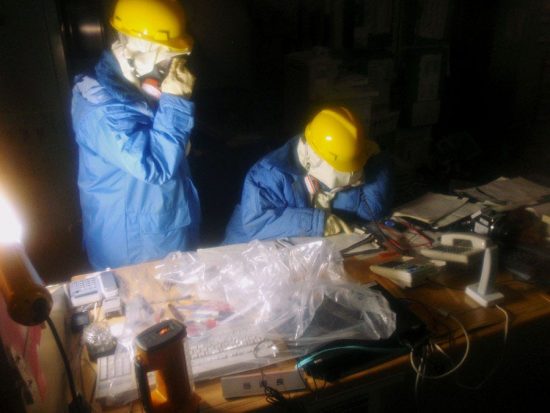
France Info 7th March 2021, For four days and four nights in March 2011, hundreds of workers tried, sometimes risking their lives, to contain the damage from the earthquake
and tsunami that destroyed the Japanese nuclear power plant.
”……….March 11, 2011, 3:27 p.m. The ocean begins to hit the enclosure of the nuclear power plant. A first wave about 4 meters high crashes against the dike. But ten minutes later, a wave some 15 meters high swept over Fukushima Daiichi. The doors of the turbine buildings are not watertight: the generators, electric meters and batteries are flooded. Vehicles and rubble litter the roads. Two operators who had gone to watch the machines in the basement of reactor building 4 drowned.
On the second floor of the earthquake-resistant building, all the lights go out. It’s pitch black in this windowless building. Worse, the measurement indicators no longer work. Impossible to know the temperature and the pressure inside the reactors, therefore to know if the emergency cooling systems are still functioning. However, if the water level in a reactor drops, the fuel rods heat up and can melt until they pierce the concrete enclosure and cause a major nuclear disaster.
“We were left speechless”
“At that time, it was astonishment. We were all so devastated that we were left speechless,” recalls Masao Yoshida during an audition transcribed in A story of Fukushima (PUF editions), by Franck Guarnieri and Sébastien Travadel. The scarce information is communicated to the two external crisis units which are set up 250 km away, in Tokyo. One at the headquarters of Tepco, the company that operates the plant; the other at Kantei, the residence of the Prime Minister.
The teams take action. Two solutions are being considered for cooling the reactors: using diesel engine fire pumps or fire trucks which are already on the site. In the absence of a measuring system, the employees concentrate first on Reactor 2. What they do not know is that the back-up system is operating there. The emergency is actually located in reactor 1. Around 6 p.m., its heart begins to melt inside the containment……..
The teams take action. Two solutions are being considered for cooling the reactors: using diesel engine fire pumps or fire trucks which are already on the site. In the absence of a measuring system, the employees concentrate first on Reactor 2. What they do not know is that the back-up system is operating there. The emergency is actually located in reactor 1. Around 6 p.m., its core begins to melt inside the containment.
That’s when they were most irradiated”
Among employees, fear of radiation escalates. “The state of Reactor 1 scared young people,” said Ryuta Idogawa, one of the plant’s reactor pilots, in an interview with Yuki Kobayashi, a doctoral student in science and engineering of risky activities. Despite the danger, however, it is necessary to choose men to open the valves of the reactors manually.
Around 4 am, the injection of fresh water, stored on site in the event of a problem, is finally launched into reactor 1. “When we saw water coming out of the pipe and reaching the reactor, we all yelled, ‘Yes!’ and raised our fists in the air “, tells the Telegraph * Kazuhiko Fukudome, one of the firefighters involved in the accident. Workers are constantly refueling the trucks to operate the water pump. “I think that’s when they were most irradiated,” admits Masao Yoshida.
……… “We sent men and it exploded”
March 13, 2011, 2:42 a.m. While the situation in reactor 1 appears to have stabilized, it is the turn of the reactor 3 emergency cooling system to cease functioning. New operations must be relaunched, but fatigue begins to be felt. “How long can we continue to work without ever sleeping? The answer is 36 hours. That’s the limit for all men,” said Takeyuki Inagaki, group leader at the plant, in an interview with Yuki Kobayashi. This duration has just been reached by the employees, fed on rice bars and instant noodles. Even Masao Yoshida dozes off.
However, new operations resume before sunrise. Reactor 3 must be ventilated and cooled. After a few hours of hard work amidst the debris, the workers succeed in hooking up new pumps and watering the building to prevent overheating. Several of them are exposed to doses of radioactivity greater than 100 millisieverts (mSv), according to the Japanese nuclear safety agency, or five times more than the annual dose authorized in France for employees in the sector.
March 14, 2011, 11:01 a.m. A new explosion, even more impressive than the first, resonates in the heart of the plant. “HQ! HQ! It’s terrible! We have a problem on site number 3!” shouts Masao Yoshida, in a recording of the Crisis Staff. This time, it is the reactor building 3 which is blown up because of the hydrogen. The manager has to face his decisions: “I was sorry. We weren’t sure, but we thought it would not explode right away. We sent men and it exploded,” he admits. .
“Right after the explosion, when I learned that there were about 40 missing, I really iexpected to die. myself.”
Masao Yoshida, director of the plant before a commission of inquiry.
The explosion ultimately caused no death, but a dozen injured. It also has an immediate consequence for the plant: the destruction of the emergency cooling system of reactor 2. “I think that is the moment when I hit rock bottom. I saw us all dead,” says Masao Yoshida. On this Monday morning, the teams are overwhelmed. “I will never forget that afternoon. My stomach ached as if a block of lead was left there,” recalls group leader Takeyuki Inagaki.
”I ask you to sacrifice your lives”
In the middle of the afternoon, the director begins to envisage an evacuation of the few hundred non-essential employees of the plant. He orders that coaches be ready to leave in case of further complications. But shortly before 8 p.m. the hard work of the workers paid off. The injection of sea water begins in reactor 2. Reluctant to any evacuation of the employees, the Prime Minister addresses them during a night videoconference: “I ask you to sacrifice your lives.”
March 15, 2011, 6:14 a.m. It has been four days since the disaster struck, and employees must continue their endless battle against the elements. This time, it is a leak in the enclosure of reactor 2 which causes an explosion and damages reactor 4. Luckily, the explosion does not cut off the seawater cooling system of the first three reactors. The exhausted workers managed to stabilize these time bombs and contain what could have turned out to be a much more deadly disaster.
“There is a special bond between us. I cannot express it in words. I imagine that it is the camaraderie that can be between soldiers in time of war, will tell the Guardian later * l One of the engineers, Atsufumi Yoshizawa. In our case, the enemy was the nuclear power plant. And we fought it together. ” This Tuesday, reinforcements will finally arrive from the surrounding power plants to restore power supplies and build protective structures. The closed-door hell of Fukushima Daiichi power plant workers is over.
Japan’s government – fading support for nuclear power
East Asia Forum 6th March 2021, Ten years after the world watched the explosions at the Fukushima Daiichi Nuclear Power Plant, Japan’s pro-nuclear advocates have lost policy
implementation power.
As part of the three-yearly energy policy review, Prime Minister Yoshihide Suga’s government needs to decide on the electricity mix for 2030 this year — including the future of nuclear
power. But given the need to maintain safety standards and public opposition to building new reactors, Japan’s nuclear target is realistically constrained to no more than an 8–10 per cent share of projected power needs.
https://www.eastasiaforum.org/2021/03/06/waning-support-for-nuclear-power-10-years-after-fukushima/
Scottish Council calls on big pension fund to stop investing in weapons makers

The Ferret 5th March 2021, Inverclyde Council has called on Scotland’s largest council pension fund to stop investing in arms and to commit to ethical investments. A motion was passed this week after Inverclyde Council was told that Strathclyde Pension Fund (SPF) held shares in 11 of the world’s 20 biggest arms manufacturers, including some involved in the production of nuclear weapons. The council’s decision has been welcomed by Campaign Against Arms Trade, Nuclear Free Local Authorities (NFLA) and Don’t Bank on the Bomb.
https://theferret.scot/inverclyde-council-pension-fund-invest-ethically/
A new setback for France’s Flamanville nuclear reactor
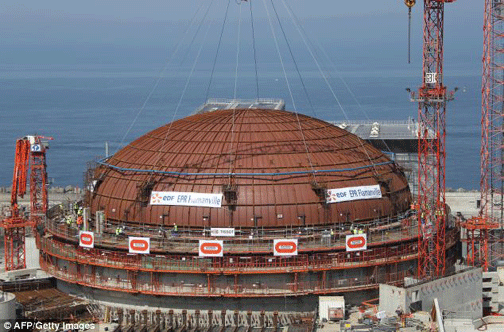 La Presse de la Manche 5th March 2021, Nuclear: a new setback for the Flamanville EPR. A “significant event” was declared on March 2, 2021 to the Nuclear Safety Authority, concerning taps on the main primary circuit of the EPR reactor. While the file of the welds to be resumed on the main secondary circuit , the steam circuit in fact, is still being examined by the Nuclear Safety Authority , EDF declared on March 2 to ASN a new “event”. significant “. It concerns deviations from the study reference system on three taps of the main primary circuit of the La Presse de la Manche 5th March 2021, Nuclear: a new setback for the Flamanville EPR. A “significant event” was declared on March 2, 2021 to the Nuclear Safety Authority, concerning taps on the main primary circuit of the EPR reactor. While the file of the welds to be resumed on the main secondary circuit , the steam circuit in fact, is still being examined by the Nuclear Safety Authority , EDF declared on March 2 to ASN a new “event”. significant “. It concerns deviations from the study reference system on three taps of the main primary circuit of theFlamanville EPR reactor. |
President Rouhani says that Iran is prepared to fulfil nuclear deal commitments
 Iran prepared to fulfill nuclear deal commitments, president tells Coveney
Hassan Rouhani says United States must lift ‘illegal sanctions’ during Tehran meeting with Minister. Irish Times,7 Mar 21,
In a meeting with Minister for Foreign Affairs Simon Coveney, Mr Rouhani said: “Iran is ready to immediately take compensatory measures based on the nuclear deal and fulfil its commitments just after the US illegal sanctions are lifted and it abandons its policy of threats and pressure.”
The Iranian leader criticised the European signatories of the historic nuclear deal for what he said was their inaction on their commitments to the agreement. He said Iran was the only country that kept its side of the bargain………. https://www.irishtimes.com/news/politics/iran-prepared-to-fulfill-nuclear-deal-commitments-president-tells-coveney-1.4503539
UN’s nuclear watchdog agency will not be ‘bargaining chip’ in Iran nuclear deal,
UN’s nuclear watchdog agency will not be ‘bargaining chip’ in Iran nuclear deal, https://news.un.org/en/story/2021/03/1086092 The head of the UN’s nuclear watchdog agency told journalists on Monday that inspections in Iran should not be used as a “bargaining chip” to revive a troubled nuclear deal.
After speaking to the International Atomic Energy Agency’s (IAEA) Board of Governors, Director General Rafael Grossi told a press conference that while the agency had opened a window of opportunity for diplomacy in Iran, it should not be put in the middle of negotiations between Iran, the United States and other nations over the deal.
On 15 February, Iran announced that it would stop implementing “voluntary transparency measures” in the Joint Comprehensive Plan of Action (JCPOA), known commonly as the Iran nuclear deal, along with other arrangements in Iran’s Safeguards Agreement.
The IAEA chief said to the 35-nation board that a “temporary bilateral technical understanding” had been agreed upon during his visit to the country last month that would enable the UN agency to “resume its full verification and monitoring of Iran’s nuclear-related commitments under the JCPOA if and when Iran resumes its implementation of those commitments”.
Serious concern
The IAEA chief also raised the alarm that nuclear activities in the Democratic People’s Republic of Korea (DPRK), commonly known as North Korea, remains “a cause for serious concern”.
“The continuation of the DPRK’s nuclear programme is a clear violation of relevant UN Security Council resolutions and is deeply regrettable”, Mr. Grossi said, adding that the Vienna-based agency was intensifying its readiness “to play its essential role in verifying North Korea’s nuclear programme”.
Reviewing nuclear safety
The IAEA chief also drew attention to the agency’s Nuclear Safety Review 2021, which provides an overview of the agency’s activities and global trends in nuclear, radiation, transport and nuclear waste safety protcols, as well as in emergency preparedness and response.
“This year, it also identifies the priorities in these areas, and provides an analytical overview of overall trends”, he said.
Moreover, the UN official flagged IAEA’s work in strengthening global preparedness for future pandemics through its Zoonotic Disease Integrated Action (ZODIAC) initiative on diseases, that jump from animals to humans – the common path for viruses such as COVID-19.
He said the initiative will help to reduce the chance that the next outbreak will wreak “the deadly destruction we are suffering today”.
And Mr. Grossi informed the members that last week, IAEA signed revised arrangements with the Food and Agriculture Organization (FAO) to “help Member States respond to emerging challenges from climate change to outbreaks of zoonotic diseases”.
Climate on the table
As the Agency prepares for the 2021 UN Climate Change Conference, known as COP26, scheduled for November in Glasgow, Scotland, Mr. Grossi said that he would personally deliver the message that “nuclear energy has a seat at the tables when the world’s future energy and climate policies are being discussed”.
“Almost five years after the signing of the Paris Agreement, governments are becoming increasingly aware that they must shift from fossil fuels to nuclear and other low-carbon technologies, if they are to reach their net zero objectives”, Mr. Grossi said.
The Director-General concluded by assuring that the agency was continuing its work on advancing gender equality, and invited Member States to join a panel discussion with some of the IAEA’s early women pioneers on 8 March, International Women’s Day.
Iran nuclear deal: a summary
-
- What is the Iran nuclear deal? The 2015 “Joint Comprehensive Plan of Action” (JCPOA), sets out rules for monitoring Iran’s nuclear programme, and paves the way for the lifting of UN sanctions.
- Which countries are involved? Iran, the five members of the Security Council (China, France, Russia, UK, US), plus Germany, together with the European Union.
- What is the UN’s involvement? A UN Security Council resolution to ensure the enforcement of the JCPOA, and guarantee that the UN’s atomic energy agency, the IAEA, continues to have regular access to and more information on Iran’s nuclear programme, was adopted in 2015.
- Why is the deal at risk? The current US Administration pulled out of the deal in 2018 and re-imposed sanctions. In July 2019, Iran reportedly breached its uranium stockpile limit, and announced its intention to continue enriching uranium, posing a more serious proliferation risk.
Most 2011 quake, Fukushima crisis survivors back ending nuclear power
March 6, 2021 (Mainichi Japan) TOKYO (Kyodo) — About four in five survivors of the 2011 earthquake, tsunami and Fukushima nuclear crisis in northeastern Japan support abolishing nuclear power generation immediately or gradually, a Kyodo News survey showed Saturday nearly 10 years after the disaster.
Some 30 percent of respondents said all nuclear power plants should be abolished immediately, with 52 percent supporting phasing out nuclear power and eventually eliminating it.
The poll conducted in November in the three hardest-hit prefectures of Iwate, Miyagi and Fukushima had 300 respondents and found that only 15 percent were in favor of restarting nuclear reactors and relying on them in the future.
Following a magnitude-9.0 earthquake and subsequent tsunami that hit on March 11, 2011, the Nos. 1 to 3 reactors at the Fukushima Daiichi nuclear plant owned by Tokyo Electric Power Company Holdings Inc. suffered meltdowns.
Decommissioning work continues to prove difficult and evacuation orders are still in place in some areas around the complex a decade after the world’s worst nuclear accident since the 1986 Chernobyl disaster.
All reactors in Japan were halted after the nuclear crisis but some have resumed operations in recent years under stricter safety regulations. The government aims for renewable energy to account for 50-60 percent of overall electricity by 2050 while relying on 30-40 percent from thermal power and nuclear energy.
By prefecture, 40 percent of respondents in Fukushima supported an immediate exit from nuclear energy, higher than 27 percent in Iwate and 24 percent in Miyagi.
Hiromi Suzuki, a 59-year-old evacuee from Namie, close to the crippled nuclear plant, said consumers remain concerned that fish from Fukushima may be contaminated with radiation…..https://mainichi.jp/english/articles/20210306/p2g/00m/0na/065000c
How Scotland’s Dunoon became an American nuclear base, and a target
|
60 years on: The day the US Navy came armed with nuclear missiles https://www.heraldscotland.com/news/19140712.60-years-day-us-navy-came-armed-nuclear-missiles/ By Sandra Dick 7 Mar 21, THE sun shone brightly over the calm Holy Loch on a beautiful early March day in 1961, as USS Proteus – 18,000 tons of American might – glided towards her foe.
By late afternoon, she was passing Islay. And as the US Navy vessel drew closer to her final destination, anti-nuclear demonstrators who had been waiting for weeks for the chance to pounce, braced themselves for their attack. The first salvo of a David versus Goliath battle saw protesters in dinghies and canoes pitted against the most menacing of modern warfare, and it would rage – on and off – for months to come. It’s now 60 years since USS Proteus, soon followed by a fleet of US Navy Polaris submarines, set up base close to Dunoon. And although the area was not unfamiliar with submarine activity – Royal Navy submarines were based in the area throughout the Second World War – the Americans, with their terrifying nuclear arsenal, a raging Cold War and the relatively fresh memories of Hiroshima and Nagasaki, meant this was no normal military manoeuvre. The US Navy and Polaris would remain a feature of the Dunoon landscape for the next 31 years. For those who could put aside any concerns of living with nuclear missiles on their doorstep, it brought economic and social benefits – and more than a few weddings between US sailors and local women. For others, the presence of the American nuclear force put a picturesque and peaceful corner of the country in Soviet crosshairs, and propelled Scotland into the very core of a deadly nuclear war machine. The announcement that the Americans were coming was completely unexpected, recalls historian Trevor Royle, who has written about the Holy Loch base in his book on the Cold War in Scotland, ‘Facing The Bear’. “It came as a great surprise to people of Scotland – it was a shock to suddenly have the Cold War on their doorstep,” he says. America needed an operating base for their Polaris fleet,” he adds. “At the time Britain’s nuclear deterrent was V Bomber Force, obsolete bombers that could fly to Moscow and drop bombs but couldn’t get back. It was a one-way mission, and Britain wanted a system which worked better than that.” Faced with being left behind as a nuclear nation, Prime Minister Harold Macmillan struck a deal with President Dwight D. Eisenhower for the Holy Loch to become an extension of US territory and a berth for nuclear bombs. In return, Britain would acquire the Polaris nuclear delivery system, enabling the Royal Navy to operate its own fleet from Faslane. However, the announcement in November 1960, propelled Holy Loch communities into a world of US and Soviet war games, which would see submarines play cat and mouse across fishing grounds and Atlantic waters. Most Scots, says Trevor, accepted what was heading their way. Some, among them taxi drivers and bed and breakfast businesses around Dunoon who had feared cheap foreign holidays were set to scupper the tourist trade, were more than happy. Others were outraged. Isobel Lindsay was just 17 years old at the time and secretary of Lanarkshire CND. Soon, she’d be among hundreds to descend on Dunoon to express outrage at the arrival of nuclear weapons in Scottish waters. “The announcement came out of the blue,” she recalls. “Until then, there had been a small anti-nuclear movement in Scotland. But this ignited it.” The arrival of the Polaris fleet’s support ship, USS Proteus, with its crew of 980 officers and men and the prospect of up to 500 dependent families on the way, signalled a call to action; protestors took to the water in tiny crafts to wave anti-nuclear banners and flags and 1,000 protesters marched along the loch. A week later, the Patrick Henry arrived, the first of ten Polaris submarines and with its 135 crew primed at a minute’s notice to blast off up to 16 Polaris rockets, each capable of destroying a city 1500 miles away. It was greeted by a lone canoeist who, after a valiant 15-minute chase by eight patrol vessels, was deliberately tipped in the water. Isobel, whose father had been among the first British forces to enter Hiroshima in the wake of the 1945 atomic bomb, remembers the protest movement growing in size. “Very quickly there were demonstrations in Glasgow and at the Holy Loch,” she says. “One march was organised from London to a 24-hour sit down that blocked Ardnadam pier. “The police tactics were to leave us sitting there – the sailors had to clamber over us to get to the pier.” Protest songs were hastily written, including Ding Dong Dollar, which set those keen to benefit financially from the base against those opposed to nuclear weapons, while protests were laboriously organised by letter, calls from phone boxes and plotted on maps. By May, a two storey floating barracks had been towed to the Holy Loch, providing accommodation for up to 350 personnel, and attitudes towards the protestors hardened. Canoeists who dared to approached US vessels were sprayed with jet hoses, on land, demonstrators were met by dozens of police, wire mesh, iron railings, barbed wire and ‘black Marias’. In Dunoon, locals picked their way between protestors and US Navy sailors. And while taxi drivers enjoyed a boom in business and generous tips, Glasgow’s prostitutes also descended. “It was a great culture shock,” adds Trevor. “Until then, the only knowledge most people had of Americans came from the movies. The Americans came with the crew cuts and smart clothes. It was like Hollywood had come to Dunoon.” Up to 4,000 Americans were attached to the Holy Loch base, their children attended local schools and accommodation was snapped up. But, says Trevor: “Dunoon was very much a target in the event of any nuclear hostilities. “In addition to Polaris submarines, the Holy Loch was home to Hunter Killer submarines, and they all played the most dangerous games of cat and mouse with their Soviet opposite numbers. “Many fishing boats were caught up, among them the Antares.” The small trawler sank in November 1990 after its nets became tangled with an RN submarine. All four crew lost their lives. By that time, Polaris protestors had turned their attention to Faslane instead. And as the Cold War ended, the US Navy packed up. The last ship left in March 1992. “They left nothing behind,” adds Trevor. “Apart from the American sailors who found themselves in a foreign country and made friends with the local girls, fell in love and married, you would have to search hard to know there had been a US presence there at all.” |
|
Bill in U.S. Congress to stop new nuclear-armed, sea-launched cruise missile
|
Lawmakers aim to prevent sea-based nuclear cruise missile, Defense News,
By: Joe Gould 7 Mar 21, WASHINGTON ― Two Democratic lawmakers are introducing legislation to kill the nuclear-armed, sea-launched cruise missile set to begin development next year and its associated warhead.
Maryland Sen. Chris Van Hollen, a lead appropriator, and House Seapower Subcommittee Chairman Joe Courtney, of Connecticut, planned Thursday to unveil the bill, a copy of which was obtained by Defense News. It’s the latest sign of pressure on President Joe Biden from his own party to scale back nuclear plans formed under the Trump administration. The bill would prohibit research and development, production, and deployment of the missile, known as the SLCM-N, arguing that the Obama administration found a similar weapon, the TLAM-N, redundant and retired it. The lawmakers say the cost of the SLCM-N would top the Congressional Budget Office estimate of $9 billion. In a statement, Courtney said that installing nuclear warheads on Virginia-class attack subs would sap resources from growing the Navy’s fleet and distract from the core mission of attack submarines in the Pacific and European theaters, where they are typically laden with ship-killing, conventional Tomahawk missiles. “This legislation is a common-sense bill that will stop the hemorrhaging of precious Navy dollars for a wasteful program that Congress barely debated.” Courtney said………. https://www.defensenews.com/congress/2021/03/04/lawmakers-aim-to-prevent-sea-based-nuclear-cruise-missile/ |
|
Olympic Games hype to deceive the world about Fukushima nuclear catastrophe – theme for March 21


SEPTEMBER 16, 2019 Tokyo Electric Power’s Fukushima Daiichi Nuclear Power Station, which experienced three massive meltdowns in 2011, is running out of room to store radioactive water. No surprise! But now, what to do about phosphorescent water?
*****
Addressing the issue, Japan’s environmental minister Yoshiaki Harada held a news conference (September 2019). Unfortunately, he proffered the following advice: “The only option will be to drain it into the sea and dilute it.” (Source: Justin McCurry in Tokyo, Fukushima: Japan Will Have to Dump Radioactive Water Into Pacific, Minister Says, The Guardian, Sept. 10, 2019)
“The only option”… Really?
Over the past 8 years, Tokyo Electric Power (TEPCO) has scrambled like a Mad Hatter to construct emergency storage tanks (1,000) to contain upwards of one million tonnes of contaminated radioactive water, you know, the kind of stuff that, over time, destroys human cells, alters DNA, causes cancer, or produces something like the horrific disfigured creature in John Carpenter’s The Thing! That’s the upshot of a triple nuclear meltdown that necessitates constant flow of water to prevent further melting of reactor cores that have been decimated and transfigured into corium or melted blobs. It’s the closest to a full-blown “china syndrome” in all of human history. Whew! Although, the truth is it’ll be a dicey situation for decades to come.
Ever since March 11, 2011, TEPCO has scrambled to build storage tanks to prevent massive amounts of radioactive water from pouring into the ocean (still, some lesser amounts pour into the ocean every day by day). Now the government is floating a trial balloon in public that, once the tanks are full, it’ll be okay to dump the radioactive water into the ocean. Their logic is bizarre, meaning, on the one hand, the meltdown happens, and they build storage tanks to contain the radioactive water, but on the other hand, once the storage tanks run out of space, it’s okay to dump radioactive water into the ocean. Seriously?
Meantime, the Fukushima meltdown brings the world community face to face with TEPCO and the government of Japan in an unprecedented grand experiment that, so far, has failed miserably. Of course, dumping radiation into the Pacific is like dumping radiation into everybody’s back yard. But, for starters, isn’t that a non-starter?
Along the way, deceit breeds duplicity, Continue reading
Fukushima, a ‘coordinator’ for the nuclear-stricken area, takes a cue from the U.S. to break away from reconstruction dependent on the government

March 6, 2021, 18:07 (Kyodo News)
On March 6, a private organization called Fukushima Hamadori Tridec was established to serve as a coordinator between industry, government and academia in the areas affected by the accident at Tokyo Electric Power Company’s Fukushima No. 1 nuclear power plant. In order to promote the reconstruction that the coastal residents of Fukushima Prefecture desire, the organization aims to unite the demands of the region and take the brunt of negotiations with the government and other parties.
The 43 founding members include local business people, researchers, and politicians. The organization will be incorporated as a general incorporated association and will invite individual and corporate members. Takayuki Nakamura, vice president of East Japan International University (Iwaki City), who will serve as the secretariat, said, “We will break away from our traditional stance of depending on the government. We will decide our own fate,” he said of the founding principles.
https://www.tokyo-np.co.jp/article/89939?fbclid=IwAR0IVgauLUBacHECWFx2axSSV7o5CUqvtvxw6KcLJtZ6A1bqoHtwcQ-cEl8
Decade After Fukushima Disaster Survivor Looks Back
The Japanese town of Tomioka ravaged by the 2011 Fukushima nuclear disaster is a shell of its former self.

March 5, 2021
The Japanese town of Tomioka ravaged by the 2011 Fukushima nuclear disaster is a shell of its former self. In some parts, houses and shops lie abandoned, and bin bags filled with contaminated soil line the streets. For Yuta Hatakeyama, who was 14 when his family had to leave their home, the town evokes bittersweet memories. “I had no idea what was going on back then,” he said. “It has been 10 years since and I have been developing sad feelings.”
A decade after the quake and tsunami, Hatakeyama has returned to the town some 10 kilometers (6 miles) from the now shuttered Fukushima No. 1 nuclear plant, and serves as a community spokesperson. The exclusion zone in the town was lifted in 2017 but around 12% of the town still remains a no-go zone where people can’t enter without an official permit.
Hatakeyama remembers a cherry blossom festival in the town, and a lane brimming with food stalls and people. Now it’s cordoned off and dotted with red safety cones. He said he and his family faced discrimination after leaving Tomioka after the disaster for Iwaki, some 50 km (30 miles) away. “When I moved to a new place and heard people there stigmatising us for being evacuated, my heart really ached.”
The 24-year-old now believes the town must get rid of the bags filled with radioactive waste and make the town more liveable. Tomioka, which used to have 16,000 residents before the disaster, is now home to 1,600 people. The town is planning to lift most of its no-go zones by March 2023.
Decade after Fukushima disaster, decontamination work remains incomplete in 85% of regions
Greenpeace says Japan should suspend returning residents to the afflicted region

Mar.5,2021
Decontamination work remains incomplete in 85% of regions where the Japanese government claims to have removed radioactive contaminants from the Fukushima Nuclear Power Plant disaster, an international environment group’s analysis shows.
In a report titled “Fukushima Daiichi 2011-2021,” published on Thursday ahead of the 10th anniversary of the disaster on March 11, Greenpeace urged the Japanese government to discontinue its policy of returning residents to the afflicted region without regard for science-based analysis.
Two weeks after the disaster struck in March 2011, the group sent a team of radioactivity exports to the scene in the first of 32 total visits through November 2020 to survey the radiation impacts in the Fukushima region. The recent report was based on its findings to date.
The Japanese government has announced the completion of most decontamination work for a Special Decontamination Area (SDA), which does not include a region close to the plant with particularly high levels of contamination that prevent residents from returning. Carried out through March 2019, the effort involved a commitment of 30 million person-hours and cost US$28 billion.
But an analysis of government data by Greenpeace showed that of the 840 square kilometers in the SDA, actual decontamination work had only been completed on 120 square kilometers, or 15 %.
In the case of Iitate — the largest of the seven administrative districts located entirely inside the SDA — decontamination had yet to be completed for 18,183 hectares, or 79% of its area. In the second-largest district of Namie, just 2,140 hectares, or 10%, had undergone even some decontamination.
Resident evacuation orders for the two regions were lifted in March 2017 — but according to Greenpeace, radiation levels make them still too dangerous for human habitation.
According to a Greenpeace study last November, the average amount of radiation in five out of 11 sites surrounding one home in Iitate was 0.5 microsieverts per hour (μSv/h), exceeding the government’s target of 0.23μSv/h.
The area immediately outside of one Namie school was found to be open to the general public despite 93% of measured sites showing radiation above the government’s targets.
“The fact that 85% of the contaminated surface area of the seven Fukushima districts inside the SDA has not been subject to decontamination is directly related to the radiological hazards posed by the mountainous forested areas,” the report explained.
“These remain a long-term source of contamination, including recontamination,” it warned.
Shaun Burnie, the Greenpeace senior nuclear specialist responsible for writing the report, urged the Japanese government to immediately suspend its return policy and decontamination program in order to protect residents of the Fukushima region, arguing that they ignore science-based analysis.
The same day, Greenpeace also published a technical report analyzing the decommissioning of the Fukushima Daiichi reactor. In it, Greenpeace proposed that the Japanese government adopt an alternative to its current decommissioning plan, which increases the amount of water contaminated with high-level radioactive material.
As an alternative approach, it suggested replacing water with air as a means of cooling reactor core fuel, while reducing the amount of contaminated water by installing moats to prevent seawater and underground water infiltration around the plant.
Chang Ma-ri, a climate energy campaigner for Greenpeace, said, “The ravages of radioactive contamination caused by the Fukushima disaster will pose a burden on humankind that will not be resolved for the next century or more.”
“The Japanese government needs to start by withdrawing its imminent plans for the release of contaminated water [into the ocean],” she urged.
By Kim Jeong-su, senior staff writer
http://english.hani.co.kr/arti/english_edition/e_international/985626.html
1 This Month
26 April – Chernobyl: Inside the Meltdown airs on National Geographic on Sunday 26th April from 4pm

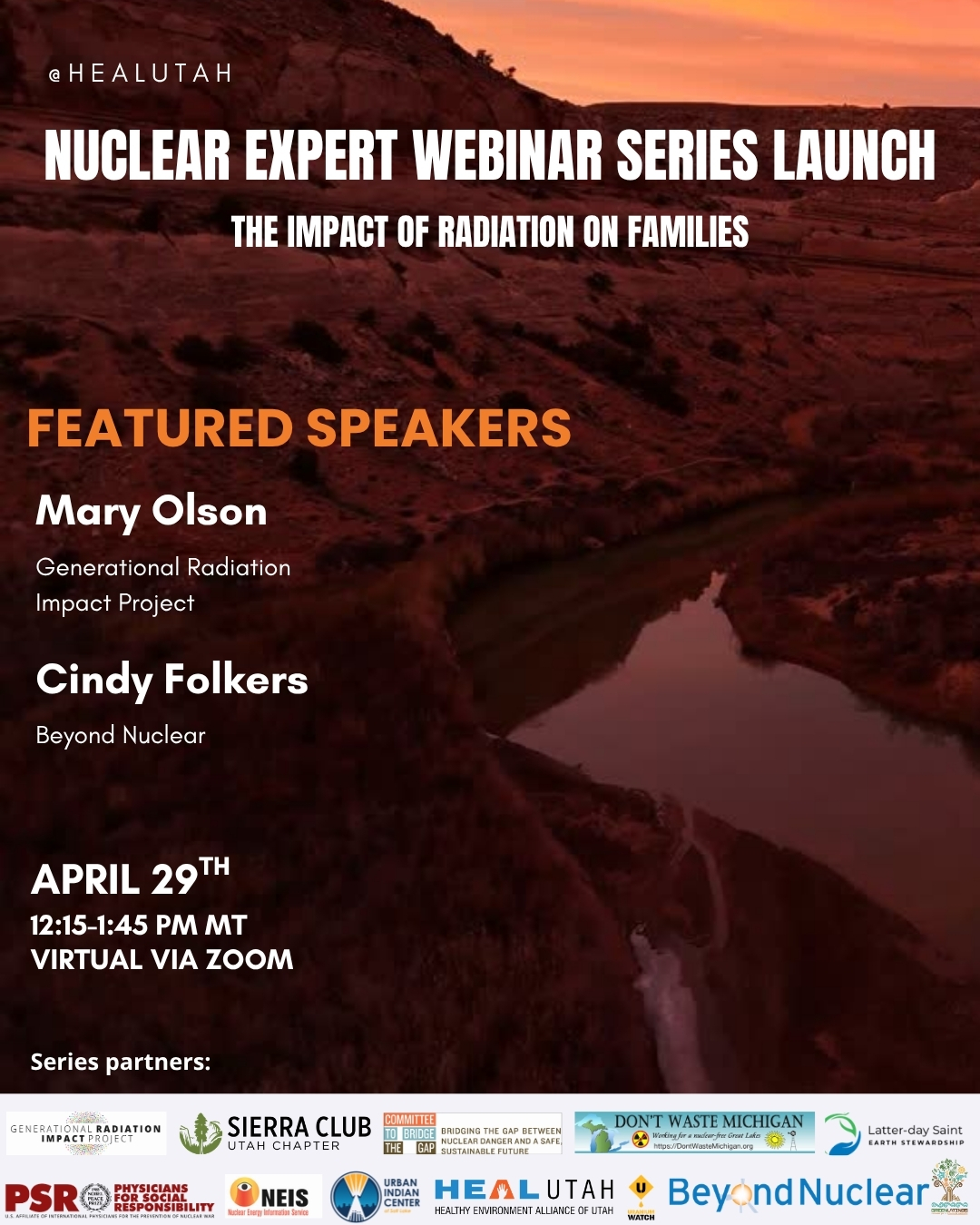
29 April – Nuclear Expert Webinar #1 – Radiation Impacts on Families with Mary Olson and Cindy Folkers
- 12:15 PM MT – 1:45 PM MT
- Location: Virtual – REGISTER TODAY

4 May -West Suburban Peace Coalition to discuss Iran war at May Educational Forum
Monday, May 4, 7:00 – 8:00 PM Central Standard Time
Title: : How Trump’s Narrative Tries to Shape the Reality of the War on Iran.
Contact Walt Zlotow, zlotow@hotmail.com 630 442 3045 for further information
14 May – online event From Bombs to Data Centres: the Face of Nuclear Colonialism

Pine Ridge Uranium is the real threat, not Tehran- Tell Burgum: Stop the Extraction.
Chernobyl: The Lost Tapes – A good documentary on Chernobyl on SBS available On Demand for the next 3 weeks– https://www.sbs.com.au/ondemand/tv-program/chernobyl-the-lost-tapes/2352741955560
To see nuclear-related stories in greater depth and intensity – go to https://nuclearinformation.wordpress.com
-
Archives
- April 2026 (327)
- March 2026 (251)
- February 2026 (268)
- January 2026 (308)
- December 2025 (358)
- November 2025 (359)
- October 2025 (376)
- September 2025 (257)
- August 2025 (319)
- July 2025 (230)
- June 2025 (348)
- May 2025 (261)
-
Categories
- 1
- 1 NUCLEAR ISSUES
- business and costs
- climate change
- culture and arts
- ENERGY
- environment
- health
- history
- indigenous issues
- Legal
- marketing of nuclear
- media
- opposition to nuclear
- PERSONAL STORIES
- politics
- politics international
- Religion and ethics
- safety
- secrets,lies and civil liberties
- spinbuster
- technology
- Uranium
- wastes
- weapons and war
- Women
- 2 WORLD
- ACTION
- AFRICA
- Atrocities
- AUSTRALIA
- Christina's notes
- Christina's themes
- culture and arts
- Events
- Fuk 2022
- Fuk 2023
- Fukushima 2017
- Fukushima 2018
- fukushima 2019
- Fukushima 2020
- Fukushima 2021
- general
- global warming
- Humour (God we need it)
- Nuclear
- RARE EARTHS
- Reference
- resources – print
- Resources -audiovicual
- Weekly Newsletter
- World
- World Nuclear
- YouTube
-
RSS
Entries RSS
Comments RSS
 nuclear-news