World climate at the crossroads – much depends on USA election result
 Guardian 26th Oct 2020, Among the myriad reasons world leaders will closely watch the outcome of a
  fraught US presidential election, the climate crisis looms perhaps largest of all. The international effort to constrain dangerous global heating will hinge, in large part, on which of the dichotomous approaches of Donald Trump or Joe Biden prevails.
anxiety has only escalated during the hottest summer ever recorded in the northern hemisphere, with huge wildfires scorching California and swaths of central South America, and extraordinary temperatures baking the Arctic.
|
|
Ocean ecosystems – future in doubt

The uncertain future of the oceans, Science Daily October 26, 2020
- Source:
- Helmholtz Centre for Ocean Research Kiel (GEOMAR)
- Summary:
- Marine food webs and biogeochemical cycles react very sensitively to the increase in carbon dioxide (CO2) – but the effects are far more complex than previously thought. Data were combined from five large-scale field experiments, which investigated how the carbon cycle within plankton communities reacts to the increase of CO2.
- The ocean plays a key role in the current climate change, as it absorbs a considerable part of the atmospheric carbon dioxide emitted by humankind. On the one hand, this slows down the heating of the climate, and on the other hand, the dissolution of CO2 in seawater leads to acidification of the oceans.
- This has far-reaching consequences for many marine organisms and thus also for the oceanic carbon cycle. One of the most important mechanisms in this cycle, is called the biological carbon pump. Part of the biomass that phytoplankton forms in the surface ocean through photosynthesis sinks to the depths in the form of small carbonaceous particles. As a result, the carbon is stored for a long time in the deep sea. The ocean thus acts as a carbon sink in the climate system. How strongly this biological pump acts varies greatly from region to region and depends on the composition of species in the ecosystem.
The study, which has now been published in the journal
Nature Climate Change, is one of the most comprehensive studies so far on the effects of ocean acidification on marine ecosystems. Scientists at the GEOMAR Helmholtz Centre for Ocean Research in Kiel have now been able to show for the first time that ocean acidification influences the carbon content of sinking organic material, and thus the biological pump. Surprisingly, the observed changes were highly variable. The carbon content of sinking particles increased or decreased significantly with increasing CO2, depending on the composition of species and the structure of the food web. Since the underlying data cover a wide range of ocean regions, this seems to be a global phenomenon. These findings allow a completely new assessment of the effects of ocean acidification……….https://www.sciencedaily.com/releases/2020/10/201026114214.htm
Britain, and other countries, got nuclear weapons for reasons of status and pride
|
We’re nuclear because of the kudos, https://www.heraldscotland.com/news/18818883.letters-nuclear-kudos/ Ian W Thomson, Lenzie. 23 Oct 20 DAVID Crawford asks a question about why the UK Government allows a large element of UK tax revenue to be spent with the US facilities to support the UK nuclear weapon submarine resource. He answers his question by saying “money”, because the UK itself is a substantial supplier of weapons
I believe that there is more to it than he suggests. The Labour Government at the end of the Second World War could have decided not to have nuclear weapons. It initially took the option to have them largely because of status and pride. Ernest Bevin, then the Foreign Secretary, stated: “We’ve got to have the bloody Union Jack on top of it.” The costs of maintaining that status have become more and more expensive over the years, which has led to the UK becoming more and more reliant upon the US for technical support at a cost. The theory must be that it is better to have a nuclear deterrent sort of independent rather than not have such deterrent at all. I also believe that status still has a large part to play in the UK’s position today, albeit we are far removed from the circumstances prevailing at the end of the Second World War. It is interesting that all five permanent members of the UN Security Council are nuclear powers: China, France, Russia, the UK and the US. The UK, no doubt, places great value upon that status and is likely to regard being a nuclear power as helping to sustain it. The original idea was that the five would progressively disarm in exchange for other states not acquiring nuclear weapon facilities. That idea has gone well, hasn’t it? Look at India and Pakistan and the likelihood of some others. |
|
Irish government welcomes 50th ratification of the Treaty on the Prohibition of Nuclear Weapons.
Statement by (Irish) Minister on the 50th Ratification of the Treaty on the Prohibition of Nuclear Weapons.
Irish Dept of Foreign Affairs 25th Oct 2020, I am pleased that the 50th instrument of ratification of the Treaty on the Prohibition of Nuclear Weapons was deposited yesterday, meaning the Treaty will enter into force on 22 January
2021.
Hope for nuclear arms control with Russia?
|
Hope for nuclear arms control with Russia? Brookings Steven Pifer, Monday, October 26, 2020 Editor’s Note: The U.S.-Russia nuclear arms treaty, New START, is set to expire in February 2021. Little progress was made during the summer and it was unclear if the two countries would reach an agreement. However, a breakthrough has given the arms control treaty a new lease on life, albeit with a lot of questions, writes Steven Pifer. This piece originally published by the Freeman Spogli Institute’s Center for International Security and Cooperation at Stanford University.
While concern had grown over the past several weeks about a breakdown in U.S.-Russian arms control, it appears the 2010 New Strategic Arms Reduction Treaty and nuclear arms control more broadly may have a new lease on life, albeit with lots of questions. Washington’s negotiation with Moscow on New START hit a roadblock on October 16. President Putin said Russia would agree to a one-year extension, which U.S. negotiators had proposed instead of five years, but without the conditions sought by the American side. National Security Advisor O’Brien summarily rejected the Russian position because it ignored the U.S. demand for a freeze on all nuclear warhead numbers.
Things changed recently. The Russians announced that they would agree to a one-year extension of New START and said they are “ready to assume a political obligation together with the United States to freeze the sides’ existing arsenals of nuclear warheads during this period.” The Russian statement added that this presumed no additional U.S. conditions. The Department of State spokesperson quickly and positively reacted, saying U.S. negotiators are “prepared to meet immediately to finalize a verifiable agreement.” New START constrains U.S. and Russian strategic nuclear forces to their lowest levels since the 1960s. However, when it comes to nuclear warheads as opposed to delivery systems, the treaty limits only “deployed” strategic warheads—that is, warheads on deployed intercontinental ballistic missiles (ICBMs) or submarine-launched ballistic missiles (SLBMs). The treaty does not cover reserve strategic warheads or any non-strategic (tactical) nuclear weapons. If Russian acceptance of a one-year freeze means that the Trump administration has succeeded in persuading Moscow to negotiate a treaty limiting all U.S. and Russian nuclear weapons, that is a commendable breakthrough. Indeed, a treaty covering all the two sides’ nuclear arms has long seemed the logical next step after New START (President Obama proposed such a negotiation in 2010). Questions remain, however. The Russian statement indicates that Moscow is ready to undertake, as a political obligation, a one-year freeze on nuclear warhead numbers. It remains unclear whether Russian officials, beyond that freeze, are prepared to negotiate a legally-binding and verifiable treaty constraining all nuclear warheads that would be in effect for a number of years (New START is in force for 10 years, with the possibility of its extension for an additional five years). ……
it appears that U.S. and Russian negotiators still have issues to resolve. Irrespective of the freeze, New START is worth saving and extending to 2026 (the treaty’s terms provide that there could be multiple extensions). Extension to 2026 would mean five more years of limits on Russian strategic nuclear forces. It would mean five more years of information about those forces provided by the treaty’s verification measures, including data exchanges, notifications and on-site inspections. And extending the treaty would require no change in U.S. strategic modernization plans, as those plans were designed to fit within the treaty’s limits. One last observation: New START requires that, if a side wishes to withdraw from the treaty, it must give the other three months’ notice before doing so. It is now October 21, which means that, if negotiations with the Russians do not go well and the Trump administration were to give notice, the United States could not actually withdraw from the treaty until after January 20, 2021—when Donald Trump will be starting his second term or Joe Biden will have become the 46th U.S. president. Mr. Biden is on record as supporting New START’s extension for five years, with no conditions. https://www.brookings.edu/blog/order-from-chaos/2020/10/26/hope-for-nuclear-arms-control/ |
|
Ukraine on the Brink: Transforming Ukraine’s nuclear cities
Ukraine on the Brink: Transforming Ukraine’s nuclear cities, 26 Oct 20, This episode of the Ukraine on the Brink series shares the stories of the Ukrainians who are bringing green energy to two of Ukraine’s most well-known nuclear cities – Chornobyl and Slavutych. These innovative and ambitious solar energy projects are a ray of hope for the future of sustainable energy in Ukraine…… (Subscribers only) https://www.kyivpost.com/multimedia/video/ukraine-on-the-brink-transforming-ukraines-nuclear-cities?cn-reloaded=1
This week: climate, coronavirus – and Nuclear Weapons Ban Treaty

Even the generally pro nuclear mainstream media could not ignore the UN Treaty on the Prohibition of Nuclear Weapons as it reached the required 50 ratifications to become law. Nuclear weapons – always inhumane and unacceptable, now illegal — IPPNW peace and health blog. The ethical and moral case grew stronger, for the U.N. nuclear ban treaty.
One important article this week links the otherwise irrational push for small nuclear reactors (SMRs) to their connection with the nuclear weapons industry.
Second COVID-19 wave swells across US and Europe as winter looms.
‘Back to the future of climate” –– research on the Eocene period, some 55 million years ago, when atmospheric levels of carbon dioxide were over 1,400 ppm, indicate what the Earth’s future climate might be. Then the temperatures on Earth must have resembled those of a sauna. It was hot and humid, and the ice on the polar caps had completely disappeared. That situation deeloped over millions of years. Now, industrialisation is bringing it about by soon after 2100.
Global Covid-19 cases top 42.5mn: Johns Hopkins Oct 25, 2020.
The passing of the UN nuclear weapons ban treaty – an embarrassment and a problem for the USA, and the other nuclear weapons nations. . Difficulties in the membership of countries in the Comprehensive Test Ban Treaty.
Why nuclear power Is unsustainable. Climate change a big threat to nuclear reactors – as water supplies at risk. Every dollar wasted on nuclear power is a dollar not invested in clean energy. The very genuine promise of cheap electricity – solar power.
Study finds that bees are harmed by quite low levels of ionising radiation.
The Guardian was grossly unfair to Julian Assange. They could still make up for this.
Geological disposal of nuclear waste – a focus of interest in the coming months.
PACIFIC ISLANDS. Pacific islands demand truth on the decades of nuclear testing, now that nuclear weapons are becoming illegal
ARCTIC. Delayed freezing of Arctic sea ice due to continued freakish warm weather. Unwanted nuclear submariness and military operations in the Arctic.
ANTARCTIC. Scientific women get together in plan for marine protected area for Antarctica Peninsula. Vital need to protect Antarctic seas: groups aim for new protected areas.
JAPAN.
- 495 local assemblies demand Japan government ratify the Treaty on the Prohibition of Nuclear Weapons
- Warnings on releasing Fukushima’s radioactive water into the Pacific Ocean. Japan puts off decision to release treated Fukushima water into sea. Japanese Prime Minister Yoshihide Suga soon to decide on disposal of Fukushima’s nuclear waste water. Half of Japanese against releasing radioactive water from Fukushima plant; Seoul, Beijing also concerned. Jeju Governor Vows to Take Legal Action against Japan’s Fukushima Water Release.
- Japan – nuclear power fine – but no nuclear waste for Aomori Prefecture, please. Hokkaido municipalities gamble on a nuclear future, but at what cost?
- Japan now has enough plutonium to make about 6,000 atomic bombs.
- Miyagi Prefectural Assembly approves nuclear reactor restart despite very strong public opposition.
SOUTH KOREA. Democratic Party leader says he demanded “transparent disclosure” of information about Fukushima water treatment. S. Korean demonstrators ramp up protests against Japan’s plans to dump radioactive water into the ocean.
USA.
- The Atlantic raised the big question. In a crisis, do Americans want Trump’s finger on the nuclear button?
- Keeping the Election Safe — limitless life American election.
- Donald Trump and Joe Biden on climate change. Fossil fuels are ”very clean” – Donald Trump. Joe Biden calls climate change the ‘number one issue facing humanity. Joe Biden’s climate plan would give the world a fighting chance. Two-thirds of voters support Biden climate plan. Largest wildfires in Colorado’s history.
- America pushes other nations to withdraw from the Treaty on the Prohibition of Nuclear Weapons. Many 1000s sick in USA, but government spending priority is $billions, $trillions – for nuclear missiles!
- Jesuit priest sentenced for peacful civil disobedience in protest against nuclear weapons. The cruel and lonely death of an American nuclear weapons scientist.
- And again, it’s delay delay at the costly Vogtle nuclear project.
- USA government puts out a financial lifeline to the failing nuclear industry. Very dubious claims made by proponents of NuScam’s small nuclear reactor plans. Another city leaves small nuclear reactor project – unanimous vote by Murray City Council, Utah. The nuclear industry’s cunning strategy to pass its clean-up costs to the tax-payer. USA aiming to beat Russia, China etc, in marketing nuclear reactors to Poland.
- USA: Millions of jobs in clean energy and infrastructure – analysis finds.
- USA Nuclear Regulatory Commission to effectively deregulate massive amounts of radioactive wastes. Trump government’s dangerous plan to deregulate disposal of radioactive trash. Alarm about dangerous transit of radioactive material through Fort Worth. How the iconic domes of San Onofre nuclear station will be dismantled. Safety of SanOnofre nuclear waste storage is disputed.
- 60 years since nuclear war very nearly happened.
RUSSIA. Russian hacking group Energetic Bear have hacked nuclear stations, now threaten USA election
TAIWAN. Taiwan furthers its departure from nuclear power, with more unused fuel rods sent back to USA.
EUROPE. An opportunity to remove American nuclear weapons from Europe. European Commission commits to retaining Iran nuclear deal.
POLAND. $40 billion cost to Poland for nuclear power – $18 billion to USA for starters.
UK.
- Small Nuclear Reactors – the Big New Way – to get the public to fund the nuclear weapons industry.
- Royal Navy officer in charge of submarine’s nuclear weapons, sent back to UK, alleged to be drunk on duty.
- UK’s Conservative politicians want strong action on climate change. Britain’s zero emissions policy will bring many 1000s of jobs, investing in green infrastructure.
- Not only Fukushima – UK nuclear reactors also empty radioactive water into the sea. Do the UK authorities really understand the hazards of radioactive mud waste dumping off Cardiff?. EDF facing legal action over planned dumping of radioactive mud, and over fish safety problems.
- Hinkley Point C nuclear station – construction costs $388.9 million every month. How would Bradwell B affect local people, place & environment? Legal fight to stop Sizewell nuclear project destroying an historic Suffolk woodland.
CHINA. China’s nuclear oppression of the Uighur people. China’s world-leading push for solar and wind energy.
IRAN. Considering the future of the Iran nuclear deal. Hard to save the Iran nuclear deal, even if Biden wins the U.S. election.
FRANCE. France’s anti nuclear activists to train citizen scientists to measure radioactivity levels around a nuclear site.
GERMANY. In Germany , a new dispute over the old abandoned Gorleben nuclear waste site. Pledge Times (India/Germany)– Hitler’s quest for nuclear weapons.
SWEDEN. Swedish council votes in favour of nuclear waste disposal facility.
SOUTH AFRICA. Trump’s USA is pushing NuScale’s small nuclear reactors for South Africa.
AUSTRALIA. After the state of Victoria’s long and difficult coronavirus lockdown, it’s now the envy of the world. As coronavirus cases plummet, it’s time to ask: Is Australia ready for the third wave?
Japan puts off decision to release treated Fukushima water into sea
is it actually possible they are actually listening ???

Japan has put off a decision to release treated radioactive water from the crippled Fukushima nuclear plant into the sea, government sources said Friday, after reports of a formal decision later this month triggered strong opposition from fishermen.
Oct 23, 2020
Economy, Trade and Industry Minister Hiroshi Kajiyama told a press conference Friday the government has no plan to make a decision on what to do with over 1.2 million tons of treated water as reported.
His remark came after other government sources said last week it would decide on the release of the water on Tuesday. Prime Minister Yoshihide Suga said last month, during a visit to the Fukushima Daiichi plant which suffered meltdowns following the March 2011 earthquake and tsunami, that the government wants “to make a decision as soon as possible” on how to deal with the water.
“We are not at a stage where we can announce the specific timing of a decision” on how to deal with the stored water, Kajiyama said, adding, “We want to proceed with the matter carefully.”
The water used to cool the damaged reactors has been treated using an advanced liquid processing system, or ALPS, to remove all radioactive material apart from tritium and is stored in tanks on the plant’s premises.
The Fukushima complex is expected to run out of water storage capacity by the summer of 2022, with contaminated water increasing by about 170 tons per day.
Several participants at a government meeting convened Friday to discuss what to do with the water said thorough measures are needed to address reputational damage to the fishery sector expected as a result of releasing the water into the environment.
Kajiyama, who chaired the meeting, said, “There is a need to further deepen our discussions” in addressing the concerns expressed by local citizens, municipalities and related organizations.
Participants from other ministries including those overseeing reconstruction from the 2011 disaster and the fisheries industry called for thorough measures to address the repercussions of releasing the stored water.
The government has so far convened seven meetings on the issue since April, hearing opinions from representatives of 29 organizations.
It has also received 4,011 public opinions, with about 2,700 expressing concerns about the treated water’s impact on human health and around 1,400 casting doubt on the process of decision making.
South Korea, which currently bans imports of seafood from the area, has also repeatedly voiced concern about the environmental impact.
The International Atomic Energy Agency’s Director General Rafael Grossi said during his visit to the plant in February that the release of the treated water into the sea meets global standards of practice in the industry.
This is a common way to release water at nuclear power plants across the globe, even when they are not in emergency situations, he said at the time.
Democratic Party leader says he demanded “transparent disclosure” of information about Fukushima water treatment
Lee Nak-yeon discussed issue with Japanese ambassador to S. Korea at National Assembly

Democratic Party lawmaker Lee Nak-yeon (left) and Japanese Ambassador to South Korea Koji Tomita at the National Assembly on Oct. 22.
October 23, 2020
Democratic Party Lee Nak-yeon, considered one of the preeminent “Japan watchers” among South Korean politicians, requested the transparent disclosure of information about treatment of radioactive water from the Fukushima Daiichi Nuclear Power Plant during a meeting with Japanese Ambassador to South Korea Koji Tomita on Oct. 22.
Speaking to reporters after his meeting with Tomita at the National Assembly that morning, Lee said, “I stressed the need for the transparent disclosure of all information regarding treatment of water from the Fukushima nuclear power plant, and told him that Japan needs to proceed with the support of the international community.”
Lee also quoted Tomita as replying that the Japanese government “has not finalized its decision and is aware of South Korea’s concerns,” adding that he would “agree to the two requests” from Lee.
“Ambassador Tomita said that all information is being shared in a transparent manner, and that the International Atomic Energy Agency [IAEA] has shared the position that [the release of contaminated water] is technically feasible and consistent with international practice,” Lee said.
Japan’s dumping of contaminated water from Fukushima into the ocean is a sensitive issue that could lead to an outpouring of anti-Japan sentiment in South Korea. The Japanese government is currently treating the water with an advanced liquid processing system (ALPS) to remove radioactive substances and storing it in 1,000-ton tanks. The number of storage tanks has exceeded 1,300 to date, a matter of increasing concern for the Japanese government. Its current plan is to dilute the water and dump it into the Pacific Ocean. While the decision is a matter of Japanese sovereignty and has the support of parties such as the IAEA, it has the potential to escalate into a sensitive diplomatic issue for Seoul and Tokyo.
Lee also quoted Tomita as “sharing his hope for the resumption of interchange and aviation routes between South Korea and Japan.” At the same time, Lee noted, “The issues related to economic measures stem from the forced conscription issue, and it’s a framework where it’s difficult for such issues to be resolved first or separately.”
http://www.hani.co.kr/arti/english_edition/e_national/967017.html
Greenpeace Warns ‘Potential Damage to Human DNA’ at Risk With Japan’s Plan to Dump Fukushima Water Into Ocean
“The policy of the Japanese government to dump nuclear waste into the Pacific Ocean is not based on scientific or environmental protection principles and has no justification.”

Storage tanks for radioactive water stand at Tokyo Electric Power Co.’s (TEPCO) Fukushima Dai-ichi nuclear power plant on Jan. 29, 2020 in Okuma, Fukushima Prefecture, Japan.
Greenpeace sounded alarm Friday over the Japanese government’s plan to release stored water from the ill-fated Fukushima nuclear plant into the Pacific Ocean, releasing a new report warning about the presence of carbon-14, which the group says “has the potential to damage human DNA.”
The warning laid out in a new report says the government and plant operator TEPCO’s controversial plan—which has been under consideration for some time—is founded on “a series of myths” and pursues the cheapest option to get rid of the water over what is best for human and ecological health.
The plan allows “the government [to] create the impression that substantial progress is being made in the early decommissioning of the Fukushima Daiichi reactors,” Greenpeace says.
Entitled Stemming the tide 2020: The reality of the Fukushima radioactive water crisis, the publication argues that the planned release of the water “will have serious, long-term consequences for communities and the environment, locally and much further afield.”
“Nearly 10 years after the start of the disaster, TEPCO and the Japanese government are still covering up the scale of the crisis at Fukushima Daiichi,” said Shaun Burnie, author of the report and senior nuclear specialist with Greenpeace Germany. He further accused the entities of having “deliberately held back for years detailed information on the radioactive material in the contaminated water.”
Beyond the remaining radioactive material tritium in the water, an additional problem is the presence of high levels of carbon-14, which belies the government’s assertion that the water is not “contaminated,” said Greenpeace.
According to the report, If the contaminated water is discharged to the Pacific Ocean, all of the carbon-14 will be released to the environment. With a half-life of 5,730 years, carbon-14 is a major contributor to global human collective dose; once introduced into the environment carbon-14 will be delivered to local, regional, and global populations for many generations. […] Contrary to the understanding of the Japanese government, water that contains large quantities of radioactive carbon-14 (as well as the other radioactive isotopes including strontium-90 and tritium) can only be described as contaminated.
Burnie said that TEPCO and the Japanese government “have failed to explain to the citizens of Fukushima, wider Japan, and to neighboring countries such as South Korea and China that the contaminated water to be dumped into the Pacific Ocean contains dangerous levels of carbon-14. These, together with other radionuclides in the water will remain hazardous for thousands of years with the potential to cause genetic damage.”
“It’s one more reason why these plans have to be abandoned,” said Burnie.
The report puts some of the blame on TEPCO’s decision to rely on technology known as ALPS that the operator should have known was incapable of bringing concentrations of radionuclides down to acceptable levels.
Rather than quickly moving to dump the water into the ocean, the Greenpeace report says the government should pursue “continued long-term storage and processing of the contaminated water.”
“There is no technical, engineering, or legal barrier to securing additional storage space for ALPS-treated contaminated water. It is a matter of political will,” said Burnie.
“The policy of the Japanese government to dump nuclear waste into the Pacific Ocean is not based on scientific or environmental protection principles,” he said, “and has no justification.”
Fukushima: Contaminated water could damage human DNA, Greenpeace says

The radioactive water has been stored in huge tanks which will fill up by 2022
October 23, 2020
Contaminated water from Japan’s Fukushima nuclear plant contains a radioactive substance that has the potential to damage human DNA, a report by Greenpeace says.
The claim from the environmental campaign group follows media reports suggesting the government plans to release the water into the ocean.
Many scientists say the risk is low but some environmentalists oppose the idea.
The government has not yet responded to the Greenpeace report.
For years Japan has debated over what to do with the more than a million tonnes of water used to cool the power station, which went into meltdown in 2011 after being hit by a massive tsunami.
Space to store the liquid – which includes groundwater and rain that seeps daily into the plant – will fill up by 2022.
The government says most of the radioactive isotopes have been removed using a complex filtration process but one isotope, tritium, cannot be removed.
Last week Japanese media reported that the government had decided to start releasing the water into the sea from 2022. Under the reported plans, the water would be diluted inside the plant first in a process that would take several decades.
In its report Stemming the tide 2020: The reality of the Fukushima radioactive water crisis released on Friday, Greenpeace claimed the contaminated water contained “dangerous levels of carbon-14”, a radioactive substance that it says has the “potential to damage human DNA”.
The group accused the government of suggesting the water was “treated” giving the impression it “only contains tritium”.
The government said no decision had been made, but observers think one could be announced by the end of the month.
Environmental groups have long expressed their opposition to releasing the water into the ocean. And fishing groups have argued against it, saying consumers will refuse to buy produce from the region.
However some scientists say the water would quickly be diluted in the vastness of the Pacific Ocean, and that tritium poses a low risk to human and animal health.
What happened in 2011?
On 11 March 2011, a 9.0 magnitude earthquake struck off the north-eastern coast of Japan, triggering a 15-metre tsunami.
While the back-up systems to prevent a meltdown at the Fukushima nuclear plant survived the initial quake, further damage was inflicted by the tsunami.
As the facility’s cooling systems failed in the days that followed, tonnes of radioactive material were released. The meltdown was the worst nuclear accident since Chernobyl in 1986.
Around 18,500 people died or disappeared in the quake and tsunami, and more than 160,000 were forced from their homes.
Billions of dollars in compensation have already been paid to individuals and businesses affected by the disaster. Last month, a Japanese high court upheld a ruling ordering the government and the plant’s operating company to pay a further $9.5m (£7.3m).
More Radiation? Fukushima to Release Radioactive Water Into Ocean, Sparking Public Outrage
October 22, 2020
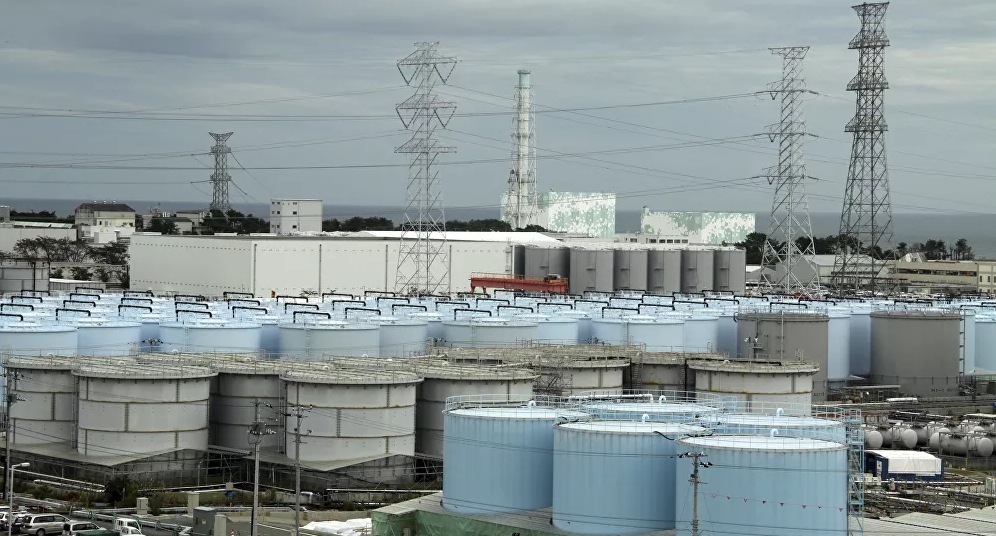
Japan is still dealing with the consequences of the 2011 Fukushima nuclear power plant meltdowns in the wake of an offshore 9.1 earthquake and tsunami. The facility is out of space to store the ever-increasing amount of radiated waste, and the government is about set to release over 1 million tonnes of radioactive water into the Pacific Ocean.
Eco activists are outraged following recent reports from Japanese media concerning a government panel’s intention to approve the release of highly-radioactive water into the ocean. An official announcement is expected to follow at the end of the month.
Authorities must increase storage capacity by constructing tanks outside the plant, nuclear specialists told DW, also accusing the government of hiding the actual radiation level of the water to solve the problem quickly and avoid extra expense. According to the Kahoko Shinpo newspaper, the levels of radioactive elements in processed water are many times above the safe norm. In particular, the level of strontium in water is 100 times above the safety cutoff, while levels of iodine exceed safe levels in at least half of all samples.
Fukushima fisherman are also against the plan, as they fear consumers will lose trust in local marine products.
Since the 11 March, 2011, undersea 9.1 magnitude Tohoku earthquake and subsequent tsunami that killed over 16,000, Japan has been seeking a safe way to get rid of radioactive water that flooded a local nuclear power reactor. Its disposal is one of the main problems of “Fukushima 1” decommissioning.
The damaged reactors must still be cooled with water that becomes highly radiated, and continues to mix with the groundwater through leaks. Thousand of containers currently store over a million tonnes of radiated water and the facility has limited space.
Tokyo has considered using evaporation techniques, but they have not worked quickly enough. Dumping the radiated water directly into the the Pacific Ocean is said by some to be acceptable only if the contaminants are purified by an ALP (Advanced Liquid Processing) filtering system and then diluted with seawater. Following this process, officials claim that no radioactive elements would remain in the water, except tritium, as it is not filterable but deemed safe in very small concentrations.
For ALP, Japan needs two years of preparations and an abundance of expensive hardware.
A magnitude 9.1 earthquake hit Japan on 11 March, 2011. It caused a giant tsunami that disabled the cooling system of the nuclear reactors and led to devastating explosions. The nuclear power plant “Fukushima 1” meltdown and explosion is the most disastrous nuclear incident after Chernobyl in 1986. Over 16,000 were killed and over 6,000 injured, while 160,000 local residents were left homeless. Healing the twon and its inhabitants will take at least 40 years, according to Tokyo.
Aomori wants reassurance that it won’t be final nuclear waste site
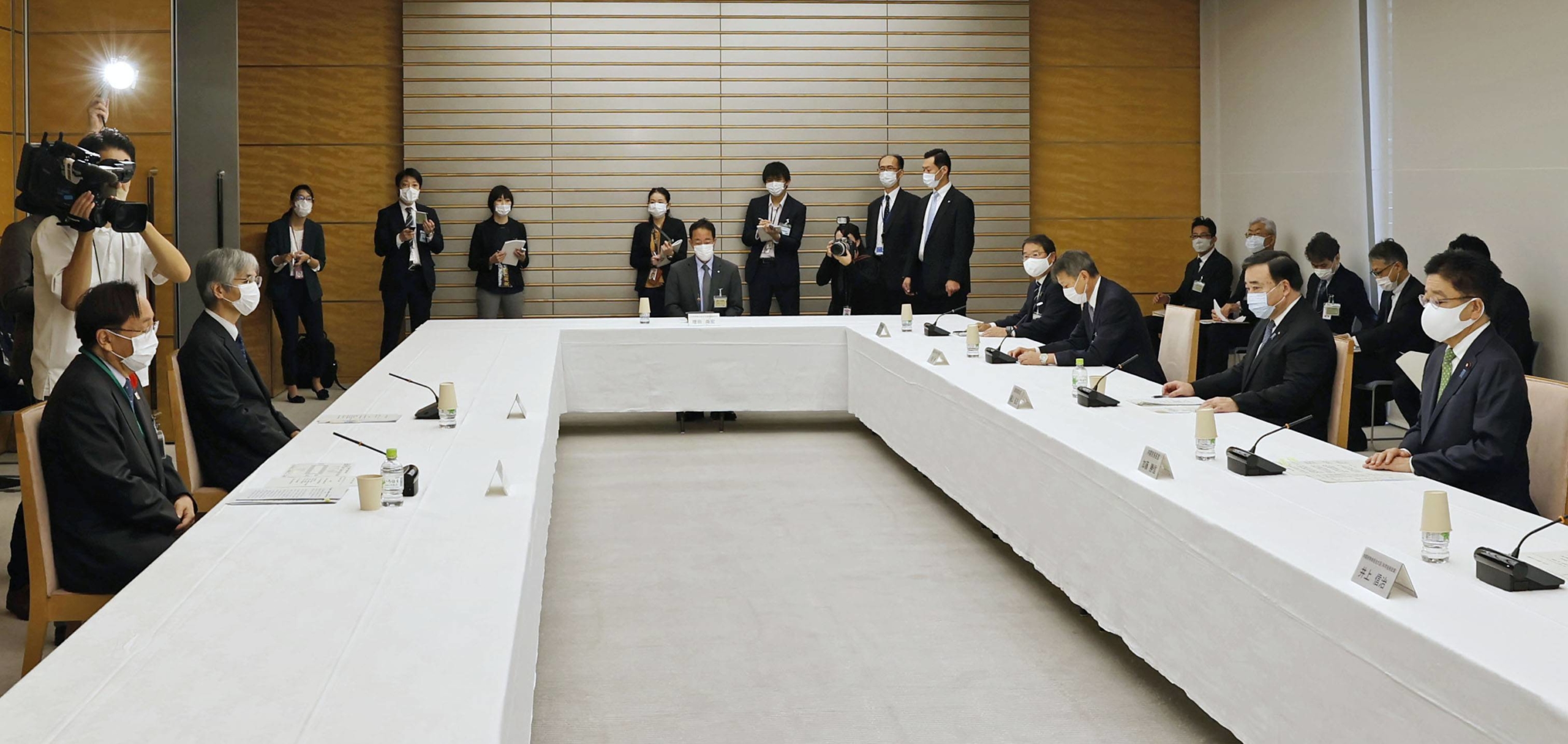
Aomori Gov. Shingo Mimura (left) and Chief Cabinet Secretary Katsunobu Kato (right) attend a meeting of a council for nuclear fuel cycle policy held at the Prime Minister’s Office Wednesday.
Oct 21, 2020
Aomori Prefecture on Wednesday urged the government to reconfirm its policy of not building in the prefecture a facility for the final disposal of high-level radioactive waste from nuclear power plants across the nation.
The request was made during a meeting of a council for discussions on issues related to the country’s nuclear fuel cycle policy between relevant Cabinet ministers and officials of the prefecture, where a spent nuclear fuel reprocessing facility is under construction. It was the first meeting of the council since November 2010.
At the day’s meeting, the Aomori side called on Prime Minister Yoshihide Suga’s Cabinet, launched last month, to maintain the promise not to make the prefecture a final disposal site, upheld by past administrations.
Participants in the meeting, held at the Prime Minister’s Office in Tokyo, included Chief Cabinet Secretary Katsunobu Kato and industry minister Hiroshi Kajiyama from the central government, and Aomori Gov. Shingo Mimura.
“It’s necessary for the state and the operator (of the reprocessing plant) to make the utmost efforts to promote, with support from Aomori, the nuclear fuel cycle policy, including the launch of the plant,” Kato said at the start of the meeting.
Mimura told reporters after the meeting that he asked the central government to abide by the promise and promote the nuclear fuel cycle policy, in which uranium and plutonium are extracted from spent fuel and reprocessed into fuel for use at nuclear power plants.
Mimura indicated that Kato showed the state’s understanding of his requests.
In July, the central government’s Nuclear Regulation Authority concluded that the basic design of the nuclear fuel reprocessing plant in the Aomori village of Rokkasho meets the country’s nuclear safety standards, which were crafted after the March 2011 accident at Tokyo Electric Power Company Holdings Inc.’s tsunami-stricken Fukushima No. 1 nuclear plant.
Japan Nuclear Fuel Ltd. aims to complete the plant in fiscal 2022. The NRA spent over six years screening the Rokkasho facility’s design.
Following the NRA’s conclusion, the Aomori side asked the state to hold a meeting of the nuclear fuel cycle policy council.
Aomori has agreed to accept spent nuclear fuel from nuclear plants across the country on the condition that a final disposal facility is not constructed in the prefecture.
The central government regards the nuclear fuel cycle as a pillar of its nuclear energy strategy.
Besides the reprocessing plant, a facility to make mixed oxide, or MOX, fuel from extracted uranium and plutonium is also under construction at the same site in Rokkasho.
https://www.japantimes.co.jp/news/2020/10/21/national/japan-aomori-nuclear-waste-disposal/
Japan PM vows swift decision on release of Fukushima radioactive water
October 21, 2020
Jakarta – Japanese Prime Minister Yoshihide Suga said Wednesday the government will swiftly decide what to do with treated radioactive water at the crisis-hit Fukushima nuclear power plant following reports of a plan to release the water into the sea.
“We cannot postpone the issue forever. We would like to make a decision responsibly as soon as possible,” Suga told a press conference in Jakarta as he wrapped up his first foreign trip since taking office in mid-September. The premier visited Indonesia and Vietnam.

Photo taken Aug. 26, 2020, at the crippled Fukushima Daiichi nuclear power plant in northeastern Japan, shows tanks for storing treated water from which most of the radioactive contamination has been removed.
“There has been no decision on when or how to deal with the water,” Suga said. The government plans to deepen discussions on the matter and work on measures to prevent reputational damage linked to radiation, he added.
Local fishermen have expressed worries while China and South Korea have cast a wary eye on the issue after it was reported that an official decision on the discharge of water from the Fukushima Daiichi nuclear plant, crippled by the 2011 devastating earthquake and tsunami, may be made by the end of this month.
The Fukushima plant operated by Tokyo Electric Power Company Holdings Inc. has been generating massive amounts of radiation-tainted water since the accident as it needs water to cool the reactors, which suffered core meltdowns.
The water has been treated using an advanced liquid processing system, or ALPS, to remove most contaminants other than the relatively less toxic tritium. It is stored in tanks on the facility’s premises.
But space is expected to run out by the summer of 2022, with contaminated water increasing by about 170 tons per day. As of September this year, the stored water totaled 1.23 million tons and continues to grow.
Seoul mulls response to Fukushima water release

Demonstrators protest the Japanese government’s plan to discharge contaminated water into the ocean in front of the old Japanese Embassy in Seoul on Monday.
October 20, 2020
Seoul authorities are mulling how to respond to Japan’s impending decision on discharging radioactive water from the devastated Fukushima nuclear plant into the sea, which could heighten concerns on public safety and environment here.
Tokyo is set to formally decide on Oct. 27 as to what to do with the more than 1 million tons of contaminated water it has collected since the Fukushima Daiichi nuclear plant was damaged by an earthquake and tsunami in 2011. Japanese media outlets said Tokyo has already made up its mind to dispose of the treated water that has been filtered to reduce radioactivity into the ocean, as the most “realistic option.”
As of Tuesday, the South Korean Foreign Ministry had not decided how to respond if its neighbor to the east presses ahead with the discharge. The government is handling the issue at a vice-ministerial meeting of related agencies to monitor Tokyo’s activities and come up with measures.
“The government has continued to call for Japan to share transparent information in regards to the disposal of the contaminated water of the Fukushima nuclear plant and has stressed the need to communicate with the international community,” Lee Jae-woong, the ministry’s deputy spokesman, said during a regular press briefing. “The government, with the foremost priority placed on the protection of our citizens’ health and safety, will devise measures in cooperation with the international community.”
The main concern for Korea is that the water, which has been filtered but is still slightly radioactive, could reach South Korea and threaten the safety of the waters and environment here, as well as of other neighboring nations that share the Pacific Ocean. Environmental activists have expressed strong opposition to the discharge, while fishermen and farmers in Japan have voiced concerns that consumers would shun seafood and produce from the region.
For years Japan has been debating how to dispose of the contaminated water, which has been stored in thousands of tanks inside the plant. But Tokyo Electric Power, the state-run operator of the plant, said the storage space is expected to run out in the summer of 2022.
Earlier this year, a panel of experts advising the Japanese government said that disposing of the water in the sea or vaporizing and releasing it into the air are the most “realistic options.” The International Atomic Energy Agency said that both of Japan’s options are technically feasible and have been used by other nuclear power plants around the world.
If Japan decides to discharge it, the water could be dumped as early as 2022, given the time needed for preparations.
The discharging of the water, regardless of what impact it will have on the environment and health, could further deal a blow to bilateral ties between Seoul and Tokyo, which is already frayed over issues of wartime history and trade.
Jeju Island Gov. Won Hee-ryong on Tuesday warned that his government will lodge a lawsuit against Japan both domestically and at the international court should Tokyo decide to discharge the water into the ocean. Research says the wastewater could reach the coastal areas of the southern resort island before any other location outside of Japan.
He also called Japan to disclose all information transparently regarding the contaminated water, and to discuss the issue with other neighboring countries.
By Ahn Sung-mi
1 This Month

of the week – Shut Down Drone Warfare!


Tell the Ukrainian Government to Drop Prosecution of Peace Activist Yurii Sheliazhenko

Petition to revoke the licensing of the Near Surface Nuclear Disposal Facility (NSDF) at Chalk River. https://www.ourcommons.ca/petitions/en/Petition/Details?Petition=e-7247
To see nuclear-related stories in greater depth and intensity – go to https://nuclearinformation.wordpress.com
-
Archives
- April 2026 (34)
- March 2026 (251)
- February 2026 (268)
- January 2026 (308)
- December 2025 (358)
- November 2025 (359)
- October 2025 (376)
- September 2025 (257)
- August 2025 (319)
- July 2025 (230)
- June 2025 (348)
- May 2025 (261)
-
Categories
- 1
- 1 NUCLEAR ISSUES
- business and costs
- climate change
- culture and arts
- ENERGY
- environment
- health
- history
- indigenous issues
- Legal
- marketing of nuclear
- media
- opposition to nuclear
- PERSONAL STORIES
- politics
- politics international
- Religion and ethics
- safety
- secrets,lies and civil liberties
- spinbuster
- technology
- Uranium
- wastes
- weapons and war
- Women
- 2 WORLD
- ACTION
- AFRICA
- Atrocities
- AUSTRALIA
- Christina's notes
- Christina's themes
- culture and arts
- Events
- Fuk 2022
- Fuk 2023
- Fukushima 2017
- Fukushima 2018
- fukushima 2019
- Fukushima 2020
- Fukushima 2021
- general
- global warming
- Humour (God we need it)
- Nuclear
- RARE EARTHS
- Reference
- resources – print
- Resources -audiovicual
- Weekly Newsletter
- World
- World Nuclear
- YouTube
-
RSS
Entries RSS
Comments RSS
 nuclear-news