Fukushima Nuclear Disaster | Increased Thyroid Cancer in U.S.
From 2013
Almost one third of children born on the Pacific coast of the United States are now at high risk for thyroid cancer (and a host of other cancers that will be revealed over time.) The inevitable has happened. Radioactive Cesium isotopes from the leaking nucelar reactors in Fukushima, Japan have reached our Pacific shores and are contaminating our ocean, our, soil, our air, our food supply and our born and unborn children. This is only the shadow of things to come over the decades ahead.
When DNA, our genetic material is damaged, the beginnings of cancer are at hand. Many cancers begin 20-30 years before diagnosis. So we really will not know all of the devastating health consequences of this nuclear disaster so far from our shores for a long long time. Pay attention. Cancer rates are sure to rise.
The fetus in the uterus of pregnant women, infants and young children, because they are growing so quickly and so their cells are dividing at a high rate and thus more vulnerable to DNA damage and are much more vulnerable to the dangers of radiation exposure. Now we are seeing the troubling results that are the tip of the iceberg. I am reprinting this disturbing post from Nation of Change, on the tangible what we know is happening to our children…Thyroid Cancer risk. Many of the fish on the Pacific Coast have Cesium in their flesh. Now are food is contaminated and radioactive as well. Pay attention, radioactivity is invisible and insidious
Third of US West Coast Children Hit with Thyroid Problems Following Fukushima By Anthony Gucciardi
Still think that the Fukushima nuclear meltdown of 2011 never affected the United States public? Young children born in the United States West Coast, right in the line of fire for radioactive isotopes, have been found to be 28 percent more likely to develop congenital hypothyroidism than infants born the year before the incident.
The study followed children born in California, Alaska, Washingto, Hawaii, and Oregon between 1 and 16 weeks after the horrific meltdown at Fukushima back in March 2011. Published in the Open Journal of Pediatrics by researchers affiliated with the Radiation and Public Health Project, the information further lends credence to previous documentation regarding the way in which radioactive fallout ended up on US soil.
The researchers explained how radioactive fallout affected the entirety of the US in varying degrees:
“Fukushima fallout appeared to affect all areas of the U.S., and was especially large in some, mostly in the western part of the nation,” they wrote.
Fukushima’s Effects on The US
The findings are likely no surprise to those who have been following the effects of Fukushima closely, as back in 2011 numerous reports surfaced regarding the ways in which Fukushima’s radioactive waste had made its way to the US geography in a big way. Despite Japanese officials downplaying the incident and its real devastating health consequences, even so much as to ignore the fact that Fukushima radiation was detected in Tokyo far beyond the evacuation zone, US scientists were quick to reveal their own measurements to the scientific community.
Even more shocking is the fact that hot particles, which are highly radioactive objects, have been found at 2 out of 3 Boston monitoring stations. In a new video report, nuclear experts detail the coming health epidemic that my result from Fukushima radiation: Read more
Scientists from UC Berkeley detailed even more concerning reports following the disaster, finding the highest cesium content in topsoil for each California location was consistent. The recordings were posted online along with the date of finding:
- Sacramento, CA Topsoil on Aug. 16, 2011: Total Cesium @ 2.737 Bq/kg
- Oakland, CA Topsoil on Sept. 8, 2011: Total Cesium @ 2.55 Bq/kg
- Alameda, CA Topsoil on Apr. 6, 2011: Total Cesium @ 2.52 Bq/kg
- San Diego, CA Topsoil on June 29, 2011: Total Cesium @ 2.51 Bq/kg
- Sonoma, CA Topsoil on Apr. 27, 2011: Total Cesium @ 2.252 Bq/kg
But the levels were nothing compared to what Marco Kaltofen, PE, of the Department of Civil & Environmental Engineering at Worcester Polytechnic Institute (WPI) recorded from his research. In his report presentation, entitled ‘Radiation Exposure to the Population in Japan After the Earthquake’, Kaltofen found samples on US soil that were 108 times greater than what UC Berkley researchers were reporting.
Fukushima unveils plans to become renewable energy hub
Japan aims to power region, scene of 2011 meltdown, with 100% renewable energy by 2040
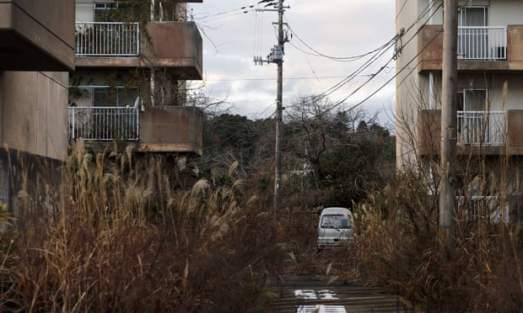 Weeds grow in an abandoned apartment complex in Futaba, Fukushima prefecture.
Jan 5, 2020
Fukushima is planning to transform itself into a renewable energy hub, almost nine years after it became the scene of the world’s worst nuclear accident for a quarter of a century.
The prefecture in north-east Japan will forever be associated with the triple meltdown at the Fukushima Daiichi nuclear power plant on 11 March 2011, but in an ambitious project the local government has vowed to power the region with 100% renewable energy by 2040, compared with 40% today.
The 2011 accident, triggered by a powerful earthquake and tsunami, sent large quantities of radiation into the atmosphere and forced the evacuation of more than 150,000 residents.
The 300bn yen ($2.75bn) project, whose sponsors include the government-owned Development Bank of Japan and Mizuho Bank, will involve the construction of 11 solar and 10 wind farms on abandoned farmland and in mountainous areas by the end of March 2024, according to the Nikkei Asian Review.
A 80km grid will connect Fukushima’s power generation with the Tokyo metropolitan area, once heavily dependent on nuclear energy produced at the prefecture’s two atomic plants. When completed, the project will generate up to 600 megawatts of electricity, roughly two-thirds the output of an average nuclear power plant.
Despite the Fukushima disaster, the world’s worst nuclear accident since Chernobyl in 1986, Japan’s conservative government is pushing to restart idle reactors.
It wants nuclear power, which generated almost a third of the country’s power before Fukushima, to make up between 20% and 22% of its overall energy mix by 2030, drawing criticism from campaigners who say nuclear plants pose a danger given the country’s vulnerability to earthquakes and tsunami.
All of Japan’s 54 reactors were shut down after the Fukushima meltdown. Nine reactors are in operation today, having passed stringent safety checks introduced after the disaster.
Renewables accounted for 17.4% of Japan’s energy mix in 2018, according to the Institute for Sustainable Energy Policies, well below countries in Europe. The government iaims to increase this to between 22% and 24% by 2030 a target the prime minister, Shinzo Abe, has described as ambitious but which climate campaigners criticise as insufficient.
Abe insists nuclear energy will help Japan achieve its carbon dioxide emissions targets and reduce its dependence on imported gas and oil, but his recently appointed environment minister, Shinjiro Koizumi, has called for the country’s nuclear reactors to be scrapped to prevent a repeat of the Fukushima disaster.
“We will be doomed if we allow another nuclear accident to occur. We never know when we’ll have an earthquake,” Koizumi said when he joined Abe’s cabinet in September.
The government is unlikely to meet its target of 30 reactor restarts by 2030 given strong local opposition and legal challenges.
Japan faces mounting international criticism over its dependence on imported coal and natural gas. It received the “fossil of the day” award from the Climate Action Network at last month’s UN climate change conference in Madrid after its industry minister announced plans to continue using coal-fired power.
Japan is the third-biggest importer of coal after India and China, according to the US Energy Information Administration. Its megabanks have been urged to end their financing of coal-fired plants in Vietnam and other developing countries in Asia.
‘Korea should take leading role in stopping Japan from discharging radioactive water’

Fukushima Reactor Cleanup Delayed by Five Years as Japanese Public Demands End to Nuclear Energy
After proposing dumping radioactive water from Fukushima reactors into sea, Japan’s government now adds the idea of allowing the treated but still contaminated water to evaporate into the air. Breathe deep
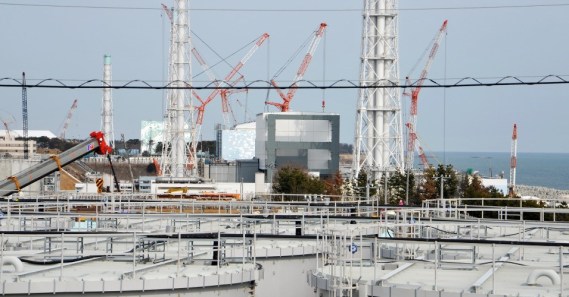 Water tanks holding contaminated water in front of the reactor buildings at Fukushima Daiichi.
December 30, 2019
The delay comes days after Japan’s government proposed releasing contaminated water from the plant into the ocean.
The Japanese government said Friday it would delay for a fourth time the removal of spent fuel from two of the reactors at the Fukushima Daichii nuclear power plant, causing concern that the cleanup of one of the worst nuclear disasters in history is happening at a dangerously slow pace.
The removal of the spent fuel was planned to begin in 2023, but the process was bumped back to 2024 at the earliest for the plant’s No. 1 reactor and 2027 or later for the No. 2 reactor.
According to the Japan Times, the government claims this aspect of the clean-up is being delayed due to safety concerns and that it plans to construct barriers around the reactors to prevent the spread of radioactive dust.
Reporting on the delay comes days after the Ministry of Economy, Trade, and Industry proposed releasing contaminated water from the plant into the ocean or allowing it to evaporate, and weeks after the ministry said the water contained higher levels of radioactive material than previously thought.
The most recent news about the cleanup process—which is under a 30-40 year plan following the 2011 earthquake and tsunami which forced more than 100,000 residents to evacuate the rural Fukushima region to avoid nuclear contamination from the plant—raised alarm among critics of nuclear power.
The Japanese public has reportedly grown increasingly anti-nuclear power since the Fukushima disaster, according to an Al Jazeera report earlier this month.
“Japanese people’s sentiment changed after Fukushima Daiichi and it is continuing until now,” Hajime Matsukubo, secretary-general of the Citizens’ Nuclear Information Center, told Al Jazeera. “They say no.”
In a 2015 poll by the Japan Atomic Energy Relations Organization, only 10 percent of Japanese respondents said the country should maintain its use of nuclear energy.
https://www.commondreams.org/news/2019/12/30/fukushima-reactor-cleanup-delayed-five-years-japanese-public-demands-end-nuclear?fbclid=IwAR0cWj8VpXce8X8kXt4Lzg2YlFL3PBZDeuEMtGCTHWD1jpQnzpYpdPwGP9I
Spent MOX fuel to be removed from Ikata nuke plant No. 3 reactor in January
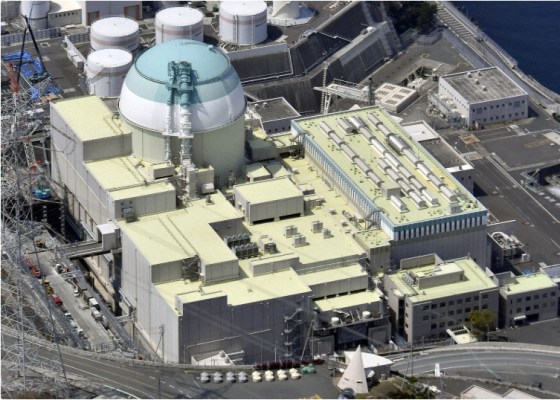 This April 2, 2018 file photo shows the No. 3 reactor at the Ikata nuclear power plant in Ehime Prefecture, western Japan
December 26, 2019
MATSUYAMA, Japan (Kyodo) — A reactor at a nuclear power plant in Ehime Prefecture, western Japan, was shut down Thursday in preparation for the removal of spent mixed oxide fuel, a first in the country.
Shikoku Electric Power Co. plans to take out 37 spent fuel rods, 16 of which are MOX, from the Ikata plant’s No. 3 unit in January.
The utility will load five new MOX fuel rods, as well as replace the reactor’s control unit, before restarting it in late March and resuming commercial operation in late April.
MOX is made using recycled plutonium and uranium and tends to run hotter than the low-enriched uranium more widely used in thermal reactors such as the No. 3 unit.
Shikoku Electric has said it will temporarily store the spent MOX in a cooling pool within the Ikata plant, but as Japan currently does not have the necessary reprocessing facilities, it is unclear where the fuel will end up.
https://mainichi.jp/english/articles/20191226/p2g/00m/0dm/038000c
UK’s planned Sizewell power station likely to become a ‘nuclear island’
Rising sea levels could turn new Sizewell power station into ‘nuclear island’ East Anglian Daily Times, 10 January, 2020, Andrew Hirst
Surging sea levels due to climate change could mean new power station Sizewell C is cut off by the water within decades, a top scientist has warned.
Small Modular Nuclear Reactors’ costs and toxicity

Small modular nuclear reactors – a case of wishful thinking at best, NB Media Cop. by Gordon Edwards, Michel Duguay, Pierre Jasmin, 21 Dec 19
“……….4 Small Modular – Nuclear – Reactors’ costs & toxicity
That Carnegie-Mellon report includes Small Modular Nuclear Reactors in its analysis, without being any more hopeful than we are. This is mainly because a new generation of smaller reactors, such as those promised for New Brunswick, will necessarily be more expensive per unit of energy produced, if manufactured individually. The sharply increased price can be partially offset by mass production of prefabricated components; hence the need for selling hundreds or even thousands of these smaller units in order to break even and make a profit. However, the order book is filled with blank pages — there are no customers. This being the case, finding investors is not easy. So entrepreneurs are courting governments to pony up with taxpayers’ money, in the hopes that this second attempt at a Nuclear Renaissance will not be the total debacle that the first one turned out to be.
Chances are very slim however. There are over 150 different designs of “Small Modular Reactors.” None of them have been built, tested, licensed or deployed. At Chalk River, Ontario, a consortium of private multinational corporations, comprised of SNC-Lavalin and two corporate partners, operating under the name “Canadian Nuclear Laboratories” (CNL), is prepared to host six or seven different designs of Small Modular Nuclear Reactors — none of them being identical to the two proposed for New Brunswick – and all of these designs will be in competition with each other. The Project Description of the first Chalk River prototype Small Modular Reactor has already received over 40 responses that are posted on the CNSC web site, and virtually all of them are negative comments.
The chances that any one design will corner enough of the market to become financially viable in the long run is unlikely. So the second Nuclear Renaissance may carry the seeds of its own destruction right from the outset. Unfortunately, governments are not well equipped to do a serious independent investigation of the validity of the intoxicating claims made by the promoters, who of course conveniently overlook the persistent problem of long-lived nuclear waste and of decommissioning the radioactive structures. These wastes pose a huge ecological and human health problem for countless generations to come.
Finally, in the list of projects being investigated, one finds a scaled-down “breeder reactor” fuelled with plutonium and cooled by liquid sodium metal, a material that reacts violently or explodes on contact with air or water. The breeder reactor is an old project abandoned by Jimmy Carter and discredited by the failure of the ill-fated French SuperPhénix because of its extremely dangerous nature. In the event of a nuclear accident, the Tennessee Clinch River Breeder Reactor was judged capable of poisoning twelve American states and the SuperPhénix half of France.
One suspects that our three premiers are only willing to revisit these bygone reactor designs in order to obtain funding from the federal government while avoiding responsibility for their inaction on more sensible strategies for combatting climate changes – cheaper, faster and safer alternatives, based on investments in energy efficiency and renewable sources.
By Gordon Edwards PhD, President of the Canadian Coalition for Nuclear Responsibility; with assistance by Michel Duguay, PhD, professor at Laval University & Pierre Jasmin, UQAM, Quebec Movement for Peace and Artiste pour la Paix. https://nbmediacoop.org/2019/12/21/small-modular-nuclear-reactors-a-case-of-wishful-thinking-at-best/
Gordon Edwards, PhD ccnr@web.ca
Michel Duguay, PhD michel.duguay@gel.ulaval.ca
Pierre Jasmin, jasmin.pierre@uqam.ca
This article is also published in French, link here.

World Nuclear Industry Status Report 2019 dispels the illusion of nuclear power as a fix for climate change
 World Nuclear Industry Status Report 2019. (Picture at left is of cover of 2017 report) Tom Burke 8th Jan 2020,
At a time when truth is under systematic political attack and digital technologies are collapsing the public attention span, the publication of long data series such as the Nuclear Industry Status Report becomes
increasingly important.
Nowhere is this more true than when it comes to dealing with nuclear issues where a loss of perspective, a failure of memory, a persistent illusion, can have catastrophic consequences. This remains true whether you arethinking about nuclear energy or nuclear weapons.
high electricity costs for businesses and consumers; a massive waste of
public money; the unproductive diversion of scare engineering talent and
material resources and to an as yet uncounted cost for managing the
back-end of the nuclear fuel cycle.
fuels in the existing electricity system and even more so for the more
electricity intensive global economy we are currently building.
to triple. To build enough to replace fossil fuels would be a global
project far bigger than the Manhattan Project or the us Moonshot.
unsolved problems that nuclear reactors face: affordability, accidents,
waste management, proliferation, special materials and talent scarcity and
system inflexibility. In the real world however, there will not be
unlimited capital and other resources available to deal with climate
change. And there is no time.
energy investment, every further pound invested in nuclear power will delay
the achievement of the government’s net zero by 2050 goal. The Prime
Minister has begun a review of departmental spending. He is looking to
identify unnecessary or inappropriate projects. Cancelling the remainder of
the current nuclear programme would meet this goal admirably. It would also
free up resources for the manifesto commitment to energy efficiency that
would get both carbon emissions and energy bills down.http://tomburke.co.uk/2020/01/08/remarks-by-tom-burke-at-the-launch-of-the-world-nuclear-industry-report-2019-chatham-house/
UK’s competition watchdog to investigate Jacobs’ acquisition of Wood Nuclear Limited
Times and Star 9th Jan 2020, The proposed £250 million acquisition of a major player in the clean-up of the Sellafield site in West Cumbria could be blocked. The Competition and Markets Authority (CMA) has launched an investigation into global engineering firm Jacobs’ acquisition of Wood Nuclear Limited – the nuclear arm of the Wood Group.
The proposal deal – announced in August last year – would see Wood Nuclear Limited along with “subsidiary and certain affiliated companies” come under control of Jacobs’ UK division. Jacobs would also take on existing contracts held by the business – which include managing the Design and Engineering lot for the Programme and Project Partners (PPP) framework.
20-year contract awarded last year by Sellafield Limited as part of its push to “revolutionise” the decommissioning of the site, could be worth up to £769 million. Wood’s nuclear division is already a long-standing big tier company at Sellafield and, in December was awarded a £50m contract to provide programmable digital control technologies to the plant.
Pro -war opinion in Washington Post, -but the author is, quietly, a board member of weapons company Raytheon
 Washington Post Runs Pro-War Column Without Disclosing Author’s Raytheon Ties, TruthOut, Robert Galbraith, Eyes on the Ties-January 10, 2020
This week The Washington Post published an opinion column by Stephen Hadley, a former Bush administration official and member of the board of directors of Raytheon. In his op-ed, Hadley justified the Trump administration’s assassination of Iranian military commander Qasem Soleimani and argued that the United States should keep its military force in Iraq. Hadley wrote that killing Soleimani was “a bold move with potentially far-reaching consequences. It unquestionably heightens the risk of war; it could also open the door to diplomacy.”
For Hadley, a heightened risk of war could mean big profits, though this is not noted anywhere in his piece.
The Post, which adopted the motto “Democracy dies in darkness” after President Donald Trump’s attacks on it and other U.S. media institutions, described Hadley as national security advisor to former President George W. Bush. However, it did not disclose that Hadley sits on the board of directors of the weapons manufacturer Raytheon, as Adam Johnson noted on Twitter. Hadley earned $304,946 in cash and stock from Raytheon last year, and owns shares in the company worth more than $2.4 million.
Hadley is far from the only defense industry-tied pundit praising the Trump administration’s escalation of hostility with Iran without reporting their profit motive in pushing the U.S. towards war. As Lee Fang reported in the Intercept, other figures — such as David Petraeus, Jeh Johnson, Jack Keane, and John Negroponte — have also been doing a media circuit defending Soleimani’s assassination. Keane and Negroponte both figured in our earlier report on Syria as well……..
We will continue to monitor the media outlets giving a platform to military industry representatives without disclosing their corporate ties throughout the coming weeks and months. https://truthout.org/articles/washington-post-runs-pro-war-column-without-disclosing-authors-raytheon-ties/?eType=EmailBlastContent&eId=08b186de-b971-4949-b6b1-4ce07a2e3cf6
Small Modular Nuclear Reactors – a wasteful distraction from real efforts to combat climate change

Small modular nuclear reactors – a case of wishful thinking at best, NB Media Cop. by Gordon Edwards, Michel Duguay, Pierre Jasmin, 21 Dec 19“…….3 Climate changes’ valid preoccupation (1)
Many people concerned about climate change want to know more about the moral and ethical choices regarding low-carbon technologies: “Don’t we have a responsibility to use nuclear?” The short reply is: nuclear is too slow and too expensive. The ranking of options should be based on what is cheapest and fastest — beginning with energy efficiency, then on to off-the-shelf renewables like wind and solar energy.
In Germany, Dr. David Jacobs, founder of International Energy Transition Consulting, is proudly mentioning the green energy sector’s contribution in achieving the lowest unemployment rate since reunification of his country in the early 1990s. Post-Fukushima Angela Merkel’s decision to close down all of its nuclear reactors by 2022 has pushed the country to purchase photovoltaic solar panels and 30,000 megawatts of wind energy capacity in only 8 years: an impressive achievement – more than twice the total installed nuclear capacity of Canada. It would be impossible to build 30,000 megawatts of nuclear in only 8 years. By building wind generators, Germany obtained some carbon relief in the very first year of construction, then got more benefit in the second year, even more benefit in the third, and so on, building up to a cumulative capacity of 30,000 MWe after 8 years.
With nuclear, even if you could manage to build 30,000 megawatts in 8 years, you would get absolutely no benefit during that entire 8-year construction period. In fact you would be making the problem worse by mining uranium, fabricating fuel, pouring concrete and building the reactor core and components, all adding to greenhouse gas emissions – earning no benefit until (and IF) everything is finally ready to function. In the meantime (10 to 20 years), you will have starved the efficiency and renewable alternatives of the funds and political will needed to implement technologies that can really make an immediate and substantial difference.
In Saskatchewan, professor Jim Harding, who was director of Prairie Justice Research at University of Regina where he headed up the Uranium Inquiries Project, has offered his own reflection; here is the conclusion of his December 2, 2019 comment:
““In short, small reactors are another distraction from Saskatchewan having the highest levels of GHGs on the planet – nearly 70 metric tonnes per capita. While the rest of Canada has been lowering emissions, those here, along with Alberta with its high-carbon tar sands, have continued to rise. Saskatchewan and Alberta’s emissions are now almost equal to all the rest of Canada. Shame on us!”
In the USA, engineers and even CEOs of some of the leading nuclear companies are admitting that the age of nuclear energy is virtually over in North America. This negative judgment is not coming from people who are opposed to nuclear power, quite the opposite — from people lamenting the decline. See, for example, one major report from the Engineering faculty at Carnegie-Mellon University.
Thousands march in Australian cities protesting government inaction on climate change
 Sydney CBD climate protest attracts over 30,000 people, SMH, By Janek Drevikovsky and Matt Bungard, January 10, 2020 — More than 30,000 protesters brushed off hot and humid conditions to voice their displeasure at the federal government’s handling of the bushfire crisis and its attitude towards climate change.The event in Sydney’s CBD was set up a few weeks ago by Uni Students for Climate Justice, in conjunction with Extinction Rebellion…….
Protesters chanted, “Hey hey, ho ho ScoMo has got to go” as speakers climbed Town Hall’s side steps, and later moved on to “The liar from the shire, the country is on fire”.
She was given a move-on order by police while protesting outside Kirribilli House last September. Her hope is that Friday’s protest will create change……….
Protests also took place in other Australian capital cities. https://www.smh.com.au/environment/climate-change/sydney-cbd-climate-protest-attracts-thousands-20200110-p53qhq.html?promote_channel=edmail&mbnr=MTM2NDAwMjM&eid=email:nnn-13omn655-ret_newsl-membereng:nnn-04%2F11%2F2013-news_pm-dom-news-nnn-smh-u&campaign_code=13INO009&et_bid=292
Bradwell nuclear power plan – foolish, in view of climate change predictions
 BANNG 8th Jan 2020, As we enter a new year, Andy Blowers muses on the massive challenge of climate change that lies ahead, globally and locally, in the column for Regional Life, January 2020.
In East Anglia, we are increasingly aware of record heatwaves, milder and wetter winters, retreating coastlines and loss of precious habitats and declining and disappearing species. To an extent, these may be tackled by adaptive measures such as managed retreat of the coastline or hard defences. Even then, land loss and inundation will be unavoidable.
The idea of a massive nuclear power station at Bradwell on a
site threatened by the impacts of climate change seems foolish in the
extreme. Far better to go for cheaper, less risky and easily deployable
renewable options. Concerted action worldwide and locally, by governments,
businesses and individuals, is needed now if we are to reduce carbon
emissions to net zero and avert catastrophe. That was a clear message from
the General Election. Now we must get on with it.
The twin horrors of nuclear weapons and climate change
At a time when major nuclear arms’ treaties are being orphaned and climate disruption is ballooning, many are asking if there are connections between these twin threats to Creation. The answer is an obvious and uncomfortable yes.
As conventional nuclear reactors fail economically, the pro nuclear turn to the fantasy of small nuclear reactors

Small modular nuclear reactors – a case of wishful thinking at best, NB  Media Coop, by Gordon Edwards, Michel Duguay, Pierre Jasmin, 21 Dec 19
On Friday the 13th, September 2019, the Saint John Telegraph-Journal’s front page was dominated by what many readers hoped will be a good luck story for New Brunswick – making the province a booming and prosperous Nuclear Energy powerhouse for the entire world. After many months of behind-the-scenes meetings throughout New Brunswick with utility company executives, provincial politicians, federal government representatives, township mayors and First Nations, two nuclear entrepreneurial companies laid out a dazzling dream promising thousands of jobs – nay, tens of thousands! – in New Brunswick, achieved by mass-producing and selling components for hitherto untested nuclear reactors called SMNRs (Small Modular Nuclear Reactors) which, it is hoped, will be installed around the world by the hundreds or thousands!
On December 1, the Saskatchewan and Ontario premiers hitched their hopes to the same nuclear dream machine through a dramatic tripartite Sunday press conference in Ottawa featuring the premiers of the provinces. The three amigos announced their desire to promote and deploy some version of Small Modular Nuclear Reactors in their respective provinces. All three claimed it as a strategy to fight climate change, and they want the federal government to pledge federal tax money to pay for the R&D. Perhaps it is a way of paying lip service to the climate crisis without actually achieving anything substantial; prior to the recent election, all three men were opposed to even putting a price on carbon emissions.
Motives other than climate protection may apply. Saskatchewan’s uranium is in desperate need of new markets, as some of the province’s most productive mines have been mothballed and over a thousand uranium workers have been laid off, due to the global decline in nuclear power. Meanwhile, Ontario has cancelled all investments in over 800 renewable energy projects – at a financial penalty of over 200 million dollars – while investing tens of billions of dollars to rebuild many of its geriatric nuclear reactors. This, instead of purchasing surplus water-based hydropower from Quebec a lot less expensive and more secure.
In a December 2 interview on QUB radio, Gilles Provost, spokesperson for the Ralliement contre la pollution radioactive (Movement against radioactive pollution, a Quebec-based group) and former environmental journalist at Le Devoir, criticized the announcement of the three premiers as ill-considered and premature, since none of the conjectural nuclear reactor prototypes exist in reality. Quite a contrast to the three premiers’ declarations, boldly claiming that “SMRs” (they leave out the “N” to minimize public opposition) will help solve climate change, knowing full well that it will take a decade or more before any benefits can possibly be realized – IF EVER.
These new nuclear reactors are so far perfectly safe, because they exist only on paper and are cooled only by ink. Declaring them a success before they are built is quite a leap of faith, especially in light of the three previous Canadian failures in this field of “small reactors.” Two 10-megawatt MAPLE reactors were built at Chalk River and never operated because of insuperable safety concerns, and the 10-megawatt “Mega-Slowpoke” district heating reactor never earned a licence to operate, again because of safety concerns. The Mega-Slowpoke was offered free of charge to two universities – Sherbrooke and Saskatchewan –both of whom refused the gift. And a good thing too, as the only Mega-Slowpoke ever built (at Pinawa, Manitoba) is now being dismantled without ever producing a single useful megawatt of heat.
2 “Nuclear renaissance” – clambering out of the dark ages?
This current media hype about modular reactors is very reminiscent of the drumbeat of grandiose expectations that began around 2000, announcing the advent of a Nuclear Renaissance that envisaged thousands of new reactors — huge ones! — being built all over the planet. That initiative turned out to be a complete flop. Only a few large reactors were launched under this banner, and they were plagued with enormous cost-over-runs and extraordinarily long delays, resulting in the bankruptcy or near bankruptcy of some of the largest nuclear companies in the world – such as Areva and Westinghouse – and causing other companies to retire from the nuclear field altogether – such as Siemens.
Speculation about that promised Nuclear Renaissance also led to a massive (and totally unrealistic) spike in uranium prices, spurring uranium exploration activities on an unprecedented scale. It ended in a near-catastrophic collapse of uranium prices when the bubble burst. Cameco was forced to close down several mines. They are still closed. The price of uranium has still not recovered from the plunge.
Large nuclear reactors have essentially priced themselves out of the market. Only Russia, China and India have managed to defy those market forces with their monopoly state involvements. Nevertheless, the nuclear contribution to world electricity production has plummeted from 17 percent in 1997 to about 10 percent in 2018. In North America and Western Europe, the prospects for new large reactor projects are virtually nil, and many of the older reactors are shutting down permanently without being replaced. By Gordon Edwards PhD, President of the Canadian Coalition for Nuclear Responsibility; with assistance by Michel Duguay, PhD, professor at Laval University & Pierre Jasmin, UQAM, Quebec Movement for Peace and Artiste pour la Paix. https://nbmediacoop.org/2019/12/21/small-modular-nuclear-reactors-a-case-of-wishful-thinking-at-best/
1 This Month
26 April – Chernobyl: Inside the Meltdown airs on National Geographic on Sunday 26th April from 4pm

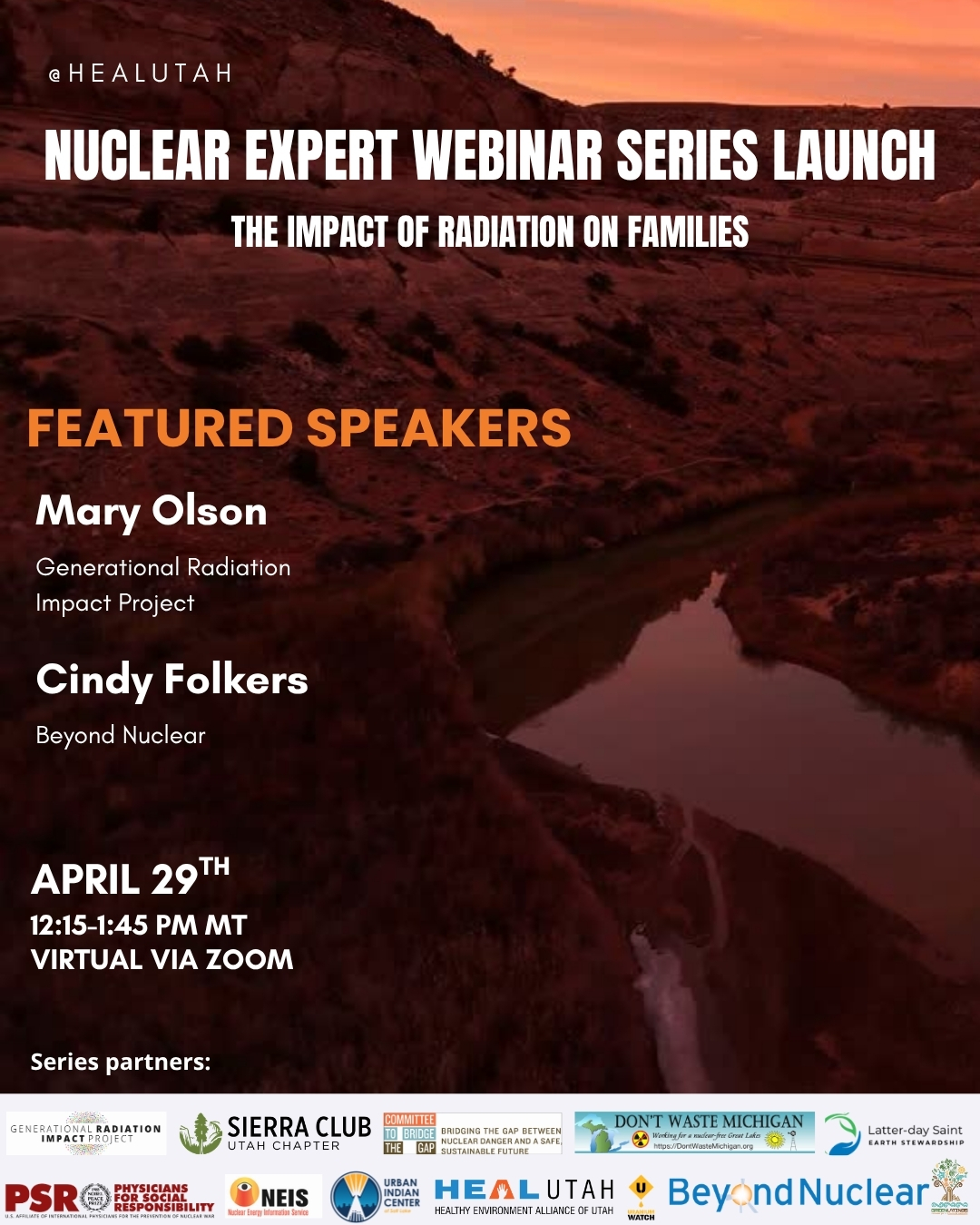
29 April – Nuclear Expert Webinar #1 – Radiation Impacts on Families with Mary Olson and Cindy Folkers
- 12:15 PM MT – 1:45 PM MT
- Location: Virtual – REGISTER TODAY

4 May -West Suburban Peace Coalition to discuss Iran war at May Educational Forum
Monday, May 4, 7:00 – 8:00 PM Central Standard Time
Title: : How Trump’s Narrative Tries to Shape the Reality of the War on Iran.
Contact Walt Zlotow, zlotow@hotmail.com 630 442 3045 for further information
14 May – online event From Bombs to Data Centres: the Face of Nuclear Colonialism

Pine Ridge Uranium is the real threat, not Tehran- Tell Burgum: Stop the Extraction.
Chernobyl: The Lost Tapes – A good documentary on Chernobyl on SBS available On Demand for the next 3 weeks– https://www.sbs.com.au/ondemand/tv-program/chernobyl-the-lost-tapes/2352741955560
To see nuclear-related stories in greater depth and intensity – go to https://nuclearinformation.wordpress.com
-
Archives
- April 2026 (317)
- March 2026 (251)
- February 2026 (268)
- January 2026 (308)
- December 2025 (358)
- November 2025 (359)
- October 2025 (376)
- September 2025 (257)
- August 2025 (319)
- July 2025 (230)
- June 2025 (348)
- May 2025 (261)
-
Categories
- 1
- 1 NUCLEAR ISSUES
- business and costs
- climate change
- culture and arts
- ENERGY
- environment
- health
- history
- indigenous issues
- Legal
- marketing of nuclear
- media
- opposition to nuclear
- PERSONAL STORIES
- politics
- politics international
- Religion and ethics
- safety
- secrets,lies and civil liberties
- spinbuster
- technology
- Uranium
- wastes
- weapons and war
- Women
- 2 WORLD
- ACTION
- AFRICA
- Atrocities
- AUSTRALIA
- Christina's notes
- Christina's themes
- culture and arts
- Events
- Fuk 2022
- Fuk 2023
- Fukushima 2017
- Fukushima 2018
- fukushima 2019
- Fukushima 2020
- Fukushima 2021
- general
- global warming
- Humour (God we need it)
- Nuclear
- RARE EARTHS
- Reference
- resources – print
- Resources -audiovicual
- Weekly Newsletter
- World
- World Nuclear
- YouTube
-
RSS
Entries RSS
Comments RSS
 nuclear-news