Excellent Analysis from Dr Ian Fairlie ….. UK Electricity: Renewables and the problem with inflexible nuclear June 21, 2020 In recent years, the share of the UK’s electricity supplied by renewable energy (RE) sources has increased substantially to the point that RE is now the second largest source after gas: It now supplies 20% to […]
Large numbers of SMRs being built? Not according to expert opinion. A 2017 Lloyd’s Register report was based on the insights of almost 600 professionals and experts from utilities, distributors, operators and equipment manufacturers, who predicted that SMRs have a “low likelihood of eventual take-up, and will have a minimal impact when they do arrive”.
A 2014 report produced by Nuclear Energy Insider, drawing on interviews with more than 50 “leading specialists and decision makers”, noted a “pervasive sense of pessimism” about the future of SMRs.
Small modular reactor rhetoric hits a hurdle https://reneweconomy.com.au/small-modular-reactor-rhetoric-hits-a-hurdle-62196/Jim Green, 23 June 2020, The promotion of ‘small modular reactors’ (SMRs) in Australia has been disrupted by the Commonwealth Scientific and Industrial Research Organisation (CSIRO) and the Australian Energy Market Operator (AEMO).
The latest GenCost report produced by the two agencies estimates a hopelessly uneconomic construction cost of A$16,304 per kilowatt (kW) for SMRs. But it throws the nuclear lobby a bone by hypothesising a drastic reduction in costs over the next decade.
The A$16,304 estimate has been furiously attacked by, amongst others, conservative politicians involved in a federal nuclear inquiry last year, and the BrightNewWorld (BNW) nuclear lobby group.
The estimate has its origins in a commissioned report written by engineering company GHD. GHD provides the estimate without clearly explaining its origins or basis. And the latest CSIRO/AEMO report does no better than to state that the origins of the estimate are “unclear”.
Thus nuclear lobbyists have leapt on that muddle-headedness and filled the void with their own lowball estimates of SMR costs.
Real-world data
Obviously, the starting point for any serious discussion about SMR costs would be the cost of operational SMRs – ignored by CSIRO/AEMO and by lobbyists such as BNW.
There is just one operational SMR, Russia’s floating plant. Its estimated cost is US$740 million for a 70 MW plant.
That equates to A$15,200 per kW – similar to the CSIRO/AEMO estimate of A$16,304 per kW.
Over the course of construction, the cost quadrupled and a 2016 OECD Nuclear Energy Agency report said that electricity produced by the Russian floating plant is expected to cost about US$200 (A$288) per megawatt-hour (MWh) with the high cost due to large staffing requirements, high fuel costs, and resources required to maintain the barge and coastal infrastructure.
Figures on costs of SMRs under construction should also be considered – they are far more useful than the estimates of vendors and lobbyists, which invariably prove to be highly optimistic.
The World Nuclear Association states that the cost of China’s high-temperature gas-cooled SMR (HTGR) is US$6,000 (A$8,600) per kW.
Costs are reported to have nearly doubled, with increases arising from higher material and component costs, increases in labour costs, and increased costs associated with project delays.
The CAREM SMR under construction in Argentina illustrates the gap between SMR rhetoric and reality. In 2004, when the reactor was in the planning stage, Argentina’s Bariloche Atomic Center estimated an overnight cost of USS$1,000 per kW for an integrated 300-MW plant (while acknowledging that to achieve such a cost would be a “very difficult task”).
When construction began in 2014, the cost estimate was US$15,400 per kW (US$446 million / 29 MW). By April 2017, the cost estimate had increased US$21,900 (A$31,500) per kW (US$700 million / 32 MW).
To the best of my knowledge, no other figures on SMR construction costs are publicly available. So the figures are:
A$15,200 per kW for Russia’s light-water floating SMR
A$8,600 per kW for China’s HTGR
A$31,500 per kW for Argentina’s light-water SMR
The average of those figures is A$18,400 per kW, which is higher than the CSIRO/AEMO figure of A$16,304 per kW and double BNW’s estimate of A$9,132 per kW.
The CSIRO/AEMO report says that while there are SMRs under construction or nearing completion, “public cost data has not emerged from these early stage developments.” That simply isn’t true.
BNW’s imaginary reactor
BNW objects to CSIRO/AEMO basing their SMR cost estimate on a “hypothetical reactor”. But BNW does exactly the same, ignoring real-world cost estimates for SMRs under construction or in operation.
BNW starts with the estimate of US company NuScale Power, which hopes to build SMRs but hasn’t yet begun construction of a single prototype. BNW adds a 50% ‘loading’ in recognition of past examples of nuclear reactor cost overruns.
Thus BNW’s estimate for SMR construction costs is A$9,132 per kW.
Two big problems: NuScale’s cost estimate is bollocks, and BNW’s proposed 50% loading doesn’t fit the recent pattern of nuclear costs increasing by far greater amounts.
NuScale’s construction cost estimate of US$4,200 per kW is implausible. It is far lower than Lazard’s latest estimate of US$6,900-12,200 per kW for large reactors and far lower than the lowest estimate (US$12,300 per kW) of the cost of the two Vogtle AP1000 reactors under construction in Georgia (the only reactors under construction in the US).
NuScale’s estimate (per kW) is just one-third of the cost of the Vogtle plant – despite the unavoidable diseconomies of scale with SMRs and despite the fact that independent assessmentsconclude that SMRs will be more expensive to build (per kW) than large reactors.
Further, modular factory-line production techniques were trialled with the twin AP1000 Westinghouse reactor project in South Carolina – a project that was abandoned in 2017 after the expenditure of at least US$9 billion, bankrupting Westinghouse.
Lazard estimates a levelised cost of US$118-192 per MWh for electricity from large nuclear plants. NuScale estimates a cost of US$65 per MWh for power from its first plant. Thus NuScale claims that its electricity will be 2-3 times cheaper than that from large nuclear plants, which is implausible.
And even if NuScale achieved its cost estimate, it would still be higher than Lazard’s figures for wind power (US$28-54) and utility-scale solar (US$32-44). BNW claims that the CSIRO/AEMO levelised cost estimate of A$258-338 per MWh for SMRs is an “extreme overestimate”.
But an analysis by WSP / Parsons Brinckerhoff, prepared for the SA Nuclear Fuel Cycle Royal Commission, estimated a cost of A$225 per MWh for a reactor based on the NuScale design, which is far closer to the CSIRO/AEMO estimate than it is to BNW’s estimate of A$123-128 per MWh with the potential to fall as low as A$60.
Cost overruns
BNW proposes adding a 50% ‘loading’ to NuScale’s cost estimate in recognition of past examples of reactor cost overruns, and claims that it is basing its calculations on “a first-of-a-kind vendor estimate [NuScale’s] with the maximum uncertainly associated with the Class of the estimate.” Huh?
The general pattern is that early vendor estimates underestimate true costs by an order of magnitude, while estimates around the time of initial construction underestimate true costs by a factor of 2-4.
Here are some recent examples of vastly greater cost increases than BNW allows for:
* The estimated cost of the HTGR under construction in China has nearly doubled.
* The estimated cost of Argentina’s SMR has increased 22-fold above early, speculative estimates and the cost increased by 66% from 2014, when construction began, to 2017.
* The cost estimate for the Vogtle project in US state of Georgia (two AP1000 reactors) has doubled to more than US$13.5 billion per reactor and will increase further. In 2006, Westinghouse said it could build an AP1000 reactor for as little as US1.4 billion – 10 times lower than the current estimate for Vogtle.
* The estimated combined cost of the two EPR reactors under construction in the UK, including finance costs, is £26.7 billion (the EU’s 2014 estimate of £24.5 billion plus a £2.2 billion increase announced in July 2017). In the mid-2000s, the estimated construction cost for one EPR reactor in the UK was £2 billion, almost seven times lower than the current estimate.
* The estimated cost of about €12.4billion for the only reactor under construction in France is 3.8 times greater than the original €3.3 billion estimate.
* The estimated cost of about €11 billion for the only reactor under construction in Finland is 3.7 times greater than the original €3 billion estimate.
Timelines
BNW notes that timelines for deployment and construction are “extremely material” in terms of the application of learning rates to capital expenditure.
BNW objected to the previous CSIRO/AEMO estimate of five years for construction of an SMR and proposed a “more probable” three-year estimate as well as an assumption that NuScale’s first reactor will begin generating power in 2026 even though construction has not yet begun.
For reasons unexplained, CSIRO/AEMO also assume a three-year construction period in their latest report, and for reasons unexplained the operating life of an SMR is halved from 60 years to 30 years.
None of the real-world evidence supports the arguments about construction timelines:
* The construction period for the only operational SMR, Russia’s floating plant, was 12.5 years.
* Argentina’s CAREM SMR was conceived in the 1980s, construction began in 2014, the 2017 start-up date was missed and subsequent start-up dates were missed.
If the current schedule for a 2023 start-up is met it will be a nine-year construction project rather than the three years proposed by CSIRO/AEMO and BNW for construction of an SMR.
Last year, work on the CAREM SMR was suspended, with Techint Engineering & Construction asking Argentina’s National Atomic Energy Commission to take urgent measures to mitigate the project’s serious financial breakdown. In April 2020, Argentina’s energy minister announced that work on CAREM would resume.
* Construction of China’s HTGR SMR began in 2012, the 2017 start-up date was missed, and if the targeted late-2020 start-up is met it will be an eight-year construction project.
* NuScale Power has been trying to progress its SMR ambitions for over a decade and hasn’t yet begun construction of a single prototype reactor.
* The two large reactors under construction in the US are 5.5 years behind schedule and those under construction in France and Finland are 10 years behind schedule.
* In 2007, EDF boasted that Britons would be using electricity from an EPR reactor at Hinkley Point to cook their Christmas turkeys in December 2017 – but construction didn’t even begin until December 2018.
Learning rates
In response to relentless attacks from far-right politicians and lobby groups such as BNW, the latest CSIRO/AEMO GenCost report makes the heroic assumption that SMR costs will fall from A$16,304 per kW to as little as A$7,140 per kW in 2030, with the levelised cost anywhere between A$129 and A$336 per MWh.
The report states that SMRs were assigned a “higher learning rate (more consistent with an emerging technology) rather than being included in a broad nuclear category, with a low learning rate consistent with more mature large scale nuclear.”
But there’s no empirical basis, nor any logical basis, for the learning rate assumed in the report. The cost reduction assumes that large numbers of SMRs will be built, and that costs will come down as efficiencies are found, production capacity is scaled up, etc.
Large numbers of SMRs being built? Not according to expert opinion. A 2017 Lloyd’s Register report was based on the insights of almost 600 professionals and experts from utilities, distributors, operators and equipment manufacturers, who predicted that SMRs have a “low likelihood of eventual take-up, and will have a minimal impact when they do arrive”.
A 2014 report produced by Nuclear Energy Insider, drawing on interviews with more than 50 “leading specialists and decision makers”, noted a “pervasive sense of pessimism” about the future of SMRs.
Last year, the North American Project Director for Nuclear Energy Insidersaid that there “is unprecedented growth in companies proposing design alternatives for the future of nuclear, but precious little progress in terms of market-ready solutions.”
Will costs come down in the unlikely event that SMRs are built in significant numbers? For large nuclear reactors, the experience has been either a very slow learning rate with modest cost decreases, or a negative learning rate.
If everything went astonishingly well for SMRs, it would take several rounds of learning to drastically cut costs to A$7,140 per kW. Several rounds of SMR construction by 2030, as assumed in the most optimistic scenario in the CSIRO/AEMO report?
Obviously not. The report notes that it would take many years to achieve economies, but then ignores its own advice:
“Constructing first-of-a-kind plant includes additional unforeseen costs associated with lack of experience in completing such projects on budget. SMR will not only be subject to first-of-a-kind costs in Australia but also the general engineering principle that building plant smaller leads to higher costs. SMRs may be able to overcome the scale problem by keeping the design of reactors constant and producing them in a series. This potential to modularise the technology is likely another source of lower cost estimates. However, even in the scenario where the industry reaches a scale where small modular reactors can be produced in series, this will take many years to achieve and therefore is not relevant to estimates of current costs (using our definition).”
Even with heroic assumptions resulting in CSIRO/AEMO’s low-cost estimate of A$129 per MWh for SMRs in 2030, the cost is still far higher than the low-cost estimates for wind with two hours of battery storage (A$64), wind with six hours of pumped hydro storage (A$86), solar PV with two hours of battery storage (A$52) or solar PV with six hours of pumped hydro storage (A$84).
And the CSIRO/AEMO high-cost estimate for SMRs in 2030 ($336 per MWh) is more than double the high estimates for solar PV or wind with 2-6 hours of storage (A$90-151).
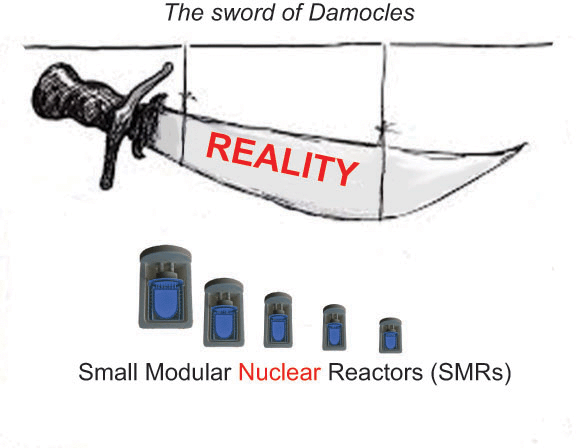
Reality bats last
The economic claims of SMR enthusiasts are sharply contradicted by real-world data.
And their propaganda campaign simply isn’t working – government funding and private-sector funding is pitiful when measured against the investments required to build SMR prototypes let alone fleets of SMRs and the infrastructure that would allow for mass production of SMR components.
Wherever you look, there’s nothing to justify the hype of SMR enthusiasts.
Argentina’s stalled SMR program is a joke. Plans for 18 additional HTGRs at the same site as the demonstration plant in China have been “dropped” according to the World Nuclear Association.
Russia planned to have seven floating nuclear power plants by 2015, but only recently began operation of its first plant. South Korea won’t build any of its domestically-designed SMART SMRs in South Korea – “this is not practical or economic” according to the World Nuclear Association – and plans to establish an export market for SMART SMRs depend on a wing and a prayer … and on Saudi oil money which is currently in short supply.
‘Reality bats last’, nuclear advocate Barry Brook used to say a decade ago when a nuclear ‘renaissance’ was in full-swing.
The reality is that the renaissance was short-lived, and global nuclear capacity fell by 0.6 gigawatts last year while renewable capacity increased by a record 201 gigawatts.
INSIDE NEW POLICY ON FINANCING NUCLEAR ABROAD: The U.S. International Development Finance Corporation mostly had small nuclear reactors in mind when it proposed this month lifting its ban on funding nuclear projects overseas. But a senior official from the DFC – a greatly expanded successor to the Overseas Private Investment Corporation – says the agency also envisions select situations for funding traditional large reactors, despite recent projects being delayed or canceled by cost overruns……..
The official cited a move by Congress a year after lawmakers passed the BUILD Act in 2018, which authorized the DFC, that called on the U.S. government to support energy diversification projects in Europe as a counter to Russia’s “energy dominance.”
It’s worth noting that some European Union member states, like Germany, are strongly anti-nuclear. Nuclear plant construction is currently underway in only three EU member states — Finland, France and Slovakia — according to the World Nuclear Association).
Opening the door for SMRs: Small modular nuclear reactors, meanwhile, are still under development and a decade or so from becoming widely operational. This has critics of the DFC’s move questioning the timing of it. The DFC official countered the new policy puts the U.S. in the game with China and Russia, which are already aggressively promoting their advanced nuclear technologies in developing countries……..
the policy shift commits DFC to nothing if small reactors end up being a flop. The DFC met with small reactor developers such as NuScale, an Oregon-based company seeking to be the first to have its license approved by the Nuclear Regulatory Commission, that were pushing for the agency to change its policy……
The DFC offers direct equity financing, loans, and political risk insurance, while Ex-Im can only offer credit or lending. The DFC has a total investment limit of $60 billion, amounting to about a $1 billion maximum per project, the official said.
He acknowledged the DFC does not have in-house expertise on nuclear power at the moment, but he said it’s not uncommon for the young agency to work with independent engineers and experts from other agencies to assess financing opportunities.
Times 23rd June 2020, Alistair Osborne: Exciting times. Tomorrow’s the deadline for the planning inspectorate to allow or reject the application from France’s EDF and China’s CGN to build Sizewell C: the nuclear disaster planned for the Suffolk coast.
Spoiler alert: it’ll be a miracle if the project falls at that hurdle, radioactive though it is. It just starts the planning process. Yet at least it means EDF and CGN will have to make public their detailed plans for the 3,200-megawatt nuke. And that’ll include their view of the risk of the plant being marooned in the sea, thanks to climate change and coastal erosion. Some experts reckon Sizewell C is at “high risk” of flooding.
They include Nick Scarr, from the Nuclear Consulting Group, a collection of academics and experts. The consulting engineer believes Sizewell C is in a “dangerous location”, a position set out in a peer-reviewed paper. But, when his views were reported here almost a fortnight ago, EDF dismissed them. It claimed his analysis of th protective effects of the offshore Sizewell-Dunwich bank and a coralline crag was both confused and wrong. EDF made its point in a background briefing, since when it has repeatedly refused to provide any on-the-record statement to back its opinion.
So, having given the company plenty of time, here’s one conclusion to draw. That Mr Scarr is bang-on. As he points out, “all the spent fuel generated by Sizewell C will be stored onsite in a high-risk flood zone”, potentially for more than a century. EDF will have to respond to this in its planning application. So there’s no reason for its high-handed carry-on.
How untrustworthy does it want to look? Big nuclear’s already toxic enough: exploding costs, endless delays, pricey electricity and lethal waste. To that, Sizewell C adds China and flood risk. The inspectorate should really save everyone the trouble and can the project now.
Julian Assange’s fiancé calls on the Australian government to secure his freedom, https://www.wsws.org/en/articles/2020/06/22/assa-j22.html, By Oscar Grenfell, 22 June 2020Stella Morris, the fiancé of Julian Assange and mother of his two young children, issued a powerful call last night for the Australian government to secure the WikiLeaks founder’s freedom and prevent his extradition to the US, where he faces life imprisonment for exposing American war crimes.
Morris was featured on Channel Nine’s “60 Minutes” program. The 24-minute segment provided an objective account of Assange’s decade-long arbitrary detention, first in Ecuador’s London embassy where he was a political refugee, and since April 2019 in the maximum-security Belmarsh Prison.
The program, presented by Tara Brown, was the first substantive examination of Assange’s plight by the Australian media since the coronavirus pandemic began.
Despite the fact that he is an Australian journalist being persecuted by the most powerful governments in the world for his publishing activities, corporate media outlets have maintained an effective D-notice on Assange for more than three months. This has dovetailed with the refusal of the Australian government, the Labor opposition and all of the official parties to defend the WikiLeaks founder.
Morris warned that Assange’s incarceration in Belmarsh, which she noted has been dubbed the “UK’s Guantanamo Bay,” is exacerbating physical and psychological health issues stemming from his protracted persecution.
“He’s very unwell and I’m very concerned for his ability to survive this,” she said. “Now he’s in the UK’s worst prison. It’s a high-security prison. One in five prisoners are murderers. He shouldn’t be there. He’s not a criminal, he’s not a dangerous person, he’s a gentle intellectual thinker and a journalist. Those people are not the people who belong in prison.”
Morris stated that she was “very worried” about Assange’s circumstances. She has been unable to visit him since February, as a result of coronavirus lockdown measures. Despite widespread infections throughout the British penitentiary system, including in Belmarsh, and Assange’s vulnerability to the virus as a result of a chronic lung condition, he has been refused bail.
“If you’re separated from your family and you’re alone in a tiny, dark room for 23-hours a day, with no control over your surroundings, I think people can imagine what that is like,” Morris said.
Brown stated that in such circumstances, “most people would probably go mad.” Morris responded: “I think any person would get very severely depressed and he is very depressed.” “60 Minutes” showed Morris and her two young children speaking with Assange on the phone. The older of the two asked Assange when he was coming home.
Morris, a 37-year-old lawyer, recounted the circumstances of her relationship with Assange. They had grown close when she was working on his legal cases after he had successfully sought political asylum in the Ecuadorian embassy.
When the couple’s two children were born in 2017 and 2018, the new Ecuadorian government had initiated closer relations with the US and was increasingly hostile to Assange. UC Global, a Spanish firm contracted to manage the embassy’s security, was surveilling every aspect of Assange’s life and was passing the the material gathered to the US Central Intelligence Agency.
When she fell pregnant, Morris informed Assange by writing the news on a piece of paper. They were fearful that any conversation about their personal life would be picked up by the audio recording devices placed throughout the embassy by UC Global. Morris sought to hide her pregnancies from the embassy staff and after the children were born, a friend of Assange pretended to be their father and brought them to the embassy.
“The real issue was I thought that our family would be targeted by the same people that were trying to harm Julian,” Morris stated. The program featured news clips of senior US government figures denouncing Assange in hysterical terms and calling for him to be silenced. Morris noted that UC Global had considered stealing the diaper of one of her children to confirm his paternity, and had even discussed plans to kill Assange or allow American agents to kidnap him.
Morris commented that it would be difficult for many people to appreciate the lawlessness that had characterised Assange’s persecution. “There’s incredible criminality that has been going on in order to gather information about Julian’s lawyers, and his family, and journalists who were visiting him,” she said. “I’ve been in a permanent state of fear for years and now it’s slowly playing out.”
Significantly, the politically-motivated character of Swedish sexual misconduct allegations against Assange was made clear in the program. The allegations were concocted by that country’s police and judiciary, in the midst of a frenzied US campaign against WikiLeaks’ exposure of war crimes in Iraq and Afghanistan.
Brown noted that Assange had never been charged with a crime in Sweden, and that the Swedish investigation had been dropped. Australian independent parliamentarian Andrew Wilkie pointed out that documents had shown that the British government used the allegations to enforce Assange’s arbitrary detention in the Ecuadorian embassy. The British authorities had been aware that the Swedish claims were a smokescreen for plans to dispatch Assange to his US persecutors.
The program concluded with an appeal from Morris to the Australian government. She said: “I want people to understand that we’re being punished as a family. It’s not just Julian in the prison. The kids are being deprived of their father. I need Julian and he needs me.”
Morris declared: “I’d like to ask [Australian Prime Minister] Scott Morrison to do everything he can to get Julian back to his family. If Australia doesn’t step in I’m very fearful this wrong won’t be righted. It’s a nightmare.”
Tellingly, Brown stated that Morrison, Foreign Minister Marise Payne and Christian Porter refused to be interviewed.
This was in line with the ten-year collaboration of Australian governments in the US-led vendetta against Assange. Beginning with the Greens-backed Labor government of Julia Gillard, they have rejected calls to defend the WikiLeaks’ founder, instead participating in the campaign against him.
The official hostility to Assange is bound up with the Australian ruling elite’s unconditional support for the US military alliance and all of American imperialism’s illegal wars and military preparations and dovetails with a domestic assault on democratic rights, including attacks on press freedom and laws increasing punishments for whistleblowers. It is facilitated by the refusal of the Greens, the pseudo-left groups and the unions to mount any campaign for Assange’s rights.
This underscores the fact that the fight for Assange’s freedom and for the defence of all civil liberties requires the mobilisation of the working class. The international protests over recent weeks against police violence have demonstrated the objective basis for building such a movement.
Monday, June 22, 2020 Blocking President Donald Trump from nuking Nevada or dumping radioactive materials here is an unpleasant task that rears its head with annoying regularity. It’s like scraping irradiated gum off the bottom of your shoe.
So here’s a show of respect and gratitude to Nevadans who are safeguarding the state.
That includes Rep. Dina Titus, who last week introduced a bill aimed at stopping Trump from conducting nuclear bomb tests at the Nevada National Security Site. Titus and Nevada Rep. Steven Horsford, who co-sponsored the bill, jumped into action after The Washington Post reported this month that senior officials in the Trump administration had dusted off the idea of live testing, an insane plan that had first been reported in 2018 but then seemingly vanished.
The bill would circumvent testing by denying federal funding for it. As Titus explained, targeting the funding was the most effective approach due to the Trump administration’s opposition to ratifying an international nuclear testing ban that was adopted by the United Nations but remains unratified by the U.S. and seven other countries — China, Iran, Israel, Egypt, India, Pakistan and North Korea.
The lack of a treaty leaves Nevada vulnerable to testing, since the federal government owns and operates the security site. And Trump apparently believes that blowing up a bomb here would give the U.S. a stronger hand in negotiations with China and Russia on national security. In other words, Nevadans would be used as pawns in geopolitical saber-rattling.
The bill is a responsible piece of legislation. Resuming nuclear bomb testing is a slice of Dr. Strangelove-esque lunacy that would ratchet up tensions between nuclear nations and for no good reason. Due to technological advances, live testing is no longer needed to ensure that nuclear stockpiles are effective and secure.
Experts like Hans Kristensen, director of the nuclear information project at the Federation of American Scientists, say Trump is off the rails.
“That’s completely nuts,” Kristensen told The Guardian. “They must be getting desperate. Instead, what it certainly would do is push China and all the other nuclear-armed states to test as well. How can someone in their right mind think that would be in the security interest of the United States or its allies?”
For Nevadans and downwinders, testing poses unacceptable health and environmental dangers. We sacrificed more than enough during the decades of testing here, when more than 1,000 bombs were exploded at the test site, just 60 miles north of Las Vegas.
Nevada shouldn’t have to endure more punishment just so the always insecure Trump can seem like a tough guy.
As the bill begins its way through Congress, Southern Nevada’s delegation sent Trump and federal officials a letter expressing opposition to testing.
“Not only would such an action compromise the health and safety of Nevadans, degrade vital water resources and harm the surrounding environment, but it would also undermine future stockpile stewardship efforts, undercut our nuclear nonproliferation goals and further weaken strategic partnerships with our global allies,” read the letter, signed by Sens. Catherine Cortez Masto and Jacky Rosen, along with Titus, Horsford and Rep. Susie Lee.
While the delegation fights off the nuclear test, a group of Native American leaders, environmentalists and outdoor-recreation advocates recently won a preliminary battle in its efforts to block a massive expansion of the bombing range at Naval Air Base Fallon in central Nevada.
Last week, the Senate Armed Services Committee shot down the proposed expansion by writing it out of the 2021 National Defense Authorization Act. Although the committee’s version of the NDAA isn’t final, the Senate leaders’ opposition to the plan is encouraging.
The plan is horrific for Nevada, and is supported by Nevada’s lone Republican congressional delegate, Mark Amodei, who would rather grovel before national GOP leaders than defend the interests of his constituents. It would serve up more than 600,000 acres of public land for bombing and other training purposes, causing a harmful impact on the environment and ancestral Native American lands. It also contains land conveyance provisions that would allow vast amounts of public lands to be developed for residential, industrial and commercial purposes.
Combined with the existing acreage on the base, the expansion would permit bombing on about 750,000 acres. While the Navy says more space is needed due to technological advances that allow weapons to be deployed from increasingly long distances, the expansion is too much to ask from Nevada. Kudos to those fighting this overreach.
Nevadans must defend ourselves from a president who clearly loathes our state and thinks we’re only good as a dumping ground for his bad ideas and worst impulses, starting with the administration’s push for the resurrection of the Yucca Mountain nuclear waste repository. No sooner had that effort been snuffed out than the Defense Department secretly sent a shipment of highly radioactive plutonium to the state, forcing Nevada leaders to go to court in hopes of getting it removed and preventing future dark-of-night incursions.
With at least six months remaining in Trump’s presidency, Nevada must keep watching the radar closely. But the vigilance of our leadership — and by that we mean not only in Washington and Carson City but in Native American communities and advocacy organizations — has been commendable.
Global nuclear news is mainly just the same old collection of handouts from the nuclear industry, faithfully regurgitated by journalists who want to keep their jobs. Otherwise, not much is happening.
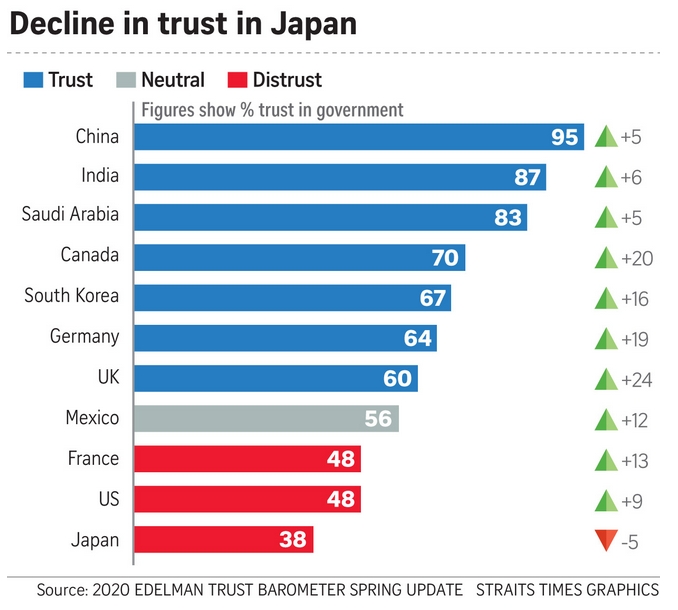
People’s trust in the governments of the Asia-Pacific rose, following a global pattern, except for Japan, according to the Edelman Trust Barometer Spring Update.
Trust in the government rose in China, India and South Korea, but declined by 5 points in Japan to 38 per cent, in Edelman’s Trust Barometer Spring Update report.
“The outlier in Asia, and indeed the world, is Japan,” noted Mr Stephen Kehoe, president and chief executive officer of Edelman’s Asia Pacific operations.
“Forced to reckon with early global attention due to the cruise ship stranded in the port of Yokohama, Japan appears to have learned few lessons from this crisis, or indeed, in the nine years since Fukushima,” he said in an article on Edelman’s website, referring to the coronavirus-hit Diamond Princess stranded in Yokohoma in February, with 3,700 people and crew on board. In the end, slightly over 700 people were found to be infected while 13 died, earning the government criticism for the delay in handling those infected.
“This, perhaps combined with the delayed decision to impose a state of emergency and subsequent reported missteps in the distribution of personal protective equipment, has resulted in a near-total collapse of confidence by the Japanese in their government to handle the ongoing crisis,” he added.
The March 2011 triple disaster in Fukushima of a tsunami, earthquake and an accident at the Daiichi nuclear power plant left more than 20,000 people dead or missing.
Japanese Prime Minister Shinzo Abe has been rapped for his handling of the coronavirus situation. A poll by public broadcaster NHK from May showed his approval rating had dropped to 37 per cent while another poll by Mainichi Shimbun showed his approval rating was only 27 per cent.
Elsewhere in Asia, people showed more trust in their governments, with the level in China up five points to 95 per cent, India (up 6 points to 87 per cent), and South Korea (up 16 points to 67 per cent).
Those surveyed also showed a high tolerance of government surveillance for public safety. The level in China was 30 points ahead of the global average (at 61 per cent), while in India it was 17 points over, and in South Korea, it was in line with the global average.
“Japan’s appetite for surveillance is the lowest in our sample at 44 per cent, continuing to reflect long-held beliefs around constitutional freedom, which date back to the aftermath of World War II,” noted Mr Kehoe.
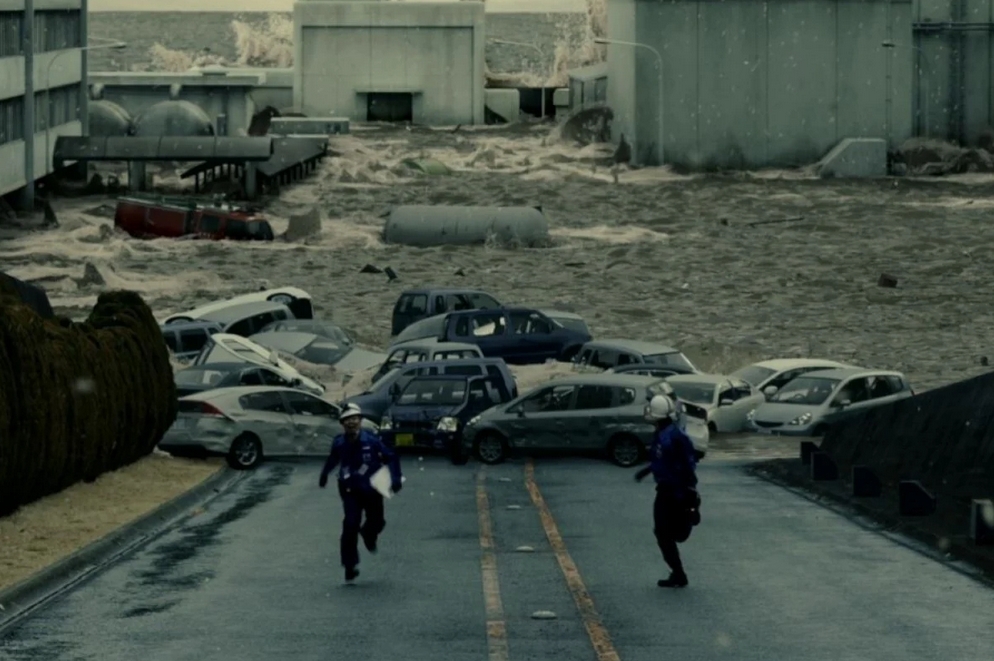
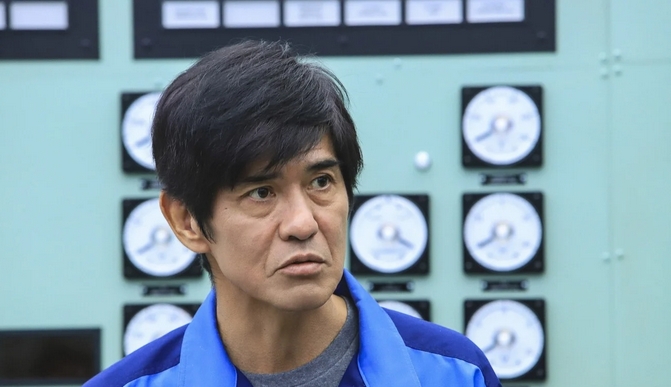
A still from Fukushima 50 (category IIA; Japanese) starring Koichi Sato and Ken Watanabe and directed by Setsuro Wakamatsu.
22 Jun, 2020
Ken Watanabe as Fukushima nuclear power plant superintendent, and Koichi Sato as shift supervisor, lead the battle to avert a meltdown after earthquake, tsunami
Blow-by-blow account of the real-life aftermath of the 2011 disaster in Japan loses much of its drama by refusing to point fingers or demonise decision-makers
2.5/5 stars
The first mainstream film to dramatise the lives of frontline workers who dealt with the 2011 Fukushima Daiichi nuclear disaster, Setsuro Wakamatsu’s Fukushima 50 is an earnest, if somewhat toothless, celebration of those who risked everything to avert a reactor meltdown.
Ken Watanabe and Koichi Sato headline this big-budget adaptation of Ryusho Kadota’s non-fiction book, On the Brink: The Inside Story of Fukushima Daiichi.
The film wastes no time setting up characters or pre-existing relationships, opening with the explosive underwater earthquake off the Tohoku coast of northeast Japan on March 11, 2011. The initial impact triggered an automatic shutdown of the Fukushima Daiichi power station’s nuclear fission reactors. The subsequent tsunami swept over the power plant’s coastal defence walls, flooded the main buildings and knocked out the backup generators responsible for cooling the reactor cores.
Facing an imminent meltdown, plant superintendent Masao Yoshida (Watanabe) and shift supervisor Toshio Isaki (Sato) spearhead a daring, potentially suicidal effort to cool the reactors using seawater, while fending off contradictory, face-saving orders from their superiors at Tokyo Electric Power Company (Tepco) and the Japanese government.
In the nine years since the disaster, the Japanese film industry has broached the disaster’s aftermath numerous times, in films from Sion Sono’s uncharacteristically sombre A Land of Hope, to the allegorical 2016 blockbuster
. The eponymous beast of the latter film has been the stand-in for national life-or-death reckonings since the dawn of the atomic era, but that film also took time to expose, and ultimately champion, the country’s multi-tiered bureaucratic leadership.
Koichi Sato in a still from Fukushima 50.
Fukushima 50, and Kadota’s impressively researched book, give blow-by-blow accounts of the disaster and the courageous sacrifices made by those who chose not to evacuate, but stay behind and ensure the nation’s safety. However, arriving in the wake of HBO’s much lauded and dramatically superior miniseries Chernobyl, about the 1986 nuclear disaster in Ukraine, Wakamatsu’s film feels lightweight, and the obstinate heads of Tepco a pushover compared to the Soviet Union’s fearsome Central Committee.
The film functions best as a memorial to Masao Yoshida, the only plant worker to have his real name used, whose willingness to go against his superiors ultimately prevented a far larger disaster, only for him to succumb to an unrelated bout of cancer in 2013. The film’s reluctance to point fingers, or demonise those responsible, saps much of the drama from this true-life tale of selfless heroism.
New film helps us find it, measure it and understand it
By Linda Pentz Gunter
There are many ways to teach people about radiation. But if you want to make that lesson accessible, compelling and even moving, then this film is the way to do it.
Let’s go on a journey. A journey to learn about radiation exposure from fallout after a nuclear power plant accident. We have the perfect guide. It is the independent French radiation research laboratory known as CRIIRAD, and its director, Dr. Bruno Chareyron.
The organization’s full name in French is Commission de Recherche et d’Information Indépendantes sur la RADioactivité, hence the acronym. In English it is translated as Commission for Independent Research and Information about RADiation.
For those not familiar with CRIIRAD, our journey begins with a little history, and so does CRIIRAD’s brilliant new 45-minute film — Invisible Fallout (Invisibles retombées is the French title), which can be viewed in its entirety on YouTube and below. The film, written and produced by CRIIRAD staff and directed by Cris Ubermann, is in French and Japanese with English subtitles.
When the Chernobyl nuclear disaster hit in April 1986, the French government engaged in a notorious cover-up, claiming that France “has totally escaped any radioactive fallout.” The whole thing was a lie. Five days before the government denial, Chernobyl’s radioactive cloud had covered all of France.
As Invisible Fallout recounts, after Chernobyl, it took 15 years until the French government published fallout maps of France. But the CRIIRAD laboratory, formed right after Chernobyl precisely to establish that France’s immunity was a myth, had already done the work that debunked the official line that the disaster was just a Soviet problem. French citizens not only got dosed by Chernobyl fallout, but would live in perpetual danger of a similar catastrophe at home, with a country almost 80% reliant on nuclear-generated electricity from its 58 reactors.
But Invisible Fallout does not linger long in the past. It segues quickly to the next nuclear catastrophe — the 2011 Fukushima-Daiichi meltdowns in Japan — and it is there that the CRIIRAD team, led by Chareyron, take us to learn about the effects of radiation exposure from nuclear power plants.
Just sixteen days after the Fukushima disaster, Japanese citizens began to detect fallout. They desperately needed to do independent monitoring but found it hard to get their hands on Geiger counters. The downplays and cover-ups by Japanese authorities, attempting to minimize the dangers and avoid mass evacuations, meant official figures could not be trusted.
An unlikely leader stepped forward in the person of composer and artist, Wataru Iwata, who, one month after the disaster, asked CRIIRAD for Geiger counters. They sent them, along with email tutorials on radioactivity, its health risks and how to protect against them. The laboratory also prepared a series of simple, clear, instructional “emergency” videos in English, designed for non-specialists, which they put online for everyone to access. This included an instructional segment on how to use a Scintillometer, one of the dozen devices CRIIRAD had sent to the Japanese activists.
We then get a short instructional video of our own on exactly how the Scintillometer is able to rapidly detect Gamma radiation in counts per second, and what those measurements mean. It glides into clarity for us, abetted by the smooth tones of the film’s excellent French narrator, Nicolas Planchais. We forget completely we are in class. Everything is, indeed, illuminated.
And we see Iwata taking his device into Fukushima Prefecture where he helps others measure the radiation levels. At a restaurant 55km away from the destroyed reactors, where people were going about their daily lives, he is shocked to record radiation levels that are 50 times higher than normal. In other areas, levels are 1,000 times higher.
Two months after the accident, CRIIRAD decided to show up in person, and Japan’s Citizens Radioactivity Monitoring Stations (CRMS), were born. CRIIRAD set up nine CRMS in Fukushima Prefecture and one in Tokyo.
CRIIRAD’s Bruno Chareyron (right) and Christian Courbon (kneeling) with Wataru Iwata, taking radiation measurements at a school in Fukushima City. (Photo: CRIIRAD)
Quickly realizing that ingestion of radioactively contaminated foodstuffs was as much of a threat as external exposure, Iwata asked for ways to measure radiation in food. This would help the people who had stayed — or who had been forced to remain — in contaminated areas to make informed choices about the food they consumed. CRIIRAD brought over a device sensitive enough to detect radiation in food, then conducted a seminar for residents of Fukushima City on on how to use it. We too, as viewers, get the tutorial.
Indeed, all of these lessons in science are subtly woven into the film, but cleverly attached to the lived experiences of real people in Japan, making it relevant and relatable.
And then, as we learn how to measure radiation levels and what they mean, we start to meet the people to whom it matters the most. We encounter a farmer who abided by the rules not to sell contaminated crops but whose family ate the food themselves so it would not go to waste. And we watch his palpable emotion as he recounts his attachment to the land and the known risks he and his family took.
CRIIRAD and its Japanese partners begin to find radioactive particles everywhere— on rooftops, in soil and vegetation, at the foot of trees, in the cracks of tarmac, even inside greenhouses.
At a school which, in denial, refused to have radiation measurements taken, Iwata is shown taking readings in the school grounds. They start at 6,000 to 7,000 counts per second, but rise to 27,000 counts per second at ground level.
The CRIIRAD team encounter what they describe as their most difficult moment when an elderly peasant farmer asks them to conduct measurements on her land just 30km away from the nuclear site. She herself was forced to evacuate, but her farm was not in the zone designated for permanent evacuation. So she came back with CRIIRAD to assess the situation.
We watch them take measurements, then gently show the results to her. She begins to sob. Then she tells them, “Thank you for coming all this way. I was in darkness and you have brought me light.” But, she knows she must now abandon the farm forever.
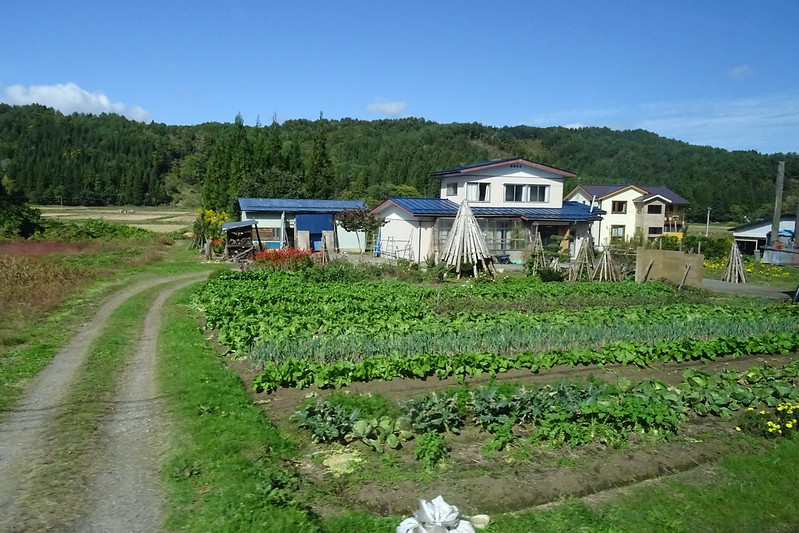
Fukushima farms were found to be contaminated. (Photo: Sek Keung Lo/Creative Commons)
After an interlude for another lesson, this time on gamma rays, we are back to some chilling truths about their effects. In Fukushima City, we learn that at an elementary school there, children are asked to frequently change places in class so that the same children are not always sitting by the window where the radiation levels are higher.
This prompts CRIIRAD to remind us that, “when it comes to radiation protection, there is no threshold below which it is harmless.” And they point out that the Japanese decision to raise the annual allowable radiation dose from 1mSv to 20mSv, “means accepting a risk of cancer 20 times higher, and this applies equally to children and pregnant women” for whom such doses present a far higher risk.
CRIIRAD warns that people living in the contaminated region will be exposed for decades and across vast areas. They will be exposed to external radiation from powerful gamma rays emitted by the soil and contaminated surfaces. They will be exposed through inhalation of radioactive dust suspended every time the wind blows, and by activities such as sowing crops, ploughing and construction work. And they will be exposed through eating foodstuffs cultivated on contaminated land in contaminated soil.
But thanks to CRIIRAD, many of them will now know how to measure these levels, what they mean and how to protect themselves. It’s a lesson that’s well worth learning for all of us.
For more information, please see the CRIIRAD website, in its original French, and in English.
Headline photo: Bruno Chareyron (center) and Wataru Iwata (right) in Fukushima Prefecture, May-June 2011, in discussion with locals before taking radiation readings on their properties. (Image courtesy of CRIIRAD)
In the East Asian democracies, nuclear energy is tied to an increasingly unpopular political and economic model.
Workers at the Fukushima Daiichi nuclear power plant pose for portraits on Feb. 23, 2016, in Okuma, Japan.
June 17, 2020
Western discussions about nuclear energy in East Asia usually start with the Fukushima disaster and end with efforts to address climate change. But anti-nuclear sentiment in Asia looks nothing like that in the West, where it was birthed during the Jane Fonda era and is still based on long-debunked claims about the intrinsic dangers of accidents and nuclear waste. The techno-angst and apocalyptic fears that have always animated Western environmentalism are largely foreign to Asian discussions of nuclear energy, climate change, and similar environmental concerns.The techno-angst and apocalyptic fears that have always animated Western environmentalism are largely foreign to Asian discussions of nuclear energy and climate change. After all, following the 2011 earthquake and tsunami in Japan that led to a meltdown at the Fukushima Daiichi nuclear plant, it was Germany—not Japan—that immediately decided to permanently phase out nuclear power, even if it meant that its carbon emissions would rise.
Japan, South Korea, and Taiwan may nonetheless take a decisive turn against nuclear power. The reasons have little to do with public fears of nuclear energy but are tied to long-standing demands for political and economic reform. That’s because the nuclear industry in each of these three countries is tied to a highly contested political and economic model that the reformers are pressing to change.
In April, the anti-nuclear Democratic Party of Korea swept to the most dominating electoral victory in South Korean history. In January, Taiwan’s reform-minded Democratic Progressive Party, which has proposed phasing out the country’s nuclear power stations, also won by a landslide. Meanwhile, both Japanese Prime Minister Shinzo Abe and his ruling Liberal Democratic Party (LDP), the country’s last major pro-nuclear party, face worsening poll numbers as a major election approaches in 2021.
The proximate causes of these political shifts have little to do with nuclear or environmental policies. South Korean President Moon Jae-in’s smashing victory followed his exemplary management of the national response to the COVID-19 pandemic. In Taiwan, it was China’s brutal crackdown on dissent in Hong Kong that heavily tipped the scales in favor of the Democratic Progressive Party, which has taken a far more defiant position on relations with China than its main rival, the Kuomintang. Japan’s LDP is languishing in the polls because of its failure to revitalize the country’s long-stagnant economy, a task made all the more challenging by the pandemic.
Dig a little deeper, however, and the same underlying political dynamics have undermined support for nuclear energy. In all three nations, the nuclear power sector has become closely identified with long-entrenched political parties and the power of state bureaucracies and industry groups over economic life. Fukushima undoubtedly amplified anti-nuclear sentiment in the region, but opposition to nuclear power has been a proxy for political and economic reform for decades.
In all three nations, state-led nuclear energy development took place during prolonged periods of political dominance by conservative parties with strong ties to industry and business interests. In the aftermath of the Chinese Civil War in the 1940s and the Korean War in the 1950s, respectively, South Korea and Taiwan were led by authoritarian governments that focused on economic development while severely restricting political freedoms. South Korea only held its first free elections in 1988; Taiwan followed in 1992. While Japan has conducted democratic elections since the 1950s, the LPD has maintained nearly continuous control.
The nuclear industries of Taiwan, South Korea, and Japan are thus the product of authoritarian or de facto one-party states, where the ruling party passed control over the energy sector (and many other parts of the economy) to state-owned corporations, government-issued monopolies, or quasi-cartels of favored companies. State-owned Taiwan Power Company controlled Taiwan’s power sector until the electricity market became more liberalized after 1995. In South Korea, the government-operated Korea Electric Power Corporation still holds a monopoly on power generation and grid infrastructure; one of its subsidiaries, Korea Hydro and Nuclear Power, operates all nuclear reactors. In Japan, the power sector consists of 10 regional monopolies that operate in close coordination with the powerful Ministry of Economy, Trade, and Industry.
And just as the nuclear establishment was part and parcel of postwar economic planning by what were effectively one-party states, opposition to that establishment has become a cause for those who demand political and economic reform.
Evolving nuclear policies in East Asia reflect a changing balance of power that is likely to persist. In Taiwan, the conservative Kuomintang’s aging demographic base and support for closer ties with mainland China now appears out of touch with a younger electorate increasingly distrustful of China and hostile to reunification. In South Korea, demographic shifts and evolving public opinion have favored reforms on issues ranging from diplomacy with North Korea to checks on powerful corporations. In both South Korea and Taiwan, successful responses to the COVID-19 pandemic have boosted the credibility of reformist leaders.
Even as the nuclear issue is taken up by reform parties, public support for nuclear energy remains strong in South Korea and Taiwan, and has been growing again in Japan.The political situation in Japan, by contrast, is more uncertain. With the pandemic set to erase the LDP’s recent successes in controlling the national debt and boost the economy, the party also faces a leadership transition when Abe steps down after his current term as prime minster, as he must according to LDP rules. But anti-nuclear opposition parties remain weak and have almost no record of winning national elections, let alone governing—an enormous disadvantage at a moment when the economy is struggling, China has reemerged as the region’s dominant power, and the public health crisis is far from over.
Even as the nuclear issue is taken up by reform parties, public support for nuclear energy remains strong in South Korea and Taiwan, and has been growing again in Japan. In Taiwan, 59 percent of voters supported a 2018 referendum to retain the nation’s nuclear power stations. In South Korea, support for nuclear energy dipped in the wake of Fukushima but has since rebounded to around 70 percent. Opinion in Japan remains divided, but support has slowly rebounded since the Fukushima accident.
The operator of the crippled Fukushima Daiichi nuclear plant has released footage showing part of the time-consuming steps needed to remove nuclear fuel from a pool at its No.1 reactor.
In the video, workers used remote-controlled tools to place a wide sheet over the surface of the pool. The radiation level there remains high.
Tokyo Electric Power Company has been engaged in removing debris from the upper part of the reactor building where the pool is located. The debris was caused by an explosion during the 2011 nuclear accident.
The sheet is meant to protect the pool and 392 nuclear fuel assemblies still inside from further damage that could result from the possible falling of debris or large machinery.
The six-by-eleven meter sheet is inflatable to a thickness of 50 centimeters. It will be filled with cement to increase its strength.
The operator plans to begin clearing the debris from around the pool by the end of the month, as soon as the sheet’s cement has solidified.
The operator plans to start removing the fuel from the pool of the No.1 reactor in fiscal 2027. Similar work at the No.2 reactor will start in fiscal 2024. Fuel removal from the pool at the No.3 reactor will be completed by fiscal 2020. The removal work is finished at the No.4 reactor.
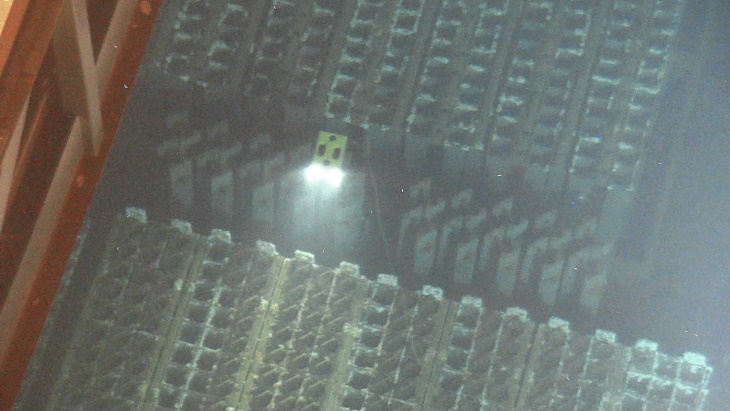
A remotely operated underwater robot casts light over nuclear fuel rods inside the fuel pool of the No.2 reactor at the Fukushima No. 1 nuclear power plant.
Jun 11, 2020
Fukushima – Tokyo Electric Power Company Holdings Inc. (Tepco) found no obstacles Wednesday to its planned removal of radioactive fuel rods from a spent fuel pool at the Fukushima No.1 nuclear power plant, the firm has said.
Tepco confirmed the findings after starting its first internal probe of the No. 2 reactor since the 2011 disaster. The investigation is expected to continue through Friday.
Using a remotely operated underwater robot to photograph the interior of the pool, submerged fuel rods and their storage racks were checked for any damage. A total of 615 spent and unspent fuel rods are stored in the pool.
White sediment was discovered on the aluminum alloy racks. It is believed to have formed from a reaction between aluminum and elements in sea water, which was injected into the pool to cool the nuclear fuel during the disaster.
Similar sediment was found in the reactor pools at units No. 3 and No. 4, from which fuel rods have already been removed, but according to Tepco it did not affect the process.
Similar to the No. 1 and No. 3 reactors, the No. 2 reactor suffered a core meltdown after it temporarily lost its cooling function in its spent fuel pool, but there was no hydrogen explosion at the building.
Because of that, the pool is thought to be free of debris and in a relatively stable condition.
High radiation levels on the top floor of the reactor building, where the fuel rods are located, have delayed cleanup efforts.
But progress in decontamination efforts has now enabled remote inspections to be carried out.
A new facility complete with a crane and equipment to lift out the fuel rods will be built on the south side of the No. 2 nuclear reactor building. The removal process is slated to begin sometime between fiscal 2024 and 2026.
The ROV surveys the used fuel pool of Fukushima Daiichi unit 2 (Image: Tepco)
11 June 2020
There are no obstacles to the removal of assemblies from the used fuel storage pool of unit 2 at the damaged Fukushima Daiichi nuclear power plant, Tokyo Electric Power Company (Tepco) said today after completing an initial survey of the pool. Removal of the assemblies is scheduled to begin fiscal year 2024.
Similar to the reactors at units 1 and 3, unit 2’s reactor suffered a core meltdown after it temporarily lost its cooling functions, but the reactor building – which also houses the fuel storage pool – was spared a hydrogen explosion.
Using a submersible remotely-operated vehicle to investigate the fuel pool, Tepco concluded there was no damage to the fuel assemblies or the storage rack they are held in. It did, however, discover sand-like sediment at the bottom of the pool.
The utility said images captured during the pool’s survey will be used for designing equipment to be used in the removal of the fuel assemblies. It plans to start removing the 587 fuel assemblies from the unit’s used fuel pool between fiscal year 2024 (ending March 2025) and fiscal year 2026 (ending March 2027).
Dose levels on the operating floor of unit 2 are high, thereby making it difficult to access. Tepco has, however, already made progress with the clean-up of equipment, etc. that remains on the operating floor, providing access to the area near the storage pool.
It plans to complete the removal of all fuel assemblies from Fukushima Daiichi units 1-6 during 2031.
U.S. conversion factory’s equipment is on the auction block
After $8 billion spent, critics see sale at ‘giveaway prices’
Need some parts for a nuclear plant? The government has a few to spare.
Electrical transformers, motors, and pieces of special glove boxes designed to safely handle radioactive material are available as the government auctions off equipment from a now-abandoned nuclear project that was supposed to turn weapons-grade plutonium into fuel for commercial nuclear reactors.
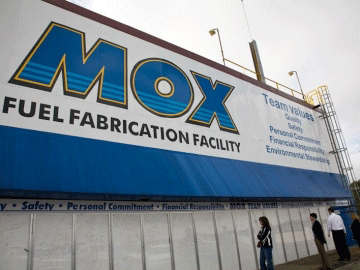
The online fire sale, which ended Thursday evening, is part of an effort to recoup some of the nearly $8 billion taxpayers spent on the so-called Mixed Oxide (MOX) Fuel Fabrication Facility in Aiken, South Carolina, which sits partially finished.
The Trump administration pulled the plug on the project in 2018 following years of ballooning cost estimates and delays. Envisioned in 1999 with a price-tag of $620 million, it swelled to nearly $48 billion with an estimated completion date in the 2040s. Metric tons of plutonium transferred to the site for conversion remain there.
The thousands of items up for grabs are in their original packaging and “present a rare opportunity to acquire brand new equipment that is top nuclear grade,” said Diana Peterson, president of the auction company AW Properties Global, which has been awarded the subcontract to sell off the goods.
Plutonium Handling
Among the items are 101 pallets of glove box assembly kits — sealed boxes with two arm-length gloves attached to holes in the side, used to handle plutonium and other radioactive materials. The high bid was $20,000 as of Thursday afternoon.
A pair of 3,750 kilo-volt-ampere transformers is going for $70,000. Also available are 300,000 pounds of ventilation equipment, as well as reams of switches, control panels, valves, and electrical equipment.
To critics, the sale is a fitting capstone to a project they say has been beset by waste from the start.
“This give-away sale of equipment from the MOX debacle highlights the massive waste of money spent on equipment that was stockpiled willy-nilly just to spend annual budgets and enrich contractors,” said Tom Clements, director of Savannah River Site Watch, a non-profit public-interest group that monitors work at the sprawling site that made nuclear bomb materials in the 1950s.
There should be a “full accounting to the public about how much was spent on stockpiled MOX equipment, how much has been given away or scrapped, and how much is being sold at pennies on the dollar,” Clements said.
The National Nuclear Security Administration, the Energy Department arm responsible for the site, said the auction was being held in accordance with all government property regulations.
“Any inventory that could not be reused by our government, is going to auction as part of our commitment to recapitalize project value,” the agency said in a statement.












 nuclear-news