Largs & Millport Weekly News 24th Sept 2020, Extract of Letter Elizabeth McLardy: Our worst unbelievable nightmare has just been confirmed. Contrary to all the concerns of individuals and numerous organisations, EDF and ONR have decided to ride roughshod over every one of us and fire up a defunct nuclear reactor that was shut down over two and a half years ago because it was unsafe to continue operating.
Over that time, it most certainly will not have improved any – if anything it will have deteriorated. EDF have done more computer modelling, given more estimates and predictions and outrageously ONR have said no problem fire it up. The silence from the Scottish Government is deafening.
All we have heard about is the loss of jobs (yet) there will be countless jobs for years to come, but astonishingly not a word about the real danger to millions of lives. (not on the web)
Radiation exposure on the moon is nearly three times that on the ISS, 25 September 2020
By Layal Liverpool Astronauts on the moon would face nearly three times more radiation exposure than those aboard the International Space Station, which could make long-term missions riskier than thought.
“Once you’ve survived being on the moon and come back to Earth, radiation damage is what stays with you for the rest of your life and that’s why this is a critical measurement,” says Robert Wimmer-Schweingruber at the University of Kiel in Germany.
NORTHAMPTON — Under a new state law, Northampton is allowed to refuse contracts with companies involved in the creation of nuclear weapons.
The act comes from a home rule petition recommended by Mayor David Narkewicz and approved by the the City Council in 2019.
“Basically, under Massachusetts contracting law, you are not allowed to discriminate against one sector or industry,” Narkewicz said, explaining the need for the change.
In July, Gov. Charlie Baker signed an act into law that reads, “the city of Northampton may disqualify from an award of a contract a bidder or vendor who participates in the design, manufacture or maintenance of nuclear weapons.”
Saturday marks the United Nations’ International Day for the Total Elimination of Nuclear Weapons. Rallies will be held in Northampton, Springfield, Sunderland and Greenfield, according to Massachusetts Peace Action. In western Massachusetts, they are hosted by a number of organizations, including The Resistance Center for Peace and Justice and Arise for Social Justice. In Northampton, for example, The Resistance Center for Peace and Justice is holding a rally at L3Harris Technologies at 11 a.m. at 50 Prince Street in Northampton. When L3 Technologies and Harris Corp. merged into L3Harris Technologies last year, the company said it created the sixth-largest defense company in the country and a top 10 defense company worldwide.
Saturday will also be “Nuclear Ban Day” in Northampton, as Narkewicz read a proclamation Thursday declaring it.
Transporting the waste to the New Mexico and West Texas facilities by rail car and through major cities, including those in the Dallas-Fort Worth region, could be a Pandora’s Box of problems for North Texans
Nuclear waste could travel through Dallas-Fort Worth if West Texas plan is approved Fort Worth Star Telegram, BY HALEY SAMSEL, SEPTEMBER 24, 2020 If approved by federal regulators, at least 5,000 tons of high-level nuclear waste from across the U.S. could travel through the Metroplex on its way to a West Texas storage facility that already stores low-level radioactive materials.
High-level nuclear waste refers to spent, or used, reactor fuel and waste materials that exist after the used fuel is reprocessed for disposal. The radioactive waste poses potentially harmful effects to humans and only decreases in radioactivity through decay, which can take hundreds of thousands of years, according to the Nuclear Regulatory Commission, the federal agency that regulates nuclear power plants and the storage and disposal of waste.
Activists who oppose the West Texas plan say the impact will not be limited to residents of Andrews County, where the toxic waste site owned by Waste Control Specialists already sits near the Texas-New Mexico border. The commission is considering a similar plan for a high-level waste storage facility in southeastern New Mexico, brought forward by the nuclear company Holtec.
Transporting the waste to the New Mexico and West Texas facilities by rail car and through major cities, including those in the Dallas-Fort Worth region, could be a Pandora’s Box of problems for North Texans, said Lon Burnam, a former state representative and the chair of the Tarrant Coalition for Environmental Awareness.
“We’ve created all this waste, there’s no good way to handle it, and the question is: What is the least objectionable way to handle it?” Burnam said. “But carting it all through Dallas-Fort Worth, from my perspective, is one of the worst ways to handle it. Why should we be the community that 90% of this stuff goes through on its way to either West Texas or the New Mexico side?”
For years, the U.S. Department of Energy has struggled to find a long-term storage solution for the country’s growing stockpile of radioactive waste. With no permanent destination for safe disposal, more than 80,000 metric tons of highly radioactive nuclear waste sit at the country’s commercial nuclear plants, according to the U.S. Government Accountability Office. ……
Amid debate over repealing House Bill 6, Energy Harbor still won’t say whether its nuclear plants are profitable Cleveland. com Sep 25, 2020, By Jeremy Pelzer,
COLUMBUS, Ohio—State lawmakers are looking at whether to keep in place a $1.3 billion public bailout for the Davis-Besse and Perry nuclear power plants along Lake Erie, a law that federal authorities say was corruptly enacted.
But throughout the debate, there’s still a glaring problem: the owner of the nuclear plants refuses to disclose whether they are profitable or not. And so far, there’s been no attempt by state lawmakers to compel the company to release its numbers before the bailout takes effect.
During last year’s debate over whether to pass the bailout as part of House Bill 6, Energy Harbor – then known as FirstEnergy Solutions – asserted it needed public subsidies or it would close the plants. But the company wouldn’t open its books to lawmakers or the public to prove that it actually needed the money, leading legislators to rely on estimates, industry averages and company officials’ word.
A look at Exelon’s 4 economically challenged nuclear plants in Illinois, S & P Global,Author, Anna Duquiatan, 25 Sep 20, Exelon Corp.-owned nuclear power plants in Illinois eyed for early retirement have had declining financial margins of late, according to an analysis using S&P Global Market Intelligence’s plant-level production cost model. ………
Exelon Generation Co. LLC announced Aug. 27 that it plans to retire its 2,346-MW Byron and 1,805-MW Dresden nuclear power stations in September 2021 and November 2021, respectively.
The Exelon Corp. subsidiary added that the 2,384-MW Braidwood Generating Station and 2,313-MW LaSalle County Generating Station are “also at high risk for premature closure,” though the company has not yet projected any closure dates for those plants………
The two-unit Dresden plant in Grundy County, the first of the four northern Illinois plants to enter service, in the early 1970s, is licensed to operate until 2029 and 2031. Braidwood in Will County, Byron in Ogle County, and LaSalle in LaSalle County all began operating in the mid- to late 1980s and are licensed to operate until the 2040s. …………..
Q2: U.S. Solar and Wind Power by the Numbers
Wrestling with the COVID-19 pandemic, solar project developers installed nearly three times as much solar power capacity in Q2’20 compared to the same period a year ago. Meanwhile, the U.S. wind industry posted one of its strongest second quarters on record in 2020, adding 2,369 MW of capacity, and the 2020 development pipeline stands strong at 30,554 MW.
Q2: U.S. Wind Power by the numbers
EssentialEnergy Insights – September, 2020
Numbers Utility-Scale Solar Surge Reaches 1.6 GW in Q2
Ministers urged to support new nuclear at a critical time for the industry
The energy giant is pressing the case for a plant at Sizewell but backing from a cash-strapped government could be limited, Sky News, Ian King 23 Sept 20, This is a critical time for the UK’s nuclear energy industry.
The construction of the UK’s first new nuclear power station for a generation, Hinkley Point C in Somerset, is well advanced and EDF Energy, the French-owned energy giant building the plant, is keen to pick up the pace on its next big infrastructure project.
Sizewell C, in Suffolk, is envisaged as a replica project to Hinkley Point C.
..But The future of new nuclear build in the UK has again been thrown into doubt by last week’s decision by Hitachi, the Japanese company, to abandon the Horizon project – which would have seen new nuclear power stations built at Wylfa Newydd on Anglesey and at Oldbury on Severn in south Gloucestershire.
Meanwhile, a cash-strapped government is unlikely to want to provide the financial support that its predecessors have given Hinkley Point C, under which EDF Energy was guaranteed a minimum price of £92.50 per megawatt hour (MWh), inflation-linked, for 35 years.
What’s next for Duane Arnold nuclear plant?, THe Gazette, 25 Sep 20,
Derecho damage prompts nuclear plant not to restart, Duane Arnold Energy Center near Palo did not restart after the Aug. 10 derecho caused “extensive” damage to its cooling towers……..
Why is it being decommissioned?
Dean Curtland, plant director, told The Gazette in 2018 Iowa’s changing energy landscape has overshadowed and outpriced Duane Arnold.
Closing the facility could save NextEra about $300 million over 21 years, with cost savings coming as early as 2021. That translates to about $42 per residential customer.
What impact did the derecho have on its decommissioning?
NextEra Energy already was planning on decommissioning Duane Arnold this year.
Replacing the cooling towers with fewer than three months until decommissioning was “not feasible,” Robbins said last month.
What is happening now that the plant is shut down?
The decommissioning process is underway as employees remove nuclear material from the facility
“There’s the nuclear fuel that was in the reactor and then nuclear fuel that was in a pool — what is called the spent fuel pool,” Robbins said. “We’ve been moving a lot of the fuel out of that pool and putting it in a storage facility on the site.”
How long will the decommissioning process take?
The process involves several steps, starting with removing nuclear material from the site.
After nuclear material goes into the spent fuel pool, it can go into dry storage.
After all the fuel is removed, officials have 60 years to decommission the facility……….
Are there any other nuclear power plants in Iowa?
Duane Arnold was the last nuclear power plant in the state. The closest nuclear power plant is in Cordova, Ill., about 20 miles northeast of Moline along the Mississippi River.
As Covid-19 continues to dominate political and economic agendas, Recharge carried a sobering reminder of the other emergency facing our world leaders – and some timely insights into how they may respond.
The latest Energy Transition Outlook from Wood Mackenzie puts at $25 trillion over 20 years the cost of investment in carbon-cutting technologies – and follows with the sting in the tail that even that won’t be enough to avoid damaging global warming without drastic measure to replace heavy-emitting industrial plant.
Such epic challenges require action from the very top, and there was a cautious welcome for an announcement from China’s leader Xi Jinping that the world’s biggest polluter would aim to be carbon net-neutral by 2060.
Although lacking in detail, Xi’s pledge is likely to add further momentum to China’s world-leading renewable energy growth, and Rechargerevealed how key power sector players are already planning how the nation can reach a terawatt or more of wind and solar in just five years.
Trump v Biden: how the election will impact US renewables policy and the global climate battle Read more
So to that other economic superpower, the US, where Recharge set out just how stark is the contrast between the two contenders in the upcoming Presidential election – Donald Trump, who views the climate emergency as a non-issue, and Joe Biden, who has pledged to rejoin the Paris Agreement withing 24 hours of taking office.
Meanwhile, while by no means a superpower (expect possibly in political black comedy and offshore wind), the UK still has plenty to say about the energy transition, especially in its role as notional host of next year’s COP 26.
Prime Minister Boris Johnson told a UN roundtable that Britain would make a ‘big bet’ on hydrogen as part of its drive to net-zero, only to be reminded by a leading UK renewables body that his government has yet to come up with a strategy for the key energy transition fuel.
Nuclear power, that most controversial piece of the energy transition jigsaw puzzle, was back in the headlines this week in a thoroughly left-field fashion.
Recharge reported how the Dutch energy minister is preparing to launch a consultation on the prospect of new nuclear plants in the Netherlands, after perusing a report that claims they can be more cost-effective (contentious) and safer (downright bizarre) than wind or solar projects.
Prime Minister Boris Johnson told a UN roundtable that Britain would make a ‘big bet’ on hydrogen as part of its drive to net-zero, only to be reminded by a leading UK renewables body that his government has yet to come up with a strategy for the key energy transition fuel.
Nuclear power, that most controversial piece of the energy transition jigsaw puzzle, was back in the headlines this week in a thoroughly left-field fashion.
Recharge reported how the Dutch energy minister is preparing to launch a consultation on the prospect of new nuclear plants in the Netherlands, after perusing a report that claims they can be more cost-effective (contentious) and safer (downright bizarre) than wind or solar projects.
The world’s oil giants are rarely out of the energy transition headlines, and this week it was the turn of Total, the French supermajor, to cause the biggest splash with news that it will buy 6TWh of solar power to supply green electricity to its entire European operation.
However, in a reality check for the world’s oil giants, Recharge Editor-in-Chief Darius Snieckus challenged them to rapidly decide that the fate of the planet is more important than any vestiges of their former fossil-led business models, then act – and invest – accordingly.
Tug of war: Stakeholders clash over nuclear, fossil fuel addition to green energy bill Norman Harsono, The Jakarta Post Jakarta / Fri, September 25, 2020 Green energy businesses and watchdogs are up in arms over the House of Representatives’ decision to add nuclear and “new” fossil fuel technologies into a landmark green energy bill. Industry players have issued statements and held public hearings with lawmakers over the past two weeks to protest such an addition in the long-awaited New and Renewables Energy (EBT) bill, which promises legal certainty and incentives for listed industries. Nuclear energy, liquefied coal and coal gas – the latter product being pioneered by state-owned coal miner PT Bukit Asam – are all categorized as “new” but not “renewable” in the draft bill, a copy of which was obtained by The Jakarta Post.
Focus this bill on renewables,” said Halim Kalla, deputy chairman for renewables with the Chamber of Commerce and Industry (Kadin), at a hearing in Jakarta on Monday with the House Commission VII overseeing energy.
Add the new energy to their respective laws [not in the bill],” Surya Darma, chairman of the Indonesian Renewable Energy Society (METI), said to lawmakers on Sept 17. “The type of energy that really does not have its own law is renewables.” METI, an umbrella organization for all local renewable energy associations, referred to the 2001 Oil and Gas law, 1997 Nuclear Energy Law and 2020 Mining Law, which covers coal.
Kadin, METI and a slew of energy watchdogs expect the bill — deliberations on which began in 2017 — to focus on spurring renewable energy use in Indonesia, a country lagging well behind its green energy commitments. Regulations stipulate that Indonesia should have reached a 17.5 percent renewable energy mix by 2019, yet the country only hit 12.36 percent that year. “This bill has been held back for three years,” analyst Jannata Giwangkara of the Institute for Essential Services Reform (IESR) said on Wednesday. “It will not immediately solve the issue but it needs to be supported by derivative regulations.” WWF Indonesia climate and energy manager Indra Sari Wardhani added: “The renewables industry is still very nascent. Don’t give it more challenges and competition.”
The business and watchdogs’ pleas responded to the fact that nuclear power plants and new energy technologies have made their way into the draft bill under Article 6 and Article 7, according to the copy. The latter article outlines the role of the government, private sector, state-owned enterprises (SOE) and a “regulatory agency” in developing nuclear and new energy facilities…….
Efforts to stamp out ‘fake news’ on social media inadvertently see ads for rooftop solar and clean energy events rejected for being too ‘political’. The post Solar and battery ads blocked by Twitter and Facebook move against “political content” appeared first on RenewEconomy.
According to the report, Mr. Tanaka wrote in the Yomiuri Shimbun on April 4, last year, “Even if the paper is withdrawn, the data analysis should be re-analyzed through appropriate procedures. It will be useful for estimation and reduction measures, “he said, and pointed out that Mr. Tanaka, who is in a position to relax the standards for food and air dose, may have influenced the paper.
Hobara Central Exchange Hall, where Mr. Miyazaki and Mr. Hayano examined “Materials for Chairman Shunichi Tanaka” on October 20, 2015
After the accident at TEPCO’s Fukushima Daiichi Nuclear Power Station, he wrote a dissertation that led to an underestimation of radiation exposure without obtaining the consent of the residents of Date City, and on the 24th, a parliamentary-style dissertation was raised. The special committee made an interim report. The researchers have severely denounced the transfer of responsibility to Date City as “an act of sin.” The report also goes into detail, pointing out the relationship with Mr. Shunichi Tanaka.
At issue are two papers published in British scientific journals between 2016 and 2017 by Professor Makoto Miyazaki of Fukushima Medical University and Professor Emeritus Ryugo Hayano of the University of Tokyo.
In February of this year, the Date City Investigation Committee released a report pointing out the suspicion of violating the Personal Information Protection Ordinance, but in response to this, the city council established a special committee to verify the city’s investigation results. It was.
Kunio Kikuchi, chairman of the special committee, first pointed out that the researchers did not give informed consent at all.
After accusing him of saying, “It is highly likely that he was trying to write by ignoring consent and disagreement rather than by explaining it,” he said,
“I try to avoid passing responsibility as if there is a problem with the city’s data provision.” Is an act of sin as a researcher, ” he pointed out the responsibility of the researcher.
Furthermore, regarding the fact that the “Paper Request Form” issued on August 1, 2015 in the name of the mayor was actually created in late October, to conceal the illegal acquisition of citizen data. It was pointed out that it was “work”. Although it had already been analyzed, Mr. Miyazaki formally applied to the Ethics Review Board and stated that he had obtained a doctorate, and even Mr. Miyazaki’s dissertation withdrawal comment was strict. I criticized it.
Pointed out the city’s omission of survey-Provided by flying in 2014 In addition, the report pointed out the omission of investigation by the city’s investigation committee. In the city’s investigation report, only the data provided in February 2015 and August of the same year was reported, but in December 2014, Mr. Miyazaki ignored the procedure for the then director Takahiro Hanzawa of the city. Then, I introduced the existence of an email that asked Mr. Hayano to provide data at his discretion. “Ignoring the Personal Information Protection Law, Illegal provision, assistance, and illegal acquisition,” he said.
Also mentioned the provision of analysis data to Mr. Shunichi Tanaka In addition, the report also mentioned that the analysis data was passed on to Mr. Shunichi Tanaka, who became the city administration advisor of Date City after the accident and then became the chairman of the Nuclear Regulation Authority.
In June 2013, a person in charge of the department had a meeting with Mr. Miyazaki and Mr. Hayano about dose measurement in the meeting materials of the Nuclear Disaster Victims Life Support Team of the Cabinet Office, which is responsible for designating and canceling evacuation orders. Pointed out that the facts that are stated. On October 20, 2015, Mr. Hayano said that the analysis data had been provided to Mr. Tanaka, and that the data of Date City was provided by illegal means, which influences the national policy he suggested.
According to the report, Mr. Tanaka wrote in the Yomiuri Shimbun on April 4, last year, “Even if the paper is withdrawn, the data analysis should be re-analyzed through appropriate procedures. It will be useful for estimation and reduction measures, “he said, and pointed out that Mr. Tanaka, who is in a position to relax the standards for food and air dose, may have influenced the paper.
JPR Comments on Papers and Withdrawals The first paper “Individual external dose monitoring of all citizens of Date City by passive dosimeter 5 to 51 months after the Fukushima NPP accident (series): 1. Comparison of individual dose with ambient dose rate monitored by aircraft surveys”
The second paper, “Individual external dose monitoring of all citizens of Date City by passive dosimeter 5 to 51 months after the Fukushima NPP accident (series): II. Prediction of lifetime additional effective dose and evaluating the effect of decontamination on individual dose”
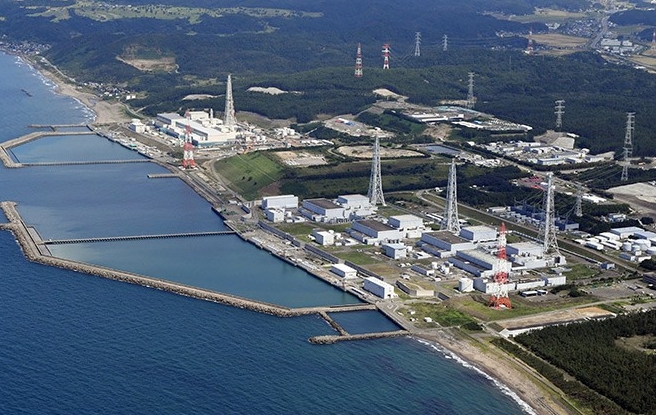
It is the largest nuclear generating station in the world by net electrical power rating. There are seven units, all lined up along the coast line. Numbering starts at Unit 1 with the south-most unit through Unit 4, then there is a large green space in between Unit 4 and 7, then it continues with Units 6 and 5, the newest of the reactors.
The plant is owned and operated by Tokyo Electric Power Company (TEPCO), same company which owns the Fukushima Daiichi nuclear plant where the nuclear disaster is still ongoing since March 2011.
The Kashiwazaki-Kariwa Nuclear Power Plant is a large, modern (housing the world’s first ABWR) nuclear power plant on a 4.2-square-kilometer (1,000-acre) site including land in the towns of Kashiwazaki and Kariwa in Niigata Prefecture, Japan on the coast of the Sea of Japan, from where it gets cooling water.
It was approximately 19 km (12 mi) from the epicenter of the second-strongest earthquake to occur at a nuclear plant, the Mw 6.6 July 2007 Chūetsu offshore earthquake.
Tokyo Electric Power Co.’s Kashiwazaki-Kariwa nuclear complex in Niigata Prefecture
September 23, 2020
Tokyo Electric Power Co. cleared a major regulatory hurdle toward restarting a nuclear power plant in Niigata Prefecture, but the utility’s bid to resume its operations still hangs in the balance of a series of political approvals.
The government’s nuclear watchdog concluded Sept. 23 that the utility is fit to operate the plant, based on new legally binding safety rules TEPCO drafted and pledged to follow. If TEPCO is found to be in breach of those regulations, it could be ordered to halt the plant’s operations.
The Nuclear Regulation Authority’s green light now shifts the focus over to whether local governments will agree in the coming months to restart the Kashiwazaki-Kariwa plant.
TEPCO is keen to get the plant back up and running. It has been financially reeling from the closure of its nuclear plants in Fukushima Prefecture following the triple meltdown at the Fukushima No. 1 nuclear plant in 2011 triggered by the earthquake and tsunami disaster.
The company plans to bring the No. 6 and No. 7 reactors back online at the Kashiwazaki-Kariwa nuclear complex, which is among the world’s largest nuclear plants.
The two reactors each boast 1.35 gigawatts in output capacity. They are the newest of the seven reactors there, first put into service between 1996 and 1997.
TEPCO has not revealed specific plans yet on what to do with the older five reactors.
In 2017, the NRA cleared the No. 6 and No. 7 reactors under the tougher new reactor regulations established in 2013 in response to the Fukushima nuclear disaster.
It also closely scrutinized the operator’s ability to run the Niigata Prefecture plant safely, given its history as the entity responsible for the nation’s most serious nuclear accident.
After several rounds of meetings with top TEPCO managers, the NRA managed to hold the utility’s feet to the fire enough to make it pledge, in writing, to abide by a new seven-point safety code for the Kashiwazaki-Kariwa plant.
The creation of the new code, which is legally binding, is meant to hold the company accountable for safety measures at the facility.
“As the top executive, the president of TEPCO will take responsibility for the safety of nuclear power,” one of the points reads. “TEPCO will not put the facility’s economic performance above its safety,” reads another.
The company promised to abide by the points set out in writing during the NRA’s examination of its safety regulations.
TEPCO also vowed to set up a system where the president is directly briefed on risks to the nuclear complex, including the likelihood of earthquakes more powerful than what the plant is designed to withstand. It must also draft safeguard measures to deal with those kinds of earthquakes and confirm whether precautionary steps are in place.
The utility additionally pledged to promptly release public records on the decision-making process concerning crucial matters related to nuclear safety, and to preserve the documents until the facility is decommissioned.
TEPCO plans to complete its work to reinforce the safety of the No. 7 reactor in December. It has not set a definite deadline for similar work for the No. 6 reactor.
To restart the Kashiwazki-Kariwa plant, TEPCO needs to obtain consent from local governments, including the Niigata prefectural government.
The prefectural government is studying the plant’s safety through a panel of experts, which is reviewing whether evacuation plans are adequate and the health impact on residents from the Fukushima nuclear disaster.
Niigata Governor Hideyo Hanazumi said he will not decide on the restart until the panel completes its review.
The nuclear complex suffered damage, including from fire at an electric transformer, when an earthquake it deemed able to withstand hit in 2007.
Gov’t. Concerned over Japan Possibly Releasing Contaminated Water from Daiichi Plant
September 23, 2020
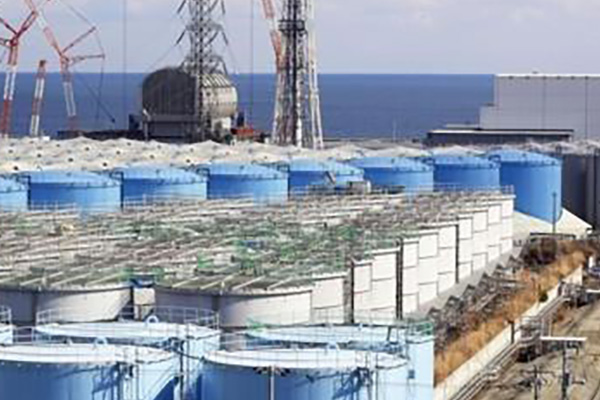
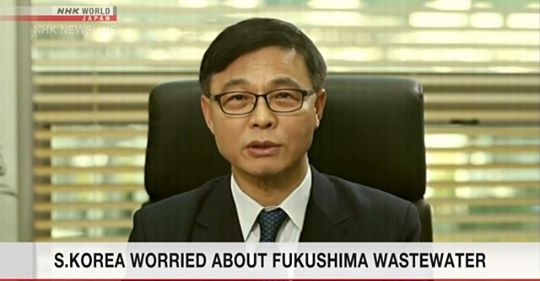
South Korea has expressed concerns over Japan strongly considering the release of contaminated water from the Fukushima Daiichi nuclear power plant disaster site into the ocean.
The Ministry of Science and ICT said First Vice Minister Jeong Byung-seon revealed the plans in a virtual keynote speech during the 64th General Conference of the International Atomic Energy Agency(IAEA) on Wednesday.
Jeong said the international community, including South Korea, is growing concerned and nervous about the environment and its safety as Japan mulls such a possibility.
The vice minister stressed the need to thoroughly analyze the mid- and long-term damage the release could have on the environment and the appropriate way to go about it, given that it could affect global marine environments.
In particular, Jeong said that in line with international laws, Japan is obligated to communicate with the international community in a transparent manner ahead of deciding on ways to dispose of the contaminated water and proposed that the IAEA play a key role in that process.
South Korea has again expressed its concerns about Japan’s plan to release into the sea radioactive wastewater building up at the crippled Fukushima Daiichi nuclear plant.
The first vice minister of South Korea’s science ministry Jeong Byungseon was speaking at a general meeting of the International Atomic Energy Agency in Vienna on Tuesday.
He said “releasing contaminated water into the ocean is not an issue of Japan itself, but one that could have a wider impact on the global marine environment, as well as the neighboring countries.”
He said Japan has “an overarching obligation to make transparent, concrete communication within the global society,” including South Korea, before making any disposal decision.
He asked the IAEA to play a proactive role in the issue.
At last year’s IAEA general meeting, South Korea raised questions about the issue and criticized Japan.
On Monday, Japan’s Science and Technology Policy Minister Inoue Shinji told the meeting that Japan is studying ways to dispose of the water, taking into consideration advice from the IAEA. He stressed Japan will provide careful and transparent explanations to the global community.
In February, a Japanese government expert panel came up with a report saying that diluting the wastewater below environmental and other standards, and discharging it into the sea, as well as vaporizing and releasing it into the air are realistic options.
The government plans to make a decision after hearing opinions from local residents and groups.
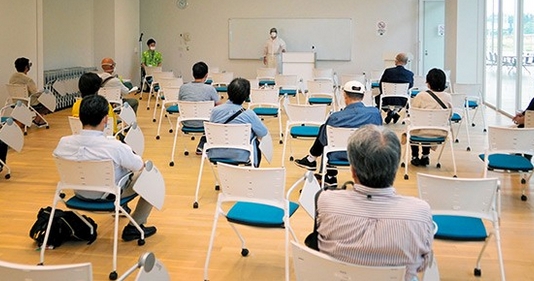
A guide gives a demonstration talk at a preview event held on Sept. 5 at the Fukushima memorial museum.
A Fukushima memorial museum staff member presents a talk on Sept. 20 when the facility opened.
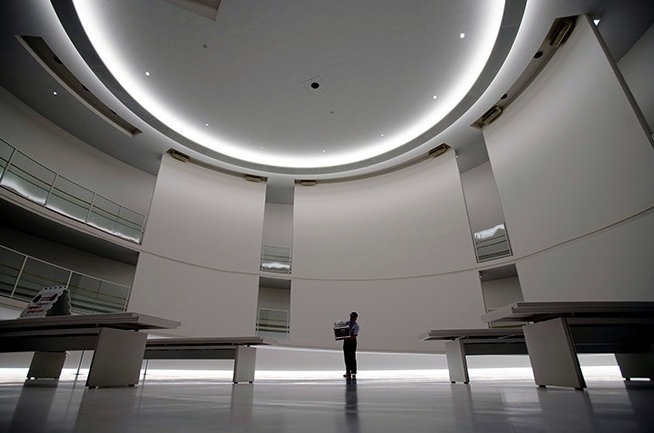
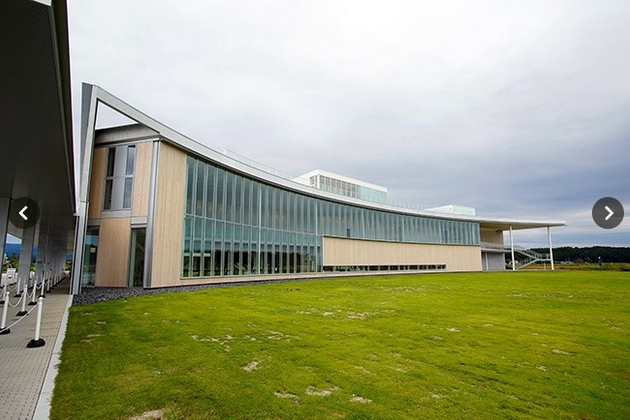
The Fukushima memorial museum in Futaba is devoted to passing on the lessons from the 2011 earthquake, tsunami and nuclear disaster.
September 23, 2020
Tour guides are bristling at instructions not to criticize the central government or Tokyo Electric Power Co. when speaking to visitors at a recently opened memorial museum to the 2011 triple meltdown at the Fukushima No. 1 nuclear power plant.
The instructions have left some Fukushima residents who signed up to be guides feeling perplexed and sparked anger in others.
The museum in Futaba, Fukushima Prefecture, opened on Sept. 20 with the objective of passing on to visitors the lessons learned from the nuclear disaster triggered by the Great East Japan Earthquake and tsunami.
It was constructed by the Fukushima prefectural government in the town of Futaba, which co-hosts the nuclear plant. Evacuation orders issued for residents following the disaster were recently partially lifted.
About 150 items chosen from the 240,000 or so materials collected from around the nation are on display at the facility operated by the Fukushima Innovation Coast Framework Promotion Organization. The central government effectively paid for the 5.3 billion yen ($50 million) that went into completing it.
The museum has 29 registered guides who either survived the 2011 disaster or underwent a training program for the work. They rotate on a daily basis and talk to visitors about their experiences, which include how they lived while living as evacuees and losing their homes in the tsunami.
Each session lasts for a maximum one hour and the guide is paid 3,500 yen for each session.
Training sessions were held in July and August for the guides in which a manual was distributed that included wording to avoid “criticizing or defaming specific organizations, individuals or other facilities.”
One question raised was what to say if a visitor asked what the guide felt about TEPCO’s responsibility, according to several guides who took part in the training sessions.
The guides were told to not directly respond to such questions, but to leave the matter up to facility staff who would be sitting in on the sessions.
Each guide was also asked to write down a script of what they intended to say. The draft was checked and revised by facility staff.
The guides were also told that if they did criticize a specific organization, their talks would be stopped immediately and they would be dismissed as a registered guide.
The manual also included instructions to contact and consult with facility staff if the script was to be changed or if the guide was contacted by media representatives for an interview.
With regard to the manual and instructions, one guide said, “While defamation is out of the question, I think it is wrong that as a victim I am unable to criticize the central government or TEPCO, which is responsible for the damage.”
A second guide had the script revised after pointing out the responsibility of the central government and TEPCO.
Another speculated that the Fukushima prefectural government was not trying to ruffle feathers since the central government had paid for the facility.
“I suffered psychological anguish from TEPCO and I’m also angry with the central government,” one tour guide said.
“To me, that is the truth. The facility has asked us to speak the truth so it is not in a position to say ‘Don’t say such things.’ I will quit as a guide if expressing my feelings is considered being critical.”
A prefectural government official admitted that the central government and TEPCO would be covered by the “specific organizations” clause in the manual.
“We believe it is not appropriate to criticize a third party such as the central government, TEPCO or the Fukushima prefectural government in a public facility,” said another prefectural government official now on the facility staff.
Committees set up by the Diet and central government to investigate the cause of the Fukushima nuclear disaster issued reports that called it a “man-made disaster” and said TEPCO never considered the possibility that the Fukushima plant would lose all electric power sources in the event of an earthquake or tsunami because it stuck to a baseless myth that the plant was safe.









 nuclear-news