12 Fukushima decontamination locations likely to leak radiation, in heavy rain
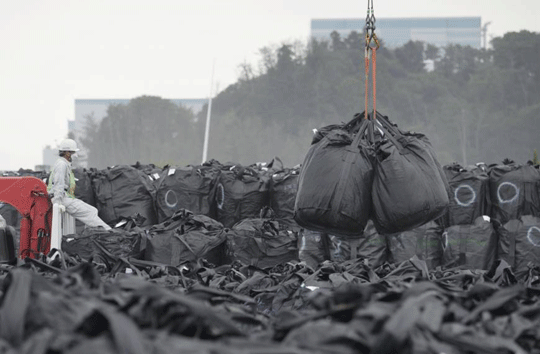
The ministry checked all the sites where the waste is kept after 91 bags were swept into rivers in Fukushima and Tochigi prefectures last year due to downpours caused by Typhoon Hagibis.
Of the 322 locations that are near rivers or in flood-prone areas, 12 sites in Fukushima Prefecture were found to be at risk of having bags of waste swept away or ruptured by mud flows.
The ministry plans to set up fences or move the waste to intermediate storage facilities to reduce the risk by the end of May this year.
Environment Minister Shinjiro Koizumi told reporters on Tuesday his ministry hopes to do the work as soon as possible because of the growing risk of sudden downpours in recent years.
With all eyes on pandemic, Nuclear Non Proliferation Treaty still needs attention
 Nuclear Proliferation Treaty Troubles Remain Unaddressed Amid a Global Pandemic, https://nationalinterest.org/feature/nuclear-proliferation-treaty-troubles-remain-unaddressed-amid-global-pandemic-138162 It is vital that would-be bombmakers be disabused of any notion that they could evade tough international sanctions. We need a country-neutral, reasonably predictable, more-or-less automatic sanction regime that puts all countries on notice, even friends of the powerful. Nuclear Proliferation Treaty Troubles Remain Unaddressed Amid a Global Pandemic, https://nationalinterest.org/feature/nuclear-proliferation-treaty-troubles-remain-unaddressed-amid-global-pandemic-138162 It is vital that would-be bombmakers be disabused of any notion that they could evade tough international sanctions. We need a country-neutral, reasonably predictable, more-or-less automatic sanction regime that puts all countries on notice, even friends of the powerful.
by Victor Gilinsky Henry Sokolski, 27 Mar 20, Just as we’ve had to discard business-as-usual thinking to deal with the current worldwide health emergency; it’s time to get serious about the spread of nuclear weapons. It doesn’t have the immediacy of the coronavirus, but it will last a lot longer and is no less threatening. In particular, we need to fortify the Nuclear Nonproliferation Treaty (NPT), which is fifty years old this year and badly needs fixing. The April 2020 Review Conference will likely be postponed, which provides time to develop something more than the usual charade of incremental proposals that nibble at the problem.
What needs fixing? Five problems: The NPT allows withdrawal on three months notice; it does not bar the use of nuclear explosives as fuels; its inspection arm, the International Atomic Energy Agency (IAEA), is too much involved in promoting nuclear energy; it lacks an established enforcement system, so each violation requires an improvised response; and it is undermined by the holdouts—India, Israel, North Korea, and Pakistan—thumbing their noses at the treaty. International lawyers may scream, but we need to make it essentially impossible to exercise the NPT’s withdrawal provision. This is vital because the member states’ safeguards agreements with the IAEA remain in force only so long as the states remain parties to the treaty. A country should not be allowed to gather the wherewithal for a bomb while a member and then free itself of its treaty responsibilities by announcing its withdrawal. It shouldn’t be allowed to leave the treaty with technology, imported or indigenous, it obtained as a member, because it did so with the forbearance of other members on the assumption that it was doing so for peaceful uses.There has to be a wide safety margin between genuinely peaceful and potentially military applications to make it impossible to surprise the world with a bomb.
The oft-cited “inalienable right” to “nuclear energy for peaceful purposes” in the NPT’s Article IV has to be interpreted strictly in terms of the treaty’s overriding objective expressed in Article I (nuclear weapons countries can’t help others get bombs), and Article II (non-weapons countries can’t get them, period). That’s a long way of saying no commercial use of highly enriched uranium or plutonium, which today has no economic justification.
Another relic embedded in the NPT and the IAEA Statute is their promotion of nuclear power. With mind-numbing regularity, IAEA officials argue that accommodating countries on nuclear energy technology helps to gain their assent to control measures. But this approach weakens the NPT by creating a zero-sum game in which nonproliferation obligations of the many members are held hostage to technology sharing by the main supplier states. Unfortunately, too many members want dangerous technologies. That is not all. The agency’s singling out of nuclear energy as the anointed energy source leads to a misallocation of economic and scientific resources in countries that can’t afford it.
In the initial years of the NPT, there was an implicit assumption that the Western states and Soviets would police their spheres. But now, with the Cold War over, the NPT needs an established enforcement mechanism to deal predictably with violations, instead of each instance requiring improvisation by the leading members. The logic of “safeguards” assumes rapid international reaction, but experience shows it is more often measured in years. It is vital that would-be bombmakers be disabused of any notion that they could evade tough international sanctions. We need a country-neutral, reasonably predictable, more-or-less automatic sanction regime that puts all countries on notice, even friends of the powerful. A permanent secretariat attached to the treaty would help. Finally, it undermines the treaty when a non-member is used to enforce it, as when the United States acquiesced in Israel’s 2007 bombing of Syria’s clandestine reactor, instead of involving the IAEA, or when it cooperated with Israel in sabotaging Iran’s nuclear program.
The most difficult issue is what to do about the three NPT holdouts—India, Israel, and Pakistan—and the member-in-violation, North Korea. The drafters’ intent to only recognize five nuclear states was to first make sure that number did not grow larger while treating reductions among the five separately. To add new nuclear weapon members in addition to these five would undermine the treaty. However impossible it may now seem, the only way that all states can be brought under the NPT system is if all commit themselves to reduce their nuclear weapons to zero. The United States and Russia have made substantial reductions, but the continuation of that process requires all nuclear states to join in further cuts. Towards this end, we would universalize the treaty—that is, regard it as applicable to all states. The three holdouts would then be in non-compliance. Of course, as a legal matter, you cannot force a country to join a treaty. But if the 190 NPT members so decided, they could treat the three holdouts, and North Korea, as countries in non-compliance, with appropriate disadvantages that would follow from that. At the same time, if these countries joined the weapons reductions process under adequate monitoring, they could be considered as approaching compliance, and disadvantages could be moderated.
This much is clear: Incremental, least-common-denominator steps are never going to get us to where we need to be, and serious people responsible for security know it. To cope with proliferation hazards in the face of weak international controls over nuclear programs, the world seems to be slipping—witness the case of Iran—into relying on greatly increased national intelligence operations backed up in the last instance by bombing and even assassinations. It is difficult to imagine that this is a workable solution for the long term.
To stop the further spread of nuclear weapons, we have to stop downplaying the NPT. Instead, we should strengthen and use it. Victor Gilinsky is a program advisor for the Nonproliferation Policy Education Center (NPEC) in Arlington, Virginia. He served on the Nuclear Regulatory Commission under Presidents Ford, Carter, and Reagan. Henry Sokolski is executive director of NPEC and the author of Underestimated: Our Not So Peaceful Nuclear Future (second edition 2019). He served as deputy for nonproliferation policy in the Cheney Pentagon. |
|
LANL Plans to Release Twice the Amount of Tritium Allowed
 LANL Plans to Release Twice the Amount of Tritium Allowed http://nuclearactive.org/ March 26th, 2020 The Department of Energy (DOE) and its contractor at Los Alamos National Laboratory (LANL) plan to vent radioactive tritium into the air in an amount twice the federal standard of 10 millirems a year. LANL estimates a possible offsite dose to the public of 20.2 he Department of Energy (DOE) and its contractor at Los Alamos National Laboratory (LANL) plan to vent radioactive tritium into the air in an amount twice the federal standard of 10 millirems a year. LANL estimates a possible offsite dose to the public of 20.2 LANL Plans to Release Twice the Amount of Tritium Allowed http://nuclearactive.org/ March 26th, 2020 The Department of Energy (DOE) and its contractor at Los Alamos National Laboratory (LANL) plan to vent radioactive tritium into the air in an amount twice the federal standard of 10 millirems a year. LANL estimates a possible offsite dose to the public of 20.2 he Department of Energy (DOE) and its contractor at Los Alamos National Laboratory (LANL) plan to vent radioactive tritium into the air in an amount twice the federal standard of 10 millirems a year. LANL estimates a possible offsite dose to the public of 20.2
In 2019, the federal Environmental Protection Agency (EPA) approved a 2018 LANL plan under the Clean Air Act. This month, the New Mexico Environment Department approved the plan under the state’s Hazardous Waste Act because there are lead tools present in the containers. But there are inconsistencies between the two plans.
For instance, the earlier Clean Air Act plan proposed using “getters” to capture a portion of the vented tritium before it is released through an open door in the prefabricated shed. The later plan deleted the use of a “getter bed” and replaced it with an unnamed air emissions control system. Nevertheless, the Hazardous Waste Act plan states the gases will pass through a molecular sieve bed and through a metering value before release. https://permalink.lanl.gov/object/tr?what=info:lanl-repo/eprr/ESHID-603412 New Mexicans are concerned about the proposed venting. Tritium is radioactive hydrogen and is highly mobile moving from air to water and back. It can cross the placenta and affect a developing fetus. The 10 millirem standard is based on a 154-pound, five feet 6 inch, Anglo “reference man,” between the ages of 20 to 30, who consumes a European diet. Beata Tsosie, a Community Doula and Gardener, from Santa Clara Pueblo, said, “As a Pueblo woman living downwind and downstream from Los Alamos nuclear weapons production, I am very concerned about the lab’s intentions to go forward with releasing radioactive tritium vapor into our air, land, waters, and ecosystems. During mid April is when our land-based community is outdoors for longer periods of time preparing their fields and gardens for planting. What will it mean to also have cumulative exposure when we consume these crops? There are also increased exposures due to active foraging of wild plants, gathering of clays, fishing, hunting, and ceremony. “Our children are also outdoors for longer periods of time due to the school shutdown for COVID-19, which is scheduled to go on indefinitely. I watch my son playing in his backyard, making his own gardens, running, getting out of breath and breathing deeply the air that I need to know is safe for him to be exposed to. We live 20 minutes away from these planned releases, and now in addition to an already stressful self-quarantine I need to worry about my family being outside enjoying their birthright. “It is my understanding that in the documents submitted to the EPA and NMED in 2018, there is no inclusion of alternatives to these releases. There should not be a rush to put our communities in harms way when all solutions have not even been discussed. I know that the federal standards for tritium exposure are not protective of land-based people of color, or pregnant families and infants who are more vulnerable to radioactive toxicity. Tritium can cross placental boundaries. These standards of exposure are still based on an obsolete model of an adult, white male of European descent and custom. There must be an informed public process that prioritizes protecting those most vulnerable. I do not consent to these toxic releases in my ancestral homelands; it is the continuation of nuclear colonialism and violence on Indigenous lands and bodies and a sorrowful history of environmental racism in our sacred Jemez Plateau. I call on all of our Congressional delegation, EPA and NMED directors to put an immediate halt and suspension to these planned tritium releases and increase in LANL production. Our communities deserve reprieve, health, calm, and wellness in these challenging times.” Given the cumulative health consequences from the proposed venting, organizations and individuals are requesting the Environment Department hold a public comment period and a public hearing. |
|
Nuclear waste disposal: Why the case for deep boreholes is … full of holes
|
Nuclear waste disposal: Why the case for deep boreholes is … full of holes, Bulletin of the Atomic Scientists, By Lindsay Krall, March 26, 2020 “….. The deep borehole concept is relatively simple and has been around since the 1950s. Rather than excavate one enormous mine like Yucca Mountain to store all US civilian nuclear waste, this solution would involve depositing nuclear waste in hundreds of narrow holes drilled into the earth’s crust.
The idea has plenty of boosters, among them a start-up called Deep Isolation, based in Berkeley, California. Founded by physicist Richard Muller and his daughter Elizabeth Muller, the company launched a Series A investment round earlier this year on the promise that it can bring the borehole concept to fruition. By leveraging the lateral drilling technology developed for tapping into shale gas deposits, the company that professes to be the “SpaceX” of nuclear waste claims to have hacked a solution for the permanent disposal of the United States’ 82,000 metric ton inventory of commercially-generated spent nuclear fuel. Unfortunately, the proposal is full of holes. The problem of Yucca Mountain. Ever since the 1950s, the United States has been searching for a place to bury its nuclear waste, which remains radioactive for tens of thousands of years. In 1987, against the will of Nevadans, the US Congress designated Yucca Mountain to host the nation’s spent fuel inventory through an amendment to the Nuclear Waste Policy Act. Ever since, the site has been treated as a political football. The facility was supposed to open in 1998, but far from completion, the project was dismantled in 2010. So far, the only thing that’s been built there is a five-mile exploratory tunnel. Meanwhile, those 82,000 metric tons of spent nuclear fuel remain in temporary storage. In practical terms, that means the spent fuel is sitting at about 80 different places spread out across 35 states, stored either in pools of water or in casks made of steel and concrete. The delays and shortcomings at Yucca Mountain have created opportunities for companies like Deep Isolation to profit from empty promises to deliver “alternative solutions.” The borehole business model. By pledging to streamline the process of disposing spent nuclear fuel, Deep Isolation has already amassed over $14 million in venture capital. To save nuclear plants from shipping their waste to a centralized repository 2,000 miles away, the company conceives to bury the waste more or less on-site at each power plant in nearly horizontal underground holes. Even though hundreds of boreholes will be required to house the nation’s spent fuel inventory, this option is said to be inexpensive, relative to Yucca Mountain. Deep Isolation cites a lower-limit cost of $2 million to drill one hole but suggests that the approach will save money overall by eliminating things like further interim waste storage, transportation, and much of the necessary construction workforce. Confronted with an economies-of-scale argument that would favor a few, large-capacity facilities, the company markets its approach as “modular,” so that the revenue generated from the completion of one easily-replicated, generic borehole can finance the development of subsequent boreholes. A supposedly irrefutable safety case accompanies these seemingly excellent financials. Unlike the Yucca Mountain repository, boreholes would be sited below the water table, at depths ranging from 600 meters to 2 kilometers, in sedimentary rock formations. The disposal zone would consist of or be overlain by shale rock formations, which contain ductile clay minerals that can heal any fractures that would otherwise facilitate the flow of water—a potential hazard—to and away from the waste. Simple tests, such as analyses of natural chlorine isotopes, show that the water in these formations is millions of years old. This, Deep Isolation hopes, will convince stakeholders that the system is impenetrable, with negligible risk for contamination of nearby aquifers. A watertight plan? Long before Deep Isolation announced its hack, the Energy Department had concluded in the 1980s that disposal of spent nuclear fuel in boreholes drilled to depths of roughly 10 kilometers was not an attractive alternative to mined repositories. In the years following, the US Nuclear Waste Technical Review Board, the US Nuclear Regulatory Commission, and waste management organizations of Sweden, the United Kingdom, and Canada reviewed concepts for shallower boreholes, with waste emplaced at depths ranging between 3 kilometers and 5 kilometers. Similar to the Energy Department study, these reviews concluded that borehole disposal would require decades of research, design, and development, which—even if successful—did not promise safety margins superior to a well-sited, deep-mined repository. A more recent study that several colleagues and I authored found that Deep Isolation’s even shallower boreholes, at depths of around 2 kilometers or less, would be plagued by the same problems and that suitable borehole disposal sites are, in fact, geographically scarce. Many challenges to the viability of borehole disposal stem from the limit that modern drilling techniques impose on borehole diameters. Although the precise borehole geometry is dependent on location-specific geologic variables, deeper boreholes generally necessitate smaller diameters. Such a limitation has implications both in terms of the barrier system that surrounds the nuclear fuel and in terms of the ability to fully characterize the geology of the disposal site. To accommodate canisters whose diagonal cross-section has a length of 30 centimeters, the diameter of Deep Isolation’s curving boreholes must be larger than 40 centimeters. Since this exceeds the 22-centimeter standard for oil and gas extraction, the technical feasibility of Deep Isolation’s drilling scheme remains unclear. But if it is feasible, then a 40-centimeter diameter borehole would restrict the thickness of the canister walls to about one centimeter. As compared to deep-mined repositories, which could accept canisters with walls thicker than 5 centimeters, thin-walled canisters will have adverse safety consequences for the workers who will load the waste into the boreholes. Therefore, potential worker exposures to and environmental releases of radioactivity during canister loading warrants careful consideration. For instance, gamma radiation emitted by spent fuel can penetrate a canister wall and expose operators to radiation. The thick-walled canisters destined for deep-mined repositories will attenuate a significant portion of this penetrating radiation, but the thin-walled canisters inherent to borehole disposal will have negligible shielding capability. The sheer number of canisters will pose further challenges. Canister designs for mined repositories will have a capacity of at least four spent fuel assemblies, whereas borehole canisters will each contain only one assembly. Lowering hundreds of thousands of flimsy canisters into hundreds of narrow boreholes in a safe, timely fashion will be tricky, to say the least. If a canister is punctured or becomes stuck during this phase, then the risk to operators and the environment could be high. Investing in the necessary research, design, and development needed for drilling, shielding, and canister emplacement for Deep Isolation’s concept might be justified, if this approach would improve the financial and long-term safety case for spent fuel disposal relative to a deep-mined repository. But, the thin-walled canisters will also adversely affect long-term safety as well, insofar as they will be more likely to fail through corrosion compared to a thicker canister. Whereas mined repository designs incorporate a series of engineered and natural barriers to delay or preclude the release of radionuclides into the groundwater system and into the biosphere, borehole disposal relies entirely on a geologic barrier. Hence, borehole developers must compile a safety case that convinces regulators and the general public that the geologic environment around their disposal sites can function on its own to sequester radionuclides over the 1 million-year regulatory period. This means that in-depth sampling and analysis will need to be performed at every disposal site, undercutting the idea that boreholes represent a modular, easily replicable solution. Ironically, the concept that has been promised to liberate stakeholders of the upfront costs associated with these site investigations is destined to increase the complexity of these activities. Rather than one or a handful of disposal sites, hundreds of disposal boreholes must be investigated thoroughly. Then, stakeholders must reach a high level of certainty that the bedrock, alone, can compensate for a lean engineered barrier system. Grappling with uncertainty. Reducing long-term performance uncertainty is the sine qua non for garnering public support for spent fuel repository projects. Over the course of decades, mined repository programs can take a phased approach to resolving the uncertainties associated with the geologic variables that control the flow of groundwater to and away from the emplaced waste. These include an initial phase during which geologic samples are collected and analyzed at several sites; an interim monitoring phase during which routine measurements are performed to capture the variability of those results; and a construction phase that allows workers, inside a rock cavern, to validate interpretations made in the earlier phases. By contrast, the deep borehole model, which relies on rapid siting, drilling, waste emplacement, and closure, affords little to no opportunity for site monitoring. It offers no way for scientists, regulators, or engaged citizens to enter the rock cavern and learn, through experience and careful examination, whether the repository will remain geologically stable for millennia. A proven approach. Deep Isolation’s rendition of borehole disposal includes a slew of Silicon Valley buzzwords apparently aimed at novice investors on crowdfunding websites. Even if several decades of labor does glean evidence of the technical feasibility of this alleged hack, then its long-term safety case would still be subject to inordinate uncertainty. Nuclear waste experts have long emphasized disposal solutions that rely on mature technologies, for simple reasons. What will happen to surface-stored spent fuel if, while waiting for some shiny new object, a malevolent dictator assumes power? Or, what if a pandemic cripples the global economy? In the end, then, a mined repository still may be the best answer. Technically viable and publicly accepted repository designs are successfully moving ahead in Sweden, Finland, Switzerland, France, Canada, and even China and Russia. Rather than committing, prematurely, to a single site (Yucca Mountain) or chasing after nonviable “alternative solutions,” the United States would be wise to scale one or more of these internationally pioneered designs to accommodate the world’s largest national spent fuel inventory. By coupling one of these technical solutions with the institutional reform proposed by expert committees, the United States might finally find somewhere to put its nuclear waste. https://thebulletin.org/2020/03/nuclear-waste-disposal-why-the-case-for-deep-boreholes-is-full-of-holes/# |
|
How will the IAEA spin the mind-boggling costs of Small Modular Nuclear Reactors (SMRs)?
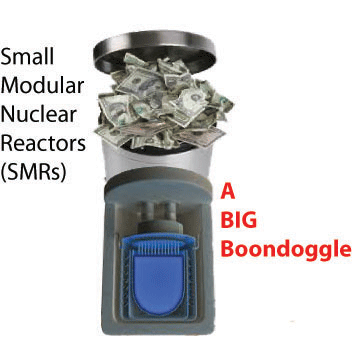 IAEA launches project to examine economics of SMRs https://www.world-nuclear-news.org/Articles/IAEA-launches-project-to-examine-economics-of-SMRs 26 March 2020, he International Atomic Energy Agency (IAEA) is launching a three-year Coordinated Research Project focused on the economics of small modular reactors (SMRs). The project will provide Member States with an economic appraisal framework for the development and deployment of such reactors.
Participants in the research project will cover: market research; analysis of the competitive landscape (SMR vs non-nuclear alternatives); value proposition and strategic positioning; project planning cost forecasting and analysis; project structuring, risk allocation and financial valuation; business planning and business case demonstration; and economic cost-benefit analysis.
The framework they establish will be applied, in particular, to assess the economics of multiples (serial production of reactors in a factory setting), factory fabrication (conditions to be met for a factory to exist), and supply chain localisation (opportunities and impacts).
The deadline for proposals to participate in the research project is 30 April.
Study: Cesium levels in fish in Fukushima lakes, rivers differ
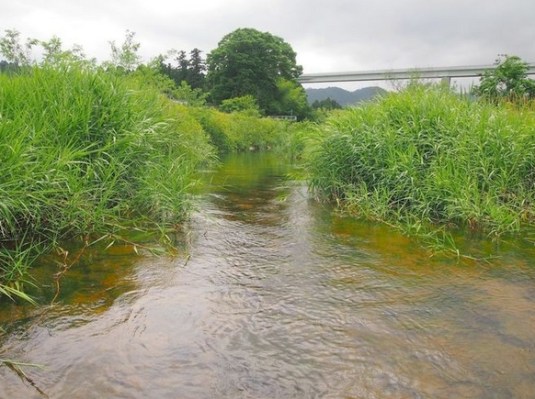 The Otagawa river, which runs through Minami-Soma, Fukushima Prefecture, and elsewhere, was surveyed for cesium levels in fish following the accident at the Fukushima No. 1 nuclear power plant. (Provided by the National Institute for Environmental Studies)
March 27, 2020
A team of scientists discovered that radioactive cesium released from the crippled Fukushima No. 1 nuclear power plant accumulates in freshwater fish differently in lakes and rivers.
How easily cesium is taken into bodies is determined by what the fish consume in lakes, although factors associated with water quality–such as the ratio of mud particles–are more important for those inhabiting rivers, according to the researchers.
The findings are expected to help predict the cesium concentration in aquatic creatures more accurately even when all of them are not examined individually, the researchers from the National Institute for Environmental Studies said.
“The discovery could be used for estimating how the cesium level has lessened in each fish species,” said Yumiko Ishii, a senior researcher at the institution’s Fukushima Branch.
Higher radioactive cesium levels are reported in freshwater fish than those in the ocean in regions contaminated by the nuclear accident that started to unfold at the Tokyo Electric Power Co. plant in March 2011 following the Great East Japan Earthquake and tsunami.
While cesium remains mainly in the flesh, how the substance is ingested differs greatly depending on the species, habitat and other elements.
Sweetfish, char, landlocked salmon, carp and other species are still banned from shipping in certain areas, even nine years after the nuclear accident.
The research team studied how cesium accumulated in different species in areas of Fukushima Prefecture, targeting 30 kinds of fish in lakes Hayamako, Inawashiroko and Akimotoko as well as the Udagawa, Manogawa, Niidagawa, Otagawa and Abukumagawa rivers two to four years after the accident.
The results revealed that cesium levels could change in lakes if the fish consume differing foods. Higher readings were measured for landlocked salmon, char and other creatures preying on small fish, likely because cesium becomes concentrated in their bodies by eating tiny creatures.
On the other hand, the kinds of food they consume do not affect the cesium concentration in fish species living in rivers.
The findings showed cesium accumulates more easily when the water contains a smaller amount of tiny mud particles and carcasses of living creatures. The higher the ratio of those particles, the lower the cesium level becomes.
The researchers said the reason is apparently that cesium in water is absorbed into those particles, making it difficult for cesium to remain in the fish bodies as the substance is discharged in the particles through feces.
Meanwhile, higher cesium levels were detected for larger species both in lakes and rivers.
The discovery has been published in the international magazine Journal of Environmental Radioactivity at: (https://www.sciencedirect.com/science/article/pii/S0265931X1830715X).
Tepco to pursue its radioactive water sea release plan
Tepco to pursue its radioactive water sea release plan and “Tepco also plans to use social media to counter rumors that exposure to radiation from the released water is harmful.”
Plan to dispose of Fukushima wastewater drafted
March 24, 2020
NHK has learned that Tokyo Electric Power Company, or TEPCO, has drafted a plan for disposing of radioactive wastewater stored at the troubled Fukushima Daiichi nuclear power plant.
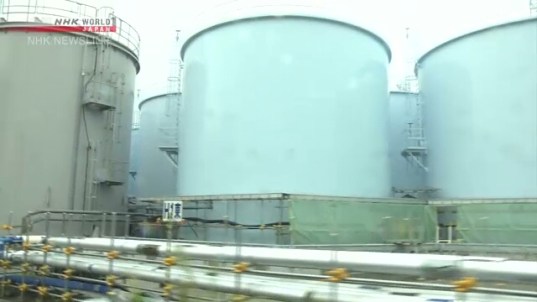
Water used to cool molten nuclear fuel from the 2011 accident is treated to remove most radioactive material. But tritium and other substances remain in the water, a huge amount of which is stored in about 1,000 large tanks.
A government panel last month compiled a report that says releasing diluted radioactive wastewater into the sea or air are realistic options.
TEPCO’s plan for doing so would involve diluting the wastewater with seawater, aiming for a tritium level of one-fortieth that allowed by national regulation.
The firm would gradually release the diluted water over about 30 years, taking into consideration the amount of similar water released at other nuclear plants.
TEPCO would also test treating the wastewater again to further remove other radioactive materials.
The utility is to explain the plan to local officials and residents in Fukushima Prefecture. People in the local fishery and tourism industries oppose releasing the water into the ocean.
https://www3.nhk.or.jp/nhkworld/en/news/20200324_42/
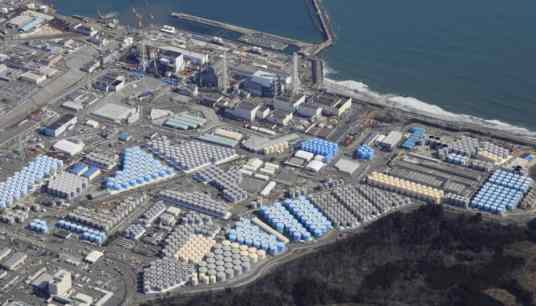 Tanks storing contaminated water at the Fukushima No. 1 nuclear power plant in February
Tepco may take 30 years to release Fukushima No. 1 radioactive water
March 25, 2020
Tokyo Electric Power Company Holdings Inc. said Tuesday it may spend up to 20 to 30 years releasing contaminated water into the surrounding environment from its disaster-crippled Fukushima No. 1 nuclear power plant.
The possible time span was mentioned in draft plans Tepco drew up in line with a government panel’s report in February, calling the release of the water into the ocean or the air in the form of vapor a “realistic option.”
The company currently stores roughly 119 tons of water that still contains tritium and other radioactive substances after passing through a treatment process at the nuclear plant, which suffered a triple meltdown in March 2011 caused by a magnitude 9.0 earthquake and tsunami. The amount of contaminated water stored at the facility is still increasing.
According to the draft plans, Tepco will first conduct secondary treatment work to reduce the amount of radioactive substances in the water other than tritium — which cannot be removed by existing systems — to levels below national standards.
Following the treatment, the water will be released into the ocean, after being diluted with seawater to lower the radiation level to 1,500 becquerels per liter, or emitted into the air from a tall exhaust stack after being vaporized.
Tepco also plans to use social media to counter rumors that exposure to radiation from the released water is harmful.
27
Tokyo 2020 Olympics postponed to 2021 due to coronavirus
Those 2020 Tokyo Olympics should never take place, if not a gigantic PR operation by PM Abe and its government in their efforts to whitewash and normalize the ongoing Fukushima disaster in the eyes of the whole world…
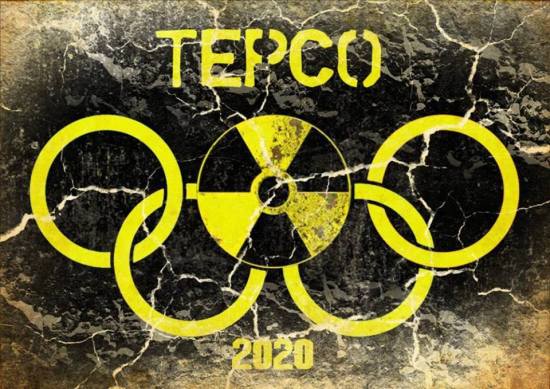 Bye-bye Tokyo 2020 radioactive-coronovirus Olympics
Report: Tokyo 2020 Olympics postponed to 2021 due to coronavirus
International Olympic Committee member Dick Pound tells USA Today “the Games are not going to start on July 24.”
March 23, 202
Huge numbers of sporting events have been canceled or postponed due to the coronavirus pandemic. And now it looks like the granddaddy of global sporting events, the Tokyo Olympic Games, set for this summer, will join them. On Monday, International Olympic Committee member Dick Pound told USA Today the 2020 Tokyo Olympic Games will be postponed, likely to 2021.
“On the basis of the information the IOC has, postponement has been decided,” Pound told USA Today. “The parameters going forward have not been determined, but the Games are not going to start on July 24, that much I know.” Details are yet to be worked out, the newspaper reported.
When asked if Pound was speaking officially for the IOC, the organization replied only that, “It is the right of every IOC member to interpret the decision of the IOC EB which was announced yesterday.” The decision referred to is the IOC announcement that it will study different scenarios regarding the future of the 2020 Games. That statement goes on to say the group will finalize discussions within four weeks, and that cancelation is “not on the agenda.”
While the Olympics have been canceled in the past, for World War I and World War II, they have never been postponed to a different year.
Also on Monday, Reuters reported that Japan Olympic Committee President Yasuhiro Yamashita said he was considering postponement, reflecting the most recent comments from Japanese Prime Minister Shinzo Abe. US President Donald Trump tweeted that he will back whatever decision Abe makes: “We will be guided by the wishes of Prime Minister Abe of Japan.”
Even if the event were to take place as scheduled, Canadian and Australian athletes wouldn’t compete. On March 22, the Canadian Olympic Committee and Canadian Paralympic Committee announced that their teams won’t head to Tokyo and urged that competition be postponed for one year. The Australian Olympic Committee’s executive board also unanimously agreed not to send a team and encouraged athletes to instead prepare for a summer 2021 event.
And on March 20, USA Swimming, the national governing body for competitive swimming, sent a letter to the US Olympic and Paralympic Committee urging the group to postpone the Summer Games to 2021.
The virus came close to the Olympics on March 19, when it was announced that Tokyo 2020 Olympics chief Yoshiro Mori, 82, attended a March 10 meeting with Kozo Tashima, the deputy head of the Japanese Olympic Committee who later tested positive for coronavirus. Mori has no symptoms and hasn’t been tested. The men were seated about 10 meters (about 32 feet) apart.
The Olympics are huge, both in numbers of people involved, and in billions of dollars spent. More than 11,000 athletes from 206 nations are hoping to compete in 339 events. Many thousands more are planning to work in some part of the games, from food and souvenir vendors to hotel clerks to trainers and coaches. NBC had been set to broadcast the games in the US, even offering a dedicated streaming Olympics package for those who want to watch as much as possible, with no ads. And as evidenced by the fact that tickets sold out last July, thousands more were planning to watch the events, whether traveling from across town or across the planet.
The 1916 Summer Games were canceled due to World War I. The 1940 and 1944 Games, both winter and summer, were canceled due to World War II. (Japan was the country affected back then, too — the 1940 Games were set for Tokyo and Sapporo.) Other games have been affected by boycotts. By contrast, in 2016, the Olympics in Rio de Janeiro, Brazil, played out as scheduled despite scientists’ warnings about the Zika virus.
The next Olympics after Tokyo are the 2022 Beijing Winter Games, followed by the 2024 Paris Summer Games, and then the 2026 Winter Games in Milan and Cortina, Italy.
PM Abe says Tokyo Olympics cannot be held under current circumstances
March 23, 202
Japanese Prime Minister Shinzo Abe said Monday this summer’s Tokyo Olympics cannot be held under current circumstances due to the new coronavirus pandemic, suggesting for the first time that the games may have to be postponed.
“If I’m asked whether we can hold the Olympics at this point in time, I would have to say that the world is not in such a condition,” Abe told a parliamentary session, adding he hopes to hold talks with International Olympic Committee President Thomas Bach over the issue.
“It’s important that not only our country but also all the other participating countries can take part in the games fully prepared,” Abe said.
The premier’s comments came a day after the IOC said it will study alternative plans for the Tokyo Olympics, scheduled to open on July 24, amid the global outbreak, and make an assessment within the next four weeks.
The Japanese government will soon tell the IOC it will accept a postponement if the organization decides on it as a precaution against the coronavirus, a source familiar with the plan said.
Tokyo Olympic organizing committee President Yoshiro Mori said he supports the IOC’s decision to review existing plans, adding representatives from Japan and the IOC will hold discussions to examine possible scenarios closely.
“Japan is in a critical state, and the situations in the United States and Europe have been abnormal,” Mori said. “We are not so foolish as to say we will do it under our first (plan).”
Abe, who has previously said he aims to hold the major sporting event in its “complete form,” told the parliamentary session, “If it is difficult to hold the games in such a way, we have to decide to postpone it, giving top priority to (the health of the) athletes.”
“Although the IOC will make the final decision (on the matter), we are of the same view that cancellation is not an option,” Abe said while vowing to work closely with the IOC and the Tokyo metropolitan government.
The IOC on Sunday officially admitted the possibility of pushing back the quadrennial event, saying it will examine various scenarios, adding that it will finalize discussions “within the next four weeks.”
“These scenarios relate to modifying existing operational plans for the games to go ahead on 24 July 2020, and also for changes to the start date of the games,” the IOC said in a statement.
Speaking at a press conference, organizing committee CEO Toshiro Muto said reviewing the possibilities, including postponement, is “not easy” and the organizers are open to “all options.”
Mori said some of the challenges organizers will face in terms of postponement include handling the costs of delaying and the availability of venues.
Meanwhile, Tokyo Gov. Yuriko Koike told reporters, “(The IOC) clearly stated that cancellation will not happen, and I am glad to share that view.”
“There are lots of issues, but I would like to discuss possible scenarios over the next four weeks with the IOC and the organizing committee,” she said. “The Tokyo Games now have another goal, to defeat the novel coronavirus.”
Mori said local organizers will decide in the coming days whether to go ahead with the opening of the domestic leg of the torch relay in Fukushima Prefecture on Thursday, as developments surrounding the pandemic have been changing rapidly.
Mori added that Bach told him that the Japanese organizers have the authority to make decisions about the domestic leg of the torch relay.
Members of the organizing committee revealed Monday they may drastically reduce the scale of the torch relay, including canceling the participation of members of the public.
Under modified plans, the Olympic flame may be carried by car in the initial stages of the relay.
Muto and Olympics minister Seiko Hashimoto each said Monday the relay will proceed as planned for the moment.
Mori also revealed that Abe is now reluctant to attend the kick-off ceremony since the Japanese government has been requesting people refrain from holding large events to prevent the spread of the virus.
Olympic torchbearers in Japan expressed concerns over the IOC’s new direction.
“Both runners and spectators of the relay would be half-hearted. I wonder whether they will let us run again if (the sporting event) is postponed,” said 66-year-old Yumiko Nishimoto, who is scheduled to run in Fukushima on Thursday as one of the 10,000 torchbearers in Japan.
The 121-day Japanese leg is scheduled to kick off at the J-Village soccer training center, which served as a frontline base of operations to battle the 2011 nuclear crisis caused by the March 11 quake-tsunami disaster that year.
A decision on postponement “should be made before the torch relay starts,” Nishimoto said. “I have mixed feelings as I feel that we are being messed around.”
The global coronavirus pandemic has cast a cloud over the hosting of the Tokyo Olympics from July 24 to Aug. 9 and the Paralympics from Aug. 25 to Sep. 6. In recent days, national Olympic committees in Brazil, Norway and the Netherlands have called for postponements.
Japanese government officials have repeatedly said preparations are under way for the games to go ahead as scheduled, and the flame for the Olympics arrived on Friday in Japan.
During a videoconference with other leaders from the Group of Seven industrialized nations earlier in the month, Abe secured support for holding “complete” games, meaning they should be held with spectators and without any downsizing.
“I think U.S. President (Donald) Trump and other G-7 leaders will support my decision,” Abe said in the parliamentary session.
Mounting Tokyo 2020 postponement calls put pressure on defiant Olympic chiefs
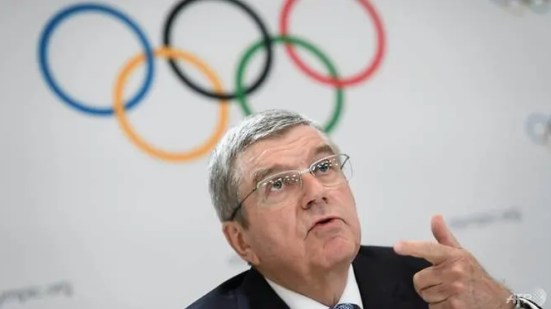 IOC President Thomas Bach insists that it is too early for the Olympics to be postponed, as the start is four months away
March 22, 2020
PARIS: Pressure mounted on Olympic organisers to postpone the 2020 Tokyo Games on Saturday (Mar 21) after the powerful US track and field federation urged this summer’s event be pushed back due to the coronavirus pandemic.
USA Track and Field became the latest influential sports body to ask for the Games to be called off after its head Max Siegel “respectfully requested” in a letter that the US Olympic and Paralympic Committee (USOPC) “advocate … for the postponement of the 2020 Olympic Games in Tokyo”.
USOPC had said it was too soon to axe the Jul 24 to Aug 9 Games, much like International Olympic Committee (IOC) head Thomas Bach, who said that it would be “premature” to make such a big decision.
“The right and responsible thing to do is to prioritise everyone’s health and safety and appropriately recognise the toll this difficult situation has, and continues to take, on our athletes and their Olympic Games preparations,” wrote Siegel.
USATF joined a growing chorus of calls from sports organisations to push back the Olympics, a day after the country’s swimming federation asked USOPC to back a postponement until 2021.
“We urge the USOPC, as a leader within the Olympic Movement, to use its voice and speak up for the athletes,” USA Swimming CEO Tim Hinchey said in a letter.
That request for a delay was echoed on Saturday by France’s swimming federation which said that the Games could not be organised properly in the “current context”.
World Athletics president Sebastian Coe told AFP Saturday that the sporting world was in “uncharted territory”.
“We have another meeting early next week to discuss the work, given the number of athletes who are struggling to train in various countries due to measures put in place to reduce the spread of the coronavirus,” said Coe.
“I don’t think we should have the Olympic Games at all costs, certainly not at the cost of athlete safety and a decision on the Olympic Games may become very obvious very quickly in the coming days and weeks.
“The issue of competition fairness is paramount. We are all managing the situation day by day and increasingly hour by hour.”
The Norwegian Olympic Committee (NOC) quickly followed, saying that it had sent a letter to the IOC on Friday, motivated in part by a Norwegian government ban on organised sports activities which had created “a very challenging time for the sports movement in Norway”.
“Our clear recommendation is that the Olympic Games in Tokyo shall not take place before the COVID-19 situation is under firm control on a global scale,” the NOC said in the letter.
IOC “PUTTING US IN DANGER”
The new chairman of the United Kingdom’s athletics governing body also questioned the need to hold the Olympics this summer given the uncertainty surrounding the spread of COVID-19, which has now killed over 12,000 people worldwide according to an AFP tally.
“To leave it where it is is creating so much pressure in the system. It now has to be addressed,” head of UK Athletics Nic Coward told the BBC.
On Friday, Bach defended the IOC’s refusal to cancel the Olympics by saying that the Games were further away than other shelved events, such as football’s European Championship which was due to start in mid-June and has been moved to 2021.
“We are four-and-a-half months away from the Games,” Bach told the New York Times.
“For us, (postponement) would not be responsible now.”
Athletes lashed out at IOC advice to continue training “as best they can”, with Olympic pole vault champion Katerina Stefanidi accusing the body of “putting us in danger”.
“The IOC wants us to keep risking our health, our family’s health and public health to train every day?” asked Stefanidi.
World champion fencer Race Imboden of the United States said on Twitter that he was “worried” about the prospect of the Olympics going ahead.
“We keep being told the Olympic Games are happening. Starting to realise it’s more important to have the games go on than the athletes be prepared or mentally healthy.”
But USOPC chairwoman Susanne Lyons insisted on Friday that organisers had time on their side.
“We don’t have to make a decision. Our games are not next week, or two weeks from now. They’re four months from now,” Lyons said.
Thousands flock to see Olympic flame in Japan despite COVID-19 fears
If you want a definition of denial, this is it. “More than 50,000 people on Saturday (Mar 21) queued to watch the flame displayed at Sendai station in Miyagi, chosen as part of the “Recovery Olympics” to showcase the region’s revival after the 2011 earthquake, tsunami and nuclear meltdown.” Yes, this despite covid-19, and despite the fact that, incredibly, the Abe government is only “considering” not holding the Olympics, a decision that should have been taken months before the outbreak, given the level of radiological contamination in some regions, lingering on long after the March 2011 nuclear disaster.
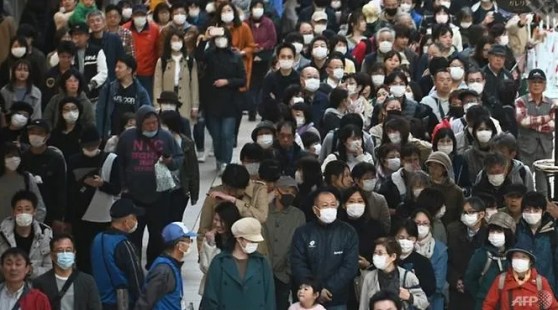 Tens of thousands queued at Sendai station to see the Olympic flame
March 22, 2020
SENDAI: Tens of thousands of people flocked to a cauldron with the Olympic flame in northeastern Japan over the weekend despite concerns about the COVID-19 pandemic.
The flame arrived in Japan to a scaled-down welcoming ceremony on Friday as doubts grew over whether the 2020 Tokyo Olympics will go ahead on schedule as the deadly virus causes chaos around the world.
The pandemic has already shredded the global sports calendar, with top sports leagues suspended and major tournaments postponed.
More than 50,000 people on Saturday (Mar 21) queued to watch the flame displayed at Sendai station in Miyagi, chosen as part of the “Recovery Olympics” to showcase the region’s revival after the 2011 earthquake, tsunami and nuclear meltdown.
Some had to stay in a 500m queue for several hours, local media said.
Many of them wore masks as they took pictures with the cherry blossom-shaped cauldron.
“I queued for three hours but watching the Olympic flame was greatly encouraging,” a 70-year-old woman told public broadcaster NHK.
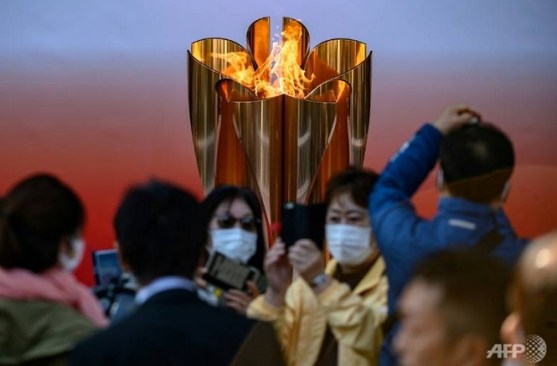 Organisers are under pressure to postpone the Tokyo 2020 Games because of the coronavirus pandemic.
But organisers, concerned about the bigger-than-expected gathering, have warned the viewing event could be suspended if a crowd becomes “extremely dense”, local media reported.
The nationwide torch relay begins on Mar 26, starting from the J-Village sports complex in Fukushima that was used as a base for workers during the 2011 nuclear disaster.
But organisers have been forced to scale back the relay, closing daily ceremonies to the public and urging spectators to “avoid forming crowds” along the route.
Tokyo 2020 Olympics on their way to be postponed…
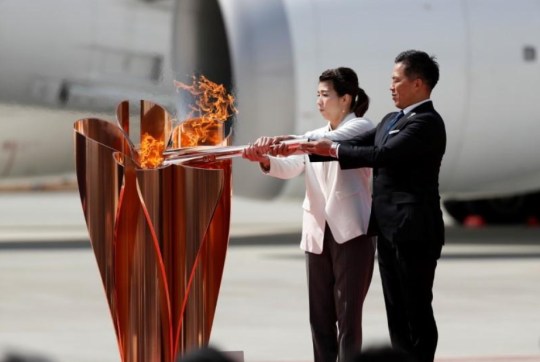
Canada and Australia will not send athletes to Tokyo Olympics
March 23, 2020
(CNN)Canada and Australia will not send athletes to the 2020 Olympic Games in Tokyo because of the risks associated with the coronavirus outbreak, the Olympic committees for both countries said in separate statements.
Both countries’ Olympic committees also are calling for the Games to be postponed until 2021.
“While we recognize the inherent complexities around a postponement, nothing is more important than the health and safety of our athletes and the world community,” the Canadian Olympic Committee and Canadian Paralympic Committee said in a joint statement Sunday. “This is not solely about athlete health — it is about public health.”
The Australian Olympic Committee’s executive board met by teleconference Monday and unanimously agreed that an Australian Olympic team could not be assembled given the changing circumstances across the world, the committee said in a statement.
The committee also said “our athletes now need to prioritise their own health and of those around them, and to be able to return to the families.”
“It’s clear the Games can’t be held in July,” said Ian Chesterman, Australian Team Chef de Mission for Tokyo. “Our athletes have been magnificent in their positive attitude to training and preparing, but the stress and uncertainty has been extremely challenging for them.”
Australian Olympic Committee CEO Matt Carroll said athletes should prepare for the Tokyo Olympics in 2021.
“The athletes desperately want to go to the games…but they also take onboard their own personal health,” Carroll told reporters in Sydney on Monday. “We need to give our athletes that certainty and that’s what we’ve done.”
IOC says its not canceling the Olympics
The committees’ decisions came hours after International Olympic Committee’s executive board said it is considering postponing — but not canceling — this summer’s Olympic Games in Tokyo because of the coronavirus pandemic.
The IOC board said it is considering several options to deal with the ongoing outbreak, including modifying plans to allow the 2020 Tokyo Games to begin on schedule on July 24 or changing the start date for the Games.
The IOC executive board ruled out canceling the Games, saying it would “destroy the Olympic dream of 11,000 athletes” and all those who support them, according to a letter to athletes from IOC President Thomas Bach.
The Canadian statement thanked the IOC for saying it would not cancel the games, saying the IOC appreciates the “the importance of accelerating its decision-making regarding a possible postponement.”
Japanese Prime Minister Shinzo Abe said that a decision to postpone the Tokyo Olympics and Paralympics may be needed if the Games cannot be held in a complete form.
Abe made the remark during a parliamentary session Monday after the IOC announced Sunday that the group has decided to step up scenario-planning for the 2020 Tokyo Games in reaction to the coronavirus pandemic.
IOC faces more pressure to postpone games
The IOC has faced increasing pressure to postpone the Games as people across the world have gotten sick and died from Covid-19. Tracks, gyms and public spaces are closed in much of the world and major qualifying events have been canceled.
Japan Olympic Committee member Kaori Yamaguchi broke ranks on Friday, saying the Games should be postponed because some athletes had been unable to train.
The heads of USA Swimming and USA Track and Field both called for the Olympics to be postponed to 2021 over the weekend.
IOC must face coronavirus reality and postpone 2020 Olympics
 New York Post back page
March 22, 2020
We are all, all of us, going through various stages of denial where sports are concerned. We are entering Week 3 of our games-free world and we are all here to report that the sun still comes up every morning, it still sets every evening, and every single time they replay the Duke-Kentucky game from 1992, Rick Pitino still doesn’t guard the inbounds pass.
(Perhaps he was distracted by the Iona job 28 years in his future.)
There is a part of us, all of us, that has to beat down the delusional optimist lurking inside. Logically, we know that it’ll be awhile before we see a live sporting event, but even as we start to dream of ordering $12 Heinekens at a ballpark, we turn on the television and there is Gov. Cuomo, saying plainly of COVID-19: “It’s going to work its way through society. But it’s going to be four months, six months, nine months. We’re in that range. Nobody has a crystal ball, no one can tell you.”
Four months. Six months. Nine months.
It’s hard for that potential reality to sink in.
It’s exponentially more fun to see Bill James, the godfather of modern baseball analysis, post on Twitter as he did this weekend: “Pick the day on which you think the major-league baseball season will begin. My pick: May 15.”
(Unless he meant May 15, 2021. That seems more reasonable.)
Of course James, like the rest of us, is a fan. We are allowed our spasms of optimism, even when that bleeds into delusion. There is, after all, nothing rational about living and dying with a hockey team; why should there be anything rational about wanting to SEE a hockey game?
It’s different when you’re talking about the people who run things. We saw a lot of that two weeks ago, when the folks who run sports leagues and basketball tournaments and other such operations came to slow, deliberate and ultimately regret-filled (but proper) decisions to shut things down. The absurdity of that St. John’s-Creighton game going on for a half is something the Big East, specifically commissioner Val Ackerman, will have to answer to in time, when we hold public and private inquests on how all of this went down.
And now there is the International Olympic Committee, which should already have reached the sad conclusion that the upcoming Tokyo Games should be, at least, postponed a year. The U.S. swimming and track and field committees have already called for that. So has a growing number of nations.
Forget the dubious possibility that the world will feel properly scrubbed and sanitized by July 24, when the parade of nations and 11,000 athletes are scheduled to march into Olympic Stadium for the Opening Ceremonies. Let’s say the optimists among us prevail, and we start seeing live sports again sometime in late June or early July.
Even that makes the notion of an on-time start silly. Only 4,000 of those 11,000 athletes have properly qualified for the Games. The trials that would determine the competitors have largely been postponed already, or are certain to be. Travel restrictions are fluid, at best. The Olympics, in optimal times, are a logistical quagmire; amid a global pandemic they would be catastrophic.
Yet the IOC reiterated Sunday that it will wait as long as four weeks before deciding what to do about the Games, with postponement until 2021 the likeliest alternative. And even that concession was only reached after the mounting pressures of local Olympic committees begging the IOC to do the right thing — but before the Canadian and Australian Olympic and Paralympic committees declared they simply won’t send contingents to Tokyo this year, in the strongest show of force — and common sense — yet.
Sometimes, the right thing is simply obvious. It is here. The Olympics, after all, have mostly known their place in world affairs. The 1916 Summer Games were canceled because of World War I, and both the summer and winter games of 1940 and ’44 were canceled due to World War II. The IOC should probably have halted the ’72 Games after terrorists bloodied the Munich Olympiad, but it has had to answer harsh questions about that for 48 years, and rightly so.
Now?
Look, this falls in line with everything else. Everything about our world stinks right now, from our daily small sacrifices (staying home, staying away from friends, honoring quarantines and social distance) to our greater concerns, the workers losing their jobs, the victims felled by this insipid virus, the heroic doctors and nurses and EMTs fighting it on the front lines.
We grapple with these things every day. We bargain in our brains how to cope. It stinks to go through that every day. But we do, all of us, every day. The IOC must do the same, and be quick about it, and smart about it.
Delusion in these times is neither a good strategy nor a good look.
Dramatizing the reality of a nuclear meltdown
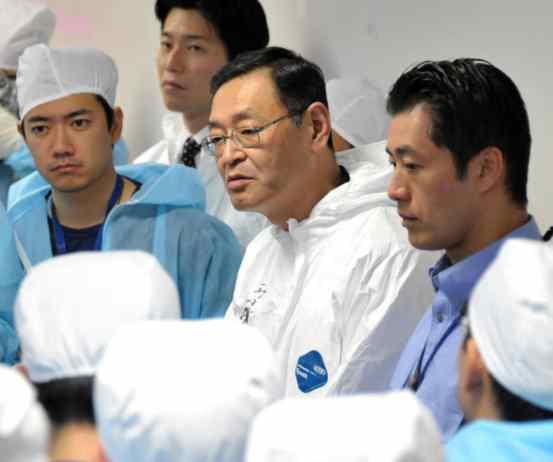 We can be heroes: “Fukushima 50” offers a dramatic account of real-life on-site manager Masao yoshida (pictured here with reporters in 2011) and his team as they fought to prevent the crippled nuclear plant from melting down in the wake of the Great East Japan Earthquake and tsunami.
March 21, 2020
As with many feature films based on real-life incidents, “Fukushima 50,” which opened nationwide March 6 and depicts the actions of the men who struggled to contain the disaster at the Fukushima No. 1 nuclear power plant following the Great East Japan Earthquake of March 2011, is a blend of factual exposition and dramatic enhancement. Stories require conflict to keep them interesting, usually with a hero fighting an adversary. In “Fukushima 50,” the hero is plant manager Masao Yoshida (Ken Watanabe), who makes life-and-death decisions in resistance against higher-ups rendered as incompetents.
One of these “villains,” as pointed out by writer and editor Yusuke Nakagawa in the March 6 online edition of Gendai Business, is Naoto Kan, who was the prime minister at the time of the disaster. In the movie, Kan’s name is never uttered and, as Nakagawa points out, the actor who plays him, Shiro Sano, doesn’t look like him, but that’s not what concerns Nakagawa. Sano portrays Kan as a puddle of hysteria whose decisions threaten lives because they make Yoshida’s job more difficult. Kan has an infamous temper and Nakagawa acknowledges that he made mistakes during the course of the emergency, but the movie fails to detail the reasons for his actions. Turning him into a babbling fool makes the filmmakers’ job easier, which is to show Yoshida as a towering figure of courage and resourcefulness in the face of a crisis that could have ended in the destruction of eastern Japan.
Nakagawa admits to having a horse in this race, as he helped Kan write his own account of what went down at the Prime Minister’s Office during those fateful days, and he concurs with the conclusion that Yoshida and the men who worked at the plant are heroes and that Yoshida’s employer, Tokyo Electric Power Company Holdings Inc. (Tepco), was the main problem. However, he can’t help but think that the film’s pillorying of Kan was due to more than dramatic license. There was something political about it. Kan has since become a pariah to many people. As much as any other matter, it was Kan’s handling of the Fukushima disaster that led to the destruction of his party. The Democratic Party of Japan no longer exists.
Nevertheless, Kan has no problem with the portrayal, according to the film’s director, Setsuro Wakamatsu, who said so during a news conference at the Foreign Correspondents’ Club of Japan following a press screening of “Fukushima 50” on March 4. Kan’s magnanimity is noble, perhaps, but it should be noted that he has his own film to promote, or, at least, a film that shows him in a more sympathetic light. “The Seal of the Sun,” originally released in 2016, had a much smaller budget than “Fukushima 50” and no marquee stars. It looks at the disaster from the vantage point of the Prime Minister’s Office, focusing on Tepco’s lack of cooperation with the government, and while it doesn’t contradict the Yoshida hero narrative, it does complicate it with points that “Fukushima 50” downplays or doesn’t even bring up.
Kan has made himself available to discuss those points at public screenings of “The Seal of the Sun.” Such local events aren’t going to counteract the message of “Fukushima 50,” and they aren’t meant to, but the narrative distinctions do show how uneven the coverage of the Fukushima disaster has been. The most glaring example of this unevenness is a 2014 story by the Asahi Shimbun’s special investigative team based on an interview that Yoshida gave to the government. The report undermined the Fukushima hero narrative by saying that 90 percent of the plant workers fled the facility in fear for their lives. The Asahi Shimbun management, already smarting from other recent scandals, eventually retracted the piece after receiving complaints saying the article implied the workers were cowards, effectively ending the special investigative team in the process. Ryusho Kadota, the journalist who wrote the book that was the basis for the “Fukushima 50” script, wrote another book refuting the Asahi Shimbun’s coverage, though, as former New York Times Tokyo bureau chief Martin Fackler points out in an article he wrote for the Asia-Pacific Journal, there was nothing essentially untrue in the Asahi Shimbun story. In fact, Tepco admitted that about 650 workers had fled, but said many were not regular company employees. The legendary “Fukushima 50” (in reality, they numbered 69), a term coined by foreign media, remained at the plant.
The argument about what really happened isn’t over facts. It’s over how those facts are interpreted. In “Fukushima 50,” Kan’s desperation is presented as a danger to the country. In “The Seal of the Sun,” it shows how hard he is trying to grasp the actual situation on the ground. Before the Yoshida report in 2014, the Asahi Shimbun’s editorial slant was generally critical of nuclear power. Afterward, it became neutral.
Nakagawa thinks these differences are politically influenced. Almost all of Japan’s nuclear power capacity has been off-line since the Fukushima incident, a situation the present government wants to reverse but finds difficult to do because of public resistance. In that sense, the story of the men who saved Japan from nuclear catastrophe can be exploited by both sides. Anti-nuclear forces say it proves how dangerous nuclear power is, while pro-nuclear forces say that it shows how Japanese ingenuity and dedication prevails.
However, even that distinction is subject to dispute. Retired Fukui District Court Chief Justice Hideaki Higuchi was one of the few judges to find in favor of plaintiffs suing to stop resumption of nuclear power plants. Higuchi reached these decisions after carefully studying the Fukushima No. 1 disaster and concluding that it was averted as much by serendipity as by Yoshida’s and the Fukushima 50’s bravery. These “miracles,” which had to do with the availability of cooling water and quake-related damage to the reactor housing, have been openly discussed, but they aren’t emphasized as much because it takes something away from the hero tale. As a judge, Higuchi had to pay closer attention to all the facts than a feature film script writer does.
Crowds form at Olympic torch event in Japan despite coronavirus caution
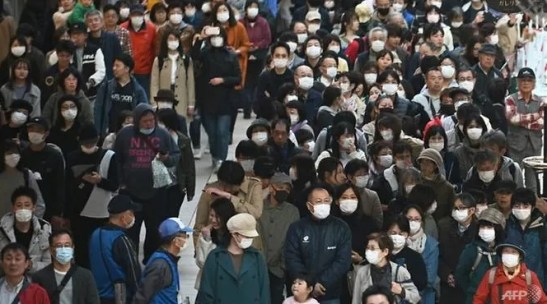 People wear protective face masks following the outbreak of the coronavirus disease as they try to watch the Olympic cauldron during the Tokyo 2020 Olympic’s Flame of Recovery tour at Ishinomaki Minamihama Tsunami Recovery Memorial Park in Ishinomaki, Miyagi prefecture on Friday
March 20, 2020
ISHINOMAKI (Reuters) An Olympic torch event in Japan drew hundreds of spectators on the day of the flame’s arrival on Friday, creating the type of packed gathering the government and Tokyo 2020 organizers have warned against to prevent coronavirus from spreading further.
About 500 people gathered in a jostling crowd to look at the flame and popular comedians taking part in a ceremony in Ishinomaki, 335 km north of Tokyo.
The Greek part of the torch relay began last week, but a day later the remainder was canceled to avoid attracting crowds.
It is not a good decision [to come here] but I am not sure if I will get another chance to see the cauldron, Ishinomaki resident and teacher Kiyotake Goto, 44, told Reuters.
Earlier in the day, a plane carrying the torch from Greece arrived at Japan Air Self-Defence Force Matsushima airbase, which was devastated by a powerful earthquake and tsunami in 2011.
No spectators were present for the arrival ceremony at the base, where officials pledged the Tokyo 2020 Games will proceed despite mounting pressure to halt the world’s biggest sporting event due to the coronavirus pandemic.
“We originally planned to have children here to welcome the flame. But, prioritizing their safety, we’ve decided to do without them, Tokyo 2020 chief Yoshiro Mori said.
That was an agonizing decision … We will do our utmost in preparing for a safe and secure event, said Mori, a former prime minister.
Organizers have repeatedly said the Games, due to run from July 24 to Aug. 9, will go ahead, but as the rapid spread of the virus brings the sports world to a virtual standstill, fears are growing that the Olympics may be postponed or canceled.
I think it’s impossible [to hold the Games]. It’ll be a global issue if the virus spreads even further, Koichiro Maeda, a 55-year-old company employee, told Reuters in downtown Tokyo.
The respiratory disease, which emerged in China late last year, has killed more than 10,000 people worldwide.
Japan is grappling with pressure to avoid a health crisis among 600,000 expected overseas spectators and athletes at an event that could see $3 billion in sponsorships and at least $12 billion spent on preparations evaporate.
The plane with the torch arrived nearly empty after the Tokyo 2020 organizing committee decided not to send a high-level delegation that was originally to have included Mori and Olympics minister Seiko Hashimoto.
This is a tough time. I hope the torch relay will bring people vigor and hope, Saori Yoshida, three-times gold-medal winning wrestler, told the welcome ceremony.
The flame will travel round the Tohoku region hit by the 2011 tsunami and earthquake, in what organizers call a recovery flame tour before the official kick-off ceremony in Fukushima on March 26.
Organizers have urged the public not to crowd the relay route, canceling many events along the way and restricting public access to others. Runners and staff will have their temperatures and health monitored, organizers said.
Some athletes, including reigning Olympic pole vault champion Katerina Stefanidi, said the International Olympic Committee’s decision to go ahead was putting their health at risk when entire countries have shut down to curb the virus.
The torch relay will begin at J-Village, a soccer training center in Fukushima that served as an operations base for workers who battled triple meltdowns at the Fukushima Daiichi nuclear power plant after the 2011 tsunami.
It is due to pass many of Japan’s most famous landmarks over a 121-day journey to Tokyo’s Olympic stadium, including Mount Fuji, Hiroshima’s Peace Memorial Park and Kumamoto Castle.
Cancel. The. Olympics.
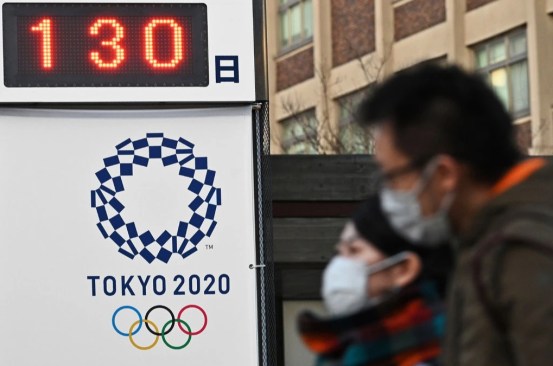 A board in Yokohama, Japan, on Monday showed the number of days until the Tokyo 2020 Olympic Games.Credit…
Amid a pandemic, it would be wildly irresponsible for the Games to go on.
March 18, 2020
Despite the coronavirus pandemic, the International Olympic Committee and Tokyo 2020 Olympic organizers insist that the Tokyo 2020 Summer Games will go on. Even with widespread cancellations in European soccer, Formula One auto racing, and professional and collegiate basketball in the United States, Prime Minister Shinzo Abe of Japan vowed, “We will overcome the spread of the infection and host the Olympics without problem, as planned.”
While sports can create an escape hatch from the grit and grind of daily life, there is no escaping the fact that the coronavirus pandemic presents an extraordinary challenge that cannot be overcome with mere platitudes and prayers. Pressing ahead with the Tokyo Games means creating a massive, potentially perilous petri dish. For the sake of global public health, the Tokyo 2020 Olympic Games should be canceled.
The Olympics are not slated to commence until July 24. But the International Olympic Committee’s response to the coronavirus has not been forward-thinking. After a recent meeting of the executive board, the I.O.C.’s president, Thomas Bach, stated that the board had not even mentioned the words “postponement” or “cancellation.” But organizers have delivered mixed messages. A Tokyo 2020 executive board member suggested delaying the Games, only to backpedal and apologize, while the organizing committee chairman, Yoshiro Mori, said, “Our basic stance is to proceed with our preparation and to hold a safe Olympics.” Japan’s Olympic minister, Seiko Hashimoto, hewed to a similar script: “The I.O.C. and 2020 organizers are not at all considering canceling or postponing the Games.”
In a communiqué issued Tuesday, the I.O.C. noted that its task force overseeing the situation was considering possible “adaptations” but that the I.O.C. “remains fully committed to the Olympic Games Tokyo 2020,” adding, “with more than four months to go before the Games there is no need for any drastic decisions at this stage; and any speculation at this moment would be counterproductive.”
Refusing to even consider alternatives is reckless. Measured, evidence-driven speculation is the responsible course. Epidemiologists have been clear that the coronavirus is a potentially historic pandemic. Each day, the World Health Organization reveals more countries and territories with reported cases of the virus. The W.H.O. recently declared that Europe, where many Summer Olympians live and train, is the pandemic’s epicenter. According to experts at the U.S. Centers for Disease Control and Prevention, the pandemic could infect between 160 million and 214 million people in the United States.
With athletes and spectators coming from around the world, the Olympics could become a dystopic coronavirus hot zone. As a Stanford University infectious disease specialist, Yvonne Maldonado, put it, with the Olympics, “You bring a lot of people together, and then you ship them back all over the world: That’s the perfect way to transmit.”
But the Olympic spectacle is a powerful drug. Last week, despite the coronavirus mayhem, the Olympic torch relay commenced in Greece, where an actor dressed as a pagan priestess ignited the Olympic flame in Ancient Olympia. Within hours, however, the torch relay was canceled over public-health concerns.
And yet, Tokyo 2020 Olympic organizers contend the torch relay will proceed on schedule, starting on March 26 in Fukushima, the prefecture decimated by the triple-whammy earthquake, tsunami and nuclear meltdown in 2011. This decision has not only raised eyebrows in light of the pandemic but also because Greenpeace has found radiation hot spots along the torch relay route.
While participants in the Olympic torch relay may be putting themselves in harm’s way, personnel at the I.O.C.’s headquarters in Lausanne, Switzerland, will not. This week, most of them began teleworking. According to the I.O.C., this measure aims “to protect the health of its staff and their families” from the coronavirus. Workers with the Tokyo torch relay are not being accorded the same precautions.
The I.O.C. has a history of pressing through catastrophe to stage the Games, adopting the mantra “the Games must go on.” In a fractious world, the Olympics symbolize international cooperation and good will. But must they in the age of coronavirus? Much remains unknown about Covid-19, and one study, forthcoming in Swiss Medical Weekly, projects the disease won’t reach its peak until winter 2020-21. Insisting that the Olympics take place while the world wobbles to the rhythms of a pandemic requires real hubris.
There are powerful interests that are keen to make sure the Tokyo 2020 Games are staged on schedule. Television broadcasters, while insured, will see profits melt away. Japanese politicians like Prime Minister Abe have sunk enormous sums of political capital into the Games. The I.O.C.’s Olympic brand could suffer damage. And there is added pressure to recoup funds after the price for the Tokyo Olympics skyrocketed from $7.3 billion at the time of the bid to more than $26 billion, according to an audit by the Japanese government. But fiscal irresponsibility does not justify exacerbating a global public-health emergency.
President Trump recently suggested that the Games should not take place this summer, although Japan’s Olympic minister immediately rebuffed postponement. Delaying the Games involves significant complications and costs. For broadcasters like NBC it means having to compete for eyeballs in a crowded sports calendar, including its own cash-cow programming like football. Postponement also adds costs to an already bloated budget for venue maintenance and the Tokyo 2020 payroll. Then there is the Olympic Village, slated to be turned into apartments, many of which have already been sold.
The Olympics have long been mired in a slow-motion crisis, with doping, athlete abuse and a dwindling number of cities keen to host. The way that Olympic power brokers have responded has been distressing. They do not deserve the benefit of the doubt.
Cancellation may appear ominous. But in reality, it would be a remarkable act of global solidarity. Pierre de Coubertin, the French aristocrat who revived the modern Olympics in the 1890s, referred to “the noble spirit of chivalry” as the foundation for sport and society. To confront the coronavirus crisis, a hefty dose of selfless chivalry is required. Amid a global pandemic, holding the Games is unconscionable. It’s time to hit the five-ring pause button and cancel the 2020 Tokyo Olympics.
-
Archives
- February 2026 (228)
- January 2026 (308)
- December 2025 (358)
- November 2025 (359)
- October 2025 (376)
- September 2025 (258)
- August 2025 (319)
- July 2025 (230)
- June 2025 (348)
- May 2025 (261)
- April 2025 (305)
- March 2025 (319)
-
Categories
- 1
- 1 NUCLEAR ISSUES
- business and costs
- climate change
- culture and arts
- ENERGY
- environment
- health
- history
- indigenous issues
- Legal
- marketing of nuclear
- media
- opposition to nuclear
- PERSONAL STORIES
- politics
- politics international
- Religion and ethics
- safety
- secrets,lies and civil liberties
- spinbuster
- technology
- Uranium
- wastes
- weapons and war
- Women
- 2 WORLD
- ACTION
- AFRICA
- Atrocities
- AUSTRALIA
- Christina's notes
- Christina's themes
- culture and arts
- Events
- Fuk 2022
- Fuk 2023
- Fukushima 2017
- Fukushima 2018
- fukushima 2019
- Fukushima 2020
- Fukushima 2021
- general
- global warming
- Humour (God we need it)
- Nuclear
- RARE EARTHS
- Reference
- resources – print
- Resources -audiovicual
- Weekly Newsletter
- World
- World Nuclear
- YouTube
-
RSS
Entries RSS
Comments RSS
 nuclear-news