But the deal failed to emerge then, and in January Argentina’s nuclear energy undersecretary, Julian Gadano, and the ambassador to China, Diego Guelar, met officials in Beijing for talks about the project, the government source said.
8 years on, contaminated water remains big problem for Fukushima clean-up

March 10, 2019
Okuma – Eight years after the Fukushima nuclear crisis, a fresh obstacle threatens to undermine the massive clean-up: 1 million tons of contaminated water must be stored, possibly for years, at the power plant.
Last year, Tokyo Electric Power Co (TEPCO) said a system meant to purify contaminated water had failed to remove dangerous radioactive contaminants.
That means most of that water – stored in 1,000 tanks around the plant – will need to be reprocessed before it is released into the ocean, the most likely scenario for disposal…
…. Fanning out across the plant’s property are enough tanks to fill 400 Olympic-sized swimming pools. Machines called Advanced Liquid Processing Systems, or ALPS, had treated the water inside them.
TEPCO said the equipment could remove all radionuclides except tritium, a relatively harmless hydrogen isotope that is hard to separate from water. Tritium-laced water is released into the environment at nuclear sites around the world.
But after newspaper reports last year questioned the effectiveness of ALPS-processed water, TEPCO acknowledged that strontium-90 and other radioactive elements remained in many of the tanks.
TEPCO said the problems occurred because absorbent materials in the equipment had not been changed frequently enough.
The utility has promised to re-purify the water if the government decides that releasing it into the ocean is the best solution. It is the cheapest of five options a government task force considered in 2016; others included evaporation and burial…
….Another option is to store the water for decades in enormous tanks normally used for crude oil. The tanks have been tested for durability, said Yasuro Kawai, a plant engineer and a member of Citizens’ Commission on Nuclear Energy, a group advocating abandoning nuclear energy.
Each tank holds 100,000 tons, so 10 such tanks could store the roughly 1 million tons of water processed by ALPS so far, he said.
The commission proposes holding the tritium-laced water, which has a half life of 12.3 years, in tanks for 123 years. After that, it will be one thousandth as radioactive as it was when it went into storage…
Read more :
Most evacuees under 50 from three Fukushima towns near nuclear disaster have no plan to return
 Representatives from East Japan Railway Co. give an update on the recovery of the Joban Line in the town of Futaba, Fukushima Prefecture, on Thursday.
Mar 9, 2019
FUKUSHIMA – A majority of people under age 50 who had lived in three towns close to the site of the 2011 Fukushima No. 1 nuclear disaster have no plans to return, an official survey showed Saturday.
Many former residents of Futaba, Namie and Tomioka say they have established new lives elsewhere and that their adopted hometowns are more convenient.
The three towns were subject to government evacuation orders in the wake of the crisis at the plant, which was triggered by a magnitude 9.0 earthquake and ensuing tsunami.
The orders for Namie and Tomioka were partially lifted in 2017. But more than 60 percent of evacuees from the two towns in their 20s and 30s and more than 50 percent in their 40s said they would not return, with other major reasons cited including concerns over the lack of medical and commercial facilities.
Regardless of age group, 49.9 percent of former Namie residents and 48.1 percent of former Tomioka residents said they would not return.
As for Futaba, which hosts part of the crippled nuclear plant and remains off limits for residents, similar proportions of those in the 20s, 30s and 40s said they would not return, and the overall figure, regardless of age group, stood at 61.5 percent.
Read more:
Eight years after triple meltdowns and explosions at the Fukushima-Daiichi nuclear power plant in Japan, major problems remain and many impacts are yet to manifest

Beyond Nuclear Press Release
Thursday, March 7, 2019
TAKOMA PARK, MD — The legacy of the Fukushima nuclear disaster will continue indefinitely, creating long-term problems for human health, radioactive waste management and the environment:
- Around 1.09 million tons of radioactively contaminated water — used to cool the destroyed reactor cores as well as groundwater flowing across the site — is being stored onsite in growing tank farms, which are now at capacity. Absent other options, Japanese authorities are looking to dump this radioactively contaminated water into the Pacific Ocean, a move strongly opposed by Japanese fishermen, ocean protection groups and the worldwide environmental community.
- In an effort to downplay or dismiss the health dangers of radiation exposure, the Japanese government has ended financial benefits to Fukushima evacuees, putting economic pressures on these families to return to the region, even though it has not been — and cannot be — adequately or effectively cleaned up and made safe for human habitation. According to noted physicist, Dr. Bruno Chareyron, who has conducted field measurements in the area, “The radioactive particles deposited on the ground in March 2011 are still there, and in Japan, millions of people are living on territories that received significant contamination.”
- In order to justify the return of evacuees and claim the region is now safe, Japanese regulatory authorities have raised the allowable radiation dose from I milisievert per year to 20, an unacceptably high rate that is especially dangerous for pregnant women and children. This policy has been cited by a UN Special Rapporteur as having “potentially grave impacts on the rights of young children returning to or born in contaminated areas.”
- Plans by Tepco and the Japanese government to begin removing melted reactor fuel in 2021 are fraught with risk and uncertainty since little is still known about its condition and there is no safe, permanent radioactive waste management plan in place.
- The Japanese government plans to hold two events — softball and baseball — in the Fukushima Prefecture during the 2020 Tokyo Olympics, a public relations maneuver to “normalize” the situation. However, in addition to unacceptable radiation exposure doses, particularly from hot spots, the discovery of radioactive particles of reactor fuel debris in the area, including uranium and cesium, would put both athletes and spectators at risk.
- The implications for returning populations to the Fukushima region come with dire warnings from the health findings in Macaque monkeys who have lived there continuously. The monkeys have been found to have bone marrows that are producing almost no blood cells, and mothers are giving birth to babies with reduced brain sizes. With a 7% difference in DNA with humans, these outcomes are alarming.
- Scandals surrounding the ill treatment of workers at the stricken Fukushima plant, many of whom are migrants and already low-income, continue. UN human rights experts found these workers to have been exploited and their health willfully jeopardized, with workers coerced “into accepting hazardous working conditions because of economic hardships, and the adequacy of training and protective measures.”
- Despite widespread public opposition in Japan, the Abe government continues to try to restart nuclear reactors. However, only nine of the 42 still operable reactors are back on line (out of 58 originally). The government has instead turned its attention to the nuclear export market, but this took a serious hit when Toshiba’s Westinghouse nuclear division went bankrupt two years ago and Hitachi withdrew from two new nuclear power plant projects in the UK in January 2019.
Nuclear power plants under threat from climate change

Susan Stranahan: Climate change’s threat to nuclear plants https://www.twincities.com/2019/03/17/susan-stranahan-climate-changes-threat-to-nuclear-plants/
|
|
The incessant statement that nuclear is “carbon free” is untrue, and the nuclear industry knows it
RealAccounting , 17 Mar 18 The incessant statement that nuclear is “carbon free” is untrue, and the nuclear industry knows it. The carbon footprint of a standard nuclear plant is in its construction and infrastructure. Many tons of concrete; google the carbon footprint of cement. Then the fossil fuel needed to dig up, crush, size, wash and transport aggregate for the concrete. We’ll ignore carbon costs of acquiring and pumping water for the concrete, at this point. Then steel. Many tons of steel; much of it specialized, using manufacturing processes that use 2-5x more heat (coal/coke) than plain mild steel. Mining. Smelting. Forming. Ore transport. Steel transport. All done with fossil fuels- not zero. Then there’s operating staff. A 2.2 MW coal plant has about 350 employees. Three Mile Island has 675. Numbers for maintaining/operating wind and solar plants are wildly variable, since so much depends on size and site at this point; but you understand that taking care of an installed wind or solar plant is a job for a very few technicians.
When “selling” a power plant to the public, the fact that it “provides” lots of jobs is seen as a positive. But in terms of carbon footprint and allocation of resources; the more humans needed to operate the plant; the bigger the carbon footprint, forever. This bit of resource accounting is always ignored, and is very far from trivial. Basically, in order to operate Three Mile Island, a small village of 700 people, + all the services they need, all the support- belongs to the carbon footprint of the nuclear plant. If those same people were elsewhere; their carbon costs would be attached to whatever enterprise they are involved in. T
ime to be serious about it; and honest. Only “Lifetime- total system” accounting – counts
Are these tiny, ‘inherently safe’ nuclear reactors the path to a carbon-free future?

Are these NuScale nuclear power stations REALLY tiny?

the industry sees the future not in building gargantuan plants, but in small modular reactors, or SMRs — factory-built units with fewer parts, designed to be installed underground with passive cooling systems that the industry says are “inherently safe.”
“SMRs seem to be a fad, as far as I can tell,” said Edwin Lyman, a senior scientist with the Union of Concerned Scientists, who wrote a widely cited paper questioning the economics of small reactors. “There’s very really little substance to its motivation, other than the private sector can’t afford ordinary sized reactors.”
…… Inside a Small Modular Reactor
Small modular reactors are factory-built, contain fewer mechanical parts, and are designed to be installed underground with passive cooling systems that are “inherently safe,” the industry says.
SMR designers say the plants will need fewer operators, and because the design is safer, they have also asked the NRC to reduce the 10-mile emergency planning zones now required for larger commercial reactors to an area confined to the plant site. Critics such as the Union of Concerned Scientists have opposed the request, saying the plants and their accumulated on-site spent fuel still pose a significant risk.
“They argue the reactors are so safe that terrorists won’t be able to effectively cause a massive radiological contamination event, and I beg to differ,” said Lyman.
The initial markets for SMRs are expected to be primarily overseas, where electricity costs are higher and nuclear energy can compete, NuScale says. Some water-starved Middle Eastern countries have expressed interest because some units can be configured to produce steam, rather than electricity, to power a nearby water desalinization plant.
Antidote to climate change
The industry is also positioning carbon-free nuclear plants as an antidote to climate change……
many environmental advocates fiercely oppose any expansion of nuclear energy’s role, including skeptics who cite safety issues exposed by the accident 40 years ago this month at Three Mile Island Unit 2 in Pennsylvania, which put the brakes on the industry’s growth in the 1980s. In the last 20 years, just one new commercial plant has begun operations in the United States, and only two are currently under construction.
Lyman said the industry would need to produce “hundreds or thousands” of units in order to cut costs and reduce the need for government assistance. ……
Nuclear power’s cost is at the heart of a debate that officially launched in Pennsylvania last week with the introduction of a proposal to give the nuclear industry $500 million in annual subsidies, paid by electric customers. Nuclear operators have threatened to shut down several Pennsylvania reactors because they are unable to compete in low-price electricity markets awash in cheap power from natural gas plants.
Exelon Generation says it will shut down Three Mile Island Unit 2, located next to the partly dismantled Unit 1, unless state lawmakers come to the rescue by June. …….
Dozens of companies are working to develop new nuclear reactors, including so-called Generation IV reactors that are cooled with such materials as molten salts, inert gases, or even liquid metals.
Several companies have focused on developing SMR designs. Holtec International, a private company in Camden whose core business is managing spent fuel at nuclear reactors and decommissioning old reactors, has developed a 160-megawatt reactor design it calls the SMR-160. The project’s status is unclear, and Holtec did not respond to written questions.
“I haven’t seen evidence of it really advancing,” said Lyman, of the Union of Concerned Scientists.
Westinghouse and BWX Technologies Inc., which both have long histories of building reactors, abandoned their SMR projects.
NuScale in September chose BWXT to build its SMR. BWXT, which built many of the small reactors used to power U.S. Navy ships and submarines, plans to subcontract component manufacturing to Precision Custom Components of York, Pa.
Mundy said by outsourcing the manufacturing to existing plants, NuScale can keep costs down compared with building a new factory. NuScale’s majority owner is the giant contractor Fluor Corp………
Lyman said that he is worried that multiple modular reactors would fail in NuScale plant, but that the NRC will accept more risk because it is under pressure to not impede the licensing process.
Indian military confirms deployment of nuclear subs amid rising tensions with Pakistan
AMN By News Desk2019-03-17 Tensions between the two nuclear-armed Asian powers escalated last month, after an incursion into Pakistani territory in Kashmir by Indian Air Force warplanes to strike at Jihadist militants led to skirmishes in the air and small arms and artillery fire along the shaky Line of Control border.
International shame for human society, that children have to take the lead on climate action
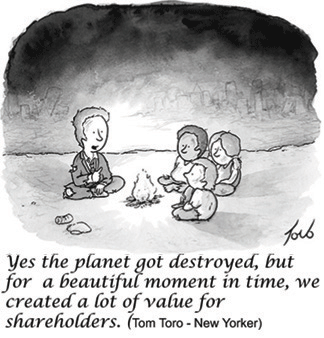 The Observer view on the school climate strikes: it’s shameful that children need to take the lead https://www.theguardian.com/commentisfree/2019/mar/17/observer-view-on-schools-climate-strike, Observer Editorial, 17 Mar 19,
 Children are right to call politicians to account over a global crisis For those who care passionately about our planet’s future, these are dispiriting times. Fossil fuel emissions, which are now causing our world to overheat dangerously, continue to rise despite scientists’ clear warnings about the likely consequences: melting ice sheets, rising sea levels, unprecedented storms, acidifying oceans and spreading deserts.
Such forecasts should have spurred global action a long time ago. Yet politicians across the world have consistently refused to act and for decades have procrastinated, discounting evidence that clearly shows global warming is already affecting our planet. Many factors account for this inaction. Lobbying by oil and gas companies obsessed with short-term gain has certainly been involved. Others have argued that only God can have a planet-wide influence and that humanity is being presumptuous in believing it could alter a global ecosystem. In addition, there are those who believe bids to introduce limits on coal and oil burning are simply the work of leftwing, anti-capitalist conspirators.
Such befuddled notions are no longer acceptable in an overheating world. In failing to act over climate change, our leaders are in real danger of betraying a generation of young people who, in a few decades, are likely to inherit a blighted world that has been denuded of much of its wildlife, coastline and fertile land. The future of our children is being stolen before their eyes.
n the face of this stark scenario, the decision by children round the planet to vent their anger and to stage an international campaign of protests and school walkouts last week is to be welcomed. It was a just response to a global injustice. Without a voice in a political debate in which their future is being threatened by the political inability of their elders, young people have had little choice. Teachers may complain that the disruption caused by last week’s protests only increases their workload and wastes lesson times, but it is clear the campaign is being driven by genuine outrage, a grievance that also explains the considerable breadth of these protests.
From Australia to America, pupils simply put down their books and took to the streets. More than 100 towns and cities in the UK saw protests. In Sydney, about 30,000 young folk held a climate march, while in Delhi more than 200 children walked out of classes.
Equally impressive were the comments and blogs. In India, 13-year-old Arya Dhar Gupta from Gurugram, whose air is some of the world’s most polluted, revealed it was no longer safe for her to play outdoors. Others called for a moratorium on all new coal, oil and gas plants. Some demanded massive investment in renewable energy projects.
But perhaps most telling were the words of Anastasia Martynenko from Kiev. She supported her actions in terms that starkly highlight the depth of her elders’ failures and underline the now desperate need for a reinvigoration of global climate policies. “We are happy to be the driving force… because when our children ask us what have you done for our future, we will have an answer.”
In over 2000 cities, hundreds of thousands of children left school to protest for climate cxation
Even in chilly Oklahoma, USA – Students rally for climate change
Hundreds of thousands leave schools world-wide to protest climate change inaction, SBS NEWS< 17 Mar 19, Hundreds of thousands of students in more than 2000 cities from Australia to Uganda and Germany left the classroom on Friday to protest government inaction on climate change.
Democrats propose policy to use nuclear weapons only in response to attack.
FROM JOSEPH FARAH’S G2 BULLETIN
DEMS PROPOSE U.S. GIVE UP FIRST-STRIKE NUCLEAR OPTION https://www.wnd.com/2019/03/dems-propose-u-s-give-up-first-strike-nuclear-option/ Plan would pledge to use nukes only in response to attack
18 Mar 19, Democrats are proposing in Congress that the United States give up the option for a nuclear first strike – for any reason, reports Joseph Farah’s G2 Bulletin.
The policy for decades deliberately has been one of “calculated ambiguity.” It stemmed from a Cold War era in which the U.S. and NATO faced “numerically superior” Soviet and Warsaw Pact conventional forces in Europe, explains a document prepared by the Congressional Research Service.
“At the time, the United States not only developed plans to use nuclear weapons on the battlefield to disrupt or defeat attacking tanks and troops, but it also hoped that the risk of a nuclear response would deter the Soviet Union from initiating a conventional attack. This is not because the United States believed it could defeat the Soviet Union in a nuclear war, but because it hoped the Soviet Union would know that the use of these weapons would likely escalate to all-out nuclear war, with both sides suffering massive destruction.”
That policy of ambiguity has been continued, with even the Obama administration promising that the U.S. “would only consider the use of nuclear weapons in extreme circumstances,” far short of a promise never to use them first.
Democrats now are demanding to change that.
Sen. Elizabeth Warren, D-Mas., and Rep. Adam Smith, D-Wash., have proposed legislation, S. 272 and H.R. 921, that would adopt the statement: “It is the policy of the United States to not use nuclear weapons first.”
Other members of Congress are divided,” the report from the CRS explained, with Sen. Deb Fischer, R-Neb., warning the Democrats’ plan “betrays a naïve and disturbed world view.”
Read more at https://www.wnd.com/2019/03/dems-propose-u-s-give-up-first-strike-nuclear-option/#6cgKvfB7PXt22tiR.99
The Trump administration already had rejected the idea, in its 2018 Nuclear Posture Review, which said the weapons contribute to “deterrence of nuclear and non-nuclear attack; assurance of allies and partners; achievement of U.S. objectives if deterrence fails; and the capacity to hedge against an uncertain future.”
For the rest of this report, and more, please go to Joseph Farah’s G2 Bulletin.
Proposed nuclear power station at Indian village – a serious threat to living beings
Nuclear power serious threat to living beings Hans News Service https://www.thehansindia.com/andhra-pradesh/nuclear-power-serious-threat-to-living-beings-512866 18 March 2019
HIGHLIGHTS The proposed Nuclear Power Plant (NPP) at Kovvada village in Ranastalam mandal is a serious threat to all living beings in the surrounding 250 kilometers radius of north coastal AP districts and south Odisha state, said Anti-Nuclear Committee national member Dr Vivek Mantory.
Srikakulam: The proposed Nuclear Power Plant (NPP) at Kovvada village in Ranastalam mandal is a serious threat to all living beings in the surrounding 250 kilometers radius of north coastal AP districts and south Odisha state, said Anti-Nuclear Committee national member Dr Vivek Mantory. Addressing a seminar on ‘Nuclear power plant at Ranastalam’ on Sunday, held under the aegis of CITU, he came down heavily on both the Central and State governments’ for neglecting the interest of people living in the area and for violation of environmental laws.
Stating that the establishment of nuclear power was a costly affair than any other power like wind, hydro, coal-based thermal power and solar power, he said all the developed and advanced countries like the USA, Russia, Japan and other nations were backed away from the nuclear power. He wondered as to why India is showing much interest without thinking safety measures and preventive technology. CITU State vice-president D Govinda Rao, district president K Srinivas and members of other unions also participated. Residents of NPP affected villages also present in the seminar.
Is it REALLY a good idea for American tax-payers to prop up the failing nuclear power industry?
 Does the United States Need a Civilian Nuclear Industry? The National Interest,
 Instead of a greater financial cushion, what the nuclear industry needs is more transparent exposure to market signals.
Advocates and industry lobbyists are proposing a new structure of subsidies to prop up the industry. Instead of a greater financial cushion, however, what the nuclear industry needs is more transparent exposure to market signals. …..
improved battery storage and transmission technology could make the entire idea of baseload energy obsolete. Government subsidies, whether to renewables, natural gas, or nuclear, only cloud the issue. It should be up to investors, with access to diverse and comprehensive market information, to bet for (or against) nuclear energy.
Another argument for subsidizing the civil nuclear industry relies on its importance for national defense. Here, the United States walks a fine line: on one hand, the United States has a commitment to uphold the nonproliferation regime. On the other hand, the United States seeks to maintain and even modernize its nuclear arsenal to provide deterrence. In August 2017, former energy secretary Ernest Moniz coauthored the Energy Futures Initiative, a report arguing for greater government support for “robust nuclear energy enterprise” that serves both nonproliferation and nuclear deterrence goals. A particular concern was ensuring the supply of tritium , a hydrogen isotope important for powering nuclear weapons. Government reactors produced tritium until 1988, when they were closed because of cost.
On closer inspection, however, these concerns about the health of the nuclear elements of national security are overblown. The Government Accountability Office finds that tritium reserves are sufficient through the 2030s, and there are other ways to acquire tritium by enriching uranium.
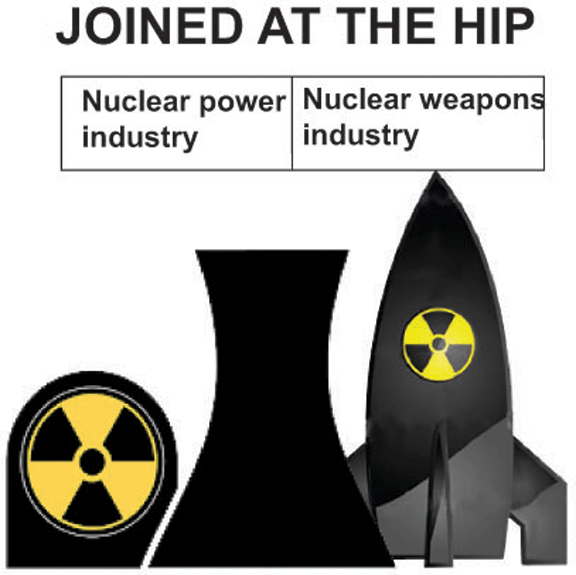 The civilian industry makes the case for electric rate subsidies and exemption of onerous licensing and export controls because of their importance for nuclear weapons and nuclear powered submarines. However, it seems just as likely that the civil nuclear industry is as dependent on the defense industry for talent and investment. The training for civil and military nuclear technology requires the same basic physics, but beyond that, the education diverges. Naval reactors are not the same as civilian ones, and the navy operates approximately 160 nuclear reactors compared to ninety-eight in the civilian sector.
Civilian universities foster research on nuclear science and technology, but the defense establishment may be more interested in state-of-the-art work on artificial intelligence or autonomous technology than nuclear energy. Many of the advances in defense nuclear operations come not from basic nuclear science, but from improved safety and storage technology or warhead design.
China trying to market nuclear technology to Argentina
 Chinese delegation set to revive stalled Argentina nuclear power plant talks
Technical team expected to go to Latin American country to discuss project reportedly worth up to US$8 billion, SCMP, 16 Mar, 2019 A delegation from China will visit Argentina this month to discuss the construction of a nuclear power plant, signalling possible progress in a deal that could increase Beijing’s deepening influence in the South American nation.
How Leonardo DiCaprio is fighting climate change with finance
 Putting his money where his mouth is. Your Money, 18 Mar 2019, Jack Derwin Digital Journalist, Oscar-winning actor and Hollywood heartthrob Leonardo DiCaprio has long been an environmental activist, but he’s now turning to the world of finance to help tackle his chosen cause.
DiCaprio has announced he will become a senior adviser to a new $150 million environmental unit at fund manager Princeville Capital that invests directly into tech companies fighting global warming.
Taking to Twitter, it appears he is willing to put his money where his mouth is, becoming an investor himself.
“What I like about Leo’s fund if you are predisposed to wanting to improve the climate or stop climate change, this is a fund that invests in companies that are trying to mitigate the effects of climate change,” The Motley Fool head of investment Scott Phillips told Your Money Live.
The major difference between DiCaprio’s fund and other ethical funds is rather than divesting from big polluters, his is actively investing in potential future solutions…….. https://www.yourmoney.com.au/wealth/investment/leonardo-dicaprio-climate-change/
 |
ReplyForward
|
1 This Month

of the week – Shut Down Drone Warfare!


Tell the Ukrainian Government to Drop Prosecution of Peace Activist Yurii Sheliazhenko

Petition to revoke the licensing of the Near Surface Nuclear Disposal Facility (NSDF) at Chalk River. https://www.ourcommons.ca/petitions/en/Petition/Details?Petition=e-7247
To see nuclear-related stories in greater depth and intensity – go to https://nuclearinformation.wordpress.com
-
Archives
- March 2026 (251)
- February 2026 (268)
- January 2026 (308)
- December 2025 (358)
- November 2025 (359)
- October 2025 (376)
- September 2025 (257)
- August 2025 (319)
- July 2025 (230)
- June 2025 (348)
- May 2025 (261)
- April 2025 (305)
-
Categories
- 1
- 1 NUCLEAR ISSUES
- business and costs
- climate change
- culture and arts
- ENERGY
- environment
- health
- history
- indigenous issues
- Legal
- marketing of nuclear
- media
- opposition to nuclear
- PERSONAL STORIES
- politics
- politics international
- Religion and ethics
- safety
- secrets,lies and civil liberties
- spinbuster
- technology
- Uranium
- wastes
- weapons and war
- Women
- 2 WORLD
- ACTION
- AFRICA
- Atrocities
- AUSTRALIA
- Christina's notes
- Christina's themes
- culture and arts
- Events
- Fuk 2022
- Fuk 2023
- Fukushima 2017
- Fukushima 2018
- fukushima 2019
- Fukushima 2020
- Fukushima 2021
- general
- global warming
- Humour (God we need it)
- Nuclear
- RARE EARTHS
- Reference
- resources – print
- Resources -audiovicual
- Weekly Newsletter
- World
- World Nuclear
- YouTube
-
RSS
Entries RSS
Comments RSS
 nuclear-news