Japan’s new reconstruction minister trumpets ‘safety’ of Tohoku region and pushes plans for 2020 Tokyo Games

Local Fury and Health Concerns as Japan Plans to Dump a Million Tons of Radioactive Fukushima Water Into Ocean

Distrust of TEPCO Hampers Decommissioning


Denials dominate 1st trial questioning of ex-TEPCO VP over tsunami-triggered nuke disaster

Added ‘development’ in the Medical Data Obtained from Minami-soma Municipal General Hospital in Fukushima

It was very courageous to the city council Koichi Oyama to leak to the public those medical data, despite the new laws to stop medical staff releasing data on health effects that may be caused by the nuclear disaster. This new controvertial law (against the supposed new open transparency purported by the nuclear industry post Fukushima disaster) was enacted in late 2013 and threatens to imprison or give huge fines to medical staff. This makes verification difficult.
Not surprisingly there was a quick reaction to that release, now claiming that the data in question represents cumulative patient visits. With the present new laws it is quite impossible to verify now that claim to be true. One thing only is sure: the Minami-soma city council issued a written warning to the city council member Koichi Oyama for disseminating the data.
The Minamisoma city council verified with the Minamisoma Municipal General Hospital business office that the data in question represents cumulative patient visits.
Once a patient is registered through the hospital system with a certain diagnosis, subsequent visits are counted cumulatively for accounting purposes unless the patient’s information is removed from the system due to reasons such as death or transfer to another hospital.
The city council chair has issued a written warning to the city council member Koichi Oyama who originally disseminated the data. (Source: Hirono town council member, Kenichi Abe)
Read also previous article: https://nuclear-news.net/?s=A+First%3A+Medical+Data+Obtained+from+Minami-soma+Municipal+General+Hospital+in+Fukushima
Trump administration about to force American public to subsidize nuclear and coal plants
 A nuclear October surprise? https://thehill.com/opinion/energy-environment/412413-a-nuclear-october-surprise, BY TIM JUDSON, 10/21/18 The Trump administration has been plotting for many months to seize power over the electrical generation sector by executive order, and despite widespread opposition and infighting that set the effort back this week, analysts say President Trump is personally invested in the idea, and that he and Energy Secretary Perry remain committed to ordering a bailout of failing coal and nuclear plants.
It wouldn’t exactly nationalize the industry or impose martial law. But the administration has invoked false national security claims and inappropriate “emergency” powers to claim the right to upend the market and force ratepayers and taxpayers to subsidize nuclear and coal plants against their will. It would commandeer their money to prop up aging, unsafe, uncompetitive plants that should, and otherwise would, shut down.
Throughout the summer the administration signaled that soon, likely before the midterm election, Trump would issue a Section 202(c) emergency order imposing a two-year moratorium on nuclear and coal plant closures, ostensibly for the Department of Energy to study the ramifications of letting them close.
Meanwhile, grid operators would be required to buy electricity from struggling coal and nuclear plants, creating the equivalent of tariffs guaranteeing large profits for nuclear and coal plants. Grid managers would be forced to buy power from them, even though it’s more expensive than other sources of electricity, including renewables and efficiency.
The Electricity Consumers Resource Council has argued against the plan. Ratepayers are a captive market, so utilities are supposed to shop around for cheaper electricity on their behalf. A Trump executive order would prevent that, on the specious theory letting uncompetitive nuclear plants close threatens electrical grid reliability and national security, so consumers should get a big rate hike to keep them open.
While in effect over the next two years, such an order could preempt closure of uncompetitive nuclear plants, including those already scheduled to close. It might also delay or derail nuclear plant closures scheduled more than two years out, including New York’s Indian Point.
The Heritage Foundation opposes the Trump plan and points out there is no evidence that subsidizing aging nuclear plants helps grid reliability or national security. Keeping them open actually increases risks of radiological accidents and cyberattacks. But there’s plenty of evidence subsidies help nuclear plant owners.
Over the last year, owners ramped up spending on lobbying and pushed through billion-dollar state subsidies to guarantee large profits at public expense, first in New York ($7.6 billion) and Illinois ($2.4 billion), then in New Jersey ($3.6 billion) and Connecticut (estimated up to $3 billion). They are now aiming at Pennsylvania and other states. They argue they deserve subsidies for fighting climate change, by supplying “clean energy” with “zero emissions.”
In fact, these aging plants are dirty and dangerous. Propping them up worsens climate change by undermining growth of renewables and efficiency measures. Owners got their subsidies anyway, after threatening state politicians with the fallout from closing their plants early.
By my calculation, most of the windfall is going to the largest US nuclear operator, Exelon. New York and Illinois subsidies accounted for about 60 percent of its profit growth this year. New Jersey and other state subsidies will swell it further. A Trump executive order would transfer yet more wealth from ratepayers to Exelon and other nuclear owners.
Is all this even legal? We’re about to find out. There are a slew of lawsuits waiting to challenge Trump’s executive order from consumer advocates and non-nuclear/non-coal generators. Many grounds for challenging it exist.
Since there is no energy or national security emergency, invoking them in a Section 202(c) order misapplies the Federal Powers Act and the Defense Production Act. Trump’s order would be unprecedented, anti-competitive, government interference in power markets. It’s a federal mandate forcing individuals and businesses to pay for uneconomical power they don’t want. Those in New York and other states already coughing up billions for state nuclear subsidies will be subject to double jeopardy from this new federal surcharge, even if they object to subsidizing nuclear power and try to opt out through renewables-only purchasing programs.
There’s a fundamental question of whether nuclear subsidies serve the public interest, or whether they violate due process and the public trust.
In New York and other states, subsidies were rammed through with only perfunctory public input. Tens of thousands of New Yorkers filed complaints after they were passed. A lawsuit in New York State Supreme Court (Matter of Hudson River Sloop Clearwater v. NYS Public Service Commission, Albany County, 7242-16) is the first to challenge state subsidies on such fundamental, public interest grounds.
The organization I lead is a plaintiff in that case, which is also the last remaining legal challenge to state nuclear subsidies still standing, since federal suits asking the more technical question of whether state subsidies interfere with federal regulation of wholesale electricity markets were struck down. The NYS Supreme Court case survived motions to dismiss, and will soon go into evidentiary hearings. That means the question of whether New York’s nuclear subsidies are unfair, illegal or improper will finally get adjudicated in court.
The suit can’t reverse nuclear subsidies already established in Illinois and other states, but it could end them in New York and deter new states from adopting them.
t may also provide a glimpse of how lawsuits against a Trump executive order could get traction. Nuclear subsidies via government fiat contradict the public will, severely distort markets, and misapply the law. Executive overreach extended so far is ripe for remedy in court.
Tim Judson is the Executive Director of the Nuclear Information and Resource Service (NIRS), one of the plaintiffs in the New York lawsuit.
5 things to know about threatened US-Russia nuclear weapons deal
 https://www.aljazeera.com/news/2018/10/5-threatened-russia-nuclear-weapons-deal-181021140208661.html https://www.aljazeera.com/news/2018/10/5-threatened-russia-nuclear-weapons-deal-181021140208661.html
Trump wants to withdraw from the INF treaty that was signed over three decades ago by the US and Soviet leaders. US President Donald Trump has said Washington will withdraw from a 31-year-old nuclear weaponsagreement with Moscow, accusing Russia of violating the treaty and demanding the inclusion of China. Here are five things to know about the Intermediate-Range Nuclear Forces Treaty (also known as the INF treaty: 1. How did the agreement come about? The INF treaty was signed in December 1987 by the then-US President Ronald Reagan and Soviet leader Mikhail Gorbachev. It resolved a crisis that had begun in the 1980s with the deployment of Soviet SS-20 nuclear-tipped, intermediate-range ballistic missiles targeting Western capitals. By signing the agreement, Washington and Moscow swore off from possessing, producing or test-flying a ground-launched cruise missile with a range between 500 and 5,500km. 2. Why is the US withdrawing from the treaty?US officials believe Moscow is developing and has deployed a ground-launched system in breach of the INF treaty that could allow it to launch a nuclear strike on Europe at short notice. Russia has consistently denied any such violation. Trump said on Saturday that it was only fair for US to develop the weapons since Russia and China (not a signatory of the treaty) were already doing it. 3. How does Russia feel about the INF deal?Moscow has long been accusing the US of violating the nuclear agreement, pointing to a NATO missile shield in Romania that could launch nuclear missiles at any time. In 2007, Russia even threatened to withdraw from the INF treaty. On Sunday, an unnamed Russian foreign ministry official told state news agencies that Washington has been “deliberately and step-by-step destroying the basis for the agreement” for many years. 4. What can the US withdrawal from the nuclear treaty lead to?The move will end the prospect of the renewal of the New Start agreement between Moscow and Washington which is set to expire in 2021, as the INF treaty is its backbone. Signed in 2010, New Start requires both nations to cut their deployed strategic nuclear warheads to no more than 1,550. Russian Senator Alexei Pushkov wrote on Twitter that the move was “the second powerful blow against the whole system of strategic stability in the world” after Washington’s 2001 withdrawal from the Anti-Ballistic Missile treaty. Gorbachev, the co-signatory of the INF treaty, said on Sunday it would be a mistake for Washington to quit the deal, and that it would undermine work he and US counterparts did to end the arms race. 5. Can the nuclear deal be saved? John Bolton, Trump’s national security adviser, is scheduled to meet Russian leaders, including Foreign Minister Sergey Lavrov and Security Council Secretary Nikolai Patrushev, this week in Moscow. The trip is likely to show whether there is a chance for the deal to be saved. Trump’s announcement on Saturday suggested that he hoped for the re-negotiation of the terms. Last week, The Guardian reported Bolton, a long-standing opponent of arms control treaties, was pushing for the US withdrawal over alleged Russian violations. US Defence Secretary James Mattis has previously suggested that a Trump administration proposal to add a sea-launched cruise missile to Washington’s nuclear arsenal could provide the US with leverage to try to persuade Russia to come back in line on the arms treaty.
|
|
USA’s failed Mixed Oxide (MOX) Fuel Fabrication Plant costs taxpayers over $1 million daily
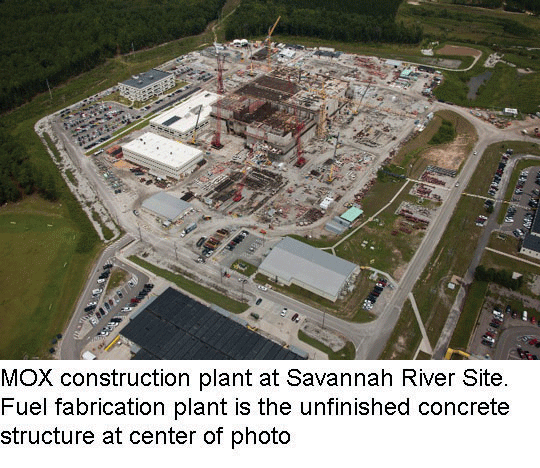 Trump should stick to his guns and close failed South Carolina nuclear MOX project https://thehill.com/opinion/energy-environment/412384-trump-should-stick-to-his-guns-and-close-failed-south-carolina
BY EDWIN LYMAN, OPINION CONTRIBUTOR — 10/20/18 Sen. Lindsey Graham (R-S.C.) is picking another fight that he promises will be even bigger spectacle than his over-the-top performance during Brett Kavanaugh’s confirmation hearings. Over what? A pork-barrel nuclear construction project in his state that his new best friend, President Donald Trump, is determined to shut down.
Graham, Sen. Tim Scott (R-S.C.), Rep. Joe Wilson (R-S.C.), and South Carolina state officials met with Trump at the White House on Thursday in a last-ditch attempt to get the president to change his mind about canceling the project. Hopefully, the president will stick to his guns and allow the Department of Energy (DOE) to finally put an end to this boondoggle. The project is costing taxpayers more than $1 million a day. The facility, the Mixed Oxide (MOX) Fuel Fabrication Plant, is three decades behind schedule and projected to cost some $15 billion more than its original $2 billion estimate. To date, the project is only 30 percent complete but has already cost more than $5 billion. The MOX plant has a long and troubled history. After the end of the Cold War in 1991, both the United States and the former Soviet Union were stuck with dozens of tons of plutonium — a key fuel for nuclear weapons — that were no longer necessary for their shrinking nuclear arsenals. Sen. Lindsey Graham (R-S.C.) is picking another fight that he promises will be even bigger spectacle than his over-the-top performance during Brett Kavanaugh’s confirmation hearings. Over what? A pork-barrel nuclear construction project in his state that his new best friend, President Donald Trump, is determined to shut down. Graham, Sen. Tim Scott (R-S.C.), Rep. Joe Wilson (R-S.C.), and South Carolina state officials met with Trump at the White House on Thursday in a last-ditch attempt to get the president to change his mind about canceling the project. Hopefully, the president will stick to his guns and allow the Department of Energy (DOE) to finally put an end to this boondoggle. The project is costing taxpayers more than $1 million a day. The facility, the Mixed Oxide (MOX) Fuel Fabrication Plant, is three decades behind schedule and projected to cost some $15 billion more than its original $2 billion estimate. To date, the project is only 30 percent complete but has already cost more than $5 billion. The MOX plant has a long and troubled history. After the end of the Cold War in 1991, both the United States and the former Soviet Union were stuck with dozens of tons of plutonium — a key fuel for nuclear weapons — that were no longer necessary for their shrinking nuclear arsenals. The DOE proposed the MOX plant as one method for converting retired U.S. plutonium weapon components into a form that was less readily usable in bombs and more difficult for terrorists to steal. The factory would turn the plutonium into fuel for commercial nuclear power reactors. After the reactors used the MOX fuel, the remaining plutonium would wind up trapped in heavy and highly radioactive spent fuel assemblies. But the MOX plan would actually increase the risk of nuclear terrorism. The MOX plant is so large and complex that if terrorists posing as plant workers diverted enough plutonium for a bomb, the loss might not be detected for weeks or even longer. Moreover, MOX fuel would have to be shipped to commercial reactors around the country, where security measures are far weaker than at DOE weapons facilities. MOX soon proved disastrous. Construction of the fuel factory, which began in 2007, has been plagued with prolonged delays and cost overruns. One major recurring problem was the need to redo defective construction. For example, the project contractor, now called CB&I AREVA MOX Services, bought 9,500 tons of steel rebar for reinforced concrete that was discovered to be inferior, but not before MOX Services installed 142 tons of it. Also, the DOE found in 2014 that “electrical work at the MOX facility was not being completed in accordance specifications and had to be repeatedly removed and reinstalled.” Adding insult to injury, the contractor billed the DOE for the extra labor needed to fix its mistakes, wasting even more taxpayer money. The DOE testified to Congress in 2015 that 25 percent of construction work had to be redone, but because MOX Services did not begin to systematically track and manage rework until 2014, the full extent of the problem may never be known. Faced with ballooning costs and uncertain prospects, the Obama administration decided in 2014 to terminate MOX and adopt a simpler, cheaper alternative that would be at much lower risk for nuclear terrorism. Surplus plutonium could be diluted with an inert material, packaged in small quantities, and shipped to the Waste Isolation Pilot Plant (WIPP) in New Mexico, the deep geologic repository for military nuclear waste. This policy made so much sense that the Trump administration rebuffed calls by MOX supporters to reverse it when it took office in 2017. For years, Graham and his South Carolina allies convinced Congress to prohibit the DOE from terminating MOX. Last year, however, Congress finally provided a way out: It decided that the DOE could shut down the MOX program if it could show that the alternative approach could dispose of all the surplus plutonium at less than half the cost of MOX. The DOE met that requirement in May, but in June the state of South Carolina won a federal injunction blocking termination, which was temporarily reversed on appeal last week. The DOE cancelled the project the very next day. That left Graham with only one card to play: a direct appeal to the president to reverse course. But is Graham’s loyalty worth $12 billion in taxpayer money? Let’s just hope Trump, who considers himself to be a shrewd businessman, really knows a bad deal when he sees one. Edwin Lyman is a senior scientist with the Union of Concerned Scientists’ Global Security Program in Washington, D.C. |
|
UK govt incentives for nuclear, coal gas – work against renewable energy development

 Dave Toke’s Blog 20th Oct 2018 UK Renewable trade associations are fighting for the survival of the renewable industry against an onslaught led by the Treasury. If the Treasury gets its way almost all future development for renewable energy in the UK will be stopped.
http://realfeed-intariffs.blogspot.com/2018/10/renewables-lobbies-fight-to-stave-off.html
 |
ReplyForward
|
Hanford given more time to empty leak-prone radioactive waste tank
 Hanford wants more time to empty leak-prone radioactive waste tank. Here’s the new deadline, Tri City Herald, BY ANNETTE CARY, acary@tricityherald.com, 18, 2018 , RICHLAND, WA
The Department of Energy will have more time to empty some of Hanford’s leak-prone underground waste storage tanks under an order issued in federal court.
Judge Rosanna Malouf Peterson agreed to a request by the state of Washington and DOE to give DOE until the end of 2026 to empty radioactive and hazardous chemical waste from nine more single-shell tanks.
It is an extension from March 31, 2024. A second deadline to keep work on pace to meet that milestone also has been extended.
DOE has another six months — until June 2021 — to have the first two tanks of the nine emptied. New court-enforced consent decree deadlines for retrieving the waste from tanks and treating it at the $17 billion vitrification plant under construction were set by Malouf Peterson in 2016………https://www.tri-cityherald.com/news/local/hanford/article220235380.html
Radioactive Contamination – podcast
 Ocean Radioactivity Transfer to Land, Food, People: UK Marine Pollution
Expert Tim Deere-Jones. Nuclear Hotseat 3rd Oct 2018
http://nuclearhotseat.com/2018/10/03/ocean-radioactivity-transfer-land-food-people-uk-marine-pollution-expert-tim-deere-jones-nh-380/
Nuclear Security UK – bolstering defences against a terror attack.
 Telegraph 20th Oct 2018 Counter-terrorism officers are to be equipped with a new fleet of high-tech
nuclear and radiological detection vehicles to trace weapons-grade materials in the UK. The Home Office is planning to buy up to 10 mobile gamma and neutron radiation detection systems to bolster its defences against them being used in a terror attack.
Ports and airports across the country already have screening systems in place to spot anyone smuggling nuclear or radiological materials into the UK as part of the Border Force’s Cyclamen monitoring system. Similar equipment was used at the Olympic Park during the 2012 Summer Olympics in London.
https://www.telegraph.co.uk/news/2018/10/20/nuclear-counter-terror-detection-systems-bolstered-high-tech/
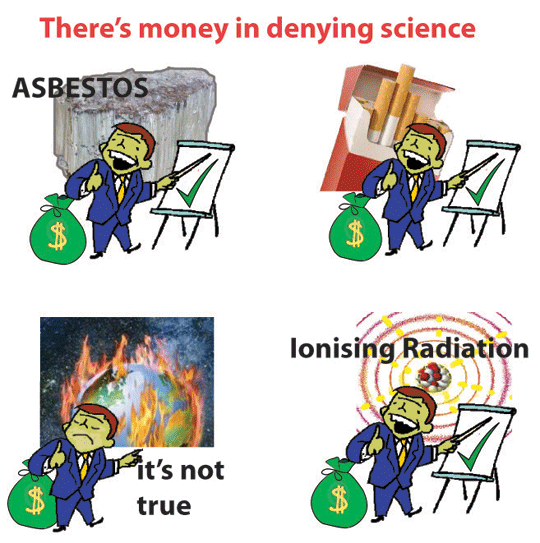
There’s money in denying the science about ionising radiation – it’s useful nuclear lobby spin
 radiation-protection-experts-are-concerned-over-epa-proposal-104895
 When the Associated Press reported that the Trump administration’s Environmental Protection Agency solicited the advice of a controversial toxicologist, Edward Calabrese, to consider changes to how it regulates radiation, it sent shock waves through the radiation protection community. Calabrese is well known for his unconventional and outlying view that low-dose radiation is not dangerous.It is important to note that the health effects of high doses of radiation are well established. We all know about the horrific effects based on studies of the populations of Hiroshima and Nagasaki after the atomic bombs were dropped. Then there was also the recent case of Russian defector Alexander Litvenenko who quickly sickened and died 23 days after being poisoned with the radioactive isotope polonium-210 in 2006.However, the effects of low doses of radiation are not well understood. Part of the reason is that these low doses are difficult to measure.
There have been questions as to whether the LNT model is appropriate for measuring cancer risk from low doses of radiation. That’s because when the radiation-induced cancer rate is low, and the sample size is small, there is more statistical uncertainty in the measurement. This allows more wiggle room in putting forward alternative dose- response models such as Calabrese’s, which have little scientific backing but that promise financial benefits for regulated industries.
Also, not being able to determine the effect of a low dose of radiation is a problem in measurement, not in the underlying linear threshold model. As doses of radiation decrease, fewer cases of radiation-induced cancers occur, making it more difficult to identify those specific cases.
This is especially true given that cancer is already a common occurrence, making it nearly impossible to disentangle radiation exposure from many other potential cancer risk factors. This is where the analogy with Takata air bags fails, because it is not possible to prove that a specific cancer death is due to ionizing radiation, but this does not make it any less real or significant.
Who profits if radiation guidelines change
The EPA issues guidance and sets regulations to “limit discharges of radioactive material affecting members of the public” associated with the nuclear energy industry. The EPA defines what radiation levels are acceptable for a protective cleanup of radioactive contamination at Superfund sites. It also provides guidance on the levels of radiation exposure that would trigger a mass evacuation. It is not surprising that certain stakeholders would welcome modifications in EPA assessment of low-dose radiation exposure given the high costs involved in preventing or cleaning up sites and in compensating victims of such exposure.
Recently, the National Council on Radiation Protection and Measurements (NCRP) – scientists who provide guidance and recommendations on radiation protection under a mandate from Congress – supported the LNT model. NCRP analyzed 29 epidemiological studies and found that the data was “broadly supportive” of the LNT model and that “no alternative dose-response relationship appears more pragmatic or prudent for radiation protection purposes.”
In fact, the National Academies’ Nuclear and Radiation Studies Board, the International Council on Radiation Protection, and other international bodies and regulators all use the LNT model for guidance and radiation protection.
From my perspective, as someone who has worked with radioactive sources, the EPA should be cognizant of the warning by the late Harvard sociologist Daniel Yankelovich that just because an effect can’t be easily quantified does not mean it is not important or does not exist.
Here’s an example of the uncritical journalistic hype over the nuclear lobby’s new filmic advertisement
(Low on facts – high on uncritical enthusiasm)

A new documentary puts fresh, young faces on the old debate over nuclear power, Grist , on Oct 18, 2018“…….. David Schumacher’s new documentary, The New Fire,…. profiles young people working to invent better versions of nuclear power plants. There’s the couple with a simple reactor design who started the company, Oklo. And there’s the Bill Gates-backed TerraPower. …..the movie serves up hope and enthusiasm……..
 heroic and charming and just completely iconoclastic. They shattered the standard image of nuclear engineers……
Genetic effects on UK soldiers – ‘guinea pigs’ at nuclear bomb tests in Australia in 1950s
 UK to probe poisonous genetic legacy of nuclear test ‘guinea pigs’ SMH, By Nick Miller, 19 October 2018 London: The UK government is considering a new study into the health of the children of British veterans used as guinea pigs in its Australian and Pacific nuclear weapons tests, to test fears of a poisonous genetic legacy.
If a link can be found it may form the basis of a claim for compensation from the UK government, despite courts previously turning down such claims from the veterans themselves.
Defence Secretary Gavin Williamson has told officials in the Ministry of Defence to look at the feasibility of a study into the health and well-being of the children of nuclear test veterans, an MOD spokesman said.
Decades ago, around 22,000 British military personnel witnessed nuclear weapons tests in South Australia, on the Montebello Islands off Western Australia, and on Kiribati’s Christmas Island in the Pacific.
Some felt the heat of the explosion on their backs and were ordered to turn around and observe the mushroom cloud. One veteran told the BBC in February the tests “bowled people over” and left them on the ground screaming. He had watched “another sun hanging in the sky”, dressed only in a t-shirt, shorts and thongs.
“We were guinea pigs,” Bob Fleming, 83, said. He said 16 of his 21 children, grandchildren and great-grandchildren had birth defects or health problems: his youngest daughter has thyroid problems and severe breathing difficulties.
The family believe it is a result of the radiation Mr Fleming was exposed to during the test.
Another veteran, RAF sergeant Roy Kirkland, slept a half a mile from Ground Zero and was ordered to collect dead seabirds from the Christmas Island test site.
The new feasibility study follows a campaign by the Mirrorand Labour deputy leader Tom Watson, who have been pushing for recognition and compensation for the veterans who were exposed to radiation during the tests in the region between 1952 and 1967 – and their families.
In 2007 a study of New Zealand nuclear test veteransfound they had more than double the expected amount of genetic damage for men of the same age – even higher than that detected in workers close to the Chernobyl nuclear accident or involved in the clean-up.
The study by researchers from Massey University found the genetic damage was most likely attributable to the veterans having been on board NZ navy frigates observing nuclear tests at Christmas Island.
In 2014 a study by European researchers found a “significant excess” of infant mortality and congenital illnesses in nuclear test veterans’ children. The veterans’ wives had five times as many stillbirths, and 57 children of veterans had congenital conditions – ten times the rate in the control group and eight times the national average. There were also significantly higher congenital illnesses – and cancer – among the veterans’ grandchildren. The researchers said their results were “highly statistically significant”. …….. https://www.smh.com.au/world/europe/uk-to-probe-poisonous-genetic-legacy-of-nuclear-test-guinea-pigs-20181019-p50alz.html
1 This Month
Chernobyl: The Lost Tapes – A good documentary on Chernobyl on SBS available On Demand for the next 3 weeks– https://www.sbs.com.au/ondemand/tv-program/chernobyl-the-lost-tapes/2352741955560

of the week–London Campaign for Nuclear Disarmament

Tell the Ukrainian Government to Drop Prosecution of Peace Activist Yurii Sheliazhenko
To see nuclear-related stories in greater depth and intensity – go to https://nuclearinformation.wordpress.com
-
Archives
- April 2026 (126)
- March 2026 (251)
- February 2026 (268)
- January 2026 (308)
- December 2025 (358)
- November 2025 (359)
- October 2025 (376)
- September 2025 (257)
- August 2025 (319)
- July 2025 (230)
- June 2025 (348)
- May 2025 (261)
-
Categories
- 1
- 1 NUCLEAR ISSUES
- business and costs
- climate change
- culture and arts
- ENERGY
- environment
- health
- history
- indigenous issues
- Legal
- marketing of nuclear
- media
- opposition to nuclear
- PERSONAL STORIES
- politics
- politics international
- Religion and ethics
- safety
- secrets,lies and civil liberties
- spinbuster
- technology
- Uranium
- wastes
- weapons and war
- Women
- 2 WORLD
- ACTION
- AFRICA
- Atrocities
- AUSTRALIA
- Christina's notes
- Christina's themes
- culture and arts
- Events
- Fuk 2022
- Fuk 2023
- Fukushima 2017
- Fukushima 2018
- fukushima 2019
- Fukushima 2020
- Fukushima 2021
- general
- global warming
- Humour (God we need it)
- Nuclear
- RARE EARTHS
- Reference
- resources – print
- Resources -audiovicual
- Weekly Newsletter
- World
- World Nuclear
- YouTube
-
RSS
Entries RSS
Comments RSS
 nuclear-news