nuclear-news

The News That Matters about the Nuclear Industry Fukushima Chernobyl Mayak Three Mile Island Atomic Testing Radiation Isotope

  • Home
  • 1 This Month.
  • ACTION !
  • Disclaimer
  • Links
  • PAGES on NUCLEAR ISSUES

A big week in climate news, a hushed week in nuclear news

The world has 10 years to ward off global warming disaster.  The Intergovernmental Panel on Climate Change (IPCC) released its 2018 Report on Monday 8th October. By Tuesday, its news was all over the media.  By Wednesday, other news had to some extent taken over. By now, in Australia, we’re back to the important stuff – horse racing and royal weddings.

However, climate change is still important, and indeed, urgent. Experts warn that the IPCC report may be understating the climate situation. And in particular – the risk of catastrophic sea-level rise.

Again, however much the nuclear lobby might not want you to know this, – the dangers of climate change and nuclear power are merging. Hurricane Michael has threatened nuclear power stations in Georgia and Florida. But there’s precious little information on how that is going.

**************************

Rising sea levels will mean flooding of vulnerable cities- e.g: London, Jakarta, Shanghai and Houston.

ExxonMobil CEO Depressed After Realizing Earth Could End Before They Finish Extracting All The Oil.

$2.4 Trillion Fossil Fuel Shift – better than climate apocalypse.

**************************

What the IPCC Report 2018 says about nuclear power.

Cheap flexibility from storage, demand-side response and distributed renewable energy generation poses a “huge threat” to the nuclear industry.

USA-Russia relations at a low ebb: nuclear treaties are under threat.

Genetic changes in children of soldiers who were exposed to ionising radiation.

Vitrified nuclear waste: glass corrodes and melts long before the radioactive trash is inert.

The very bad news about what space travel can do to your gut.

JAPAN. Residents in Miyagi file suit to block burning of radiation-tainted waste from Fukushima nuclear disaster. Fukushima nuclear plant owner apologises for still-radioactive water.  TEPCO bungles it again in dealing with Fukushima tainted water.

SOUTH KOREA. S. Korean activists demand Japan not dump Fukushima’s radioactive water into the sea.

USA. 

  •  VA Nuke Plant Suffers Transformer Trip From Hurricane Michael .
  • USA’s Nuclear Protection Agency, -sorry, Environment Protection Agency , set to weaken radiation guidelines. “Transparency”- the Trump administration’s dirty trick to strangle access to reputable science on nuclear radiation.  The Leader in the Fight to Stop Yucca Mountain, Heller Demands Information on the Proposed Reclassification of High-Level Radioactive Waste.
  • New research raises further concern about radioactive contamination from US arms testing.
  • Donald Trump’s priority is profit from weapons sales to Saudi Arabia: murder of Washington Post journalist is irrelevant. Trump administration’s unreasonable tolerance for Saudi Arabia’s war crimes in Yemen.  USA administration salivating about lucrative sale of nuclear technology to Saudi Arabia – if only they could get over the proliferation problem.
  • USA restricts nuclear technology exports to China.
  • MOX nuclear fuel plant in South Carolina “on life support”, following court case.
  • How workers inadvertently contributed to Westinghouse nuclear factory’s radiation leak.
  • Towns face the end of the nuclear era, and the problems of radioactive trash.

UK. Welsh Labour Government allows Hinkley nuclear station’s mud dumping off Penarth, despite local opposition.    Dumping of Hinkley nuclear station mud closed – for now  Wales should be “sceptical” about nuclear power – Welsh Labour leadership candidate.  Anniversary of UK’s Windscale nuclear accident. Jeremy Corbyn gives a vision of a smarter, cleaner, more secure and equitable future. UK agonising over its nuclear industry future, leaving the Euratom Treaty, because of Brexit.

NORTH KOREA. North Korea is not really making any big nuclear concession. US Secretary of State Mike Pompeo says that North Korea is ready to allow inspection of key nuclear site. Nuclear safety should be the first priority in the Korean Peninsula.

TURKEY. Council of Europe concerned at construction of the Akkuyu nuclear power plant in an earthquake-prone region.

FRANCE. New delay in sight for Flamanville EPR.   France to defend lawsuit over its Pacific nuclear tests- “accepted its nuclear legacy with serenity” (whatever that means!).  Plan to sue France over ‘crimes against humanity’ in nuclear tests in South Pacific. France’s government to postpone the phaseout of nuclear power – to the detriment of the renewable energy industry.

BELGIUM Belgium’s phaseout of nuclear power.

CHINA. Nuclear weapons proliferation risks in China’s push to export nuclear reactors.

RUSSIA. Dubious claim from Russia, about bacteria “neutralising nuclear waste”.

October 13, 2018 Posted by Christina Macpherson | Christina's notes | 7 Comments

A First: Medical Data Obtained from Minami-soma Municipal General Hospital in Fukushima

Sean Arclight commenting: “Health statistics from Minamisoma Municipal General Hospital seems to prove cancers and other health issues are on the rise in Fukushima.
In Japan there are new laws to stop medical staff releasing data on health effects that may be caused by the nuclear disaster. This new controvertial law (against the supposed new open transparency purported by the nuclear industry post Fukushima disaster) was enacted in late 2013 and threatens to imprison or give huge fines to medical staff. This makes verification difficult.
These statisitcs are for a relatively small area covered by the Minamisoma General Hospital within the Fukushima Prefecture.
As we now have the statistics we can challenge the authorities to deny or confirm the figures. If they deny the figures and later it comes to light, then at least we will have someone to hold responsible and to question further. This is the best we can do with whistleblowers from Japans health workers and it is important to publish the claims as we are doing here.
There has been a long fight over health issues caused by radiation and toxicity from the destroyed nuclear plant. The authorities have constantly denied “rumours” of nosebleeds, skin rashes and childrens Thyroid cancers over the past 7 years or so. Some of these “rumours” are slowly being proven true and the nuclear industry also has co-opted the psychological effects, blaming the victims weakness and ignorance instead of the psychological effects of trauma caused by the huge industrial accident and its consequences.
A recent UN report has highlighted how corporations often play down any physical and mental health issues caused by these sorts of industrial contamination, writing off any direct links to toxicity and mental health especuially.
Another report has highlighted that micro particles (thought to be harmless until around 10 years ago) can penetrate the blood brain Barrier and we can anticipate some mental impacts from these toxins entering the very sensitive brain tissues.
The new UN report has highlighted that Fukushima decontamination workers and the local communities concerns are often ignored and should be taken into account instead.
Also, many of the workers at the plant may fall outside regular health checks into the future because of the nature of their contracts and the illegal practises of contractors that has been present in japan for many decades. Thus, skewing the actual health effects to workers toiling in such contaminated environments.”
Minamisōma is about 25 kilometres (16 miles) north of Fukushima I Nuclear Power Plant, the site of the nuclear accident that followed the 2011 Tōhoku earthquake and tsunami. Much of the city lies within the 30 kilometer mandated evacuation zone near the plant, and thus most of the residents were forced to leave.
In March 2012, the city was divided into three zones: in the first, people were free to go in and out but not allowed to stay overnight; in the second, access was limited to short visits; and in the third area, all entry was forbidden because of elevated radiation levels that were not expected to go down within five years after the accident.
On April 15, 2012 some of people of Minamisōma were able to return to their homes when the evacuation zone was reduced from 30 kilometers to 20 kilometers from the reactors, with the exception of a wide area on the western border of the city with the town of Namiie. At the time the evacuation order was lifted the centre of city was still scattered with ruins and lacked electricity and running water, while schools and hospitals remained closed.
On July 12, 2016 the evacuation order was lifted for all areas of the city except the western border region with Namiie; this permitted all of the remaining evacuees (with the exception of one household) to return home. In August of the same year, elementary schools and junior high schools, which has been closed since 2011, were allowed to reopen.
27336874_889983554509492_3441021472763742145_n
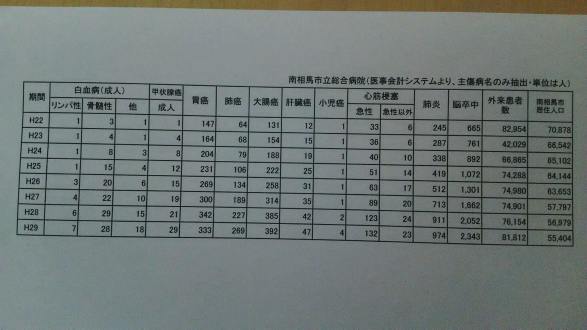
The lawyer Ken’ichi IDO got these data from a member of the Minami-soma municipal council who himself obtained these data from the Minamisoma municipal hospital.
Ken’ichi IDO’s group of lawyers intend to submit the data to the court as evidence for the ongoing trial, “Trial to get the children out of the irradiation “(Kodomo datsu hibaku saiban).
We were worried that Fukushima might be a Chernobyl, which sparked health damage to residents. However, the country and Fukushima prefecture did not have a health investigation except for pediatric thyroid cancer.
At this time, Mr. Kōichi Oyama, a member of the Minami- Soma City Council, obtained data from the Minami-soma municipal general hospital.
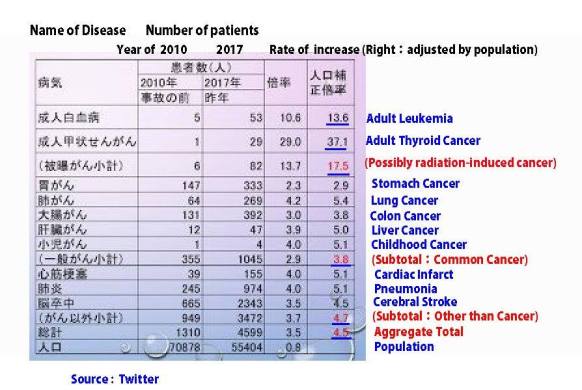
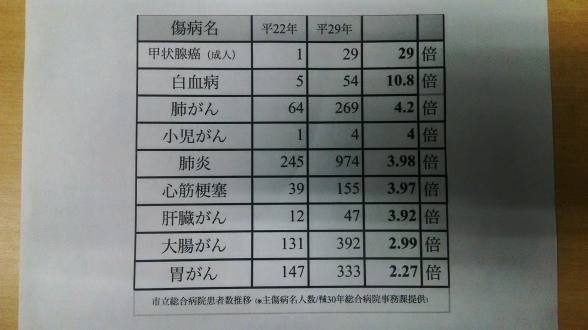
“The shocking data came out: when year 2010 and year 2017 year were compared, there were 29 times more of adult thyroid cancer, 10.8 times more of leukemia, 4.2 times more of lung cancer, 4 times more of pediatric cancer, 3.98 times more of pneumonia, 3.97 times of myocardial infarction, 3.92 times more of liver cancer, 2.99 times more of large intestine cancer, 2.27 times more of stomach cancer, and 3.52 times more of stroke.
There is not a lot of data for sure, but it is necessary to be careful to short-circuited the entire hospital data. We should also consider the effects of closed-down medical institutions, reducing population, aging of residents, and physical fatigue and mental stress, accompanied by a tsunami or nuclear accident.
However, the number of patients in the hospital was compared, 70,878 people in fiscal year 2010, and in fiscal year 2017 they did not increase. Population over 65 years old in Minami-soma city in 2010 was 18,809, and in 2017 it was 18,452, and it has not increased.
Stress also seems to have been more serious in the early days, but the number of patients continues to be consistent for these 7 years.
We are planning to submit this evidence on the date of our oral argumentation in court (October 16) in order to raise this important medical issue.”
44031727_1594388037333679_5859545361340694528_n21
Source: Ken’ichi IDO
https://www.facebook.com/profile.php?id=100005962957611&sk=photos&collection_token=100005962957611%3A2305272732%3A69&set=a.841172482758176&type=3
https://www.facebook.com/permalink.php?story_fbid=841174066091351&id=100005962957611

October 13, 2018 Posted by dunrenard | Fukushima 2018 | Fukushima, Medical records, Minamisoma City | 7 Comments

The Mayor of Nowhere: Former cattleman runs campaign to revitalize Namie, Fukushima

1
October 5, 2018
On the last Friday in July 2018, a car with speakers mounted on the roof pulled up to the TEPCO headquarters near Hibiya Park. At a little past 5pm, the utility’s employees began streaming out of the building and, as they glided through the automatic doors, recognition flashed over their faces. As they turned toward the Shinbashi nightlife district, the office workers shot sour looks at the man in the blue-and-yellow sash, who stood in front of the car.
“You should take responsibility. How can you just walk by? You are polluting Fukushima’s waters,” he yelled into a microphone, blasting the company for its actions since the triple meltdowns at the Fukushima Daiichi nuclear power plant.
Masami Yoshizawa was running for mayor of Namie, one of the seven cities, towns and villages surrounding the damaged power plant that remain under partial evacuation orders. As part of his campaign, he’d come to TEPCO to deliver a letter outlining his plans to take the company to court for damages and to demand the utility cancel plans to release tons of radiation-contaminated water into the Pacific.
2
Yoshizawa had spoken in front of the headquarters before. The first time was in the days following the earthquake and tsunami on March 11, 2011. Back then, he’d held out as long as he could on his ranch, 14 kilometers from the power plant. Once it became clear that his herd of 328 Japanese beef cows had lost all their value — the animals had been worth over ¥450 million before they were exposed to the radiation released from the plant — he decided to go to Tokyo to make his voice heard. After driving down, he walked into the scrum of police and news vans that surrounded the TEPCO headquarters and demanded to speak with someone from the company. Though the police seized him by the arms, he didn’t give up until a representative from the utility eventually agreed to listen to his complaint.
After returning to Fukushima, he started visiting his ranch to feed his animals, unwilling to let them starve. Eventually, he decided to ignore the mandatory evacuation order and began living on his land again. In his youth, he’d been part of the Japanese student movement and this experience informed him as he poured his energy into the anti-nuclear campaign: he hauled his irradiated cattle down to the Ministry of Agriculture and made impassioned speeches in Shibuya and Sendai, attempting to raise awareness of the plight of farmers and ranchers around Fukushima Daiichi. His land, which he renamed the Ranch of Hope, became a hub for activists and environmentally-minded volunteers, who came to support him and help take care of the cows.
Then in June of this year, Tamotsu Baba, Namie’s three-term mayor, resigned. He had stomach cancer and, two weeks after stepping down, he passed away in a hospital in Fukushima City. A special election was scheduled for August 5 and Yoshizawa declared his intention to run.
He withdrew his membership from the Japanese Communist Party and created his own group, the Organization for a Hopeful Namie, though his politics retained a radical tinge. He promised to force TEPCO to increase damage payments by 50 percent and to support local farmers by using the town’s contaminated fields to grow rice for use in ethanol. He railed against the Abe administration’s plan to hold the 2020 Olympics in Tokyo and decried the sunnier visions of the recovery effort: in his view, no more than half the town’s residents would ever return. “As a town, Namie is finished,” he often said during his speech, suggesting that the population would dip below 10,000. “In the future, Namie will be a village.”
In some ways, Yoshizawa’s policy positions were less important than his stance toward the recovery effort. Of the 17,791 officially registered residents, only 777 have returned to live in the few dozen square kilometers where the evacuation order has been lifted; thus, being mayor of Namie effectively means being the leader of a town that exists mostly on paper. More than anything, the election was a way of gauging the mood of the voters, most of whom had been evacuated from their home for over seven years.
This was a point Yoshizawa stressed to the TEPCO employees, who were heading out of the office to enjoy their Premium Friday: “We can’t go home! You have houses to return to, places to work. But we can’t return to Namie. Our town is ruined, our lives are crushed.”
3
The following day, Yoshizawa campaigned in his home prefecture. After the evacuation, Namie’s residents had been dispersed across the prefecture, with the bulk winding up in Fukushima City, Nihonmatsu, Koriyama and Minamisoma. Evacuees initially lived in hastily constructed temporary housing, but facing the prolonged recovery effort ahead, the prefectural government built “recovery homes” — apartments and blocks of single-family houses — and is now moving the nuclear refugees into these units.
Late in the afternoon, Yoshizawa’s car pulled up to a series of oblong three-story buildings. He stepped out, placed a plastic milk crate upside-down on the sidewalk, and stood on it as he launched into his stump speech.
Three volunteers working for his campaign watched for anyone who stepped outside to listen to him or who happened to be crossing the parking lot as he spoke. If they spotted a potential voter, the volunteers sprinted to them — even if this involved several flights of stairs — and handed them a flyer, asking for their vote.
As Yoshizawa’s rhetoric echoed through one corner of the apartment complex, a white van pulled up to the opposite corner, and a man with a bullhorn got out. Kazuhiro Yoshida had been the head of the former mayor’s support group and was Yoshizawa’s only opponent in the election. Like Yoshizawa, he was deeply tanned, with rough features and a straightforward manner. But unlike his rival, Yoshida’s message was one of continuity: the handpicked successor of the previous mayor, with connections to the ruling Liberal Democratic Party, he promised to press forward with the recovery plans, such as they were. He spoke optimistically about reconstructing Namie and rebuilding a local economy based on agriculture and fishing.
Yoshida’s quasi-incumbent status was confirmed by the sparse nature of his campaign. He had no flyers or banners, not even a business card to hand out to inquiring media-types. No volunteers flanked him, and, if you removed the references to disaster and recovery, his policy proposals could’ve been meant for any struggling town in Tohoku: create a safe and secure environment, support the elderly and so on.
These contrasts were not lost on the handful of voters who spilled out of the apartment blocks to listen to campaign speeches. One former store owner in her 60s planned on voting for Yoshida, and was realistic about the future: “I think I won’t ever go back… Still, I want them to make a town where it’s easy to live again.” A middle-aged man from the coastal district of Ukedo said his vote wasn’t decided, but that the most important thing for him was stability.
Meanwhile, many of Yoshizawa’s voters were more inclined toward extremes of optimism or despair. Yoko Konno, who had owned a salon in Namie’s Gogendo district, wasn’t planning to move back, as her children had relocated and she needed to be near a hospital so she could get treatment for her heart condition: “There’s no one left in Namie.” By contrast, Shiba, the head of the residents’ association in a different public housing block, said, “I want to go back. We need to make a new plan though.”
4
Yoshizawa’s volunteers were a collection of journalists, animal lovers and activists. The campaign was a kind of traveling, temporary family, and, as with any middle-class Japanese household, lunchtime was likely to find them in a family restaurant, as was the case two days before the election, when they stopped at a tonkatsu (fried pork cutlet) place in a residential neighborhood of Koriyama.
Most of the team was drawn from Ranch of Hope volunteers, like Masakane Kinomura, a photographer for the Asia Press Front, who had first learned about Masami Yoshizawa and the Ranch of Hope through a fellow journalist. He pointed across the table with his chopsticks at a volunteer named Monguchi, “I was coming back from the ranch and she picked me up in her taxi in Tokyo.”
She brushed a braid of dyed red hair behind her shoulder. “When I picked him up, I thought he was just some tired middle-aged man. But then the way he talked about caring for these 300 cows. I couldn’t see his face, but I could tell he was a good person.”
Originally from Osaka, she had never volunteered until the Kumamoto earthquake damaged her grandmother’s house. After her first experience, she wanted to do more to help, but Kyushu was too far. She had always loved animals — a quality which helped her connect with pet-owning voters — and the chance to be close to the cattle led her to the Ranch of Hope.
Next to Monguchi was Ohamazaki, an outside political consultant and the only paid member of the campaign staff. With the sleeves of his dress shirt rolled up and his tie pulled away from his collar, he exuded a sense of business. “I’ve worked with the Liberal Democrats, Communists, Independents. Over 200 elections.” With his help, he believed Yoshizawa could win as many as six in ten voters, though turnout would be low. In the previous mayoral election, over half of Namie’s residents had voted, but he believed the percentage would fall in the summer’s election. “People have moved here and there, so it’ll be closer to 40 percent.”
On this point, Ohamazaki proved right, as 43 percent of residents went to the polls. However, the result of the election would fall against his client, with 80 percent of voters opting for the stability offered by Kazuhiro Yoshida. Despite all they’ve been through (or perhaps because of it) Namie’s voters weren’t interested in a new, more confrontational approach. In some ways, the story of this mayoral election in the exclusion zone, echoes one of the problems facing the Japanese political left as a whole: an inability to show voters — even those who are disenchanted with the status quo — how a narrative of resistance and change will impact their lives for the better.
In the weeks since the election, Masami Yoshizawa has returned to his ranch, where he herds his irradiated cattle over the green hills of Fukushima. Namie Town heads into its eighth year of recovery, its future suspended in uncertainty, with no end in sight.
5
https://metropolisjapan.com/the-mayor-of-nowhere-namie-fukushima/

October 13, 2018 Posted by dunrenard | Fukushima 2018 | Fukushima, Mayoral Election, Namie | Leave a comment

The risk of catastrophic sea-level rise

What’s Another Way to Say ‘We’re F-cked’?  https://www.rollingstone.com/politics/politics-news/climate-change-sea-level-rise-737012/  One of the leading climate scientists of our time is warning of the horrifying possibility of 15-to-20 feet of sea-level rise, By JEFF GOODELL,13 Oct 18

Hurricane Michael, the third most intense storm on record to make landfall in the U.S., has caused widespread destruction, turning places like Mexico Beach, Florida, into a hellscape of broken homes and overturned cars. It will be a while before we learn the full extent of the damage — and the human suffering and death — caused by the storm’s 155 mph winds and the 14-foot storm surge that swamped the coastline.

Bad as the hurricane was, imagine the damage and destruction if that storm surge had been 15 feet or so higher. And if instead of receding, that wall of water never went away. That is what we could be facing in the not-so-distant future if we don’t dramatically cut fossil-fuel pollution.

If that sounds alarmist, watch this short video. In it, you’ll see a scientist named Richard Alley in a Skype discussion with students at Bard College, as well as with Eban Goodstein, director of the Graduate Programs in Sustainability at Bard. It would be just another nerdy Skype chat except Alley is talking frankly about something that few scientists have the courage to say in public: As bad as you think climate change might be in the coming decades, reality could be far worse. Within the lifetime of the students he’s talking with, Alley says, there’s some risk — small but not as small as you might hope — that the seas could rise as much as 15-to-20 feet.

Let’s pause to think about what 15-to-20 feet of sea-level rise in the next 70 or so years looks like. I’ll put it bluntly: It means not just higher storm surges from hurricanes, but the permanent drowning of virtually every major coastal city in the world. Miami, New Orleans, large parts of Boston and New York City and Silicon Valley, not to mention Shanghai, Jakarta, Ho Chi Min City, Lagos, Mumbai — all gone. And I don’t mean “sunny day flooding,” where you get your feet wet on the way to the mall. I mean these cities, and many more, become scuba diving sites.

There are not enough economists in the world to calculate the trillions of dollars worth of real estate that would be lost in a scenario like this. Nor are there enough social scientists to count the hundreds of millions of people who would be displaced. You think the world is a chaotic place now? Just wait.

Richard Alley is not a fringe character in the world of climate change. In fact, he is widely viewed as one of the greatest climate scientists of our time. If there is anyone who understands the full complexity of the risks we face from climate change, it’s Alley. And far from being alarmist, Alley is known for his careful, rigorous science. He has spent most of his adult life deconstructing past Earth climates from the information in ice cores and rocks and ocean sediments. And what he has learned about the past, he has used to better understand the future.

“Sea-Level Rise: Inconvenient, or Unmanageable?” Richard B. Alley

For a scientist of Alley’s stature to say that he can’t rule out 15 or 20 feet of sea-level rise in the coming decades is mind-blowing. And it is one of the clearest statements I’ve ever heard of just how much trouble we are in on our rapidly warming planet (and I’ve heard a lot — I wrote a book about sea-level rise).

To judge how radical this is, compare Alley’s numbers to the latest report from the Intergovernmental Panel on Climate Change, which was released on Monday. That report basically argued that if we don’t get to zero carbon emissions by 2050, we have very little chance of avoiding 1.5 Celsius of warming, the threshold that would allow us to maintain a stable climate. The report projected that with 2 Celsius of warming, which is the target of the Paris Climate Agreement, the range of sea level rise we might see by the end of the century is between about one and three feet.

So why is Alley arguing that the risk of catastrophic sea-level rise is so much higher than the report that is often cited as “the gold standard” of climate science?

For one thing, IPCC reports are notoriously conservative. They are written in collaboration with a large group of scientists and are often watered down by endless debate and consensus-building. (There are 18 lead authors and 69 contributing authors on the chapter that considers sea-level rise.) For another, they rely on published science that is often out of date — or at least, far from the cutting edge. The new IPCC report has already been criticized for low-balling risks by climatologists like Penn State’s Michael Mann, who has pointed out that the report understates the amount of warming we’ve already experienced as a result of burning fossil fuels, which means that we are much closer to the 1.5 and 2 degrees Celsius thresholds than the report implies.

Alley simply has a broader understanding of ice dynamics than many scientists, who tend to be highly specialized in their research. Alley’s analysis includes not only geology and paleoclimatology, but also a big dose of physics and engineering — which is especially helpful when it comes to understanding the possibility of rapid ice sheet collapse. (To help me visualize how quickly ice cliffs on Antarctic glaciers can disintegrate, Alley sent me a video of a 1978 landslide in Norway.) In the IPCC report, “tipping points” in the climate system, such as ice-cliff collapse, are either disregarded or buried deep in the 1,000-page document.

The Quick Clay Landslide at Rissa – 1978 (English commentary)

Alley is not the only one who has suggested that the risks of rapidly rising seas are higher than this IPCC reports acknowledges. The National Ocean and Atmospheric Administration, the top science agency in the U.S., says the seas are likely to rise by between one and eight feet by 2100. And a few years ago, James Hansen, the godfather of global warming science, argued that the world could see six feet of sea level rise in as little as 50 years and then keep rising at an exponential rate after that.

Hansen’s expertise, however, is in atmospheric chemistry and physics. Alley understands the secrets of ice.

For Alley, the engine of potential catastrophe is West Antarctica. The details are complex, but here’s a short version of what’s happening: warm water from the Southern Ocean is melting the underside of big glaciers like Thwaites and Pine Island, which, due to the unusual terrain there, have the potential to collapse quickly. (I wrote a much longer, more detailed account of the mechanics of ice sheet collapse here). If West Antarctica goes, that’s 10 feet of sea-level rise right there. Then if you add in ice loss from Greenland, a little from East Antarctica and other sources, you quickly get to 15 to 20 feet.

The big question is, how soon could it happen?

“We don’t really know,” Alley tells Rolling Stone via email. He points to the lack of constraints in physical data and models that would put a speed limit on the collapse. “The most-likely future as projected by the IPCC is well on the small-change/small-damage ‘good’ end of the possible futures, with potential for slightly better, slightly worse, and much worse, but without a balancing ‘much better,’” Alley writes.

In other words, when it comes to ice-sheet collapse, uncertainty is not our friend. The collapse might not happen fast. Then again, he can’t rule out the possibility that it will happen fast, very fast.

Alley points out that the best way to avoid this uncertainty is to keep climate warming below 1.5 Celsius or less. In existing climate models, West Antarctica remains fairly stable below that threshold. But given the world’s current burn rate of fossil fuels, and the massive industrial and political transformation required to keep temperatures below that threshold, Alley knows that’s unlikely.

“I personally am not planning to tell people that I know what [amount of warming determines if] ice shelves will or won’t break off, leaving cliffs that will or won’t crumble rapidly,” Alley writes to me. “So, for now, I have to leave large, rapid changes within my error bars, and I believe I have a duty to tell people this.”

And that’s one of the things that makes Alley such a great scientist. He not only understands the world-changing risks we face better than almost anyone. He also understands that it’s his job to warn us about them.

October 13, 2018 Posted by Christina Macpherson | 2 WORLD, climate change | Leave a comment

Cheap flexibility from storage, demand-side response and distributed renewable energy generation poses a “huge threat” to the nuclear industry

‘Cheap as chips’ flexibility poses ‘huge threat’ to nuclear,  https://utilityweek.co.uk/cheap-chips-flexibility-poses-huge-threat-nuclear/ 12/10/2018  Cheap flexibility from storage, demand-side response and distributed generation poses a “huge threat” to the nuclear industry, according to former energy secretary Ed Davey.

 Tom Grimwood  Speaking at a conference held by Aurora Energy Research in London yesterday (11 October), Davey said the falling costs of such technologies raise “serious questions” about the government’s pursuit of new nuclear plants.“There’s no doubt storage and flexibility pose a huge threat to nuclear industry,” he told the audience.  “Nukes are expensive; take a hell of a long time to build. In ten years, where are we going to be with storage and flexibility?

“I think it’s going to be cheap as chips and have variations we don’t even know about today, because so much is evolving. The energy revolution is going apace.”

“That has to ask serious questions of the nuclear strategy which the government is pursuing”.

Davey hailed the government and Ofgem’s smart systems and flexibility plan as the “best thing” he’d seen in terms of policy since leaving office in 2015.

However, he added: “I don’t see much movement. And I’m not saying it’s because it’s easy… But we really need to be moving forward on that to give people better markets and contracts that are more investible… I think we could do a lot better.”

He continued: “If you had better policy you might be able to answer this question of do we keep a big centralised system, investing in lots of big centralised assets, or do we have more of a hybrid system.

“And we’ve gone to a hybrid system a little bit without thinking it all through but for good reasons. Solar took off much quicker than people thought, for example, and the capacity brought on peakers which weren’t really in the picture.

“We’ve now got that hybrid system and my worry is no one’s really thinking that through strategically.”

Davey also raised concerns over the influence of large generators on policy and regulatory decisions: “My worry is that the lobbying power of the big centralised generators… is a bit bigger than those of us who think a lot of the future is in the decentralised sector.

“If I have political message to people, it’s to really think that through because I think we’ve seen in some of the network code debates and elsewhere a politics which is very much in favour of centralised generators.”

Speaking to Utility Week in early 2017, the chief executive of UK Power Reserve, Tim Emrich, accused the Connection and Use of System panel of being unduly influenced by incumbents after the industry body recommended drastic cuts to the triad avoidance payments available to small-scale distributed generators.

The changes were approved by Ofgem later in the year. https://utilityweek.co.uk/cheap-chips-flexibility-poses-huge-threat-nuclear/

October 13, 2018 Posted by Christina Macpherson | 2 WORLD, decentralised, energy storage | Leave a comment

Climate change threat is worse than UN report states: risk of runaway warming

Climate report understates threat https://thebulletin.org/2018/10/climate-report-understates-threat/?utm_source=Bulletin%20Newsletter&utm_medium=iContact%20email&utm_campaign=October12

By Mario Molina, Veerabhadran Ramanathan, Durwood J. Zaelke, October 9, 2018 The UN’s Intergovernmental Panel on Climate Change’s Special Report on Global Warming of 1.5 degrees Celsius, released on Monday, is a major advance over previous efforts to alert world leaders and citizens to the growing climate risk. But the report, dire as it is, misses a key point: Self-reinforcing feedbacks and tipping points—the wildcards of the climate system—could cause the climate to destabilize even further. The report also fails to discuss the five percent risk that even existing levels of climate pollution, if continued unchecked, could lead to runaway warming—the so-called “fat tail” risk. These omissions may mislead world leaders into thinking they have more time to address the climate crisis, when in fact immediate actions are needed. To put it bluntly, there is a significant risk of self-reinforcing climate feedback loops pushing the planet into chaos beyond human control.

The report does describe how much more serious climatic impacts will be if the world lets warming reach 2 degrees Celsius above pre-industrial levels. Limiting the warming to 1.5 degrees Celsius can, for example, cut many impacts in half, including those of fresh water shortage and losses of many species and of ocean fish catch. The report is relatively optimistic that this can be done, but only with unprecedented commitment and cooperation from governments, industry, religious and secular leaders, and citizens around the world.

So far, average temperatures have risen by one degree Celsius. Adding 50 percent more warming to reach 1.5 degrees won’t simply increase impacts by the same percentage—bad as that would be. Instead, it risks setting up feedbacks that could fall like dangerous dominos, fundamentally destabilizing the planet. This is analyzed in a recent study showing that the window to prevent runaway climate change and a “hot house” super-heated planet is closing much faster than previously understood. Continue reading →

October 13, 2018 Posted by Christina Macpherson | 2 WORLD, climate change | Leave a comment

Council of Europe concerned at construction of the Akkuyu nuclear power plant in an earthquake-prone region

Council of Europe requests Turkey to consult neighbours for Akkuyu nuclear plant https://ahvalnews.com/council-europe/council-europe-requests-turkey-consult-neighbours-akkuyu-nuclear-plant

The Parliamentary Assembly of the Council of Europe (PACE) expressed on Thursday deep concern at the construction of the Akkuyu nuclear power plant in an earthquake-prone region of Turkey only 85 kilometres from the border with Cyprus.

In a resolution it adopted, the assembly said that Turkey’s first nuclear plant being constructed as a joint Turkish-Russian project is in very close proximity to the other neighbouring countries.

The assembly asked Turkey to join the UN Convention on Environmental Impact Assessment in a Transboundary Context, also known as the Espoo Convention, and to take into account all concerns expressed, including those expressed by Turkish citizens.

The Espoo Convention , adopted in 1991, sets out the obligations of parties to assess the environmental impact of certain activities at an early stage of planning. It also lays down the general obligation of states to notify and consult each other on all major projects under consideration that are likely to have a significant adverse environmental impact across boundaries

The assembly also requested from the Turkish government to consult with neighbouring countries on the construction of the nuclear plant according to the International Convention on Nuclear Safety.

The construction of the Akkuyu nuclear plant located in the southern province of Mersin was kicked off by President Recep Tayyip Erdoğan and his Russian counterpart Vladimir Putin on Apr. 3.

The nuclear plant “raises concerns for a possible impact in terms of safety because such a power plant in this area affects our country much more than the largest part of the Turkish territory,” said the Cypriot government’s spokesman Prodromos Prodromou, following the groundbreaking ceremony in Mersin.

“Turkey did not take into account the grave reservations expressed by various quarters, nor did it heed the European Parliament’s call to terminate the construction plans since this is a seismologically vulnerable area,” he said.

Environmentalists in Turkey are also concerned about the potentially destructive ecological consequences of the Akkuyu nuclear power plant and several organisations form Mersin filed a lawsuit to stop its construction

October 13, 2018 Posted by Christina Macpherson | EUROPE, politics international, safety, Turkey | Leave a comment

Nuclear lobby spreads confusion as it touts “SMRs” – nuclear fantasy research

Steve Dale Nuclear Fuel Cycle Watch South Australia, October 10

Small Modular Reactors don’t exist yet, and the picture below shows that the size of these speculative reactors are far from “small” (red arrow points to tiny human figure). Yet Barry Brook continues to receive funding from the “Australian Research Council” to investigate all things nuclear, including putting these reactors on small islands. How much money has gone to funding pro-nuclear fantasy research?
https://www.facebook.com/groups/1021186047913052/

Noel Wauchope they are now referred to by IAEA as small and medium reactors (SMRs)…..A subcategory of very small reactors – vSMRs – is proposed for units under about 15 MWe, especially for remote communities……..Note that many of the designs described are not yet actually taking shape. ……. There’s a bewildering array of reactor designs, listed in MWe (MegaWatts electic) -not in physical size.

October 13, 2018 Posted by Christina Macpherson | AUSTRALIA, Small Modular Nuclear Reactors | Leave a comment

Donald Trump’s priority is profit from weapons sales to Saudi Arabia: murder of Washington Post journalist is irrelevant

America deserves to know how much money Trump is getting from the Saudi government, His corruption is a national security issue. VOX, By Matthew Yglesias@mattyglesiasmatt@vox.com  Oct 12, 2018 A foreign government — an American ally, no less — can’t just murder a US resident with impunity while he’s on the soil of a NATO member state because they didn’t like his newspaper columns.

And yet that seems to be exactly what President Donald Trump wants to let Saudi officials do, explaining to reporters on Thursday that he does not want to respond to the murder of Washington Post columnist Jamal Khashoggi because “I don’t like stopping massive amounts of money coming into our country” and “I don’t like stopping an investment of $110 billion in the United States.”……….

Why is Trump so willing to let the Saudis slide? Is Trump getting paid by Saudi Crown Prince Mohammed bin Salman, a.k.a. MBS, and the Saudis? Is his son-in-law, Jared Kushner?  Normally, these would be absurd questions to raise about a president. But they are serious. Trump has commented before on his business ties to Saudi Arabia, bragging at a campaign rally in Alabama about how much business he did with Saudi interests. And he’s never fully aired the extent of his vast business and financial ties.

Now, as the White House is preparing to make policy (or not) in a crucial moment, how can the public have any confidence that the president isn’t just looking out for his own interests and not the country’s?………..https://www.vox.com/policy-and-politics/2018/10/12/17964884/trump-saudi-money-khashoggi

October 13, 2018 Posted by Christina Macpherson | civil liberties, Saudi Arabia, secrets,lies and civil liberties, USA | Leave a comment

USA-Russia relations at a low ebb: nuclear treaties are under threat

WORLD WAR 3: Russian minister warns nuclear treaties under threat as relations plunge

SKY-HIGH tensions between the US and Russia are putting critical treaties designed to prevent a nuclear arms race in jeopardy as relations sink to an all-time low, a senior Russian official has warned.

By SIMON OSBORNE, Express UK,  Oct 11, 2018 Moscow’s Deputy Foreign Minister Sergei Ryabkov described Western governments as “adversaries, not friends” and said a “complete malfunction of the American system” meant longstanding weapons agreements could be binned, leaving nuclear powers without constraint in the event of a future conflict.

He said: “We could lose several elements on arms control infrastructure. The building is shaky.”

Mr Rybakov warned another round of sanctions intruded by Donald Trump in the summer were “dangerous” and getting in the way of negotiations over renewing the New Strategic Arms Reduction Treaty “New START” which saw both sides agree to reduce their deployed nuclear arms by half but is set to expire in 2021.

He said: “If there is no progress then risk of a real backfire grows.

Mr Ryabkov was speaking as negotiators from the two countries met in Geneva to discuss a Cold War era treaty that was supposed to keep expansion of long-range nuclear-capable missiles in check.

Moscow and Washington have repeatedly accused each other of breaching the Intermediate-Range Nuclear Forces (INF) Treaty, a 1987 pact which bans firing land-based missiles with a range of up to 5,500km.

The US ambassador to NATO warned Moscow against developing a new cruise missile that could be armed with nuclear warheads, arguing that it was in breach of the INF and could be used against members of the Western military alliance.

Kay Bailey Hutchison said: “Counter measures by the United States would be to take out the missiles that are in development by Russia in violation of the treaty. They are on notice.”

The US government took a more aggressive line against Russia this year, when Mr Trump unveiled a new nuclear strategy that revolved around countering Russia and called for the development of small tactical nuclear weapons that were cheaper to maintain and could be used in more realistic scenarios.

Washington has also accelerated long-running US military plans to develop new intercontinental ballistic missiles (ICBMs) and nuclear-capable cruise missiles and has just confirmed hypersonic weapons testing is well underway……..https://www.express.co.uk/news/world/1030089/world-war-3-russian-minister-sergei-ryabkov-nuclear-treaties-moscow-washington-cold-war

October 13, 2018 Posted by Christina Macpherson | politics international, Russia, USA, weapons and war | Leave a comment

Welsh Labour Government allows Hinkley nuclear station’s mud dumping off Penarth, despite local opposition

Penarth Daily News 11th Oct 2018 , The Welsh Labour Gover nment last night marshalled every vote it could
muster to see-off the combined forces of Plaid Cymru and the Conservative
Party in order to allow the dumping of 320,000 tons of ‘nuclear mud’
off Penarth to continue uninterrupted .

Outside the Welsh Assembly last night – immediately before the debate and vote on the issue in the
Assembly chamber – a mass protest rally took place attended by over 300
demonstrators who were addressed by the leader of Plaid Cymru Adam Price.

The Vale of Glamorgan Council and Barry Town Council votes to oppose the
dumping but a call for a debate on the issue in Penarth Town Council –
which had been initiated by the Deputy Mayor of Penarth Cllr Angela Thomas
– was quashed by the Labour Party.

PDN sources say the Labour leadership didn’t want to rock the sensitive Labour boat so near to a party
leadership election – due in December. Speaking against the
Plaid/Conservative motion was the Welsh Labour Government’s Energy
Minister Lesley Griffiths – a former personal secretary .

It was she whohad issued the licence to allow the mud dumping in the first place. She
said it was “deeply disappointing there are some who are deliberately
seeking to mislead the public for their own political gains and
misrepresenting the facts”. Griffiths warned the skippers of the fishing
boats circling in the waters outside the Assembly not to attempt any
blockade of the mud-dumping operation because it would be “a risk to
public safety”.

https://penarthnews.wordpress.com/2018/10/11/the-labour-party-is-dumping-on-wales-say-hinkley-mud-protesters/

October 13, 2018 Posted by Christina Macpherson | politics, UK | Leave a comment

Trump administration’s unreasonable tolerance for Saudi Arabia’s war crimes in Yemen

In Yemen, Trump Is Taking Tolerance for War Crimes to a New Level, Truthout, BY Khury Petersen-Smith
Truthout, October 11, 2018 
Twenty days after Saudi Arabia and the United Arab Emirates (UAE) bombed a school bus full of children in Yemen this August, Defense Secretary James N. Mattis hosted officials from the two US allies at the Pentagon. They were all gathered as part of a meeting of representatives from the Gulf Cooperation Council, at which Mattis thanked them for their “regional leadership and years of close cooperation with the United States.”……..

In this war, the Saudi and Emirati militaries are dropping the bombs, and the United States plays a critical role in every step of the operations. The coalition’s munitions are made in the US, as are the planes dropping them — all of which were sold to Saudi Arabia and the UAE in deals brokered by the US government.  ……..

It is remarkable that — despite the international spotlight on the war in Yemen resulting from the highly publicized school bus bombing — Trump administration officials continue to embrace Saudi Arabia, the United Arab Emirates, and their operations. The killing of dozens of children and wounding of dozens more in the bombing was not itself an aberration from the daily operations of the war — which have involved the coalition targeting weddings, funerals and markets with alarming regularity. What stood out about the attack however, was the level of attention that it received in the US.

Both The Washington Post and The New York Times editorialized against US involvement in the war. In a move that may be unprecedented, CNN not only covered the atrocity extensively, but also reported on the US weapons manufacturers who made the bombs for that and other attacks. ……..

The United States has long flouted international law. But Trump is taking its defiance of any notions of accountability whatsoever, and its tolerance for blatant war crimes, to a new level. It is openly assisting those crimes in Yemen. After all, the US is enthusiastically supplying weapons to countries that demonstrate a clear pattern of targeting civilians. The coalition has also committed the crime of targeting medical facilities and civilian infrastructure, and has only received affirmation, weapons and other support from the United States. ……..https://truthout.org/articles/in-yemen-trump-is-taking-tolerance-for-war-crimes-to-a-new-level/

October 13, 2018 Posted by Christina Macpherson | politics international, Saudi Arabia, USA, weapons and war | Leave a comment

The Leader in the Fight to Stop Yucca Mountain, Heller Demands Information on the Proposed Reclassification of High-Level Radioactive Waste

5 Oct 18, WASHINGTON – U.S. Senator Dean Heller (R-NV) is today demanding additional information from the U.S. Department of Energy (DOE) regarding any potential changes to the classification of “high-level radioactive waste” so as to ensure that the reclassification will not warrant storage of any type of nuclear waste in the State of Nevada. On Thursday of this week, DOE announced that it had opened a 60-day comment period in an effort to interpret the term “high-level radioactive waste,” which, at this time, encapsulates all waste that has been created as a byproduct of used nuclear fuel.

“As Nevada’s senior Senator and the person whose leadership has stopped Yucca Mountain from getting the green light, it is important that I ensure your Department’s proposed redefinition of high-level nuclear waste is not part of a larger ploy to defeat the will of Congress and the clear and consistent opposition of the State of Nevada,” wrote Heller.  “As someone who has worked repeatedly with the Senate Appropriations Committee, the Senate Armed Services Committee, and Senate leadership to ensure that not a single dollar goes toward funding the failed Yucca Mountain project, I am troubled by any action, such as the reclassification of high-level nuclear waste, that could potentially be undertaken to disrupt or circumvent the restrictions on Yucca Mountain that I marshaled into law.

The full text of the letter can be found HERE or below:……….https://www.heller.senate.gov/public/index.cfm/pressreleases?ID=2A0F1C28-88A2-470C-BD01-3F9EEEB981C9

October 13, 2018 Posted by Christina Macpherson | general | Leave a comment

New delay in sight for Flamanville EPR.

Le Monde 11th Oct 2018 Flamanville**  [Machine Translation] New delay in sight for Flamanville EPR. According to
the Nuclear Safety Authority, “important technical work” remains to be done
to correct the anomalies identified on certain welds. The “battle of the
welds” probably did not finish to delay the construction of the EPR of
Flamanville (Channel). In a note sent to EDF and made public on 3 October, the president of the Nuclear Safety Authority (ASN) has severely reframed the public electrician, worrying about a “monitoring failure” on the Normandy nuclear site .


“It’s the whole chain of surveillance that has
malfunctioned,” says ASN. Pierre-Franck Chevet also indicated that
“important technical work remains to be done” to correct anomalies
identified on certain welds. To understand the vivacity of the reaction of
the nuclear policeman, we must return to the origin of the case. In
February, EDF discovered problems on 38 secondary circuit welds. This water
circuit serves to evacuate the steam towards the turbine. It consists of
four loops, associated with four steam generators. At first, the group
explains that these pipes comply with the regulations but that they should
have corresponded to the “high quality” standard, which is more demanding.

Specifically, EDF had defined this new standard for the construction of the
EPR and was unable to enforce it by its own subcontractors. And things got
complicated a few weeks later. The extensive examination of the welds
reveals that a large part of them do not comply with the standard required
by EDF, or even the regulations required for pressurized nuclear equipment.
Result: the group has to take back fifty-three welds, knowing that a single
weld represents at least eight additional weeks of work.
https://www.lemonde.fr/energies/article/2018/10/11/nouveau-retard-en-vue-pour-l-epr-de-flamanville_5367969_1653054.html

October 13, 2018 Posted by Christina Macpherson | business and costs, France | Leave a comment

“Nuclear Savage: The Islands of Secret Project 4.1”- SANTA FE INDEPENDENT FILM FESTIVAL 2018

SANTA FE INDEPENDENT FILM FESTIVAL 2018

“Nuclear Savage: The Islands of Secret Project 4.1” and “Atomic Artist” Pasatiempo, Michael Abatemarco

      Oct 12, 2018

NUCLEAR SAVAGE: THE ISLANDS

    OF SECRET PROJECT 4.1  

      Documentary, not rated, 87 minutes

    ATOMIC ARTIST  Short documentary, not rated, 27 minutes

    Santa Fe’s own Adam Horowitz, producer, writer, and director of Nuclear Savage, begins this unsettling documentary on secret radiation experiments conducted on Pacific Islanders with a brief history of the Marshall Islands, from the first European contact there to the devastating tests on Bikini Atoll starting in 1946. Early in the film, footage is shown of the Castle Bravo detonation over the atoll, a 15-megaton hydrogen blast that, in addition to its deleterious impact on the environment, took an immediate and lasting toll on the health of human populations. In the 12 years after that first test, the U.S. government detonated nearly two dozen such devices in the area. That number increased to 67 by the end of the Cold War. The race to remain ahead of the Soviets in the development of nuclear weapons became the justification for denying the islanders the privilege of their humanity, with government officials choosing instead to regard them as simple savages.

    Parts of the islands remain uninhabitable, their residents unable to return to their homes due to high levels of radiation. They live in squalor on other islands, displaced by the thousands. The Marshallese government official in charge of foreign affairs from 2008 to 2009, when the film was in production, calls for greater scrutiny of U.S. documents that were declassified in 1993. These files lend weight to suspicions of cover-ups on the part of the American government concerning the deliberate radiation poisoning of island inhabitants. Horowitz presents credible evidence and does a fine job tying information that’s been available to the public for years with new information gleaned from the government’s Project 4.1, strongly implicating it as a top-secret operation to study radiation effects on unwitting subjects.

    It’s hard to refute the eyewitness testimony recounted in the documentary. One islander, a middle-aged woman, states plainly and wistfully, “They wanted to find out what would happen to us from the bomb. They used us as human experiments.” Video footage is shown of islanders from Rongelap Atoll who were exposed to heavy fallout from the Bravo blast and suffered severe radiation burns. No action was taken to see that the several hundred inhabitants of Rongelap were evacuated before the test. Young children were born with deformities or cancer, people’s hair fell out, and islanders began dying of cancer at alarming rates.

    Nuclear Savage is compelling, disturbing, thought-provoking filmmaking, in which Horowitz contrasts the idyllic music and customs of the islanders with footage of horrific events. Funded by Pacific Islanders in Communications, a public broadcasting company that provides programming to PBS, Nuclear Savage is a damning look at America’s presence in the Marshall Islands, and is an important, timely documentary. The film has won numerous awards at international festivals, including several jury prizes, and was an official selection at the Film Society of Lincoln Center in New York. An official screening was sponsored by the United Nations in 2015 in conjunction with nuclear nonproliferation hearings…………

    Jean Cocteau Cinema; “Atomic Artist” precedes “Nuclear Savage” at 1:30 p.m. Saturday, Oct. 20. Screenings include Q&As with the filmmakers.  http://www.santafenewmexican.com/pasatiempo/movies/nuclear-savage-the-islands-of-secret-project-and-atomic-artist/article_744df6d9-bfa7-5c2

    October 13, 2018 Posted by Christina Macpherson | environment, OCEANIA, Resources -audiovicual | Leave a comment

    « Previous Entries    

    1 This Month.

    Let’s keep radioactive waste away from our river!

    Nuclear Power? -Never again

    (Switzerland –https://www.greenpeace.ch/de/handeln/atomkraft-nie-wieder/+)

    PETITION – Close Down the Monticello Nuclear Reactor on the Mississippi River!

    Now until to February 10, 2026 Radioactive waste storage in France: the debate is finally open! How to participate?

    • Categories

      • 1
        • Arclight's Vision
      • 1 NUCLEAR ISSUES
        • business and costs
          • employment
          • marketing
        • climate change
        • culture and arts
        • ENERGY
          • renewable
            • decentralised
            • energy storage
        • environment
          • oceans
          • water
        • health
          • children
          • psychology – mental health
          • radiation
          • social effects
          • women
        • history
        • indigenous issues
        • Legal
          • deaths by radiation
          • legal
        • marketing of nuclear
        • media
          • investigative journalism
          • Wikileaks
        • opposition to nuclear
        • PERSONAL STORIES
        • politics
          • psychology and culture
            • Trump – personality
          • public opinion
          • USA election 2024
          • USA elections 2016
        • politics international
        • Religion and ethics
        • safety
          • incidents
        • secrets,lies and civil liberties
          • civil liberties
        • spinbuster
          • Education
        • technology
          • reprocessing
          • Small Modular Nuclear Reactors
          • space travel
        • Uranium
        • wastes
          • – plutonium
          • decommission reactor
        • weapons and war
          • Atrocities
          • depleted uranium
        • Women
      • 2 WORLD
        • ANTARCTICA
        • ARCTIC
        • ASIA
          • Burma
          • China
          • India
          • Indonesia
          • Japan
            • – Fukushima 2011
            • Fukushima 2012
            • Fukushima 2013
            • Fukushima 2014
            • Fukushima 2015
            • Fukushima 2016
            • Fukushima continuing
          • Malaysia
          • Mongolia
          • North Korea
          • Pakistan
          • South Korea
          • Taiwan
          • Turkey
          • Vietnam
        • EUROPE
          • Belarus
          • Bulgaria
          • Denmark
          • Finland
          • France
          • Germany
          • Greece
          • Ireland
          • Italy
          • Kazakhstan
          • Kyrgyzstan
          • Russia
          • Spain
          • Sweden
          • Switzerland
          • UK
          • Ukraine
        • MIDDLE EAST
          • Afghanistan
          • Egypt
          • Gaza
          • Iran
          • Iraq
          • Israel
          • Jordan
          • Libya
          • Saudi Arabia
          • Syria
          • Turkey
          • United Arab Emirates
        • NORTH AMERICA
          • Canada
          • USA
            • election USA 2020
        • OCEANIA
          • New Zealand
          • Philippines
        • SOUTH AMERICA
          • Brazil
      • ACTION
      • AFRICA
        • Kenya
        • Malawi
        • Mali
        • Namibia
        • Niger
        • Nigeria
        • Somalia
        • South Africa
      • Atrocities
      • AUSTRALIA
      • Christina's notes
      • Christina's themes
      • culture and arts
      • Events
      • Fuk 2022
      • Fuk 2023
      • Fukushima 2017
      • Fukushima 2018
      • fukushima 2019
      • Fukushima 2020
      • Fukushima 2021
      • general
      • global warming
      • Humour (God we need it)
      • Nuclear
      • RARE EARTHS
        • thorium
      • Reference
        • Reference archives
      • resources – print
      • Resources -audiovicual
      • Weekly Newsletter
      • World
      • World Nuclear
      • YouTube
    • Pages

      • 1 This Month.
      • ACTION !
      • Disclaimer
      • Links
      • PAGES on NUCLEAR ISSUES
        • audio-visual news
        • Anti Nuclear, Clean Energy Movement
          • Anti Nuclear movement – a success story
            • – 2013 – the struggle for a nuclear-free, liveable world
            • – 2013: the battle to expose nuclear lies about ionising radiation
              • Speakers at Fukushima Symposium March 2013
              • Symposium 2013 Ian Fairlie
        • Civil Liberties
          • – Civil liberties – China and USA
        • Climate change
        • Climate Change
        • Economics
          • – Employment
          • – Marketing nuclear power
          • – Marketing Nuclear Power Internationally
          • nuclear ‘renaissance’?
          • Nuclear energy – the sick man of the corporate world
        • Energy
          • – Solar energy
        • Environment
          • – Nuclear Power and the Tragedy of the Commons
          • – Water
        • Health
          • Birth Defects in the Chernobyl Radiation Affected Region.
        • History
          • Nuclear History – the forgotten disasters
        • Indigenous issues
        • Ionising radiation
          • – Ionising radiation – medical
          • Fukushima FACT SHEET
        • Media
          • Nuclear Power and Media 2012
        • Nuclear Power and the Consumer Society – theme for December 2012
        • Peace and nuclear disarmament
          • Peace on a Nuclear Free Earth
        • Politics
          • – Politics USA
        • Public opinion
        • Religion and ethics
          • -Ethics of nuclear power
        • Resources – print
        • Safety
        • Secrets and lies
          • – NUCLEAR LIES – theme for January 2012
          • – Nuclear Secrets and Lies
        • Spinbuster
          • 2013 nuclear spin – all about FEAR -theme for June
          • Spinbuster 1
        • Technology
          • TECHNOLOGY Challenges
        • Wastes
          • NUCLEAR WASTES – theme for October 2012
          • – Plutonium
        • Weapons and war
        • Women
    • Archives

      • December 2025 (213)
      • November 2025 (359)
      • October 2025 (377)
      • September 2025 (258)
      • August 2025 (319)
      • July 2025 (230)
      • June 2025 (348)
      • May 2025 (261)
      • April 2025 (305)
      • March 2025 (319)
      • February 2025 (234)
      • January 2025 (250)
    • Categories

      • 1
        • Arclight's Vision
      • 1 NUCLEAR ISSUES
        • business and costs
          • employment
          • marketing
        • climate change
        • culture and arts
        • ENERGY
          • renewable
            • decentralised
            • energy storage
        • environment
          • oceans
          • water
        • health
          • children
          • psychology – mental health
          • radiation
          • social effects
          • women
        • history
        • indigenous issues
        • Legal
          • deaths by radiation
          • legal
        • marketing of nuclear
        • media
          • investigative journalism
          • Wikileaks
        • opposition to nuclear
        • PERSONAL STORIES
        • politics
          • psychology and culture
            • Trump – personality
          • public opinion
          • USA election 2024
          • USA elections 2016
        • politics international
        • Religion and ethics
        • safety
          • incidents
        • secrets,lies and civil liberties
          • civil liberties
        • spinbuster
          • Education
        • technology
          • reprocessing
          • Small Modular Nuclear Reactors
          • space travel
        • Uranium
        • wastes
          • – plutonium
          • decommission reactor
        • weapons and war
          • Atrocities
          • depleted uranium
        • Women
      • 2 WORLD
        • ANTARCTICA
        • ARCTIC
        • ASIA
          • Burma
          • China
          • India
          • Indonesia
          • Japan
            • – Fukushima 2011
            • Fukushima 2012
            • Fukushima 2013
            • Fukushima 2014
            • Fukushima 2015
            • Fukushima 2016
            • Fukushima continuing
          • Malaysia
          • Mongolia
          • North Korea
          • Pakistan
          • South Korea
          • Taiwan
          • Turkey
          • Vietnam
        • EUROPE
          • Belarus
          • Bulgaria
          • Denmark
          • Finland
          • France
          • Germany
          • Greece
          • Ireland
          • Italy
          • Kazakhstan
          • Kyrgyzstan
          • Russia
          • Spain
          • Sweden
          • Switzerland
          • UK
          • Ukraine
        • MIDDLE EAST
          • Afghanistan
          • Egypt
          • Gaza
          • Iran
          • Iraq
          • Israel
          • Jordan
          • Libya
          • Saudi Arabia
          • Syria
          • Turkey
          • United Arab Emirates
        • NORTH AMERICA
          • Canada
          • USA
            • election USA 2020
        • OCEANIA
          • New Zealand
          • Philippines
        • SOUTH AMERICA
          • Brazil
      • ACTION
      • AFRICA
        • Kenya
        • Malawi
        • Mali
        • Namibia
        • Niger
        • Nigeria
        • Somalia
        • South Africa
      • Atrocities
      • AUSTRALIA
      • Christina's notes
      • Christina's themes
      • culture and arts
      • Events
      • Fuk 2022
      • Fuk 2023
      • Fukushima 2017
      • Fukushima 2018
      • fukushima 2019
      • Fukushima 2020
      • Fukushima 2021
      • general
      • global warming
      • Humour (God we need it)
      • Nuclear
      • RARE EARTHS
        • thorium
      • Reference
        • Reference archives
      • resources – print
      • Resources -audiovicual
      • Weekly Newsletter
      • World
      • World Nuclear
      • YouTube
    • RSS

      Entries RSS
      Comments RSS

    Site info

    nuclear-news
    Create a free website or blog at WordPress.com.
    Privacy & Cookies: This site uses cookies. By continuing to use this website, you agree to their use.
    To find out more, including how to control cookies, see here: Cookie Policy
    • Subscribe Subscribed
      • nuclear-news
      • Join 2,081 other subscribers
      • Already have a WordPress.com account? Log in now.
      • nuclear-news
      • Subscribe Subscribed
      • Sign up
      • Log in
      • Report this content
      • View site in Reader
      • Manage subscriptions
      • Collapse this bar
     

    Loading Comments...