China and UK to work together on promoting the nuclear industry to universities etc
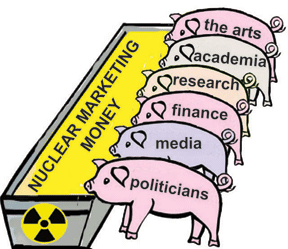
Energy Live News 29th June 2018 , China’s largest nuclear power producer has signed a Memorandum of
Understanding (MOU) with the UK Nuclear Advanced Manufacturing Research
Centre (Nuclear AMRC) to help deepen its links with Britain’s supply
chain.
CGN, the developer of the Bradwell B project, hopes to develop its
expertise and knowledge, as well as improve commercial and academic
connections. The wide-ranging deal includes working out how UK businesses
and universities can prepare themselves to participate in the project and
how these organisations can add value to CGN’s nuclear operations in
China and elsewhere.
https://www.energylivenews.com/2018/06/29/cgn-signs-mou-to-deepen-links-with-uks-nuclear-supply-chain/
Plan to save nuclear reservoir at Winfirth from “collapse”
Dorset Echo, Richard Percival, 1 July 18
Germany’s biggest utility E.ON to merge with its biggest competitor RWE
Energy Post 26th June 2018 , It came as a great surprise to me some weeks back that Germany’s biggest
utility E.ON reached an “agreement in principle” with its biggest
competitor RWE to acquire its grid and retail business Innogy via a
wide-ranging “exchange of assets,” including RWE taking over the
renewables and other power generation businesses of E.ON.
The result, if the various competition authorities and regulators allow the deal to take
place, will be the biggest European grid company and energy retailer in the
form of E.ON, with RWE becoming the second biggest power generator in
Europe and third biggest owner of renewable assets. In addition, as part of
the deal, RWE will keep a minority stake in E.ON which ties the companies
together.
http://energypost.eu/trying-to-make-sense-of-the-rwe-eon-utility-deal/
Costs of UK’s Nuclear Decommissioning Authority: call for submissions by July 10
Public Accounts Committee 29th June 2018 , A new report by the National Audit Office into the NDA found that work at
Sellafield accounted for 61% of the NDA’s total £3.3 billion expenditure
in 2017–18. 8 of NDA’s 10 most hazardous sites are at Sellafield,
whilst NAO expected current major projects at Sellafield will cost £6
billion total.
The NAO found that the NDA had made significant progress in
reducing delays and meeting significant milestones, but expects major NDA
projects to cost more than originally estimated in 2015.
Evaluating performance at Sellafield remained difficult due to the complexity and
scale of the site, but more could be done to explain progress, and to
provide assurance of major projects. The Committee will take evidence from
the Department of Business, Energy and Industrial Strategy, the Nuclear
Decommissioning Authority, and Sellafield to explore NDA and Sellafield’s
progress and performance. If you wish to submit written evidence to this
inquiry, the deadline to do so is midday on Tuesday 10 July.
https://www.parliament.uk/business/committees/committees-a-z/commons-select/public-accounts-committee/inquiries/parliament-2017/nuclear-decommissioning-authority-17-19/
Questions on whether Saudi Arabia plans for nuclear weapons
Analysis: Israeli regime backs Saudi nuclear ambitions: Tactic or Strategy?, July 1, 2018 – (AhlulBayt News Agency) – On Tuesday, the Israeli Energy Minister Yuval Steinitz said that Tel Aviv will support Saudi Arabia’s entry to the club of nuclear states if Riyadh signs the treaty preventing nuclear weapons proliferation, NPT.
Steinitz, addressing World Gas Conference in Washington, said that the Israeli regime supports the development of nuclear power in the Arab kingdom if it includes the gold standard protections and if the kingdom purchases uranium from the US.
The remarks on the Saudi nuclear ambitions on the one hand signal the sensitivity and significance of a nuclear Saudi Arabia in the Israeli security strategy and on the other hand carry hallmarks of an eased tone of Tel Aviv on Riyadh’s nuclear ambitions after the Arab monarchy showed a will to support Arab-Israeli diplomatic normalization efforts. Saudis are winning the Israeli positive stance as they are deeply engaged in an endeavor to pave the way for the “deal of the century” on al-Quds (Jerusalem) through putting strains on the Palestinians to bow.
The oil-rich Arab monarchy has designed ambitious plans to develop the nuclear energy as part of a futuristic roadmap. A royal decree issued in 2010 by then-King Abdullah led to setting up a nuclear power and renewable energies research center, dubbed (KA-Care), in the capital Riyadh. The facility was meant to suggest solutions to address energy and water needs of the country in the future. A year later, the center announced the kingdom aims to build 16 nuclear reactors to produce about 20 percent of its electricity by 2032.
The nuclear roadmap resulted in nuclear cooperation agreements with a series of nuclear technology holders, including France, Argentina, South Korea, and Kazakhstan. According to the deals, Saudi Arabia will see its nuclear industry fully operational and production-ready by 2040. In June 2017, Prince Mohammed bin Salman replaced Prince Mohammad bin Nayef as crown prince. The young crown prince very soon started his motion to get the US green light and technology allowing the Saudis to enrich the uranium on their soil. Media reports suggested that nuclear cycle acquisition was a top case in the prince’s negotiations with the American officials during his March visit to the US.
Despite the Saudi show of desire to become a nuclear state, some factors affect the nuclear technology acquisition possibility: The argument on the type of nuclear power use, Tel Aviv’s role-playing in this course, and the Israeli insistence on keeping its military superiority in the region through nuclear weapons monopoly.
Now a question presents itself: Is the Israeli compromise to the Saudi nuclear ambitions a fruit of Prince Mohammed-led pro-normalization policy, concession to the Israelis, and turning a blind eye to US embassy relocation to al-Quds at the price of the Palestinian cause?
…….. Another reason for Saudi Arabia to move towards developing nuclear arms is its military weakness and vulnerability caused by its geopolitical position. With its 2.15 million square kilometers of area size, Saudi Arabia is a big country. The capital is in the center, but the income sources and facilities, like oil facilities, are located on the Persian Gulf and the Red Sea coasts, hence being an easy target for military action from air and sea. The failure to win a war waged against Yemen in 2015 after three years has exhibited the Saudi military weakness.
But Saudi nuclear ambitions are unlikely to materialize despite Riyadh’s compliance with the Western and Israeli interests in the Palestinian dispute. An unclear Saudi future caused by the fragility of the Al Saud family rule prevents a US go-ahead to nuclear technology acquisition.http://en.abna24.com/news/comment/analysis-israeli-regime-backs-saudi-nuclear-ambitions-tactic-or-strategy_899893.html
In France a captured Islamic State jihadist talks of a terrorist plot to attack a nuclear power plant.
Breitbart 30th June 2018 ,Captured Islamic State jihadist Jonathan Geffroy has made even more
startling revelations, claiming terrorists buried multiple Kalashnikov
rifles around the city of Toulouse, France and plotted to attack a nuclear
power plant.
https://www.breitbart.com/london/2018/06/30/captured-french-islamic-state-fighter-reveals-buried-kalashnikovs-plot-to-attack-nuclear-power-plant/
Vermont Yankee nuclear power station water cost: $6M and counting
Vermont Yankee water cost: $6M and counting, VT Digger, By Mike FaherJul 1 2018,
Nuclear energy on the decline, especially in developed countries
Modern Diplomacy 29th June 2018 ,For more than 40 years, nuclear energy has been an important contributor in
several countries to energy security and a key source of zero-emissions
generation.
But the future of nuclear energy is facing growing challenges,
increased competition with renewables and gas and, in some cases, public
opposition. With the aim of identifying the key issues and exploring the
future of nuclear power, the International Energy Agency (IEA) held a
high-level meeting in Paris yesterday titled “Nuclear Energy: Today and
Tomorrow.”
The sessions highlighted how, under current policy frameworks,
and with limited investment in new plants, the contribution of nuclear to
the power mix in mature markets is set to decline significantly. Most new
construction is in Asia, with China and India accounting for over half of
the new reactors under construction. In IEA’s World Energy Outlook New
Policies Scenario, nuclear power production grows with two countries, China
and India, responsible for over 90 percent of net growth to 2040.
By contrast, outside of Japan, nuclear power generation in developed economies
is set to decline 20 percent by 2040. The meeting also heard about new
initiatives to advance innovative nuclear power technologies, including
those that can address better the need for greater power systems
flexibility, spurred by the rise of generation from variable renewables.
https://moderndiplomacy.eu/2018/06/29/iea-holds-high-level-meeting-on-the-future-of-nuclear-power/
James Hansen – a prophet on climate change, but a crank on nuclear power
James Hansen and the whale, a tragi-comedy in four chapters, The Reality Based Community, By
“………..[James Hansen] he said :
Nuclear, especially next-generation nuclear, has tremendous potential to be part of the solution to climate change. The dangers of fossil fuels are staring us in the face. So for us to say we won’t use all the tools [such as nuclear energy] to solve the problem is crazy.
These crucial policy and technical developments were the fruit of a fairly small number of enterprising, determined and lucky individuals. They included:
- Researchers on solar: Becquerel, Willoughby Smith, Fritts, Einstein, Czochralski, the Bell Labs team of Chapin, Fuller, and Pearson. On wind: Poul La Cour and Johannes Juul in Denmark. On batteries: John Goodenough, who coming up to his 96th birthday still unprized in Stockholm, has just announced a research breakthrough on a high-density solid-state lithium battery.
- Politicians and bureaucrats: NASA in the 1960s, MITI in the 1970s; Hans-Josef Fell and Hermann Scheer, leaders of the Energiewende in Germany and instigators of the 2000 Renewable Energy Act (EEG); Jerry Brown of California; Barack Obama (through targeted ARRA funding and the bilateral deal with China that made Paris possible).
- Businessmen: Tokuji Hayakawa of Sharp in Japan; Elon Musk of Tesla; Wang Chuanfu of BYD.
This is an incomplete list, and no doubt unfair from my lack of knowledge. But it is near-certain that without these 18, and the then leaders of MITI and NASA, renewable energy and electric transport would not be where they are today.
The challenge also induced a lot of effort on enhanced geothermal, wave energy, OTEC, power kites, fuel cell cars, and other ideas that have not so far panned out. Nobody knows in advance which ideas will work out, and the failures also deserve their share of praise….. http://www.samefacts.com/2018/07/everything-else/james-hansen-and-the-whale-a-tragi-comedy-in-four-chapters/

TEPCO aims to build more Fukushima-type nuclear reactors, vows to ‘excel in safety’ this time

Fuel removal from Fukushima reactor may be delayed

Mayor of Namie, near shuttered Fukushima nuclear plant, dies at 69

1 This Month
Chernobyl: The Lost Tapes – A good documentary on Chernobyl on SBS available On Demand for the next 3 weeks– https://www.sbs.com.au/ondemand/tv-program/chernobyl-the-lost-tapes/2352741955560

of the week–London Campaign for Nuclear Disarmament

Tell the Ukrainian Government to Drop Prosecution of Peace Activist Yurii Sheliazhenko
To see nuclear-related stories in greater depth and intensity – go to https://nuclearinformation.wordpress.com
-
Archives
- April 2026 (189)
- March 2026 (251)
- February 2026 (268)
- January 2026 (308)
- December 2025 (358)
- November 2025 (359)
- October 2025 (376)
- September 2025 (257)
- August 2025 (319)
- July 2025 (230)
- June 2025 (348)
- May 2025 (261)
-
Categories
- 1
- 1 NUCLEAR ISSUES
- business and costs
- climate change
- culture and arts
- ENERGY
- environment
- health
- history
- indigenous issues
- Legal
- marketing of nuclear
- media
- opposition to nuclear
- PERSONAL STORIES
- politics
- politics international
- Religion and ethics
- safety
- secrets,lies and civil liberties
- spinbuster
- technology
- Uranium
- wastes
- weapons and war
- Women
- 2 WORLD
- ACTION
- AFRICA
- Atrocities
- AUSTRALIA
- Christina's notes
- Christina's themes
- culture and arts
- Events
- Fuk 2022
- Fuk 2023
- Fukushima 2017
- Fukushima 2018
- fukushima 2019
- Fukushima 2020
- Fukushima 2021
- general
- global warming
- Humour (God we need it)
- Nuclear
- RARE EARTHS
- Reference
- resources – print
- Resources -audiovicual
- Weekly Newsletter
- World
- World Nuclear
- YouTube
-
RSS
Entries RSS
Comments RSS
 nuclear-news