Vogtle nuclear power station in Georgia, only half completed, and 7 years behind schedule
 Saporta Report 24th May 2018, A new report on the construction status of the Vogtle nuclear plant,
released Wednesday by Moody’s Investors Service, provides greater detail
than a May 10 statement released by Georgia Power and cites a number of
risks that could further delay the plant’s opening date. Moody’s report
addresses a list of frequently asked questions about the Vogtle project as
it relates to MEAG, the Municipal Electric Authority. MEAG is a partner in
the Vogtle project, along with Georgia Power, Oglethorpe Power Corp., and
the City of Dalton Combined Utility. The first sentence of Moody’s report
observes: “Construction is progressing on the Vogtle Nuclear Units 3 and
4 in Georgia, offering additional credit stability to the owners of the
units, though the work is still only around 50 percent completed and is
several years behind the original schedule.”
Delay in start-up for United Arab Emirates nuclear reactor, marketed by South Korea
 UAE’s first nuclear reactor start-up delayed, MEMO, May 27, 2018
Jordan drops plans for large nuclear reactors, will try small ones from Russia
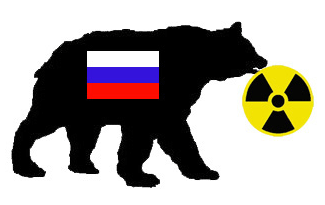 Jordan Settles for Smaller Russian Nuclear Reactor by 2022 May 27th, 2018 via SyndiGate.info
Pennsylvania nuclear lobby hoping for nuclear industry salvation via Tax-payer funding

 Nuclear plants hope not to close, The Daily Item, By John Finnerty CNHI Harrisburg reporter, May 26, 2018, HARRISBURG — New Jersey Gov. Phil Murphy signed into law this week a $300 million Zero Emissions Certificate program intended to prop up the state’s nuclear power plants.
May 27 Energy News

Opinion:
¶ “The Silence of the Bugs” • Fifty-six years after Rachel Carson’s “Silent Spring” warned of bird die-offs from pesticides, a new biocrisis may be emerging. A study published last fall, showing a 76% decline in the total seasonal biomass of flying insects netted at 63 locations in Germany over the last three decades, tells only part of the story. [The New York Times]
 Artwork by Enzo Pérès-Labourdette
¶ “Climate Change Canaries and Our Changing Climate” • While some disagree over its causes, the reality of climate change is an incontrovertible fact. The planet is warming, affecting our weather and our oceans. Our growing seasons are affected, in turn having effects on our food. Crops fail, causing shortages and price hikes. [The Market Oracle]
¶ “Electric Buses A Crucial Portion Of Our Mobility Needs” • So far, the electric news limelight has been around electric…
View original post 758 more words
Novel Method of Quantifying Radioactive Cesium-Rich Microparticles (CsMPs) in the Environment from the Fukushima Daiichi Nuclear Power Plant

Fukushima-Daiichi radioactive particle release was significant says new research

Nuclear issue again takes center stage in Niigata election

Cattle return to graze in Fukushima village for 1st time since nuke plant meltdowns

The week in nuclear, climate, environment news
 Back to the brink, as Donald Trump cancels the North Korea-USA Summit? Optimistic commentators rattle on about how this could turn out better. It’s deeply disappointing for South Korea’s President Moon who has tried so hard to defuse the tensions. Trump has been a failure as a negotiator, – seems aimed at wrecking international agreements – climate, Iran, North Korea …. Meanwhile, all nuclear powers, but America in particular are doing a feeding frenzy on nuclear weapons spending. USA excels in illogic, with USA National Nuclear Security Administration (NNSA) plan for unsafe and unnecessary production of plutonium pits (nuclear weapons triggers), – of which they already have a glut.
Earth’s climate could increase by 4 °C, compared to pre-industrial levels, before the end of 21st century.
I just had to put “environment” in the headline today. Of course, everything is connected anyway, but – what’s happening to the world’s insects? There’s a dramatic decline in insect numbers, the world is losing species. Is it due to climate change? Is it due to electromagnetic radiation causing disorientation in them? 5 G networks soon, Wow! Oh heck – insects are only little. They don’t matter. OR DO THEY?
The very real and very serious danger of nuclear reactor accidents in space. Cosmic radiation will damage the brains of space travellers.
NORTH KOREA. North Korea destroys its nuclear weapons site.
SOUTH KOREA. Korean women lead the peace movement , supported by international delegation of women.
IRAN. Iran negotiating with Europe to stay in the 2015 Joint Comprehensive Plan of Action (JCPOA)
CHINA. China lands nuclear strike bombers on South China Sea islands. Uncertainty about China‘s nuclear power future.
JAPAN. New research reveals significant Fukushima radioactive particle release. Storage capacity for radioactive water at Fukushima power plant nears limit. Japan’s government weighs dumping radioactive Fukushima water into the Pacific. Radiation monitors in Fukushima to be scrapped after malfunctioning to the tune of ¥500 million a year. Hiroshima bomb survivor Setsuko Thurlow continues her fight for a nuclear free world. Air duct corrosion and holes found at seven nuclear plants.
UK. Britain’s big future nuclear power plans hang on government subsidising Hitachi. UK short of funds for its £51bn nuclear defence programme. Many years before massive nuclear power station could be built at Bradwell. Hitachi’s build of Wylfa nuclear power station delayed – may never happen. UK’s contentious new arrangement for nuclear safeguards, following exit from Euratom. Toxic radioactive mud dumping is a toxic issue for Wales. Scotland’s ambitious target for 100% renewable energy.
CANADA. Ontario NDP only party speaking out against nuclear waste bunker near Lake Huron.
USA.
- USA Congress rejects move to limit new low-yield nuclear weapon. F-35 bombers to get B61 Mod 12 nuclear weapon. USA and others start a new desperate push to promote nuclear power.
- Call to White House to oppose Saudi Arabia’s threat to acquire nuclear weapons.
- Trump’s reckless propping up of the nuclear industry pleases its big lobbyists. Trump’s lawyer Cohen opens doors for Alabama nuclear developer Haney. Huge corporate subsidy to be given by New Jersey Governor to nuclear industry. Nuclear industry’s big gamble on going small – but it mightn’t work!
- Solar and Wind Subsidies are a Clear Success. The Coal and Nuclear Industries Just Aren’t Ready to Admit it.
- USA Department of Veterans Affairs conveniently lost hundreds of claims for children, grandchildren of contaminated veterans. Missouri legal case – claim that cancer caused by Manhattan Project.
- Fraudulent radioactive data management at San Francisco’s Hunters Point. SCE and G misled lawmakers about critical nuclear report.
- Mox plutonium reprocessing plant has been a huge waste of U.S. taxpayers’ money.
AUSTRALIA. Will Australia’s Prime Minister Turnbull cave in to USA pressure for Australia to join in USA efforts against Iran ?
SAUDI ARABIA. USA’s Pentagon speeds up weapons sales to Saudi Arabia. Saudi government will not be able to silence courageous women activists. -Saudi Arabia arrests 11 human rights activists as “traitors”.
GERMANY. German government to compensate utilities over the phaseout of nuclear power.
SOUTH AFRICA. Eskom ‘abandoned’ plans to build a nuclear power station in the Eastern Cape – but is paying R16.5 million to keep it alive.
PHILIPPINES. Philippines consider nuclear revival, but active earthquake fault poses danger.
Trump’s incompetence at negotiation, his year of failures, bring the world closer to conflicts
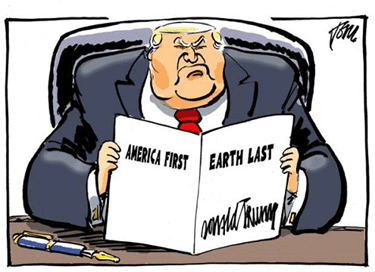 Trump’s nuclear failures from Iran to North Korea
In just over a year, Donald Trump has managed to nudge the world closer to conflict on both ends of the Asian continent. Aljazeera, by Richard Javad Heydarian 25 May 18
The American president vaguely cited North Korea’s “open hostility” and “trail of broken promises” as a pretext for calling off the historic meeting. Not short of bluster, he warned the North Korean regime against committing any “foolish or reckless acts”.
Trump has placed the American military on alert, signalling its readiness to engage in another round of brinkmanship with nuclear-capable North Korea.
And just like that, both protagonists are now back to square one. If anything, the American president may have snuffed the life out of an unprecedented opportunity to end the Korean conflict.
Just weeks earlier, the US unilaterally withdrew from the Iranian nuclear deal – a binding international agreement supported by all major powers, except Trump. To careful observers, both decisions were shocking, yet far from surprising.
The Trump administration simply lacks the basic strategic understanding and diplomatic finesse to cope with perplexing foreign policy challenges. When confronted with difficult geopolitical realities, Trump seems to prefer turning things into reality show episodes.
An unreliable superpower
Trump’s announcement was met by a melange of puzzlement, outrage and profound anxiety across the world. South Korea responded in total confusion, struggling to find a way out of the latest plot twist in the Trump-Kim saga.
South Korean presidential spokesman Kim Eui-kyeom admitted, “We are attempting to make sense of what, precisely, President Trump means.”
The visibly flustered South Korean President Moon Jae-in, who played an instrumental role in facilitating the summit, was confessedly “perplexed“. He described Trump’s decision as deeply “regrettable”.
……. Moon staked his presidency on unlocking the Korean conflict. In an event of actual war, Seoul, which lies within the range of North Korean artilleries, would likely be the first and biggest victim.
…..frustration is running high among allies. In recent days, German Chancellor Angela Merkel, the de facto leader of the “free world”, went so far as stating that Europe can no longer rely on the US as a source of protection.
One by one, the US’ most important allies have openly questioned the Trump administration’s capacity for global leadership. For them, Washington is an increasingly unreliable superpower, which is beginning to threaten the existing international order with “Trump-style” leadership.
Edging towards conflict
Interestingly, North Korea responded with uncharacteristic restraint, expressing its continued “willingness to sit at any time, in any way to resolve issues”. All of a sudden, Pyongyang looked like the adult in the room.
Yet, it’s hard to imagine that the regime would maintain its equanimity for long………..
The upshot is that both Iran and North Korea now feel betrayed and increasingly outraged. And they will likely up the ante in response to Trump’s perfunctory decisions.
A year into power, the controversial American president has nudged the world closer to two potential conflicts on the opposite ends of the Asian continent.
More fundamentally, countries around the world, both friends and foes, are wondering whether the US is a country that can be negotiated with at all. https://www.aljazeera.com/indepth/opinion/trump-nuclear-failures-iran-north-korea-180525102228377.html
Korean women lead the peace movement , supported by international delegation of women
Seventy Years After Korea’s Division, Women Lead Push for Peace Truthout, May 25, 2018By Jon Letman, When scores of Korean women representing a coalition of some 30 peace groups and NGOs entered South Korea’s National Assembly on the banks of Seoul’s Han River, they weren’t alone. This week, the Korean peace makers were joined by an international delegation of women peace activists for a symposium focused on ending the Korean War. A women’s peace walk along the Korean Demilitarized Zone (DMZ) is scheduled for May 26.
For the fourth time since 2015, these activists gathered to strategize how to most effectively advance peace on the Korean Peninsula and support diplomatic efforts to that end. #WomenPeaceKorea delegates’ efforts include engaging with South Korean government officials, foreign diplomats and US embassy officials.
Most of the international delegates are members of Women Cross DMZ and the Nobel Women’s Initiative who have traveled to Seoul to lend their support and raise awareness of the vital role women play in ending conflict.
Multiple studies have shown that when women participate in negotiations, the likelihood of achieving peace increases substantially and that peace lasts longer.
Ahn Kim Jeong-ae, one of the symposium’s organizers, said the diplomatic thaw between North and South Korea makes this week’s events even more crucial.
Ahn Kim noted that 2018 marks the 70th anniversary of the establishment of separate governments in Seoul and Pyongyang. This spring was also the 70th anniversary of the April 3 incident in which some 30,000 civilians on South Korea’s Jeju Island were massacred over a seven-year period when US military-backed right-wing forces violently purged opponents of a divided and occupied Korea.
“We want to commemorate these historical facts on May 24, International Women’s Day for Disarmament and Peace,” Ahn Kim said, noting that because women suffer disproportionately in war, they have a critical role to play in conflict resolution.
A Change in Tone
Christine Ahn is the international coordinator for Women Cross DMZ, which crossed from North to South Korea in 2015. She said the fact that this year’s symposium was held at the National Assembly (the South Korean equivalent of the US Congress), was “hugely significant.”
Unlike in 2015, when Women Cross DMZ was barely acknowledged by South Korea’s Ministry of Unification, this year’s symposium was financed by the South Korean Ministry of Gender, Equality and Family, Ahn said.
The difference reflects a dramatic change from the administration of deposed South Korean President Park Guen-hye to the progressive administration of current President Moon Jae-in, who favors engagement with the North.……..http://www.truth-out.org/news/item/44590-seventy-years-after-korea-s-division-women-lead-push-for-peace
Britains big future nuclear power plans hang on government subsidising Hitachi

 UK nuclear plans ‘risk collapse if Hitachi talks fail’https://www.theguardian.com/environment/2018/may/25/new-uk-nuclear-power-plants-hinge-on-deal-between-hitachi-and-government– Adam Vaughan
Japanese group believed to be demanding direct financial support with consumers making up the difference.
Britain’s hopes for a number of new nuclear power stations could collapse if the government and the Japanese conglomerate Hitachi fail to make a breakthrough on talks for a plant in Wales, a top nuclear lobbyist has warned.
Hiroaki Nakanishi, the firm’s chairman, met Theresa May earlier this month, to press the prime minister for financial support for two reactors at Wylfa on the island of Anglesey.
The company’s board is understood be meeting on Monday to decide whether it can proceed with the UK’s subsequent offer, believed to include a multibillion-pound loan.
Tim Yeo, chairman of the industry-backed group New Nuclear Watch Europe, said the outcome of the negotiations had huge consequences for other international firms hoping to build reactors in Britain.
“If Hitachi walk away from Wylfa that probably spells the end of new nuclear in the UK,” he said.
The 3GW plant at Wylfa by the Hitachi subsidiary Horizon Nuclear Power would be the UK’s second new nuclear power station after EDF Energy’s Hinkley Point C, under construction in Somerset.
More are planned: EDF wants to build at Sizewell on the Suffolk coast, South Korea’s Kepco at Moorside in Cumbria and China’s CGN at Bradwell in Essex, with EDF’s help.
Hitachi wants to build abroad because of a moribund home market,
while the UK government sees nuclear as an important source of low-carbon power.
Despite the protracted discussions between the two parties, London appears to still be committed to making the economics of nuclear work.
“I sense there’s still a lot of political will to make new nuclear happen from government, and backbenchers seem to want it in their areas,” a Whitehall source said.
An industry source said the deal would work if the government offered some form of financial support directly, while energy bill payers footed the rest through a subsidy known as a contract for difference.
That would mean Hitachi receiving a guaranteed price of power, likely to be around £80 a megawatt hour, lower than Hinkley’s £92.50 but still nearly twice the wholesale cost of electricity.
The Department for Business, Energy and Industrial Strategy (BEIS) is understood to be enthusiastically backing the project, while the Treasury, which would have to see an equity contribution or loan for the construction period on government books, is more sceptical.
Paul Dorfman at the Energy Institute at University College London said: “This would mean the hardworking UK taxpayer and energy consumer, who are labouring under ramping austerity, are being asked to stump up for an extraordinarily expensive nuclear plant just at the time that renewable costs are plummeting.”
Japanese media have reported the UK government’s loan for the project could be as much as £13bn, and put the total cost of the plant at more than £20bn, even more than Hinkley Point C. The details are understood to have been leaked by the Japanese government, not Hitachi, and the UK government has said it “does not recognise” the reports.
Greenpeace said the UK was wrongly pursuing a “dinosaur” technology and should focus on renewables, batteries and interconnectors to other countries.
Kate Blagojevic, the group’s head of energy, said: “It’s unacceptable the Japanese public are hearing about this before the British public, if what we’re hearing is true that over £13bn of British taxpayer money is going to a Japanese company to build a plant in Wales.
“It’s pretty outrageous the government hasn’t been upfront about what they’re proposing and why.”
A spokesperson for BEIS said: “These discussions are commercially sensitive and we have no further details at this time.”
A Horizon spokesperson said: “It’s no secret we’re in discussions with the UK and Japanese governments, and have been for some time, over support for our project. With these discussions still ongoing it is too early to comment on the specifics of what a future deal may look like.
“We’re confident, given the strategic importance of our project to both nations, we’ll reach a successful conclusion to these discussions in the near future.”
Iran negotiating with Europe to stay in the 2015 Joint Comprehensive Plan of Action (JCPOA)
Iran asks Europe what it can offer to keep it in the nuclear deal after U.S. pullout, WP, By Michael BirnbaumMay 25 Email the author
VIENNA — Iran will decide within weeks whether to stay in a faltering deal to restrain its nuclear program and is pressing Europe to compensate for President Trump’s decision to reimpose sanctions, a senior Iranian official said Friday.
The official warned that Tehran could also pull out from a separate treaty that limits the spread of nuclear weapons.
The caution came ahead of the first talks involving all the remaining parties to the landmark 2015 deal since the United States pulled out this month.
An official report Thursday declared that Iran is still in compliance with the stringent controls on its nuclear program.
Iran has long declared that its program is limited to the peaceful generation of nuclear energy and production of medical isotopes. If it were to pull out of the 2015 Joint Comprehensive Plan of Action (JCPOA) and the 1970 Treaty on the Nonproliferation of Nuclear Weapons (NPT) and seek nuclear weapons, it could spark an arms race in the already volatile Middle East.
The United States and Israel have also warned that an Iranian nuclear weapons program would be countered with force……….https://www.washingtonpost.com/world/europe/iran-asks-europe-what-it-can-offer-to-keep-it-in-the-nuclear-deal-after-us-pullout/2018/05/25/f0e8be70-6011-11e8-8c93-8cf33c21da8d_story.html?utm_term=.74b34870a29f
1 This Month

of the week – Shut Down Drone Warfare!


Tell the Ukrainian Government to Drop Prosecution of Peace Activist Yurii Sheliazhenko

Petition to revoke the licensing of the Near Surface Nuclear Disposal Facility (NSDF) at Chalk River. https://www.ourcommons.ca/petitions/en/Petition/Details?Petition=e-7247
To see nuclear-related stories in greater depth and intensity – go to https://nuclearinformation.wordpress.com
-
Archives
- April 2026 (79)
- March 2026 (251)
- February 2026 (268)
- January 2026 (308)
- December 2025 (358)
- November 2025 (359)
- October 2025 (376)
- September 2025 (257)
- August 2025 (319)
- July 2025 (230)
- June 2025 (348)
- May 2025 (261)
-
Categories
- 1
- 1 NUCLEAR ISSUES
- business and costs
- climate change
- culture and arts
- ENERGY
- environment
- health
- history
- indigenous issues
- Legal
- marketing of nuclear
- media
- opposition to nuclear
- PERSONAL STORIES
- politics
- politics international
- Religion and ethics
- safety
- secrets,lies and civil liberties
- spinbuster
- technology
- Uranium
- wastes
- weapons and war
- Women
- 2 WORLD
- ACTION
- AFRICA
- Atrocities
- AUSTRALIA
- Christina's notes
- Christina's themes
- culture and arts
- Events
- Fuk 2022
- Fuk 2023
- Fukushima 2017
- Fukushima 2018
- fukushima 2019
- Fukushima 2020
- Fukushima 2021
- general
- global warming
- Humour (God we need it)
- Nuclear
- RARE EARTHS
- Reference
- resources – print
- Resources -audiovicual
- Weekly Newsletter
- World
- World Nuclear
- YouTube
-
RSS
Entries RSS
Comments RSS
 nuclear-news