Yes Virginia, reactor-grade plutonium can be used to make nuclear weapons
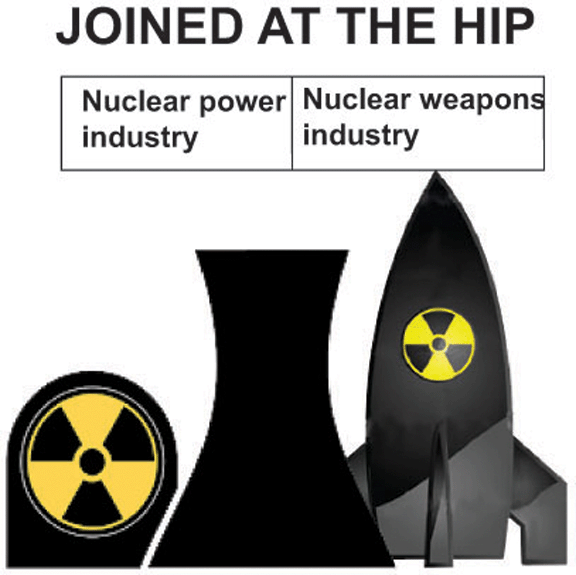
NPEC 20th April 2018 , In Reactor-Grade Plutonium and Nuclear Weapons: Exploding the Myths,
long-time defense analyst Gregory S. Jones draws from his decades of
research using publicly available, unclassified information to debunk the
persistent fallacy that reactor-grade plutonium cannot be used to build
reliable nuclear weapons. This belief has long been held by a segment of
the nuclear power industry determined to use plutonium as reactor fuel
despite its highly uneconomical nature. Further, this mistaken belief has
made reactor-grade plutonium readily available to many non-nuclear weapon
states.
http://www.npolicy.org/thebook.php?bid=37
Belgium’s move away from nuclear power – now pushing offshore wind parks
Reuters 20th April 2018, Belgium will double the area of its North Sea waters made available to
offshore wind parks after 2020, the government announced on Friday, as part
of its exit strategy from nuclear power. The country has four offshore wind
parks that produce 871 megawatts of power and wants to increase that
capacity to 2.2 gigawatts by 2020 and to 4 gigawatts by 2030. After 2020,
the government plans to designate a new, 221-square-kilometre (85 square
miles) area near French waters.
https://uk.reuters.com/article/us-belgium-renewables/belgium-to-double-offshore-wind-energy-capacity-as-it-exits-nuclear-power-idUKKBN1HR1U3?rpc=401&
Prof. Mark Jacobson – new research for 100% global renewable energy
Environmental Research Web 21st April 2018 , Dave Elliott: Prof. Mark Jacobson and his team at Stanford University got some flack for their 100% global renewable energy study last year. It said
139 countries around the world could obtain 100% of their energy from wind,
water and solar (WWS) sources by 2050.
It had been based on their 2015
study that examined the ability of 48 US states to meet all their energy
needs stably from these renewables. Some said their approach was flawed,
and, for example, relied too heavily on energy storage solutions and on
adding turbines to existing hydroelectric dams to get extra power.
In response, Jacobson and colleagues at Stanford, the University of California
at Berkeley and Aalborg University in Denmark have now produced a new
study, focusing on 20 global regions encompassing the 139 countries, with
supply and demand matching modelled for a range of storage/backup options
over the period 2050-54.
The team is adamant that there would be no major
problems with balancing. They note that many previous studies had examined
matching time-dependent demand with supply for up to 100% renewable
electricity and some has looked at all-energy matching. All had found that
‘time-dependent supply can match demand at high penetrations of renewable
energy without nuclear power, natural gas, or fossil fuels with carbon
capture’. So had they.
But they claim to have added more certainty: in
their new scenarios they say ‘100% of all end-use energy, rather than
100% of just electricity (which is ~20% of total end use energy), is
decarbonized’ with balancing solutions found ‘by considering many
storage options, namely heat storage in rocks and water; cold storage in
water and ice; electricity storage in CSP-storage, pumped hydropower,
existing hydropower reservoirs, and batteries; and hydrogen storage; and by
considering demand response and, in one scenario, heat pumps’.
Japan ‘covering up’ Fukushima nuclear danger-zone radiation levels and blackmailing evacuees to return to radiated areas swarming with radioactive pigs and monkeys

Three reactors went into meltdown after the 2011 Japanese tsunami in the worst accident since Chernobyl, leaving an apocalyptic vision of ghost towns and overgrown wildernesses and scared residents refuse to return
JAPAN is lying to the world about nuclear-ravaged Fukushima’s recovery while forcing terrified evacuees to return to their radioactive homes, it is claimed.
More than seven years after the nuclear catastrophe rocked the world, many of the 154,000 people who fled their homes have not returned and towns remain deserted.
Thousands of irradiated wild boars and monkeys roam around while poorly paid and protected decontamination workers scrub homes, schools and shops down ready for people to come home.
Chilling footage of taken inside the evacuated areas of Fukushima City and Köryama lay bare the disaster that unfolded after an earthquake, measuring 9.01 on the Moment Magnitude scale, struck off the coast of Japan on March 11, 2011.
But it was the following 50ft tsunami that damaged reactors at the Fukushima nuclear power plant.
This led to the evacuation of thousands of people from a 12-mile exclusion zone, with roads guarded by roadblocks and officials in protective gear.
Now there is a big campaign is under way to make people return but residents, campaigners and experts believe it not safe.
They accuse the Japanese authorities of wanting to allay public fears over the nuclear power by downplaying the dire consequences of the leak.
Propaganda videos showing the remarkable recovery of Fukushima have been spread by the government on its social media accounts.
“Since the Great East Japan Earthquake in 2011, #Fukushima has been working towards a bright future.
Strict safety standards and monitoring means that #food from the prefecture is enjoyed all over #Japan.” See Fukushima’s amazing recover in this video:http://bit.ly/2CqP0HC
But senior nuclear specialist Shaun Burnie, from Greenpeace Japan, said the nuclear nightmare continues.
He said: “They are not telling the whole truth either to the 127 million people of Japan or to the rest of the world – about the radiation risks in the most contaminated areas of Fukushima.
“The nuclear crisis is not over – we are only in year seven of an accident that will continue to threaten public health, and the environment, for decades and well into the next century.
“Attempts by the government and the nuclear industry communicate that it is safe and it’s over are a deliberate deception.”
Most of Japan’s power plants shut in the wake of the Fukushima nuclear disaster.
But in 2015 the Prime Minister announced plans to restart reactors because the economy needed cheap energy and using fossil fuels risked huge carbon emission fines.
Now five of them are back on – and it’s aimed to to have at least 12 in use by 2025.
The nuclear crisis is not over – we are only in year seven of an accident that will continue to threaten public health, and the environment, for decades and well into the next century (Senior nuclear specialist Shaun Burnie)
Mr Burnie said: “If they can create the illusion of the region that that has recovered from the nuclear accident they think it will reduce public opposition.”
But meanwhile the crisis continues at the Fukushima plant.
He said: “The massive Ice Wall built at the nuclear plant to stop contamination of groundwater is a symbol of this failure and deception – this is no Game of Thrones fantasy but the reality of a nuclear disaster that knows no end.”
Today he says “there were areas of Fukushima where radiation levels could give a person’s maximum annual recommended dose within a week.”
He said: “This is of particular concern with regards to poorly paid decontamination workers, thousands of whom have been involved in attempts to decontaminate radiation around people’s homes, along roads and in narrow strips of forest.”
Mr Burnie said the government claims decontamination has been completed in 100 percent of affected areas after a £8bn clean up operation.
But he added: “What they don’t explain is that 70-80 percent of areas such as Namie and Iitate – two of the most contaminated districts – are forested mountain which it is impossible to decontaminate.
“In areas opened in March 2017 for people to return – radiation levels will pose a risk until the middle of the century.
“These areas are still to high in radiation for people to return safely – and is one reason so few people are returning.”
Meanwhile heavy-handed tactics are being used with some fearful residents reporting that they have been warned they won’t receive lifeline compensation cash if they don’t comply.
Dr Keith Baverstock, a radiation health expert who was at the World Health Organization at the time disaster, told Sun Online: “For the past two years the Japanese government has encouraged the evacuees to return to their homes, but relatively few people have taken up this offer, even though there is a threat – it may even now be a fact – that their compensation will cease.”
Japan Anti-Nuke Movement Seen Unscathed After Key Governor Quits

WTO rules in favor of Japan on South Korea’s post-Fukushima seafood ban

Using underpaid Foreign Trainees for Fukushima’s Decontamination

Niigata’s Prefecture Governor Resignation to Affect the Approval of Tepco’s Kashiwazaki-Kariwa Nuclear Plant Restart…

Earth Day and the climate message of the “hockey stick” graph
Earth Day and the Hockey Stick: A Singular Message https://blogs.scientificamerican.com/observations/earth-day-and-the-hockey-stick-a-singular-message/
On the 20th anniversary of the graph that galvanized climate action, it is time to speak out boldly
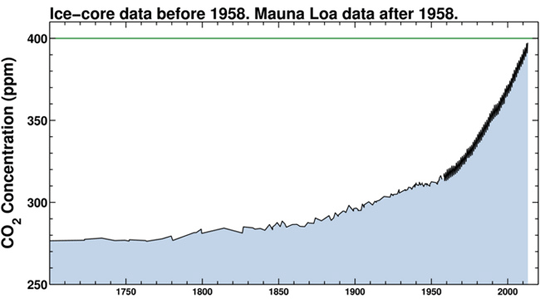
By Michael E. Mann on April 20, 2018 Two decades ago this week a pair of colleagues and I published the original “hockey stick” graph in Nature, which happened to coincide with the Earth Day 1998 observances. The graph showed Earth’s temperature, relatively stable for 500 years, had spiked upward during the 20th century. A year later we would extend the graph back in time to A.D. 1000, demonstrating this rise was unprecedented over at least the past millennium—as far back as we could go with the data we had.
Although I didn’t realize it at the time, publishing the hockey stick would change my life in a fundamental way. I was thrust suddenly into the spotlight. Nearly every major newspaper and television news networkcovered our study. The widespread attention was exhilarating, if not intimidating for a science nerd with little or no experience—or frankly, inclination at the time—in communicating with the public.
Nothing in my training as a scientist could have prepared me for the very public battles I would soon face. The hockey stick told a simple story: There is something unprecedented about the warming we are experiencing today and, by implication, it has something to do with us and our profligate burning of fossil fuels. The story was a threat to companies that profited from fossil fuels, and government officials doing their bidding, all of whom opposed efforts to reduce greenhouse gas emissions. As the vulnerable junior first author of the article (I was a postdoctoral researcher), I found myself in the crosshairs of industry-funded attack dogs looking to discredit the iconic symbol of the human impact on our climate…by discrediting me personally.
In my 2013 book, The Hockey Stick and the Climate Wars: Dispatches from the Front Lines, I gave a name to this modus operandi of science critics: the Serengeti strategy. The term describes how industry special interests and their facilitators single out individual researchers to attack, in much the same way lions of the Serengeti single out an individual zebra from the herd. In numbers there is strength; individuals are far more vulnerable.
The purpose of this strategy, still in force today, is twofold: to undermine the credibility of the science community, thus impairing scientists as messengers and communicators; and to discourage other researchers from raising their heads above the parapet and engaging in public discourse over policy-relevant science. If the aggressors are successful, as I have argued before, we all lose out—in the form of policies that favor special interests over our interests.
As the Serengeti strategy has been deployed against me, I have beenvilified on the editorial pages of The Wall Street Journal and other conservative media outlets, and subject to inquisitions by fossil fuel industry–funded senators, congressmen and attorneys general. My e-mails have been stolen, cherry-picked, taken out of context and broadcast widely in an effort to embarrass and discredit me. I have been subject to vexatious, open-records law requests by fossil fuel industry–funded front groups for my personal e-mails and numerous other documents. I have experienced multiple death threats and have endured threats against my family members. All because of the inconvenience my scientific findings posed to powerful and influential special interests.
Yet, in the 20 years since the original hockey stick publication, independent studies again and again have overwhelmingly reaffirmed our findings, including the key conclusion: recent warming is unprecedented over at least the past millennium. The highest scientific body in the U.S., the National Academy of Sciences, affirmed our findings in an exhaustive independent review published in June 2006. Dozens of groups of scientists have independently reproduced, confirmed and extended our findings, including a team of nearly 80 scientists from around the world who in 2013 published their finding in the premier journal Nature Geoscience that recent warmth is unprecedented in at least the past 1,400 years.
The latest report of the Intergovernmental Panel on Climate Change, the most authoritative and exhaustive assessment of climate science on the planet, concluded recent warmth is likely unprecedented over an even longer time frame than we had concluded. There is tentative evidence, in fact, that the current warming spike is unprecedented in tens of thousands of years.
Of course, the hockey stick is only one of numerous lines of evidence that have led the world’s scientists to conclude climate change is (a) real, (b) caused by burning fossil fuels, along with other human activities and (c) a grave threat if we do nothing about it. There is no legitimate scientific debate on those points, despite the ongoing effort by some people and groups to convince the public otherwise.
Their preferred tactic is to exaggerate the uncertainty in models that project where climate change is heading and argue such uncertainty is a cause for inaction, when precisely the opposite is the case. Arctic sea ice is disappearing faster than the climate models have predicted. The Greenland and Antarctic ice sheets appear prone to collapse sooner than we previously thought—and with that, estimates of the sea level rise we could see by the end of this century have doubled from previous estimates of about three feet to more than six feet. If anything, climate model projections have proved overly conservative; they are certainly not an exaggeration.
Scientists are finding other examples as well. In part as a result of our own work three years ago, there is an emerging consensus—as publicized in recent news accounts—that the “conveyor belt” of ocean circulation may be weakening sooner than we expected. The conveyor delivers warm waters from the tropics to the higher latitudes of the North Atlantic, supporting vibrant fish communities there and moderating climates in western Europe and eastern North America. The earlier melt of Greenland ice, it appears, is freshening the surface waters of the subpolar North Atlantic, inhibiting the sinking of cold, salty water that helps drive the conveyor.
When the hockey stick was first attacked in the late 1990s I was initially reluctant to speak out, but I realized I had to defend myself against a cynical assault on my science and on me. I have come to embrace that role. What more noble cause is there than to fight to preserve our planet for our children and grandchildren?
There is great urgency to act now if we are to avert a dangerous 2- degree Celsius (3.6-degree Fahrenheit) planetary warming. My own recent work suggests the challenge is greater than previously thought. Yet I remain cautiously optimistic we will act in time. Along with many other Americans, I have been inspired by the renewed enthusiasm of our youth, who are demanding action now when it comes to the societal and environmental threats they face. Indeed, I have committed myself to helping insure a future in which we avoid catastrophic climate change. So let me conclude with this exhortation from the epilogue of The Hockey Stick and the Climate Wars:
“While slowly slipping away, that future is still within the realm of possibility. It is a matter of what path we choose to follow. I hope that my fellow scientists—and concerned individuals everywhere—will join me in the effort to make sure we follow the right one.”
Hotline set up between North and South Korea
North and South Korea set up first hotline between leaders ahead of summit , ABC News 21 Apr 18
North and South Korea have installed the first telephone hotline between their leaders as they prepare for a rare summit next week aimed at resolving the nuclear standoff with Pyongyang.
Key points:
Kim Jong-un and Moon Jae-in will make their first call before next week’s summit
Their meeting will be only the third since the end of the Korean War in 1953
Kim Jong-un could also meet Donald Trump in May or June
South Korea’s presidential office said a successful test call was conducted on the hotline between Seoul’s presidential Blue House and Pyongyang’s powerful State Affairs Commission.
South Korean President Moon Jae-in and North Korean leader Kim Jong-un plan to make their first telephone conversation sometime before their face-to-face meeting next Friday at the border truce village of Panmunjom.
Too early to celebrate?
Donald Trump and Kim Jong-un have agreed to meet — but what’s the significance of the meeting and is it too early to have a sigh of relief?
South Korean officials say the hotline, which will be maintained after the summit, will help facilitate dialogue and reduce misunderstanding during times of tension………http://www.abc.net.au/news/2018-04-20/koreas-set-up-first-hotline-between-leaders-ahead-of-summit/9682364
Trump’s North Korea talks not likely to succeed
 Expect Trump’s North Korea talks to be fruitless, Chicago Tribune, Steve Chapman, Contact Reporter
“…….. Why isn’t Trump likely to succeed? The first reason is that nuclear weapons are the ultimate security guarantee.
The second reason to expect failure is that Trump has indicated we can’t be trusted. Under the Obama administration, Iran agreed to dismantle much of its nuclear infrastructure and submit to a strict inspections regime. U.N. inspectors have repeatedly affirmed that Iran is complying with the terms.
Yet Trump, his national security adviser, John Bolton, and his nominee for secretary of state, Mike Pompeo, all detest the accord. The president said in January that if the Iranian agreement isn’t amended to his satisfaction — which is unlikely — he’ll abandon it.
He has until May 12 to decide whether to continue waiving U.S. sanctions on Iran, and Senate Foreign Relations Committee Chairman Bob Corker predicted last month that he won’t. The lesson for North Korea is that even if one president agrees to certain obligations, the next one may renege.
In any case, Trump will have to confront an unpleasant prospect in the talks with North Korea. Kim is not about to trade a cow for a bag of magic beans. Getting him to surrender something the North Koreans value so highly and have invested so much to achieve would require comparable concessions on our part.
……. Whatever we get from North Korea, we can expect to pay for in full. Trump may not be willing to bear that cost — or be able to persuade Republicans in Congress to go along. In negotiations such as this, nothing big comes without painful compromises…….http://www.chicagotribune.com/news/opinion/chapman/ct-perspec-chapman-north-korea-talks-trump-0422-20180420-story.html
Donald Trump has no strategy for following through after talks with Kim Jong Un
 Under pressure to show results on North Korea, Trump the showman can’t stop raising the bar for success WP, “……… In many regards, a first-ever summit between a sitting U.S. president and a North Korean leader is perfectly suited to the ego of Trump, who thrilled supporters during the Republican National Convention in July 2016 when he declared, “I alone can fix it.”……..
New report on safety dangers at North Korea’s Yongbyon nuclear power plant
Telegraph 20th April 2018 Shortcuts on safety standards, poor maintenance and disdain for operational

 protocols at North Korea’s Yongbyon nuclear power plant are putting 100
million people across north-east Asia in “mortal danger”, according to a
new report.
Authored by Oleg Shcheka, a professor of physics and chemistry
who is based in the Russian Far East city of Vladivostok, the study
suggests the North Korean regime’s need for energy is increasing the
likelihood of an accident similar to the Chernobyl disaster in 1986.
North Korea has been attempting to shift to nuclear energy since the 1960s but
progress has been hampered by a lack of funding and international sanctions
designed to inhibit the regime’s nuclear weapons programme.
The Soviet Union helped to construct the first 2-megawatt reactor a t Yongbyon in
1965, while North Korean scientists have since probably developed the
skills and equipment required to build a facility similar to a Soviet-era
RBMK-1000 light water graphite reactor – the same type that was in use at
Chernobyl.
And while a relatively simple design, the political pressure to
“crank up more power to generate electricity inevitably leads to an
increased risk of disasters associated with human errors as well as
imperfect operation and protection systems”, Mr Shcheka wrote in the study,
published on the 38 North website operated by the US-Korea Institute at
Johns Hopkins School of Advanced International Studies.
https://www.telegraph.co.uk/news/2018/04/20/north-koreas-nuclear-reactor-puts-100-million-people-mortal/
America’s dangerous stockpile of old plutonium cores
 America’s nuclear headache: old plutonium with nowhere to go https://www.reuters.com/article/us-usa-nukes-plutonium-specialreport/americas-nuclear-headache-old-plutonium-with-nowhere-to-go-idUSKBN1HR1KC, Scot J. Paltrow
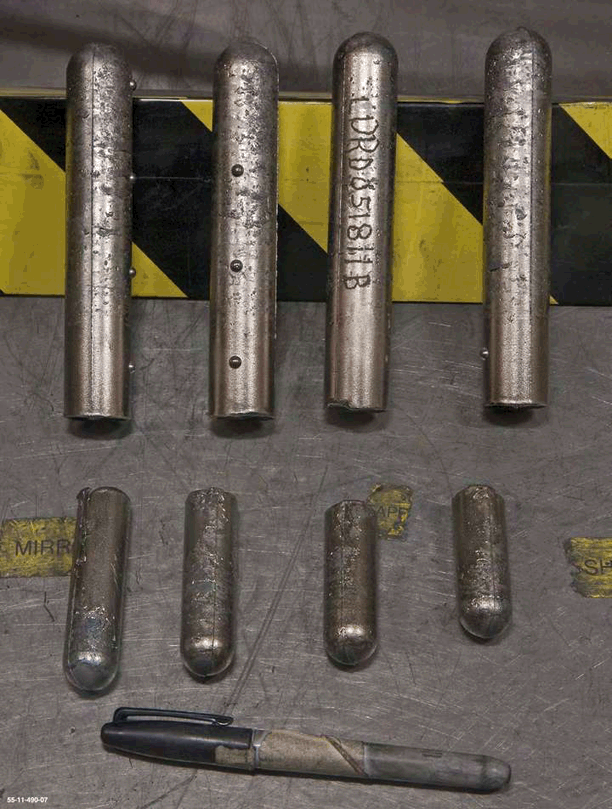
AMARILLO, Texas (Reuters) – In a sprawling plant near Amarillo, Texas, rows of workers perform by hand one of the most dangerous jobs in American industry. Contract workers at the U.S. Department of Energy’s Pantex facility gingerly remove the plutonium cores from retired nuclear warheads.
Although many safety rules are in place, a slip of the hand could mean disaster.
In Energy Department facilities around the country, there are 54 metric tons of surplus plutonium. Pantex, the plant near Amarillo, holds so much plutonium that it has exceeded the 20,000 cores, called “pits,” regulations allow it to hold in its temporary storage facility. There are enough cores there to cause thousands of megatons of nuclear explosions. More are added each day.
The delicate, potentially deadly dismantling of nuclear warheads at Pantex, while little noticed, has grown increasingly urgent to keep the United States from exceeding a limit of 1,550 warheads permitted under a 2010 treaty with Russia. The United States wants to dismantle older warheads so that it can substitute some of them with newer, more lethal weapons. Russia, too, is building new, dangerous weapons.
The United States has a vast amount of deadly plutonium, which terrorists would love to get their hands on. Under another agreement, Washington and Moscow each are required to render unusable for weapons 34 metric tons of plutonium. The purpose is twofold: keep the material out of the hands of bad guys, and eliminate the possibility of the two countries themselves using it again for weapons. An Energy Department website says the two countries combined have 68 metric tons designated for destruction – enough to make 17,000 nuclear weapons. But the United States has no permanent plan for what to do with its share.
Plutonium must be made permanently inaccessible because it has a radioactive half-life of 24,000 years.
“A MUCH MORE DANGEROUS SITUATION”
Edwin Lyman, a physicist at the Union of Concerned Scientists, a science advocacy group based in Washington, says solving the problem of plutonium storage is urgent. In an increasingly unstable world, with terrorism, heightened international tensions and non-nuclear countries coveting the bomb, he says, the risk is that this metal of mass annihilation will be used again. William Potter, director of the James Martin Center for Nonproliferation Studies at the Middlebury Institute of International Studies, told Reuters: “We are in a much more dangerous situation today than we were in the Cold War.”
Washington has not even begun to take the steps needed to acquire additional space for burying plutonium more than 2,000 feet below ground – the depth considered safe. Much of America’s plutonium currently is stored in a building at the Savannah River Site in South Carolina – like Pantex, an Energy Department site. Savannah River used to house a reactor. Local opponents of the storage, such as Tom Clements, director of SRS Watch, contend the facility was never built for holding plutonium and say there is a risk of leakage and accidents in which large amounts of radioactivity are released.
The Energy Department has a small experimental storage site underground in New Mexico. The department controls the radioactive materials – plutonium, uranium and tritium – used in America’s nuclear weapons and in the reactors of nuclear-powered aircraft carriers and submarines. In a Senate hearing in June 2017, Energy Secretary Rick Perry said the Energy Department has been in talks with New Mexico officials to enlarge the site. Environmental groups there have strongly opposed expansion.
Under an agreement with Russia, the United States was to convert 34 metric tons of plutonium into fuel for civilian reactors that generate electricity. The fuel is known as MOX, for “mixed oxide fuel.” Plutonium and uranium are converted into chemical compounds called oxides, and mixed together in fuel rods for civilian nuclear power plants. The two metals are converted into oxides because these can’t cause nuclear explosions. But the U.S. effort has run into severe delays and cost overruns.
The alternative method is known as dilute-and-dispose. It involves blending plutonium with an inert material and storing it in casks. The casks, however, are projected to last only 50 years before beginning to leak, and so would need to be buried permanently deep underground.
Fears that Russia’s huge floating nuclear power could attract a terrorist attack
Express 19th April 2018 Russia moves huge floating nuclear power plant amid World Cup TERROR ATTACK
fears. RUSSIA is moving a huge floating nuclear power plant this week, amid
fears the site could become a target for terrorists as the World Cup
approaches.
https://www.express.co.uk/news/world/948677/Russia-nuclear-power-terror-world-cup-Akademik-Lomonoso
1 This Month
Chernobyl: The Lost Tapes – A good documentary on Chernobyl on SBS available On Demand for the next 3 weeks– https://www.sbs.com.au/ondemand/tv-program/chernobyl-the-lost-tapes/2352741955560

of the week–London Campaign for Nuclear Disarmament

Tell the Ukrainian Government to Drop Prosecution of Peace Activist Yurii Sheliazhenko
To see nuclear-related stories in greater depth and intensity – go to https://nuclearinformation.wordpress.com
-
Archives
- April 2026 (126)
- March 2026 (251)
- February 2026 (268)
- January 2026 (308)
- December 2025 (358)
- November 2025 (359)
- October 2025 (376)
- September 2025 (257)
- August 2025 (319)
- July 2025 (230)
- June 2025 (348)
- May 2025 (261)
-
Categories
- 1
- 1 NUCLEAR ISSUES
- business and costs
- climate change
- culture and arts
- ENERGY
- environment
- health
- history
- indigenous issues
- Legal
- marketing of nuclear
- media
- opposition to nuclear
- PERSONAL STORIES
- politics
- politics international
- Religion and ethics
- safety
- secrets,lies and civil liberties
- spinbuster
- technology
- Uranium
- wastes
- weapons and war
- Women
- 2 WORLD
- ACTION
- AFRICA
- Atrocities
- AUSTRALIA
- Christina's notes
- Christina's themes
- culture and arts
- Events
- Fuk 2022
- Fuk 2023
- Fukushima 2017
- Fukushima 2018
- fukushima 2019
- Fukushima 2020
- Fukushima 2021
- general
- global warming
- Humour (God we need it)
- Nuclear
- RARE EARTHS
- Reference
- resources – print
- Resources -audiovicual
- Weekly Newsletter
- World
- World Nuclear
- YouTube
-
RSS
Entries RSS
Comments RSS
 nuclear-news