Contractor skimmed pay of Vietnamese trainees doing Fukushima cleanup work

Arbitration ends for Fukushima damages claim

Seven years later: Contradictory responses to Fukushima

Journalists, bloggers to be scrutinised by U.S. Department of Homeland Security

Homeland Security to Compile Database of Journalists, Bloggers, https://biglawbusiness.com/homeland-security-to-compile-database-of-journalists-bloggers/ By – Bloomberg Government April 5, 2018
- Seeks contractor that can monitor 290,000 global news sources
• ‘Media influencer’ database to note `sentiment’ of coverage
The U.S. Department of Homeland Security wants to monitor hundreds of thousands of news sources around the world and compile a database of journalists, editors, foreign correspondents, and bloggers to identify top “media influencers.”
It’s seeking a contractor that can help it monitor traditional news sources as well as social media and identify “any and all” coverage related to the agency or a particular event, according to a request for information released April 3.
The data to be collected includes a publication’s “sentiment” as well as geographical spread, top posters, languages, momentum, and circulation. No value for the contract was disclosed.
“Services shall provide media comparison tools, design and rebranding tools, communication tools, and the ability to identify top media influencers,” according to the statement. DHS agencies have “a critical need to incorporate these functions into their programs in order to better reach federal, state, local, tribal, and private partners,” it said.
The DHS wants to track more than 290,000 global news sources, including online, print, broadcast, cable, and radio, as well as trade and industry publications, local, national and international outlets, and social media, according to the documents. It also wants the ability to track media coverage in more than 100 languages including Arabic, Chinese, and Russian, with instant translation of articles into English.
The request comes amid heightened concern about accuracy in media and the potential for foreigners to influence U.S. elections and policy through “fake news.” Nineteen lawmakers including Reps. Josh Gottheimer (D-N.J.), Lee Zeldin (R-N.Y.), Ron DeSantis (R-Fla.), and Sen. Ted Cruz (R-Texas), sent a letter to Attorney General Jeff Sessions last month, asking whether Qatar-based Al Jazeera should register as a foreign agent because it “often directly undermines” U.S. interests with favorable coverage of Hamas, Hezbollah and al-Qaeda’s branch in Syria.
The DHS request says the selected vendor will set up an online “media influence database” giving users the ability to browse based on location, beat, and type of influence. For each influencer found, “present contact details and any other information that could be relevant, including publications this influencer writes for, and an overview of the previous coverage published by the media influencer.”
A department spokesman didn’t immediately return a phone call and email seeking comment.
Responses are due April 13. Seven companies, mainly minority- or women-owned small businesses, have already expressed interest in becoming a vendor for the contract, according to the FedBizOpps web site.
— With assistance from Daniel Snyder
To contact the reporter on this story: Cary O’Reilly in Washington atcoreilly@bgov.com
To contact the editors responsible for this story: Loren Duggan atlduggan@bgov.com; Robin Meszoly at rmeszoly@bgov.com; Theresa Barry attbarry@bgov.com
Deutsche Welle Expose Nuclear Power and Nuclear Weapons Link
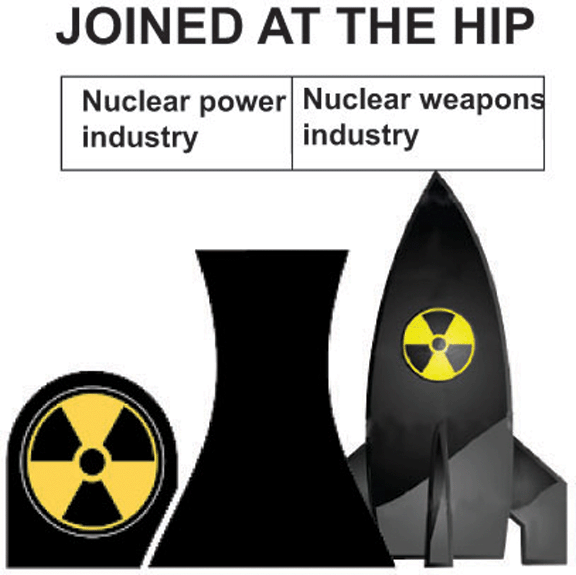 Marianne Wildart, 8 Apr 18In this recent article the German News outlet ‘Deutsche Welle’ expose the link between civil nuclear and nuclear weapons. Nuclear ‘energy’ is a political choice.
……….A study by the Lappeenranta University of Technology (LUT) in Finland simulating the costs of the global transition to renewables and found that a 100-percent renewable energy system would be cheaper that what we have today.
Fell, meanwhile, has documented the explosion of nuclear powers costs, as well as the security concerns over new nuclear reactors.
Yet India, Saudi Arabia, Turkey and the UK remain committed to building new nuclear power plants. And Fell sees a motive for this that has nothing to do with securing an affordable energy supply. “The main driving force behind the new nuclear reactors are nuclear weapons, and the desire for nuclear weapons,” he told DW.
Scientists at the University of Sussex have come to a similar conclusion. In their study of British nuclear policy they attribute the construction of new reactors to cross-funding with military nuclear programs. They argue that maintaining nuclear power programs and expertise at the expense of electricity customers has the advantage of relieving the defense budget…. https://wordpress.com/read/feeds/331643/posts/1820643667
No wonder that nuclear company AREVA changed its name (to ORANO): former director indicted for corruption.
 Le Monde 7th April 2018, Acquisition of Uramin: the former director of the Areva mines indicted for “corruption” The former director of the Areva mines has been indicted in Paris for “corruption” in the investigation of the acquisition of the mining company Uramin in 2007.
Areva, now Orano, had paid 1.8 billion euros to acquire the Canadian Uramin, but the exploitation of the three deposits
of the company in Namibia , South Africa and Central Africa had proved much more difficult than expected. The operation had turned into a financial chasm and had forced Areva, at the end of 2011, to provision 1.5 billion euros.
http://www.lemonde.fr/police-justice/article/2018/04/07/rachat-d-uramin-l-ex-directeur-des-mines-d-areva-mis-en-examen-pour-corruption_5282269_1653578.html
Demolition of plutonium processing plant stalled due to radiation risks to workers
 Danger from radiation shuts down nuclear plant demolition in Washington state, WLWT5,
NICHOLAS K. GERANIOS, 8 Apr 18, SPOKANE, Wash. — Seven decades after making key portions of the atomic bomb dropped on Nagasaki, Japan, workers at the Hanford Nuclear Reservation are being exposed to radiation as they tear down buildings that helped create the nation’s nuclear arsenal.
Dozens of workers demolishing a plutonium processing plant from the 1940s have inhaled or ingested radioactive particles in the past year, and even carried some of that radiation into their vehicles, according to the U.S. Department of Energy.
The incidents have prompted the federal government, along with state regulators, to halt the demolition of the sprawling Plutonium Finishing Plant until a safe plan can be developed.
The contamination has also shaken confidence in a massive cleanup of Hanford, the nation’s most polluted nuclear weapons production site. The work costs the federal Treasury around $2 billion a year. Hanford is near the city of Richland, about 200 miles southeast of Seattle.
“This is a very disturbing set of incidents,” said Tom Carpenter, head of the Seattle-based watchdog group Hanford Challenge.
The Energy Department, which owns Hanford, has launched an independent investigation into the spread of radiation at the plant. The investigation will be conducted by an agency office that is not connected to work at Hanford.
Radioactive particles are known to have contaminated 42 workers, which led to the shutdown of demolition, the agency has said.
Carpenter said widespread worker contamination has been rare at Hanford in recent decades. Plutonium production ended in the 1980s and the site in 1989 switched its focus to cleanup of nuclear wastes.
“It’s one of the more serious events to happen in the age of cleanup at Hanford,” Carpenter said. “There have been other incidents, but none rose to the level of plutonium contamination of this many people and private vehicles and being found miles and miles away.”
A union representing some Hanford workers said it was closely monitoring the situation…..http://www.wlwt.com/article/danger-from-radiation-shuts-down-nuclear-plant-demolition-in-washington-state/19712632
Through “back channels”, secret talks go on between USA and North Korea
Secret, direct talks underway between US and North Korea, By Elise Labott, Kevin Liptak and Jenna McLaughlin, CNN, April 7, 2018 Washington The United States and North Korea have been holding secret, direct talks to prepare for a summit between President Donald Trump and North Korea leader Kim Jong Un, a sign that planning for the highly anticipated meeting is progressing, several administration officials familiar with the discussions tell CNN.
South Africa: confusion and uncertainty over costly nuclear deal
Uncertainty mounts over costly nuclear deal https://www.iol.co.za/sundayindependent/uncertainty-mounts-over-costly-nuclear-deal-14317275 SUNDAY INDEPENDENT / 8 APRIL 2018, SIYABONGA MKHWANAZI Cape Town – South Africa’s decision on the nuclear programme is likely to be clarified in the next two weeks when Minister of Energy Jeff Radebe briefs Parliament on whether it’s officially off the table or not.
Portfolio committee on energy chairperson Fikile Majola said on Saturday Radebe would appear before the committee in the week of April 17 to talk about independent power producers (IPP), the nuclear energy programme and the sale of the country’s oil reserves.
Majola said he did not know if a definite decision had been made to scrap the nuclear programme, but Radebe would shed light on this then.
President Cyril Ramaphosa said in Davos, Switzerland, in January the programme was off the table.
This was followed by statements from former finance minister Malusi Gigaba and his successor Nhlanhla Nene to the effect that the nuclear project was unaffordable.
But Majola said he was not aware that nuclear energy was off the table.
“The committee is not aware of what is going to happen besides what the president has said.”
The government signed several agreements this week with the IPPs amounting to R55.6 billion. But this elicited an angry response from the National Union of Mineworkers and National Union of Metalworkers of South Africa.
When the matter was in the High Court in the Western Cape, Radebe said there would not be any nuclear deal until the matter had been brought before Parliament.
However, Ramaphosa has said it was off the table and did not even mention it in his State of the Nation Address.
Russian energy firm Rosatom told Independent Media recently it was still bidding for nuclear contracts and had not heard anything from the government.
Rosatom has signed multiple agreements in Africa to deliver nuclear energy. In Egypt the Russians bagged a nuclear deal worth $30 billion (R360 billion), with $25bn of it to be vendor financing.
This week, Russian president Vladimir Putin was in Turkey to sign another nuclear deal.
The Russians are to build a nuclear plant on the coast of Turkey. This followed an agreement signed a few years ago.
Head of Rosatom in southern Africa Viktor Polikarpov said recently the company was in Ghana and was moving into East Africa.
International Energy Agency underestimates renewable energy
Is the IEA underestimating renewables? Spreading nuclear weapons cost, DW, 26 Mar 18 Gero Rueter Scenarios from the International Energy Agency (IEA) have failed to predict the growth of renewables and overestimated the role of nuclear. Critics say that’s a political choice.
Last year, the world’s photovoltaic power capacity overtook nuclear for the first time – reaching 402 gigawatts, compared to 353 (GW). Wind power outstripped nuclear back in 2014, and by the end of 2017 amounted to 539 GW.
According to the World Wind Energy Association, 2017 saw the installation of 52.6 GW of new wind capacity. The latest estimates from Solar Power Europe put PV capacity installed in that year at 98.9 GW.
New nuclear power facilities going online were modest in comparison – amounting to just 2.7 GW, according to Mycle Schneider, lead author of the World Nuclear Industry Report.
Back in 2010, you might not have predicted such a shift in the global energy mix – at least, not if you were basing your predictions on the International Energy Agency’s annual Word Energy Outlook (WEO), which estimated annual deployment of less than 10 GW of photovoltaic capacity.
According to this scenario, globally installed solar capacity would hit around 85 GW last year – 315 GW less than the actual figure.
Critics say this is part of a pattern of the IEA consistently underestimating the growth of renewables while making unrealistic assumptions about the development of nuclear.
The 2010 WEO estimated that nuclear capacity would reach 470 GW by the end of 2017, over 110 GW more than the current global figure.
And that imbalance has, according to a 2015 study, has continued in subsequent annual WEOs from the IEA, which ignores facts such as “climate protection and divestment of finance from the conventional energy sector.”
Political bias?
Claudia Kemfert, head of the German Institute for Economic Research’s energy and environment department, told DW the IEA has underestimated drop in renewable power costs, as well as the cost of nuclear and fossil alternatives.
“Probably for political and economic reasons, neither the external costs of fossil fuels nor the cost increases of nuclear energy have been factored in,” Kemfert said. “The fossil fuel and nuclear industries have an interest in artificially exaggerating the cost of renewables in order to influence policy in their favor.”
Sven Teske of the Institute for Sustainable Futures at Sydney University, an advisor to the International Panel on Climate Change, told DW he’d been told unofficially that how much nuclear power was included in IEA scenarios was “basically dictated.”
Hans-Josef Fell, president of the Energy Watch Group, says the IEA acts “on behalf of the OECD governments that ultimately oversee it,” and reflects their ongoing commitment to the fossil fuels sector.
And that has serious consequences, Fell says. “It is likely these scenarios are a major culprit in the global community’s failure to put a sufficiently intensive focus on renewable energy over the last ten to 20 years,” he told DW. “It paints a picture of renewables as too expensive and unable to expand fast enough.”…………http://www.dw.com/en/is-the-iea-underestimating-renewables/a-43137071
China and South Korea at odds over first step in nuclear crisis talks
SCMP, 07 April, 2018, Beijing wants to ensure it has a major role in reining in Pyongyang’s nuclear programme while Seoul prefers a process built around US talks with the two Koreas, the Posthas learned…….http://www.scmp.com/news/china/diplomacy-defence/article/2140694/platform-talks-north-korea-nuclear-crisis-divides-china
1C rise in atmospheric temperature causes rapid changes to world’s largest High Arctic lake
An interdisciplinary team of scientists explores Lake Hazen’s response to climate change, Science Daily
April 6, 2018
- Source:
- University of Alberta
- Summary:
- An interdisciplinary team of scientists examining everything from glaciology to freshwater ecology discovered drastic changes over the past decade to the world’s largest High Arctic lake. And from glacial melt to the declining lake ice to changes in lake ecology, the results from Lake Hazen on Ellesmere Island in Canada are alarming……..https://www.sciencedaily.com/releases/2018/04/180406155402.htm
Pressure on assistant professor to downplay dangers of nuclear power

 Hokkaido METI bureau requested changes to nuclear energy part of high school lecture https://mainichi.jp/english/articles/20180407/p2a/00m/0na/017000c (Mainichi Japan) SAPPORO –– High-ranking officials from the local bureau of the Ministry of Economy, Trade and Industry (METI) requested that an assistant professor change an October 2017 lecture to high school students pointing out the dangers of nuclear power, it has been learned.
“We will review our operations so as not to cause misunderstandings,” stated industry minister Hiroshige Seko regarding the request by the Hokkaido Bureau of Economy, Trade and Industry.
The lecture at Hokkaido Niseko High School in the prefectural town of Niseko was on energy issues. The school had been chosen by the Agency for Natural Resources and Energy, an industry ministry-affiliated body, as a model for energy education last academic year, and the lecture by Hokkaido University assistant professor Sadamu Yamagata was supported by a government grant.
According to multiple sources close to the matter, Yamagata sent his lecture materials to the school beforehand to be printed, and the school handed the documents over to METI’s Hokkaido bureau at the latter’s request. Two high-ranking officials from the bureau then visited Yamagata and requested that he make changes to a section of the materials explaining the dangers and costs of nuclear power, illustrated with a photo of the aftermath of a hydrogen explosion at the Fukushima No. 1 Nuclear Power Plant. The officials told Yamagata that this was “only one perspective” and that called it “impression manipulation.”
Yamagata added the statement, “natural energy is not necessarily 100 percent safe” along with a photo of a collapsed windmill, but did not comply with the request to change the section about nuclear energy.
“I found it uncomfortable that (the request for changes) was focused on nuclear power,” Yamagata told the Mainichi Shimbun. Hokkaido Niseko High School principal Noboru Baba said, “The lecture content was good. I don’t know if there was intrusion (by the ministry) into education.” However, residents who were aware of what had happened view the flow of events as meddling by the government in education, and the Niseko Municipal Government has held three meetings to explain the situation to locals.
Industry minister Seko told a post-Cabinet meeting news conference on April 6, “It’s common sense that the government takes responsibility for the content of an agency-commissioned program, but with the focus (by the bureau officials) only on nuclear energy, misunderstandings can arise easily.”
The incident comes on the heels of criticism of the Ministry of Education, Culture, Sports, Science and Technology for pressuring the Nagoya Municipal Board of Education by requesting a report about a lecture given by former vice minister of education Kihei Maekawa.
But how should the Hokkaido case be understood? The class taught by Maekawa was set up by the school and the Nagoya education board, completely independently of the central government. On the other hand, the Hokkaido case was funded by a central government grant, and Japan’s stance has so far been that funding gives related government bodies a say in how the monies are used.
The Hokkaido bureau’s Natural Resources, Energy and Environment Department denied intervening, telling the Mainichi, “The purpose was to show both the merits and demerits of all types of energy sources, and if the lecture had hypothetically been extremely critical of natural energy resources, the same request for alternations would have been made. If only the shortcomings of nuclear energy are presented while ignoring the benefits, that is a problem.”
However, experts are critical. Hokkaido University emeritus professor Yoichi Anezaki said, “The case of the education ministry requesting a report of Maekawa’s class was also problematic, but in this case with the industry ministry, which plays a key role in nuclear power policies, requesting that a section pointing out the issues with nuclear energy be changed, it’s an intrusion into education by authority and is much worse. It’s tantamount to censorship.”
“The belief that just because the government provided the grant, it means that it can have its say on the content of education doesn’t make sense,” said Kyoto University of Art and Design professor and former education ministry bureaucrat Ken Terawaki. “If we allow for this, then it means that it’s fine for the Ministry of Foreign Affairs to promote the Trans-Pacific Partnership and the Ministry of Defense the necessity of military affairs in the classroom. Intrusion into education is a serious matter.”
(Japanese original by Ryuko Tadokoro, Hokkaido News Department)
What if terrorists unleashed a dirty bomb, or even a small nuclear bomb, on a city?
Bulletin of Atomic Scientists 21st Feb 2018, As seen by recent events such as the bombing in Manchester, UK, terrorism can occur anywhere, at any time. So far, the terrorist incidents have been
relatively low-tech – such as improvised explosive devices detonating
inside pressure cookers, trucks driving down crowded sidewalks, or bombs
exploding in backpacks containing metal bolts and screws.
But what if terrorists were to build a dirty bomb that contained radioactive materials
instead of bits of metal shrapnel, and set it off in a major city? Or,
worse, what if they managed to build a fully functioning nuclear weapon,
cart it to the downtown of a city, and then detonate it – even a small,
rudimentary one that was much smaller than the atomic bomb dropped on
Hiroshima?
What would the social, economic, and political impacts of the
successful terrorist use of a nuclear weapon look like? What planning has
the international community done for such an event?
https://www.tandfonline.com/doi/full/10.1080/00963402.2018.1436812
The heavy health and environmental toll of rare earths mining in China
Rare-earth mining in China comes at a heavy cost for local villages https://www.theguardian.com/environment/2012/aug/07/china-rare-earth-village-pollution Pollution is poisoning the farms and villages of the region that processes the precious minerals, Guardian, Cécile Bontron, 7 Apr 18,
From the air it looks like a huge lake, fed by many tributaries, but on the ground it turns out to be a murky expanse of water, in which no fish or algae can survive. The shore is coated with a black crust, so thick you can walk on it. Into this huge, 10 sq km tailings pond nearby factories discharge water loaded with chemicals used to process the 17 most sought after minerals in the world, collectively known as rare earths.
The town of Baotou, in Inner Mongolia, is the largest Chinese source of these strategic elements, essential to advanced technology, from smartphones to GPS receivers, but also to wind farms and, above all, electric cars. The minerals are mined at Bayan Obo, 120km farther north, then brought to Baotou for processing.
The concentration of rare earths in the ore is very low, so they must be separated and purified, using hydro-metallurgical techniques and acid baths. Chinaaccounts for 97% of global output of these precious substances, with two-thirds produced in Baotou.
 The foul waters of the tailings pond contain all sorts of toxic chemicals, but also radioactive elements such as thorium which, if ingested, cause cancers of the pancreas and lungs, and leukaemia. “Before the factories were built, there were just fields here as far as the eye can see. In the place of this radioactive sludge, there were watermelons, aubergines and tomatoes,” says Li Guirong with a sigh.
It was in 1958 – when he was 10 – that a state-owned concern, the Baotou Iron and Steel company (Baogang), started producing rare-earth minerals. The lake appeared at that time. “To begin with we didn’t notice the pollution it was causing. How could we have known?” As secretary general of the local branch of the Communist party, he is one of the few residents who dares to speak out.
Towards the end of the 1980s, Li explains, crops in nearby villages started to fail: “Plants grew badly. They would flower all right, but sometimes there was no fruit or they were small or smelt awful.” Ten years later the villagers had to accept that vegetables simply would not grow any longer. In the village of Xinguang Sancun – much as in all those near the Baotou factories – farmers let some fields run wild and stopped planting anything but wheat and corn.
A study by the municipal environmental protection agency showed that rare-earth minerals were the source of their problems. The minerals themselves caused pollution, but also the dozens of new factories that had sprung up around the processing facilities and a fossil-fuel power station feeding Baotou’s new industrial fabric. Residents of what was now known as the “rare-earth capital of the world” were inhaling solvent vapour, particularly sulphuric acid, as well as coal dust, clearly visible in the air between houses.
Now the soil and groundwater are saturated with toxic substances. Five years ago Li had to get rid of his sick pigs, the last survivors of a collection of cows, horses, chickens and goats, killed off by the toxins.
The farmers have moved away. Most of the small brick houses in Xinguang Sancun, huddling close to one another, are going to rack and ruin. In just 10 years the population has dropped from 2,000 to 300 people.
Lu Yongqing, 56, was one of the first to go. “I couldn’t feed my family any longer,” he says. He tried his luck at Baotou, working as a mason, then carrying bricks in a factory, finally resorting to selling vegetables at local markets, with odd jobs on the side. Registered as farmers in their identity papers, the refugees from Xinguang Sancun are treated as second-class citizens and mercilessly exploited.
The farmers who have stayed on tend to gather near the mahjong hall. “I have aching legs, like many of the villagers. There’s a lot of diabetes, osteoporosis and chest problems. All the families are affected by illness,” says He Guixiang, 60. “I’ve been knocking on government doors for nearly 20 years,” she says. “To begin with I’d go every day, except Sundays.”
By maintaining the pressure, the villagers have obtained the promise of financial compensation, as yet only partly fulfilled. There has been talk of new housing, too. Neatly arranged tower blocks have gone up a few kilometres west of their homes. They were funded by compensation paid by Baogang to the local government.
But the buildings stand empty. The government is demanding that the villagers buy the right to occupy their flat, but they will not be able to pass it on to their children.
Some tried to sell waste from the pond, which still has a high rare-earth content, to reprocessing plants. The sludge fetched about $300 a tonne.
But the central government has recently deprived them of even this resource. One of their number is on trial and may incur a 10-year prison sentence.
This article originally appeared in Le Monde
1 This Month
Chernobyl: The Lost Tapes – A good documentary on Chernobyl on SBS available On Demand for the next 3 weeks– https://www.sbs.com.au/ondemand/tv-program/chernobyl-the-lost-tapes/2352741955560

of the week–London Campaign for Nuclear Disarmament

Tell the Ukrainian Government to Drop Prosecution of Peace Activist Yurii Sheliazhenko
To see nuclear-related stories in greater depth and intensity – go to https://nuclearinformation.wordpress.com
-
Archives
- April 2026 (139)
- March 2026 (251)
- February 2026 (268)
- January 2026 (308)
- December 2025 (358)
- November 2025 (359)
- October 2025 (376)
- September 2025 (257)
- August 2025 (319)
- July 2025 (230)
- June 2025 (348)
- May 2025 (261)
-
Categories
- 1
- 1 NUCLEAR ISSUES
- business and costs
- climate change
- culture and arts
- ENERGY
- environment
- health
- history
- indigenous issues
- Legal
- marketing of nuclear
- media
- opposition to nuclear
- PERSONAL STORIES
- politics
- politics international
- Religion and ethics
- safety
- secrets,lies and civil liberties
- spinbuster
- technology
- Uranium
- wastes
- weapons and war
- Women
- 2 WORLD
- ACTION
- AFRICA
- Atrocities
- AUSTRALIA
- Christina's notes
- Christina's themes
- culture and arts
- Events
- Fuk 2022
- Fuk 2023
- Fukushima 2017
- Fukushima 2018
- fukushima 2019
- Fukushima 2020
- Fukushima 2021
- general
- global warming
- Humour (God we need it)
- Nuclear
- RARE EARTHS
- Reference
- resources – print
- Resources -audiovicual
- Weekly Newsletter
- World
- World Nuclear
- YouTube
-
RSS
Entries RSS
Comments RSS
 nuclear-news