
Since President Donald Trump took office, some members of Congress have shown renewed interested in the mothballed Yucca Mountain project in Nevada as a long-term solution. But the industry has shown support for temporary storage as part of the storage equation because of the amount of time it would take to license a facility at Yucca Mountain.
Is Putin’s new nuclear system the source of mysterious radioactivity in the air?

If it is true that Russia have tested its new nuclear-powered missiles, some radioactive releases could occur, says Norwegian nuclear safety expert.
Thomas Nilsen
March 03, 2018
Flexing his nuclear muscles like never before, the Russian President in his annual state-of-the-nation speech presented two new nuclear-powered delivering systems for warheads.
Several times over the last two years, tiny small traces of radioactive iodine-131 have been measured in Europe, especially in the Scandinavian countries. National radiation agencies have been unable to direct the source of release, speculating in everything from leakages at a medical isotope production facility to leakages from operative nuclear reactors.
In Norway and Finland, radioactive isotopes were discovered at monitoring stations in January and March last year, as well as in January and February this year. The first cloud of radioactivity last year was first detected at Svanhovd air filter station on Norway’s border to Russia in the north, but spread over most of Europe south to France and Spain over the following two weeks.
Authorities underline that the levels were nearly undetectable and are far from presenting any health concern to population.
«Nobody has anything like this»
Spending much of speech to lawmakers in Moscow on Thursday talking about nuclear weapons, Vladimir Putin sent a clear message to the United States. Russia has developed new missiles and a underwater torpedo that would be immune to ballistic missiles shields and other means to stop an nuclear attack.
«Nobody has anything like this,» Putin said simultaneously as a video animation was displayed on big screens. Two of the screened weapons Putin presented are new nuclear-powered delivery systems.
The nuclear-powered underwater drone is known from before, although it is highly unclear how far Russian weapons constructers have come in regards towards deploying such massive drone.
Arctic test?
More remarkable is the nuclear-powered cruise missile. Using nuclear power for a missile has the advantage of extending the range significantly. On Putin’s screen, the video animation showed the missile flying southbound through the Atlantic, before turning north again on the west coast of South America.
On Thursday this week, Fox News reporter Lucas Tomlinson sent a tweet where he quoted U.S. officials saying «Russia’s nuke powered cruise missile not operational yet, still in ‘R&D’ phase and has crashed recently in testing in the Arctic, despite claims by Putin today.»
Tomlinson’s tweet is referred to in an article in the Washington Post.
If this is true or not is difficult to check. According to a source in Russia’s military-industrial complex speaking to Vedomosti, the radiation safety during the testing of the missile was ensured. «The nuclear installation on board was represented by an electric power supply,» the source said.
That could have been the case if the missile was tested on-ground, but unlikely if it was a real flight test.
Talking about the successful test, President Vladimir Putin said in his speech that the missile was launched with a nuclear installation. «At the end of 2017, a successful launch of the newest Russian cruise-missile with a nuclear-power plant took place at Russia’s Central Range,» Putin told the applauding audience.
Likely radioactive releases
Nils Bøhmer, a nuclear physicist with the Bellona Foundation in Oslo says to the Barents Observer that a test of a nuclear-powered cruise missile would most likely have caused releases of detectable isotopes.
«If it is true that Russia has tested its new nuclear-powered missile, some radioactive released could have occurred,” Bøhmer says and points to the United States’ on-ground testing of reactors for a nuclear-powered aircraft back in the late 1950s. «That project was cancelled because of high releases of radioactivity behind the engines at the test site in Idaho Falls,» Nils Bøhmer explains.
He says there could be a connection between the mysterious iodine-131 detected and Russia’s new missile. «This could be explained by the secret testing of Russia’s new nuclear-powered missile. Because of short half-life of eight days of iodine-131, this isotope measured in the air could only be explained by reactor operations. Other isotopes, like Cecium-137 that has a half-life of 30 years is found in nature long after the releases have happened. This could explain why only iodine-131 is detected, because Cesium-137 is masked by the releases from the Chernobyl accident,» Bøhmer tells.
A nuclear-powered cruise-missile with a small reactor would most likely have an partly open-air cooling system, where isotopes simply would fly out as the missile speeds away.
Nuclear sniffer
The United States’ so-called “nuclear sniffer” WC-135 plane has by several occasions since early 2017 been deployed to the British air base in Surrey. From the base, the plane has made take-offs for flights to Norway and Baltic Sea area to monitor radioactivity levels, the newspaper Independent reported in February last year.
WC-135 can detect and identify radioactive isotopes from nuclear weapons testing as well as releases from reactors or other sources.
Althoug Nils Bøhmer agrees with radiation safety authorities in the Nordic countries that the levels measured do not present any health risk to population, he is concerned. «We know from history that when military scientists are developing weapons involving nuclear technology, safety is not always the number one priority.»
«The releases of radioactivity could be quite high directly at the site where the nuclear-powered cruise-missile is tested, which could lead to potential health concerns for the local population,» Nils Bøhmer says.
«It is also said by Putin that Russia is developing a new underwater nuclear-powered drone. Very little information is know about the technology on-board this drone, but one could speculate that also this nuclear-powered vehicle could lead to radioactive releases.»
Bøhmer says such radioactive releases could contaminate the fishing ground of the Barents Sea, if the testing takes parts in those areas.
The Barents Observer reported about the new underwater drone, known as STATUS-6, first time in 2016.
This week propaganda about Tokyo Olympics, and other nuclear news to 4th March
 The corporate-political-media machine now gears up the spin for the 2020 Tokyo Olympics. This is no coincidence, as March will mark the seventh anniversary of the Fukushima nuclear catastrophe. After the 1945 nuclear bombing of Hiroshima and Nagsaki, the American government swamped Japan with propaganda for setting up nuclear reactors – and indeed, the world, for”Atoms for Peace”. So again, the deception now is that the Fukushima tragedy is over – solved – fixed.
The Winter Olympics are over. We now return to your regularly scheduled nuclear crisis.
CLIMATE: Record warming in the Arctic. Some of the world’s biggest lakes Are drying.
We already have a global cancer epidemic. A nuclear attack on North Korea would make it much worse.
High stakes talks as Trump forces a deadline on revising Iran nuclear deal.
Thorium Church: a trojan horse in the “green” movements
FUKUSHIMA.
- Radiation levels in Fukushima zones higher in 2017 than 2016, and still above government target despite cleanup.
- Environmental impact of Fukushima nuclear disaster more long-lasting than expected.
- Thyroid cancer relapses in some Fukushima children.
- Debris in Fukushima nuclear reactor 2 – it “fell out of reactor”. TEPCO: Frozen soil wall effect limited. Fukushima Daiichi groundwater inflow increased 4 times as much as normal.
JAPAN. Removal of spent fuel from Fukui’s defunct Fugen reactor delayed by nine years. More Fukushima Propaganda to Come from Japan’s Ministry of the Environment. Tepco sets sights on global expansion.
UK. Damning report accuses UK government on the collapse of contract to clean up redundant fleet of Magnox nuclear reactors. Jeremy Corbyn’s pledge to keep Britain in EU internal energy market (IEM) and in Euratom.
USA. Senator Ed Markey warns on danger in allowing Saudi Arabia to enrich uranium, reprocess spent nuclear fuel. Energy Secretary Rick Perry ready to make concession to Saudi Arabia – to market US nuclear power to that country. Los Alamos Board of Public Utilities – doubtful about viability of Small Modular Nuclear Reactors (SMRs).
SOUTH KOREA. Moon Jae-in, the South Korean president, has called on the US to “lower the bar” for discussions with North Korea.
NIGER. INTERVIEW: Niger: “In Arlit, people drink water contaminated by radioactivity”.
INDIA. India’s State-owned nuclear power corporation plans new nuclear units, without nuclear waste facilities set up.
NORWAY, FINLAND. Norway and Finland find tiny amounts of recently released radioactive particles in the air.
FRANCE. Zombie nuclear corporation AREVA arises from dead -as “Orano”, “Framatome”. Flamanville EPR: defects affect secondary circuit welds in nuclear reactor. EDF discovering many more “anomalies ” and “non-conformities” in nuclear reactors.
RUSSIA. Putin announces a new array of nuclear weapons, that could evade a US-built missile shield. A forgotten nuclear disaster? 1985 Russian submarine accident.
SAUDI ARABIA. The last thing the Middle East needs is another country with the potential to build nuclear weapons.
AUSTRALIA. Australia’s extreme right wing Senator promises $445 billions to South Australia, if it takes in the world’s radioactive trash.
We Now Return to Your Regularly Scheduled Nuclear Crisis
The Olympics are over, and the high-stakes Trump-Kim showdown is no closer to resolution. By FRED KAPLAN, FEB 27, 2018
Displayed sign carried during a demonstration in Japan, at the end of the seventh year…

From Shuji-san:
Displayed sign carried during a demonstration in Japan, at the end of the seventh year…
“Do not forget Fukushima, but please do not come to Fukushima.”
“Do not forget Fukushima, but please do not eat anything in Fukushima.”
“When everyone comes to Fukushima for sightseeing, children of Fukushima will not escape.”
“When you eat the food of Fukushima, the children in Fukushima are eating radioactive substances. “
About Fukushima Food Contamination

From Shuji-san:
It will become increasingly severe in the future to turn your eyes off from the facts or interpret the facts with distortion.
Exports from Japan will also increase.
If we do not keep informed only to those who are willing to face facts, there will be no end to the increase and spread of damage.
I am translating this illustration into native language of various countries and sending it.
Nukespeak: The language used about nuclear weapons helps make the idea of using them “clean’and “acceptable”
 The antiseptic language of Nukespeak cleans up the very dirty business of nuclear weapons https://www.jsonline.com/story/opinion/contributors/2018/02/27/nukespeak-cleans-up-language-nuclear-holocaust/378235002/
Climate change urgency: the Arctic is heating

Antarctic ice sheet loss and sea level rise Guardian, [Excellent graphs] 1 March 2018
A new study looks at how much global sea level will continue to rise even if we manage to meet the Paris climate target of staying below 2°C hotter than pre-industrial temperatures. The issue is that sea levels keep rising for several hundred years after we stabilize temperatures, largely due to the continued melting of ice sheets in Antarctica and Greenland from the heat already in the climate system.
The study considered two scenarios. In the first, human carbon pollution peaks somewhere between 2020 and 2035 and falls quickly thereafter, reaching zero between 2035 and 2055 and staying there. Global temperatures in the first scenario peak at and remain steady below 2°C. In the second scenario, we capture and sequester carbon to reach net negative emissions (more captured than emitted) between 2040 and 2060, resulting in falling global temperatures in the second half of the century.
The authors found that global average sea level will most likely rise by about 1.3 meters by 2300 in the first scenario, and by 1 meter in the second. However, there is large uncertaintydue to how little we understand about the stability of the large ice sheets in Greenland and especially Antarctica. At the high end of possible ice sheet loss, we could see as much as 4.5 meters of sea level rise by 2300 in the first scenario, and close to 3 meters in the second scenario.
The study also shows that it’s critical that our carbon pollution peaks soon. Each 5-year delay – a peak in 2025 instead of 2020, for example – most likely adds 20 cm of sea level rise by 2300, and could potentially add a full meter due to the uncertainty associated with the large ice sheets:
we find that a delay of global peak emissions by 5 years in scenarios compatible with the Paris Agreement results in around 20 cm of additional median sea-level rise in 2300 … we estimate that each 5 years of delay bear the risk of an additional 1 m of sea-level rise by 2300 … Delayed near-term mitigation action in the next decades will leave a substantial legacy for long-term sea-level rise.
And remember, this is all for scenarios in which we meet the Paris climate targets, which we’re currently not on pace to achieve. If we miss the Paris targets, sea levels will rise higher yet.
Another new study, published in the Proceedings of the National Academy of Sciences, found that sea level rise has been accelerating. If the rate of acceleration continues – which the lead author notes is a conservative estimate – we would see an additional 65 cm (close to a meter above pre-industrial sea level) of sea level rise by 2100.
Yet another new study published in The Cryosphere using satellite data found that while the East Antarctic Ice Sheet has remained stable in recent years, ice loss from the West Antarctic Ice Sheet has accelerated. Antarctica is now discharging 1.93 trillion tons of ice each year, up from about 1.89 trillion tons per year in 2008. When accounting for snow accumulation, the continent is losing about 183 billion tons of ice per year – enough to raise sea levels by about 3 to 5 millimeters per decade by itself. The melting of the Greenland Ice Sheet is likewise accelerating and is now responsible for about 25% of annual sea level rise (8.5 millimeters per decade).
Meanwhile, the Arctic has been remarkably warm in February – as much as 35°C hotter than average in some areas. In mid-winter, when sea ice should be growing, in the Bering Sea it’s instead shrinking.
The hot Arctic is important because the temperature difference between the Arctic and lower latitudes is one of the main forces that keeps the jet stream moving steadily west-to-east. With a hot Arctic, the jet stream is weakened, leading to weird weather in the USA and Europe. As a result, the western states have been experiencing relatively quite cold temperatures, while the US east coast has been unseasonably hot.
To sum up, ice sheet melt is accelerating, as in turn is sea level rise. Even if we manage to achieve the Paris target of less than 2°C global warming above pre-industrial temperatures, we’re likely to eventually see more than a meter of sea level rise, and potentially several meters. The longer we take to reach peak carbon pollution in the coming years, the higher the oceans will rise. Disappearing sea ice in the rapidly-warming Arctic also appears to be causing increasingly weird and extreme weather in places like America and Europe.
The plight of the world’s big lakes, in the era of climate change
 What a great article! and magnificent photos!. And Kenneth Weiss has a degree in folklore! Doesn’t that tell us something?
We are in an age where we are constantly being told that STEM (Science Technology Engineering Maths) are what matters most – indeed, are all that matters. Well- yes, they do matter. But what about the humanities – arts, social studies, history literature, cultures? We need more Kenneth Weiss’s – more students of folklore !
Combating Desertification and Drought, TerraViva United Nations Some of the World’s Biggest Lakes Are Drying Up. Here’s Why. [see this  article if only for the superb photos]
Russia’s near nuclear disaster outside Murmansk in 2011
 While Putin brags about new nuclear weapons, his Deputy Prime Minister admits near-disaster outside Murmansk in 2011, https://thebarentsobserver.com/en/security/2018/03/while-putin-brags-about-new-nuclear-missiles-his-deputy-prime-minister-admits-world By Thomas Nilsen, March 01, 2018
Russian President Vladimir Putin spent much of his state-of-the-nation speech on Thursday talking about nuclear weapons. With a clear message to the United States, he especially highlighted new missiles that would be immune to possible missile defence shields.
“Nobody has anything like this,” Putin said simultaneously as a video animation was displayed on big screens, showing how both Russia’s new ballistic- and cruise missiles can’t be intercepted.
Putin’s nuclear war-drumming were applauded by the audience in Moscow consisting of the country’s lawmakers, ministers, high-ranking officials and key business bosses. Around the world, the President’s speech got massive media attention.
What got much less attention, was a small sentence in a larger interview with Russia’s Deputy Prime Minister Dmitry Rogozin published by newspaper Kommersant this week.
Rogozin, who was Russia’s ambassador to NATO in Brussels until December 2011, talks in the interview about his first days at work as Deputy Prime Minister in charge of defence industry.
“The presidential decree on appointment was issued on December 23,” Dmitry Rogozin says when explaining why he will remember the first days in new position for the rest of his life: “a fire on board the ballistic missile submarine “Ekaterinburg” in the dock of the shipyard in Roslyakovo.”
Rogozin and other military officials tried to predict what could happen and had to make quick decisions, because, as he puts it: “After all, the vessel did not unload the weapons before the repair: there were torpedoes on board, and regular ballistic missiles.”
“Ekaterinburg” was at the time one of the Northern Fleet’s six ballistic missile submarines and a core part of the naval leg in Russia’s nuclear triad. The submarine, also known as K-84, is a Delta-IV class that normally carries 16 ballistic missiles, each armed with four nuclear warheads. That means up to 64 nuclear bombs in the missile tubes at the time when the fire started on December 29.
Additionally, the submarine is powered by two nuclear reactors.
The reactors were shut down when the K-84 was taken into the dock on December 8, and when the fire made headlines across Russia and international media, Defence Ministry officials assured the world that also the missiles had been removed. What Rogozin now says in the interview with Kommersant confirms what many for years have believed; the removal of the nuclear-armed missiles was simply not true.
Not removing the nuclear missiles or other weapons is a violation of the navy’s safety regulations and practice when submarines are taken into a dock for repair.
After about 20 hours, the fire on the rubber coating of the submarine was put out simply by lowering the dock and let seawater in. What worst-case scenario could have been if the torpedo fuel or ballistic missile fuel had caught fire is hard to imagine.
Rogozin himself went to the shipyard just north of Murmansk a few days later to personally thank the workers who had saved the submarine “and all of us from the grave consequences.”
The R29RM missiles used liquid fuel and in a worst case scenario with burning fuel, the missiles could have exploded and fragmented the plutonium warheads and spread radioactivity to the surrounding area. Additionally, parts of the plutonium could have been taken up in the atmosphere by the smoke from the fire and brought over longer distances by the wind.
In the aftermath of the fire, both Norway’s Foreign Minister Jonas Gahr Støre and Sweden’s Foreign Minister Carl Bildt said they were critical to the lack of official information from Moscow.
“Most of what I know, I have learned through the media,” Bildt said to Swedish TV. Støre said when the fire was debated in the Norwegian Parliament two months later that “when there is a fire in a submarine we are worried. There are extra reasons to be worried after what we have heard the last few days from official Russian spokespersons, that there could have been nuclear weapons on board.”
The question about possible nuclear weapons on board K-84 started to spread when the fire became known in the Murmansk area.
Roslyakovo is a settlement with a few thousand inhabitants located six kilometres north of Murmansk and seven kilometres southwest of the Northern Fleet’s main base Severomorsk.
More than 400,000 people were living within a radius of about 30 kilometres from the submarine on fire. That includes the two cities of Murmansk and Kola, and the five closed military towns of Severomorsk, Snezhnogorsk, Polyarny, Gadzhiyevo and Vidyaevo. The Norwegian town of Kirkenes is 145 kilometres away while Finland’s northernmost town of Ivalo is 230 kilometres from Roslyakovo.
Serious accidents involving nuclear weapons, including fires, are infrequent but have happened before. The best known was back in 1968 when an American B-52 carrying four hydrogen bombs crashed at Thule Air Base on Greenland. Radioactive plutonium was then spread over a larger area. In 1991, an are intest-missile exploded in the silo on board a Typhoon submarine loaded with 19 nuke-missiles and caught fire in the White Sea.
Two years before, the Northern Fleet’s submarine “Komsomolets” caught fire in the Norwegian Sea and sank with two nuclear torpedoes on board. “Komsomolets” and her two warheads are still on the seabed some 160 kilometres southwest of the Bear Island.
Daniel Ellsberg on the urgent need to dismantle the doomsday nuclear weapons machine
You would not have these arsenals, in the US or elsewhere, if it were not the case that it was highly profitable to the military-industrial complex, to the aerospace industry, to the electronics industry, and to the weapons design labs to keep modernizing these weapons, improving accuracy, improving launch time, all that. The military–industrial complex that Eisenhower talked about is a very powerful influence. We’ve talked about unwarranted influence. We’ve had that for more than half a century.
………. What’s it all for? It is for [military] service share of the budget. Lockheed Martin, Boeing, Grumman, Northrop. Jobs, jobs, jobs, jobs, as one after another official has put it, from James Baker to others. Profits, as I say, jobs, and campaign donations.
Daniel Ellsberg on dismantling the doomsday machine, Bulletin of Atomic Scientists, John Mecklin , 26 FEBRUARY 2018
More than 45 years after he became famous for leaking the Pentagon Papers and earning the wrath of President Richard Nixon and his plumbers, Daniel Ellsberg is again a focus of public consciousness. The hit movie The Post reprises part of the Pentagon Papers story, reminding older Americans (and explaining to younger viewers) how Ellsberg’s decision to reveal a top-secret history of duplicitous US policy in Indochina changed the course of the Vietnam War and American history.
And shortly before The Post premiered early in January, Ellsberg’s latest book, The Doomsday Machine: Confessions of a Nuclear War Planner, was published to significant national media attention.
In the book, Ellsberg chronicles his early career as a RAND Corporation analyst deeply involved in the crafting of American nuclear war plans in the 1960s —plans that were meant to be more controlled and discriminating than earlier versions but, he came eventually to understand, were actually blueprints for the obliteration of civilization.
“Working, conscientiously, obsessively, on a wrong problem, countering an illusory threat, I and my colleagues at RAND had distracted ourselves and helped distract others from dealing with the real dangers posed by the mutual superpower pursuit of nuclear weapons—dangers which we were helping make worse—and from real opportunities to make the world more secure,” Ellsberg writes. “Unintentionally, yet inexcusably, we made our country and the world less safe.”
Since the 1970s, Ellsberg has been deeply involved in efforts to reduce world nuclear arsenals and eventually eliminate them altogether. He and I spoke at length earlier this year about how the danger of nuclear weapons might be conveyed more effectively to the general public. What follows is an edited transcript of parts of that wide-ranging conversation……….
John Mecklin: The major media tend to almost never actually confront or describe the actual effects of a major nuclear war. Why do you think that is?
Daniel Ellsberg: That’s hard for me to say, really. I certainly agree with you. I would say they have been shockingly derelict in reporting this. I can’t give an answer. I haven’t been able to ask their editors what’s going on
But it’s a very interesting question. My speculative answer would have to be that the major media have always supported basically—until quite recently perhaps—our basic nuclear arsenals. Insane as they are; they’re unjustifiable, if you really look at them critically. And yet they’re treated as though they are reasonable responses to the nuclear era, which they are not. Nothing reasonable about them at all.
You would not have these arsenals, in the US or elsewhere, if it were not the case that it was highly profitable to the military-industrial complex, to the aerospace industry, to the electronics industry, and to the weapons design labs to keep modernizing these weapons, improving accuracy, improving launch time, all that. The military–industrial complex that Eisenhower talked about is a very powerful influence. We’ve talked about unwarranted influence. We’ve had that for more than half a century.
………. What’s it all for? It is for [military] service share of the budget. Lockheed Martin, Boeing, Grumman, Northrop. Jobs, jobs, jobs, jobs, as one after another official has put it, from James Baker to others. Profits, as I say, jobs, and campaign donations. It’s embedded in all 50 states of the union, one way or another, in the various expenditures, and very hard to get rid of. Almost impossible. I just don’t see that you can say it’s impossible……….I would also say that no significant change has occurred at all, and we are maintaining this mad policy. But it is being done, again, in the absence of almost any public awareness or debate. In the last several elections—but let’s take the last one in particular—nuclear winter, of course is not mentioned. But there’s really no dispute that came up significantly about the arms budget, about the nuclear budget, or any of the rest of it. That’s hardly an excuse, but it’s an explanation in a way for no media discussion of it, except in the Bulletin of Atomic Scientists, thanks a lot. Your role is essential but not sufficient, it would seem. ………. https://thebulletin.org/daniel-ellsberg-dismantling-doomsday-machine11539
Nevada residents urged to renew the fight against Yucca Mountain nuclear waste dump plan
 Nevada, keep up the fight against nuclear waste: RGJ Editorial Board (includes poll – currently 45% opposed) http://www.rgj.com/story/opinion/editorials/2018/03/01/nevada-keep-up-fight-against-nuclear-waste-rgj-editorial-board/387365002/
A new proposal to store nuclear waste in New Mexico
 Proposal advances to store nuclear waste in New Mexico, https://abcnews.go.com/Technology/wireStory/proposal-advances-store-nuclear-waste-mexico-53456176
A new proposal to store nuclear waste underground in southern New Mexico — this time from nuclear reactors across the country — has cleared an initial regulatory hurdle and can now be vetted for detailed safety, security and environmental concerns, the Nuclear Regulatory Commission announced Thursday.
Federal nuclear regulators said the proposal from Holtec International to temporarily store spent nuclear fuel in southeastern New Mexico is sufficiently complete to begin the technical review process that eventually involves expert testimony and public comment.
Holtec is seeking an initial 40-year license for an underground storage facility that could accept radioactive used fuel piling up at reactors across the United States.
Southern New Mexico already is the site of the nation’s only underground nuclear waste repository that handles radioactive material from decades of bomb-making nuclear research. A 2014 radiation release at the Waste Isolation Pilot Project caused by an inappropriately packed container of waste forced the closer of that facility for three years, with extended repairs estimated to cost more than half a billion dollars.
For the proposed spent nuclear fuel storage facility, safety advocates have warned of transportation risks associated with moving massive casks of used fuel thousands of miles to New Mexico, and urged the public to speak up about the proposal.
“Up to now, it’s been Holtec talking to the Nuclear Regulatory Commission for the last 11 months,” said Don Hancock, nuclear programs director for the Southwest Research and Information Center, an Albuquerque-based environmental protection group. “Now the public is going to be able to get involved.”
Many local residents and politicians including New Mexico Gov. Susana Martinezhave voiced support for Holtec’s plans.
In a written notice to Holtec, federal nuclear regulators outlined a series of reviews that could be completed by July 2020 — or be delayed and suspended, based on responses from the company and safety determinations.
Federal officials have long acknowledged that the future of nuclear energy in the U.S. depends on the ability to manage used fuel and high-level radioactive waste.
Britain’s Nuclear Decommissioning Authority (NDA) wasted tax-payers’money bigtime , in its failed contract with Cavendish Fluor
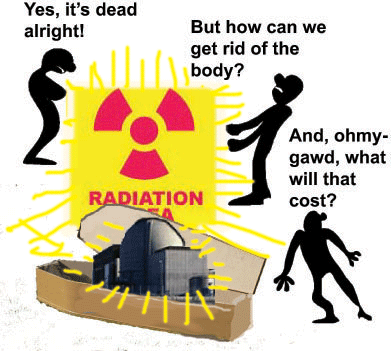
 Nucnet 1st March 2018, The Nuclear Decommissioning Authority (NDA) completely failed in both the procurement and management of a contract to clean up the UK’s Magnox
nuclear reactor and research sites, a report by the Public Accounts
Committee says.
The report, released on 28 February 2018, says this
disrupted an important component of vital nuclear decommissioning work and
cost the taxpayer upwards of £122m (€137m, $167m). The £6.2bn contract
— one of the largest awarded by the UK government — was to dismantle 12
first-generation Magnox nuclear sites.
It was awarded to Cavendish Fluor Partnership, a joint venture between UK-based Babcock International and
Fluor of the US. The committee, which oversees government expenditure,
said: “The NDA ran an overly complex procurement process, resulting in it
awarding the contract to the wrong bidder, and subsequently settling legal
claims from a losing consortium to the tune of nearly £100m.”
The committee also said the NDA, a public body established in 2004 to oversee
the clean-up of the UK’s nuclear legacy, “drastically
under-estimated” the scale of the work needed to decommission the sites
at the time it let the contract – a failure which ultimately led to the
termination of the Magnox contract nine years early.
The NDA did not have sufficient capability to manage the procurement or the complex process of
resolving differences between what the contractor was told to expect on the
sites and what it actually found, the committee concluded.
The NDA will now have to spend even more effort and money to find a suitable way of managing
these sites after the contract comes to an official end in September 2019,
the committee said. The NDA may have further wasted taxpayers’ money by
paying its previous contractor for work that was not done. The NDA cannot
fully account for £500m of the £2.2bn increase in the cost of the
contract between September 2014 and March 2017. In particular, it does not
know whether the £500m cost increase was due to its incorrect assumptions
about the state of the sites when it let the contract or underperformance
by the previous contractor.
https://www.nucnet.org/all-the-news/2018/03/01/accounts-committee-says-nda-completely-failed-with-6-2-billion-uk-magnox-contract
Cancer epidemic: health and environmental toll of U.S. military operations on Terceira Island in the Azores
 Anti-Nuclear Movement Founder Backs Cancer Crisis Clean-Up at US Base in Azores, 1 March 2018 , WASHINGTON (Sputnik) – The cancer epidemic sweeping Terceira Island in the Azores, home to the US Air Base at Lajes, is a health crisis that requires an immediate environmental cleanup, Dr. Helen Caldicott, founder of a Nobel Peace Prize anti-nuclear movement told Sputnik.
New Jersey’s largest utility is canceling spending on nuclear power project
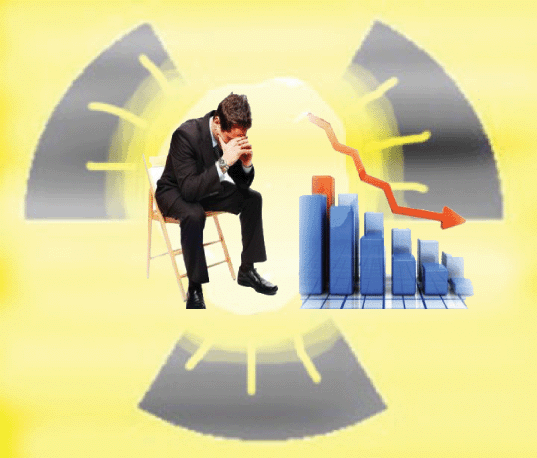
 PSEG canceling nuclear plant spending due to stalled bailout, By: MICHAEL CATALINI, Associated Press
Public Service Enterprise Group said in a Securities and Exchange Commission filing dated Wednesday that it will halt the projects at the Salem nuclear plant in southern New Jersey. A spokesman said the spending covered efficiency and reliability maintenance.
PSEG says the decision comes after “recent postponements” of a vote on legislation to provide the financial rescue. The bill, which has undergone several changes and was held during a recent session, includes clean-energy requirements that lawmakers say were sought by Democratic Gov. Phil Murphy.
PSEG filed the document along with Exelon, which is a co-owner of the plant. It said that funding for the projects may be restored if legislation is enacted “that sufficiently values the attributes of nuclear generation and Salem benefits from such legislation.”…….http://www.actionnewsjax.com/news/pseg-canceling-nuclear-plant-spending-due-to-stalled-bailout/709838467
1 This Month
Chernobyl: The Lost Tapes – A good documentary on Chernobyl on SBS available On Demand for the next 3 weeks– https://www.sbs.com.au/ondemand/tv-program/chernobyl-the-lost-tapes/2352741955560

of the week–London Campaign for Nuclear Disarmament

Tell the Ukrainian Government to Drop Prosecution of Peace Activist Yurii Sheliazhenko
To see nuclear-related stories in greater depth and intensity – go to https://nuclearinformation.wordpress.com
-
Archives
- April 2026 (172)
- March 2026 (251)
- February 2026 (268)
- January 2026 (308)
- December 2025 (358)
- November 2025 (359)
- October 2025 (376)
- September 2025 (257)
- August 2025 (319)
- July 2025 (230)
- June 2025 (348)
- May 2025 (261)
-
Categories
- 1
- 1 NUCLEAR ISSUES
- business and costs
- climate change
- culture and arts
- ENERGY
- environment
- health
- history
- indigenous issues
- Legal
- marketing of nuclear
- media
- opposition to nuclear
- PERSONAL STORIES
- politics
- politics international
- Religion and ethics
- safety
- secrets,lies and civil liberties
- spinbuster
- technology
- Uranium
- wastes
- weapons and war
- Women
- 2 WORLD
- ACTION
- AFRICA
- Atrocities
- AUSTRALIA
- Christina's notes
- Christina's themes
- culture and arts
- Events
- Fuk 2022
- Fuk 2023
- Fukushima 2017
- Fukushima 2018
- fukushima 2019
- Fukushima 2020
- Fukushima 2021
- general
- global warming
- Humour (God we need it)
- Nuclear
- RARE EARTHS
- Reference
- resources – print
- Resources -audiovicual
- Weekly Newsletter
- World
- World Nuclear
- YouTube
-
RSS
Entries RSS
Comments RSS
 nuclear-news