Authorities finally admit that Argayash was at the centre of a radiation cloud. Henry Foy in Argayash , 24 Nov 17
Argayash is a cynical, mistrustful town. Decades of being lied to by the government about being down the road from a leaking nuclear plant does that to a place. So too does watching generations of people dying of radiation-related ailments while officials assure them nothing is amiss.
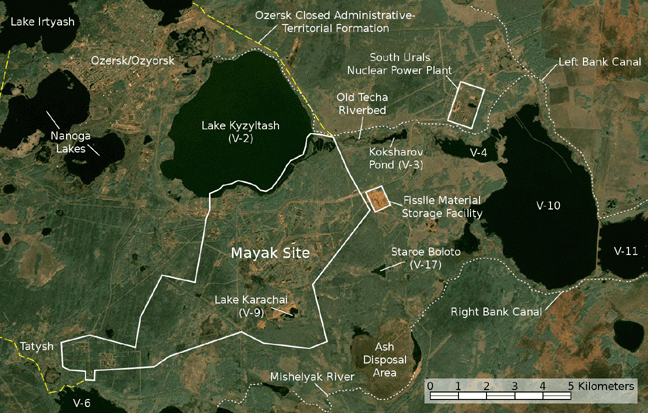
A small, two-road settlement where homes roofed with corrugated iron and Soviet-era Lada cars nod to its poverty, Argayash is one of a handful of towns surrounding the Mayak Production Facility in southern Russia, one of the world’s biggest radiation emitters where a litany of tragic accidents has made it a byword for the dangers of the atomic industry.
This week, 76 years after radiation first began seeping from Mayak into the surrounding rivers, lakes and atmosphere, Russian authorities admitted that Argayash was at the centre of a radiation cloud containing “exceptionally high” levels of radioactive isotope ruthenium-106, which spread so far west that it reached France. The radiation was detected by Russia’s meteoological agency in late September, but only revealed on Monday, after local politicians had spent weeks denying rumours of a leak and rubbishing reports from EU agencies that had tracked the cloud’s movement.
The levels of the isotope in Argayash were almost 1,000 times the normal level. Officials say it is not harmful to public health. “Nobody tells us anything. They keep it secret,” says Lilia Galimzhanova, a cook at a café in the town. “We are afraid. We are afraid for our children and grandchildren.” “But we know that the air, the environment is very bad here,” she says. Her 80-year-old mother suffers from radiation poisoning from Mayak. “We are not protected by anyone here . . . We are survivors.”
The source of the leaked isotope, which does not occur naturally and is produced during the processing of nuclear fuel, has not been confirmed. Rosatom, which operates the Mayak facility, has repeatedly denied it is to blame. “[Mayak] is not a source of increased content of ruthenium-106 in the atmosphere,” Rosatom said in a statement. On Thursday, the company published a message poking fun at journalists on its Facebook page, inviting them to tour the plant, which it sarcastically dubbed “the cradle of ruthenium”. The local region’s chief oncology specialist has told concerned residents to stop worrying, advising them to instead “watch football and drink beer”.
But local residents see little to laugh about. Many scoff at official denials, having heard similar for decades, even as they watched family and friends die from radiation-related ailments. “We are not told anything about Mayak,” says Nadia, an 18-year-old medical student living in the town, 1,700km east of Moscow. “The government should not keep things secret when people suffer.” “People in the west know more about this than we do here,” she adds.
Ms Galimzhanova only heard of the radiation that had enveloped her town when a friend in Germany read about it in a western newspaper. Before the authorities admitted its existence, text messages had been sent to residents saying that high levels of pollution from nearby industrial factories meant people should stay indoors. Regardless of the potential health risks, many here say the government’s initial silence, denial and obfuscation has dredged up painful memories of a past that refuses to stay buried. Secretly constructed in the 1940s, Mayak was at the forefront of the USSR’s scramble to catch up with the US nuclear programme. As it raced to produce weapons-grade plutonium, a vast amount of nuclear waste was discharged into nearby lakes and the Techa river. Then, in 1957, nuclear waste storage tanks at the site exploded, raining fallout over hundreds of towns — and releasing more radiation than any other nuclear accident except Chernobyl and Fukushima. Ten years later, an adjacent reservoir used for waste disposal dried out, and powdered radioactive dust was blown over the area.
Not that local people were evacuated, or even warned: Mayak’s very existence was only acknowledged in the late 1980s, as information began to circulate about the long-term contamination. An estimated 450,000 were exposed to radiation from the accidents and the discharging of waste into the water supply, Russian authorities said in 1993, making Mayak one of the world’s biggest sources of harmful radiation. But anti-nuclear campaigners say safety breaches continued: a 2005 court case revealed nuclear waste was still being dumped into rivers as late as 2004, while Rosatom only sealed off the radioactive lake that caused the 1967 disaster in 2015.
An estimated 450,000 were exposed to radiation from the accidents and the discharging of waste into the water supply, Russian authorities said in 1993, making Mayak one of the world’s biggest sources of harmful radiation. But anti-nuclear campaigners say safety breaches continued: a 2005 court case revealed nuclear waste was still being dumped into rivers as late as 2004, while Rosatom only sealed off the radioactive lake that caused the 1967 disaster in 2015.
“Previous experience has taught us that they lie and suppress information,” said Andrey Talevlin, co-chairman of the Russian Social-Ecological Union NGO. “We can’t trust what they say, whether they mislead the population on purpose or not.”
Mr Talevlin, an academic and environmental activist who this week was branded a “foreign agent” by Russian state TV after he called for an investigation into the ruthenium leak, says that suppression of anti-nuclear groups in Russia has rapidly increased over the past two decades. A fellow activist, Nadezhda Kutepova, fled to France in 2015 seeking political asylum after a similar media campaign accused her of “industrial espionage”. President Vladimir Putin’s spokesman said this week that the Kremlin has “no information” regarding any possible causes of the radiation. And some in Argayash say it is little more than an occupational hazard of living in one of Russia’s most industrialised regions.
The authorities say they do not know anything about it. And we must trust them,” says Jamshed, who runs a greengrocer on the town’s main Lenin Street. “Nobody has proven anything. And even if something is proved, I am sure our government will immediately take measures,” he says, looking over his locally-grown vegetables.
Earlier this week, we noted that Russia’s state-owned nuclear energy agency had taken baby steps toward recognizing the dangers posed by an aging nuclear storage facility in Chelyabinsk, a town located on Russia’s southern border with Kazakhstan, when it officially acknowledged the extraordinary high levels of radiation in the area. Though the government refused to admit culpability, as many believe the radiation leaked out of the Mayak nuclear power plant, which has a history of serious nuclear accidents.
Still, a month after the mysterious radiation cloud was first observed over Europe, Russian authorities have said little other than admitting the spike in radiation – a troubling trend that’s making some locals nervous and angry.
As the Financial Times points out, 76 years after radiation first began seeping from Mayak into the surrounding rivers, lakes and atmosphere, Russian authorities admitted that the nearby town of Argayash was at the center of a radiation cloud containing “exceptionally high” levels of radioactive isotope ruthenium-106, which spread so far west that it reached France.
But residents of the town are demanding more information from authorities, whom they blame for putting the health of locals at risk.
The FT described Argayash is a cynical, mistrustful town. Apparently, decades of being lied to by the government about being down the road from a leaking nuclear plant does that to a place. So too does watching generations of people dying of radiation-related ailments while officials assure them nothing is amiss.
A small, two-road settlement where homes roofed with corrugated iron and Soviet-era Lada cars nod to its poverty, Argayash is one of a handful of towns surrounding the Mayak Production Facility in southern Russia, one of the world’s biggest radiation emitters where a litany of tragic accidents has made it a byword for the dangers of the atomic industry.
Until earlier this week, Russia’s state-controlled Rosatom corporation – the same company implicated in the Uranium One scandal – had insisted that there had been no radiation leak from Mayak’s facilities. Then earlier this week, it revised its story, admitting that radiation was leaking in the area around the plant but refusing to accept that the plant was responsible for the leak after the Russian meteorological service (Rosgidromet) reported that it had detected record levels of radiation in the area. Some calculating that the radiation exposure levels were up to 1,000x higher than the normal rate.
In a statement, the Russian Meteorological Service said that it recorded the release of Ruthenium-106 in the southern Urals in late September and classified it as “extremely high contamination.”
At this point, the denials are almost comical – but local residents don’t find them funny in the least.
Many scoff at official denials, having heard similar for decades, even as they watched family and friends die from radiation-related ailments.
“We are not told anything about Mayak,” says Nadia, an 18-year-old medical student living in the town, 1,700km east of Moscow. “The government should not keep things secret when people suffer.”
“People in the west know more about this than we do here,” she adds.
The Russian government’s refusal to admit that Mayak is probably the source of the radiation leak is in keeping with a decades-long pattern of secrecy surrounding the activities at the plant. An explosion at the site in 1957 rained down nuclear fallout on the surrounding area, causing the third-worst nuclear crisis in history (after Chernobyl and the meltdown at Fukushima).
Still, locals know relatively little about the threat posed by the plant. One woman who spoke with the FT said she only learned of the radiation that had enveloped her town when a friend in Germany read about it in a western newspaper. Before the authorities admitted its existence, text messages had been sent to residents saying that high levels of pollution from nearby industrial factories meant people should stay indoors.
Regardless of the potential health risks, many here say the government’s initial silence, denial and obfuscation has dredged up painful memories of a past that refuses to stay buried.
Secretly constructed in the 1940s, Mayak was at the forefront of the USSR’s scramble to catch up with the US nuclear programme. As it raced to produce weapons-grade plutonium, a vast amount of nuclear waste was discharged into nearby lakes and the Techa river.
Then, in 1957, nuclear waste storage tanks at the site exploded, raining fallout over hundreds of towns – and releasing more radiation than any other nuclear accident except Chernobyl and Fukushima. Ten years later, an adjacent reservoir used for waste disposal dried out, and powdered radioactive dust was blown over the area.
In 2004 the government confirmed that waste was being dumped in the local river. Nuclear regulators say that no longer happens, but anti-nuclear activists say it’s impossible to tell, and are deeply mistrustful of the government’s assurances.
Earlier this week, Greenpeace said that it would petition the Russian Prosecutor General’s office to investigate “a possible concealment of a radiation accident” and check whether public health was sufficiently protected.
Still, given Russia’s history with horrendous nuclear accidents, it’s possible that locals will never learn the real story behind the radiation cloud.
Toshiba Corp. will remove its corporate logo from its prominent position atop the One Times Square Building overlooking New York’s iconic tourist hub as part of cost-cutting efforts, sources close to the matter said Wednesday.
In addition to terminating its contract for the Times Square screen in the first half of next year, the company has also formally decided to end its sponsor’s agreement with two long-running Japanese television programs — a popular cartoon show and a Sunday night drama — at the end of March, the sources said.
Aging Tokai No. 2 nuclear plant should be decommissioned http://www.asahi.com/ajw/articles/AJ201711240017.html November 24, 2017 Japan Atomic Power Co.’s Tokai No. 2 nuclear power plant in Tokai, Ibaraki Prefecture, seems doomed to be decommissioned given the strong doubts and practical difficulties surrounding the company’s plan to restart the reactor at the plant.
Japan Atomic Power plans to apply to the Nuclear Regulation Authority to extend the operating life of the idled reactor at the plant beyond the legal life span of 40 years in principle.
The currently offline reactor will reach the end of its legal life span in one year. The operator is seeking to persuade the NRA to make an exception of the reactor for bringing it back on line.
It has been estimated that the required safety measures will cost the company at least 170 billion yen ($1.52 billion). In an unusual move, the nuclear safety watchdog has told Japan Atomic Power, which is on a fragile financial footing, to come up with a workable plan to raise the funds to finance the measures.
With the local communities and governments around the plant struggling to develop required plans for emergency evacuations, there is strong skepticism about the feasibility of the company’s plan to restart the reactor.
Since there is little chance of the company’s other reactors being restarted, the fate of Japan Atomic Power hinges on whether the Tokai No. 2 plant will be allowed to come on stream again.
But that doesn’t justify taking it as a given that the company will get the green light for restarting the reactor. Japan Atomic Power, the major electric utilities with major stakes in the company and the Ministry of Economy, Trade and Industry, which regulates the power industry, should carefully reassess the future of the company without assuming that the reactor will start running again.
The 40-year legal life for nuclear reactors is an important rule to reduce the risk of accidents involving aging reactors. It was introduced following the disastrous accident at the Fukushima No. 1 nuclear power plant in 2011.
The operational life can be extended by up to 20 years if approved by the NRA.
When the law was revised, however, the government said such extensions would be highly exceptional cases.
But Kansai Electric Power Co.’s applications for life extensions for its three aging reactors have all been approved.
If the Tokai No. 2 plant is added to the list, the rule will move closer to becoming a dead letter.
There are no special reasons for restarting the old reactor, such as a serious risk of a power shortage.
Japan Atomic Power’s plan should not be given a go-ahead simply to help the embattled company.
The Tokai No. 2 plant is located at the northern tip of the Tokyo metropolitan area. Some 960,000 people live within 30 kilometers from the plant, more than in any other 30-km radius of a nuclear plant. Local governments located within the zone are required to develop evacuation plans.
It is obviously difficult to secure safe evacuation routes, facilities to accept evacuees and the means to transport them for the entire 30-km zone around the plant.
None of the 14 municipalities that are subject to the requirement has worked out an evacuation plan.
The outlook for local government support for the plan is also dismal.
The government of Ibaraki Prefecture and the mayor of Tokai intend to base their decisions on local public opinion as to whether to give their consent to the plan.
Recent Asahi Shimbun surveys of local voters found that opponents to the plan far outnumbered supporters.
Five other cities around the plant are demanding the consent rights similar to those given to Tokai in order to take part in the decision-making process.
Japan Atomic Power and the major utilities that own the firm should confront these realities.
The utilities that are under contract to buy electricity from Japan Atomic Power continue paying more than 100 billion yen of basic fees in total every year even though the company currently generates no power to sell with all its reactors out of operation.
It should not be forgotten that the money comes from the electricity bills paid by consumers.
It has been proposed that Japan Atomic Power should serve as a vehicle for the consolidation of the power industry driven by the decommissioning of aged nuclear reactors.
Instead of simply shelving the problem, the parties involved should accelerate their efforts to map out a viable future for the company.
The utility operating the sole reactor at the Tokai No. 2 nuclear power plant in Ibaraki Prefecture on Friday filed for state approval to extend the unit’s operation beyond the government-mandated 40-year limit.
It is the fourth time that an application has been filed with the Nuclear Regulation Authority to extend the operation of an aging reactor for an additional 20 years, but the latest request is the first for a boiling water reactor — the same type as at the crisis-hit Fukushima No. 1 nuclear complex.
The application for the Tokai plant, currently offline, comes despite local governments lacking emergency plans to evacuate around 960,000 people living within 30 km of the plant. Of all the nuclear power plants in Japan, Tokai has the most densely populated surrounding area.
Tougher safety rules introduced in the wake of the Fukushima disaster, triggered by the 2011 earthquake and tsunami, in principle prohibit the operation of nuclear reactors beyond 40 years. But extending a unit’s life for an additional 20 years is possible if operators carry out safety upgrades and pass the regulator’s screening.
It is unclear whether the operator, Japan Atomic Power Co., which is jointly owned by nine of the country’s utility companies, can secure an estimated ¥180 billion in costs to implement measures to enhance the safety of the aging reactor, with its business struggling after all its reactors ceased operations.
The Tokai No. 2 plant, sitting on the Pacific coast, is currently having its safety features assessed by the Nuclear Regulation Authority for a reactivation.
So far, three pressurized water reactors belonging to Kansai Electric Power Co. have gained the authority’s approval to extend their operations for 20 years.
The Tokai No. 2 plant, which started commercial operations in 1978, will be decommissioned if it cannot gain the authority’s approval for safety measures and extension by November next year.
But even if the authority approves the resumption and extension of the plant, the actual reactivation will happen later than March 2021, which would be the earliest that work on implementing safety measures will likely be completed.
Japan Atomic Power filed for the extension after its president, Mamoru Muramatsu, told Ibaraki Gov. Kazuhiko Oigawa of the utility’s intention to seek it in a meeting Tuesday.
Now scientists are trying to work out just what the long term effects are of changes in the brain during extended missions in space before NASA’s planned mission to Mars.
More people today are poised to explore space than ever before; and those who do will experience the effects of microgravity on the human body.
Roberts, of The Medical University of South Carolina, said: “Exposure to the space environment has permanent effects on humans that we simply do not understand.
“What astronauts experience in space must be mitigated to produce safer space travel for the public.”
NASA astronauts have experienced altered vision and increased pressure inside their heads during spaceflight aboard the International Space Station (ISS).
The conditions can be serious problems for astronauts.
To describe the symptoms, NASA coined the term visual impairment intracranial pressure syndrome, or VIIP Syndrome.
The cause of VIIP Syndrome is thought to be related to the redistribution of body fluid toward the head during long-term microgravity exposure, but the exact cause is unknown.
NASA has made determining the cause of VIIP Syndrome and how to resolve its effects a top priority.
Roberts proposed to NASA that MRI scans be used to investigate the anatomy of the brain following spaceflight.
She suspected subtle anatomical changes in the brains of astronauts during spaceflight might be contributing to the development of VIIP Syndrome.
She examined the brains and muscular responses of participants who stayed in bed for 90 days, during which time, they were required to keep their heads continuously tilted in a downward position to simulate the effects of microgravity.
Using MRI scans, Roberts evaluated brain neuroplasticity, studying the brain’s motor cortex before, during and after long-term bed rest.
Results confirmed neuroplasticity in the brain occurred during bed rest.
As Roberts evaluated the brain scans, she noted a “crowding” occurrence at the vertex, or top of the brain, with narrowing of the gyri and sulci, the bumps and depressions in the brain that give it its folded appearance.
The crowding was worse for participants who were on longer bed rest.
Roberts also saw evidence of brain shifting and a narrowing of the space between the top of the brain and the inner table of the skull.
She questioned if the same thing might be happening to the astronauts during spaceflight.
She also acquired brain MRI scans and related data from NASA’s Lifetime Surveillance of Astronaut Health program for two groups of astronauts: 18 who had been in space for short periods of time aboard the U.S. Space Shuttle and 16 who had been in space for longer periods of time, typically three months, aboard the ISS.
The researchers compared the brain images of the two groups of astronauts.
The results confirmed a narrowing of the brain’s central sulcus, a groove in the cortex near the top of the brain that separates the parietal and frontal lobes, in 94 percent of the astronauts who participated in long-duration flights and 18.8 percent of the astronauts on short-duration flights.
Cine clips also showed an upward shift of the brain and narrowing of the CSF spaces at the top of the brain among the long-duration flight astronauts but not in the short-duration flight astronauts.
Her findings concluded that “significant changes” in brain structure occur during long-duration space flight.
And, more importantly, the parts of the brain that are most affected — the frontal and parietal lobes — control movement of the body and higher executive function.
The longer an astronaut stayed in space, the worse the symptoms of VIIP syndrome would be.
To further understand the results of the study, Roberts plans to compare repeated post-flight imaging of the brains of astronauts to determine if the changes are permanent or if they will return to normal after some time back on Earth.
With NASA’s Mars expedition mission set to launch in 2033, there’s an urgency for researchers to collect more data about astronauts and understand the basics of human space physiology. A journey to Mars can take three to six months, at best.
During the two-year time period, crew members would remain on Mars, conducting exploration activities. The gravity on Mars is around one-third that of Earth.
Considering travel to and from Mars, along with the time on the surface, Roberts said the Martian expedition crew would be exposed to reduced gravity for at least three years.
To date, the longest continuous time in space was 438 days, a record held by Russian cosmonaut Valery Polyakov.
Roberts said: “We know these long-duration flights take a big toll on the astronauts and cosmonauts; however, we don’t know if the adverse effects on the body continue to progress or if they stabilize after some time in space.
“These are the questions that we are interested in addressing, especially what happens to the human brain and brain function?”
Study co-author Dr. Michael Antonucci added: “This study is exciting in many ways, particularly as it lies at the intersection of two fascinating frontiers of human exploration — space and the brain.
“We have known for years that microgravity affects the body in numerous ways.
“However, this study represents the most comprehensive assessment of the impact of prolonged space travel on the brain.
“The changes we have seen may explain unusual symptoms experienced by returning space station astronauts and help identify key issues in the planning of longer-duration space exploration, including missions to Mars.”
An American Spy Base Hidden in Australia’s Outback, NYT By JACKIE DENT The trials — and the Australian government’s uncompromising prosecution of the protesters — has put a spotlight on a facility that the United States would prefer remain in the shadows.
— Margaret Pestorius arrived at court last week in her wedding dress, a bright orange-and-cream creation painted with doves, peace signs and suns with faces. “It’s the colors of Easter, so I always think of it as being a resurrection dress,” said Ms. Pestorius, a 53-year-old antiwar activist and devout Catholic, who on Friday was convicted of trespassing at a top-secret military base operated by the United States and hidden in the Australian outback.
¶ The world has been given a stark warning by some of its leading scientists: there is much worse climate change on the way. The warning came in a report introduced at COP 23, which had been prepared by the League with Future Earth. The report summarizes recent Earth-system science and economic research. [environmentalresearchweb]
Refugee shelters in Somalia (Image: DFID/UK Dept for International Development via Wikimedia Commons)
¶ A study by scientists at the University of Bath shows that the fatty acids released into the air while frying food may help clouds that cool the atmosphere to form. Fatty molecules in the air form complex structures that endure longer than most molecules, allowing moisture to gather and form into clouds, which in turn cool the air. [Daily Sabah]
World:
¶ According to ClimateWise, a global network of 28 insurance industry organizations, not only…
THE WASTE disposal contract with Russia published first in a local daily on August 27 is an unwise (and potentially fatal) decision taken by our government for the 2,400MW Nuclear Power Plant at a staggering cost of US $11.385 billion. This writer is not sure, if this also includes the cost of sending our personnel for training in Russia, and the cost of Russian personnel running the plant for sometime. I think if we needed a nuclear power plant, we should have gone for a radiation-safe U-238-fuelled nuclear power plant.
We could have had a nuclear power plant of higher capacity and totally radiation-free conventional thermal power plants for this amount of money. Feed back from our power plant procurement personnel on this important matter would be most welcome. The report also does not specify two very important issues, like, the costs involved in shipping and safe dumping of nuclear waste, including as well as the regularly disposing of all used electrodes of the nuclear power plant that needs to be changed regularly. Naturally the contract time-frame for disposal of nuclear waste and electrodes should be made for the entire life span of the plant. If it is for a limited period we shall be compelled to go to the Russians for disposal of this dangerous nuclear waste and spent electrodes.
Therefore, in all likelihood, the cost of waste disposal will be getting higher and higher; from term to term as long as the nuclear power plant is kept running. This could be around 20 to 25 years at least and all these expenses will have to be paid in foreign exchange. Since just waste disposal involves huge amount of public money, in hard earned foreign exchange, it should be publicly reported, and should not remain as a secret. Considering the overall high interest rate being charged by the Russians, the additional cost in foreign exchange for disposal of nuclear waste and spent electrodes are likely to be quite high including the cost of transporting it all to Russia. What will be the actual cost of power generation per KWh which is definitely going to be far higher than any conventional thermal power plant where the capital cost is lower. Also these plants will normally be operated by local personnel.
To sum it up, it will be one of the most expensive power plants that involves among other things the possibility of fatal and dangerous radiation in a poor country like ours. Engr. S. A. Mansoor Gulshan, Dhaka-1212
Sixty holes violating the Building Standards Act were found recently in firewalls at the Kashiwazaki-Kariwa nuclear plant in Niigata Prefecture, in addition to two similar holes found in July this year, plant operator Tokyo Electric Power Co. (TEPCO) announced Nov. 22.
Of the 60 holes, 49 date back to the 1980s when the No. 1 reactor building was built, revealing administrative agencies’ lack of consideration for proper construction management.
Reactor buildings have several thousand holes in them for pipes. Of these holes, those going through firewalls are required to have any gaps filled in with mortar caulk or other nonflammable material. In July, TEPCO found two holes in a firewall in the No. 2 reactor building that had not been properly filled in. A subsequent inspection of the entire plant found that 60 holes had not been filled in — a building code violation — of which 41 were in radiation-control areas.
The power company will begin taking countermeasures, such as filling the holes in, as early as the beginning of the New Year. “At the time the reactor buildings were built, our awareness of the risks was insufficient,” TEPCO spokesperson Yoshimi Hitosugi said.
“Japan is a totalitarian corporate state where corporate interests are protected from liability by layers of subcontractors and by vested interests of powerful political bodies and extremely harsh state secrecy laws. As such, it is believed that nuclear safety and health issues, including deaths, are underreported and likely not reported at all in most cases. Therefore, the worldview of nuclear power, as represented in Japan at Fukushima Daiichi, is horribly distorted in favor of nuclear power advocacy.”
The radiation effects of the Fukushima Daiichi Nuclear Power Plant triple meltdowns are felt worldwide, whether lodged in sea life or in humans, it cumulates over time. The impact is now slowly grinding away only to show its true colors at some unpredictable date in the future. That’s how radiation works, slow but assuredly destructive, which serves to identify its risks, meaning, one nuke meltdown has the impact, over decades, of 1,000 regular industrial accidents, maybe more.
It’s been six years since the triple 100% nuke meltdowns occurred at Fukushima Daiichi d/d March 11th, 2011, nowadays referred to as “311”. Over time, it’s easy for the world at large to lose track of the serious implications of the world’s largest-ever industrial disaster; out of sight out of mind works that way.
According to Japanese government and TEPCO (Tokyo Electric Power Company) estimates, decommissioning is a decade-by-decade work-in-progress, most likely four decades at a cost of up to ¥21 trillion ($189B). However, that’s the simple part to understanding the Fukushima nuclear disaster story. The difficult painful part is largely hidden from pubic view via a highly restrictive harsh national secrecy law (Act on the Protection of Specially Designated Secrets, Act No. 108/2013), political pressure galore, and fear of exposing the truth about the inherent dangers of nuclear reactor meltdowns. Powerful vested interests want it concealed.
Following passage of the 2013 government secrecy act, which says that civil servants or others who “leak secrets” will face up to 10 years in prison, and those who “instigate leaks,” especially journalists, will be subject to a prison term of up to 5 years, Japan fell below Serbia and Botswana in the Reporters Without Borders 2014 World Press Freedom Index. The secrecy act, sharply criticized by the Japanese Federation of Bar Associations, is a shameless act of buttoned-up totalitarianism at the very moment when citizens need and in fact require transparency.
The current status, according to Mr. Okamura, a TEPCO manager, as of November 2017: “We’re struggling with four problems: (1) reducing the radiation at the site (2) stopping the influx of groundwater (3) retrieving the spent fuel rods and (4) removing the molten nuclear fuel.” (Source: Martin Fritz, The Illusion of Normality at Fukushima, Deutsche Welle–Asia, Nov. 3, 2017)
In short, nothing much has changed in nearly seven years at the plant facilities, even though tens of thousands of workers have combed the Fukushima countryside, washing down structures, removing topsoil and storing it in large black plastic bags, which end-to-end would extend from Tokyo to Denver and back.
As it happens, sorrowfully, complete nuclear meltdowns are nearly impossible to fix because, in part, nobody knows what to do next. That’s why Chernobyl sealed off the greater area surrounding its meltdown of 1986. Along those same lines, according to Fukushima Daiichi plant manager Shunji Uchida: ”Robots and cameras have already provided us with valuable pictures. But it is still unclear what is really going on inside,” Ibid.
Seven years and they do not know what’s going on inside. Is it the China Syndrome dilemma of molten hot radioactive corium burrowing into Earth? Is it contaminating aquifers? Nobody knows, nobody can possibly know, which is one of the major risks of nuclear meltdowns, nobody knows what to do. There is no playbook for 100% meltdowns. Fukushima Daiichi proves the point.
“When a major radiological disaster happens and impacts vast tracts of land, it cannot be ‘cleaned up’ or ‘fixed’.” (Source: Hanis Maketab, Environmental Impacts of Fukushima Nuclear Disaster Will Last ‘decades to centuries’ – Greenpeace, Asia Correspondent, March 4, 2016)
Meanwhile, the world nuclear industry has ambitious growth plans, 50-60 reactors currently under construction, mostly in Asia, with up to 400 more on drawing boards. Nuke advocates claim Fukushima is well along in the cleanup phase so not to worry as the Olympics are coming in a couple of years, including events held smack dab in the heart of Fukushima, where the agricultural economy will provide fresh foodstuff.
The Olympics are PM Abe’s major PR punch to prove to the world that all-is-well at the world’s most dangerous, and out of control, industrial accident site. And, yes it is still out of control. Nevertheless, the Abe government is not concerned. Be that as it may, the risks are multi-fold and likely not well understood. For example, what if another earthquake causes further damage to already-damaged nuclear facilities that are precariously held together with hopes and prayers, subject to massive radiation explosions? Then what? After all, Japan is earthquake country, which defines the boundaries of the country. Japan typically has 400-500 earthquakes in 365 days, or nearly 1.5 quakes per day.
According to Dr. Shuzo Takemoto, professor, Department of Geophysics, Graduate School of Science, Kyoto University: “The problem of Unit 2… If it should encounter a big earth tremor, it will be destroyed and scatter the remaining nuclear fuel and its debris, making the Tokyo metropolitan area uninhabitable. The Tokyo Olympics in 2020 will then be utterly out of the question,” (Shuzo Takemoto, Potential Global Catastrophe of the Reactor No. 2 at Fukushima Daiichi, February 11, 2017).
Since the Olympics will be held not far from the Fukushima Daiichi nuclear accident site, it’s worthwhile knowing what to expect, i.e., repercussions hidden from public view. After all, it’s highly improbable that the Japan Olympic Committee will address the radiation-risk factors for upcoming athletes and spectators. Which prompts a question: What criteria did the International Olympic Committee (IOC) follow in selecting Japan for the 2020 Summer Olympics in the face of three 100% nuclear meltdowns totally out of control? On its face, it seems reckless.
This article, in part, is based upon an academic study that brings to light serious concerns about overall transparency, TEPCO workforce health & sudden deaths, as well as upcoming Olympians, bringing to mind the proposition: Is the decision to hold the Olympics in Japan in 2020 a foolish act of insanity and a crude attempt to help cover up the ravages of radiation?
Thus therefore, a preview of what’s happening behind, as well as within, the scenes researched by Adam Broinowski, PhD (author of 25 major academic publications and Post Doctoral Research Fellow, Australian National University): “Informal Labour, Local Citizens and the Tokyo Electric Fukushima Daiichi Nuclear Crisis: Responses to Neoliberal Disaster Management,” Australian National University, 2017.
The title of Dr. Broinowski’s study provides a hint of the inherent conflict, as well as opportunism, that arises with neoliberal capitalism applied to “disaster management” principles. (Naomi Klein explored a similar concept in The Shock Doctrine: The Rise of Disaster Capitalism, Knopf Canada, 2007).
Dr. Broinowski’s research is detailed, thorough, and complex. His study begins by delving into the impact of neoliberal capitalism, bringing to the fore an equivalence of slave labor to the Japanese economy, especially in regards to what he references as “informal labour.” He preeminently describes the onslaught of supply side/neoliberal tendencies throughout the economy of Japan. The Fukushima nuke meltdowns simply bring to surface all of the warts and blemishes endemic to the neoliberal brand of capitalism.
According to Professor Broinowski: “The ongoing disaster at the Fukushima Daiichi nuclear power station (FDNPS), operated by Tokyo Electric Power Company (TEPCO), since 11 March 2011 can be recognised as part of a global phenomenon that has been in development over some time. This disaster occurred within a social and political shift that began in the mid-1970s (ed. supply-side economics, which is strongly reflected in America’s current tax bill under consideration) and that became more acute in the early 1990s in Japan with the downturn of economic growth and greater deregulation and financialisation in the global economy. After 40 years of corporate fealty in return for lifetime contracts guaranteed by corporate unions, as tariff protections were lifted further and the workforce was increasingly casualised, those most acutely affected by a weakening welfare regime were irregular day labourers, or what we might call ‘informal labour.”
In short, the 45,000-60,000 workers recruited to deconstruct decontaminate Fukushima Daiichi and the surrounding prefecture mostly came off the streets, castoffs of neoliberalism’s impact on “… independent unions, rendered powerless, growing numbers of unemployed, unskilled and precarious youths (freeters) alongside older, vulnerable and homeless day labourers (these groups together comprising roughly 38 per cent of the workforce in 2015) found themselves not only (a) lacking insurance or (b) industrial protection but also in many cases (c) basic living needs. With increasing deindustrialisation and capital flight, regular public outbursts of frustration and anger from these groups have manifested since the Osaka riots of 1992.” (Broinowski)
The Osaka Riots of 25 years ago depict the breakdown of modern society’s working class, a problem that has spilled over into national political elections worldwide as populism/nationalism dictate winners/losers. In Osaka 1,500 rampaging laborers besieged a police station (somewhat similar to John Carpenter’s 1976 iconic film Assault on Precinct 13) over outrage of interconnecting links between police and Japan’s powerful “Yakuza” or gangsters that bribe police to turn a blind eye to gangster syndicates that get paid to recruit, often forcibly, workers for low-paying manual jobs for industry.
That’s how TEPCO gets workers to work in radiation-sensitive high risks jobs. Along the way, subcontractors rake off most of the money allocated for workers, resulting in a subhuman lifestyle for the riskiest most life-threatening jobs in Japan, maybe the riskiest most life-threatening in the world.
Japan has a long history of assembling and recruiting unskilled labor pools at cheap rates, which is typical of nearly all large-scale modern industrial projects. Labor is simply one more commodity to be used and discarded. Tokyo Electric Power Company (“TEPCO”) of Fukushima Daiichi fame adheres to those long-standing feudalistic employment practices. They hire workers via layers of subcontractors in order to avoid liabilities, i.e. accidents, health insurance, safety standards, by penetrating into the bottom social layers that have no voice in society.
As such, TEPCO is not legally obligated to report industrial accidents when workers are hired through complex webs or networks of subcontractors; there are approximately 733 subcontractors for TEPCO. Here’s the process: TEPCO employs a subcontractor “shita-uke,” which in turn employs another subcontractor “mago-uke” that relies upon labor brokers “tehaishilninpu-dashi.” At the end of the day, who’s responsible for the health and safety of workers? Who’s responsible for reporting cases of radiation sickness and/or death caused by radiation exposure?
Based upon anecdotal evidence from reliable sources in Japan, there is good reason to believe TEPCO, as well as the Japanese government, suppress public knowledge of worker radiation sickness and death, as well as the civilian population of Fukushima. Thereby, essentially hoodwinking worldwide public opinion, for example, pro-nuke enthusiasts/advocates point to the safety of nuclear power generation because of so few reported deaths in Japan. But, then again, who’s responsible for reporting worker deaths? Answer: Other than an occasional token death report by official sources, nobody!
Furthermore, TEPCO does not report worker deaths that occur outside of the workplace even though the death is a direct result of excessive radiation exposure at the workplace. For example, if a worker with radiation sickness becomes too ill to go to work, they’ll obviously die at home and therefore not be reported as a work-related death. As a result, pro-nuke advocates claim Fukushima proves how safe nuclear power is, even when it goes haywire, because there are so few, if any, deaths, as to be inconsequential. That’s a boldfaced lie that is discussed in the sequel: Fukushima Darkness – Part 2.
“As one labourer stated re Fukushima Daiichi: ‘TEPCO is God. The main contractors are kings, and we are slaves’. In short, Fukushima Daiichi clearly illustrates the social reproduction, exploitation and disposability of informal labour, in the state protection of capital, corporations and their assets.” (Broinowski)
Indeed, Japan is a totalitarian corporate state where corporate interests are protected from liability by layers of subcontractors and by vested interests of powerful political bodies and extremely harsh state secrecy laws. As such, it is believed that nuclear safety and health issues, including deaths, are underreported and likely not reported at all in most cases. Therefore, the worldview of nuclear power, as represented in Japan at Fukushima Daiichi, is horribly distorted in favor of nuclear power advocacy.
Tepco’s representatives and METI’s officials have spent 15 minutes at the top floor of the reactor 3 building, 30 meters above the ground.
0,08mSv/per hour on the platform and 0,7mSv/per hour near the fuel pool with its 566 fuel assemblies supposed to be unloaded within 6 months. According to Tepco, workers cannot stay up there more than one hour or two per day….
The real content of that fuel pool is still mysterious, as no whole picture of that pool has ever been released.
The top floor of the Fukushima No. 1 nuclear plant’s No. 3 reactor building is seen on Nov. 21, 2017. The spent fuel pool can be seen at lower left. (Mainichi)
The top level of the Fukushima No. 1 nuclear plant’s No. 3 reactor building was opened to the news media on Nov. 21.
The Ministry of Economy, Trade and Industry along with plant operator Tokyo Electric Power Co. (TEPCO) guided reporters to the reactor building’s top floor for a tour lasting about 15 minutes.
The building was badly damaged by a hydrogen explosion in the first days of the Fukushima nuclear crisis in March 2011. However, the debris has been cleared away, and radiation that had stood at 800 millisieverts per hour just after the reactor meltdowns was measured at 0.08 mSv/h on the 7-meter-high platform, on which fuel removal equipment and other devices have been installed, on Nov. 21. Closer to the fuel pool, the figure rose to 0.7 mSv/h. According to TEPCO, workers are limited to just one to two hours on the platform.
The top floor is about 30 meters from the ground. The spent fuel pool currently contains 566 fuel assemblies, and preparations are underway to start the removal process as early as mid-fiscal 2018, with equipment for the job already installed on the platform. A net currently covers the pool to prevent anything — or anyone — from falling in.
A semi-cylindrical cover is also being constructed to prevent radioactive materials from escaping when fuel removal operations begin.
By Judith MohlingRocky Mountain Peace and Justice Center
Posted: 11/23/2017 11:41:26 AM MST
The country is reeling with the daily blows of a sexual counter-revolution. With accusations of sexual assaults that are finally out in the open and being believed, the careers and reputations of accused men are in jeopardy. Can there be a parallel nuclear/sexual counter-revolution?
Stanley Kubrick’s 1964 film “Dr. Strangelove (or How I Learned to Stop Worrying and Love the Bomb)” is filled with sexual innuendo. “The erect warheads and the cascading mushroom clouds are perceived to signify male penetration and ejaculation,” according to Dr. Kathleen Sullivan, nuclear academic.
Tony Macklin wrote in Film Comment that “the picture opens with two planes refueling in the sky in great metal coitus as the sound track croons ‘Try A Little Tenderness.’ The film ends with the mushroom clouds of orgiastic world destruction as the track croons, ‘We’ll Meet Again.’ The purgation is thorough and devastating.”
Eighty-two percent of American women oppose the design and development of new nuclear weapons (61 percent strongly oppose) according to a poll by Lake Sosin Snell & Associates for Abolition 2000. When it comes to actual use of nuclear weapons, we are all women being harmed against our will. In the event of a nuclear war, the Earth itself would be a woman being penetrated and harmed against her will.
Beyond Nuclear has joined Physicians for Social Responsibility, the Union of Concerned Scientists and other national, regional, and faith-based peace and disarmament organizations including the Rocky Mountain Peace and Justice Center right here in Boulder, asking the United States to make nuclear disarmament the centerpiece of national security policy. In a joint resolution — Back from the Brink: A Call to Prevent Nuclear War — the groups call on the United States to lead a global effort to prevent nuclear war by:
• renouncing the option of using nuclear weapons first
• ending the president’s sole, unchecked authority to launch a nuclear attack
• taking U.S. nuclear weapons off hair-trigger alert
• cancelling the plan to replace its entire arsenal with enhanced weapons;
• actively pursuing a verifiable agreement among nuclear-armed states to eliminate their nuclear arsenals.
Additionally, the world now has a treaty being signed and ratified at the United Nations by a majority of the world’s nations — with the sad exception of nuclear weapons states — banning nuclear weapons, and when 50 nations have ratified the treaty it will be international law. Spread the word.
The Rocky Mountain Peace and Justice Center’s “Peace Train” runs every Friday in the Colorado Daily.
This study is corrupted science, on the payroll of the nuclear lobby, to justify future ‘radiation safety’ limits increases.In Japan, after the Fukushima Daiichi the radiation ‘tolerance’ threshold was raised from 1mSv/per year to 20mSv/per year, which is the radiation ‘tolerance’ threshold for nuclear plant workers in the other countries. The nuclear lobby would like to raise further all today’s radiation ‘tolerance’ thresholds.
Which radiation risk model did they use? ICRP, I bet, which is silent on inhaled and ingested radioactivity, and underestimates risk of congenital defects by 10,000 times. If you care about the children run like hell and don’t look back. That was Professor Alexey Yablokov’s advice and it still stands with abundant studies made in the past 30 years to back it up.
Evacuating a nuclear disaster areas is (usually) a waste of time and money, says study
Over 110,000 people were moved from their homes following the Fukushima nuclear disaster in Japan in March 2011. Another 50,000 left of their own will, and 85,000 had still not returned four-and-a-half years later.
While this might seem like an obvious way of keeping people safe, my colleagues and I have just completed research that shows this kind of mass evacuation is unnecessary, and can even do more harm than good. We calculated that the Fukushima evacuation extended the population’s average life expectancy by less than three months.
To do this, we had to estimate how such a nuclear meltdown could affect the average remaining life expectancy of a population from the date of the event. The radiation would cause some people to get cancer and so die younger than they otherwise would have (other health effects are very unlikely because the radiation exposure is so limited). This brings down the average life expectancy of the whole group.
But the average radiation cancer victim will still live into their 60s or 70s. The loss of life expectancy from a radiation cancer will always be less than from an immediately fatal accident such as a train or car crash. These victims have their lives cut short by an average of 40 years, double the 20 years that the average sufferer of cancer caused by radiation exposure. So if you could choose your way of dying from the two, radiation exposure and cancer would on average leave you with a much longer lifespan.
How do you know if evacuation is worthwhile?
To work out how much a specific nuclear accident will affect life expectancy, we can use something called the CLEARE (Change of life expectancy from averting a radiation exposure) Programme. This tells us how much a specific dose of radiation will shorten your remaining lifespan by on average.
Yet knowing how a nuclear meltdown will affect average life expectancy isn’t enough to work out whether it is worth evacuating people. You also need to measure it against the costs of the evacuation. To do this, we have developed a method known as the judgement or J-value. This can effectively tell us how much quality of life people are willing to sacrifice to increase their remaining life expectancy, and at what point they are no longer willing to pay.
You can work out the J-value for a specific country using a measure of the average amount of money people in that country have (GDP per head) and a measure of how averse to risk they are, based on data about their work-life balance. When you put this data through the J-value model, you can effectively find the maximum amount people will on average be willing to pay for longer life expectancy.
After applying the J-value to the Fukushima scenario, we found that the amount of life expectancy preserved by moving people away was too low to justify it. If no one had been evacuated, the local population’s average life expectancy would have fallen by less than three months. The J-value data tells us that three months isn’t enough of a gain for people to be willing to sacrifice the quality of life lost through paying their share of the cost of an evacuation, which can run into billions of dollars (although the bill would actually be settled by the power company or government).
The three month average loss suggests the number of people who will actually die from radiation-induced cancer is very small. Compare it to the average of 20 years lost when you look at all radiation cancer sufferers. In another comparison, the average inhabitant of London loses 4.5 months of life expectancy because of the city’s air pollution. Yet no one has suggested evacuating that city.
We also used the J-value to examine the decisions made after the world’s worst nuclear accident, which occurred 25 years before Fukushima at the Chernobyl nuclear power plant in Ukraine. In that case, 116,000 people were moved out in 1986, never to return, and a further 220,000 followed in 1990.
By calculating the J-value using data on people in Ukraine and Belarus in the late 1980s and early 1990s, we can work out the minimum amount of life expectancy people would have been willing to evacuate for. In this instance, people should only have been moved if their lifetime radiation exposure would have reduced their life expectancy by nine months or more.
This applied to just 31,000 people. If we took a more cautious approach and said that if one in 20 of a town’s inhabitants lost this much life expectancy, then the whole settlement should be moved, it would still only mean the evacuation of 72,500 people. The 220,000 people in the second relocation lost at most three months’ life expectancy and so none of them should have been moved. In total, only between 10% and 20% of the number relocated needed to move away.
To support our research, colleagues at the University of Manchester analysed hundreds of possible large nuclear reactor accidents across the world. They found relocation was not a sensible policy in any of the expected case scenarios they examined.
More harm than good
Some might argue that people have the right to be evacuated if their life expectancy is threatened at all. But overspending on extremely expensive evacuation can actually harm the people it is supposed to help. For example, the World Heath Organisation has documented the psychological damage done to the Chernobyl evacuees, including their conviction that they are doomed to die young.
From their perspective, this belief is entirely logical. Nuclear refugees can’t be expected to understand exactly how radiation works, but they know when huge amounts of money are being spent. These payments can come to be seen as compensation, suggesting the radiation must have left them in an awful state of health. Their governments have never lavished such amounts of money on them before, so they believe their situation must be dire.
But the reality is that, in most cases, the risk from radiation exposure if they stay in their homes is minimal. It is important that the precedents of Chernobyl and Fukushima do not establish mass relocation as the prime policy choice in the future, because this will benefit nobody.
No national decision is as consequential, irreversible and fateful as the decision to use nuclear weapons. In the United States the president, and only the president, has the authority to order the unleashing of nuclear weapons. This power is not given by the Constitution, nor any specific law. It results from a series of Cold War-era decisions made secretly by the executive branch and the U.S. military.
Which means recent statements by current and former four-star commanders of the Strategic Command — the branch of the military that would launch nuclear weapons were such a thing to happen — that the military would only carry out “legal” presidential orders to use nukes shouldn’t be particularly reassuring.
News coverage of these comments seemed to convey the idea that the military could be a fail-safe to prevent a nuclear launch, but the opposite remains true. Instead, they revealed what many of us outside the system have suspected for a long time: There are no “checks and balances” on nuclear launch decisions in any formal sense. There is no need for congressional authorization; there is no “two-man rule” for the decision to use the bomb; and although the process for initiating a nuclear attack spells out the need for “consultation” with officials such as the secretary of defense, they have no power to veto the order, and ultimately, their consent is not required. If President Trump wants to use one of the thousands of nuclear weapons in the U.S. military’s arsenal, the chance of anyone stopping him appears to be very low.
Both Gen. John Hyten, the head of U.S. Strategic Command, and retired Gen. C. Robert Kehler, the commander from 2011 to 2013, have spoken recently about not following “illegal” orders to use nukes. Speaking at the Halifax International Security Forum last weekend, Hyten said he’d push back: “I provide advice to the president, he will tell me what to do,” he said. “And if it’s illegal, guess what’s going to happen? I’m going to say, ‘Mr. President, that’s illegal.’ And guess what he’s going to do? He’s going to say, ‘What would be legal?’ And we’ll come up with options, with a mix of capabilities to respond to whatever the situation is, and that’s the way it works. It’s not that complicated.”
Hyten meant this to calm alarm, but it shouldn’t. If anything, it reaffirms our belief that “legality” is the wrong issue altogether. For a general to affirm that he would not obey an “illegal” order is not a strong stance — it’s a simple refusal to willingly commit a war crime, the bare minimum we should expect from a high-ranking American officer. The rest of Hyten’s statement makes clear that he sees his role as a bargainer who would advise the president how to accomplish his desired ends by facilitating a legal alternative.
In other words, this is not a principled form of resistance. It is, in the end, “not that complicated”: The president, one way or another, will probably get what he wants.
Hyten’s remarks came just a few weeks after Sen. Bob Corker (R-Tenn.), chair of the Senate Committee on Foreign Relations, held the first hearings since 1976 on presidential nuclear authority. The hearings in the 1970s featured the looming specter of Richard Nixon as the “mad man” to be feared. The recent hearings took place amid concerns about trusting Trump with the most awesome presidential decision: to release the ultimate “fire and fury.”
Kehler attempted to reassure senators that rash use — or abuse — of nuclear weapons was unlikely under the current system. An unexpected order from the president, he explained, would end up on his desk, and he wouldn’t just execute it unthinkingly like a robot. Rather, he and his legal staff would evaluate it as they would any other order. And if it was an “illegal” order, he wouldn’t follow it.






 nuclear-news