GR: Still ringing the alarm, but no one is pouring into the streets. CO2 levels are rising, farms are expanding, forests are disappearing, population is rising, and the oceans–the oceans are getting warmer, deeper, and more acidic. Plants and animals are dying. (Here’s another story on extremes.)
This story focuses on the extremes that are beginning.
“New Delhi [India], Mar. 27 (ANI): The increase of devastating weather extremes in summer is likely linked to human-made climate change, mounting evidence shows.
“Giant airstreams are circling the Earth, waving up and down between the Arctic and the tropics. These planetary waves transport heat and moisture. When these planetary waves stall, droughts or floods can occur.
“Warming caused by greenhouse-gases from fossil fuels creates favorable conditions for such events, an international team of scientists now finds.
“The unprecedented 2016 California drought, the 2011 U.S. heatwave and 2010 Pakistan flood as well…
¶ “A conservative still pushing for a carbon tax” • If five years ago Bob Inglis’ optimism about building a coalition of conservatives to enact a carbon tax seemed far-fetched, today it’s a study in faith. He lost his South Carolina Congressional seat to a Tea Party candidate in 2010, but has been reborn as a conservative climate activist. [Pittsburgh Post-Gazette]
With rising seas, sunny day flooding in Hollywood, Florida (AP)
¶ “What Rural Alaska Can Teach the World about Renewable Energy” • Many remote Alaskan communities have integrated renewables into their diesel-based power grids very successfully. In remote Alaskan villages, the cost of electricity was usually based on the cost of transporting diesel fuel, until renewable power became available. [Scientific American]
Science and Technology:
¶ In bacterial fuel cells, microbes convert chemical energy into electrical energy. They emit little to no CO2 doing this…
This paper focuses on the radioactive Cs in seawater and summarizes estimates of the total amount of released radioactive Cs from the FNPP site, spatio–temporal changes in the concentrations of 134Cs and 137Cs not only off the coast of Fukushima and adjacent prefectures, but also in the North Pacific, and adjacent seas such as Japan Sea, East China Sea, based on measurement results and simulation models published during 4 years since the FNPP accident.
14 decembre 2016
Oceanic dispersion of Fukushima-derived radioactive cesium: a review
Abstract
This review summarizes the more than 70 papers published during the 4 years since the Fukushima Dai-ichi nuclear power plant accident that occurred on 11 March 2011, and details the radioactive cesium dispersion pattern in the North Pacific and adjacent seas. The total amount of Fukushima-derived radioactive cesium released into the North Pacific via atmospheric deposition and direct release, spatial and temporal changes in the Pacific coast around the accident site, and the concentration levels of radioactive cesium around the Japanese Islands, not only the Pacific coast but also in adjacent seas, such as Japan Sea, East China Sea are summarized. Based on observational data mostly obtained during 2 years since the accident, and simulation results, oceanic dispersion of radioactive cesium in the entire area of the North Pacific is described. The Fukushima-derived radioactive cesium dispersed eastward as surface water and extended to the eastern side of the North Pacific in 2014, and was also observed via a southward intrusion to subsurface waters as Subtropical Mode Water and Central Mode Water. The radioactive cesium movement related to mode water is important in terms of the circulation of cesium into the ocean interior. Some new technologies and techniques concerning emergency monitoring of radioactivity in the ocean environment are also reported, the effectiveness of which has been demonstrated by use in relation to the Fukushima accident.
Introduction
On 11 March 2011, the Great East Japan Earthquake (Mw 9.0) occurred at the plate boundary off the coast of Tohoku, northeastern Japan. A huge tsunami was generated and caused 15 729 fatalities and 4539 missing in the Hokkaido, Tohoku and Kanto regions (The National Police Agency, as of 24 August 2011). Preliminary surveys reported tsunami waves with run-up heights exceeding 30 m (Mori et al., 2011). The tsunami also hit the Fukushima Dai-ichi Nuclear Power Plant (FNPP) sites located at 37˚25’N, 141˚02’E, and a loss of electric power at FNPP resulted in overheated reactors and hydrogen explosions. Radioactive materials were then released into the ocean through atmospheric fallout (such as aerosols and precipitation) and as direct releases (controlled releases related to safety issues at FNPP) as well as uncontrolled leaking of the heavily contaminated coolant water (Buesseler et al., 2011; Chino et al., 2011; Takemura et al., 2011). This accidental release of anthropogenic radionuclides (mostly iodine-131, cesium-134 and -137; 131I, 134Cs and 137Cs) resulted in severe elevations of these radionuclides in fisheries products in the coastal areas of Fukushima and adjacent prefectures (Buesseler, 2012; Yoshida and Kanda, 2012; Wada et al., 2013; Nakata and Sugisaki, 2015). Owing to its relatively long half-life (2.07 years for 134Cs and 30.07 years for 137Cs), the evaluation of these radioactive Cs isotopes in the marine environment is important for addressing risks to both marine ecosystems and public health through consumption of fisheries products. Generally, cesium is a conservative element and mostly occurs in the dissolved phase in the marine environment. The concentration of radioactive cesium in marine organisms is strongly affected by its concentration in the surrounding seawater. Actually, temporal changes in radioactive Cs concentrations of many pelagic fish species in the near coastal area off Fukushima and adjacent prefectures were associated with those in seawater after the FNPP accident (e.g., Wada et al., 2013; Takagi et al., 2015; Morita et al., unpublished data). Kaeriyama et al. (2015) and Morita et al. unpublished data revealed the time-lagged temporal changes in radioactive Cs in organisms (zooplankton and Pacific saury) and seawater under non-steady-state conditions after the FNPP accident, and showed that the concentration ratios in these organisms had been elevated when compared with those before the FNPP accident. With regard to zooplankton, Baumann et al. (2015) discussed the possible uptake of Fukushima-derived radioactive Cs from phytoplankton dominated suspended particles. As a consequence, radioactive Cs would be transferred to the higher trophic level not only via surrounding seawater but also by prey-predator interactions in the pelagic ecosystem. Shigenobu et al. (2014) reported the radioactive Cs concentrations of fat greenling (Hexagrammos otakii) caught off the coast of Fukushima Prefecture, and reported two outlier specimens caught in August 2012 and May 2013 which had ambiguously high 137Cs concentrations of more than 1000 Bq/kg-wet. Probability analysis indicated that the two outlier fat greenlings had migrated from the port of FNPP. In the port of FNPP, extremely high 137Cs concentrations were reported from Japanese rockfish (Sebastes cheni), brown hakeling (Physiculus maximowiczi) and fat greenling (H. otakii) caught during January and February 2013 (Fujimoto et al., 2015). The maximum concentration of 137Cs (129 kBq/kg-wet) was detected from fat greenlings. Wada et al. (2013) with the corrigendum (Wada et al., 2014) summarized the monitoring results of radioactive Cs concentrations in fisheries products from Fukushima Prefecture and revealed time-series trends. Clear trends include a slower decrease of radioactive Cs in demersal fish compared to pelagic fish as well as spatial heterogeneity; specimens sampled in the area south of FNPP tended to have higher concentrations of radioactive Cs than those caught in the area north of FNPP. Sohtome et al. (2014) reported the time-course trends in concentration of radioactive Cs in invertebrates in the coastal benthic food web near the FNPP. The difference in decreasing trends observed within the organisms and the concentrations of radioactive Cs in some of the sea urchins (Echinocardium cordatum and Glyptocidaris crenularis) were clearly affected by the contaminated sediments taken into their digestive tract.
This paper focuses on the radioactive Cs in seawater and summarizes estimates of the total amount of released radioactive Cs from the FNPP site, spatio–temporal changes in the concentrations of 134Cs and 137Cs not only off the coast of Fukushima and adjacent prefectures, but also in the North Pacific, and adjacent seas such as Japan Sea, East China Sea, based on measurement results and simulation models published during 4 years since the FNPP accident.
Total Amount of FNPP–Released Radioactive Cesium
Information on the total amount of the FNPP-released radioactive Cs into the North Pacific is critical information to enable effective monitoring and resource management. However, despite its importance, estimation of atmospheric deposition is complex due to lack of the observational data in the oceanic environment. The activity ratios of 134Cs/137Cs, decay corrected to March–April 2011, were reported to be almost 1.0 for the entire North Pacific (e.g., Buesseler et al., 2011, 2012; Kaeriyama et al., 2014). This ratio means an equivalent amount of 134Cs and 137Cs was released into the ocean. Under the limitation of data concerning not only the amount of radioactive Cs in aerosols but also on precipitation in the North Pacific, estimation of atmospheric deposition remains a source of considerable uncertainty (5–15 PBq of 134Cs and 137Cs; 1 PBq = 1015 Bq, Table 1). In contrast, the direct release of radioactive Cs (134Cs and 137Cs) into the ocean as uncontrolled leaking of the heavily contaminated coolant water is well estimated as approximating the value of 3.5 PBq, with the exception of Bailly du Bois et al. (2012) and Charette et al. (2013) (Table 1). Dietze and Kriest (2012) discussed the possible overestimates by Bailly du Bois et al. (2012) as a result of methodological issues. Charette et al. (2013) estimated the direct release inventory from the observational data of radioactive Cs with radium isotopes in May–June 2011, and no atmospheric deposition was assumed. Their estimates of direct releases may be included in the atmospheric deposition. Tsumune et al. (2012) clearly showed that direct releases started on 26 March 2011 using 131I/137Cs activity ratios, which varied much more before 26 March 2011 when the atmospheric deposition was the major source. The most recent estimations have revealed that 3–4 PBq of 134Cs and 137Cs were directly released into the ocean and 12–15 PBq of 134Cs and 137Cs were deposited on the surface seawater in the North Pacific (Aoyama et al., 2015a).
Table 1. Estimated total inventory of 137Cs (PBq) in the North Pacific in 2011
Figure 1.
Schematic view of current system: (a) in the North Pacific and (b) around the Japanese Islands. Solid lines indicate surface current and dashed lines indicate the movement of mode waters. FNPP: Fukushima Dai-ichi Nuclear Power Plant; STMW: Subtropical Mode Water; CMW: Central Mode Water. Based on Kumamoto et al. (2014); Oka et al. (2011, 2015); Talley (1993) and Yasuda (2003) [Colour figure can be viewed at wileyonlinelibrary.com].
The Nos. 3 and 4 reactors at the Takahama nuclear power plant
Japan court rules in favor of restart of Kansai Elec’s Takahama reactors
A Japanese high court on Tuesday overturned a lower court’s order to shut two reactors operated by Kansai Electric Power, a company spokesman said, potentially ending a drawn-out legal battle and helping the utility to cut fuel costs.
The decision, while positive for Kansai Electric, is not likely to speed the broader process of getting reactors back online nationally after the Fukushima nuclear disaster of six years ago, said a former advisor to the government and others.
“The future of nuclear power is still uncertain. The decision does not mean that the courts will give a ‘yes’ to other legal cases. Political uncertainty remains strong, too,” said Tatsujiro Suzuki, a former vice chairman of the Japan Atomic Energy Commission, a government body.
The Osaka High Court overturned the first court-ordered shutdown of an operating nuclear plant in Japan. The lower court had decided last year in favor of residents living near the Takahama atomic station west of Tokyo after they had petitioned for the reactors at the plant to be shut.
Kansai Electric, Japan’s most nuclear-reliant utility before the disaster, estimates it will save 7 billion yen ($63 million) per month in fuel once it restarts both reactors.
The restart schedule for the reactors, however, is still uncertain because the utility has been conducting safety checks requested by local authorities after a large crane toppled onto another reactor building at the site due to strong winds in January, a Kansai Electric spokesman said earlier.
There are four reactors at the Takahama plant, with the earlier court order covering the two newest ones.
The company released a profit forecast after the verdict on Tuesday saying it estimates net income of 133 billion yen ($1.2 billion) in the year through March 31, 2017.
The Kansai case was one of many going through the courts after the Japanese public turned away from nuclear power following the Fukushima meltdowns of 2011, the world’s worst nuclear calamity since Chernobyl in 1986.
Just three out of Japan’s 42 operable reactors are running and the pace of restarts has been protracted despite strong support from Prime Minister Shinzo Abe’s government, which is keen to restore a power source that provided about a third of electricity supply before the Fukushima disaster.
Residents have lodged injunctions against nuclear plants across Japan and lower courts have been increasingly siding with them on safety concerns.
Contentious verdicts are usually overturned by higher courts, where judges tend to be more attuned to government policy, judicial experts say.
“We are going to win some and we are going to lose some, but the political and social situation is such that unstable prospects for restarts are here to stay,” Aileen Mioko Smith, an advisor to the plaintiffs and a co-plaintiff in other lawsuits, told Reuters by phone from Osaka.
There are more than 30 cases going through Japan’s courts in which communities are seeking to stop reactors from operating, she said.
Kansai Electric shares had ended trading before the court decision was released. They closed 0.3 percent higher on Tuesday at 1,283 yen, while the broader market rose more than 1 percent.
Evacuated: An evacuee rests in a gymnasium serving as an evacuation centre in Yamagata, Japan, in March 2011. Residents from the vicinity of Fukushima Dai-ichi nuclear power plant were sheltered at the gym, as officials and workers struggled to contain the situation at the badly damaged nuclear facility.
A COLUMBAN missionary has witnessed a massive contamination clean-up in the Japanese region surrounding Fukushima, where a 2011 earthquake and tsunami triggered a nuclear power plant meltdown.
Fr Paul McCartin, recently visited the Fukushima region, six years after the nuclear disaster, and ahead of a government evacuation order being lifted at the end of this month, which will allow people to return home.
Arriving by bullet train at the town of Kouriyama, 60km west of Fukushima Number One Nuclear Power Plant, Fr McCartin said the first surprise was the large radiation monitor in front of the station.
“Over the next three days I saw similar monitors in cities, beside country roads and along expressways,” Fr McCartin, the Columban Justice, Peace and the Integrity of Creation co-ordinator in Japan, said.
He has worked in Japan since 1979 and visited the Fukushima last September.
“I had taken face masks but our guides gave us better ones,” he said.
“We were told to make sure we washed our hands and around our mouths before eating.
“I was given a small radiation monitor to wear around my neck.
“Over the two-and-a-half days I was exposed to 8.1 micro Sieverts, an ‘acceptable’ amount.”
The Sievert is a measure of the health effect of low levels of ionising radiation on the human body.
As Fr McCartin drove through the Fukushima countryside, he found houses barricaded, roads closed and warnings from officials amidst a massive clean-up.
“I was restricted. There were roadblocks with security personnel,” he said.
“I was advised not to hike in Fukushima as there is a lot of radiation in the mountains, especially at the base of mountains as rain washes it down.
“Buildings and roads are being washed down, and contaminated soil and vegetation being removed.”
He said topsoil to a depth of five centimetres was being removed and replaced with soil from unaffected areas.
“There are large collections of industrial waste bags all over the place. There must be hundreds of thousands, if not millions,” he said.
At the end of March, Japan is set to lift evacuation orders for parts of Namie, located 4km from the wrecked Fukushima Daiichi nuclear plant, as well as three other towns.
More than half of Namie’s former 21,500 residents have decided not to return.
Namie, and other nearby centres are now ghost towns, dilapidated, and for many, they conjure horrific memories.
Tsunami damage: Facilities near the seawater heat exchanger building at Tokyo Electric Power Company’s Fukushima Daini nuclear power plant Unit 3 reactor on April 2, 2011, days after an earthquake and tsunami hit the area in north-east Japan.
A government survey showed last year, there were lingering concerns over radiation and the safety of the nuclear plant, which is being decommissioned.
Beyond radiation risks, an unexpected nuisance looms – hundreds of wild boars have descended from surrounding hills and forests into the deserted towns.
The creatures have roamed across the radioactive contaminated region.
In Namie, wild boars occupy the empty streets and overgrown backyards foraging for food.
In the nearby town of Tomioka, local hunters have captured an estimated 300 boars.
Following his visit last September, Fr McCartin is concerned about the spread of contaminated material.
“Low-level waste is being recycled,” he said.
“Highly contaminated waste is being burned.
“So far only one per cent of high-level waste has been burned.
“More incinerators are being constructed.
“Contaminated waste is being used in the wall being built along the shore to prevent another tsunami hitting the area.
“In fact, there is so much radioactively contaminated waste that local facilities can’t handle it, so ‘low-level waste’ is being transported to many distant places for disposal.
“Contaminated fishing gear and nets are being disposed of in the town where I live.
“In this way, radiation is being spread to many parts of the country.
“It would seem to make sense to keep it where it is and avoid unnecessarily contaminating the rest of the country.”
Fr McCartin said the Japanese media was muzzled from challenging the government on Fukushima and the hazards of nuclear power.
The efforts of individual journalists reporting on the issue were often dismissed.
“A Catholic in Yokohama told me last year that after his daughter wrote a piece on Fukushima for the newspaper she works for, her boss told her, ‘No more on Fukushima’,” he said.
“The government has threatened to shut down any media organisation that publishes something the government doesn’t like.
“In the last year or so three forthright and prominent media personalities have been sacked or not had their contracts renewed.”
Fr McCartin said he supported a call by Japanese Catholic bishops to abandon the nuclear power industry.
“I believe that if the government transferred a small fraction of the trillions of dollars it throws at the nuclear industry to the renewable energy industry, the country would be awash in safe energy in a very short time,” he said.
Of the 11 municipalities in Fukushima Prefecture which came under evacuation orders after the 2011 Fukushima No. 1 nuclear plant meltdowns, five do not have evacuation plans in case a nuclear accident occurs again, even though no-entry orders are gradually being lifted.
The central government requests local municipalities located near nuclear power plants to draw up evacuation plans in case of a nuclear emergency. According to central government policy, local governments should issue immediate evacuation orders to residents living within 5 kilometers of a plant in case of a “full-scale emergency” — situations including the loss of cooling power at nuclear reactors.
As a basic rule, those living between 5 and 30 kilometers from a plant are subject to indoor evacuation, and when a radiation dose of 20 microsieverts per hour is detected, evacuation should be completed within one week. Immediate evacuation is recommended when the dose hits 500 microsieverts per hour.
A representative of the village of Katsurao, whose residents have started moving back, told the Mainichi Shimbun that the municipal government has not created its evacuation plan because “there are only two officials in charge of the matter.” The official added, “We don’t have expert knowledge (about nuclear evacuations) and we can’t handle it with all the other work we have to do. Neither the state nor the Fukushima Prefectural Government is giving us advice.”
An official from the village of Iitate, where the evacuation order will be lifted at the end of March, said in addition to a workforce shortage, “it’s difficult to make a plan before examining how many residents will come back.” The city of Tamura, whose residents have started coming back, and the towns of Futaba and Okuma, where it remains unknown when residents will be able to return, do not have evacuation plans.
Meanwhile, the towns of Namie and Tomioka have mapped out their plans, which take the basic principle of evacuating all townspeople in case of a full-scale emergency — more drastic measure than central government policy requires — saying that just following the state’s evacuation policy will not protect their residents’ safety. Namie Mayor Tamotsu Baba told the Mainichi, “Residents don’t believe they would be safe if they remain inside a building.”
With regard to local evacuation plans, a support team for nuclear accident victims at the Cabinet Office points out that while such plans are not requirement for the state to lift evacuation orders, local governments should prepare disaster prevention measures.
The stricken Fukushima No. 1 nuclear plant is different from other nuclear stations in the country as decommissioning work is in progress for all its six reactors. At the same time, a rough road is expected for the project to remove melted fuel, and the estimated hourly radiation dose inside No. 2 reactor is as much as 650 sieverts.
According to an opinion poll by the Reconstruction Agency targeting residents of the city of Tamura, 61.5 percent of those who said they wanted to live in other municipalities than Tamura cited concerns over decommissioning work and management of the nuclear plant as reasons for not wanting to come back.
Hirotada Hirose, professor emeritus at Tokyo Woman’s Christian University and an expert in nuclear disaster prevention, commented, “The condition of melted nuclear fuel (at the Fukushima plant) is unknown and aftershocks are still continuing in Fukushima Prefecture. It’s a problem that evacuation orders are being lifted while local governments have not come up with their evacuation plans.”
A survivor of the 1945 atomic bombing of Hiroshima has called for the creation of a new global treaty to prohibit nuclear weapons.
Toshiki Fujimori spoke in New York on Sunday at a meeting of the International Campaign to Abolish Nuclear Weapons. The NGO group held the meeting ahead of the start of UN negotiations on a legally binding international nuclear ban treaty.
Fujimori experienced the bombing when he was 16 months old. He is scheduled to speak on the first day of the UN negotiations.
Fujimori expressed hope for the talks, which he referred to as an attempt to draw up a treaty that has yet to arrive due to strong pressure from nuclear powers.
He said the voices of atomic bomb survivors and their numerous supporters have spurred momentum to ban the weapons. He said such voices remind the world of the inhumanity of nuclear weapons, which cause indiscriminate mass destruction of human life and inflict radiation on survivors.
He stressed that while their exposure problems are at different stages, each of the 170,000 survivors still alive in Japan has a cross to bear until death.
He urged people to listen to the cries of survivors and move a step forward toward achieving a world free of nuclear weapons
Workers move big black plastic bags containing radiated soil. Fukushima prefecture, near Fukushima Daiichi nuclear power plant.
Soil from the Fukushima prefecture may be used as landfill for the creation of “green areas” in Japan, a government panel has proposed, facing potential public backlash over fears of exposure to residual radiation from the decontaminated earth.
The advisory panel of the Environment Ministry on Monday proposed reusing soil that was contaminated during the Fukushima nuclear meltdown of 2011 as part of future landfills designated for public use, Kyodo news reported.
In its proposal, the environmental panel avoided openly using the word “park” and instead said “green space,” apparently to avoid a premature public outcry, Mainichi Shimbun reported.
Following an inquiry from the news outlet, the Ministry of the Environment clarified that “parks are included in the green space.”
In addition to decontaminating and recycling the tainted earth for new parks, the ministry also stressed the need to create a new organization that will be tasked with gaining public trust about the prospects of such modes of recycling.
To calm immediate public concerns, the panel said the decontaminated soil will be used away from residential areas and will be covered with a separate level of vegetation to meet government guidelines approved last year.
In June last year, the Ministry of the Environment decided to reuse contaminated soil with radioactive cesium concentration between 5,000 to 8,000 becquerels per kilogram for public works such as nationwide roads and tidal banks.
Under these guidelines, which can now be extended to be used for the parks, the tainted soil shall be covered with clean earth, concrete or other materials.
Such a landfill, the government said at the time, will not cause harm to nearby residents as they will suffer exposure less than 0.01 mSv a year after the construction is completed.
The Fukushima Daiichi nuclear power plant suffered a blackout and subsequent failure of its cooling systems in March 2011, when it was hit by an earthquake and a killer tsunami that knocked out the facility, spewing radiation and forcing 160,000 people to flee their homes. Three of the plant’s six reactors were hit by meltdowns, making the Fukushima nuclear disaster the worst since the Chernobyl catastrophe in 1986.
Gov’t proposes reusing Fukushima’s decontaminated soil on green land
The Environment Ministry on Monday proposed reusing decontaminated soil from disaster-hit Fukushima Prefecture as landfill for parks and green areas.
At a meeting of an advisory panel, the ministry also called for launching a new organization to map out plans on how to gain public understanding about the reuse of decontaminated soil, ministry officials said.
The proposals come at a time when Fukushima Prefecture faces a shortage of soil due to the decontamination work following the 2011 nuclear meltdown.
Some big changes are in store for the boardroom of the company that operates the Fukushima Daiichi nuclear plant. A planned reshuffle at Tokyo Electric Power Company Holdings is aimed at speeding up work at the crippled plant and moving ahead with business reforms.
The government owns a majority of the shares in TEPCO Holdings, giving it effective control. The company faces a decades-long task of decommissioning the melted down reactors and paying compensation.
Sources say government officials are now putting the finishing touches on a plan to replace Chairman Fumio Sudo. Taking his place will be Takashi Kawamura, chairman emeritus of electronics-maker Hitachi.
TEPCO Holdings President Naomi Hirose will become vice chairman and he’s going to focus on efforts to help revitalize Fukushima Prefecture.
Tomoaki Kobayakawa, who heads the group’s retail unit, will be taking over his job.
TEPCO plans to hold a board meeting as early as Friday to formally approve the new lineup.
State taps director Kobayakawa to become Tepco’s next president
The government plans to appoint Tomoaki Kobayakawa, a director on the board of Tokyo Electric Power Company Holdings Inc., as president of the nationalized utility, it was learned Sunday.
Kobayakawa, 53, is president of Tepco Energy Partner Inc., a retail subsidiary.
The government plans to have Tepco President Naomi Hirose, 64, step aside to take the post of vice chairman so he can concentrate on decommissioning the disaster-stricken Fukushima No. 1 nuclear plant and compensating the people and businesses affected by the March 2011 triple core meltdown, informed sources said.
To replace Tepco Chairman Fumio Sudo, 76, the government has already asked Takashi Kawamura, 77, honorary chairman of Hitachi Ltd.
Tepco plans to adopt the appointments this month. The new management team is expected to be launched after a shareholders meeting in June.
Tepco is expected to invite Shoei Utsuda, 74, who advises trading house Mitsui & Co., and Kazuhiko Toyama, 56-year-old chief executive officer of Industrial Growth Platform Inc., as outside board members.
By revamping Tepco’s top management, the government hopes to speed up its reform mainly through operational realignment that may involve other companies. This is aimed at improving its competitiveness and raising funds to finance the enormous costs of dealing with the man-made nuclear accident triggered by the March 2011 earthquake and tsunami, according to the sources.
The leaders of Tepco’s subsidiaries are also expected to be replaced.
With Kobayakawa at the helm, the holding company plans to rejuvenate its management team and promote rehabilitation under the leadership of Kawamura, who engineered the drastic recovery of Hitachi’s earnings.
The new Tepco team will face the challenge of balancing work to address the consequences of the world’s worst nuclear disaster since Chernobyl and boosting its earnings capacity.
Tepco plans to draw up soon a new business reconstruction program calling for, among other steps, the integration of its electricity transmission and nuclear businesses with other companies.
Nuclear states are in breach of the Non-Proliferation Treaty https://www.theguardian.com/world/2017/mar/26/nuclear-states-are-in-breach-of-the-non-proliferation-treaty, Jim Pragnell Otford, Kent The UN conference to negotiate a global multilateral nuclear ban treaty begins its substantive session on 27 March. All the nuclear states, including the UK, are boycotting the conference, because they prefer a step-by-step approach within the framework of the Non-Proliferation Treaty.
The NPT, concluded in 1968, required the nuclear states to pursue negotiations to bring about nuclear disarmament at an early date. Nearly 50 years on, it can reasonably be concluded that they are in breach of this obligation.
Another approach is long overdue. Any use of nuclear weapons would be in breach of international humanitarian law. Disarmament undertaken in the context of this law rather than arms control could be concluded quickly, with the more difficult technical negotiations taking place later. This approach would build on the humanitarian disarmament treaties that have banned landmines and cluster bombs.
The government says it is committed to the long-term goal of a world without nuclear weapons. But its decision to renew Trident and its boycott of the UN conference cast doubt on this.
It takes a very special person to label the photographed, documented, filmed and studied phenomenon of mass coral bleaching on the Great Barrier Reef“fake news”. You need lashings of chutzpah, blinkers the size of Donald Trump’s hairspray bill and more hubris than you can shake a branch of dead coral at.
It also helps if you can hide inside the bubble of the hyper-partisan Breitbart media outlet, whose former boss is the US president’s chief strategist.
So our special person is the British journalist James Delingpole who, when he’s not denying the impacts of coral bleaching, is denying the science of human-caused climate change, which he says is “the biggest scam in the history of the world”.
Delingpole was offended this week by an editorial in the Washington Post that read: “Humans are killing the Great Barrier Reef, one of the world’s greatest natural wonders, and there’s nothing Australians on their own can do about it. We are all responsible.”
Like the thriving polar bear, like the recovering ice caps, like the doing-just-fine Pacific islands, the Great Barrier Reef has become a totem for the liberal-left not because it’s in any kind of danger but because it’s big and famous and photogenic and lots and lots of people would be really sad if it disappeared. But it’s not going to disappear. That’s just a #fakenews lie designed to promote the climate alarmist agenda.
Now before we go on, let’s deal with some language here.
When we talk about the reef dying, what we are talking about are the corals that form the reef’s structure – the things that when in a good state of health can be splendorous enough to support about 69,000 jobs in Queensland and add about $6bn to Australia’s economy every year.
The Great Barrier Reef has suffered mass coral bleaching three times – in 1998, 2002 and 2016 – with a fourth episode now unfolding. The cause is increasing ocean temperatures.
CORAL BLEACHING
“Is the Great Barrier Reef dying due to climate change caused by man’s selfishness and greed?” asks Delingpole, before giving a long list of people and groups who he thinks will answer yes, including “the Guardian” and “any marine biologist”.
“Have they been out there personally – as I have – to check. No of course not,” says Delingpole.
Yes. James Delingpole has been out there “personally” to check, but all those other people haven’t. He doesn’t say when he went but he has written about one trip before. It was back in late April 2012. Everything was fine, he said, based on that one visit. I can’t find any times when he has mentioned another trip since.
So here’s the rhetorical question – one that I can barely believe I’m asking, even rhetorically.
I mean, come on? Why can those two things – Delingpole making a boat trip with mates and a coordinated and exhaustive scientific monitoring and data-gathering exercise – not be the same?
So it seems we are now at a stage where absolutely nothing is real unless you have seen it for yourself, so you can dismiss all of the photographs and video footage of bleached and dead coral, the testimony of countless marine biologists (who, we apparently also have to point out, have been to the reef ) and the observations made by the government agency that manages the reef.
Senator Pauline Hanson and her One Nation climate science-denying colleagues tried to pull a similar stunt last year by taking a dive on a part of the reef that had escaped bleaching and then claiming this as proof that everything was OK everywhere else…….
Government ministers at federal and state levels, of both political stripes, claim they want to protect the reef.
Taking the North Korean leader out with military action is now being discussed, but that could lead to much bigger problems and plunge the region into years of chaos and instability. Worse still, it could force a confrontation between China and the US.
On the face of it, the North Korean military looks impressive. It has about 1.2 million troops. But the reality is that the weaponry is outdated and obsolete, much of it from the Soviet era. It’s no match for any modern army, so Mr Kim could be removed effectively.
Christopher Hill, probably the most experienced US diplomat in North Korean affairs, says with Mr Kim in power, there is no chance of dialogue. “Frankly, we don’t have a real insight into his thinking — we do know he seems to be totally uninterested in negotiation,” he said.
The real danger, said Mr Hill, is that the Trump administration has little understanding about how to deal with the North Korea threat, and the US State Department is in disarray. “We have a kind of Home Alone situation at the State Department, so we don’t have a lot of people focusing on this issue at this point,” he said.
Military action could prove costly Despite this, while visiting North Asia last week, US Secretary of State Rex Tillerson ruled out negotiation and put military action on the table. It’s action that could prove costly: a humanitarian disaster, with biological and nuclear weapons at play; a contested occupation as China and America battle for control.
Dr Euan Graham from the Lowy Institute says it could prove more destructive and costly than the Iraq war.
“Kicking in the door is the easy part; once you go in and occupy ground, then if that’s contested you can very quickly find even superpowers’ resources can become thinly spread,” he said.
Mr Hill says people like to compare the situation on the Korean Peninsula with the reunification of Germany, but this would actually be much worse. Frankly speaking, the difference between North Korea and East Germany cannot be described,” he said.
“They are just worlds apart in terms of what Germany had to do and what the South Koreans would have to do.”
These immense challenges make policymakers and experts around the world question the value of removing Mr Kim and his nuclear program.
Dr Graham says the US then has a choice: “Is it better to live with this threat and manage it through deterrence and existing sanctions like it did with China and the Soviet Union for decades? Or does it become so unacceptable that it has to accept the high cost of potential economic recession in north-east Asia and military conflict that could take several thousands if not higher numbers of lives?”
China and America are at oddsThe complicating factor is that the powers at play cannot agree on what North Korea should become. They all have competing strategic needs.
China wants a new regime that will serve its interests, and it fears US troops on its border.
Professor Cheng Xiaohe from Beijing Renmin University says China will have to deal with a flood of refugees.
“Millions of North Koreans will seek safe havens in China or across the 38th parallel into the minefields to seek protection in South Korea,” he said.
“Even hundreds of thousands will take to boats to sail boat to other countries to seek refuge.”
It’s doubtful whether America wants to lead another foreign intervention. The Iraq campaign almost bankrupted the country with little to show in return, and it left hundreds of thousands dead.
South Korea too is losing its desire for reunification. It would cost several trillion dollars at least and threaten South Korea’s thriving high tech economy which is 18 times bigger than North Korea’s.
Dr Jiyoung Song from the Carnegie Council for Ethics in International Affairs says the younger generation in the South have very little in common with their brethren in the North.
Most South Koreans are definitely worried about the economic side — the unification costs, but also the unemployment and competition for jobs and universities.
The only way forward…Mr Hill, who led the push for a negotiated solution with the six-party talks that ended in 2009 after North Korea withdrew and resumed its nuclear program, says the only way forward is to engage with China and plan how to deal with the regime and the aftermath.
“We have to have an in-depth dive deep with the Chinese to really figure out how together we can deal with that and I think we need to do it and do it a lot more,” he said.
But Mr Hill says both sides have to get over their mutual distrust.
“Many Chinese see the demise of North Korea as a Chinese defeat and a US victory,” he said.”They worry that the US might take advantage of this and put US troops right up on the Chinese border.”
Dr Cheng agrees that China is afraid of being played by the US.
“All countries need to work together to settle their differences and adopt a joint line to build that country for peace and stability and carry out post-reunification works,” he said.
But while experts may agree in a call for global engagement, the Trump administration seems to be turning inwards towards more isolationist policies.
It is unclear whether the reported presence of vehicles indicates preparation for a potential missile launch. IBT, By India Ashok, 26 Mar 17, Satellite imagery of a North Korean nuclear test site reportedly reveals hectic activity, sparking fears of a potential missile launch or nuclear test. Images from a commercial satellite of the Punggye-ri nuclear test site in North Korea purportedly show four or five vehicles or trailers present at the entrance of the site where North Korea’s previous four nuclear tests took place.
The activity may indicate that North Korea is gearing up for its sixth nuclear test. Satellite images also indicate that some construction material, presumably sand and aggregate, remains undisturbed at the site, according to a report by US think tank 38 North.
The report stated: “That material, if it is sand and aggregate, when mixed with concrete, may be intended to ‘stem,’ that is to plug segments of the tunnel to prevent a nuclear explosion from escaping into the atmosphere.”
Satellite images also reportedly show that apart from a few mining carts and two trucks at the West Portal, there’s little to no activity at the nuclear site. According to 38 North, this lack of activity may indicate that either “Pyongyang is inthe final stages of test preparation or that the site is in a standard operating mode.”
On Friday (24 March), South Korean officials warned that Pyongyang appeared to be in the last stages of preparing for yet another nuclear test and could carry out detonations within hours of an order issued by leader Kim Jong-un.
Numerous reports surfaced last week about North Korea preparing for yet another potential missile or nuclear test, amid rising tensions with its neighbours and the West.
It remains unclear whether the reported presence of the vehicles at the Punggye-ri nuclear site is indicative of Pyongyang’s willingness to conduct yet another nuclear test.
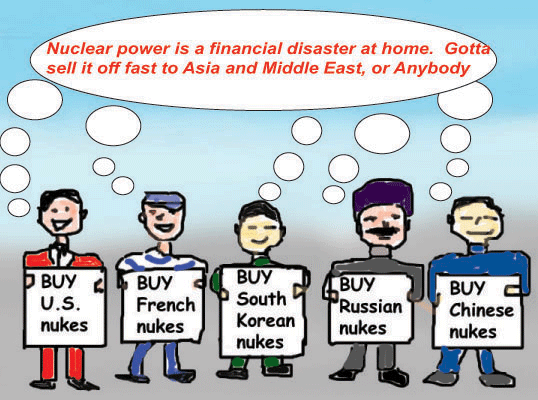
Foreign companies flock to build nuclear plants in the UK A South Korean firm is just the latest to be lured by Britain’s atomic amibitions as safety concerns and cost stalk the industry, Guardian, Adam Vaughan, 26 Mar 17, Nuclear energy faces an uncertain future globally as concerns over safety and cost dog the industry. But in the UK, foreign investors are queueing up to back projects. The latest is South Korea. Its biggest power company is in talks to join the consortium backing a nuclear power station in Cumbria, in a sign of the continuing allure of Britain’s atomic ambitions to international companies. Kepco said last week it was interested in taking a stake in NuGen, which is 60% owned by Japan’s Toshiba and 40% by France’s Engie, confirming what had been an open secret in the industry for months.
Kepco’s president, Cho Hwan-eik, said that once the terms of a potential deal were ironed out, “we will be the first to jump into the race”…….
Potential investors have been drawn by the UK government’s enthusiasm and a nuclear standstill elsewhere, amid lingering safety fears in the wake of the Fukushima disaster and cost overruns at the Flamanville site in France which is using a new reactor design. As a result, South Korea has joined Japan, China and France in showing interest in British nuclear.
It’s pretty simple. We are the only people building new nuclear power stations and we have by far the biggest new nuclear programme outside China for the next 10 years,” said Peter Atherton, an analyst at consultancy Cornwall Energy. “The civil nuclear programme globally doesn’t have any orders.”
One expert, Mycle Schneider, called the UK the “last hope” for the nuclear construction giants of the world. The Paris-based nuclear consultant said: “In Korea the political situation will dramatically change after the upcoming elections, [probably] not in favour of the nuclear industry. Success overseas will help survival at home. The Japanese industry clearly has no future at home and little prospects abroad [because of Fukushima].”
The UK has also dangled the prospect of economic support for foreign nuclear builders. French state-owned EDF, which is building two new reactors at Hinkley Point in Somerset at a cost of £18bn, struck a subsidy contract with the government that will see it guaranteed twice the wholesale price of electricity for 35 years. The deal means Hinkley would be an “absolute goldmine” when operational, Atherton said.
He said UK financial support was not dissimilar to the deal Kepco has in the United Arab Emirates, where it is building four new reactors paid for by the UAE’s state-owned utility. “The economics of the project, and the economic risks of the project, fall on the host government,” said Atherton.
Countries with crisis-ridden nuclear programs or phase-out policies (e.g. Germany, Belgium, and Taiwan) account for about half of the world’s operable reactors and more than half of worldwide nuclear power generation
Lobbyists debate responses to the nuclear power crisis, Online opinion
By Jim Green – , 27 March 2017, Nuclear lobbyists are abandoning the tiresome rhetoric about a nuclear power ‘renaissance’. Indeed they’ve turned full-circle and are now warning about a crisis. Michael Shellenberger from the Breakthrough Institute, a US-based pro-nuclear lobby group, has recently written articles about nuclear power’s “rapidly accelerating crisis” and the “crisis that threatens the death of nuclear energy in the West“.A recent articlefrom the Breakthrough Institute and the like-minded Third Way lobby group discusses “the crisis that the nuclear industry is presently facing in developed countries” and states that “the industry is on life support in the United States and other developed economies”.
‘Environmental Progress’, another US pro-nuclear lobby group connected to Shellenberger, also acknowledges a nuclear power crisis. The lobby group notes that 151 gigawatts (GW) of worldwide nuclear power capacity (38% of the total) could be lost by 2030 (compared to 33 GW of retirements over the past decade).
As a worldwide generalisation, nuclear power can’t be said to be in crisis. To take the extreme example, China’s nuclear power program isn’t in crisis ‒ it is moving ahead at pace. Nuclear power is moving ahead at snail’s pace in some other countries (e.g. Russia, South Korea), while in others the industry faces problems but is not in crisis (e.g. UK, Sweden, Switzerland, Belgium, Ukraine).




 Senator Pauline Hanson and her One Nation climate science-denying colleagues tried to pull a similar stunt last year by taking a dive on a part of the reef that had escaped bleaching and then claiming this as proof that everything was OK everywhere else…….






 nuclear-news