 As a U.S. Business, Nuclear Power Stinks http://www.powermag.com/blog/as-a-u-s-business-nuclear-power-stinks/ 01/01/2017 | Kennedy Maize Regardless of one’s views of the social values of nuclear power — compelling cases can be made all around — as a business proposition nuclear stinks.
The latest evidence comes from the giant Japanese conglomerate Toshiba, which saw a third of its market value vanish in two days of trading (20% in one day, a free-fall stopped only by a limit to trading losses imposed by the Japanese stock market). Credit rating agencies promptly downgraded the company’s debt.
Toshiba’s stock crash was a result of billions in reported losses from its Westinghouse Electric subsidiary and Westinghouse’s ruinous investment last year in nuclear engineering and construction behemoth CB&I Stone & Webster, itself the product of an ill-fated merger. Toshiba’s nuclear business has been hemorrhaging money at its U.S. construction projects in Georgia and South Carolina. Westinghouse is years behind schedule and billions of dollars over budget at its two construction projects: Southern’s Vogtle and Scana Corp.’s Summer units, a total of four Westinghouse AP1000 reactors under construction. Toshiba faces the possibility that its nuclear troubles will lead the company to a negative net worth.
My colleague Aaron Larson describes the gory business details well. The bottom line is that Westinghouse threatens to bring Toshiba to its financial knees, although the firm is too large to fail entirely. It may well require a Japanese government bailout.
Then there is France’s Areva, which has been bleeding red ink for more than a decade and would have expired but for its French government owners, and a recent bailout.
The company is far behind schedule and vastly over budget on construction projects in Finland and France. Late last year, discovery of quality control problems in carbon steel forgings from Areva’s Le Creusot Forge shocked the company. The allegations closed 20 of France’s 58 operating reactors, which also could jeopardize regulatory approval for extended operation at the aging plants.
In late December reports surfaced that Areva employees for decades hid problems in reactor parts it manufactured at Le Creusot Forge. Inspectors from the U.S., France,
China, and the U.K. descended on Areva to examine records and investigate the allegations. “I’m concerned that there keep being more and more problems unveiled,” Kerri Kavanagh, who leads the U.S. Nuclear Regulatory Commission’s unit inspecting Le Creusot, told the Wall Street Journal.
The business case for existing nukes in the U.S. is also ominous. Just last week, an Ohio newspaper reported that Akron-based FirstEnergy will close or sell its long-troubled, 900-MW Davis-Besse nuclear unit this year or next, without counting on a state bailout. “We have made our decision that over the next 12 to 18 months we’re going to exit competitive generation and become a fully regulated company,” CEO Chuck Jones said. “We are not going to wait on those states to decide what they are going to do there.” This comes on top of multiple closings of U.S. nukes unable to compete in competitive markets in recent years, state subsidies in Illinois and New York to keep uneconomic plants open, and threats of even more shutdowns.
At the same time as the Davis-Besse warning, Environmental Progress, a pro-nuclear group, released an analysis that concluded that a quarter to two-thirds of operating U.S. nuclear plants could face premature closure. If it weren’t for actions by state governments in Illinois and New York, the picture would look worse.
The Environmental Progress analysis counts 35 GW of nuclear capacity as at “triple risk” because “they are in deregulated markets, uneconomical (according to Bloomberg New Energy Finance) and up for relicensing before the end of 2030.” Facing greatest jeopardy for early closure? D.C. Cook in Michigan, Seabrook in New Hampshire, Millstone in Connecticut, and Davis-Besse in Ohio.
January 6, 2017
Posted by Christina Macpherson |
business and costs, USA |
Leave a comment
Greenland Ice Melt Could Push Atlantic Circulation to Collapse New research gives a glimpse of the potential long-term consequences of anthropogenic warming, Hakai Magazine, by Rebecca Boyle January 3, 2017
In the North Atlantic, east of North America and south of Greenland, the ocean’s upper layers are much warmer than one might presume given the extreme latitude. This unexpected warmth is a product of the Atlantic Meridional Overturning Circulation (AMOC), a vitally important system of ocean currents that moves warm salty water northward from the tropics and cold fresher water south. The AMOC looms large in the Earth’s climate: it is responsible for redistributing nutrients throughout the Atlantic Ocean and is a major driving force controlling the climate on both sides of the pond.
Ocean currents all experience fluctuations, which can dramatically change the distribution of nutrients, heat, and fish. The best known example is probably the El Niño-Southern Oscillation, in which unusually warm water occasionally disrupts the Pacific Ocean’s Humboldt Current that flows north from Chile toward Peru. El Niño events can shift the jet stream south, cause excessive rainfall and devastating floods, and temporarily collapse fish stocks.
To date, most climate research suggests that the AMOC is relatively stable and carries water throughout the ocean in a reliable, repeating cycle. But anthropogenic climate change seems to have made the current weaken slightly, raising the question of whether more dramatic shifts are in store. As of the most recent Intergovernmental Panel on Climate Change report, a shutdown of the circulation from further warming is considered unlikely. Yet a new study says that the unprecedented melting of Greenland’s massive ice sheets, previously overlooked in most climate modeling, will result in the AMOC weakening, and maybe even collapsing, within the next 300 years……..https://www.hakaimagazine.com/article-short/greenland-ice-melt-could-push-atlantic-circulation-collapse
January 6, 2017
Posted by Christina Macpherson |
2 WORLD, climate change, oceans |
Leave a comment
Scientists say the global ocean circulation may be more vulnerable to shutdown than we thought, WP, By Chelsea Harvey January 4 2017, Intense future climate change could have a far different impact on the world than current models predict, suggests a thought-provoking new study just out in the journal Science Advances. If atmospheric carbon dioxide concentrations were to double in the future, it finds, a major ocean current — one that helps regulate climate and weather patterns all over the world — could collapse. And that could paint a very different picture of the future than what we’ve assumed so far.
The Atlantic meridional overturning circulation, or AMOC, is often described as a large oceanic conveyor belt. It’s a system of water currents that transports warm water northward from the Atlantic toward the Arctic, contributing to the mild climate conditions found in places like Western Europe. In the Northern Atlantic, the northward flowing surface water eventually cools and sinks down toward the bottom of the ocean, and another current brings that cooler water back down south again. The whole process is part of a much larger system of overturning currents that circulates all over the world, from pole to pole.
But some scientists have begun to worry that the AMOC isn’t accurately represented in current climate models. They say that many models portray the current as being more stable than real-life observations suggest it actually is. Recent studies have suggested that the AMOC is weakening, although there’s some scientific debate about how much of this has been caused by human activities and how much by natural variations.
[In Greenland, a once doubtful scientist witnesses climate change’s troubling toll]
Nevertheless, the authors of the new study point out, many climate models assume a fairly stable AMOC — and that could be affecting the predictions they make for how the ocean will change under future climate change. And because overturning circulation patterns have such a significant effect on climate and weather all over the world, this could have big implications for all kinds of other climate-related projections as well.
“This is a very common and well-known issue in climate models,” said the new study’s lead author, Wei Liu, a postdoctoral associate at Yale University, who conducted the work while at the University of California at San Diego. “I wanted to see, if I use a corrected model, how this will affect the future climate change.”
Liu and colleagues from the UC-San Diego and the University of Wisconsin at Madison took a commonly used climate model and corrected for what they considered to be the AMOC stability bias. Then they ran an experiment to see how the correction would affect the model’s projections under future climate change. They instantaneously doubled the atmospheric carbon dioxide concentration from present-day levels in both the corrected and uncorrected models, and then they let both models run for hundreds of simulated years.
The differences were striking. In the uncorrected climate model, the AMOC weakens for a while, but eventually recovers. In the corrected model, however, the AMOC continues to weaken and after 300 years, it collapses altogether.
[Why scientists are so worried about sea-level rise in the second half of this century]
In a commentary also published today in RealClimate, Stefan Rahmstorf, an oceans physics expert at the Potsdam Institute for Climate Impact Research, explained how such a collapse could occur when the AMOC gets too weak.
“Freshwater continually flows into the northern Atlantic through precipitation, rivers and ice-melting,” he wrote. “But supply of salty waters from the south, through the Gulf Stream System, balances this. If however the current slows, there is less salt supply, and the surface ocean gets less salty.”
Because freshwater is less dense than salty water, this process can lead to a kind of stratification, in which the lighter freshwater gets stuck on the surface of the ocean and can’t sink to the bottom when it reaches the cooler north. When this happens, the overturning process that drives the current back down south again can’t occur.
“There is a critical point when this becomes an unstoppable vicious circle,” Rahmstorf wrote. “This is one of the classic tipping points in the climate system.”
The resulting climate consequences, compared to the uncorrected model, are also dramatic. Without the usual transport of warm water into the north, the corrected model predicts a marked cooling over the northern Atlantic, including in the United Kingdom, Iceland and northwestern Europe, as well as in the Arctic, where sea ice begins to expand.
Because the AMOC is part of a larger global conveyor system, which ferries warm and cold currents between the equator and both poles, the model predicts disruptions in other parts of the world as well. Without cold water moving back down south again, the corrected model indicates a stronger warming pattern south of the equator than what’s predicted by the uncorrected model, causing a polarization in precipitation patterns over the Americas — more rain for places like northeastern Brazil and less rain for Central America. The model also predicts a greater reduction in sea ice for the Antarctic.
All this doesn’t necessarily mean that everything we thought we knew about the future climate is wrong……..https://www.washingtonpost.com/news/energy-environment/wp/2017/01/04/scientists-say-the-global-ocean-circulation-may-be-more-vulnerable-to-shutdown-than-we-thought/?utm_term=.59c29620139f
January 6, 2017
Posted by Christina Macpherson |
2 WORLD, climate change, oceans |
Leave a comment
State of The Transition, December 2016: As fossil fuel diehards take over The White House, the evidence of a fast-moving global energy transition has never been clearer Jeremy Leggett, January 3, 2017 As captains of the fossil fuel industries and their lobbyists prepare to take over the White House – appointed by a President elected by a minority, claiming to represent the people on an anti-elite ticket yet possessing by far the highest cumulative wealth of any cabinet ever – they will face evidence breaking out all around them of a fast-moving global energy transition threatening to strand the fossil fuels they seek to boost.
“World energy hits a turning point”, a Bloomberg headline read on 16th December. “Solar power, for the first time, is becoming the cheapest form of new electricity,” the article marvelled. Analysis of the average cost of new wind and solar in 58 emerging-market economies – including China, India, and Brazil – showed solar at $1.65 million per megawatt and wind at $1.66.
Google leads the giant corporations eagerly going with this flow. The largest corporate buyer of renewable energy announced on 6th December that it expects to hit its target of 100% renewable power in, wait for it, 2017. Google is a huge consumer of power, and going solar means deep emissions cuts, especially when solar infrastructure is hooked up with all the digital efficiency-enhancement fandangoes that Silicon Valley giants are zeroing in on in the fast emerging era of artificial intelligence in an internet of things.
Google’s emissions reductions will be meaningful even considering full product life cycles. Solar panels made today pay back the energy used to make them in little more than a year, a Belgian research team from the University of Louvain reported in December. “For every doubling of installed photovoltaic capacity”, Atse Louwen and his colleagues write, “energy use decreases by 13 and 12% and greenhouse gas footprints by 17 and 24%, for poly- and monocrystalline based photovoltaic systems, respectively.” This means that solar panels now return more energy than American oil: an average energy-return on energy-invested of around 14 (and rising) versus around 11 (and falling).
This is excellent news not just for rich Californians but for the developing world, where “solar lanterns and rooftop photovoltaics are becoming the energy of choice”, so Bloomberg reported. In India, “the millions not connected to the grid may never connect” now, dooming much coal to be stranded underground in the process. The cumulative market of new Indian households accessing small-scale energy is potentially 200 gigawatts, with only a tiny fraction currently served.
In Myanmar the government needs no further persuasion: it announced plans to bring solar to all as soon as 2030. The technical advances in batteries and electric vehicles also became ever clearer in December. “Diesel faces global crash as electric cars shine”, the Financial Times announced. According to a UBS report, this whole category of oil use will be gone from the global market within ten years.
The positives of EVs synergise with the negatives of air pollution to create a perfect storm for diesel. At the C40 cities summit, Paris, Mexico City, Madrid and Athens all vowed to ban diesel vehicles by 2025. In China, the worst air pollution this year put 24 cities on red alert, with schools shut and flights grounded. Half a billion people were affected by this “airpocalypse”. In Chengdu, protestors took to the streets, putting smog masks on statues in the city centre. A heavy handed response by the police suggested that the government is super-sensitive to this issue.
Which is not to say that the Chinese authorities aren’t trying to abate the problem at source. I have summarised their rapid advances in renewables in earlier monthly reports. This month, a presentation in London by Zhang Gang, Counsellor of the State Council of China, revealed that China’s efforts to use electricity more efficiently, cutting the need for coal, now involve 317 million smart meters in operation across 100% of urban areas and 70% of rural areas. These are hooked up in smart co-ordination, spanning all aspects of grids, at all scales, in a vast project involving 230 million users. Part of this co-ordination involves China’s first expressway fast-charging EV network, stretching for 1,262 km between Beijing and Shanghai.
No other country comes remotely close to this kind of smart-grid deployment. On 12th December, the International Energy Agency issued a report concluding that China’s coal fired power plants “make no economic sense”. Small wonder.
India is on a similar rapid transition path. On 12th December the Central Electricity Authority announced that India does not need more coal-based capacity addition until 2022. The Authority now plans for non-hydro renewables to meet 43% of electricity as soon as 2027. Such an ambition would have been inconceivable until recently. On 20th, Bloomberg analysed the widening gap between projected and actual demand in the world’s third largest emitter, and put their conclusion in an encouraging headline: “India’s energy forecasts are falling short and climate could win.”
What are investors to make of all this? Well, it is rare for a report to hold the potential to change the world. But one published on 14th December did. The Recommendations of the Task Force on Climate-related Financial Disclosures (TCFD) aim to give investors, lenders and insurers visibility of how climate-change risk will affect individual businesses, and a roadmap for reacting to it. The report presents the results of a year of deliberations by 32 representatives of companies with market capitalisation of $1.5 trillion and financial institutions responsible for assets of $20 trillion. Their intention is for the capital markets to behave consistently with the aims of the Paris Agreement on climate change, which is to say progressively retreat from fossil fuels, and increasingly favour clean-energy investments, not least renewables………..
How has Big Energy coped on the transition frontier as 2016 came to a close? Two snapshots. The utility industry continues to be split into companies seeking to defend the fast shrinking status quo, and those now rushing to be part of the new world. One of the latter, Engie (formerly GdF Suez) announced that it sees the oil price falling to $10 as a result of current trends in energy markets, and the wave of clean-energy investments it and other major corporates are making. That would be interesting, should it transpire. For example, on 1st December BP gave the green light to a $9bn investment in a deepwater oilfield, rather appropriately named Mad Dog 2, due onstream (cue laughter, based on the industry’s record of delivering major projects on time) in 2021. Good luck to them in recouping their investment if Engie’s view of the world comes to pass.
My conclusion, as the new year begins, is that the global energy transition is progressing faster than many people think, and is probably irreversible. Trump’s prospects of resurrecting coal, and giving the oil and gas industry the expansionist dream ticket most of it wants, are very low.
There is a caveat, of course: that he doesn’t manage to blunder into a world war. All bets would be off then.
In 2017, I will consider this wider security question in my summaries, plus the issues of cybersecurity and fast-emerging artificial intelligence and robotics. For they have all now become clearly relevant to the ultimate outcome of the great global drama in the energy-climate-data nexus. http://www.jeremyleggett.net/2017/01/state-of-the-transition-december-2016-as-fossil-fuel-diehards-take-over-the-white-house-the-evidence-of-a-fast-moving-global-energy-transition-has-never-been-clearer/
January 6, 2017
Posted by Christina Macpherson |
2 WORLD, ENERGY |
Leave a comment
All those terror attacks’: Sweden’s nuclear sites to get armed guards Rt.com 5 Jan, 2017 Sweden has decided to tighten up security around nuclear plants by requiring guards to be armed. The measures will be introduced following recent terrorists attacks across the globe.
“Just look at all the terror attacks, for example in Istanbul recently. We have to keep up and protect our operations as best we can,” Anders Österberg, spokesperson for OKG AB, a Swedish corporation which owns and operates the country’s Oskarshamn Nuclear Power Plant, said, according to Sveriges Radio on Thursday.
Starting from February 4, guards at three Swedish nuclear plants – in Ringhals, Oskarshamn, and Forsmark – will be equipped with guns, Österberg later told TT news agency. Under new regulations, security officers are required to use guard dogs for patrolling nuclear power sites.
Until now, the guards were only allowed to carry batons……..https://www.rt.com/news/372732-sweden-security-nuclear-sites/
January 6, 2017
Posted by Christina Macpherson |
safety, Switzerland |
Leave a comment
Amanda Oglesby , @OglesbyAPPApp.com Jan. 4, 2017 LACEY – The U.S. Nuclear Regulatory Commission performed special inspections of Oyster Creek Generating Station after personnel found a box of uranium-containing monitors outside the nuclear power plant’s designated nuclear-containing Material Access Area.
The box of eight local power range monitors was found Oct. 6 under a pallet and other material inside the warehouse, where it mostly likely sat for decades, according to a letter from Exelon Generation to the U.S. Nuclear Regulatory Commission. Nothing on the box marked the contents as containing radioactive material, according to the letter.
The monitors, which measure power inside of the nuclear reactor, contained less than a gram of uranium-235, said Neil Sheehan, a spokesman for the Nuclear Regulatory Commission.
Uranium-235 is radioactive. If ingested or inhaled, it can cause cancer or serious damage to major organs in the body, according to the Centers for Disease Control.
It is the same isotope of uranium that is used within the plant’s fuel rods, said Dave Lochbaum, director of the Nuclear Safety Program for the Union of Concerned Scientists. With enough of the material, someone could make a dirty bomb or nuclear weapon, he said.
“You want to control this material so it doesn’t get into places it shouldn’t be,” Lochbaum said.
Radiation is odorless and tasteless, so it can cause harm before someone realizes they are being exposed, he said……http://www.app.com/story/news/investigations/watchdog/investigations/2017/01/04/nuclear-material-misplaced-oyster-creek/96165918/
January 6, 2017
Posted by Christina Macpherson |
incidents, USA |
Leave a comment
Reuters, By Kentaro Hamada | NIIGATA, JAPAN, Jan 5, 2017
The governor of Japan’s Niigata prefecture reiterated his opposition to the restart of Tokyo Electric Power’s (Tepco) Kashiwazaki-Kariwa nuclear plant, adding it may take a few years to review the pre-conditions for restart.
During a meeting on Thursday with Tepco Chairman Fumio Sudo and President Naomi Hirose, Governor Ryuichi Yoneyama, who was elected in October on his anti-nuclear platform, repeated his pledge to keep the plant shut unless a fuller explanation of the 2011 Fukushima nuclear disaster was provided.
He also said that evacuation plans for people in Niigata in case of a nuclear accident and the health impacts that the Fukushima accident have had would need to be reviewed before discussing the nuclear plant’s restart……..http://www.reuters.com/article/us-japan-tepco-idUSKBN14P0IK
January 6, 2017
Posted by Christina Macpherson |
Japan, politics |
Leave a comment
Nuclear workers in strike threat at Wylfa and Trawsfynydd, Daily Post 4 Jan 17 Union leaders are to meet to discuss potential action over a pensions row Union leaders representing nuclear workers at Wylfa and Trawsfynydd are to consider strike action over pensions.
The unions said 16,000 workers at 19 sites across the UK face cuts under plans by the Nuclear Decommissioning Authority to make savings of £660 million.
They include hundreds of Magnox staff at Wylfa on Anglesey, which is currently de-fuelling after ending operations at the end of 2015, and Trawsfynydd in Gwynedd, which is being decommissioned.
The unions said the Government’s expectation is that the final salary pension schemes in place across the NDA estate will be reformed by April 2018.
Justin Bowden, GMB national officer, said: “There is no justification for this attack on the pensions of these nuclear workers and their communities.
“These pension funds are in a sound state and underwent considerable reform 10 years ago…….http://www.dailypost.co.uk/business/business-news/nuclear-worker-strike-threat-wylfa-12409439
January 6, 2017
Posted by Christina Macpherson |
employment |
Leave a comment
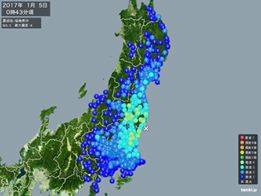
Strong quakes jolt eastern Japan
TOKYO (Kyodo) — A pair of earthquakes with a preliminary magnitude of 5.3 and 5.8 struck Fukushima and Ibaraki prefectures in eastern Japan early Thursday, the Japan Meteorological Agency said. No tsunami warning was issued.
The temblors occurred at around 12:44 a.m. and 2:53 a.m., originating at depths of about 60 and 30 kilometers off the coast of Fukushima. They measured up to 4 on the Japanese seismic scale of 7 in southern Fukushima and northern Ibaraki.
After the quakes, no abnormalities were detected at two nuclear power plants — the crippled Fukushima Daiichi and idled Fukushima Daini, according to the operator, Tokyo Electric Power Company Holdings Inc.
Fukushima was hard hit by the March 11, 2011 earthquake-tsunami and nuclear crisis.
http://mainichi.jp/english/articles/20170105/p2g/00m/0dm/001000c
Pair of strong late-night quakes jolt Fukushima, Ibaraki
A magnitude-5.3 earthquake and another of magnitude-5.8 struck Fukushima and Ibaraki prefectures early Thursday, the Meteorological Agency said. No tsunami warning was issued.
The earthquakes occurred at 12:44 a.m. and 2:53 a.m., originating at depths of about 60 km and 30 km off the coast of Fukushima, respectively. They measured up to 4 on the Japanese seismic scale to 7 in southern Fukushima and northern Ibaraki.
After the quakes, no abnormalities were detected at the crippled Fukushima No. 1 nuclear plant and the nearby idled Fukushima No. 2 plant, according to Tokyo Electric Power Company Holdings Inc.
Fukushima was hit hard by the March 11, 2011, earthquake-tsunami and nuclear crisis.
http://www.japantimes.co.jp/news/2017/01/05/national/pair-strong-late-night-quakes-give-fukushima-ibaraki-jolts/#.WG57TFzia-c
January 5, 2017
Posted by dunrenard |
Fukushima 2017 | Earthquakes, Fukushima, Ibaraki |
1 Comment
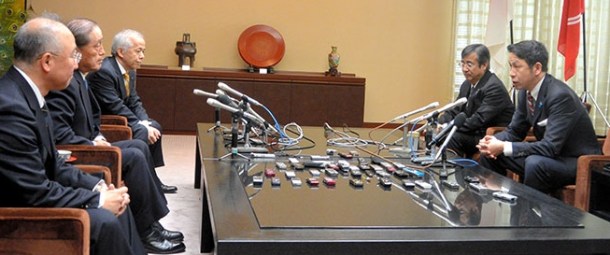
Niigata Governor Ryuichi Yoneyama, far right, holds talks with executives of Tokyo Electric Power Co. in the Niigata prefectural government office on Jan. 5.
Niigata governor rejects restarts in 1st meet with TEPCO execs
NIIGATA–Niigata Governor Ryuichi Yoneyama met Jan. 5 with top executives of Tokyo Electric Power Co. (TEPCO) for the first time, reiterating his opposition to restarting the Kashiwazaki-Kariwa nuclear power plant.
“It will be difficult to approve the restart as long as (the causes of) the accident at the Fukushima No. 1 nuclear power plant are not verified. In the present circumstances, I cannot accept the restart,” Yoneyama told Fumio Sudo, chairman of Tokyo Electric Power Co. Holdings Inc., and Naomi Hirose, president of the company.
It was the first time for Yoneyama to meet with TEPCO executives since he assumed the post of Niigata governor last October. The talks were held in the Niigata prefectural government office.
Yoneyama, noting that it will take several years for the Niigata prefectural government to verify the causes of the 2011 nuclear disaster, asked the TEPCO executives to provide more information and other forms of cooperation.
In response, Sudo said, “The priority is to hear voices of local residents.”
This seemed to suggest that TEPCO will not restart the Kashiwazaki-Kariwa nuclear power plant as long as the Niigata governor continues to resist the move.
A council of experts of the Ministry of Economy, Trade and Industry announced late last year that the costs for dealing with the aftermath of the Fukushima nuclear disaster will almost double to 21.5 trillion yen ($185 billion) from 11 trillion yen initially estimated in 2013.
To help cover the amount, TEPCO planned to restart two reactors at the Kashiwazaki-Kariwa to generate 100 billion yen in annual profits. But that now looks difficult, given Yoneyama’s firm stance on the issue of restarts.
http://www.asahi.com/ajw/articles/AJ201701050067.html
Gov. says restart of nuclear plant in Niigata to take “several years”
The restart of a nuclear power plant operated by Tokyo Electric Power Company Holdings Inc. on the Sea of Japan coast will likely take “several years,” the governor of Niigata Prefecture said Thursday, highlighting the difficulty in concluding post-2011 nuclear disaster reviews.
The utility known as TEPCO has been seeking to reactivate the Kashiwazaki-Kariwa nuclear plant, the world’s largest by generation capacity, as soon as possible to boost revenue, as it grapples with ballooning costs stemming from the 2011 nuclear disaster in Japan’s northeast.
“There can be no discussions about a restart without reviewing” factors including the cause of the Fukushima nuclear accident and evacuation plans for residents, Niigata Gov. Ryuichi Yoneyama said in his first talks with TEPCO executives since assuming office in October.
http://english.kyodonews.jp/news/2017/01/452300.html
Japan governor tells Tepco bosses nuclear plant to stay shut
The governor of Japan’s Niigata prefecture reiterated his opposition to the restart of Tokyo Electric Power’s (Tepco) Kashiwazaki-Kariwa nuclear plant, adding it may take a few years to review the pre-conditions for restart.
During a meeting on Thursday with Tepco Chairman Fumio Sudo and President Naomi Hirose, Governor Ryuichi Yoneyama, who was elected in October on his anti-nuclear platform, repeated his pledge to keep the plant shut unless a fuller explanation of the 2011 Fukushima nuclear disaster was provided.
He also said that evacuation plans for people in Niigata in case of a nuclear accident and the health impacts that the Fukushima accident have had would need to be reviewed before discussing the nuclear plant’s restart.
The restart of the Kashiwazaki-Kariwa plant, the world’s largest, is key to helping Tepco rebound from the aftermath of the 2011 disaster at its Fukushima-Daiichi plant.
The Japanese government last month nearly doubled its projections for costs related to the disaster to 21.5 trillion yen ($185 billion), increasing the pressure on Tepco to step up reform and improve its performance.
Many of Japan’s reactors are still going through a relicensing process by a new regulator set up after the Fukushima disaster, the world’s worst since Chernobyl in 1986.
Shutting the Kashiwazaki-Kariwa plant for additional years would mean that the company would have to continue relying heavily on fossil fuel-fired power generation such as natural gas.
Governors do not have the legal authority to prevent restarts but their agreement is usually required before a plant can resume operations.
Three reactors at Tepco’s Fukushima-Daiichi nuclear plant melted down after a magnitude 9 earthquake struck Japan in March 2011, triggering a tsunami that devastated a swathe of Japan’s northeastern coastline and killed more than 15,000 people.
http://www.reuters.com/article/us-japan-tepco-idUSKBN14P0IK?il=0
January 5, 2017
Posted by dunrenard |
Japan | Kashiwazaki-Kariwa NPP, Niigata Governor, Tepco |
Leave a comment
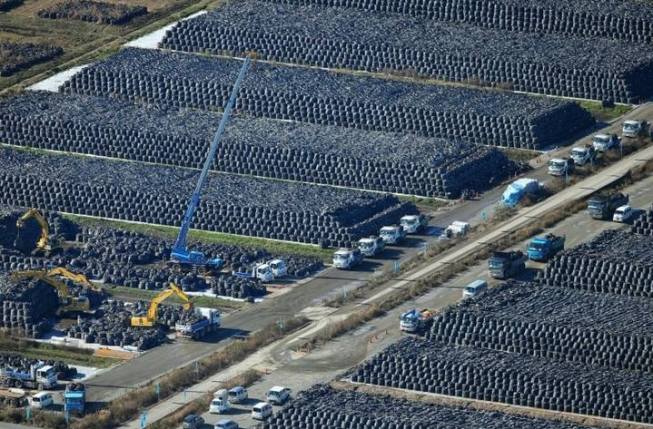
The Ministry of the Environment deleted some of its remarks made in closed-door meetings on reuse of contaminated soil stemming from the Fukushima nuclear disaster from the minutes of the meetings, it has been learned.
When the ministry posted the minutes on its website, it said it had “fully disclosed” them. The deleted remarks could be taken to mean that the ministry induced the discussions. The remarks led the meetings to decide on a policy of reusing contaminated soil containing up to 8,000 becquerels of radioactive cesium per kilogram. An expert on information disclosure lashed out at the ministry’s handling of the minutes, saying, “It is extremely heinous because it constitutes the concealment of the decision-making process.”
The meetings were called the “working group to discuss safety assessments of impacts of radiation.” The meetings were attended by about 20 people, including radiation experts, officials of the Environment Ministry and the Japan Atomic Energy Agency (JAEA) and others. The meetings were held six times from January to May in 2016.
The meetings discussed the reuse of radioactively contaminated soil generated when areas affected by the Fukushima nuclear crisis were decontaminated.
Initially, the meetings themselves were unpublicized. But because requests for information disclosure on the meetings were filed one after another, the Environment Ministry posted the minutes and relevant data on its website in August. As a matter of clerical procedures, the ministry said at that time that everything was disclosed.
The minutes that were disclosed contain “draft minutes” that were prepared before becoming official documents, but the Mainichi Shimbun obtained an “original draft” that was prepared even before then. Comparing the disclosed minutes with the original draft, the Mainichi found multiple cases of remarks being deleted or changed. According to the original draft, an Environment Ministry official said at the fourth meeting on Feb. 24, “With the assessments of soil with 8,000 becquerels, there have been cases in which the annual radiation dose slightly exceeds 1 millisievert in times of disasters and the like. But it will be good if it stays within 1 millisievert.” But the remark was deleted from the disclosed minutes.
Soil contaminated with radiation exceeding 8,000 becquerels is handled as “designated waste,” but discussions were held on reusing of contaminated soil containing 8,000 becquerels of radioactive cesium per kilogram during a series of meetings. In the Feb. 24 meeting, the JAEA showed an estimate that workers engaged in recovery work on a breakwater made of contaminated soil of 8,000 becquerels that has collapsed in a disaster would be exposed to radiation exceeding 1 millisievert per year — the maximum dose allowed for ordinary people. Based on the estimate, there was a possibility of the upper limit for reusing contaminated soil being lowered, but the Environment Ministry official’s remark promoted experts and others to call for s review to make a new estimate, with one attendee saying, “If it collapses, it will be mixed with other soil and diluted.”
A fresh estimate that the annual radiation dose will stay at 1 millisievert or lower was later officially presented, and the Environment Ministry officially decided in June on a policy of reusing contaminated soil containing up to 8,000 becquerels of radioactive cesium per kilogram.
http://mainichi.jp/english/articles/20170105/p2a/00m/0na/007000c
January 5, 2017
Posted by dunrenard |
Fukushima 2017 | Contaminated Soil, Contaminated Waste, Fukushima |
Leave a comment
 geoharvey
Science and Technology:
¶ 2016 was the hottest year on record globally. While the world
is still waiting for confirmation of just how high the record was, there’s a lot of data to digest from the US. Nearly every square inch of the country was dramatically warmer than normal, and 85% of extreme temperature records set in 2016 were record highs. [CleanTechnica]
 Percentages of temperature records set that were for hot weather
¶ Evidence the earth experienced a slowdown in global warming over the past couple of decades has been further eroded with a new US study confirming climate change continues unabated. NOAA found the oceans had warmed at the rate of 0.12° per decade since 2000, or nearly twice the previous estimate. [The Sydney Morning Herald]
¶ One of the world’s largest ocean circulation systems may not be as stable as believed, according to a…
View original post 777 more words
January 5, 2017
Posted by Christina Macpherson |
Uncategorized |
Leave a comment
 jpratt27
The tipping point for climate change is nigh upon us
All this while climate change seemed like the mountain was far enough. But time is running out and we don’t seem to be concerned about the impending crash

Up until now, the conversation on the issue of climate change has almost always been hopeful. In various rounds of international negotiations, we have looked into the future and said that if we cap global carbon emissions, we will be able to stall temperature increases. While the “if” part of that conversation has been the proverbial can that has been conveniently kicked down the road time and again, the tone has generally been optimistic.
President-elect Donald Trump’s ascent to the White House is going to change things, however. While businessman-Trump, in 2009, had undersigned a full-page advertisement in The New York Times supporting President Barack Obama’s efforts to drum up a climate…
View original post 816 more words
January 5, 2017
Posted by Christina Macpherson |
Uncategorized |
Leave a comment
 Radiation Free Lakeland

The following is a message from Steamboat Andy he draws our attention to a great book by Kristin Shrader-Frechette which exposes the industry lies about their heroic climate saviour status used as justification for diabolic new build.
“ok, so at the heart of the climate change case for expanding atomic energy is the climate necessity argument,the claim that, because nuclear generation of electricity is carbon free, it is needed to help address CC, Note that the nuke industry have trimmed the figures down to including only stage 7 of a 14 stage nuclear fuel cycle, These stages are
(1) mining uranium ore- or leaching it out,by using hundreds of metric tons of chemicals such as sulfuric acid, nitric acid and ammonia.
(2) milling the ore to extract the roughly 0.2 percent uranium oxide from it.
(3) converting the uranium oxide to gaseous uranium hexafluoride by means of fluorine.
(4) enriching…
View original post 1,984 more words
January 5, 2017
Posted by Christina Macpherson |
Uncategorized |
Leave a comment
geoharvey
Opinion:
¶ “Trump’s climate-policy rollback may not be easy” • The US treasury is being offered millions in wind energy project bids. The wind industry creates huge numbers of jobs, and wind-farm technician is America’s fastest-growing occupation. The US President-elect’s promise of a rollback on climate-change policy may not come easy. [ETEnergyworld.com]
 Wind farm
Science and Technology:
¶ Renewable energy is on the rise, with the biggest development being the Paris Climate Agreement that all UN members signed. However, a study by researchers at Duke University indicates that green technology proliferation needs to increase by a factor of ten in order to have any lasting effect on reducing greenhouse gasses. [EconoTimes]
¶ Blooming rhododendrons, with their conspicuous displays of deep red or pale pink flowers, have always heralded the arrival of spring in the Himalayas. Now, however, this has undergone a dramatic change, as peak flowering…
View original post 748 more words
January 5, 2017
Posted by Christina Macpherson |
Uncategorized |
Leave a comment







 nuclear-news