France ready to save nuclear group Areva, regardless of election outcome, Globe and Mail, GEERT DE CLERCQ, PARIS — Reuters, Jan. 04, 2017 A government-led rescue of French nuclear group Areva and the wider atomic-energy industry may cost the state as much as €10-billion ($13.94-billion Canadian), but political support is almost certain whoever wins the presidential election in May.
While taxpayers will ultimately pick up the huge bill, the main election contenders – from the Socialists and conservatives to the far-right National Front – broadly back the bailout, which involves splitting up Areva.
On top of its dire financial state, Areva is beset by technical, regulatory and legal problems. But given its importance to a nuclear industry that generates three quarters of France’s electricity and employs 220,000 people, the next government probably has little choice but to stand by the scheme hatched under outgoing Socialist President Francois Hollande.
France has a small but fierce anti-nuclear movement and some critics oppose investing billions in extending the life of aging reactors. Nevertheless, nuclear energy is broadly accepted, even though neighbouring Germany has decided to ditch it altogether following the 2011 disaster at Japan’s Fukushima plant…….
The nuclear industry rescue also involves a cash injection for power utility EDF, which operates France’s 58 nuclear reactors and will buy part of Areva’s business. But for all the domestic support, Brussels must also rule on whether the bailout complies with European Union rules on state aid………
Once the champion of France’s nuclear industry, 87-per-cent state-owned Areva has seen its equity wiped out by years of losses. Among its biggest problems is a nuclear plant it is building in Olkiluoto, Finland. Work is almost a decade behind schedule and huge cost overruns have led to Finnish utility TVO and Areva claiming billions from each other.
A similar project in Flamanville, France is also running years late, with costs spiralling. Areva has also had to take heavy writedowns on its African uranium mines while foreign orders have generally slumped since the Fukushima accident.
On top of this, U.S. and other regulators are investigating possible safety problems related to the suspected falsification of documents at Areva’s Le Creusot plant, which makes components for reactors worldwide.
In a restructuring that means an end to Areva as an integrated nuclear group, the firm will sell its reactor unit Areva NP to EDF. The French state will effectively nationalize the Olkiluoto liabilities and Areva will receive a mainly state-funded cash injection of €5-billion to refloat it as a uranium mining and nuclear fuel group.
— In the last days of the Obama Administration, the U.S. Environmental Protection Agency is about to dramatically increase allowable public exposure to radioactivity to levels thousands of times above the maximum limits of the Safe Drinking Water Act, according to documents the agency surrendered in a federal lawsuit brought by Public Employees for Environmental Responsibility (PEER). These radical rollbacks cover the “intermediate period” following a radiation release and could last for up to several years. This plan is in its final stage of approval.
The documents indicate that the plan’s rationale is rooted in public relations, not public health. Following Japan’s Fukushima meltdown in 2011, EPA’s claims that no radioactivity could reach the U.S. at levels of concern were contradicted by its own rainwater measurements showing contamination from Fukushima throughout the U.S. well above Safe Drinking Water Act limits. In reaction, EPA prepared new limits 1000s of times higher than even the Fukushima rainwater because “EPA experienced major difficulties conveying to the public that the detected levels…were not of immediate concern for public health.”
When EPA published for public comment the proposed “Protective Action Guides,” it hid proposed new concentrations for all but four of the 110 radionuclides covered, and refused to reveal how much they were above Safe Drinking Water Act limits. It took a lawsuit to get EPA to release documents showing that –
The proposed PAGs for two radionuclides (Cobalt-60 and Calcium-45) are more than 10,000 times Safe Drinking Water Act limits. Others are hundreds or thousands of times higher;
According to EPA’s own internal analysis, some concentrations are high enough to deliver a lifetime permissible dose in a single day. Scores of other radionuclides would be allowed at levels that would produce a lifetime dose in a week or a month;
The levels proposed by the Obama EPA are higher than what the Bush EPA tried to adopt–also in its final days. That plan was ultimately withdrawn; and
EPA hid the proposed increases from the public so as to “avoid confusion,” intending to release the higher concentrations only after the proposal was adopted. The documents also reveal that EPA’s radiation division even hid the new concentrations from other divisions of EPA that were critical of the proposal, requiring repeated efforts to get them to even be disclosed internally.
“To cover its embarrassment after being caught dissembling about Fukushima fallout on American soil, EPA is pursuing a justification for assuming a radioactive fetal position even in cases of ultra-high contamination,” stated PEER Executive Director Jeff Ruch, noting that New York Attorney General Eric Schneiderman has called for the PAGs to be withdrawn on both public health and legal grounds. “The Safe Drinking Water Act is a federal law; it cannot be nullified or neutered by regulatory ‘guidance.’”
Despite claims of transparency, EPA solicited public comment on its plan even as it hid the bulk of the plan’s effects. Nonetheless, more than 60,000 people filed comments in opposition.
“The Dr. Strangelove wing of EPA does not want this information shared with many of its own experts, let alone the public,” added Ruch, noting that PEER had to file a Freedom of Information Act lawsuit to force release of exposure limits. “This is a matter of public health that should be promulgated in broad daylight rather than slimed through in the witching hours of a departing administration.”
NuGen ‘remains committed’ to Moorside nuclear plant http://www.in-cumbria.com/NuGen-remains-committed-to-Moorside-nuclear-plant-b026a08f-7adb-4f7a-b6ff-c67aa3026e0a-ds by Duncan Bick January 5, 2017NUGEN says it “remains committed” to plans for a nuclear power station in Cumbria, despite the crisis affecting its majority shareholder Toshiba. Forty per cent was wiped off the Japanese company’s value in the last week of 2016 after it said that its US subsidiary, Westinghouse Electric, may have overpaid by several billions of dollars for another nuclear construction and services business.
To compound matters, the company is embroiled in an accounting scandal.
Its shares plunged to 259 yen (£1.81) on Thursday before staging a modest recovery on Friday. Yesterday they settled at slightly more than 277 yen when the Tokyo stock exchange closed.
Toshiba holds a 60 per cent stake in developer NuGen, alongside ENGIE of France.
They are due to decide next year whether to proceed. If the do, a £10bn power station will be constructed at Moorside, Sellafield. The credit agency Moody’s has downgraded Toshiba’s ratings and warned that the writedown could affect the company’s ability to pay its debts.
But a spokesman for NuGen said: “NuGen’s shareholders [Toshiba and ENGIE] remain committed to the development of our Moorside project.
“NuGen is actively engaged in exploring a universe of investment opportunities to bring in additional investments, including debt and equity, to help fund the construction of Europe’s largest new nuclear power station.”
He added: “NuGen welcomed the recent signing of a memorandum of cooperation between the UK and Japanese governments.
“The agreement shows confidence in the progress and deliverability of Moorside and commitment to nuclear as a solution to meeting the UK’s low carbon electricity requirements.”
NuGen has been seeking further backers for the scheme and is understood to have held talks about investment from the Korea Electrical Power Corporation.
If Moorside does go ahead, Westinghouse, once owned by British Nuclear Fuels, would supply three reactors.
They would have a capacity of up to 3.8GW, enough to supply 7.5 per cent of the UK’s electricity.
Tesla Flips the Switch on the Gigafactory Musk meets a deadline: Battery-cell production begins at what will soon be the world’s biggest factory—with thousands of additional jobs. Bloomberg, by Tom Randall January 5, 2017 The Gigafactory has been activated.
Tesla’s solar roofs could revolutionize the industry
Hidden in the scrubland east of Reno, Nev., where cowboys gamble and wild horses still roam—a diamond-shaped factory of outlandish proportions is emerging from the sweat and promises of Tesla CEO Elon Musk. It’s known as the Gigafactory, and today its first battery cells are rolling off production lines to power the company’s energy storage products and, before long, the Model 3 electric car. 1
The start of mass production 2 is a huge milestone in Tesla’s quest to electrify transportation, and it brings to America a manufacturing industry—battery cells—that’s long been dominated by China, Japan, and South Korea. More than 2,900 people are already working at the 4.9 million square-foot facility, 3 and more than 4,000 jobs (including temporary construction work) will be added this year through the partnership between Tesla and Panasonic. 4
By 2018, the Gigafactory, which is less than a third complete, will double the world’s production capacity for lithium-ion batteries and employ 6,500 full-time Reno-based workers, according to a new hiring forecast from Tesla. The company’s shares, having touched their highest point since August, closed up $10 at $226.99 in New York trading.
The full activation of the Gigafactory carries existential significance for Tesla, representing a new sense of urgency at a company known for its unreachable deadlines. After missing almost every aggressive product milestone it set for itself over the last decade, Tesla must prove to investors and customers that it can stay on schedule for its first mass-produced car.
There are promising signs. ………
The storage products fit into Musk’s long-term vision of transforming Tesla from an an electric car company to a clean-energy company. That’s the same motivation behind his recently concluded deal to acquire SolarCity Corp., the largest U.S. rooftop solar installer. Last week, Tesla reached a deal with Panasonic to expand its relationship to produce solar cells in Buffalo, N.Y., bringing some 1,400 jobs to the region.
At a time when President-elect Donald Trump has taken to Twitter to skewer manufacturers for moving jobs to Mexico or China, Tesla stands apart as an all-American carmaker, battery maker, and solar producer. About 95 percent of the Model 3’s components will be made in the U.S., and 25,000 of the company’s 30,000 employees are based there. Musk, who visited Trump recently in New York City, was named to a strategy group to advise the new Republican president. ……. https://www.bloomberg.com/news/articles/2017-01-04/tesla-flips-the-switch-on-the-gigafactory
The “madman theory” of nuclear war has existed for decades. Now, Trump is playing the madman.VOX, by Nicole Hemmer Jan 4, 2017, Is Donald Trump a madman? Or, at least, would he like foreign leaders to think he might be just a little unstable? Such questions are being batted around in papers like the Boston Globe and the Washington Post in response to the president-elect’s foreign policy moves: his provocations toward China, his attacks on NATO and the UN, his warm overtures toward Rodrigo Duterte and Vladimir Putin.
Across the pundit-sphere, analysts are asking, is he crazy, or crazy like a fox?
In no context is the question more pertinent than Trump’s position on nuclear weapons. His comments both as candidate and president-elect show a more cavalier attitude toward their proliferation and use than any president in the past 30 years. “You want to be unpredictable,” Trump said last January on Face the Nation when asked about nuclear weapons. More recently, he tweeted that it was time for the US to start stockpiling nukes again. The comments prompted instant parallels to Richard Nixon’s “madman theory” of foreign relations: the idea that the president couldn’t be controlled — including where America’s nuclear arsenal was concerned — so foreign leaders should do everything in their power to appease him.
The madman question is so important here because madness has been a mainstay of nuclear culture since the atomic age flashed into being in the Jornada del Muerto desert in 1945. The bomb, carefully engineered by some of the 20th century’s most brilliant scientists, able to raze cities and civilizations, has always spanned rationality and irrationality, logic and madness.
The brightest minds created the most destructive force, and then leaders spent years working out rationales for its world-ending use. It was a madness begot by logic. But that madness doesn’t always present in the same way, which is why the history of nuclear madness has to precede our understanding of the Trump-as-madman debate…….
A brief, terrifying history of America’s nuclear mishaps
four years after Hiroshima and Nagasaki, the Soviets tested their own nuclear bomb, and the race was on for more powerful bombs, for better strike capability, for the ability to annihilate the other side before it could return fire. By the mid-1950s, the arms race had reached its illogically logical endpoint: If one side struck, everyone would be wiped out. Mutual assured destruction. MAD.
The acronym stuck, perhaps because of the horrific absurdity of it all. The logical conclusion, the position to which the world had been brought by the combined education and expertise of scientists and strategists, was the verge of obliteration………
As time passed, Mutually Assured Destruction came to seem — MAD……….
Maybe it was the exhaustion of the arms race, or the terror of the missile crisis, or the apocalyptic consequences of MAD, but by 1964 the idea of ever using nuclear weapons was considered insane. If the outcome truly was mutual assured destruction, then it would take an act of self-destructive madness to press the button………
World leaders understand that nations with nuclear weapons are treated differently than those without, and so there is a rational reason for pursuing nuclear technology. At the same time, the use of nuclear weapons against an enemy would make a nation-state into a global pariah. It would be insane.
Enter Donald Trump. The president-in-waiting is schooled in none of these particulars, claiming to believe only in strength and the desire to use it. His loose talk about nukes has re-raised the long-dormant question: Is he crazy enough to actually press the button?
Here, the history of nuclear madness may be as much a trap as a guide. Because the questions now shouldn’t be about Trump’s madness but his impulsivity and ignorance. Whatever one thinks of Nixon and Kissinger’s madman theory, it was a calculation. Kissinger was steeped in game theory and Nixon had a deep knowledge of international affairs. Reagan was a foreign policy autodidact with experienced ideological advisors. Their administrations could tell a hawk from a handsaw. (Admittedly, some of these comforting thoughts were only fully evident in hindsight.)
Trump doesn’t share his predecessors’ considered strategic thinking and mastery of geopolitics, but that doesn’t make him a madman. The madness is in the weapons themselves, powerful enough to obliterate entire countries, entire peoples, and in the logics that grew up around them to govern their disuse. The only hope is that, as with Nixon and Reagan before him, Trump’s time in office makes clear how badly things can go in an atomic age, and how important it is to continue the push to contain, if not eliminate, the madness in our midst.
Fukushima Radiation Looms. No Nuclear Power Plant On Planet Earth! “The Incompatibility of Radiation with Human Life” By Eiichiro OchiaiGlobal Research, January 05, 2017.…………… Approximately 450 nuclear power reactors are presently on this earth. In the nuclear power production of electricity, only one third of the heat produced in a reactor is converted into electricity, and the remainder two third of heat is released into the surrounding. A typical 1giga watt reactor will release 4.7 x 10¹⁶ joule of heat into the environment per year. This much heat will bring 100 million tons of water at zero degree to boiling. This is with a single nuclear reactor. The nuclear power reactors are excellent environmental heaters. Hundreds of such reactors are operating on this earth. But this fact is ignored in the argument of the nuclear power being environmentally clean. This is not the only reason for the nuclear reactors being unclean.
In addition, this typical reactor of 1 giga (thousand mega) watt of capacity (electricity) produces in a year radioactive material equivalent to about 1000 Hiroshima atomic bombs. In 2015, the total amount of electricity produced by nuclear reactors was 2,441 BkWh (billion kilo watt hours: data [7]), which is 8.79 x 10¹⁸ joule. It was produced by about 280 nuclear reactors of 1 giga watt capacity. So they produced radioactive material approximately equivalent to 280,000 Hiroshima bombs. In addition, they released 1.3 x 10¹⁹ joule of heat into the environment. These are the values for just one year. Nuclear power reactors have been operating the last forty years, though not always this many.
Anyway, an enormous amount of radioactive material has been made on the earth. How much of it has been released into the environment is not easy to estimate. They have come out into the environment through the tests of the nuclear weapons, use of depleted uranium bombs, the routine release of some radioactive material from the nuclear facilities under normal conditions and others, in addition to the accidents at nuclear facilities. The effects of the released radioactive material have been amply observed and reported, and yet are not shared with the majority of humankind. We mention here only a few cases, and refer them to a few major sources. The nuclear weapon explosion tests in the atmosphere affected the people in the eastern side, Utah, of the test site in Nevada (1951-1960, ref [8]). Chernobyl nuclear reactor accident in the present Ukraine (1986) was one of the worst nuclear facility accidents, and people are still suffering [9]. Fukushima nuclear power plant disaster (2011) cause by the huge earthquake along with tsunami is far from settled, and health effects are only now becoming manifest [10]. These incidents represent the notion that the nuclear power is “not clean” at all, rather it is the dirtiest……http://www.globalresearch.ca/fukushima-radiation-looms-no-nuclear-power-plant-on-planet-earth-the-incompatibility-of-radiation-with-human-life/5566712
Pak should have privileges as India in nuclear development: Chinese state media Hindustan Times, Jan 05, 2017 India has “broken” UN limits on nuclear arms and long-range missiles and Pakistan should also be accorded the same “privilege”, state-run Chinese media said on Thursday as it criticised New Delhi forcarrying out Agni-4 and 5 missile tests whose range covers the Chinese mainland.
“India has broken the UN’s limits on its development of nuclear weapons and long-range ballistic missile,” the ruling Communist Party-run tabloid Global Times said in its editorial.
“The US and some Western countries have also bent the rules on its nuclear plans. New Delhi is no longer satisfied with its nuclear capability and is seeking intercontinental ballistic missiles that can target anywhere in the world and then it can land on an equal footing with the UN Security Council’s five permanent members,” it said.
………At this time, Pakistan should have those privileges in nuclear development that India has,” it said, indicating that China which shared all-weather ties with Islamabad will back it if it develops long-range missiles.
“In general, it is not difficult for India to produce intercontinental ballistic missiles which can cover the whole world. If the UN Security Council has no objection over this, let it be. The range of Pakistan’s nuclear missiles will also see an increase. If the world can adapt to these, China should too,” it said.
Toshiba admits to a ruinous overpayment for an American nuclear firm Its share price plunged by 40% in three days as investors worried about its financial viability, The Economist, Jan 7th 2017 | TOKYO THE probe in 2015 into one of Japan’s largest-ever accounting scandals, at Toshiba, an electronics and nuclear-power conglomerate that has been the epitome of the country’s engineering prowess, concluded that number-fiddling at the firm was “systemic”. It was found to have padded profits by ¥152bn ($1.3bn) between 2008 and 2014. Its boss, and half of the board’s 16 members, resigned; regulators imposed upon it a record fine of $60m.
Now its deal-making nous is in doubt too. In December 2015—the very same month that it forecast hundreds of billions of yen in losses for the financial year then under way, as it struggled to recover from the scandal—Toshiba’s American arm, Westinghouse Electric, bought a nuclear-construction firm, CB&I Stone & Webster. One year on, on December 27th, Toshiba announced that cost overruns at that new unit could lead to several billions of dollars in charges against profits.
Its shares fell by 42% in a three-day stretch as investors dumped them, fearing a write-down that could wipe out its shareholders’ equity, which in late September stood at $3.1bn. Moody’s and S&P, two ratings agencies, announced credit downgrades and threatened more. Toshiba’s explanation for how it got the numbers so wrong on a smallish purchase is woolly. But it is clear that missing construction deadlines on nuclear-power plants can send costs skyrocketing. Its projects in America, and in China, are years behind schedule. Mycle Schneider, a nuclear expert, says that in America, as elsewhere, engineering problems are compounded by a shortage of skilled manpower. Few plants have been built there recently.
Part of the $229m that Westinghouse paid for CB&I Stone & Webster included $87m of goodwill (a premium over the firm’s book value based on its physical assets). It is that initial estimate that is now being recalculated.
Toshiba had looked to be bouncing back from its accounting nightmare………
Toshiba’s central part in a plan by the government of Shinzo Abe, the prime minister, to pep up growth by exporting nuclear-power technology to emerging countries may help. In June Westinghouse clinched a deal in India to build six new-generation AP1000 reactors, Toshiba’s first order since the triple meltdown at the Fukushima Dai-ichi nuclear plant in 2011. Toshiba is also involved in that site’s costly and complex clean-up. Some think that Japanese banks, known for keeping zombie firms on life support, will stand behind it, come what may. Shares in Toshiba’s two main lenders, Sumitomo and Mizuho, slid last week after the profit warning. Investors expect more big bank loans or a debt-for-equity swap, which allows a bank to turn bad loans into shares.
The Salem County complex operated by Public Service Gas and Electric, where three nuclear reactors are located, also was identified by French Greenpeace as one of nine nuclear plants nationwide that may have imported defective safety components manufactured at the Le-Cruseot-Areva forge in France.
The cancer study, released by the Radiation Public Health Project (RPHP) and written by epidemiologist Joseph Mangano at the request of Unplug Salem, a citizen’s group, indicates rising cancer rates in communities around the facility. Mangano has published 34 medical journal articles on the effects of radiation on public health, including areas around the Oyster Creek nuclear reactor in Lacey that showed elevated pediatric cancer rates and the presence of radioactive strontium 90 in baby teeth. Strontium 90 is a radioactive isotope that can be found only in a nuclear bomb or nuclear plant.
The report states that Salem County had the highest cancer rates of any New Jersey county for 2014, the most recent year statistics were gathered. Prior to 1990, the county cancer death rate was below the state rate. Since then, the county rate has steadily risen. The report indicates the 2014 rate was 40 percent higher than the state rate.
The study does not draw a definite link between radiological releases from the plant and cancer rates, but strongly urges state and federal agencies to do more in-depth analysis.
In light of the revelations of potentially flawed components at Salem and the RPHP report, the NRC must step up its oversight and provide the public with hard-core data proving the public is not at risk.
The NRC has refused to confirm or deny whether there are American nuclear plants using defective French parts, saying it is proprietary information between the plant operator and manufacturer, and that there is not a safety concern at this time.
The proprietary information argument is absurd. The NRC should not have to be reminded that its obligation and mandate is the protection of the American public. If this were a defective automobile part, recall notices would be sent to owners and then advertised in nationwide news outlets.
The French Nuclear Safety Authority reported in April 2016 that analysis showed manufacturing flaws, and since then, regulators in France have shut down 18 reactors to test for potentially defective parts. The parts include crucial cooling components.
We need to do exactly what France is doing.
According to Beyond Nuclear, a national nuclear watchdog group, the parts include reactor pressure vessels and replacement steam generators. In addition to uncovering the defective parts, French regulators also suspected falsification of manufacturing reports.
Beyond Nuclear’s Paul Gunter has filed an emergency petition with the NRC to release the list of nuclear plants that could be using defective French parts.
Congress must join that call and demand proof that those potentially defective parts could not cause a catastrophic accident or meltdown. Until that analysis is conducted and made public, any nuclear plant operating with a potentially defective part must be shut down.
The NRC’s long history of putting nuclear industry profits ahead of public safety, and its abrupt cancellation of a cancer study around nuclear plants, including Oyster Creek, does nothing to quell public unease. International cancer studies in France, Germany and the United Kingdom have found increased childhood leukemia rates in neighborhoods around nuclear plants.
The public is exposed to daily emissions of low-level radiation from nuclear plants. These nuclear isotopes are man-made and not naturally occurring. The National Academies of Science has stated in a report referred to as the Bier VII that no amount of continuous exposure to radiation can be considered safe.
The unfolding events at Salem/Hope Creek, which had three safety problem findings in 2015, including the presence of icicles that contained tritium about 500 times the federal standard, demands immediate state and congressional attention.
A new governor will be in Trenton in 2017, and that individual must get New Jersey on track toward a renewable energy future so that we can leave dangerous nuclear energy and dirty fossil fuels in the past. It’s time to embrace 21st century technology and become a shining example for other states. Las Vegas is now entirely powered by renewables. If Las Vegas can do it, so can New Jersey. It just takes political will, determination and a hefty dose of foresight for the well-being of the planet and future generations.
Janet Tauro is New Jersey board chair of Clean Water Action.
French watchdog deepens probes into Areva nuclear parts Concerns about quality and documentation could have knock-on effect on Hinkley Point Rt.com JANUARY 4, 2017 by: Michael Stothard in Paris
Investigators are widening probes into potentially faulty nuclear reactor components made at a factory operated by Areva, the struggling French manufacturer, after the problems contributed to multiple shutdowns of power plants last year.
Julien Collet, deputy director of the ASN, France’s nuclear regulator, said he wanted to “go much further” with investigations into Areva’s components, including one probe into the falsification of documents that certified the quality of certain parts.
Separately, the ASN is expected to issue a report this year about issues with components made by Areva for a new nuclear power plant at Flamanville in France. The report’s findings could have an impact on the proposed Hinkley Point C nuclear plant in the UK, which is due to use the same technology as Flamanville.
The ASN is leading investigations into two scandals relating to Areva’s supply of components for France’s existing nuclear power stations.
First, French investigators said in June that some steel components made at Areva’s Le Creusot factory — notably parts used in steam generators — had excessive carbon levels, which could make them vulnerable to cracking.
Second, Areva announced in May that it had found evidence suggesting employees had doctored quality-assurance documents relating to many different nuclear reactor components made at Le Creusot for up to 40 years.
Both affairs have contributed to French nuclear power plants run by EDF, the utility, being shut down last year………
Overseas regulators are monitoring events in France. David McIntyre of the US Nuclear Regulatory Commission said it was concerned by the revelations about doctored documents at Le Creusot, which has supplied some components to US nuclear power plants……..
Beyond Areva’s potentially faulty components in France’s existing nuclear power stations, there is another — potentially even larger — issue looming.
In 2014, the reactor vessel at the planned new nuclear power plant at Flamanville — which was made at Areva’s factory in Chalon/Saint-Marcel — was found to have potentially critical structural weaknesses as a result of excessive carbon levels……….
Any significant problems with the vessel could be catastrophic for EDF, as redoing this important piece of the plant would mean restarting much of the construction work, which is already billions of euros over budget and years late.
“If the reactor vessel is deemed faulty, it would be a disaster,” said Denis Florin, founder of Lavoisier Conseil, a consultancy.
Flamanville is a flagship project for EDF, using European Pressurised Reactor technology that is also earmarked for the Hinkley Point C power plant in the UK.
Any further delays at Flamanville could pose problems for Hinkley. This is partly because the financial support package the UK government has offered for Hinkley is premised on Flamanville being operational by 2020.
If Flamanville’s reactor vessel is found to be flawed, it could push back the completion date — currently scheduled for the end of 2018 — beyond 2020.
EDF has said it does not plan to use the UK financial support package, as it is financing the project from its own balance sheet, but this could still rob the company of room for manoeuvre should Hinkley face problems.
Full Documentary Films – Children of Chernobyl – Discovery Channel Documentaries
It’s Been 30 Years And Chernobyl Is Still Having An Impact – Especially On The Children http://goodstuffbuzz.com/30-years-chernobyl/ [excellent photos] On that fateful day in April of 1986, many already knew what the future would hold. While nuclear power we being sold as the “safe” alternative to our addiction to fossil fuels, we had already dodged a bullet with Three Mile Island. In fact, a meltdown was a more frightening (and possible) prospect than an all out global exchange of bombs with our enemies.
These Are The Faces Of Chernobyl, Both Good
And Not So
Still, when it happened, when Russia finally had to come clean and explain what had happened at Chernobyl, the writing was all over the wall. Nuclear power would become a pariah. An entire industry and science would have to answer for what happened halfway across the planet, and watchful eyes would be set on the city surrounding the power plant. How would this accident affect the population, and what lessons could we learn about the release of so much radiation into the atmosphere?
Many Feel The Russian Government Has Abandoned Them
Part of the answer comes in a terrifying documentary – included here – called The Children of Chernobyl. Both literal and figurative, the film follows the decades since a main reactor went down and sent fatal fallout throughout the countryside. It addresses both the international concerns and the local lies. Even now, in a more open society, Russia is still secret about the consequences of the leak. This movie makes it clear about what really happened.
Especially, The Children
Particularly, The Children
The high levels of radiation had random effects on the people of Chernobyl as well as those in the outlying areas. Animals died. Land became barren. And in one of the most heartbreaking consequences, children were born with various genetic and biological aberrations. These “mutants” became an embarrassment for the government and their treatment will anger you. Thirty years ago, the world got as close to a full blown nuclear meltdown as we are likely to ever see. The aftermath continues to linger, and anger.
A new study has shown that a 2015 NOAA paper finding that the Earth is warming more rapidly than previously thought was correct.
Once again, science is shown to work. The laborious process in which scientists check and recheck their work and subject their ideas to peer review has led to another success. An independent test of global warming data has confirmed a groundbreaking 2015 study that showed warming was faster than prior estimates.
Because of its inconvenient findings, the study’s lead author Thomas Karl was subjected to harassment by Lamar Smith (R-TX), chair of the House Science Committee, in an effort to impugn his credibility. But now Karl and his co-authors have been vindicated.
Let’s take a step back and discuss the science. Measuring the temperature of the Earth is hard. There are many locations to measure and many choices to make. Should we measure the temperature of the ground? Of the ocean waters? How deep in the water? If we measure air temperatures, what height should the measurements be taken? How many locations should we make measurements at? What happens if the instruments change over time or if the location changes? What happens if a city grows near a measurement location and the so-called urban heat-island effect grows? How do we estimate the temperatures in areas where no measurements exist?
These and many other questions make measuring global warming challenge. Different groups of scientists make different decisions so that depending on the institution, they will get a slightly different temperature result.
But this diversity is also a good thing. It turns out that it doesn’t matter whose results you use – NASA, NOAA, The Hadley Centre in the UK, the Japanese Meteorological Agency, or the Berkeley Earth group – they all report a warming world. However, the rates are slightly different. So, one persistent question is, which group is most accurate? Whose methods are best?
The new study looks into just this question. The group focused on perhaps the biggest differences among the groups – how they handle ocean temperatures. Specifically, global temperature values typically use a combination of near-surface air temperatures in land regions and sea surface temperatures in ocean regions. Since oceans cover approximately 70% of our planet, the way ocean temperatures are dealt with can separate the warming rates between these groups.
Ocean temperatures can be measured by ship-based temperature sensors, by special floating measuring instruments, or by satellites. Prior to the advent of satellites and floating sensors, ships were the main temperature sensing platforms. Ship sensors, which measure engine intake water, are known to be slightly warmer than the actual water. So using them introduces a warm bias in the measurements.
Also, as ships have gotten larger, the depth of the engine intakes have increased – meaning the tested water was further from the actual ocean surface. Since the temperature results from buoys differs from ship measurements, the various scientific groups have tended to try to perform corrections between the different sensors. The way the correction is done affects the reported warming rate.
The authors recognized that one of the biggest questions is how to stitch together different temperature results from different sensors. Therefore, the broke the temperature data up into groups according to the measurement device (buoys, satellites, ARGO floats, ships, etc.) and they evaluated warming rates separately for each group. The authors also used advanced statistics to handle areas where no data were recorded.
After applying their tests, the authors found that the results promoted by Karl at NOAA are the best, and other groups, in particular the Hadley Centre in the UK and the Japanese agency, are too cold.
So what does this all mean? A few things. First, this study is a nice reminder that the proper way for science to work is for publications to be scrutinized and checked by others. This process leads the entire scientific community to a deeper understanding of the science.
Second, this validates the scientists who were originally attacked by political non-scientists and in some cases by contrarian scientists. For instance, Judith Curry, a well-known critic of mainstream climate science was quoted as saying:
The new NOAA dataset disagrees with a UK dataset, which is generally regarded as the gold standard for global sea surface temperature datasets … The new dataset also disagrees with ARGO buoys and satellite analyses … Color me unconvinced.
I actually study ocean temperatures so I knew this statement by Judith Curry was complete nonsense. It is nice to see a team actually take the time to prove it. Perhaps she and others will finally admit they were wrong. Click here to read the rest
The biggest environmental battles facing the Trump administration Some flashpoints for environmental activists relating to climate change that are likely to erupt in the first few months of Donald Trump’s presidency, Guardian, Mazin Sidahmed, Nicole Puglise and Oliver Milman, 6 Jan 17,Donald Trump is likely to face unprecedented opposition from environmental groups during his presidency as activists prepare to battle the new administration on a number of fronts across the US.
While environmentalists clashed with Barack Obama over the Keystone and Dakota Access oil pipelines, these fights could pale in comparison to the array of grievances Trump will face overwater security, fracking and climate change.
The president-elect has vowed to approve the Keystone pipeline, which Obama blocked, and “very quickly” resolve the Dakota Access project, currently held up by the federal government after months of protests by Native Americans. Trump has pledged to remove “roadblocks” to oil, gas and coal developments and threatened to end all climate and clean energy spending.
Opposition to this agenda has already begun in earnest, following a prediction by former vice-president Al Gore that there will be a “huge upsurge” in environmental activism, stoked by the new administration’s plans to cut science funding, remove the US from the Paris climate deal and appoint Scott Pruitt as administrator of the Environmental Protection Agency – an agency he has sued multiple times as Oklahoma attorney general.
What will be the first actions Trump takes as president?
350.org, an international environmental organization, pledged to make January a month of a resistance against Trump’s cabinet picks. On 9 January, the organization will mobilize its chapters in all 50 states to stage protests at senators’ district offices. It will be the beginning of what they say will be a sustained protest throughout the year.
In New York City in December, the Sierra Club protested Pruitt’s nomination by projecting an image of rising seas and the words “Don’t Trump the planet” on to the side of the Trump Building on Wall Street. It’s the opening salvo of what is likely to be a war of attrition waged by America’s largest environmental group, which has drawn in more monthly donors in the weeks since Trump’s election than it has in the past four years.
“If Trump keeps choosing to drag us backwards to the dirty energy of the past, he will find unfettered opposition every step of the way,” said Michael Brune, executive director of the Sierra Club.
Here are some of the flashpoints for environmental activists protesting issues relating to climate change happening around the country now and likely to erupt in the first few months of Trump’s presidency:
Eminent domain in Iowa
South of Standing Rock, the sprawling Dakota Access pipeline faces another dispute. Landowners in Iowa are challenging the government seizure of their land to build the pipeline………
Divestment movement on campus
Campuses across the country have been pushing universities to divest from from the fossil fuel industry over the past few years. Organizers are hoping the environmental threats posed by Trump’s cabinet nominations of energy industry leaders will further galvanize the movement……..
Money is still being funnelled into the industry, but these days it is mostly just for upkeep of idle reactors.
When disaster struck the Fukushima nuclear plant in Japan in March 2011, there were 54 nuclear reactors operating in the country and generating about one third of Japan’s power.
But with the triple, reactor-core meltdown at Fukushima came concerns about nuclear power in other areas of Japan. The government of the day ordered an immediate review of the safety aspects of the remaining reactors.
Today, there are just four reactors in operation across Japan (although one is “paused” while a legal challenge is heard).
Eleven are in the process of being decommissioned — six of these are at Fukushima — and decisions are yet to be made about 42 other reactors.
Tom O’Sullivan, an energy sector analyst in Japan, said five or six other reactors should come back online in 2017, but there were localised protests to some of those planned restarts.
“Some of the polling that has been done indicates that 60-70 per cent of the Japanese people actually oppose the restarting of the reactors,” Mr O’Sullivan said.
An operating nuclear reactor was just 120 kilometres from the epicentre of the quake. Roads and bridges were damaged and landslides cut off access to some areas — aggravating the fears of local people about how they would evacuate if another nuclear disaster was to occur.
Future energy needs questioned
In the years to come, the Japanese Government has major decisions to make about the future of the nuclear industry. Nuclear reactors have a natural operating life of 40 years.
“The average age of the Japanese reactors is now close to 30 years, so most of them have only a remaining operating life of 10 years,” Mr O’Sullivan said.
“Once they start hitting the 40-year time limit, they’re going to have to write off some of the residual costs associated with them. Then of course you have the additional, significant issue of having to decommission them and the costs in that regard are very, very significant.”
The Government has had very little to say in recent months about its energy policy.
The most recent utterings of Prime Minister Abe were back in March — when Japan was marking the five-year anniversary of the nuclear disaster. He said his Government was aiming to achieve 20-22 per cent of energy needs met by nuclear by 2030.
Environmental group Greenpeace said that aim would be close to impossible to achieve.
“The reality is, they will never get to that 20 or 22 per cent. I think inside Government, there are factions that basically believe that maybe we can reach that target, but a more realistic assessment says maybe it will be a lot less,” Greenpeace nuclear spokesman Shaun Burnie said.
“I think the Japanese Government will be forced to change its energy policy. This cannot go on indefinitely. Nuclear utilities are unable to operate their reactors.”
2.5 billion people, nukes and missiles. What could go wrong?By Joshua Berlinger, CNN January 5, 2017
Story highlights
India successfully tested a nuclear-capable ICBM that can reach Beijing in December
India’s defense minister has publicly questioned the country’s nuclear doctrine
But the country still isn’t close to deploying the technology, one analyst says
Hong Kong (CNN)It’s a frightening prospect, India and China going to war.
The countries are home to 2.5 billion people, a long and sometimes disputed border — which they’ve fought wars over — and each have nuclear weapons.
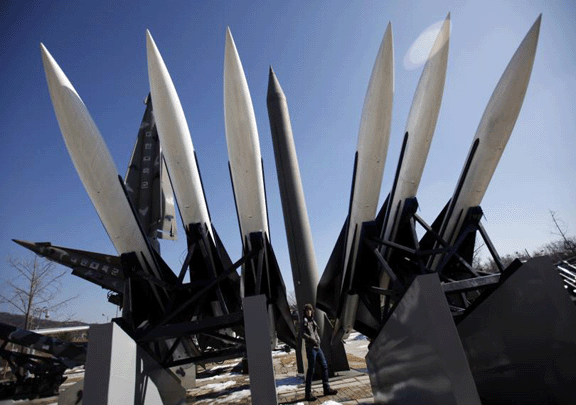
And India announced last month it successfully tested the Agni-V intercontinental ballistic missile (ICBM), which could theoretically deliver a nuke to Beijing.
Indian Prime Minister Narendra Modi tweeted the accomplishment “makes every Indian proud.” But some in China see the test as a provocation. And provocations can make the region less stable, which can lead to hostilities, says Victor Gao, the director of the China National Association of International Studies.
“To contemplate a war, especially involving involving nuclear weapons, against each other is completely ludicrous,” Gao told CNN. “And it’s a misallocation of resources.”
Hua Chunying, a spokeswoman for China’s Foreign Ministry, responded to a question about the missile launch by noting UN Security Council regulations regarding nuclear capable ballistic missiles and stressing that the two countries “are not rivals for competition but partners for cooperation.”
An Indian Foreign Ministry spokesman responded by telling CNN that its “strategic capabilities are not targeted against any particular country,” and that the country abides by its international obligations.
But not everyone shares such a sanguine view of the Sino-Indian relationship.
“Everyone should be interested in and concerned about India’s successful ICBM test, inc(luding) China because it’s within range of this new missile and because it especially of the major Asian countries understands the dangers of nationalism and its volatility,” says Yvonne Chiu, a professor of at Hong Kong University.
Precisely ambiguous’
India and China both maintain what’s called a “no first use” policy as part of their nuclear doctrine.
The policy means exactly what it sounds like — in the event of a war, the country won’t use nuclear weapons unless they’re attacked by an enemy using nuclear weapons.
But India’s hawkish defense minister, Manohar Parrikar, publicly mused in November whether India should be bound by the “no first use” policy.
“If a written down policy exists, or you take a stand on a nuclear aspect, I think you are truly giving away your strength in nuclear,” Parrikar said. “Why should I bind myself? I should say I’m a responsible nuclear power and I will not use it irresponsibly.”………
The elephant in the room
Pakistan is the big wild card.
The country, which boasts its own nuclear arsenal, is India’s historic adversary and considered an “all-weather” friend of China.
Those relationships form a double-edged sword, analysts say.
On the one hand, it offers India an excuse for building up its missile systems that doesn’t involve China, so “both sides can continue relations without the sense one of them has suddenly been put under undue pressure,” Chiu says…….









 nuclear-news