At least one person has died in an explosion at a power plant in central Russia, media are reporting, citing Emergencies Ministry sources. The blast caused metal structures to collapse over a 600-square-meter area.
“According to preliminary reports, a gas mixture exploded at the power plant,” TASS news agency reported, citing a source at the Emergencies Ministry of the Penza region.
The total number of victims is yet unclear, the source said. However, TASS has reported that one person died, citing the Russian Center for Disaster Medicine.
The building of the TPP-1 power plant has been partially destroyed, and some 600 square meters of its roof are said to have collapsed, according to RIA Novosti, citing a source at Emergencies Services.
The incident has not affected the city’s heating supply, TASS reported, citing the head of the Emergencies Ministry’s press service, Anna Shupilova.
“The incident did not affect the heating system of the city; the whole heating system is operating in normal mode,” she said.
The Novocherkasskaya GRES coal-fired power plant is owned by OGK-2 (Second Generating Company of the Wholesale Power Market), a subsidiary of the Russian gas giant Gazprom. The plant is located near the city of Novocherkassk, and consists of eight 264-MW coal-fired units. Construction was originally approved in 1952; the first unit went online in 1965, and the final, eighth unit in 1972. The plant has since been converted to run on gas as a supplementary fuel, but the primary fuel is still coal.[1][2]
The plant was formerly owned by OGK-6, which was also majority-owned by Gazprom; Gazprom merged OGK-6 into OGK-2 in November 2011. The boilers in Units 6 and 7 were replaced in 2005 and 2009, respectively.[3]
Description of Expansion
In 2011, OGK-2 signed a contract for the construction of a 330-MW ninth coal-fired unit at Novocherkasskaya. The construction contractor is SWECO Soyuz Engineering, a subsidiary of SOYUZ Holding. Unit 9 will run on circulating fluidized bed technology. Total construction cost will be about $700 million.[3] The boiler was built by U.S. company Foster Wheeler.[4] Completion was originally scheduled for November 2015.[5] In July 2015, the provincial government said the unit was on track to be completed in late 2015 or early 2016.[6]
The unit was successfully tested in December 2015.[7] The unit was completed and brought online in July 2016.[8
UCY.TV email: contact.ucytv@gmail.com. Real news, for the people, by the people.
FAIR USE NOTICE: This video may contain copyrighted material. Such material is made available for educational purposes only.This constitutes a ‘fair use’ of any such copyrighted material as provided for in Title 17 U.S.C.section 106A – 117 of the U.S.Copyright Law.
Study finds Rising Infant Death Rates Attributable to the Diablo Canyon Nuclear Power Plant http://www.busbyway.com/2016/09/19/study-finds-rising-infant-death-rates-attributable-to-the-diablo-canyon-nuclear-power-plant/Peer-reviewed study documents rising infant mortality rates over the past 25 years in zip codes surrounding Diablo Canyon Santa Barbara, California (PRWEB) September 19, 2016 Today, the World Business Academy announced the publication of a scientific study that it commissioned to closely examine recent public health data showing abnormally high levels of infant deaths near the Diablo Canyon nuclear power plant. This study by Dr. Christopher Busby appears in the peer-reviewed Jacobs Journal of Epidemiology and Preventive Medicine (See attached copies of “Article Summary” and of full article, “
Is there evidence of adverse health effects near US nuclear installations? Infant mortality in coastal communities near the Diablo Canyon nuclear power station in California, 1989-2012”). The article documents “a remarkable and statistically-significant 28% overall increase in infant mortality rates in the coastal strip group relative to the inland control group.” According to the study, a pattern of rising infant death rates (in the first year of birth) has occurred since Diablo Canyon opened in the mid-1980s at Avila Beach in San Luis Obispo County, California. Dr. Busby’s study found that “
The increases over the period correlate significantly with cumulative releases of Tritium from the nuclear plant to the sea.” Furthermore, during this same period, infant mortality rates fell for the whole of California and for the local inland control group in the county, providing additional evidence that federally approved, routine radiation releases from U.S. nuclear power plants damage infant health. Dr. Christopher Busby is an expert on the health effects of radiation and has published extensively on the issue. He was Visiting Professor at the University of Ulster in Ireland until retirement in 2012. He has been Scientific Secretary of the European Committee on Radiation Risk since 1998 and was a member of two British Government committees investigating radiation effects. He has served as a reviewer for more than twelve scientific and medical journals and is currently on the Editorial Board of Environmental Health and Toxicology and Jacobs Journal of Epidemiology and Preventive Medicine.
Dr. Jerry Brown, director of the Academy’s Safe Energy Project, stated that, “the Busby study provides further confirmation of significant potential human health dangers that could result from the continued operation of the Diablo Canyon nuclear power plant through 2025, as recently proposed by Pacific Gas & Electric (PG&E), the utility that owns and operates this nuclear plant.” Academy President Rinaldo S. Brutoco states that, “The World Business Academy plans to submit this study in support of the testimony provided to the California State Lands Commission on June 28, 2106, which should prove to be very valuable in its lawsuit against the Commission filed on August 2, 2016.”
During the California State Lands Commission public hearing of June 28, 2016, on PG&E’s request for a lease extension for Diablo Canyon, the World Business Academy informed the Commission of this “soon-to-be-released” study by Dr. Busby and of its ominous implications that infants would die from the plant’s continued operation. The Academy implored the Commission to examine these radiation-health issues by means of an Environmental Impact Report (EIR) in order to verify whether the data in this study are accurate; however, the Commission refused to order an EIR for the Diablo Canyon nuclear power plant. Mr. Brutoco observed that “
We believe the Commission’s failure, among other things, to examine the validity of these critical infant health statistics in an Environmental Impact Report was an arbitrary and capricious decision, which violates the State Lands Commission’s responsibilities under the California Environmental Quality Act and the Public Trust doctrine.”
Brutoco continued, “This is why we felt honor bound to sue the Commission on August 2, 2016, arguing that the many ‘unusual circumstances’ present at Diablo Canyon, including the adverse effects of radiation releases on public health, require the Commission to conduct a full environmental review under the California Environmental Quality Act.” (See attached copy of lawsuit, Petition for Writ of Mandamus.) For the original version on PRWeb visit: http://www.prweb.com/releases/2016/09/prweb13695217.htm
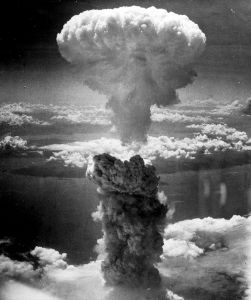
Nagasaki nuclear explosion photo by Charles Levy from one of the B29 Superfortresses
GR: A group of concerned scientists created the Doomsday Clock at the end of World War II. The goal was to use best estimates of global conditions to create a visual display of the nuclear danger. Now, however scientists consider climate change as well as nuclear war as the most pressing threats to our survival. In 2010, after the hopeful conclusion to the Copenhagen Climate-Change Conference, the Clock was at six minutes to midnight. However, nuclear developments in North Korea and continuing tension in southern Asia moved the Clock to five minutes until midnight in 2012. The nuclear situation has not improved and the climate situation is worse. Today the Clock is at two and one-half minutes until midnight.
Climate Change Catastrophe Image by Geralt
I included a link to an informative slide show at the end…
¶ “China will be the only winner in Donald Trump’s war on clean energy and the EPA” • Critics have environmental objections to Trump’s EPA nominee. But from a business perspective, the big risk is that reversing course on clean energy will hurt the US companies already slipping behind in the global clean energy race. [International Business Times UK]
Loss of polar ice (iStock photo)
¶ “Australia is investing billions in madman Donald Trump” • In an interview with America’s ABC News’ 20/20 program Donald Trump said, “We should’ve taken the oil,” adding, “and if we took the oil you wouldn’t have ISIS. And we would have had wealth.” I’ve just watched the program. … It was scary. [The Sydney Morning Herald]
World:
¶ Dong Energy and Macquarie acquired 35% and 50% stakes respectively of the 128-MW Formosa 1 offshore wind farm in Taiwan from…
Over recent days, the forests of Central Chile appear to have finally succumbed to the unprecedented and unrelenting punishment. One by one, massive wildfires ignited through Chile’s bone-dry woods — scorching hillsides, decimating more than 100 vineyards, and resulting in the tragic loss of four firefighters. As of today, more than 85 wildfires have burned approximately 190,000 hectares of land — or about 733 square miles.
This charred chunk of Chile more than half the size of…
¶ “Trump has a great opportunity to save our environment” • Donald Trump is rolling back EPA rules. But the nonpartisan federal Office of Management and Budget calculated that the rules imposed by the EPA over the decade ending 2012 yielded benefits 10 times their costs, the best ratio of all federal agencies they reviewed. [Huffington Post]
¶ “Solar energy: the alternative” • The need for renewable energy is no longer linked only with climate change and clean air. It is also properly linked to: 1) economic prosperity, 2) preventing structural violence against the least well off, 3) prevention of conflict, and 4) a solution to energy shortages in a world of finite resources. [The Nation]
¶ “Renewables = Over 50% New Electricity Capacity But 16% Of Energy Investment” • The wide gap in investment figures versus new…
Today marks an important moment in the history of the divestment movement: A majority vote was passed in the Irish Parliament on first-of-its-kind fossil fuel divestment legislation.
Ireland now has the historic opportunity to become the first country in the world to fully divest its sovereign wealth fund, worth over €8 billion, from coal, oil and gas.
Last Thursday in the Dáil, all political parties, with the exception of Fine Gael, indicated their strong support for the Fossil Fuel Divestment Bill – a piece of legislation getting Ireland’s Strategic Investment Fund to divest from fossil fuels. Today, this bill has passed. The Fossil Fuel Divestment Bill will now go to Committee stage in the Irish Parliament.
This success is the result of fantastic campaigning by our friends at Trócaire, key members of parliament, and many people across Ireland taking action on fossil fuel divestment.
“With a climate-sceptic recently inaugurated into the White House, this move by elected representatives in Ireland will send out a powerful message. The Irish political system is now finally acknowledging what the overwhelming majority of people already know: That to have a fighting chance to combat catastrophic climate change we must phase out fossil fuels and stop the growth of the industry that is driving this crisis,” said Éamonn Meehan of Trócaire.
Yet another reason to never doubt, even in trying times such as these, that we are winning together.
A member of the media, wearing a protective suit and a mask, looks at the No. 3 reactor building at Tokyo Electric Power Co’s (TEPCO) tsunami-crippled Fukushima Daiichi nuclear power plant in Okuma town, Fukushima prefecture, Japan February 10, 2016.
A plan to remove spent nuclear fuel from Tokyo Electric Power Co Holdings Inc’s Fukushima Daiichi nuclear plant hit by the March 2011 tsunami has been postponed again due to delays in preparation, the Nikkei business daily reported on Thursday.
Work is now set to begin in fiscal 2018 at the earliest, the Nikkei said.
Removal of the spent fuel from the No. 3 reactor was originally scheduled in the first half of fiscal 2015, and later revised to fiscal 2017 due to high levels of radioactivity around the facilities, the Japanese business daily reported.
The timeline has been changed again as it was taking longer than expected to decontaminate buildings and clean up debris, the news agency reported.
The report comes a few months after the Japanese government said in October the cost of cleaning up the Fukushima plant may rise to several billion dollars a year, adding that it would look into a possible separation of the nuclear business from the utility.
I am sharing here with you a sample of Japanese Government propaganda, a video about Fukushima, claiming that everything is now fine.
By watching this propaganda video, you can imagine, you will get an idea of the intensity of propaganda that the Japanese government is subjecting its people with, thru all the government controlled mainstream media, claiming that all is very safely and controlled for everyone’s safety by a safety conscious government absolutely caring for its people safety. Nice, isn’t it?
Propaganda from PM Abe’s government forcefully pushing innocent victims back to live in highly contaminated areas, trying to make believe all is ok just in time for the coming 2020 Olympics. Like when they previously sent children to clean off radiation off route 6 just for propaganda’s sake !
Amazing, Chernobyl is still horribly contaminated after over 30 years, but Fukushima radiation is the new self cleaning kind that just vanishes after 5 years? And that while there are ongoing reactions that are still completely uncontained.
Well isn’t that special. What a load of crap ! How stupid do they think we are to buy this crap?
From what I’ve seen, people should not even be living in certain parts of Tokyo and its vicinity.
I despise with much passion all the ETHOS scoundrels and all those Japanese government criminals. Shame on you. Your pride and your denial will be your downfall.
Long live Fukushima , Long live the Children of Fukushima!
Japan’s Fukushima Prefecture has been making tremendous progress in its revitalization since the 2011 Great East Japan Earthquake.
The area continues to undergo recovery efforts, residents are returning to their everyday lives, and food from Fukushima is being enjoyed all over Japan under strict safety regulations.
The March 2011Great East Japan Earthquake caused an enormous tsunami that overwhelmed the Fukushima Daiichi Nuclear Power Station.
A continuous water injection cooling system has now stabilized the plant’s reactors and reduced radiation emissions dramatically.
Food grown in Fukushima…
… is widely available and popular across Japan.
All food produced in Fukushima must first pass a test for radiation to be sold on the market.
The standards set by the Japanese government are much stricter than the international standards.
Thanks to these rigorous safety standards, Fukushima rice is enjoyed throughout Japan.
A joint research project was conducted in 2014 by high school students in Fukushima and overseas under the supervision of experts.
The survey found that the radiation exposure levels of students in Fukushima were almost the same as in Europe.
The total area of Fukushima prefecture subject to evacuation orders has been progressively reduced since 2014, as decontamination efforts have lowered radiation to safe levels,
allowing people to return to their homes.
A lot of work still has to be done before the area fully recovers,
but every day we are making progress toward a brighter future.
The five members of Put Down the Sword arriving at Reading Court for their trial earlier today.
Last June they protested at AWE BURGHFIELD. They are charged with willful obstruction of the highway. A disputed crossing of a green line in the road
Update ; The @PutDownTheSword defendants have been found guilty.
Sentence: six months conditional discharge. £100 costs and £20 court surcharge. So £120 each in total.
Upcoming events
Monday March 27th 2017. Trident Ploughshares and friends. “Oyez Oyez, Good news from the United nations”. Meet Trafalgar Square 9.30am for Town Crier Action. Small groups taking the news to central London venues. Contact Sylvia Boyes <tridentsylvia@gmail.com>
Sat 8th to Sun 16th July 2017. Disarmament camp at Coulport in the West of Scotland. As the Global Nuclear Ban Treaty conference finishes in New York we will gather to disrupt the Trident submarine bases at Faslane & Coulport. Contact Jane Tallents <tp2000@gn.apc.org> More info here
4-8 Sept 2017 Trident Ploughshares will be taking part in the week of action against DSEI, the world’s largest arms fair. We are planning a day of action to highlight the involvement of the world’s largest arms companies in Trident. Contact Chris Bluemel <chrisbluemel@yahoo.co.uk>
Any time in 2017 – unannounced acts of resistance against weapons of mass destruction.
Faslane peace camp protest in Scotland 24 January 2017
In other Protest news .. Well done Faslane Peace Camp!
We don’t want a real missile to land anywhere but if they can’t even be sure which way it will go it makes nonsense of the whole business. And if it didn’t matter the Government wouldn’t have been so keen to keep it quiet! Thank you for speaking out!
A residential area of namie-Cho, Namie-Cho, radiation measured 1.3μSv/h at 1 meter above ground and 16μSv/h at ground level
As Japan is trying desperately to use any tactics and resources such as “the cult like” ETHOS to incite refugees to return to their radioactive land, just in time to display the reconstruction of Fukushima to dumb tourists who will visit the prefecture during the next Tokyo Olympics, the reality of things with a Geiger counter and willing citizens paints a total different picture.
This is in Namie cho, a residential district in Fukushima.
What tourist won’t see while traveling Fukushima:
– Tons of highly radioactive waste buried hastily under the grounds of school grounds or abandonned at random on forests or radioactive ash poured into rivers.
– Tons of radioactive waste being burned across incinerators in Japan, spraying dangerous isotopes all over – continuously for the past 4 years.
– Children cleaning up roads of radiation so close to Daiichi – most with no real protection.
– Daiichi sinking, leaking, spewing radiation for 5 years into the ground, the air, rivers and the ocean.
– Contaminated food cleverly being distributed, mislabeled, mixed with non contaminated produces to lower the amount of bequerels and served to children in Japan.
– The discrimination within the prefecture between victims over beliefs or aid money (which no one will soon be able to have access to) and non victims.
– The fear of mothers over their children’s health and future.
A residential area of namie-Cho, Namie-Cho, and 1.3 meters in the ground, 1 meters in the ground, 1.4 mSv/h and on the ground 16 mcSvhr. Courtesy of Oz Yo
The oil companies are planning how they might best deal with supplying energy supplies after a megathrust earthquake in Japan. Within the document is a very basic diagram and summary of the location of power plants and the estimated seismic damage that different areas will be subjected to. Also withing the report are locations of oil refineries.
Japan’s coal imports for power generation fell in 2016 from four years of successive record highs and liquefied natural gas (LNG) purchases dropped for a second year as an energy crisis brought on by the 2011 Fukushima disaster eased, official data showed.
Rising supplies of homegrown renewable energy and the return of some nuclear power, amid falling demand as Japan’s population declines, mean the world’s third-largest economy has more diversity in its sources of energy.
Thermal coal imports declined to just below 110 million tonnes in 2016, down from a record-high 113.84 million tonnes in 2015, the Ministry of Finance said on Wednesday. Import costs fell 20 percent from a year earlier.
Shipments of liquefied natural gas (LNG) dropped for a second year last year, down 2 percent to 83.34 million tons , while their value fell 40 percent.
Japan is the world’s biggest importer of LNG, gas chilled to liquid form for transportation on ships, and demand had surged to successive records after the March 2011 meltdowns at the Fukushima Daiichi nuclear plant led to the eventual shutdown of all reactors in the country.
But two reactors are now operating under new safety standards and more may be restarted this year. (Note The output from last year was minimal compared to renewables output because of outages and a late start on reactors Arclight2011 aka Shaun)
Crude oil imports slipped to 3.35 million barrels per day, o 194.828 million kilolitres for the year, the lowest since 1988, with their value falling by nearly a third.
The following tables lay out Japan’s fossil fuels imports for last month and for all of 2016, with volumes of crude, oil products and gasoline/naphtha in million kilolitres; LNG, LPG and coal in million tonnes; values in millions of yen.
Numbers are preliminary.
       December
             Fuel    Volume   Yr/yr %       Value   Yr/yr %
    Mineral fuels         -         -   1,304,492      -4.8
        Crude oil    18.061       3.0     599,350       1.8
 All oil products         -         -     127,216     -11.3
 Gasoline/naphtha     2.374     -11.9      84,264     -20.9
              LNG     7.549      -6.5     323,361     -25.5
              LPG     0.963       1.0      46,251     -13.6
       Total coal    16.314       3.9     203,451      39.4
     Thermal coal     9.454      -5.5      96,880       9.8

        Full year
             Fuel    Volume   Yr/yr %       Value   Yr/yr %
    Mineral fuels         -         -  12,044,238     -33.9
        Crude oil   194.828      -0.3   5,534,054     -32.4
 All oil products         -         -   1,073,286     -41.1
 Gasoline/Naphtha    26.295     -13.0     824,332     -38.8
              LNG    83.340      -2.0   3,283,913     -40.4
              LPG    10.900      -0.8     446,943     -31.3
       Total coal   189.732      -0.5   1,654,450     -16.2
     Thermal coal   109.931      -3.4     876,746     -20.0
Fonte : Reuters (Reporting by Aaron Sheldrick and Osamu Tsukimori; Writing by Aaron Sheldrick)
Dr Birol also highlighted recent changes in siting regulations and reductions in the support mechanisms for renewable energy which have created uncertainty, and have had negative implications for investor confidence. “The future of renewable energy in Poland looks uncertain”
Poland’s new energy strategy should put the country on a pathway towards a cleaner energy system while strengthening energy security, the International Energy Agency said in its latest review of the country’s energy policies. The forthcoming energy strategy is likely to prioritise long-term energy security, placing a strong emphasis on reducing greenhouse gas (GHG) emissions and air pollution, increasing energy efficiency and decarbonising the transport system.
The new energy strategy will require significant investments to reduce the share of carbon-intensive power plants and increase the share of low-carbon energy, including nuclear energy and renewables, said Dr Fatih Birol, the IEA’s Executive Director, at the launch in Warsaw of Energy Policies of IEA Countries: Poland 2016 Review.
Dr Birol also noted that Poland is investing in nuclear energy capacity in order to strengthen its energy independence, security of supply and reduce GHG emissions. The IEA review highlights the need to develop a skilled workforce and the mechanisms for financing the construction and operation of the new nuclear power plants as soon as possible.
The review notes that according to the government coal will remain the cornerstone of the energy system of Poland for the long term. The mining sector is a major source of employment and policies affecting the sector have a large social and regional impact. Dr Birol said that the new energy strategy must determine the long-term role of coal in the economy.
Coal combustion remains the largest source of greenhouse gas emissions and local air pollution in Poland. Many of its coal-fired power plants are old and inefficient: the replacement of these plants by plants with the newest technology represents an economic challenge for the sector, but at the same time offers an opportunity to reduce GHG emissions, air pollution and the carbon footprint from power generation. Coal use in household heating, together with waste burning, is a major source of local air pollution and “the government must ensure that less-well-off households are provided with the means to switch to cleaner solutions, such as natural gas or district heating where available,” said Dr Birol.
Poland’s energy efficiency policies have been strengthened by the adoption of measures such as the white certificate scheme, and have incentivised industry to increase energy savings. These measures represent a solid starting point, but the government needs to broaden the scheme while at the same time developing and implementing new measures targeted at the buildings sector. In the electricity sector, Poland must step up investment in new generation and strengthen interconnections with neighbouring countries if the country is to satisfy future demand for electricity.
Dr Birol also highlighted recent changes in siting regulations and reductions in the support mechanisms for renewable energy which have created uncertainty, and have had negative implications for investor confidence. “The future of renewable energy in Poland looks uncertain” Dr Birol added. On the other hand, Dr Birol welcomed the country’s decision to pursue nuclear energy as a means to reduce emissions and strengthen energy security while highlighting the importance of making the correct technology and partner choice in a timely manner.








 nuclear-news
