Dahr Jamail | Record Heating of Earth’s Oceans Is Driving Uptick in Hurricanes http://www.truth-out.org/news/item/37877-record-heating-of-earth-s-oceans-is-driving-uptick-in-hurricanes Thursday, 06 October 2016 By Dahr Jamail, Truthout | Report As Hurricane Matthew impacts the East Coast of the US this week, it is important to consider how rising ocean temperatures are contributing to the intensification of storms worldwide.
Earlier this year, a scientific study titled “Industrial-era global ocean heat uptake doubles in recent decades” was published in the journal Nature Climate Change. The study showed that half of the total global ocean heating increase that has happened since 1865 has occurred in just the last 20 years.
Given that oceans absorb more than 90 percent of Earth’s excess heat generated by anthropogenic climate disruption (ACD), the fact that the oceans are warming at a non-linear pace is, while not surprising, extraordinarily troubling.
To see more stories like this, visit “Planet or Profit?”
This ongoing trend is showing no signs of changing for the better.
This July, the US National Oceanic and Atmospheric Administration’s (NOAA)monthly global analysis report showed that the worldwide ocean surface temperature for that month was .79 degrees Celsius (1.42 degrees Fahrenheit) above the 20th century average, which, according to NOAA, was “the highest global ocean temperature for July in the 137-year record.” The previous record had been set just the year before. Moreover, this July was the 40th consecutive July that saw global ocean temperatures above the 20th century average. NOAA reported, “The 13 highest monthly global ocean temperature departures have all occurred in the past 13 months.” July saw record-high sea surface temperatures across portions of the western, southwestern, central and southeastern Pacific, the southern and western Atlantic, and the northeastern Indian Ocean, according to NOAA.
n August, which is at the time of this writing the most current month of NOAA’s global analysis report, oceanic surface temperatures were nearly as high as July’s, and were the second highest August temperatures on record — only .04 degrees Fahrenheit less than 2015’s record. As in July, large areas of the Atlantic, Pacific and Indian Oceans’ all saw record warm temperatures persisting.
In 2014, US government climate scientists stated that the warming of oceans due to ACD was unstoppable. At that time scientists warned that the impacts of the warming ocean temperatures would be felt for centuries to come, even if there were immediate and dramatic efforts to cut CO2 emissions globally.
Needless to say, nothing like those types of cuts have occurred. Emissions have continued to slowly increase or stay at roughly the same levels that have caused the crisis we are in, and dramatic impacts from rising oceanic water temperatures are on the rise.
Record-Breaking Storms and Rainfall
Warmer-than-normal tropical waters are one of the key factors in the formation ofHurricane Matthew, which is now easily one of the most powerful Atlantic hurricanes in the last decade. At the time of this writing, the massive storm had lashed Haiti with 145 mph winds, driving rains and claimed at least 17 lives.
Record-Breaking Storms and Rainfall
Warmer-than-normal tropical waters are one of the key factors in the formation ofHurricane Matthew, which is now easily one of the most powerful Atlantic hurricanes in the last decade. At the time of this writing, the massive storm had lashed Haiti with 145 mph winds, driving rains and claimed at least 17 lives.
Current models show the hurricane on track to scour much of the eastern seaboard of the US, with the storm still being a Category 3 hurricane by the time it reaches Florida on Friday.
Across the Pacific, Typhoon Megi, the equivalent of a Category 4 hurricane, became the third tropical cyclone of the season to pummel Taiwan, knocking out power to 3 million people across the country while dumping an incredible three feet of rain over parts of the island.
Meanwhile, major flooding events in the US have been coming in quick succession. August saw record floods across much of Louisiana, in what became the worst flooding since Hurricane Sandy, according to the Red Cross. That is only one example of many, as at least 18 major flooding events have struck Texas, Louisiana, Oklahoma and Arkansas since March 2015, according to The Weather Chanel.
Marine Life Impacted
The impacts of warming ocean waters on marine life are far too numerous and vast to detail here. However, some broad-brushstrokes include, according to a National Environmental Education Foundation report from earlier this year:
- More than 80 percent of Earth’s marine life is migrating to different places and changing their breeding and feeding patterns due to warming waters.
- Ocean species are migrating in response to climate change 10-times faster than land species.
- Some marine species have migrated as much as 600 miles from where they were abundant just a few decades ago.
Warming waters cause certain nutrients to be more or less available, which causes redistributions of global marine species, which then opens the migrating species to new diseases, new predators and other issues.
A recent example of this is evident in a study, released in September, that showed that baby lobsters are struggling to survive when they are reared in water 5 degrees Fahrenheit warmer than the temperatures that are currently typical of the western Gulf of Maine. “The UN’s [Intergovernmental Panel on Climate Change (IPCC)] expects the Gulf of Maine’s temperature to warm by [5 degrees Fahrenheit] by the year 2100,” Truthout recently reported. “Keep in mind, too, that thus far, the IPCC’s temperature predictions have consistently been too low.”
The entire food web of the oceans is being disrupted, and many global fisheries are undergoing dramatic, deleterious changes.
As we watch the weather worsen, we must not forget the links between weather and climate — and how warming oceans affect us all.
October 8, 2016
Posted by Christina Macpherson |
2 WORLD, climate change |
1 Comment
Work starts on on-shore infrastructure for Russian floating plant, World Nuclear News 07 October 2016
A ceremony was held on 4 October in Pevek, Russia, to mark the start of construction of the coastal infrastructure for the first-of-a-kind floating nuclear power plant. The floating power and heat plant is set to be commissioned there in 2019.
The event in Pevek in the Chukotka Autonomous Region – the northern most city of Russia – was attended by, among others, the regional governor Roman Kopin; Rosenergoatom deputy CEO and director of special projects and initiatives Pavel Ipatov; and head of the floating nuclear power plant construction administration Sergey Zavyalov.
During the ceremony, the first sheet pile driving into the foundation of the on-shore infrastructure was carried out. A memorial plaque and a time capsule were then installed to mark the start of construction of the infrastructure…….
Zavyalov said, “We expect that the works on elaborating the technical conditions for the floating plant’s power delivery we carry out jointly with the Department of Energy, Chukotenergo, and RAO EES Vostok will be completed by October-November 2016.” He added, “In December, we plan to be ready to submit operational documents and to order the electric technical equipment to be installed on our site.”……
The Akademik Lomonosov is undergoing trials at the Baltic Shipyard. These trials are expected to be completed by late October 2017 and it should be ready to be transported to Pevek later that year. Rosenergoatom plans to start installation of the plant in September 2019, followed by trials and operational launch. http://world-nuclear-news.org/WR-Work-starts-on-on-shore-infrastructure-for-Russian-floating-plant-0710165.html
October 8, 2016
Posted by Christina Macpherson |
Russia, technology |
Leave a comment
Safety fears as Hurricane Matthew hits TWO nuclear reactors: Storm also sweeps past heads Cape Canaveral and Trump’s Mar-a-Lago resort Hurricane Matthew started hitting Florida early this morning with heavy rain and strong winds
Experts say there is very little risk of a repeat of the Fukushima accident in Japan in 2011 Daily Mail. By CHRIS SUMMERS FOR MAILONLINE 7 October 2016 The storm arrived on shore on Friday north of Palm Beach County, which has a population of 1.4 million people, and the National Hurricane Center predicted it would push along the Interstate 95 corridor towards Jacksonville.
The St Lucie nuclear reactor was right in the storm’s path while Turkey Point in southern Florida was also affected by high winds.
The Department of Energy said: ‘Some reactors were shut as a precaution to protect equipment from the storm; others were forced to shut down or reduce power output due to damage to plant facilities or transmission infrastructure serving the plant.’………
The strongest winds of 120 mph were just offshore, but Matthew’s wrath still menaced more than 500 miles of coastline and 26 million Americans.
Government officials declared a state of emergency in several states in an effort to plan ahead since the deadly Category Three storm is expected to wreak havoc with its 120mph winds.
Two million people across the Southeast have been warned to flee inland as tens of millions along 500 miles of coastline battened down the hatches. ……..http://www.dailymail.co.uk/news/article-3826653/Safety-fears-Hurricane-Matthew-heads-TWO-nuclear-reactors-Storm-set-hit-Cape-Canaveral-Trump-s-Mar-Lago-resort.html
October 8, 2016
Posted by Christina Macpherson |
climate change, USA |
Leave a comment
The True Scale of Nuclear Bombs Is Totally Frightening http://sploid.gizmodo.com/the-true-scale-of-nuclear-bombs-is-totally-frightening-1787538060 Casey Chan, 8 Oct 16 Nuclear weapons are already scary enough, but when you dig deeper and find out how powerful the weapons truly are, they get even more terrifying. The weapons we’ve built after the first atomic bombs are so strong that you can basically use Hiroshima as a unit of measurement. The largest nuclear explosion in human history, the Tsar Bomba, detonated with a force of 50 megatons or the power of 3,333 Hiroshimas.
Discovery Channel – Ultimates – Explosions – Tsar bomb segment
October 8, 2016
Posted by Christina Macpherson |
2 WORLD, weapons and war |
Leave a comment
 Desperate uranium miners switch to survival mode despite nuclear rebound, Reuters, By Geert De Clercq 7 OCT 16 LONDON “……..BULGING INVENTORIES Mining executives partly blame the slump on their customers’ wait-and-see attitude, as utilities believe that the uranium market’s over-capacity will persist for years and see no need to rebuild their dwindling stockpiles.
Demand for uranium is determined by the number of nuclear plants in operation worldwide, but supply and demand are disjointed by huge stocks and uranium’s long production cycle……..
In the five years before Fukushima, utilities worldwide bought about 200 million pounds of uranium per year, he said. Although Japan’s consumption averaged only around 25 million pounds per year, when it closed its reactors demand was cut far further, falling by half. European and U.S. utilities saw that the market was over-supplied and reduced inventories, buying less.
Mining firm Energy Fuels estimates global uranium stocks held by utilities, miners and governments are now at around 1 billion pounds. That is down from a peak around 2.5 billion pounds in 1990, but still many years’ worth of consumption.
Despite the plunge in uranium prices after the 2008 financial crisis and again after Fukushima, uranium production has doubled from 80-90 million pounds in the mid-1990s to about 160 million pounds last year, according to Energy Fuels data……
DESPERATE TIMES
With so much new supply, and demand sliding, prices have fallen to a level where most uranium miners operate at a loss.
“At today’s spot prices, the primary uranium mining industry is not sustainable,” US uranium producer Energy Fuels COO Mark Chalmers told the World Nuclear Association’s London conference last month.
He added that many legacy long-term supply contracts will expire in 2017-18, which will force many mines to close or throttle back even further than they already have.
Miners like Canada’s Cameco, France’s Areva and the uranium arms of global mining companies have closed or mothballed several mines and deferred new projects in order to cut back supply.
Paladin – the world’s second-largest independent pure-play uranium miner after Cameco and the seventh or eighth-largest globally – has production capacity of 8 million pounds of yellowcake uranium but produced just 4.9 million pounds last year at its Langer Heinrich mine in Namibia.
Molyneux said the firm will produce about 4 million pounds this year and will cut output further to about 3.5 million pounds next year if prices do not recover.
Paladin suspended production at its 2.3 million pounds per year capacity Kayelekera mine in northern Malawi in 2014 but maintains equipment so it can resume when prices recover.
Meanwhile it is trying to further reduce its debt, which already fell from $1.2 billion five years ago to $362 million.
Paladin has agreed to sell 24 pct of Langer Heinrich to the China National Nuclear Company and plans to use the expected proceeds of 175 million dollars to further reduce debt.
Bigger peer Cameco in April suspended production at its Rabbit Lake, Canada mine while also curtailing output across its U.S. operations, saying market conditions could not support the operating and capital costs needed to sustain production.
Cameco marketing head Tim Gabruch told the WNA conference that “desperate times call for desperate measures”.
Supply adjustments and producer discipline had not yet been sufficient to counter the loss of demand, he said.”As difficult as those decisions have been, we recognize that those actions may not be enough.”(Reporting by Geert De Clercq; editing by Peter Graff) http://www.reuters.com/article/us-uranium-nuclearpower-idUSKCN1230EF
October 8, 2016
Posted by Christina Macpherson |
2 WORLD, business and costs, Uranium |
Leave a comment
The Nazarbayev government, lacking financial resources, has done very little to address the security problems at Semipalatinsk and has not spent a penny to clean up the area.
 The continuing danger of Semipalatinsk http://thebulletin.org/continuing-danger-semipalatinsk9969 6 OCTOBER 2016 Magdalena Stawkowski
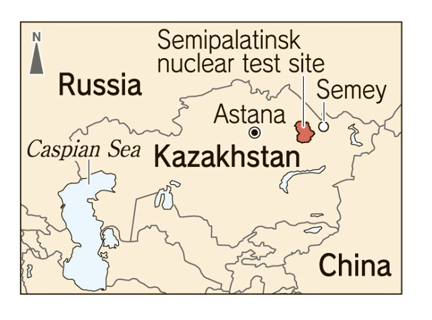
 During the Cold War, the Semipalatinsk Nuclear Test Site in Kazakhstan was the Soviet Union’s primary nuclear weapons testing ground. Between 1949 and 1989, more than 450 nuclear bombs were exploded above and below ground on its once secret, 7,000-square-mile territory. In the post-Soviet period,
Kazakhstan has attracted much international praise for its “extraordinary leadership” and “courage” in closing Semipalatinsk, for giving up its nuclear weapons stockpile, and for helping to create a nuclear weapon free zone in Central Asia. Kazakhstan has also been celebrated for having an extraordinary record in advancing nuclear security and thus was judged to be perfectly suited to host an international fuel bank for low-enriched uranium. The Obama administration has described Kazakhstan’s president, Nursultan Nazarbayev, as “really one of the model leaders in the world” on
non-proliferation and nuclear safety issues.
These commendations are perhaps overly enthusiastic. They exaggerate Kazakhstan’s commitment to nuclear safety; actually, Kazakhstan’s leadership has done little to address pressing humanitarian issues at Semipalatinsk, failing to provide adequate funding for environmental clean up and adequate security for the site itself. How can the world talk about nuclear safety in Kazakhstan when it is the only place on Earth where thousands of people still live in and around an atomic test site? How can there be safety, when residual radioactivity and environmental damage are a normal part of life for people who live there? Nuclear security should mean more than the physical protection of nuclear materials. Nuclear security must also mean the physical protection of individual citizens from radioactivity.
Today, most of the abandoned Semipalatinsk territory is accessible to anyone who wishes to enter. Except for a 37-mile area “exclusion zone” at the Degelen Mountain complex, guarded by drones and other surveillance equipment, few signs indicate radiation danger. For the thousands living nearby, it is no secret that the former nuclear testing area is poorly secured. I have been conducting anthropological fieldwork in the region since 2009, living in Koyan, a remote village on the nuclear test site’s border. I know first hand the ease with which people make use of the territory. (“Koyan” and “Tursynbek,” the name of an ethnographic interlocutor mentioned later in this article, are pseudonyms, used to protect village residents and the interlocutor following the convention of confidentiality spelled out in the American Anthropological Association Code of Ethics on professional responsibility).
Koyaners, like most everyone else living in and around Semipalatinsk, use the test site in a number of ways: They drive across the dusty steppe during warmer months to visit relatives in nearby villages. In July and August, men, women, and children come back from the site, buckets brimming with wild strawberries they have picked from its shallow valleys. Many graze their herds of sheep, goats, horses, and cows on the Semipalatinsk pastures, sometimes near craters formed by underground explosions. Many of these places are known to contain radioactive “hot spots,” but since the area around Koyan is mostly unmarked, no one in the village is certain where the hot spots are. Koyaners are not privy to this information, because no one in the government shares it with them.
On a hot, sunny day in July 2015, Tursynbek, a burly stockbreeder and miner in his mid-50s, decided we should go out and measure radiation on our own. As we got in the car, he complained that when he has had a chance to ask scientists, who occasionally do research in the area, if there is radiation, they dismiss his concerns by saying, “There is nothing here; no radiation.” I made sure to bring my Geiger counter on this trip, and a short car ride later I was looking down from the rim of a nuclear crater, trying to hear the Geiger counter readings Tursynbek was shouting. His camouflage jacket was barely visible on the steep pitch, among the tall grasses; a rather sizeable water hole was beyond, inside the crater. He scanned the ground for radioactivity, his white paper sanitary mask pulled down under his chin, rather than over his mouth. The sanitary mask was meant to protect against small particles of plutonium or other radioisotopes that are dangerous when inhaled but can be stopped by a sheet of paper. But Tursynbek was not afraid. Tursybek knows this area well; he was born in Koyan and has decades of experience raising livestock, sheep, goats, cows, and horses, which includes grazing them on the test site.
Still, he had never been here on this kind of mission. As he climbed out, he eagerly used the Geiger counter to check the wreckage of the atomic landscape: trenches, mangled barbed wire enclosures, scattered cement blocks with clusters of electrical cables jutting from them. The frantic clicking of the Geiger counter disturbed the otherwise calm summer afternoon. Not far from us, Kazakhstan’s Institute of Radiation Safety and Ecology (IRSE) wazik (van) carrying “geologists,” as the scientists are known to Koyaners, passed by. “They have never shared any of this information with us,” Tursynbek said motioning to the van and pointing at the .700 milliRem per hour reading displayed by the counter.
Normal background is between .008-.015 milliRem/hr. According to the US Nuclear Regulatory Commission (NRC), Americans receive an average radiation dose of about 620 milliRem per year. Half of this dose comes from naturally occurring radiation found in soil, rocks (uranium), and air (radon). The other half comes from man-made sources, like radiation therapy, x-rays, and nuclear power plants. At the crater, five weeks is enough time to receive the average yearly dose of radiation described by the NRC. In one year that dose is equal to 6,136 milliRem.
Looking around the abandoned test site, it is almost never obvious what went on here, except at a few key experimental locations, which have decaying cement structures and other visible points of interest. The once high levels of security have long since disappeared. Yet for 40 years various technical sites at Semipalatinsk were used to experiment with different types of nuclear explosions. At “Ground Zero” for example, 116 aboveground tests were conducted, as part of a full-scale experiment designed to record damage done to animals (sheep, goats, cows, and pigs), plants and soil, building construction, military equipment, and people living in settlements found near the site. At other technical areas, more than 300 underground nuclear explosions were used to test their peaceful applications. Several of these high-yield tests produced nuclear craters and contaminated much of the area nearby.
Near the nuclear crater Tursynbek and I visited, only a small and badly faded radiation warning sign clung to a mangled barbed wire enclosure that once provided some level of protection. The plight of people who suffered from radiation exposure during the Soviet-era is well known in the country and abroad, even if the level of radioactive pollution and its impact on human health are hotly disputed, in local and international peer-reviewed scientific journals.
In an August 2015 editorial for the Bulletin of Atomic Scientists, Kazakhstan’s ambassador to the United States, Kairat Umarov, highlighted the fate of 1.5 million Kazakh citizens whose lives continue to be affected by nuclear testing. He wrote with the optimism of a man hoping to promote a nuclear-weapons-free world. But Umarov ignored an obvious fact: The Nazarbayev government, lacking financial resources, has done very little to address the security problems at Semipalatinsk and has not spent a penny to clean up the area. Praise of the nation’s leadership for making Kazakhstan a non-nuclear state has come at a price: It has overshadowed and limited conversations about lack of oversight of Semipalatinsk and the toxic mess that the Soviet nuclear testing program left behind and continues to endanger thousands of citizens living in the area. Given this unresolved and underreported situation at Semipalatinsk, the international community should offer financial help and expertise for the cleanup of Semipalatinsk, or at the very least help with cordoning off the most contaminated areas of the site.
October 8, 2016
Posted by Christina Macpherson |
environment, Kazakhstan, secrets,lies and civil liberties, weapons and war |
1 Comment
World War Three will be ‘extremely lethal and fast’: US Army bosses reveal what could happen if the US took on Russia or China http://www.inkl.com/news/world-war-three-will-be-extremely-lethal-and-fast-us-army-bosses-reveal-what-could-happen-if-the-us-took-on-russia-or-chinaOct 6, 2016 t is a chilling vision of war – and one unlike any other ever fought.
US military bosses have revealed their predictions for a major conflict, and say war between nation states at some point in the future “is almost guaranteed”.
Artificial intelligence and smart weapons would be at the fore – with a “modern nation-states acting aggressively” the likely enemy
“A conventional conflict in the near future will be extremely lethal and fast, and we will not own the stopwatch,’ said Major General William Hix on a future-of-the-Army panel at the annual meeting of the Association of the U.S. Army in Washington, according to Defence One.
“The speed of events are likely to strain our human abilities,’ Hix said.
“The speed at which machines can make decisions in the far future is likely to challenge our ability to cope, demanding a new relationship between man and machine.”
China and Russia are both mustering conventionally massive militaries that are increasingly technological – and forcing the Pentagon to contemplate and prepare for “violence on the scale that the U.S. Army has not seen since Korea,” said Hix .
Lt. Gen. Joseph Anderson, Army deputy chief of staff for operations, plans, and training said the US faces threats from “modern nation-states acting aggressively in militarised competition.”
“Who does that sound like? Russia?” he said.
War between nation states at some point in the future ‘is almost guaranteed,’ said Army Chief of Staff Gen. Mark A. Milley at the same event.
Future adversaries could end the air superiority the U.S. Air Force has provided since the Korean War, Milley said, and anti-access, area-denial capabilities could prevent the Navy from getting to the fight, he warned.
So “land forces will have to enable sea forces,” and the Army ‘is definitely going to have to dominate the air above our battle space,’ he said.
Milley said the Army also must be prepared to engage in cyber warfare, operate without the space-based communications and precision navigation it has taken for granted, and fight in a complex urban setting.
Milley cited a long list of ‘fundamental changes’ confronting the nation and the Army, including the renewed threat from Russia, the growing economic power and military strength of China, an expanding number of fragile nation states, and climate change that could lead to more instability.
“While we’re ready now, we are being challenged,” he said.
If the aim is to deter war, “our Army and our nation must be ready.”
The Army’s future weapons will also need to be better designed, Katharina McFarland, acting assistant Army secretary for acquisition, logistics, and technology said.
“You travel all over the world, don’t you?’ McFarland asked the gathered audience of soldiers, Army civilians, and industry reps.
“You can pretty much get in a car anywhere and drive it.”
“As an engineer, I think in terms of a simple interface – no matter what helicopter, you can get in and operate it.”
October 8, 2016
Posted by Christina Macpherson |
general |
Leave a comment
St. Lucie Power Plant shut down because of Hurricane Matthew, TC Palm Isadora Rangel , isadora.rangel@tcpalm.com, October 6, 2016 RIVIERA BEACH — The Florida Power & Light Co. shut down its St. Lucie County Nuclear Power Plant in preparation for Hurricane Matthew, but no customers are expected to lose power because of it, a company spokesman said.
Federal rules require nuclear plants to be shut down at least one hour before hurricane winds hit the site, spokesman Peter Robbins said. FPL closed the Hutchinson Island plant at 11:15 a.m. and will reopen it after the category 4 storm is over. Its reopening might be delayed if access roads are blocked because rules require an evacuation route for a power plant to remain open, he said.
FPL is using electricity from other plants to serve the 2 million customers who get their power from the St. Lucie plant and, if needed, the company could buy power from other utilities, Robbins said………http://www.tcpalm.com/story/weather/hurricanes/2016/10/06/st-lucie-power-plant-hurricane-matthew/91698020/
October 8, 2016
Posted by Christina Macpherson |
general |
Leave a comment
There’s been the usual evasion and wilful dishonesty on the part of both EdF and the Government as to exactly how the costs of managing that waste over the projected 30-year lifetime of Hinkley Point will be paid for. In the first instance, how best should EdFbe required to accrue for a sufficient share of revenue to cover those costs arising during the reactor’s lifetime – and then for decades/centuries beyond that once HinkleyPoint has stopped generating?
This is such a huge issue – financially and morally. The sums of money involved in treating, storing and finally disposing of nuclear waste are eye-watering, and if they were properly factored into the day-to-day operating costs of all nuclear power stations, it would make the whole ludicrous edifice finally topple over.
this is not just a managerially incompetent, technologically redundant, financially bankrupt and wilfully dishonest industry – it is inherently immoral.
The Hinkley Horror Story: Don’t Mention the Waste! http://www.jonathonporritt.com/blog/hinkley-horror-story-dont-mention-waste I haven’t been able to bring myself to write anything about Hinkley Point since the UK Government gave the go-ahead on 15th September. I suppose I’ve lived for so long with the inevitability of this insane project being approved, at some point, notwithstanding the endless delays, that I wasn’t particularly surprised when it happened. Just a weird mixture of resigned, weary and enraged.
Deep down, I still don’t believe that Hinkley Point will ever be completed. I’ve no doubt work will start in one or two years’ time (just as soon as a mountain of continuing problems at EdF’s project at Flamanville have either been resolved or permanently buried), but it won’t be long before the inherent ‘unconstructability’ of this particular reactor design (the EPR) sees exactly the same inevitable delays and cost overruns kick in – and keep on kicking in from that point on.
And somewhere along the way, there’s an equally strong likelihood of EdF/Areva going bust – or having its role comprehensively redefined by the French Government so that it focusses solely on managing upgrades in the French reactor fleet and dealing with all the legacy issues.
And those legacy issues are vast. As they are for all nuclear operators all around the world. Which is the main reason, I suspect, why hardly anyone has been talking about what’s been agreed in terms of dealing with all the new nuclear waste that would be generated by Hinkley Point.
There’s been the usual evasion and wilful dishonesty on the part of both EdF and the Government as to exactly how the costs of managing that waste over the projected 30-year lifetime of Hinkley Point will be paid for. In the first instance, how best should EdFbe required to accrue for a sufficient share of revenue to cover those costs arising during the reactor’s lifetime – and then for decades/centuries beyond that once HinkleyPoint has stopped generating?
This is such a huge issue – financially and morally. The sums of money involved in treating, storing and finally disposing of nuclear waste are eye-watering, and if they were properly factored into the day-to-day operating costs of all nuclear power stations, it would make the whole ludicrous edifice finally topple over.
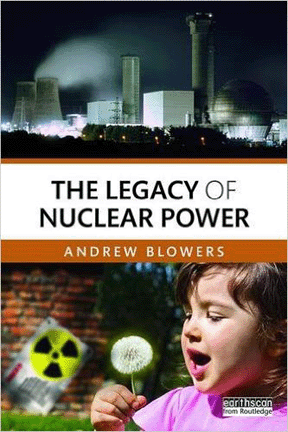
Nobody’s thought more about these legacy issues, going back to the origins of the nuclear industry here in the UK in the 1950s, than Andy Blowers. His new book, ‘The Legacy of Nuclear Power’, has just been published, and even for those who have been tracking this particularly wretched aspect of an almost entirely wretched industry, it’s a pretty mind-boggling story that emerges.
Here are the words that I contributed by way of an endorsement for ‘The Legacy of Nuclear Power’:
“The nuclear industry invites us, all the time, to look forward – never to look back. Andy Blowers’ compelling study shows why: its legacy, all around the world, is a shocking one, with no long-term solutions to the problem of nuclear waste in sight, and countless communities blighted, in one way or another, by the nuclear incubus in their midst.”
Unbelievably, the UK’s dismal record in managing its nuclear waste (for both military and civilian facilities) is no worse than that of the USA (with the Hanford site in Washington State posing equally horrendous, ongoing legacy issues as Sellafield here in the UK) or of France, with its reprocessing waste management facilities at La Hague. Only Germany can demonstrate a rather better record – though that has little to do either with the industry or with the German Government, and everything to do with an implacably hostile anti-nuclear movement which has fought for decades to ensure that Germany’s nuclear waste should not be dumped at the designatedGorleben site and then forgotten about.
Andy has written an excellent summary article about these four sites.
(And for the story about what’s going on at Sellafield – in terms of the UK’s nuclear fuel reprocessing debacle – check out this article from Ian Fairlie, commenting on BBC Panorama’s recent exposé.)
What I most admire about Andy’s analysis is that it not only covers the all-but-unbelievable financial consequences of our nuclear legacy, but forces people to confront the moral implications of an industry that defers costs not just into the future but across generations.
One of the reasons why I’m still passionate about the concept of sustainable development (rather than the environment per se) is its unwavering advocacy ofintergenerational justice: being explicit about what any one generation owes to all those generations that succeed it. The nuclear industry today only survives by ruthlessly ignoring those intergenerational obligations: the economics of nuclear power only ‘work’ because it dumps the intractable problems of managing its waste onto future generations.
In other words, this is not just a managerially incompetent, technologically redundant, financially bankrupt and wilfully dishonest industry – it is inherently immoral.
And yet, even now, there are a few misguided environmentalists who tell us that our low-carbon future depends on investing yet more countless billions of dollars in this failed horror story of an industry.
October 8, 2016
Posted by Christina Macpherson |
Religion and ethics, UK, wastes |
Leave a comment
The focus should be on managing it where it is rather than a premature search for new places and possibly new communities for deep disposal. The problem we already have is difficult enough and will only be compounded if new reactors are built extending the time-scales for implementation for very long, unknowable periods in the future. The burden of the existing legacy is unavoidable; we should not entertain having to deal with the avoidable wastes of a new build programme………
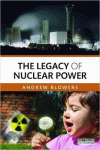 The Legacy of Nuclear Power,This fascinating short article on four nuclear communities tellingly demonstrates why radioactive waste is a moral issue and explains what the priorities for its management should be. Routledge, By Andy Blowers. 7 Oct 16
Peripheral communities tend also to be politically powerless. Although nuclear industries tend to have a dominant position in their dependent communities, strategic decisions are taken elsewhere by governmental and corporate institutions. Key political decisions affecting peripheral communities are vested in national governments to which local governments, even in federal systems like the USA and Germany, are subordinated in terms of nuclear decision making.
These nuclear peripheral communities also express distinctive cultural characteristics. Although it is difficult to pin down the complex, ambiguous and sometimes contradictory values and attitudes encountered in these places, there does seem to be a particular ‘nuclear culture’, that is both defensive and aggressive. This may be summarised in three distinguishing and complementary cultural features – realism, resignation and pragmatism – which combine to convey a resilience that provides the flexibility and resolution necessary for cultural survival.
Nuclear communities fulfil a fundamental social role in that they take on (or more usually have to accept) the radioactive legacy of nuclear power. They bear the burden of cost, risk and effort necessary to manage the legacy on behalf of the wider society, a responsibility extending into the far future. This social role enables places like Sellafield, La Hague and Hanford to exercise some economic and political leverage. Economically they are relatively secure for, once production ceases, there remain decades of clean up activity often sustaining a large workforce with continuing and open ended commitment from the state. Politically they are able, with varying success, to gain compensation, investment and diversification. By contrast, there are those communities which have mobilised resources of power sufficient to prevent or halt the progress of nuclear power. The story of the Gorleben movement provides a compelling example of the power of resistance. https://www.routledge.com/posts/10360?utm_source=adestra&utm_medium=email&utm_campaign=160701303
Finding a Solution
It is in places like Hanford, La Hague and Sellafield that the nuclear legacy has accumulated and which face the problem of managing it now and for generations to come. There is a recognised obligation, stated in principle by the International Atomic Energy Agency, that the legacy shall be managed in ‘such a way that will not impose undue burdens on future generations’ (IAEA, Principle 5). Much of this effort to find a final solution has been focused on deep geological disposal, removing the problem altogether by burying it deep underground. Yet, this solution is controversial since some radionuclides remain harmful for thousands of years and over infinitely long time-scales the uncertainties about safety and security of engineered barriers and geological containment in a repository become incommensurable……….
Seeking and securing disposal sites which is the contemporary approach, has in most countries thus far proved a slow, tedious and unsuccessful process. Successive attempts to secure political or social blessing for a site near Sellafield have failed and in Germany the resistance of Gorleben has been legendary. The history of trying to find sites for a repository for radioactive wastes is littered with examples where, to transcribe a biblical expression, many sites have been called but few chosen. The idea of the accumulating legacy of nuclear wastes from existing nuclear programmes being neatly and routinely packaged and transferred to a welcoming and pristine repository there to be entombed for ever is, with rare exceptions, little more than a distant prospect at this point in time……..
Given the time-scales involved there is no need to hurry towards a disposal solution that may, in terms of proving a concept and finding a site, be difficult to implement. Society can, and should, take its time in dealing with its nuclear legacy. Meanwhile the focus should be on managing it where it is rather than a premature search for new places and possibly new communities for deep disposal. The problem we already have is difficult enough and will only be compounded if new reactors are built extending the time-scales for implementation for very long, unknowable periods in the future. The burden of the existing legacy is unavoidable; we should not entertain having to deal with the avoidable wastes of a new build programme………
This article previews a new book by Andrew Blowers, The Legacy of Nuclear Power, Routledge, 2016, isbn 9780415869997. It is published at a critical time when the future of nuclear energy is high on the political agenda across the world. With the political focus on whether to build new nuclear power stations, this important book is a timely reminder that nuclear energy comes with a legacy of radioactive waste and clean-up that will be a burden on communities and generations far into the future. Written from the author’s perspective of active involvement in nuclear policy making, as academic, politician, government advisor and activist, this is a book that demonstrates the scale of the problem of nuclear’s legacy. https://www.routledge.com/posts/10360?utm_source=adestra&utm_medium=email&utm_campaign=160701303
October 8, 2016
Posted by Christina Macpherson |
2 WORLD, wastes |
Leave a comment

An industry group has estimated costs for decontamination work at the disaster-struck Fukushima nuclear plant and compensation for nuclear damage to be around ¥8 trillion ($77.10 billion) more than the current official projection, a source said Thursday.
The Federation of Electric Power Companies of Japan, which consists of the country’s 10 electric power companies, has informally asked Prime Minister Shinzo Abe’s government to use state funds to cover the extra costs, the source also said.
The costs are supposed to be covered by the utilities, including Tokyo Electric Power Company Holdings Inc., operator of the crippled Fukushima No. 1 nuclear power plant, where three reactors melted down in the aftermath of the March 2011 quake-tsunami disaster. The government is cautious about using taxpayer money to deal with the issue, the source said.
Under the current estimate, compensation payments are projected to total ¥5.4 trillion, while decontamination costs are forecast to reach ¥2.5 trillion.
Tepco and other nuclear power plant operators have paid contributions for compensation payments to a state-backed fund. As for decontamination costs, the fund will seek to retrieve that money by selling Tepco shares that it owns.
http://www.japantimes.co.jp/news/2016/10/07/business/federation-estimates-fukushima-nuke-plant-cleanup-costs-redress-may-rise-%C2%A58-trillion/#.V_gNhCTKO-c
October 7, 2016
Posted by dunrenard |
Fukushima 2016 | Decommissioning Costs, Fukushima Daiichi |
Leave a comment
The Japanese government plans to create ways to encourage consumers to buy food from Fukushima Prefecture. The area still suffers from the perception that its foodstuffs are unsafe due to the 2011 Fukushima Daiichi nuclear power plant accident.
Reconstruction Minister Masahide Imamura and senior government officials held a meeting on Friday.
The officials reported that a lot produce and processed foods from Fukushima are forced to be sold at prices lower than their pre-accident levels.
They explained farmers and food producers from the region face numerous challenges, such as fewer sales routes and reluctance to buy their products.
They decided to offer benefits to consumers who purchase the food.
Imamura stressed simply advertising won’t be enough and he wants the officials to create a framework that will entice consumers. He noted giving them rewards in a point system is one idea.
http://www3.nhk.or.jp/nhkworld/en/news/20161007_35/
October 7, 2016
Posted by dunrenard |
Fukushima 2016 | Contamination, Fukushima continuing, Government, Processed Foods, Produce, Promotion |
Leave a comment

On the Issue of Japan, Fukushima and Rice
In Japan, rice is life. The word for “life” is also the word for “meal” or “food.” The importance of rice to the Japanese people cannot be overstated. The word for rice has been called “emotive.” Damage to Japan’s rice crops goes beyond simple damage to the diet. To be confronted with a shortage of rice calls forth powerful feelings of deprivation in the Japanese. Japanese rice, irradiated by the events of “3/11,” is in danger.
“3/11” is what the Japanese call the series of deadly disasters which struck northern Japan in March of 2011; the earthquake, tsunami, and the Fukushima Daiichi nuclear power plant meltdown. Northern Japan was devastated and recovery will take many decades.
When the Fukushima Daiichi nuclear power facility was badly damaged by irradiation, local crops, including batches of rice grown in Fukushima, found to be badly affected by radiation, were swiftly removed from the market.
Five years after the quake, Fukushima rice producers still have difficulty marketing their produce. But the Japanese government, working in tandem with nonprofits and private organizations, has developed a positive and creative response to the Fukushima food crisis.
The Rice Peace Project Seminar, held on September 19, 2016 in New York, was inspired by the initiatives of a Japanese government supported campaign working together with non-profits, corporate projects, and organizations, including the NPO Project 88.
The NPO Project 88, which takes name from the 88 processes of rice production, mobilizes Japanese high-quality rice as an emergency relief food. Developing tasty, nutritious, non-GMO, low pesticide, and allergen-free, organic and gluten-free rice products is also central to NPO Project 88’s mission, helping to spread peace and disaster-relief in the world through rice.
The Rice Peace Project Seminar, held to publicize the efforts of the NPO Project 88, featured three speakers from Japan. Mrs. Akie Abe, spouse of Prime Minister Shinzo Abe, Mr. Hiroshi Sakurai, President of the sake brewery Asahi Shuzo, and Ms. Nari Takahashi, President of NPO Project 88. The speeches were followed by a sushi tasting prepared by Sushi Chef Yoichi Akashi of Kappo Akashi using Eco-rice as well as a tasting of “Dassai” sake, the sake Prime Minister Abe offered President Obama during the U.S. President’s 2014 visit to Japan.
Jeff Santos, CEO of the Santos Media Group who hosted the seminar, introduced Mrs. Akia Abe. Santos described Mrs. Abe as an activist. Abe is actively engaged in supporting the NPO Project 88 and in promoting Fukushima’s agricultural industry by creating Yamato No Kokoro sake from rice produced in Fukushima.
Mrs. Akie Abe said that in 2011, in the wake of the Tohoku earthquake, she realized the importance of supporting Japanese food production, especially rice. With the encouragement of US Ambassador to Japan, Caroline Kennedy, Abe began to support the production of Fukushima rice and sake,
Abe described the production of rice in Japan as highly political. She said that 150 years ago, after extensive warring between the Chochu and Aizu clans. the two prefectures began to cultivate rice for sake and to brew sake, jointly. The joint effort was successful and the two prefectures now live in harmony.
Abe said that for Japanese, now as always, rice and sake are spiritual foods. “In Japan, we like to get our hands dirty [working the land.] We are a part of nature. We owe our gratitude to nature. It is my pleasure to work with rice producers and sake producers.”
She closed with a warm invitation: “Please enjoy the sushi and sake tasting today and please also come to Japan to enjoy them!”
Hiroshi Sakurai, President of Sake Brewery Asahi Shuzo, opened with praise for Japanese sake in general and Asahi Shuzo’s sake in particular. “Sake has to be ‘oishii’ (delicious) If it is not delicious what is the point of creating it? And our sake is especially ‘oishii!’”
Sakurai said that he wanted to show two world leaders enjoying Japanese sake, Prime Minister Abe and US President Barack Obama. Sakurai’s photo array displayed pictures from the U.S. President’s 2014 visit to Japan.
Sakurai said that his company, Asahi Shuzo, had partnered with the king of rice producers, Yamada Nishiki, accounting for 6.5 percent of total rice production in Japan. He has a staff of 100 and his employees are the best. Production is entirely by hand- they do not use machines. Production is around the clock, 24/7, to produce “oishii” sake.
Sakurai said that rice production in Japan is very eco- friendly. They recycle all that remains from rice production, such as rice husks, used to make sembei, or rice milk.
In closing, he said: “We are eager to promote our sake and we hope you enjoy the tasting.”
Nari Takashashi, President of NPO Project 88. Ms. Takahashi said that rice was the first food served to Fukushima quake victims. It was sometimes all that aged survivors could eat. And for those who could not eat plain rice she and her company developed soft rice cakes. They were very popular, as were their cream puffs.
Takahashi said that some kids with allergies couldn’t eat even the rice cookies or cream puffs. So she developed allergy-free cookies made with rice powder and delivered to the schools. Kids loved them.
Takahashi said that the application for allergy free products goes well beyond Fukushima. Survivors of the Kumamoto quake this past April are their next potential customers. She believes there is a huge market for these products world wide, especially to disaster survivors and to millennials.
After this spirited set of speeches, it was no surprise that the sushi and sake tastings were extraordinary.
http://intpolicydigest.org/2016/10/06/on-the-issue-of-japan-fukushima-and-rice/
October 7, 2016
Posted by dunrenard |
Fukushima 2016 | Contaminated Products, Fukushima continuing, Rice, Sake |
Leave a comment
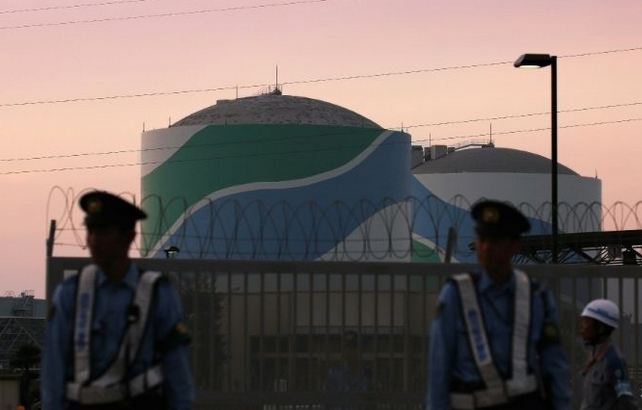
Nuclear reactor buildings of the Kyushu Electric’s Sendai nuclear power plant in southern Kagoshima in 2015.
Japan nuclear reactor shuttered for safety work
TOKYO: A reactor at the centre of Japan’s national debate over nuclear power was halted on Thursday (Oct 6) under stricter post-Fukushima safety standards, as Tokyo struggles to bring back atomic energy.
Utility Kyushu Electric is shutting down the No. 1 reactor at its Sendai plant in southern Kagoshima for a few months of inspections and maintenance, leaving Japan with just two operating reactors.
But there is speculation that the reactor’s safety work could drag on longer.
Thursday’s shutdown follows demands from the region’s top politician that Kyushu Electric conduct extra safety inspections at its two operating reactors in the Sendai plant – after deadly quakes hammered a neighbouring prefecture in April.
Last month, the company refused governor Satoshi Mitazono’s demands to immediately shut down the reactors over safety concerns.
But it agreed to what it called “special inspections” in addition to regular maintenance work. Sendai’s No. 2 reactor will be shut down for a similar review starting in December.
Dozens of reactors were switched off in the wake of the March 2011 Fukushima accident, the worst nuclear disaster in a generation.
Anti-atomic sentiment still runs high five years later, challenging a push by Prime Minister Shinzo Abe and utility companies to switch Japan’s stable of reactors back on.
The catastrophe forced resource-poor Japan to turn to expensive fossil fuels to plug its energy gap, but fears about the safety of nuclear power and radiation exposure linger.
The two Sendai reactors were restarted last year under new safety regulations brought in after Fukushima, where reactors went into meltdown in March 2011 after a huge earthquake and tsunami.
Another reactor has been restarted at the Ikata plant in western Japan.
Opposition to nuclear power has seen communities across the country file lawsuits to prevent restarts, including the Sendai plant.
The residents argued that the plant’s operator underestimated the scale of potential earthquakes and volcanic eruptions that could hit the region. A court rejected their argument and ordered restarts.
http://www.channelnewsasia.com/news/asiapacific/japan-nuclear-reactor-shuttered-for-safety-work/3184554.html
October 7, 2016
Posted by dunrenard |
Japan | Reactor 1, Safety Work, Sendai NPP, Shut |
Leave a comment
Tokyo Electric Power Co. is still struggling to put the Fukushima nuclear disaster behind it, admitting this week that paying for decommissioning the plant in one go risks leaving it insolvent.
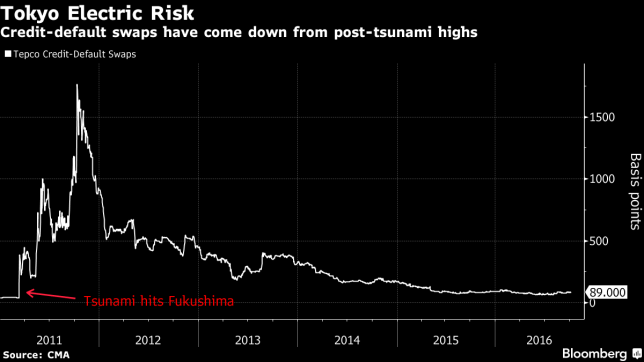
The cost to insure debt in Japan’s biggest utility climbed to a seven-month high of 89 basis points on Oct. 5 after President Naomi Hirose said after a meeting in Tokyo with a government commission that the company is asking for help in avoiding financial ruin. Tepco has already received state aid for compensation and decontamination.
The March 2011 nuclear accident and its fallout will ultimately cost more than 11 trillion yen ($106 billion), according to a study by academics including Kenichi Oshima, a professor of economics at Ritsumeikan University. Tepco has estimated that decommissioning alone will cost about 2 trillion yen. Investors should hold off buying bonds of other utilities until there is more clarity on how the government will close the Fukushima plant, according to BNP Paribas SA.
“Now is not the best time to be investing in electricity utility bonds, with discussions going on about nuclear plant decommissioning, and the potential for spreads to widen,” said Mana Nakazora, chief credit analyst at BNP Paribas in Tokyo. Even so, she added, “the government has little choice but to take measures to avoid a default by Tokyo Electric.”
While Prime Minister Shinzo Abe’s government has committed to provide up to 9 trillion yen for compensation to individuals and business hurt by the Fukushima disaster and for decontaminating areas affected, that figure doesn’t include decommissioning of the nuclear plant itself, according to a report by Moody’s Investors Service last month.
Scrapping the Fukushima reactors may take 30 years to 40 years, and Tokyo Electric will only start removing debris from the plant from in 2021, a decade after the incident, according to the utility’s road map for dealing with the remnants of the disaster.
In speaking to reporters, Tepco President Hirose was probably making a public case for more government support, according to Yutaka Ban, the chief credit analyst at SMBC Nikko Securities Inc. in Tokyo. Ban said he saw little probability that support will be withheld.
“Things will likely settle down” after the government adopts the new measures, said Ban. “Without government support, the costs would be extremely high.”
For a Bloomberg Intelligence report on Asia-Pacific utilities, click here.
Tepco’s credit-default swaps have come down from as high as 1,762 basis points in October 2011, according to data provider CMA. The utility has said it plans to return to the bond market by the end of the fiscal year to March 2017. Jun Oshima, a spokesman for Tokyo Electric, said that plan is still in place. It stopped issuing notes after the Fukushima disaster.
The extra yield on Tepco’s 1.155 percent bonds due in 2020 was 64 basis points more than sovereign debt, the lowest since before the Fukushima disaster, according to Bloomberg-compiled prices. The spread on Osaka-based Kansai Electric Power Co.’s 0.976 percent notes due in 2020 was 39 basis points.
Tokyo Electric has a Ba3 rating from Moody’s and BB- score from S&P Global Ratings, both three levels below investment grade.
“Decommissioning is currently the biggest unknown, and clarity matters in terms of credit,” said Mariko Semetko, a Moody’s analyst in Tokyo. “The lack of clarity there has been holding back the credit quality.”
http://www.bloomberg.com/news/articles/2016-10-06/fukushima-clean-up-talks-put-tepco-survival-risk-back-in-focus
October 7, 2016
Posted by dunrenard |
Fukushima 2016 | Decommissioning Costs, Fukushima Daiichi, Insolvency, Tepco |
Leave a comment




 nuclear-news