EDITORIAL: Cost estimate needed first to decommission Fukushima plant
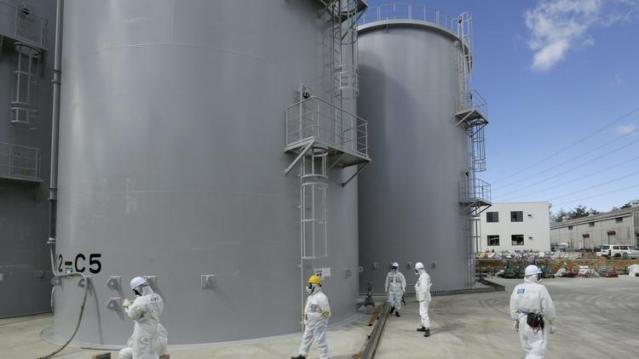
An industry ministry panel of experts is tackling two key questions concerning the decommissioning of the crippled Fukushima No. 1 nuclear power plant.
One is how much money will be needed to decommission the plant’s reactors, three of which melted down. The other is who should foot the bill and how.
However, there are some serious flaws in the way the expert panel is working on these knotty questions, which could lead to a huge financial burden on the public.
First of all, the panel’s meetings are not open to the public. The main points of the discussions are published later, but many details, including who made specific remarks, are omitted.
The fate of Tokyo Electric Power Co., which operates the Fukushima plant and is responsible for its decommissioning, will be largely determined by whether it can restart its Kashiwazaki-Kariwa nuclear power plant in Niigata Prefecture.
Panel members include many business leaders who have been promoting nuclear power generation.
The outcome of the recent Niigata gubernatorial election underscored the strong opposition of local residents against TEPCO’s plan to bring the plant back online.
The panel’s lineup raises concerns that its discussions may be based on the assumption that the Kashiwazaki-Kariwa nuclear plant will eventually be restarted, despite the situation in the prefecture.
Another troubling fact is that the government has yet to announce any estimate of the total decommissioning cost.
In the panel’s first meeting, some members urged the government to swiftly present an estimate of the cost. In the second meeting, however, the Ministry of Economy, Trade and Industry only said that annual spending could grow to several hundreds of billions of yen from about 80 billion yen ($703 million) spent now.
The ministry says a specific estimate of the total cost will be announced as early as the end of the year, along with a plan for management reforms at TEPCO and a package of related measures the government will take.
But this timetable doesn’t make sense. Pinning down the overall decommissioning cost should be the starting point for the panel’s discussions.
With the conditions of the melted nuclear fuel remaining unclear, it is certainly difficult to accurately estimate the cost.
Still, an estimate should first be shown to ensure substantive debate on whether the method used for the work is appropriate and whether there are ways to curb the cost.
As for financing, the panel has supported the proposal that TEPCO should secure the necessary funds on its own through management reform over other options, such as the utility’s liquidation involving debt forgiveness by its creditors, tax financing by the government and a continuation of the current state control of TEPCO.
In an apparent attempt to stress the importance of TEPCO’s own efforts to save itself, the panel has also recommended that the Kashiwazaki-Kariwa nuclear plant should be spun off from TEPCO and integrated with the nuclear power business of another utility.
There is no disputing that TEPCO should push through thorough management reforms to prevent the public from shouldering part of the cost through tax financing or hikes in electricity rates.
The question, however, is whether the embattled utility’s own efforts will be enough to cover the entire decommissioning cost, expected to reach several trillions of yen.
If a plan based on the company’s own efforts fails and disrupts the decommissioning process, the reconstruction of disaster-hit areas in Fukushima Prefecture could be seriously delayed.
It is vital for the panel to win broad public support for its proposals on the national challenge of decommissioning the Fukushima No. 1 nuclear power plant.
This requires careful, exhaustive and reasonable debate, open to the public, on the cost and the financing method.
http://www.asahi.com/ajw/articles/AJ201610270028.html
Men Over 30 Whole-Body Counter Examination increasing at Iwaki city Mothers Radiation Lab
Since 2014 the number of men over 30 years old having whole body counter examination(Radioactivity measurement of the whole body) is increasing at the Tarachine Mothers Radiation Lab in Iwaki city, Fukushima,. Most of them are decontamination workers.
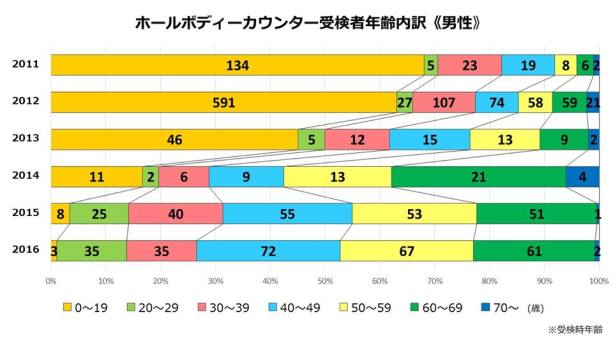
Whole-body counter men examinees breakdown by age.
Japan won’t support U.N. resolution urging nuclear weapons ban

Hiroshima bombing
TOKYO — Japan has decided not to support a draft U.N. resolution urging the start of negotiations in 2017 to outlaw nuclear weapons, a senior Japanese official and other sources close to the matter said.
Japan, the world’s sole victim of atomic bombings, will consider either abstaining or voting against the draft at the General Assembly this week because it would only “further deepen the rift between nuclear and non-nuclear states and meaningful treaty negotiations cannot be expected,” the senior official said.
Although the draft is likely to be adopted by a majority vote, the United States and other states possessing nuclear weapons are expected to boycott the negotiations.
Foreign Minister Fumio Kishida and other senior members of the government of Prime Minister Shinzo Abe are expected to make a final decision soon on Japan’s position, the sources said.
The draft, submitted by Austria and others to the First Committee on disarmament and security issues at the General Assembly on Oct. 13, sets out to establish a mandate on a “legally binding instrument to prohibit nuclear weapons, leading towards their total elimination.”
The United States has been urging Japan to oppose the draft, the sources said. It remains to be seen whether Japan, which comes under the U.S. nuclear umbrella, will decide to join the talks to ban nuclear weapons expected to start in March next year.
The draft resolution had drawn support from nearly 50 countries in Southeast Asia, Africa, Latin America and other regions by the end of last week. The submitting countries have stressed the humanitarian impact of the use of nuclear weapons.
The Japanese Foreign Ministry is unsupportive of the resolution, questioning its effectiveness with nuclear powers reluctant to join the treaty negotiations. The ministry also believes the draft does not take into consideration security aspects such as the impact of the loss of nuclear deterrence, the sources added.
But such a stance by the Japanese government could trigger opposition at home and disappoint states supportive of the resolution.

Hiroshima bombed
The Different Dangerosity of Some Radioactive Elements.

Japanese Flawed steel Components at the Center of French Nuclear Crisis – Major Questions & Implications for Japanese Reactors Safety
25 October 2016, Tokyo – The safety and regulation of the Japanese nuclear fleet is called into serious question by the discovery of Japanese-manufactured flawed steel components installed in operating French nuclear reactors forced to shut down last week by the French nuclear safety regulator ASN, according to a new Greenpeace report. The threat to nuclear reactor safety in Japan is due to the supply of steel components to the nuclear industry from both Japan Casting and Forging Company (JCFC) and the Japan Steel Works (JSW), according to the technical report (http://bit.ly/2eMqJMm) released today by Greenpeace Japan, by the nuclear engineering consultancy, Large&Associates of London. Evidence of astonishingly high levels of excess carbon far outside regulatory limits with the associated loss of steel toughness and significant increase in the risk of catastrophic failure of primary containment components, have been discovered in JCFC-manufactured components installed in steam generators in 12 reactors owned by the French state-utility, EdF. The independent French nuclear agency, IRSN, recently warned that due to the excess carbon content, there was an increased risk of failure of the affected steam generator leading to a potential reactor core meltdown.(1)

These components are so fundamental to reactor safety, and consequences so potentially severe, that in every country with nuclear reactors across the planet, nuclear regulators require that these components must not have any possibility of failure under any operating circumstance over the lifetime of the reactor – so-called “break-preclusion” for the reactor safety case. For this reason the French regulator warned its worldwide counterparts, including the Nuclear Regulation Authority (NRA) in Japan, of the potential enormity of the situation should their nuclear power plants have similarly flawed components installed.
During the period 1994-2006, JCFC supplied flawed components to France, which somehow managed to pass through the quality assurance controls of JCFC, the supplier Areva, and the French regulator to be installed in operating reactors. How the defects were not detected along the supply chain has not yet been disclosed. A commissioner from the NRA is visiting France this week to discuss the crisis.
From 1984-1993, JCFC also supplied steam generator components to the following Japanese reactors: Takahama 3&4, Sendai 2, Tomari 1&2 and Tsuruga 2; JCFC steam generator and reactor pressure vessel components are installed in a total of 14 Japanese reactors (not including two reactors at Fukushima Daiini).
“As a result of substandard manufacturing in Japan, citizens in France have been unknowingly exposed to the risk of catastrophic failure of critical reactor components which could result in a reactor core meltdown. Japanese-supplied steel is now at the center of France’s unprecedented nuclear crisis the scale of which has never been seen in any country. All 12 reactors supplied by JCFC are either in forced shutdown or about to be. It lacks all credibility that the Japanese nuclear industry would claim that there are no implications for the safety of their own nuclear reactors. The steel production records released in France did not reveal the scale of excess carbon, which was only found after physical testing. There are currently no plans for such tests in Japan. That is wholly unacceptable. There are many urgent questions that need to be answered by the industry and the NRA, and with full public disclosure and transparency,” said Shaun Burnie, senior nuclear specialist at Greenpeace Germany.
The French nuclear safety regulator has been investigating components supplied by both JCFC and the Japan Steel Works (JSW). Test results obtained by Greenpeace in June 2016 indicated that there was a possibility of excess carbon problem in JSW-manufactured components in the steam generator boiler pods – there are 3 or 4 steam generators in each pressurized water reactor PWR nuclear power plant, each weighs upwards of 300 to 400 tonnes and, typically, the cost of replacement is around US$130 to 150 million.
Since the French publication of the JCFC and JSW component test results, it has been claimed that JSW components are free of excess carbon. However, no tests results proving this have been disclosed and Large&Associates research raises questions over the credibility of this claim. The non destructive testing that has been conducted in France is incapable of identifying the scale of excess carbon. Large&Associatess recommends destructive testing as the only guaranteed method for proving carbon concentration.
“The fact that French nuclear reactors have been operating with flawed Japanese-supplied critical components is astounding. This is an utter failure of both nuclear regulation and on the part of the Japanese steel suppliers to meet quality control requirements. The implications for Japan may be even greater, as JSW is also implicated in this scandal because it supplies the forged steel parts that make up the reactor pressure vessel, which is the very heart of both PWR and boiling water reactors (BWR) used in Japan. Every reactor in Japan has critical components from these two suppliers and they must all undergo non destructive testing, with the priority being the two reactors currently in operation, Ikata-3 and Sendai 2, which must be immediately shutdown and tested, in addition reactors slated for decommissioning must have their components destructively tested, ” said John Large, head of Large&Associates.
The Japanese utilities are required to submit documentation to the NRA by 31 October 2016 detailing the quality of the steel components supplied by Japanese companies, JCFC, JSW and the other steel supplier, JFE. This is however only a paper exercise and not the result of actual physical testing of components installed in reactors.
Greenpeace has today sent a copy of the Large&Associates report to the NRA. A series of urgent questions will be submitted, via a member of the Japanese Diet, to the NRA in the coming days.
Priority reactors to be assessed and tested in Japan due to their status: operating, possibility of early operation or approval by the NRA for restart are: Ikata 3, Sendai 2, Takahama 2, Takahama 3&4 (under appeal by Kansai Electric); and next in line for approval by NRA – Genkai 3&4 and Kashiwazaki-kariwa 6&7.
Notes:
(1) The Japanese supplied components under investigation in France are designated Class 1, by which they are not permitted under any circumstances to fail during operation due to the potentially severe consequences. Specifically the components are Steam Generator tube support plates, elliptical domes, and bottom channel heads; as well as Reactor Pressure Vessel upper and lower heads, rings and pressurizers. The French governments Institute for Radiological and Nuclear Safety (IRSN) warned in August that there was a risk of reactor fuel melt down if steam generators with excess carbon operated. A maximum carbon limit is set by regulation to prevent a reduction in the toughness of the steel in the steam generators and Reactor Pressure Vessel, reduced toughness can lead to thermal shock induced fast fracture, where the steel shatters like glass. See, IRSN, 2016 2016-00275 Objet: EDF – REP – Paliers CP0, CPY et N4 – Ségrégations en carbone des fonds primaires de générateurs de vapeur – Analyse de sûreté et mesures compensatoires, 5th August 2016.
Download the report
For further information:
Shaun Burnie, senior nuclear specialist, Greenpeace Germany (Tokyo): shaun.burnie@greenpeace.org, +81 (0)80 3694 2843
Kendra Ulrich, senior global nuclear campaigner, Greenpeace Japan: kendra.ulrich@greenpeace.org, +81 (0) 90 6478 5408
Chisato Jono, communications officer, Greenpeace Japan: chisato.jono@greenpeace.org, +81 (0)80-6558-4446
http://www.greenpeace.org/japan/ja/news/press/2016/pr201610251/
Ministry mulls 2020 start for Monju decommissioning after nine-month activation
Just before the 2020 Tokyo Olympics, very nice…. Is the ongoing catastrophe at Fukushima Daiichi, yet not under control, yet unsettled, not enough for them???
“Under the plan, a nine-month trial period will be created from the spring of 2019 during which the reactor will run for four months in a bid to minimize the risk of accidents.”

The science and technology ministry overseeing the trouble-prone Monju fast-breeder reactor is considering starting decommissioning of the facility in 2020, ministry sources said Tuesday.
It is the first time a specific time frame for decommissioning work for the Monju reactor in Fukui Prefecture on the Sea of Japan coast has been revealed in a proposed plan by the Ministry of Education, Culture, Sports, Science and Technology.
The move comes as the government is fundamentally reviewing the Monju project, including the decommissioning of the reactor, which has been plagued with a series of safety problems and has come under fire for being costly.
The plutonium-burning Monju has hardly operated over the past 20 years, due to a spate of problems and incidents, despite its intended key role in Japan’s nuclear fuel recycling policy.
The plan to start scrapping the reactor is on the condition of running the reactor for a short period of time to obtain necessary data for the future development of fast reactors.
Under the plan, a nine-month trial period will be created from the spring of 2019 during which the reactor will run for four months in a bid to minimize the risk of accidents.
Other countries have also shown interest in fast-reactor technology due to its purported use in radioactive waste reduction among other benefits.
But the Nuclear Regulation Authority has been reluctant to allow the reactor’s restart.
During a government panel meeting held Oct. 7, the ministry presented an estimate that if Monju is reactivated, at least ¥540 billion ($5.2 billion) would be necessary over a 16-year period.
One of the sources said the cost of running the reactor for only a short period of time would be ¥200 billion at most. With necessary safety measures in place following the Fukushima nuclear meltdowns in 2011, the ministry believes no additional work is needed to meet regulatory requirements for its brief operation.
The government will continue to discuss the matter through the panel and formally decide by the end of the year.
The Monju reactor dates back to 1980, when the nation began trying to reduce its reliance on fossil fuels. Almost all oil, coal and gas burned in Japan is imported.
Still, the reactor was costly and suffered under mismanagement and repeated accidents, only going live for a few months during its more than three decades of existence.
Monju first reached criticality in 1994 but was forced to shut down in December 1995 after a leak of sodium coolant and a fire. There was a subsequent attempt at a cover-up.
In November 2012, it emerged that the operator, Japan Atomic Energy Agency, had failed to properly check as many as 10,000 of the reactor’s components, as required by the safety rules in place at the time.
In November last year, the Nuclear Regulation Authority declared that the government-affiliated JAEA was “not qualified as an entity to safely operate” the facility.
It told the government either to find an alternative operator or scrap the project. The government was unable to find new management.
On first day in office, new Niigata governor again rejects early reactor restart
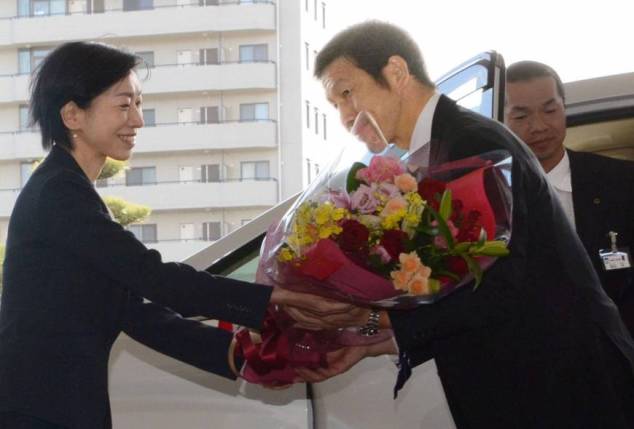
Gov. Ryuichi Yoneyama receives flowers on his first day in office Tuesday at the Niigata Prefectural Government office in the city of Niigata
NIIGATA – On his first day in office, Niigata Gov. Ryuichi Yoneyama reiterated his opposition to an early restart of the Kashiwazaki-Kariwa nuclear power plant.
“I can’t discuss (the matter) while the investigation is still in progress,” Yoneyama told a news conference Tuesday, referring to the probe into the March 2011 meltdowns at the Fukushima No. 1 power plant.
“I can’t accept a resumption of the plant’s operation under what I understand as the current situation,” he said.
Having never before held public office, Yoneyama won a landslide victory on Oct. 16. His campaign stressed his negative stance toward the restart of the power plant that straddles the village of Kariwa and the city of Kashiwazaki.
Operated by Tokyo Electric Power Company Holdings Inc., it is the biggest nuclear power plant in the world.
Supported by three opposition parties — the Japanese Communist Party, the Social Democratic Party and the Liberal Party — Yoneyama defeated a candidate backed by the ruling Liberal Democratic Party and its coalition partner Komeito.
At his inaugural news conference, Yoneyama expressed his intention to “thoroughly investigate” the Fukushima crisis.
He referred to Tepco’s failure to quickly disclose the meltdowns at Fukushima No. 1, which a joint committee of the Niigata Prefectural Government and the company is currently investigating.
The matter will be “scrutinized to an extent at which guidelines to judge (nuclear plant) safety can be drawn up,” Yoneyama said, expressing his hope of hashing out a conclusion by the end of his four-year term.
He said he hopes to hold talks with the central government and Tepco soon on the possible restart. “It’s important to confirm each other’s positions,” he observed.
At a news conference in Tokyo, Chief Cabinet Secretary Yoshihide Suga said there is no change in the central government’s policy of pursuing a restart of any reactor that has passed a Nuclear Regulation Authority safety examination.
“We hope to secure local support while listening sufficiently to the new governor,” Suga said.
Paper sludge that polluted sea cleans up soil in Fukushima
Another one after so many others. Always nice to read so as to reduce the anxiety of the Fukushima people who have to live with that contamination.
But does it truly works? Or is it just another soothing story cooked by the ETHOS project whose only intent is to make people stay put in the contaminated areas, the costs of evacuation being too high…

A heap of sludge produced in papermaking
FUJI, Shizuoka Prefecture–Charcoal from paper mill sludge that once polluted the ocean here southwest of Tokyo could be used to restore contaminated land near the crippled Fukushima No. 1 nuclear power plant.
An experiment in 2011 showed that the charcoal is effective in reducing radioactive substances in soil and preventing the absorption of cesium by plants, said research leader Ai Van Tran.
Tran, 68, a doctor in agricultural science, was conducting the research for the Corelex Group that includes Corelex Shin-ei Mfg. Co., which has the largest share of recycled toilet paper in Japan.
“We would be delighted if our byproduct, which was once a source of environmental pollution, is useful in decontamination. It will also contribute to reducing the waste from papermaking, so it is killing two birds with one stone,” said Satoshi Kurosaki, the president of the Corelex Shin-ei.
In making recycled paper, about 30 percent of the raw material remains as sludge. In 2002, the Corelex Group developed “blacklite,” a type of activated carbon produced by burning paper sludge. It has a variety of useful properties such as soil conditioning, deodorizing, underfloor humidity control, melting snow and more.
The company produces blacklite from the paper sludge generated at a paper mill in Hokkaido, and it is used at golf courses and farms on the island.
After the radioactive fallout from the accident at the Fukushima No. 1 nuclear plant contaminated a vast area, the team, led by Tran, suggested conducting a trial to use the absorbent property of blacklite to decontaminate the soil.
Between May and October 2011, the company rented about 1,000 square meters of rice fields in Iitate, Fukushima Prefecture. It is one of the most heavily contaminated areas. The team grew rice in soil containing blacklite, and compared the amount of radioactivity in the rice with crops grown on soil with no blacklite.
The result was clear.
The rice harvested from the paddies that contained blacklite had just one-35th of the amount of radioactive cesium that was found in the rice grown on untreated soil. The cesium concentration in the treated soil was about half that in the untreated soil.
Also, the rice in the paddies with blacklite showed much better growth than the other crop.
As the ingredients of blacklite is industrial waste, it only costs about 500 yen ($4.80) for a 30-liter bag.
The enormous amount of soil removed from the surface of the ground in Fukushima Prefecture in the decontamination effort has been bagged and piled up at a temporary storage site. It is waiting to be transferred to an interim storage facility, which is still under construction.
It is expected to take a significant amount of time to process this soil and concerns have been raised over radiation leakage in the meantime.
Tran, who is originally from Vietnam, and his team have acquired the patent for a new method to contain radiation by mixing contaminated soil with blacklite and then sealing it in a tank made of concrete.
It is believed that the soil is gradually decontaminated when an ion exchange process occurs between the mineral in blacklite and the radioactive cesium in the soil.
Tran’s paper on his team’s experiments attracted attention in the United States, and he has been invited to speak at an international conference on nuclear chemistry scheduled for December in Texas.
The research is still in its early stages, but the Corelex Group has contacted the economy ministry to ask whether blacklite can be used in the decontamination project in Fukushima in the future.
http://www.asahi.com/ajw/articles/AJ201610260012.html
German Owned Biomass Plants Burning Radioactive Wood For Electricity in Fukushima
Japan to burn irradiated wood to create electricity, releasing gases to the environment AGAIN! Safe disposal?
“Germany’s Federal Office for Radiation Protection declined to comment on the process of burning radioactive waste in Fukushima. Entrade’s biomass units will be located about 50 kilometers (31 miles) from the Tepco reactors, said Uhlig.”
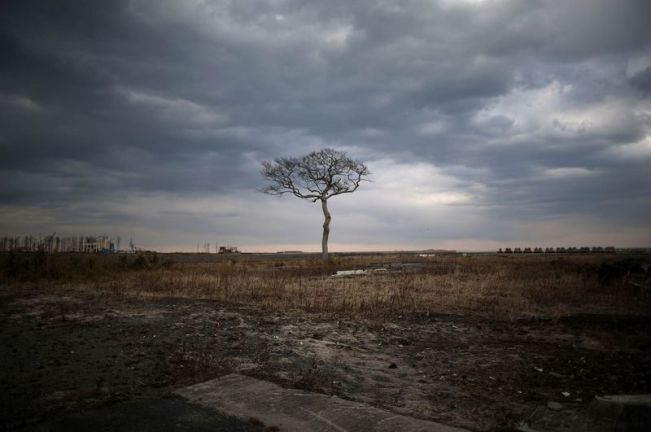
A lone tree inside exclusion zone, close to the devastated Fukushima Daiichi Nuclear plant in February 2016.
Radioactive Fukushima Wood Becomes Power in German Machine
- Entrade contracts 20 megawatts of power sales to Fukushima
- Lighty radiated wood turned to power in 400 biomass plants
Japan is turning to a small German company to generate power from timber irradiated by the Fukushima Dai-Ichi nuclear meltdowns.
Closely held Entrade Energiesysteme AG will sell electricity from 400 of its container-sized biomass-to-power machines set up in Fukushima Prefecture, said the Dusseldorf-based company’s Chief Executive Officer Julien Uhlig. The devices will generate 20 megawatts of power by next year and function like a “biological battery” that kicks in when the sun descends on the the region’s solar panels, he said.
Selling green power with Entrade’s mobile units could support Japanese attempts to repopulate a region that’s struggled to restore normality after the March 2011 earthquake and tsunami killed 18,000 people while also triggering the Fukushima nuclear meltdown that dislocated 160,000 others. The prefecture aims to generate 100 percent of its power from renewable energy by 2040.

Entrade’s so-called E4 plants, four of which fit inside a 40-foot (12-meter) container, can reduce the mass of lightly irradiated wood waste by 99.5 percent, according to Uhlig. Shrinking the volume of waste could help Japanese authorities who need to reduce the volume of contaminated materials. Workers around Fukushima have been cleaning by scraping up soil, moss and leaves from contaminated surfaces and sealing them in containers.
“Burning won’t destroy radiation but we can shrink detritus to ash and create a lot of clean power at the same time,” said Uhlig, a former German government employee, in a phone call from Tokyo on Oct. 21. “There’s a lot of excitement about this project but I also detected a high degree of reluctance in Fukushima to talk about radiation.”
Ballooning Costs
The decommissioning of Tokyo Electric Power Co. Holdings Inc.’s stricken plant is set to take as long as four decades and the government estimates environmental clean-up costs may balloon to $3.3 trillion yen ($31.5 billion) through March 2018.
Prime Minister Shinzo Abe said in March that Japan cannot forgo nuclear power. His government wants about a fifth of Japan’s power generated by nuclear by 2030, compared with almost 30 percent before three reactors melted down at the Fukushima plant.
Currently, just two of the nation’s 42 operable nuclear reactors are running, which has translated into higher costs for imported fossil fuels as well as more greenhouse gas emissions.
Germany’s Federal Office for Radiation Protection declined to comment on the process of burning radioactive waste in Fukushima. Entrade’s biomass units will be located about 50 kilometers (31 miles) from the Tepco reactors, said Uhlig.
Like Muesli
Entrade’s biomass plants, which rely partly on technology developed by Germany’s Fraunhofer Institute, are “compactors” of lightly irradiated waste, said Uhlig. The “all in the box” technology is attractive to environmentally-conscious clients who have a steady stream of bio waste but don’t want to invest in a plant, he said.
Uhlig’s company is cooperating with London’s Gatwick Airport to turn food waste from airlines into power. Royal Bank of Scotland financed another project supplying power from 200 units to an industrial estate near Liverpool, U.K.
Entrade has experimented with 130 types of biofuel since beginning operation in 2009. The company claims its plants convert biomass to power with 85 percent efficiency.
“It’s a bit like mixing muesli, taking what’s available from clients or the locality and blending it,” said Uhlig.
Entrade is moving its headquarters to Los Angeles to generate investment capital and help meet demand in the U.S. and Caribbean, he said. The company has 250 units in California and can hardly keep up with demand, Uhlig said.
1 This Month

of the week – Shut Down Drone Warfare!


Tell the Ukrainian Government to Drop Prosecution of Peace Activist Yurii Sheliazhenko

Petition to revoke the licensing of the Near Surface Nuclear Disposal Facility (NSDF) at Chalk River. https://www.ourcommons.ca/petitions/en/Petition/Details?Petition=e-7247
To see nuclear-related stories in greater depth and intensity – go to https://nuclearinformation.wordpress.com
-
Archives
- March 2026 (244)
- February 2026 (268)
- January 2026 (308)
- December 2025 (358)
- November 2025 (359)
- October 2025 (376)
- September 2025 (257)
- August 2025 (319)
- July 2025 (230)
- June 2025 (348)
- May 2025 (261)
- April 2025 (305)
-
Categories
- 1
- 1 NUCLEAR ISSUES
- business and costs
- climate change
- culture and arts
- ENERGY
- environment
- health
- history
- indigenous issues
- Legal
- marketing of nuclear
- media
- opposition to nuclear
- PERSONAL STORIES
- politics
- politics international
- Religion and ethics
- safety
- secrets,lies and civil liberties
- spinbuster
- technology
- Uranium
- wastes
- weapons and war
- Women
- 2 WORLD
- ACTION
- AFRICA
- Atrocities
- AUSTRALIA
- Christina's notes
- Christina's themes
- culture and arts
- Events
- Fuk 2022
- Fuk 2023
- Fukushima 2017
- Fukushima 2018
- fukushima 2019
- Fukushima 2020
- Fukushima 2021
- general
- global warming
- Humour (God we need it)
- Nuclear
- RARE EARTHS
- Reference
- resources – print
- Resources -audiovicual
- Weekly Newsletter
- World
- World Nuclear
- YouTube
-
RSS
Entries RSS
Comments RSS
 nuclear-news