Water guzzling nuclear power not a good idea for Pueblo County, Colorado
No to nuclear power, http://www.chieftain.com/opinion/5111644-120/nuclear-power-pueblo-operations, Paul D. Conatore, 4 Sept 16 An opinion published in The Pueblo Chieftain touted nuclear power as “safe, reliant, and clean,” and proclaimed “Pueblo would be an ideal location for a new nuclear power plant.”
A veiled attempt to resurrect a failed proposal for an NPP in Pueblo, the opinion is ill-founded and ill-considered in its assertions and omissions.
Absent are the discussions of major problems in uranium mining, milling and enrichment; fuel fabrication operations; nuclear reactor operations; radioactive waste operations that result in radioactive and chemical pollution and contamination of air, water and earth; and adverse public health and environmental impacts.
 Consider this also: Nuclear power is the most water-guzzling of energy sources, but no connection is drawn between limited water resources in Pueblo County and the water requirements of an NPP built here.
Nuclear power plants consume tens of millions to a few billion gallons of water each day, depending on the type and number of reactors. They have an insatiable thirst for cooling water.
Intense competition for water among agricultural, environmental, industrial and municipal consumers already exists. Introducing nuclear power consumption would only exacerbate the situation.
Anyone honestly advocating protection of the Arkansas River water resource would be well advised to look deeply into the facts before backing a plant in Pueblo.
China ratifies Paris climate agreement
 China has ratified Paris climate agreement, state media says, ABC News 3 Sep 16 China has ratified the Paris agreement on climate change, according to state media, a key move by the world’s biggest polluter that brings the deal a major step closer to coming into force.
The National People’s Congress legislature voted to adopt “the proposal to review and ratify the Paris Agreement”, the official Xinhua news agency said.
The Paris pact calls for capping global warming at well below two degrees Celsius, and 1.5C if possible, compared with pre-industrial levels.
China is responsible for about 25 per cent of global carbon emissions, with the US in second place on about 15 per cent, making their efforts crucial in the fight against warming.
The Paris deal will come into force 30 days after at least 55 countries, accounting for 55 per cent of global greenhouse gas emissions, have ratified it……..http://www.abc.net.au/news/2016-09-03/china-ratifies-paris-climate-agreement3a-xinhua/7811778?section=environment
Indigenous people battle against uranium mining in Grand Canyon watershed
 Grand Canyon tribe fears for its future amid battle against uranium mining Conservationists and other campaigners are urging President Obama to designate 1.7 million acres of the Canyon watershed a national monument before he leaves office, Independent Tim Walker Arizona @timwalker 30 August 2016 “…….First mined for copper at the turn of the 20th Century, the Orphan Mine became a source of uranium to supply the nuclear arms race in the 1950s. It was closed in 1969, but not before contaminating the water in nearby Horn Creek with enough uranium that passing hikers are warned not to drink it. The US National Park Service has already spent millions on a clean-up effort that is still in its early stages. “It proves not everything you dig up can be covered again,” says Kaska, a member of the Havasupai tribe.
The Havasupai, whose name means “people of the blue-green water”, have lived in the Canyon for at least 800 years. The tribe, who today number fewer than 700, rely for their income on the tourists – some 20,000 per year – who visit their reservation to see its strikingly beautiful blue-green waterfalls. But now they fear their lives and livelihoods could be endangered by another uranium mine being drilled nearby.
Canyon Mine sits far from the tourist attractions of the Grand Canyon, six miles to the south in a quiet, 15-acre patch of the Kaibab National Forest. But it is close to Red Butte, a Havasupai sacred site – and, more perilously, it threatens to affect the tribe’s water. The aquifer under the mine flows into Havasupai Springs, their sole water source…
Now, the Havasupai, the Navajo and the Grand Canyon Trust are all part of a coalition of tribes, conservationists and other campaigners hoping to persuade President Obama to create a national monument that would permanently protect the Grand Canyon watershed from any further uranium mining.
Since taking office, Obama has created or enlarged 26 national monuments, protecting almost 550 million acres of federal land and water – at least twice as much as any of his predecessors. Last week, under the US Antiquities Act, he created the largest protected area on Earth, expanding a national marine monument around Hawaii to 582,578 square miles……..http://www.independent.co.uk/news/world/americas/grand-canyon-tribe-uranium-mining-obama-national-monument-a7215776.html
Evacuation drill held near Ikata nuclear plant
 Local residents take part in evacuation drill held near Ikata nuclear plant http://www.japantimes.co.jp/news/2016/09/04/national/local-residents-take-part-evacuation-drill-held-near-ikata-nuclear-plant/#.V8yIJlt97Gg IKATA, EHIME PREF. – The Ehime Prefectural Government on Sunday held an evacuation exercise around Shikoku Electric Power Co.’s Ikata nuclear power plant, the first of its kind since the Aug. 12 restart of the No. 3 reactor at the plant.
Some 400 residents in the town of Ikata joined the exercise to check how to get to Misaki Port from their homes under the scenario a serious accident had happened.
Led by local police cars, participants began appearing at a temporary meeting place near the port some 20 minutes after they started evacuation by sharing rides.
From the meeting place, where candies were delivered as iodine pills by nurses, they rode on buses to the port as instructed by local authorities. All attendees arrived at the port, where maritime evacuation begins, about 50 minutes after the start of the drill.
As the nuclear plant is located at the base of Cape Sada, evacuation operations on both land and marine routes are under consideration. Last November, an exercise was held to take evacuees by ship to Oita Prefecture on the other side of the Seto Inland Sea.
A resident who joined Sunday’s drill said that if there were a landslide caused by heavy rain, it would be difficult to come to the port.
Russia continues its frantic nuclear marketing – to Jordan this time
 Russia expects feasibility study for Jordan in early 2017, WNN 02 September 2016
A
feasibility study on the construction of nuclear power plants in Jordan is to be prepared in the first half of next year, Sergey Kirienko,
director general of the Russian state nuclear corporation Rosatom said today. Kirienko spoke to reporters at the second Eastern Economic Forum that opened today in the Russian city Vladivostock…….http://tinyurl.com/hh5mgty
September 4 Energy News

Opinion:
¶ “Trump’s Fossil-Fueled Ambitions Are Totally Out of Step With Economic Trends” • Considering how much he brags about his business acumen, shouldn’t Donald Trump do a better job of keeping up with economic trends? Instead of looking to the future, Trump is wallowing in nostalgia for coal mining. [AlterNet]
 Why stop at coal? We could bring back manual typewriters! Slide
rules! Whale oil for lamps! Photo Credit: Max Goldberg / Flickr CC
¶ “Ohio must return to innovative roots to develop clean energy” • A global revolution in the world of energy generation and distribution is increasingly gaining momentum. Change is happening at the speed of a wind turbine’s blade tip. If America wants to keep up, we’re going to have to pick up the pace. [Crain’s Cleveland Business]
¶ “Why Natural Gas Could Be the Bridge Fuel to Nowhere” • Increasingly, knowledgeable people argue it’s…
View original post 684 more words
EnerSys Warned of Potential (Emergency) Battery Failures at Nuclear Power Stations as Hurricane Hermine Threatened Numerous Nuclear Power Stations

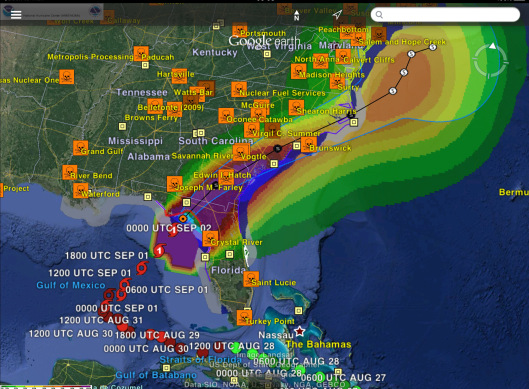
Hurricane Hermine Tract Prediction Overlay with Nuclear Power Stations (Orange Skulls). Although non-operating since 2009, Crystal River Nuclear Power Station still has spent fuel in a cooling pool.
On Sept. 1st, 2016 EnerSys notified the US NRC of potential battery failures at nuclear power stations apparently due to how their batteries interact with the nuclear power station connections. Why are they trying to absolve themselves of responsibility? Why are they not working with their customers, the nuclear utilities, to make sure that this integral part of nuclear reactor safety works? Batteries are needed as emergency backup power. Did the timing have to do with Hurricane Hermine entering the Gulf of Mexico, where it threatened numerous nuclear power stations?
According to the US DOE: “When an earthquake or other emergency disrupts normal power supplies at a nuclear power plant, a backup power system must be available for controlling…
View original post 1,476 more words
September 3 Energy News
Opinion:
¶ “Why smart utilities are embracing distributed electricity” • The growth of distributed energy generation, particularly in the form of solar energy, leaves the aging, monopolistic electric utility system a daunting choice: Defense of the status quo or accepting a clean energy future. [eco-business.com]
 Reducing fossil fuel use is a challenge. Image: Shutterstock.
Science and Technology:
¶ At Yellowstone Park, the question of how to respond to climate change doesn’t yield an easy answer, with warming temperatures, decreasing snowpacks, longer fire seasons, and disappearing food sources for animals. Each means something different and requires a different response. [Chron.com]
¶ Over recent decades, the US has seen a dramatic rise in the number of extreme winter temperature events at opposite ends of the country. According to a new study, the ‘warm West, cold East’ temperature gap is growing, and is likely driven greenhouse gas emissions. [Daily…
View original post 561 more words
Climate and Nuclear Threats – this week’s news

Christina Macpherson’s websites & blogs
NUCLEAR. It is generally acknowledged that the risk of nuclear war is greater right now than it was at the height of the Cold War, and that includes the risk of a nuclear war started by accident. Some “nuclear umbrella” States feel trapped by their nuclear weapons protection.
CLIMATE. It is also becoming acknowledged that the tipping point is approaching, might even be upon us already. Unprecedented pace of global climate change – NASA. $8.8 Trillion Climate Tab left for next generation, if climate “business as usual”.
Governments, media, the public still see these issues in terms of “national interest”, but haven’t made that necessary leap of understanding that demands a global collaborative approach. Pope Francis gets it. So do those most sober and deliberative of scientists – geologists. At the International Geological Congress in Cape Town, on 29th August, an official expert group recommended that a new geological epoch be defined – the Anthropocene epoch. Human impact on Earth is so profound that the most recent epoch, the 12,000 year Holocene, must give way to an epoch defined by nuclear tests, environmental pollution, and changing climate. The most appropriate commencement marker would be the spread of radioactive elements from the nuclear bomb tests beginning in 1950s.
CLIMATE.
- Catholic churches and other religions taking action against climate change, switching to green energy.
- 30 megacity leaders join forces to urge for climate change action at the G20 in China.
- Polarisation on climate change is now worse than ever in America.
- Climate change is affecting the marine ecosystem – krill disappearing from Antarctic waters.
- China’s glaciers– the “third pole” are losing ice mass.
NUCLEAR. An awful lot in the media about marketing of nuclear reactors, especially to South Asia. China’s aggressive nuclear marketing is causing it some problems.
UK. PM Theresa May to be pressured at G20, by China, to approve Hinkley nuclear power project. Chinese build nuclear project at Bradwell, Essex, UK might be postponed. Great danger in air transport of nuclear wastes: anger in Aberdeen.
JAPAN.
Fukushima:
- Typhoons cause ‘ice wall’ to melt at Fukushima nuclear plant. Underground Ice Wall is Japan’s gamble to contain Fukushima’s irradiated water.
- Public Cost of Fukushima Cleanup Tops $628 Billion and Is Expected to Climb.
- Problems persist at Japan’s crippled Fukushima nuclear reactors.
- Niigata prefecture governor Hirohiko Izumida not seeking re-election: new hope for restarting Fukushima nuclear plant.
- Radioactive Boar Are Thriving And Causing Havoc Near The Fukushima Power Plant.< Japan Extends Reactor Lifetimes for First Time Since Fukushima. Japan considers scrapping fast-breeder reactor as costs mount.
USA. Legal challenges to New York nuclear power subsidies. Watts Bar nuclear reactors shut down indefinitely, following transformer fire. Fort Calhoun nuclear power plant to shut down permanently on October 24.
NORTH KOREA‘s grandiose plans for ‘nuclear backpack’ squad, and giant submarine.
SOUTH KOREA worried about North Korea, plans its own Missile Defense System
PHILIPPINES bishop, climate movement, oppose revival of mothballed nuclear plant
ISRAEL under pressure from UN to ratify nuclear test ban treaty.
Tepco detects increase in temperature in ice wall in Fukushima
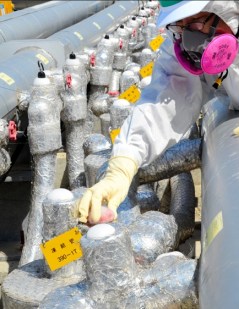 Tokyo Electric Power : Plant operator detects increase in temperature in ice wall in Fukushima
Tokyo, Sept 2 (EFE).- Tepco Electric Power, or TEPCO, the owner of the Fukushima nuclear plant has detected an increase in the temperature of some parts of the underground ice wall that could affect its further construction and the dismantling of the plant.
The temperature rise was caused by intense rainfall in the region where the plant is located due to the typhoons that have been affecting the area since mid-August, a spokesperson of the company told EFE Friday.
The temperature of the wall to the south of reactor No.4 has gone up from minus 5 degrees to 1.8 degrees, according to the measurements carried out by TEPCO on Thursday.
An increase in temperature from minus 1.5 degrees to 1.4 degrees has also been detected east of reactor No.3.
The company is injecting a chemical in both the walls to solidify them, reduce the flow of water and accelerate the freezing process and is discussing other options in case these measures prove ineffective, the spokesperson explained.
Temperatures in these sections are already higher than those in other parts of the ice wall before the storms. However, there are fears some sections of the wall could have thawed with the increase in underground water flow due to the rains.
The company said that this incident could affect the deadlines for the completion of the wall but the construction, which entered the second and second last phase in early June, will continue.
The purpose of the wall is to isolate the ground around the four reactors – affected by the 2011 earthquake and tsunami – to prevent water from natural aquifers flowing into them and coming into contact with the radioactive refrigerant and the contaminated water then finding its way into the Pacific Ocean.
This setback increases pressure on the company, that had barely made progress in bringing down the water still within the reactor basements and had said in July that the ice wall will not be 100 percent effective in blocking the groundwater, thus complicating efforts to dismantle the plant.
Fukushima could host 2020 events

Organizers of the 2020 Tokyo Olympics are working toward staging a baseball and softball game in the 2011 earthquake and tsunami struck Fukushima Prefecture, a source close to the matter said Friday.
Baseball and softball were among the five sports approved last month by the International Olympic Committee to be added to the Tokyo Games program, and the 2020 organizers will look to get approval for the plan from the IOC executive board in December.
The organizers are working to present the idea to IOC president Thomas Bach in October when he visits Japan for a meeting.
Three baseball parks inside the prefecture — all previous hosts of NPB games — are on the shortlist, and organizers are likely to argue accessibility from Tokyo and the possibility of installing fixed seats in the outfield stands as to why the idea is feasible.
The main ballpark for the 2020 Games is set to be Yokohama Stadium, home of the Yokohama BayStars.
Former Olympic minister Toshiaki Endo reiterated on March 11 — the fifth anniversary of the disaster — that the prefecture could host some games in order to demonstrate the revitalization of the Tohoku region, most affected by the disaster.
Fukushima Gov. Masao Uchibori met Yoshiro Mori, the Tokyo 2020 organizing committee president, on Wednesday to request his region be given the opportunity to host the two games in the baseball and softball tournaments’ first round.
http://www.japantimes.co.jp/sports/2016/09/03/olympics/fukushima-host-2020-events/#.V8rqwa3KO-c
Tepco telling California 9th Circ. To Send Sailors’ $1B Fukushima Suit To Japan
TEPCO trying to block the hearing of this case in California under US law.
Watch recording for case: Lindsay Cooper v. Tokyo Electric Power Co., No. 15-56424
http://www.ca9.uscourts.gov/media/view_video.php?pk_vid=0000010155
9th Circ. Told To Send Sailors’ $1B Fukushima Suit To Japan
Law360, Los Angeles (September 1, 2016, 5:47 PM ET) — Tokyo Electric Power Co. urged the Ninth Circuit on Thursday to dismiss a $1 billion putative class action on behalf of 70,000 U.S. sailors allegedly exposed to radiation while responding to the Fukushima nuclear disaster, arguing the claims belong in Japan.
During oral arguments in Pasadena, California, Daniel Collins of Munger Tolles & Olson LLP, representing Tokyo Electric Power Co. Holdings Inc., the owner of the Fukushima nuclear plant, urged a three-judge panel to reverse U.S. District Judge Janis L. Sammartino’s refusal to dismiss the suit….
http://www.law360.com/articles/835597/9th-circ-told-to-send-sailors-1b-fukushima-suit-to-japan
VOX POPULI: A curse that lasts 100,000 years: buried nuclear waste
Homo sapiens sapiens, or anatomically modern humans, emerged on the African continent about 200,000 years ago. They started migrating to various parts of the globe around 60,000 years ago with some eventually reaching the Japanese archipelago.
The Paleolithic era came and went, and rice cultivation began in the Neolithic era.
I started thinking about these prehistoric times after a recent news report mentioned “100,000 years” in connection with radioactive waste that must be disposed of when nuclear reactors are dismantled.
It takes a mind-boggling number of years for nuclear waste, stored deep underground, to decrease in radioactivity to a level that is no longer a health hazard.
With respect to highly radioactive waste such as reactor control rods, the Nuclear Regulation Authority has just set its basic policy, which is that electric power companies will be responsible for the management of such waste for 300 to 400 years, and then the government will take over for the next 100,000 years.
Every precaution must be taken to prevent future humans from accidentally entering sites where the waste is buried and digging the ground. The potential effects of earthquakes and volcanic eruptions on the stored waste also has to be considered.
In determining the extent of responsibility to be shouldered by utilities, it was agreed that it would not be realistic to expect them to manage the storage sites for tens of thousands of years to come.
According to “Hyakunen Tsuzuku Kigyo no Joken” (Conditions necessary for businesses to last 100 years) compiled by Teikoku Databank, a corporate credit research and database service company, there are some, but not many, Japanese companies that have remained in business for more than 400 years.
They include Sumitomo Metal and Mining Co., Yomeishu Seizo Co., and Matsuzakaya, which were founded before or during the Edo Period (1603-1867).
Are Japan’s electric power companies also destined to join their ranks?
But whether it’s 400 years or 100,000 years from now, nobody in our present generation can remain responsible for all those years. I shudder at this “ultrarealistic” reality.
Incidentally, Japan’s first nuclear reactor commenced commercial operation 50 years ago.
Test fishing for flounder begins off Fukushima coast
Flounders surely vacuum well the radionuclides from the ocean floor, and the government-imposed limit of 100 becquerels per kg does no mean no contamination.
There is no such a thing as a low dose when it comes to internal radiation such as the one from ingested contaminated food. Any radioactive contamination may cause harm.
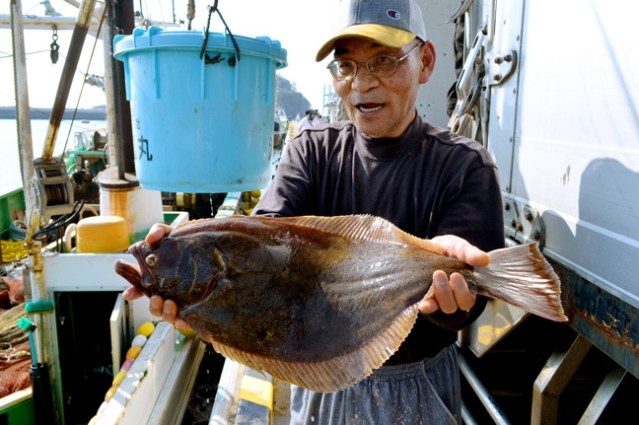
This flounder was caught on Sept. 2 off the coast of Iwaki, Fukushima Prefecture, during the first test fishing for the species since the 2011 disaster at the Fukushima No. 1 nuclear plant.
Test fishing for flounder begins off Fukushima coast
IWAKI, Fukushima Prefecture–Fishermen here caught flounder for sales on Sept. 2 for the first time since the 2011 disaster at the Fukushima No. 1 nuclear plant.
Eleven boats equipped with dragnets left Hisanohama wharf in the morning, and they snared five of the bottom-dwelling flatfish, previously a specialty of Fukushima Prefecture.
“It is a big step (for flounder fishing),” said Akira Egawa, 69, head of the Iwaki city fishery association. “We are going to recover one by one.”
On Aug. 25, 10 kinds of fish, including flounder, were added to the list for “test fishing” off the coast of Fukushima Prefecture. These fish can be caught for the resumption of sales of “safe” fish.
In 2010, 734 tons of flounder were caught in Fukushima Prefecture, the third most in Japan.
The peak season for flounder fishing is around the end of October.
http://www.asahi.com/ajw/articles/AJ201609020065.html
Japan authorizes commercial flounder ‘test-fishing’ off Fukushima
The sales of flounder caught in Fukushima Prefecture might soon resume, with fishermen already “test-fishing” for the first batches of the flatfish. The five-year-long halt in flounder fishing and sales was prompted by the deadly nuclear disaster.
On Friday fishermen caught flounder off the coast of Iwaki, Fukushima Prefecture, during the first test fishing since the 2011 nuclear disaster, Japan’s Asahi Shimbun reports. Flounder along with ten other kinds of fish was added to the list for “test-fishing” last week, meaning it is “safe” for sales.
As many as five flatfish were captured with the help of 11 boats equipped with dragnets.
“It is a big step [for flounder fishing],” said Akira Egawa, head of the Iwaki city fishery association. “We are going to recover one by one.”
Following the nuclear disaster the government issued an outright ban on more than 35 kinds of fish including flounder, angler fish and rockfish which were said to contain high levels of radioactive substances.
The ban has had a huge effect on Fukushima’s fishing industry which has significantly gone down after 2011. Around 5,600 tons of fish were caught off Fukushima coast last year compared to about 38,600 tons before March, 2011.
After March 2011, 50 percent of the fish samples tested for radiation levels exceeded the government-imposed limit of 100 becquerels per kg. However, after April 2015, no fish exceeded that number, according to The Japan Times.
However, after April 2015, no fish exceeded that number, according to The Japan Times.
https://www.rt.com/news/358095-flounder-test-fishing-fukushima/
Tokyo Hopes To Lift No Go Zone Order In Fukushima In Next Five Years
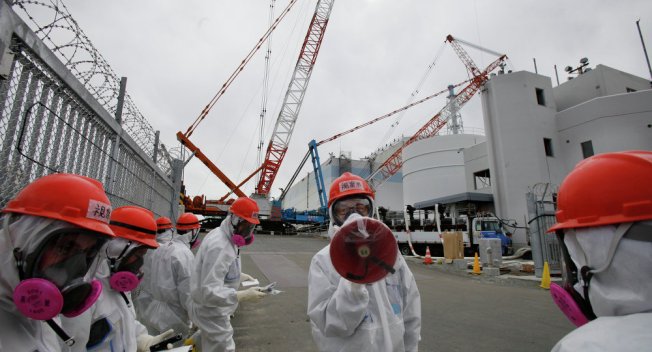
By the end of the 2021 fiscal year, the Japanese government intends to repeal an evacuation order on the remaining “no go zone” around the Fukushima no.1 nuclear plant, the site of one of the worst nuclear accidents in history.
Tokyo announced Wednesday that it aims to conduct infrastructure restoration and radiation clean ups in reconstruction bases built within the zone, which was highly contaminated when the plant, operated by Tokyo Electric Power Co. Holdings Inc. (TEPCO), was shut down during a March 2011 tsunami and earthquake.
Prime Minister Shinzo Abe, at a joint meeting of the Reconstruction Promotion Council and Nuclear Emergency Response Headquarters, where the proposal was adopted, said, “Based on the basic policy, we will embark on reconstruction work in the zone as soon as possible.” In June 2015 the government decided it would lift the ban on areas of Fukushima with lower contamination levels by March of 2017.
Headquarters also announced that the decontamination of Fukushima would be paid for with state funds. It was estimated in 2013 that cleanup would cost upwards of 2.5 trillion yen (about $24 billion), and the decontamination efforts would be financed with funds collected from selling state-owned shares of TEPCO.
Tokyo hopes to profit 2.5 trillion yen from selling the shares, but TEPCO stock would have to trade at about 1,050 yen for that to happen, and shares are currently valued at around 360 yen. After evacuation and some rearranging, Tokyo has been gradually lifting no-go zones restrictions in Fukushima since 2013.
53-year-old Toshiko Yokota, who was able to return to clean up her home in Naraha in 2015 said, “My friends are all in different places because of the nuclear accident, and the town doesn’t even look the same, but this is still my hometown and it really feels good to be back. I still feel uneasy about some things, like radiation levels and the lack of a medical facility,” she said. “In order to come back, I have to keep up my hope and stay healthy.”
According to Jiji Press, the public cost of decontamination and cleanup of the nuclear accident exceeded 4.2 trillion yen by the end of the 2015 fiscal year. Factoring in costs for reactor decommissioning, compensation payments to people and organizations affected by the accident and radioactive decontamination, the government spent about 33,000 yen per capita.
http://sputniknews.com/asia/20160902/1044873179/tokyo-lift-no-go-zone.html
1 This Month
Chernobyl: The Lost Tapes – A good documentary on Chernobyl on SBS available On Demand for the next 3 weeks– https://www.sbs.com.au/ondemand/tv-program/chernobyl-the-lost-tapes/2352741955560

of the week–London Campaign for Nuclear Disarmament

Tell the Ukrainian Government to Drop Prosecution of Peace Activist Yurii Sheliazhenko
To see nuclear-related stories in greater depth and intensity – go to https://nuclearinformation.wordpress.com
-
Archives
- April 2026 (152)
- March 2026 (251)
- February 2026 (268)
- January 2026 (308)
- December 2025 (358)
- November 2025 (359)
- October 2025 (376)
- September 2025 (257)
- August 2025 (319)
- July 2025 (230)
- June 2025 (348)
- May 2025 (261)
-
Categories
- 1
- 1 NUCLEAR ISSUES
- business and costs
- climate change
- culture and arts
- ENERGY
- environment
- health
- history
- indigenous issues
- Legal
- marketing of nuclear
- media
- opposition to nuclear
- PERSONAL STORIES
- politics
- politics international
- Religion and ethics
- safety
- secrets,lies and civil liberties
- spinbuster
- technology
- Uranium
- wastes
- weapons and war
- Women
- 2 WORLD
- ACTION
- AFRICA
- Atrocities
- AUSTRALIA
- Christina's notes
- Christina's themes
- culture and arts
- Events
- Fuk 2022
- Fuk 2023
- Fukushima 2017
- Fukushima 2018
- fukushima 2019
- Fukushima 2020
- Fukushima 2021
- general
- global warming
- Humour (God we need it)
- Nuclear
- RARE EARTHS
- Reference
- resources – print
- Resources -audiovicual
- Weekly Newsletter
- World
- World Nuclear
- YouTube
-
RSS
Entries RSS
Comments RSS
 nuclear-news