10,000 tons of toxic water pools in Fukushima nuclear plant trenches
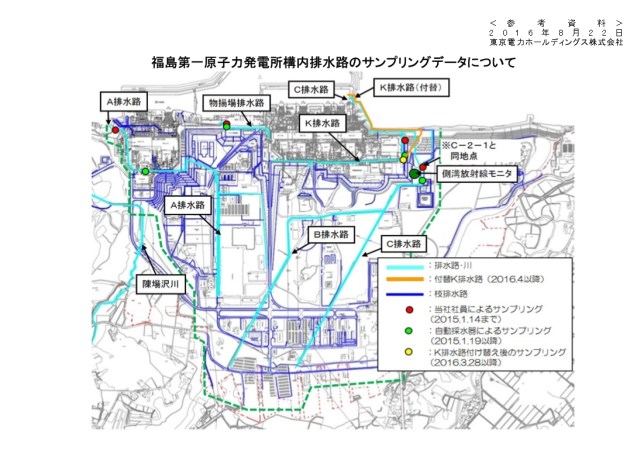
Drainage chart/map
TOKYO (Kyodo) — Around 10,000 tons of contaminated water have pooled in underground trenches around the Nos. 1 to 4 reactor buildings of the crippled Fukushima Daiichi nuclear power plant, according to the plant operator Tokyo Electric Power Company Holdings Inc.
Tokyo Electric has no immediate plan to remove the water in the trenches where cables run for the nuclear power complex devastated by the March 2011 earthquake and tsunami disaster.
Water that flew into the trenches in the wake of the huge tsunami is believed to have been mixed with highly radioactive water leaking from the basements of reactor buildings and contaminated rain water.
“Compared with around 70,000 tons of highly contaminated water that remain in the basements of the reactor buildings, (the water in the trenches) has a low level of concentration and thus poses little threat in terms of radiation exposure and the environment,” said an official of the utility known as TEPCO.

TEPCO said in a report issued in July — based on research conducted in fiscal 2015 — that it has found around 8,000 tons of toxic water in 17 locations in the trenches that connect with reactor buildings where highly radioactive water accumulates, as well as around 3,000 tons of toxic water at 11 locations in trenches that do not connect with reactor buildings.

Of the water in the trenches around the Nos. 1 to 4 reactor buildings, a removal procedure was completed by June for around 500 tons of water in a pipe that measured the highest level of radioactive cesium at 500,000 becquerels per liter.
The level of radioactive cesium in water at other locations in the trenches was mostly measured at several thousands becquerels or below.
The level in toxic water in the basements of reactor buildings has been measured at around dozens of millions becquerels at maximum.
TEPCO has said it will continue to monitor and measure the level of contamination in water in the trenches regularly and consider taking measures to remove the water in the future. But no concrete plan has been created yet.
The electricity firm has so far removed a total of around 10,000 tons of highly radioactive water at three locations in the trenches running in the seaside of the complex and completed the procedure to fill locations concerned with cement to prevent water leaks.
Still, the level of radioactive cesium remains unchecked at 40 locations in the trenches due to high radioactive levels as well as debris and other objects blocking the research operation.
Around 8,000 tons of contaminated water, including those with an extremely low level of contamination, have also been found in the trenches running around the Nos. 5 and 6 reactor buildings. The two units have lower levels of radiation doses than the Nos. 1 to 4 units as there were no nuclear meltdowns or hydrogen explosions there during the nuclear disaster.
http://mainichi.jp/english/articles/20160823/p2g/00m/0dm/074000c
Drainage charts/maps.
https://t.co/EIJkR80Biq
Tepcos Reports (PDF)
https://t.co/lTM563FjQe
August 22 Energy News

Opinion:
¶ “UK energy mix faces seismic shift” • These last weeks have been a time when an inescapable set of signals emerges, all pointing in the same direction. The idea that renewables are not competitive with fossil fuels and nuclear power has lost all basis in fact. It’s time to wake up to the energy revolution. [Climate Home]
 Wind turbine and moon. Pic: Pixabay.
¶ “Trump’s Toxic Threat: Oblivion To Climate Change, Even In His Backyard” • One of the largely unrecognized dangers of Donald Trump’s slash-and-burn presidential campaign is that his many outrageous statements are causing us to lose sight of the very real threat he poses to our shared environment. [WBUR]
Science and Technology:
¶ A team of Australian National University scientists brought economically competitive solar thermal energy generation closer to reality. They hit a record in efficiency for the technology with a…
View original post 495 more words
Government subsidies to help Fukushima farmers restart operations

The central government plans to set up a new subsidy system to help farmers in 12 municipalities near the stricken Fukushima No. 1 nuclear plant restart their operations, according to sources.
The program represents part of the government’s efforts to promote the reconstruction of areas damaged by the March 2011 earthquake and tsunami in the Tohoku region and the subsequent meltdowns at the Tokyo Electric Power Co. nuclear station.
The government will earmark around ¥7 billion for the program under a planned supplementary budget for its special account related to the 2011 disaster, the sources said Monday.
The program will help farmers buy equipment and livestock.
A support system is already available in which the 12 municipalities in Fukushima Prefecture buy facilities and equipment such as greenhouses and tractors and lend them for free to farmers aiming to get back on their feet.
But the system is inconvenient for individuals who want to resume farming operations, because it is mainly designed for group farming and other big operations. Also, approval from local assemblies is necessary to lend out the facilities and gear.
Under the new program, the Fukushima Prefectural Government will cover 75 percent of farmers’ purchase costs for farming equipment and livestock, the sources said. The upper limit on support per farmer will likely be ¥10 million, they said.
The central government will shoulder all costs incurred by prefectural government, the sources said.
The 12 municipalities are Tamura, Minamisoma, Kawamata, Hirono, Naraha, Tomioka, Okuma, Futaba, Namie, Kawauchi, Katsurao and Iitate.

Wind and cars disperse radioactive material
By Kurumi Sugita
A remarkable documentary of the RTBF about contaminated areas, including Minami Soma in Fukushima prefecture. These areas are heavily contaminated. Nevertheless, the Japanese government makes the people return by lifting the evacuation order and stopping aid.
The Nos Voisins Lointains 3.11 association, exchanged messages with Mr. Ozawa, the engineer interviewed in the documentary. According to him, the most worrisome problem is the fact that black substances in the mall parking area get attached to car tires and are transported everywhere, as we can see in the documentary. The risk of radiation is thus dispersed.

On the other side of the parking area, we see collective dwellings from where children play outside, according to Mr. Owaza.
See also the video sent by Mr. Ozawa showing the wind lifting and dispersing the contaminated dust from fields now uncultivated.
Linens that are drying on the balcony outside are exposed to radioactive material transported by these dusty winds. Just watch at which height the dust is lifted compared to the passing car towards the end of the video. Farmers working the land inhale this dust.
With the forced return of the population this will become their daily reality.
American nuclear expert Arnie Gundersen warns: “There is a possibility that now in Fukushima recontamination is occurring.”
CCTV (Channel 17 in Burlington, Vermont), published Jun 20, 2016
Maggie Gundersen, Chiho Kaneko and Caroline Phillips of Fairewinds Energy Education discuss the nuclear risk concerns for children not only near the nuclear disaster sites of Fukushima-Dai-ichiin Japan and Chernobyl in Ukraine, formerly the Soviet Union, but globally where areas near all nuclear power plants are contaminated with radiation. Since mothers in Japan especially bear the responsibility to protect children, they experience greater hardships in an environment where just expressing one’s concern about radiation is seen as a treasonous act. Even 30 years later, the Belarus government recognizes the merits of relocating children away from radiation contaminated areas but the children of Japan are socially forced to stay put in highly contaminated areas.
Margaret Harrington, host: I know you mentioned Arnie Gundersen, the chief engineer at Fairewinds, and he said that he measured the radiation there, too. Could you talk about that a little bit?
Maggie Gundersen, Fairewinds Energy Education founder and CEO: He’s working with some other scientists who are studying — both Japanese scientists, the samples that they took, and the US scientists who are evaluating the samples — and they’re finding astronomical amounts of radiation, even in downtown Tokyo outside of METI’s door. METI is the regulatory agency over nuclear power… When he and others were downtown in Tokyo, they took samples right there in a garden right outside the door and on the front doormat, and these are really, really high samples. Frightening, because people walking in Tokyo will then be inhaling that dust. What was the film we saw from Japan that had the mothers who were in an area where kids play and run from middle school?
Caroline Phillips, Fairewinds Energy Education: It’s a fantastic video… it’s a mothers organization, they live in the Fukushima Prefecture and they’re actually using Geiger counters that have been issued by the government. They’re walking along the river [in Fukushima City.]
Maggie Gundersen: What’s so tragic about it – kids are running along dirt paths doing gym class and track and things like that and the mothers are right down in areas that are not posted and the kids can go after school and play, and people do nature hikes and stuff. And the radiation readings are horrific.

Gendai Business Online’s top ranked article is an exclusive interview with Fairewinds Chief Engineer Arnie Gundersen titled, American nuclear expert warns: “There is a possibility that now in Fukushima recontamination is occurring.” With more than 10,000 likes on Facebook, this Japanese article delves into the truth about nuclear contamination from Fukushima Daiichi as uncovered by Arnie Gundersen during his most recent trip to Japan. Fairewinds, with the help of Japanese translators, provides you with an English translation:
On a mid-February morning, just before the 5th anniversary of the triple meltdown at Fukushima Daiichi, a group of young girls in the city of Minami-Soma rode their bikes to school past a shocked and saddened pedestrian. That upset observer was Arnie Gundersen, nuclear reactor expert and Chief Engineer with Fairewinds Associates. Mr. Gundersen has 45 years of experience as a design, operations, and decommissioning nuclear engineer. He has engaged in research of the effects of the meltdown at Three Mile Island (TMI) and conducts independent research of the triple meltdown at Fukushima Daiichi. Mr. Gundersen is in ongoing conversations with both the US and Japanese media concerning the dangers of nuclear reactors and nuclear power operation. Invited by “Peace News Japan” and several other civil groups, Mr. Gundersen visited the Fukushima prefecture five years after the catastrophe at Fukushima Daiichi.
“What surprised me at this visit to Japan [his third since the meltdowns] is that the decontaminated area is contaminated again,” Mr. Gundersen said while explaining why it was such as sad shock to witness the girls on their bicycles. “This was not what I had expected. I had thought that we would not find such high doses of radiation in the decontaminated area. But, sadly, our results prove otherwise.”
During his Japan visit, Mr. Gundersen collected samples of dust from the rooftop of Minami-Soma city town hall, the floor mat of a 7-Eleven convenience store, and the roadsides of Minami-Soma city. Although the official data cannot be released before the publication of formal scientific papers, it is evident that high doses of radiation, usually found in nuclear waste, was detected from these samples.
“This means that highly radioactive dust is flying around the city. In other words, the decontaminated land is contaminated again. Little girls are affected by the radiation 20 times as much as adult men. The Japanese government’s standard of 20 mSv is based on exposure assessments for adult men. The girls on their bicycles are actually being affected by a radiation dose equivalent to as much as 400 mSv.”
Mr. Gundersen also pointed out that human lungs are heavily affected by internal exposures to radiation.
“At this visit, I wore a radiation proof mask that can filter out 99.98% of radiation for six hours. I sent my filter to the lab, and they found a high dose of Cesium. But, unfortunately, the Japanese government only cares about the number on a Geiger counter and does not consider the internal exposure. This has resulted in a hazardous downplay of this kind of data and human lungs are affected by the serious internal exposure.”
Why is the recontamination happening? One of the reasons is that the government did not decontaminate thoroughly. Mr. Gundersen witnessed first-hand the poor decontamination of the prefecture.
“In the house I visited, only half of the garden area was decontaminated because only that half fell into the category of a contaminated area. It should not be like that. The other half would be contaminated too. Furthermore, one person discovered highly radioactive dust in their driveway where decontamination had occurred. So, of course, this person notified the related offices but the related offices told them that it was not necessary to decontaminate the driveway again because it had already been done once. It’s unbelievable. This person’s house is located near a ravine and the opposite side of the ravine is designated a non-habitable zone.”
Another reason for recontamination is that the radiation from the mountains are coming back to the city by way of wind and rain. Mr. Gundersen noted the extreme radioactive contamination of the mountains.
“We tracked wild monkeys in the mountains and found a high dose of radiation in their feces. I received the meat of a wild pig as a gift and since I could not bring it back to the US [it is illegal to bring meat back to the United States from Japan], tested the meat on a Geiger counter. The meat showed 120 counts/min. I think that the Japanese government should spend more money to decontaminate the mountains but they don’t appear to have that kind of political will. I also worry that contamination in the rivers is not monitored as rain from the mountains flow down into the rivers.”
Due to the heavy radiation contamination of the mountains, vegetables grown in that area exceed the government’s standard by 1500 Bq. These vegetables were sold at the MichinoEki in Tochigi prefecture, and the bamboo shoot grown in this contaminated region was used for elementary school lunches in Utsunomiya. These school lunches contained more than twice as much radiation as the government’s standard.
Recontamination is happening due to poor decontamination and residents of Kawauchi village in Fukushima prefecture claim that the decontamination in the forests is not enough. However, the government continues to push for the end of people’s relocation and force the return to recontaminated areas.
“If I had a little child, I would never let them live there,” Mr. Gundersen pointedly states.
Mr. Gundersen also found that Tokyo remains contaminated. He measured dust collected from the sidewalk in front of MITI (Ministry of International Trade and Industry) and found a high dose of radiation. That dust is in the air that will be inhaled by the visitors and athletes of the 2020 Olympic Games. Needless to say, the current residents are inhaling it every day. “Mr. Abe should not take the advice from IAEA, MITI and TEPCO seriously,” Mr. Gundersen insists. “Instead, he should have an independent organization conduct research and listen to the advice from them.”
Japan asks Pokemon GO players to stay out of Fukushima fallout zone – but yet still allows thousands to return living in contaminated land

Evolution at its best! Japan asks Pokemon GO players to stay out of Fukushima fallout zone – but yet still allows thousands to return living in contaminated land.
So far, everything from car crashes to shootings have been associated with the addictive game, and countries all over the world are now trying to stop accidents before they can happen. That, you see, is why Japan is asking Niantic to remove any wild pokemon that are currently cropping up in the Fukushima fallout zone.
TEPCO has asked the developer to keep pocket monsters far, far away from the radioactive site. Obviously, they are worried about trainers stumbling upon the area in their pursuit to catch, say, a Nucleon.
Currently, Tepco has confirmed, “the Fukushima Daiichi plant, the Fukushima Daini plant and the Kashiwazaki-Kariwa plant in Niigata Prefecture,” were all scouted. Unsurprisingly, pokemon were found at all three of the sites.
Masao Uchibori, the governor of Fukushima, said it would be dangerous for trainers to enter the areas due to their radioactive nature. As such, he’s confirmed that, “the prefectural government will consider how to draw attention to this.” Beyond that, the city of Nagasaki has also asked for Niantic to remove the app’s presence from Nagasaki Peace Park, a local memorial for the victims of the 1945 atomic bombing.
A month later following the announcement though, Earthquake-stricken regions in Japan are turning to the “Pokemon Go” phenomenon to catch more tourism money.
The Iwate, Miyagi, Fukushima and Kumamoto prefectural governments said Aug. 10 they will partner with Niantic Inc., operator of the popular “Pokemon Go” smartphone app, to promote local tourism.
Money talks !
Credit to Nelson Surjon
14 arrested for smuggling illegal irradiated seafood into China from waters off coast of Fukushima

14 arrested for smuggling irradiated seafood in Shandong
Customs authorities in Qingdao, East China’s Shandong Province, detained 14 people for smuggling frozen seafood from Japan, including irradiated high-end seafood from waters near Fukushima prefecture, China Central Television (CCTV) reported on Monday.
The group has smuggled over 5,000 tons of frozen seafood – including shrimp and king crab – valued at 230 million yuan ($34.5 million) into China over the past two years, according to an announcement by the Qingdao Customs District (QCD) posted on its official website on Monday.
Some of the high-end products were from Fukushima, one of 12 Japanese prefectures from which China has banned any seafood imports due to the contamination of their waters after the Fukushima nuclear accident in 2011, according to CCTV.
Before sending the products to Shandong, smugglers transferred the seafood from Hokkaido to Vietnam, where they changed the items’ packaging and altered their production dates to evade taxes and avoid quarantine, Li Fudong of the QCD Anti-Smuggling Department told CCTV.
An investigation by officers from the Anti-Smuggling Department in the neighboring city of Yantai traced some low-priced seafood on the local market to a Shandong-based import corporation that had opened branches in East China’s Fujian Province, South China’s Guangxi Zhuang Autonomous Region and Northeast China’s Liaoning Province.
Qingdao preventive officers arrested the smuggling group’s head in June after he returned to China from the US.
Most of the smuggled seafood products were sold in Beijing, Shanghai and Guangzhou, Shandong-based dzwww.com reported.
An expert from a tissue engineering and regenerative medicine research center who asked for anonymity told the Global Times on Monday that radioactive nuclear materials can cause irreversible damage to the human body at the cellular level. The expert said such radiation can even damage our DNA and may be present in the body for many years before symptoms occur.
She said that remaining nuclear material may still affect sea life in the waters surrounding the Fukushima site, even though five years have passed since the nuclear accident.
http://www.globaltimes.cn/content/1002105.shtml
【Thyroid Cancer in Fukushima】Fukushima Thyroid Examination Under Dual Review

Monday, August 8, 2016
Below is unofficial translation of two Fukushima Minyu articles regarding the review of the thyroid examination, published on August 8, 2016 and July 4, 2016. The August article is based on an interview of Hokuto Hoshi, Chair of Oversight Committee for the Fukushima Health Management Survey. It might be tied to this post. The July article covers the launch of an independent exploratory committee by Fukushima Pediatric Association.
Interestingly, a telephone inquiry by a concerned citizen revealed the Division of the Fukushima Health Management Survey at the Fukushima Prefectural Office was unaware of the content of the August article before its publication in newspaper. They declined to comment on the issue for the time being while contacting Oversight Committee Chair Hoshi to confirm facts and discuss the issue internally.
On September 26-27, 2016, the 5th International Expert Symposium “Chernobyl+30, Fukushima+5: Lessons and Solutions for Fukushima’s Thyroid Question” will be held in Fukushima, organized by Nippon Foundation and co-organized by Fukushima Medical University, Nagasaki University and Sasakawa Memorial Health Foundation. Judging from the symposium theme, there seems to be a rush to bring closure to the thyroid cancer issue even before the final results of the second round screening are released. A glance at the program is quite revealing.
*****
Oversight Committee for the Fukushima Health Management Survey Plan to Review the Thyroid Examination: Reduction in Target Population Considered
August 8, 2016
Oversight Committee for the Fukushima Health Management Survey, engaged in discussion on the status of the survey to examine the health effects due to the nuclear accident, will begin discussions as early as September to consider reduction in target population as well as review of the screening procedure.
The thyroid examination that targets all residents who were age 18 or younger at the time of the accident will face a big turning point, as revealed by the Oversight Committee Chair Hokuto Hoshi in the interview with Fukushima Minyu as of August 7th.
The thyroid examination targets about 380,000 residents. Thyroid cancer cases detected by the examination are considered “unlikely to be the effect of radiation exposure at this time” by the Oversight Committee.
What lies behind starting the discussion to consider review of the examination is the concern about detection of “latent cancer” cases, which exist at a constant rate regardless of radiation exposure, by screening with high sensitivity.
Thyroid cancer is curable in many cases, and the across-the-board cancer screening is unlikely to give rise to the merit of “reduced mortality.” Thus thyroid cancer screening is not globally recommended. This has led medical providers to voice concerns that “participation in the examination alone can be detrimental to the participants.”
Under the circumstance, the Oversight Committee is expected to begin discussions on issues such as: 1) Whether residents older than age 18 should be included in the target population in the future; and 2) Whether to change the method of mass screening currently conducted in school settings which has been pointed out to interfere with the participant’s wish not to participate.
*****
“Thyroid Examination” Should Be Reviewed: Fukushima Pediatric Association to Establish an Independent Committee
July 4, 2016
Fukushima Pediatric Association (president: Kazuhiro Ohga) adopted a general assembly statement incorporating the establishment of its own exploratory committee to consider the status of the thyroid examination on July 3, 2016 at the general meeting held in Kooriyama City. The thyroid examination, part of the Fukushima Health Management Survey that investigates health effects of the Tokyo Electric Fukushima Daiichi nuclear power plant accident, is conducted by the prefecture targeting residents who were age 18 or younger at the time of the accident. The association deems necessary to review the thyroid examination, taking a fresh look at part of it. This is the first time the association expresses the need to review the examination.
Five years have passed since the nuclear accident, a question was raised about the status of the thyroid examination mainly by pediatricians performing medical examinations on residents who are targeted for the thyroid examination.
According to the Fukushima Pediatric Association, there are 172 individuals (as of the end of March 2016) who have been diagnosed with thyroid cancer or “suspicion of cancer.” Thyroid cancer is curable in many cases, and the screening is unlikely to give rise to the merit of “reduced mortality,” while there is a mental detriment when diagnosed with cancer. Thus thyroid cancer screening is not globally recommended.
The general assembly statement referred to health worries experienced by children participating in the thyroid examination and their guardians as well as residents, stating “It is necessary to explain (the results) to the participants with care and compassion and offer an easily comprehensible explanation to residents.”
President Ohga stated, “The thyroid examination was started in order to alleviate anxiety of residents, but it is possible the examination created (new) anxieties. It is necessary to review the examination from the standpoint of the participants.”
The Exploratory Committee, comprising the association members, is scheduled to begin discussions this fall. It will take up opinions of those diagnosed with thyroid cancer and intend to set directions before next year’s general assembly. In addition, the content of the general assembly statement will be sent to the prefectural government as a request in the future.
The statement also incorporates items regarding the response to health effects on children, long-term health management, and continuing support for children and their families who are evacuated or returning.
Positive international report for nuclear disarmament, despite disruption by Australia
Tim Wright, Asia-Pacific director of the International Campaign to Abolish Nuclear Weapons (Ican), said it was thought that Australia’s foreign minister, Julie Bishop, instructed her diplomats to disrupt the international gathering late on Friday afternoon by forcing a vote. While others then joined Australia to vote against the report, Australia was alone in forcing the vote to happen.
The acceptance of the report was seen as a major milestone by anti-nuclear campaigners.
“This is a significant moment in the seven-decade-long global struggle to rid the world of the worst weapons of mass destruction,” said Beatrice Fihn, executive director Ican. “The UN working group achieved a breakthrough today.”
 Australia attempts to derail UN plan to ban nuclear weapons Diplomats force a vote
on a report to begin negotiations on a ban in 2017 that had been expected to pass unanimously, Guardian, Michael Slezak, 21 Aug 16, Australia has attempted to derail a ban on nuclear weapons at a UN meeting on disarmament, by single-handedly forcing a vote on a report that had been expected to pass unanimously.
The report, which recommended negotiations begin in 2017 to ban nuclear weapons, was eventually passed by 68 votes to 22. An Austrian-led push for the treaty had reached a milestone on Friday, when the report was presented to representatives of 103 nations in Geneva.
Moves towards a ban have been pursued because many saw little progress under the existing non-proliferation treaty, which obliges the five declared nuclear states to “pursue negotiations in good faith” towards “cessation of the nuclear arms race … and nuclear disarmament”.
The proposal recommended a conference be held next year to negotiate “a legally binding instrument to prohibit nuclear weapons, leading towards their total elimination”.
The text was carefully negotiated, and compromise was attempted on contentious paragraphs.
Anti-nuclear campaigners involved in the process expected the report would pass without objection. But Australia surprised observers by objecting and forcing a vote.
The vote was accepted by an overwhelming majority, with 68 voting in favour, 22 against and 13 abstaining.
The next step will be for the proposal for negotiations to begin in 2017 will be tabled at the United Nations general assembly, after which it is likely formal negotiations will begin.
In an opening statement the Australian diplomat Ian McConville told the meeting: “A simple Ban Treaty would not facilitate the reduction in one nuclear weapon. It might even harden the resolve of those possessing nuclear weapons not to reduce their arsenals.”
The Department of Foreign Affairs and Trade said on its website that it opposed a ban on nuclear weapons because although it “might seem to be a straightforward and emotionally appealing way to de-legitimise and eradicate nuclear weapons,” it would actually “divert attention from the sustained, practical steps needed for effective disarmament”.
But in 2015, documents obtained under Freedom of Information revealed Australia opposed the ban on nuclear weapons, since it believed it relied on US nuclear weapons as a deterrent.
“As long as the threat of nuclear attack or coercion exists, and countries like the DPRK [North Korea] seek these weapons and threaten others, Australia and many other countries will continue to rely on US extended nuclear deterrence,” said one of the briefing notes for government ministers.
The documents revealed however that Australia and the US were worried about the momentum gathering behind the Austrian-led push for a ban nuclear weapons, which diplomats said was “fast becoming a galvanising focus for those pushing the ban treaty option”.
Japan’s ambassador to the UN conference on disarmament expressed disappointment that a vote was required.
“We are deeply concerned that the adoption by voting will further divide the international disarmament community and undermine the momentum of nuclear disarmament for the international community as a whole,” he said.
Tim Wright, Asia-Pacific director of the International Campaign to Abolish Nuclear Weapons (Ican), said it was thought that Australia’s foreign minister, Julie Bishop, instructed her diplomats to disrupt the international gathering late on Friday afternoon by forcing a vote. While others then joined Australia to vote against the report, Australia was alone in forcing the vote to happen.
“Australia is resisting the tide of history. A majority of nations believe that nuclear weapons are unacceptable and must be prohibited. And now they are ready to negotiate a ban,” Wright said.
“Australia’s attempt to derail these important disarmament talks was shameful and outrageous. It provoked strong criticism from some of our nearest neighbours in Asia and the Pacific, who believe that the world should be rid of all weapons of mass destruction,” he said.
The acceptance of the report was seen as a major milestone by anti-nuclear campaigners.
“This is a significant moment in the seven-decade-long global struggle to rid the world of the worst weapons of mass destruction,” said Beatrice Fihn, executive director Ican. “The UN working group achieved a breakthrough today.”
“There can be no doubt that a majority of UN members intend to pursue negotiations next year on a treaty banning nuclear weapons,” said Fihn.
“We expect that, based on the recommendations of the working group, the UN general assembly will adopt a resolution this autumn to establish the mandate for negotiations on a ban on nuclear weapons in 2017.”
A Department of Foreign Affairs spokesman said: “Australia called for a vote on the report as it was the most effective way to register our opposition to a recommendation to start negotiations on a ban treaty. A consensus report was not possible in the circumstances…..https://www.theguardian.com/world/2016/aug/21/australia-attempts-to-derail-un-plan-to-ban-nuclear-weapons
The case for ending the policy of Pre-emptive Nuclear Strike
 End the First-Use Policy for Nuclear Weapons http://www.nytimes.com/2016/08/15/opinion/end-the-first-use-policy-for-nuclear-weapons.html By JAMES E. CARTWRIGHT and BRUCE G. BLAIRAUG. 14, 2016 Throughout the nuclear age, presidents have allowed their senior commanders to plan for the first use of nuclear weapons. Contingency plans were drawn to initiate first strikes to repel an invasion of Europe by the Soviet Union, defeat China and North Korea, take out chemical and biological weapons and conduct other missions.
After the end of the Cold War, which coincided with revolutionary advances in our nonnuclear military capacities, the range of these missions steadily narrowed to the point where nuclear weapons today no longer serve any purpose beyond deterring the first use of such weapons by our adversaries. Our nonnuclear strength, including economic and diplomatic power, our alliances, our conventional and cyber weaponry and our technological advantages, constitute a global military juggernaut unmatched in history. The United States simply does not need nuclear weapons to defend its own and its allies’ vital interests, as long as our adversaries refrain from their use.
Using nuclear weapons first against Russia and China would endanger our and our allies’ very survival by encouraging full-scale retaliation. Any first use against lesser threats, such as countries or terrorist groups with chemical and biological weapons, would be gratuitous; there are alternative means of countering those threats. Such use against North Korea would be likely to result in the blanketing of Japan and possibly South Korea with deadly radioactive fallout.
But beyond reducing those dangers, ruling out first use would also bring myriad benefits. To start, it would reduce the risk of a first strike against us during global crises. Leaders of other countries would be calmed by the knowledge that the United States viewed its own weapons as deterrents to nuclear warfare, not as tools of aggression.
The policy would also reduce costs by gutting the rationale for retaining the large arsenal of land-based strategic missiles in silos across the Midwest and the tactical nuclear weapons deployed in Europe. Those missiles are mainly for first-use; they are a risky option for second-use because they are highly vulnerable to enemy attack. Eliminating these weapons entirely would be the best option.
Phasing out land-based missiles and shifting to a reliance on submarines and bombers would save about $100 billion over the next three decades. The elimination of smaller, tactical nuclear weapons would save billions more. President Obama could begin the phaseout of land-based missiles before he left office by instructing the Department of Defense to remove 550 weapons from the operationally deployed category and transfer them to long-term storage, thereby reducing the operationally deployed inventory to about 1,000 strategic warheads. These missiles are surplus weapons no longer needed for deterrence.A no-first-use policy would also reduce the risks of accidental or unauthorized use of nuclear weapons. By scrapping the vulnerable land-based missile force, any need for launching on warning disappears. Strategic bombers can be sent aloft on warning of an apparent incoming attack, which may or may not be a false alarm, and stay up until the situation clarifies. Strategic submarines are extremely survivable and exert no pressure on decision-makers to fire them quickly. They can patrol for months waiting for instructions. Both bombers and submarines are also less vulnerable to cyberwarfare than the strategic missiles on land.
Although a no-first-use policy would limit the president’s discretion by imposing procedural and physical constraints on his or her ability to initiate the use of nuclear weapons, we believe such checks on the commander in chief would serve the national interest.
President Obama has an opportunity to further delegitimize nuclear weapons by adopting no-first-use as a core principle of United States security policy on the grounds that first-use is unnecessary and a threat to national survival and humanity itself. We could still maintain a robust nuclear umbrella to protect ourselves and our allies.
China and India adopted this policy long ago, and the American people overwhelmingly support it, according to a recent survey. In that poll, two-thirds say the United States should use nuclear weapons only in response to a nuclear attack or not at all, while just 18 percent think that first-use may be justified sometimes.
President Obama would be wise to follow China’s example. As commander in chief, he can adopt no-first-use overnight and lead the way in establishing it as a global norm among all of the nine countries with nuclear weapons. The next president ought to stay that course. Our nation, our allies and indeed the world will be better and safer for it.
James E. Cartwright, the chairman of the Global Zero Commission on Nuclear Risk Reduction, is a former vice chairman of the Joint Chiefs of Staff and former commander of the United States Strategic Command. Bruce G. Blair is a research scholar at Princeton, a founder of Global Zero and a former Minuteman launch officer.
Conflicts increase as a result of climate-related events
 Climate-related disasters raise conflict risk, study says, Skeptical Science 19 August 2016 by dana1981This is a re-post from Carbon Brief by Robert McSweeney Extreme weather increases the risk of armed conflict in ethnically-diverse countries, a new study suggests. Around 23% of conflict outbreaks in these countries over the last three decades have occurred during climate-related disasters, such as droughts and heatwaves, the paper says. The results don’t suggest that weather extremes directly trigger conflict, the researchers say, but that they can be one of many contributing factors.
Carbon Brief speaks to a number of experts to dig a bit deeper into what has become quite a controversial field of climate research.
Climate-related disasters A host of different factors can increase the risk of armed conflict breaking out in a country. Some examples picked out by previous research include poverty, weak governance, a history of conflict, income gaps between rich and poor, and disputes over natural resources.
The new study, published in the Proceedings of the National Academy of Sciences, suggests that climate-related disasters should be added to this list.
This conclusion stems from a statistical analysis of armed conflicts and the economic damage caused by extreme weather events over the period 1980-2010. The researchers looked at three categories of climate-related disasters. These include meteorological events (blizzard/snowstorm, hailstorm, tornado, tropical cyclone, winter storm), hydrological events (avalanche, flash flood, general flood, landslide, storm surge), and climatological events (cold wave/frost, drought, heatwave, wildfire). The results suggest that around 9% of all armed conflicts over the past 30 years have occurred during – i.e. in the same month as – an extreme climatological event.
Taking all three disaster types together, the researchers only found a link when they added another factor – “ethnic fractionalisation” – into their analysis. This is a measure of how how ethnically diverse a country is.
The researchers find that in top-50 most fractionalised countries, around 23% of armed conflicts have occurred at the same time as a climate-related disaster of any kind. Other studies of highly fractionalised countries have identified similar links, the paper notes. Prolonged droughts, for example, may have contributed to outbreaks of conflict in Somalia and the ongoing conflict in Afghanistan. The results suggest that disasters may increase the risk of conflict – though not directly cause it, says lead author, Dr Carl-Friedrich Schleussner, from the Potsdam Institute forClimate Impact Research. He tells Carbon Brief:
“We do not report evidence that climate disasters are directly triggering conflict outbreak, but rather that they may enhance the risk of an outbreak of a conflict rooting in context-specific circumstances.”
While more work is needed to establish exactly how disasters enhance the risk of conflicts, the findings suggest they add pressure to existing ethnic divides, says Schleussner:
“It seems…plausible that such disruptive events fuel smoldering social tensions.”
With extreme weather (pdf) likely to be more intense and frequent as global temperatures rise, the climate could be become a more prominent factor for conflict in the future, says Schleussner:
“Several of the world’s most conflict-prone regions – including North and Central Africa as well as Central Asia – are both exceptionally vulnerable to human-made global warming and characterised by deep ethnic divides.”
This means that a changing climate should be taken into account when developing security policies in these regions, Schleussner says. No clear picture………http://www.skepticalscience.com/climate-disasters-raise-conflict-risk.html
Nuclear industry started the now sophisticated practice of corporate greenwashing
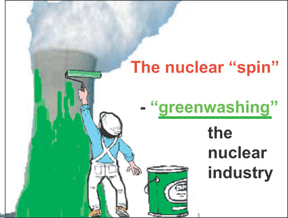
The troubling evolution of corporate greenwashing The term “greenwashing” was coined in the 1980s to describe outrageous corporate environmental claims. Three decades later, the practice has grown vastly more sophisticated, Guardian, Bruce Watson, 21 Aug 16, In the mid-1980s, oil company Chevron commissioned a series of expensive television and print ads to convince the public of its environmental bonafides. Titled People Do, the campaign showed Chevron employees protecting bears, butterflies, sea turtles and all manner of cute and cuddly animals.
The commercials were very effective – in 1990, they won an Effie advertising award, and subsequently became a case study at Harvard Business school. They also became notorious among environmentalists, who have proclaimed them the gold standard of greenwashing – the corporate practice of making diverting sustainability claims to cover a questionable environmental record.
The term greenwashing was coined by environmentalist Jay Westerveld in 1986, back when most consumers received their news from television, radio and print media – the same outlets that corporations regularly flooded with a wave of high-priced, slickly-produced commercials and print ads. The combination of limited public access to information and seemingly unlimited advertising enabled companies to present themselves as caring environmental stewards, even as they were engaging in environmentally unsustainable practices.
But greenwashing dates back even earlier. American electrical behemoth Westinghouse’s nuclear power division was a greenwashing pioneer. Threatened by the 1960’s anti-nuclear movement, which raised questions about its safety and environmental impact, it fought back with a series of ads proclaiming the cleanliness and safety of nuclear power plants. One, featuring a photograph of a nuclear plant nestled by a pristine lake, proclaimed that “We’re building nuclear power plants to give you more electricity,” and went on to say that nuclear plants were “odorless […] neat, clean, and safe”……
One shift has been outreach. Many companies are now working to engage customers in their sustainability efforts, even as their core business model remains environmentally unsustainable. The Home Depot and Lowes, for example, both encourage customers to do their part by offering onsite recycling for several products, including compact fluorescent lights and plastic bags. Meanwhile, they continue to sell billions of dollars per year worth of environmentally damaging products, such as paints that are loaded with toxic ingredients and which release noxious fumes.
“It’s misdirection, and it’s intended to shift the customer’s focus from a company’s appalling behaviors to something that’s peripheral,” Ballard says.
The bottled water conundrum
The water industry trades heavily on images of rugged mountains and pristine lakes to sell its products. And many companies – Nestle, in particular – spend millions of dollars trying to convince the public that their bottled water isn’t only good to drink, but is also good for the planet. Over the past few years, the bottled water giant has claimed that its Eco-Shape bottle is more efficient, that itsResource recycled plastic bottle is more environmentally responsible and that its use of plant-based plastics is less damaging to the planet.
In 2008, Nestle Waters Canada even ran an ad claiming: “Bottled water is the most environmentally responsible consumer product in the world.”…….
A golden oldie
What the commercial failed to mention was that, two years earlier, Westinghouse was cited by the Nuclear Regulatory Commission for concealing flaws in its reactor designs and submitting false information to regulators. And, in February 2016, another plant that uses Westinghouse reactors, New York’s Indian Point,leaked radioactive material into the surrounding area’s groundwater.
Greenwashing may have taken on a new shape in the last decade, but it’s still as murky as ever. https://www.theguardian.com/sustainable-business/2016/aug/20/greenwashing-environmentalism-lies-companies
Exelon readies for legal fight to keep New York nuclear subsidies
 Exelon girds for challenges to Cuomo’s N.Y. nuclear subsidy, Jeffrey Tomich and Saqib Rahim, E&E reporters EnergyWire: Friday, August 19, 2016 Even before the first counterpunch to New York’s plan to subsidize a trio of upstate nuclear power plants in the name of fighting climate change, the beneficiary of almost $500 million in annual payments is airing its legal defenses.
Chicago-based Exelon Corp., owner of the R.E. Ginna and Nine Mile Point plants and the soon-to-be-owner of a third plant, James A. FitzPatrick, said it has vetted all of the potential arguments its opponents could raise and its defense is airtight.
“Given the importance to the company, we’ve gone through these legal theories in great detail and each of the potential challenges,” William Von Hoene, Exelon’s senior executive vice president and chief strategy officer, said in a recent presentation. “And we will have the challenges.”
Exelon is on the same page as New York’s Public Service Commission, which designed the policy to avoid specific legal tripwires. Experts say there’s likely to be a court challenge anyway, if only because of the money at stake and the precedent it could establish. If it survives, the plan could be a blueprint for other states to achieve the same policy goals, even after similar efforts have been blocked by judges and regulators.
This year, the U.S. Supreme Court overturned a Maryland incentive program for new gas-fired generation because it strayed too far into federal jurisdiction over wholesale electricity markets (Greenwire, April 19). And the Federal Energy Regulatory Commission blocked a plan approved by Ohio regulators to subsidize utility-owned coal and nuclear plants because it clashed with affiliate transaction rules (EnergyWire, April 28).
The New York PSC approved its clean energy standard (CES) on Aug. 1, formalizing the state’s goal of getting half its power from renewable energy by 2030. Toward that end, the CES will subsidize three nuclear power plants, giving more time for wind and solar power to develop in New York…..
Opponents said the process moved too fast given the high stakes. They’ve said it’s dubious to peg the subsidy to the social cost of carbon, and that it will lead to burdensome costs for large energy users, like manufacturers. And some environmentalists have objected to any support for nuclear power in a policy meant to advance renewable energy…….
Regulators moved quickly to finalize the clean energy standard. Entergy Corp., the owner of FitzPatrick, planned to shut the plant in January. Exelon was willing to buy it and add to its nuclear fleet, but it wanted clarity about what their economics would be……
On July 8, the state Department of Public Service proposed its plan to rescue the nuclear plants with ZECs. The plan contemplated nearly $1 billion in subsidies for the first two years. It said the $4 billion net benefit, largely from cutting carbon, was worth it.
Regulators took public comments for two weeks and issued a final order on Aug. 1.
Opponents said the process moved too fast given the high stakes. They’ve said it’s dubious to peg the subsidy to the social cost of carbon, and that it will lead to burdensome costs for large energy users, like manufacturers. And some environmentalists have objected to any support for nuclear power in a policy meant to advance renewable energy.
Legal fight on the horizon?
What remains unclear: Will any of the objections lead to a formal legal challenge?…….
Parties have 30 days to petition the PSC for a rehearing, said Jon Sorensen, a spokesman for the Department of Public Service. They have four months to challenge a decision at the New York Supreme Court.
At FERC, parties could lodge a complaint at any time, asserted Tyson Slocum, energy program director at Public Citizen, a consumer watchdog.
What might be the substance of such a challenge? “We do expect opponents to challenge the order both on administrative process as well as the merits,” said Fox of ClearView.
That opens many angles of attack, though not all of them are equally likely. Some parties question how regulators set the amount of the nuclear subsidy. At first, it was based on the cost of running the reactors. They ultimately decided to use the social cost of carbon.
Whether the recent appellate court ruling validates the social cost of carbon metric, some critics say the PSC staff didn’t allow enough time for parties to vet the formula.
“Two business weeks is a wholly inadequate amount of time for parties to review, evaluate and comment on a proposal that is projected to result in billions of dollars in costs and with a newly-created methodology for calculating ZEC prices,” the National Energy Marketers Association said in a filing last month.
The PSC’s timetable violated the state’s Administrative Procedure Act, NEMA said. It declined to comment on a possible challenge to the CES.
Exelon is also bracing for challenges that claim the PSC strayed too far into FERC’s jurisdiction……http://www.eenews.net/stories/1060041817
While Louisiana drowns, sociopaths sabotage action on climate change
 The Path of the Sociopath They did it while Louisiana drowned. http://washingtonmonthly.com/2016/08/20/the-path-of-the-sociopath/#.V7jF_CUlnoY.twitter by D.R. Tucker August 20, 2016
They didn’t give a damn about how many people had lost their lives, or how many people will lose their lives if we don’t transition as quickly as possible away from fossil fuels. They couldn’t care less about the health impacts of carbon pollution, and the fact that it is inherently unfair to deprive innocent people of a stable climate and clean air. Their arrogance has reached new heights–in fact, the level of their arrogance is as high as the sea levels will be in a few decades.
As DeSmogBlog’s Sharon Kelly reports:
A long-awaited campaign to rebrand fossil fuels called Fueling U.S. Forward made its public debut at the Red State Gathering 2016 [in Denver, Colorado last] Saturday, where the organization’s President and CEO Charles Drevna gave attendees the inside scoop on the effort, and confirmed that the campaign is backed financially by Koch Industries.
Back in February, Peter Stone first reported in the Huffington Post that a $10 million-a-year effort was proposed by a Koch Industries board member, James Mahoney, and Mr. Drevna, aiming “to boost petroleum-based transportation fuels and attack government subsidies for electric vehicles.” In early August, the Fueling U.S. Forward website launched, and on Saturday, the first public comments were made about the campaign by Mr. Drevna, and they revealed a lot about how the Koch-backed initiative is working to re-frame fossil fuels…
The top line takeaway from Mr. Drevna’s comments is that the Koch-funded Fueling U.S. Forward is an effort to rebrand fossil fuels, focusing on the “positive” sides of oil, gas and coal.
The new initiative comes at a time when the impacts of climate change are becoming more difficult to ignore. 2016 is already on track to be the hottest year ever recorded, a mid-year climate analysis from NASA reported, and unusual storms, like the torrential rainfall that struck the Gulf Coast over the past few days causing historic flooding, have become more frequent.
Charles and David Koch built this, this monument to malevolence. We always knew they were ruthless…but to do this while Louisiana drowned as a clear result of fossil-fueled climate change is beyond heartless. This is Trumpian in its treachery.
Spare me the nonsense that the Koch family doesn’t like Trump. Yes, Charles and David may scorn Trump in public, but if the bigoted billionaire manages to turn things around and win the White House, both men will be wholly satisfied with Trump’s dirty-energy agenda. (In addition, let’s not forget that another Koch Brother, William “Death to Cape Wind” Koch, has officially boarded the Trump train.)
When Bill McKibben calls for a “war” on climate change, he’s calling for a war on Koch ideology. It’s a war that progressives, moderates and whatever remains of the rational right must be prepared to fight and win. This is an enemy that must be conquered before it conquers us.
The sociopathy of the Kochs shocks the conscience. Looking at a world on fire, they call for the use of more fossil fuels to further increase their profits as they further inflame the planet. If Joseph Welch were alive today, he wouldn’t ask the Kochs if they had any sense of decency; he’d tell them he already knew they had none.
I’ve yet to read Daniel Schulman’s 2014 Koch biography Sons of Wichita, though I imagine that Schulman was thoroughly disgusted by their disregard for their fellow human beings. (Considering their latest actions, I have to say Schulman’s title is incomplete, since obviously Wichita is not the only thing these fossil-fuel fiends are sons of.)
I give Wisconsin talk radio star Charlie Sykes credit for admitting, at long last, that the right-wing media noise machine has created a “monster” comprised of millions of Americans who are resistant to facts and logic. Of course, Janeane Garofalo basically said the same thing seven years ago, and received nothing but scorn from the right for saying so:
Fox News loves to foment this anti-intellectualism because that is their bread and butter. If you have a cerebral electorate, Fox News goes down the toilet, you know, very, very fast…They‘re been doing this for years. That‘s why Roger Ailes and Rupert Murdoch started this venture; it is to disinform and to coarsen and dumb-down a certain segment of the electorate.
Thanks to right-wing radio, Fox and the wingnut blogosphere, we have far too many Americans who scorn science and reject reason…far too many Americans who think the lies of Charles, David and William Koch are the truth…far too many Americans who will suffer as a result of the actions of the fossil fuel industry and its media allies.
They did it while Louisiana drowned.
While Louisiana drowned.
Damn them.
1 This Month
Chernobyl: The Lost Tapes – A good documentary on Chernobyl on SBS available On Demand for the next 3 weeks– https://www.sbs.com.au/ondemand/tv-program/chernobyl-the-lost-tapes/2352741955560

of the week–London Campaign for Nuclear Disarmament

Tell the Ukrainian Government to Drop Prosecution of Peace Activist Yurii Sheliazhenko
To see nuclear-related stories in greater depth and intensity – go to https://nuclearinformation.wordpress.com
-
Archives
- April 2026 (139)
- March 2026 (251)
- February 2026 (268)
- January 2026 (308)
- December 2025 (358)
- November 2025 (359)
- October 2025 (376)
- September 2025 (257)
- August 2025 (319)
- July 2025 (230)
- June 2025 (348)
- May 2025 (261)
-
Categories
- 1
- 1 NUCLEAR ISSUES
- business and costs
- climate change
- culture and arts
- ENERGY
- environment
- health
- history
- indigenous issues
- Legal
- marketing of nuclear
- media
- opposition to nuclear
- PERSONAL STORIES
- politics
- politics international
- Religion and ethics
- safety
- secrets,lies and civil liberties
- spinbuster
- technology
- Uranium
- wastes
- weapons and war
- Women
- 2 WORLD
- ACTION
- AFRICA
- Atrocities
- AUSTRALIA
- Christina's notes
- Christina's themes
- culture and arts
- Events
- Fuk 2022
- Fuk 2023
- Fukushima 2017
- Fukushima 2018
- fukushima 2019
- Fukushima 2020
- Fukushima 2021
- general
- global warming
- Humour (God we need it)
- Nuclear
- RARE EARTHS
- Reference
- resources – print
- Resources -audiovicual
- Weekly Newsletter
- World
- World Nuclear
- YouTube
-
RSS
Entries RSS
Comments RSS
 nuclear-news