June 4 Energy News

Science and Technology:
¶ Scientists say climate change is causing Himalayan glaciers to melt at an alarming rate, creating huge glacial lakes which could burst their banks and devastate mountain communities. The surface area of one lake grew from 0.4 to 1.01 square kilometres between 1984 and 2009. [Deccan Chronicle]
 Glaciers in the Everest region could shrink by 70%
or even disappear. (Representational Image)
¶ Swedish researchers, whose study was reported in Science, found exposure to high concentrations of polystyrene makes perch larvae favor the particles over more natural foods. As a result of exposure to plastic, the young perch are smaller, slower and more susceptible to predators. [BBC]
World:
¶ Much of Europe prides itself on its determination to act resolutely on climate change, but in at least one key respect it has failed to back its rhetoric with action. Its investment in renewable energy…
View original post 556 more words
Siberian Heatwave Wrecks Sea Ice as Greenland High Settles In | robertscribbler

 We’ve never seen Arctic sea ice extents that are as low as they are now in early June. And with Arctic heatwaves, warm winds, warm storms, and a Greenland High all settling in, something had better change soon or otherwise the ice cap over the northern Polar Ocean is basically screwed.
On the shores of the Arctic Ocean’s East Siberian Sea (ESS), near the town of Logashinko, temperatures today are expected to rise to near 80 degrees Fahrenheit. Readings that are about 40 to 50 degrees (F) above normal for this near-polar region during this time of year.
Source: Siberian Heatwave Wrecks Sea Ice as Greenland High Settles In | robertscribbler
Yes to Clean Energy and Clean Air. No to Coal and Climate Change. | Climate Reality
Please click the link below and sign the petition.
Climate Reality Project: “In the coming months, Millennium Bulk Terminals plans to build the largest coal export terminal in the US near Longview, Washington, exporting up to 44 million metric tons of dirty coal annually from the Pacific Northwest to Asia.
 Photo: NBCNews.com
“Our choice is simple. We can support clean energy and protect the health of Northwest communities and the stunning beauty of our mountains and rivers. Or we can let coal trains spread dangerous coal dust across towns and cities, pollute our air and water, and accelerate the climate crisis devastating our planet.
“It’s time to put our environment and planet before coal company profits – and today, you can help. Add your name by June 13 and help ensure Millennium’s coal export proposal doesn’t move forward.
“Add your name below and say no to coal and yes to…
View original post 25 more words
Hidden Risks in a Warming Antarctic – D-brief
 As the rest of the world heats up and the Arctic hemorrhages ice, a different story is playing out in Antarctica. Total ice coverage there has actually increased, and temperatures have risen only mildly. As researchers have attempted to adequately model the changing climate, the Antarctic paradox has served as ammunition for climate change deniers and challenged climate scientists.
But three recently published papers help explain why the Antarctic isn’t falling in line with the rest of the world, while highlighting an overlooked trend in Antarctic sea ice.
Not So Rosy After AllWhile Antarctica may appear to buck the trend of warming and sea level rise, a problem may be lurking beneath the surface.
Source: Hidden Risks in a Warming Antarctic – D-brief
How the Advertising Giant Dentsu Dominates Japanese Media Presentation on Nuclear Power?
Does the advertising giant Dentsu pull the strings of the Japanese media?
Sachie Mizohata, Translation from French and Introduction
Original French article in INA Global
Japanese translation by Uchida Tatsuru (see May 15, 2016)
Introduction: How the Advertising Giant Dentsu Dominates Japanese Media Presentation on Nuclear Power?
French journalist Mathieu Gaulène describes the business practices of Dentsu and its competitor Hakuhodo, the biggest and the second biggest advertising companies of Japan respectively. Specifically, it examines how their close relations to the media and the nuclear industry play out in the wake of the 3.11 earthquake, tsunami and nuclear disaster. Focusing Dentsu, Gaulène discusses how the marketing and public relations (PR) giant has dominated major media which large advertising contracts from the nuclear industry. The article is particularly timely as Dentsu unveils its deep ties to the Tokyo 2020 Olympic bid and the Panama Papers. Regrettably, however, with rare exceptions, there is little media coverage of the influence of Dentsu in mainstream Japanese newspapers and magazines.
According to the author, a partial translation of the French original was made by Kazparis (username), and quickly received more than 70,000 views on Twitter. Then, Uchida Tatsuru, a specialist in French literature, and HACK & SOCIETAS published two other Japanese translations. Soon after, Tokyo Shimbun and Mainichi Shimbun published long articles about Dentsu. SN
Summary
Dentsu, the fifth largest communication group in the world, holds a large share of the Japanese advertising market, which impacts media freedom in Japan. This is particularly true in relation to the nuclear power industry.
– Dentsu and information on nuclear power
– Indirect pressures on press journalists
– The 2016 comeback of nuclear advertisements and the resignations of TV journalists
The moment remains famous. On the eve of Japan’s Upper House elections, former actor Yamamoto Taro, an anti-nuclear power candidate supported by no party, campaigned on Twitter to win an upper house seat in the Diet. Censored by the media, the young candidate, famous for his verve, had mainly campaigned against nuclear power, but he also called out the big media, accusing it of being in the pay of sponsors and thus of electric companies and of systematically censoring critical information on nuclear power.
A television channel granted him an interview at the end of a program, but only after presenting a journalist to defend his profession. On screen, the young senator was given only one minute to respond. “I will take a simple example. Food can now hold up to 100 becquerels per kilogram; that means even just via eating we are irradiated. It is never said on television… ” Yamamoto had to stop. The ending jingle started, and the presenter at the studio announced, bantering, that the show was over, before launching an advertising page.
The video, which was available online for 3 years, was removed on May 16, 2016 shortly after the publication of this article.
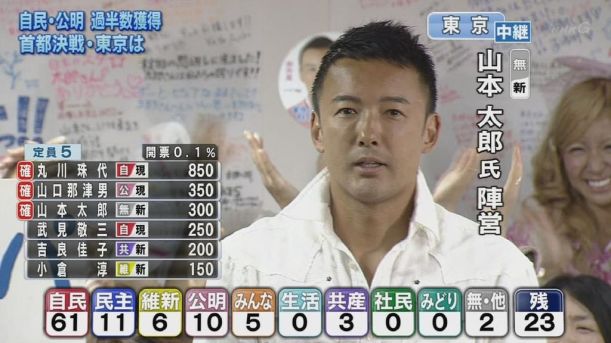
Yamamoto Taro on NHK, 21 July 2013
Advertisements in Japan are literally everywhere: a veritable hell of posters or screens in trains and stations, giant posters on buildings, bearers of advertising placards or lorries with huge posters and loud PA systems in the streets: even advertising displays mounted atop urinals in some restaurants. In this advertising empire, the media are no exception. In the press, naturally, as in France, major companies pay for full page advertisements. But, above all in television. An entertainment show generally starts with the announcement of sponsors, and is interrupted every five minutes by numerous short advertising spots, where we often find the same sponsors. There is virtually no time for thinking, most TV channels offer programs close to the world of pachinko: garish colors, constant noise, and frat humor even of the most vulgar kind.
In this immense television arena, advertising is orchestrated by one of the global giants, Dentsu, the 5th communication group in the world and the number one ad agency. With its rival Hakuhodo, 2nd in the archipelago, the two agencies nicknamed “Denpaku,” combine advertising, public relations, media monitoring, crisis management for the largest Japanese and foreign companies, the local authorities, political parties or the government. Together they hold nearly 70% of the market. A true empire that some accuse of ruling the roost in the Japanese media.
A figure allows sizing up Dentsu’s reach: in 2015, the group secured nearly 7 billion euros in revenue, second only to the French Publicis with 9.6 billion euros during the same period. Most of its business is in TV advertisements. For example, Dentsu has created a commercial series for Softbank for almost ten years: the famous “Shirato” family characterized by a white dog as the father; an American black actor as the older brother; and Tommy Lee Jones as a housekeeper.
In July 2013, the group expanded internationally by acquiring the British Aegis for 3.7 billion euros to establish the Dentsu Aegis Network in London. This international network, consisting of ten advertising agencies in more than 140 countries, allowed the Japanese to beef up their activities, particularly in digital marketing, and to secure a position in the international market which accounts for more than half of its total global business (54.3% in 2015). Dentsu employs 47,000 people worldwide, including 7,000 in Japan.
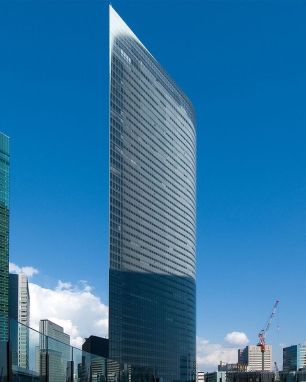
Dentsu and information on nuclear power
Dentsu headquarters, Shiodome
Located in the business district of Shiodome, not far from Nippon TV, Fuji TV and the Asahi Shimbun newspaper, the Dentsu tower dominates the skyline with its imposing beauty. Designed by the French architect Jean Nouvel, its gentle curves and perfect glass walls soothe the eye. Inside the building, Mr. Kannan Shusaku, communications director of the group, receives us, all smiles for a visit of the site. The ground floor is filled with contemporary art, like a white chessboard by Yoko Ono. From there, a noria of lifts takes employees towards different floors and rigorously separates departments. The group’s customers are the top 5 in each industry, and “everything is done so that employees working for competing enterprises never meet each other.” Mr. Kannan assures us. Dentsu obviously prizes transparency, but is its image that stainless?

Honma Ryu, Dentsu and Nuclear Coverage
In a book published in 2012, Honma Ryu looked into some of Dentsu’s backstage, and its tight control over the media, especially on behalf of one of its major clients: Tokyo Electric Power Company, Tepco. Honma is not alien to advertising circles; he worked for 18 years at number 2, Hakuhodo, then after one year imprisonment for fraud, he began writing, first about his prison experience, then about his years of advertising and the methods he used to coax the media. In 2012, his book Dentsu and Nuclear Coverage became a bestseller within a few months, despite almost universal media blackout.
Honma meticulously described the mechanisms by which Dentsu, the inevitable intermediary, implicitly imposes on media what can or cannot be written on nuclear power, and under what conditions. “Dentsu occupies a special position since the agency holds 80% of the market for nuclear advertising in Japan,” he reminded us during an interview in a coffee shop at Ueno Station. In 2010, in this huge advertising market, Tepco, a regional firm, indeed ranked 10th in terms of advertising expenses, next to power plant manufacturer Mitsubishi Heavy Industries. That year, on the eve of the Fukushima accident, Tepco had spent more than 2 million euros on advertising. The overall advertising expenses of the 10 regional electrical power companies amounted to 7 million euros.
For decades, especially since the 1990s when public opinion began to become critical of nuclear power following several accidents, Tepco and other power companies stepped up commercials and advertorials in the press.
On television, the advertisements can be enough in themselves to overwhelm criticism. Big groups often sponsor TV programs, talk shows or series for an entire season. Sometimes, entire documentaries are produced by Denjiren, [the Federation of Electric Power Companies of Japan (FEPC)], a key player in the nuclear lobby, to promote the industry. Any dissenting voice is unwelcome for fear of losing sponsors. After Fukushima, Yamamoto Taro paid the price; appearing regularly on TV as a tarento [talent] until then when he suddenly became persona non grata on TV and even in cinema for having expressed opposition to nuclear power. This is hardly new since the great figures of the anti-nuclear movement, best-selling authors such as Hirose Takashi or Koide Hiroaki are almost never invited to appear on TV, especially after the Fukushima accident. This “control by media” denounced by Honma Ryu obviously is not limited to the nuclear power industry. Thus, he reminds us of the case of the millions of Toyota vehicle recalls due to a defective accelerator pedal. It was necessary to wait until the Toyota CEO apologized to the U.S. Congress before that affair really appeared in the Japanese press. “No doubt the advertising agency had succeeded until then in preserving the image of its client, but when the scandal became too big and was in the public eye abroad, the media had no choice but to reveal the affair” he states. It is hardly an exaggeration to say that apart from some programs such as “Hodo Station” on TV Asahi, which provide good quality information, sometimes being critical of the government, most TV news in Japan rarely address subjects that can offend one or another group, relaying communications from the government without critically stepping back, and not introducing international news except when the subject involves Japanese citizens.
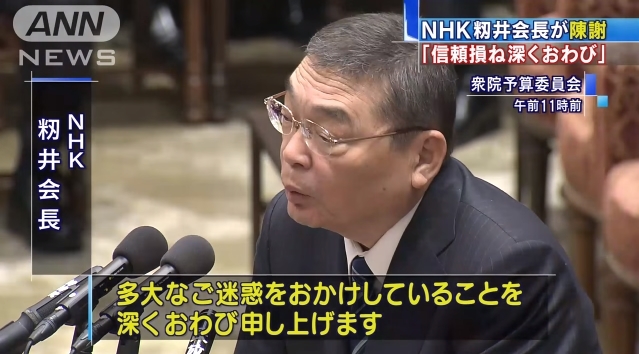
Momii Katsuto apologizing at Lower House Budget Committee session, 13 January 2016
Amid all these private media groups, only NHK escapes this advertising empire and can claim to be independent, receiving its funding directly from viewers. Alas, the situation at NHK is even more disastrous, its president Momii Katsuto having said without embarrassment on several occasions that the chain had to be the spokesman for the Abe government. In a recent statement before 200 retired NHK employees, he even seemingly acknowledged having ordered NHK journalists to confine broadcasts to reassuring communiqués from the authorities about Kyushu earthquakes and potential risks they pose to nuclear plants and instructing them not to interview independent experts.
Indirect pressures on the press
What about the press? Dentsu has long had a special relationship with the two news agencies Kyodo News and Jiji Press: the three entities formed a single information group before the war. If information in the press is more difficult to control, Dentsu not only advertises, but provides after-sales customer service — media monitoring, advice on crisis management, and indirect pressure on newspapers.
Whereas in France, the acquisition of media companies by large industrial groups is the prelude to direct pressure, in Japan pressure comes via advertising agencies that act as true ambassadors for the groups. “I know very well how this happens, as Honma Ryu amusingly relates, I did the same thing when I was at Hakuhodo. If an incident occurs in a factory or a plant and the press reports it, Dentsu directly intervenes and visits the business department of the newspaper in question.” Things are done in the “Japanese” way. “We ask them politely to try to speak less about the case, not to put the article on the front page, or to publish it in the evening paper which is less read.” Such messages are directly transmitted by the business staff of the journal to top management.
Journalists will never know, but the next day their article will be relegated to the inside pages, or sometimes simply not published, or, for example, claiming lack of space. But, suspicions are numerous, and, Honma reports, after the publication of his book, many journalists came to see him confirming cases of censorship. Advertisements of nuclear power are mainly distributed in weekly and daily newspapers. Since the accident at the Fukushima nuclear plant, they stopped; but for Dentsu, a profitable new business emerged: promoting agricultural products from Fukushima. Since 2011, with the participation of star singers, Fukushima Prefecture has never skimped on promoting its peaches, rice, or tomatoes, with slogans like “Fukushima Pride” or “Fukushima is well!”


“Fukushima Pride”
All this thanks to the help of Dentsu and Dentsu Public Relations (PR). “Dentsu PR also works for the METI [Ministry of Economy, Trade, and Industry],” explains Ms. Fujii Kyoko, Director of communications at Dentsu PR. “We organized free tours of Tohoku for foreign journalists, such as Thai and Malaysian journalists, to show that the region is recovering from the disaster.” And to expunge the surrounding radioactivity?
Dentsu thus occupies a very special position in the promotion of nuclear power, beside Tepco but also the powerful Ministry of Economy, Trade, and Industry (METI) and the Liberal Democratic Party (LDP), both clients of the advertising company. Under these conditions, can Dentsu not be considered to actively underwrite the “nuclear village”? To this question, Mr. Kannan Shusaku, who received us in his office at the top of the Dentsu tower, answered without beating around the bush. “We have no power to influence the media and we do not practice politics.” Yet when asked why Dentsu is a member of the Japan Atomic Industrial Forum (JAIF), the main organization of nuclear lobbying, along with Japanese electric utility companies and EDF [Electricity of France, Électricité de France], Mr. Kannan became more circumspect. “I do not know this association… Really, are you sure?” he replied, slightly annoyed, before reaching for his smartphone. “Oh, yes, we are members. But, you know we are members of many associations. People ask us to send someone and sign, that’s all.” Apparently unconvinced by his own argument, he finally found a getaway and suddenly exclaimed: “You see, Hakuhodo is also a member!” obviously happy about not being the only one enlisted in the lobby.
The 2016 comeback of nuclear advertisements and resignations of TV journalists
For Honma Ryu, this is a sign of a resumption of promotion activities of nuclear power. “Hakuhodo has actually been a member of the JAIF for two years,” he explained, after the Fukushima accident. Obviously, having been sidelined for several decades from this gold mine of nuclear advertisements, the rival agency wants to restore its share in the promotion of nuclear power in the post-Fukushima era. These ads had, however, completely disappeared since the accident on March 11, 2011. After a final full page apology in the press and broadcast on television by Tepco, the plant operators and manufacturers had chosen to keep a low profile, not broadcasting advertisements on nuclear power for five years.
But, although plant restarts have been hindered by dozens of lawsuits, some victorious as in Takahama, and the general population has generally been reluctant to see resumption of reactors, promoting nuclear power has again become intense. After restarting one plant in 2015, 2016 is the year of a discreet comeback for nuclear advertisements. These appear in the press and on local television of the prefectures with power stations. Honma Ryu reports that since February 2016, full-page advertisements have been published in Fukui Shimbun by the Kansai Electric Power Company, where the Takahama plant was closed a month after its restart due to a lawsuit filed by citizens. Tepco advertisements for restarting Kashiwazaki-Kariwa have also appeared in the Niigata Nippo and on local television in a particular context: the current governor is firmly anti-nuclear and opposes any restart, but elections will be held by the end of this year when his term ends. This resurgence of Tepco nuclear advertising, however, has raised the ire of Niigata citizens, especially refugees from Fukushima who have launched a petition to stop them.
The message of all of these advertisements is identical, revealing the hand of Dentsu behind the scenes. Electric companies promise to make every effort to ensure the safety of power plants, while photographs highlight the plight of nuclear workers who are often poor and sometimes dependent on jobs in the nuclear industry. According to Honma Ryu, these advertisements are certainly only the tip of the iceberg. They are part of a campaign to closely monitor all information published on nuclear power, as well as the quasi-guarantee that local newspapers will limit the voice of opponents.
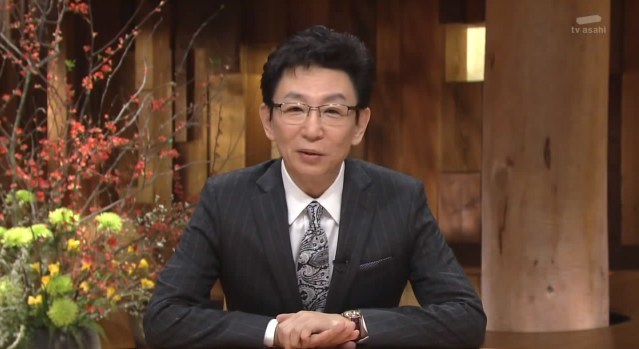
Furutachi Ichiro on “Hodo Station”
In a report on press freedom released in April 2016, Reporters Without Borders ranked Japan 72nd, behind Hungary and Tanzania. Six years ago, it ranked 11th. Visiting Tokyo, a United Nations rapporteur alerted the country to the growing pressures on Japanese journalists who work for private media or NHK. This is because of increasing government pressure, exacerbated by the entry into force in the past year of a law on state secrets, including nuclear related matters. A law with vague outlines threatens journalists with imprisonment for disclosing “secret” information. A sign of the times is that three television journalists known for their independence announced their resignation at the beginning of the year. Among them is Furutachi Ichiro, presenter of “Hodo Station,” which, according to Honma Ryu, was targeted by Dentsu for several years because of his critical views on nuclear power and the Abe administration. No doubt Dentsu, privileged ambassador of the largest industrial groups, will continue to play its role in the great media lockdown ongoing in Japan.
http://apjjf.org/2016/11/Gaulene.html
Japanese gov’t withheld report on Chernobyl disaster’s health effects
The Japanese government has withheld an investigative report it compiled on health effects from the 1986 Chernobyl nuclear catastrophe despite spending 50 million yen on the survey in the wake of the Fukushima nuclear disaster, it has been learned.
The government’s investigation into the aftereffects of the Chernobyl disaster began in November 2012 — the year after the meltdowns at the Fukushima No. 1 Nuclear Power Plant — under the then Democratic Party of Japan (DPJ)-led administration, and was completed in March 2013 after the Liberal Democratic Party returned to power.
The investigative report denies local documents that confirmed far more serious health hazards from the Chernobyl accident in the former Soviet Union than those recognized by international organizations. An expert familiar with information disclosure points out that the report “should be publicized as a resource for verification from a critical point of view, considering that public money was spent on it” amid sharply divided opinions over nuclear power in Japan.
The investigation was budgeted by the Ministry of Education, Culture, Sports, Science and Technology and was commissioned to a Tokyo-based consulting firm funded by power companies. A committee set up to evaluate the survey results was chaired by Nagasaki University professor emeritus Shigenobu Nagataki, who formerly served as chairman of the Radiation Effects Research Foundation. The investigative team primarily examined and assessed two local reports — “Twenty-five years after the Chernobyl accident: Safety for the future” and “Chernobyl: Consequences of the catastrophe for people and the environment.”
The “Safety for the future” report, which was compiled by Ukraine’s Ministry of Emergencies in 2011, points out that the ratio of healthy workers dealing with post-disaster work in Chernobyl plunged from 67.6 percent in 1988 to 5.4 percent in 2008. The latter report, which was put together by local researchers in 2009, estimates that a total of 985,000 people died from the effects of the Chernobyl disaster between April 1986 and December 2004 after their constant exposure to radiation following the disaster triggered cancer, heart and vein disorders and other ailments.
Both reports claim far more serious health hazards than those recognized by international organs, and gained much public attention here in Japan after the reports were highly publicized in the wake of the 2011 Fukushima disaster.
The Japanese government report’s assessment panel examined the two reports with regard to 124 parts concerning blood and lymphatic disorders and analyzed whether radiation dose assessments were carried out where radiation exposure was linked to health damage. The committee also conducted an on-site investigation and concluded that it couldn’t find any resources with which they could determine the relationship between exposure doses and health damage, based on scientific grounds.
Subsequently, the science ministry department that was in charge of the survey was moved to the secretariat of the Nuclear Regulation Authority (NRA) in April 2013, and the Japanese government’s report was not released. The NRA secretariat eventually placed the report in the National Diet Library by way of the Environment Ministry.
Nagataki told the Mainichi Shimbun, “After we filed the investigation report with the science ministry, the ministry department in charge was shifted to the NRA secretariat, leaving us no clues as to what has become of the report. I felt uncomfortable when I heard the report was kept at the National Diet Library, but I also thought it would be inappropriate for us to demand that the report be released.”
A source close to the government told the Mainichi, “The investigation was decided upon under the DPJ administration, and we had to use up the budget. As the government changed hands, we had no intention of proactively publicizing the report.” Another government insider said, “Nondisclosure of the report was also intended to avoid causing fear among people in Fukushima. It was also aimed at preventing harmful rumors.”
http://mainichi.jp/english/articles/20160604/p2a/00m/0na/006000c
Geology graduates investigate Fukushima-derived radioactivity in Hawaii

Trista McKenzie in the lab
On March 11, 2011, following the Tohoku earthquake and tsunami, several reactors at the Fukushima Dai-ichi Nuclear Power Plant suffered damage and released radioactive chemicals into the atmosphere and contaminated wastewater into the nearby Pacific Ocean. Hannah Azouz and Trista McKenzie, two recent graduates from the University of Hawaiʻi at Mānoa School of Ocean and Earth Science and Technology (SOEST) bachelor of science in geology program, assessed the extent to which the soil of Hawaiʻi and locally purchased fish have been impacted by radioactivity from this event.
The students’ mentor, Henrietta Dulai, associate professor of geology, explained the motivation for this work, “My research team has been monitoring Fukushima-derived cesium in the Pacific Ocean since 2011 and we concluded that the Hawaiian Islands were spared from a direct hit of radionuclide plume spread by ocean currents. Yet, fish migrate and so even fish caught locally may accumulate some cesium in waters north of Hawaiʻi. Further, only one week after the disaster, the Department of Health identified Fukushima-derived radionuclides in the air, milk and precipitation over Hawaiʻi Island. We wanted to determine how much cesium was deposited from the atmosphere to the islands.”

Fresh-caught Ahi tuna
Locally-purchased fish
To investigate the impact on locally-purchased fish, Azouz measured Fukushima-derived cesium isotopes in thirteen types of fish that are most commonly consumed in Hawaiʻi.
The FDA-accepted intervention limit for cesium isotope intake is 300 Bq/kg for fish. All fish tested were significantly below intervention limits—the highest cesium concentration in the examined species was in the Ahi tuna, carrying less than 1 Bq/kg.
“These data are informative to the community and they reassure me about the safety of the food we consume,” said Azouz. “The activities of the radionuclides were gratefully low—a person consuming the annual average amount of fish would receive the same dose of radioactivity as if they consumed one banana.”
“I did not know how passionate I would become about earth sciences,” said Azouz, who grew up in California but now calls Kailua home. “The most rewarding thing about this project is providing honest relief and real answers to the public. I can’t wait to publish this study and get it out onto the internet for the rest of the community to see!”
Azouz’s work was funded by the Undergraduate Research Opportunities Program (UROP) at UH Mānoa, with support from the Honors Program and SOEST.
“I recommend the University’s Honors Program as a great way to jump start a future career in your favored field. The research opportunities are endless,” said Azouz.

Soil and mushrooms
To estimate the atmospheric fallout of Fukushima-derived cesium and iodine onto Hawaiʻi, McKenzie analyzed mushroom and soil samples from Oʻahu and Hawaiʻi Island from areas with various average rainfall.
McKenzie’s research confirmed and quantified the presence of Fukushima-derived fallout in Hawaiʻi—the radioactive elements were present in both mushrooms and soil. However, the activities detected were much lower than fallout associated with the nuclear weapons testing in the Pacific. Additionally, they found that Fukushima-derived cesium in soils was correlated with precipitation—the more rainfall, the more cesium.
The levels of cesium activity (factoring both historical and Fukushima-derived fallout) in mushrooms were more than 12 times under the Derived Intervention Limit. For soils, there is no specific safety limit for radiocesium, but McKenzie found cesium inventories were not high—up to 1,200 Bq/m2 cesium in Hawaiʻi soils compared to 200,000 Bq/m2 in forest soils found near the Fukushima Power Plant.
McKenzie’s fieldwork was funded by UROP at UH Mānoa, as was a trip to Vienna, Austria, to present her research at the European Geosciences Union (EGU) General Assembly. Subsequent to her presentation in Vienna, McKenzie also won the American Geophysical Union Multi-Society Undergraduate Spring 2016 Virtual Poster Showcase.
“I chose this project for my undergraduate research because it offered me a chance to investigate a really important question,” said McKenzie. “I’ve enjoyed both the field and lab work, and as a result of attending the EGU, I was able to meet geologists from all over the world and gain valuable presentation experience,” said McKenzie.
Both Azouz and McKenzie will continue working with Dulai in the fall—this time as graduate students.

Hannah Azouz sharing research findings at the 2015 SOEST Open House
Geology graduates investigate Fukushima-derived radioactivity in Hawaiʻi
“The Choices the Evacuee Moms Made:to Protect Precious Life”
This is an English subtitled video recording of the sixth performance of Choices Evacuee Moms Made by Gekidan Q performed in Osaka in August, 2014. The play depicts the lives of some of the evacuees after the Fukushima nuclear disaster in 2011. The plot is a fictionalized account of the actual speeches made by evacuees. Be sure to watch to the end (Part 4) where Akiko Morimatsu speaks after the performance. We hope you will share this video with your friends.
No.1
No.2
No.3
No.4
http://sandori2014.blog.fc2.com/blog-entry-1064.html
Urgent Statement Regarding G7 Summit Heads of G7 countries must face and learn from the tragedy and suffering of people caused by the Fukushima nuclear crisis
May, 27th 2016
Today, the “G7 Ise-Shima Leaders’ Declaration” was announced. The declaration states, “We welcome the steady progress on decommissioning and treatment of contaminated water at Fukushima Daiichi Nuclear Power Station, and Japan’s effort to proceed in an open and transparent manner in close communication with the international community, towards developing accurate global understanding of the situation in Fukushima…it[nuclear power] substantially contributes to the reduction of future GHG emissions and works as a base load energy source.”
However, the declaration does not mention the irreversible damages, loss of beautiful hometowns, and broken communities caused by the nuclear crisis; additionally, the declaration also ignores the reality that the nuclear crisis is still going on.
The nuclear crisis is far from over. Many workers work onsite while being exposed to radiation. Despite efforts, massive amounts of radioactive waste-water is still leaking. There are not enough tanks to keep up with the work that needs to be done. Implementation of the “Frozen ground wall” as a solution for the leaking contaminated water was decided on at the closed meeting by the Ministry of Economy, Trade and Investment. The wall does not seem to work to prevent the leakage of contaminated water. While the Nuclear Regulatory Committee is supposed to regulate these policies, they are pushing for these policies instead.
After the nuclear crisis, at least 100,000 people fled from Fukushima and now spend their lives far from their hometowns. Most of them decided not to return or cannot decide whether they want to go back. However, the government is going to lift the regulation on the no-go zone by next March and decrease housing assistance for voluntary evacuees. This means the government wants to minimize the number of ‘evacuees’ and use it as a pretext to reconstruction from the disaster. According to data collected by the Fukushima Prefectural Health Checks, 166 children are diagnosed with pediatric thyroid cancer.
World leaders must see this reality: the reality that people are still suffering greatly from the nuclear crisis. Learning from the Fukushima nuclear crisis, they must facilitate the shift to renewable energy and an energy efficient society. Currently, we are still living in a materialistic society, which requires massive amounts of energy consumption; therefore, world leaders must also make efforts to move away from this type of society and shift toward an environmentally sustainable society.
Contact:
Friend of the Earth Japan
Tel:+81-3-6909-5983 Fax:+81-3-6909-5986
info@foejapan.org
http://www.foejapan.org/en/energy/doc/160527.html

Exelon reactor closures show how the nuclear rot is really settling in for America
 Exelon Corp. (EXC) Nuclear Plant Closures Point To Wider Challenges Facing US Nuclear Sector, International Business Times, BY MARIA GALLUCCI @MARIAGALLUCCI ON 06/03/16 Exelon Corp.’s announcement this week that it plans to shutter two Illinois nuclear plants comes at a harrowing time for the U.S. nuclear power sector. Amid fierce competition from cheap natural gas and withering support from state policymakers, utilities are increasingly struggling to keep the aging, hulking power plants in operation.
Chicago-based Exelon (NYSE:EXC), which owns utilities serving Chicago, Philadelphia and Baltimore plus many power plants, said it will close its Clinton plant in mid-2017 and the Quad Cities plant in mid-2018. The nuclear stations lost a combined $800 million in the past seven years, despite being two of the company’s best-performing plants, Exelon said Thursday.
The power company had been waiting on Illinois policymakers to adopt measures to reward nuclear plants and other carbon-free power sources that help the state meet its climate change targets. The legislation included other provisions that would have slapped new charges on consumer energy bills. The policies are entangled in a broader budget war between Republican Gov. Bruce Rauner and House Speaker Michael Madigan, a Chicago Democrat……
Wholesale prices are likely to remain low in the next few years, which could spell a death sentence for aging plants in need of costly upgrades and lengthy repairs. The majority of the country’s 99 nuclear reactors are more than 30 years old and could operate potentially for as long as 80 years — but only if utilities can afford to keep them running.
Between 15 and 20 nuclear reactors are considered at risk of premature closure within the next five to 10 years, the Nuclear Energy Institute, a trade group, has estimated.
Opponents of nuclear power say that may be a good thing, given the longstanding concerns over radioactive waste disposal and the looming threat of a meltdown, particularly in the wake of the 2011 disaster in Fukushima, Japan. An Associated Press investigation that year found that radioactive tritium has leaked from three-quarters of U.S. nuclear power sites and in some cases contaminated the drinking wells of nearby homes.
Entergy’s Indian Point nuclear plant, which sits just 25 miles north of New York City, has faced a series of mishaps in the last year, including a power failure in the reactor core, an alarm failure and the escape of radiated water into groundwater. Federal officials with the Nuclear Regulatory Commission are now investigating the degradation of critical stainless steel baffle bolts in one of the plant’s nuclear reactors.
“This aging nuclear power plant is becoming increasingly unreliable and puts the welfare of 20 million people at risk every day,” Paul Gallay, president of the citizen group Riverkeeper, which opposes Indian Point, said in a recent opinion piece………..http://www.ibtimes.com/exelon-corp-exc-nuclear-plant-closures-point-wider-challenges-facing-us-nuclear-2377652
1.5C or 2C global warming> Scientists compare the climate effects
 Scientists compare climate change impacts at 1.5C and 2C , Skeptical Science, 2 June 2016 Half a degree makes a very big difference when judging how different parts of the world will feel the effects of climate change.
This is the conclusion from the first study to compare and contrast the consequences of 1.5C world compared to a 2C world, published today in Earth System Dynamics.
Both 2C and 1.5C are explicitly mentioned in the Paris agreement as potential upper limits for global warming since the preindustrial era, but details from scientists on how the temperature thresholds compare have been sparse.
For example, an extra 0.5C could see global sea levels rise 10cm more by 2100, water shortages in the Mediterranean double and tropical heatwaves last up to a month longer. The difference between 2C and 1.5C is also “likely to be decisive for the future of coral reefs”, with virtually all coral reefs at high risk of bleaching with 2C warming.
The authors presented their research today at the European Geosciences Union, an annual major gathering of geoscientists taking place this week in Vienna.
“Two-headed goal”
The Paris agreement – adopted in December 2015 and due to be officially signed by more than 150 countries on Friday – codified what the authors of today’s study call a “two-headed” temperature goal.
It pledged to keep the average global surface temperature “well below 2C” and “pursue efforts” to limit the increase since preindustrial times to 1.5C.
The nod to 1.5C recognised that many low lying island nations are already feeling the impacts of climate change and that coral reef and Arctic ecosystems face high risks well below 2C.
But the specific reference to 1.5C as well as 2C caught the scientific community somewhat off-guard. Today’s paper says:
“Despite the prominence of these two temperature limits, a comprehensive overview of the differences in climate impacts at these levels is still missing.”
A recent commentary in Nature by Prof Simon Lewis, professor of global change at University College London, is a little stronger on this point. As he puts it:
“The emergence of 1.5 C as a serious policy position comes with important lessons for scientists. The global research community has shockingly little to say on the probable impacts of a 1.5 C rise.”
The scientific community now, at least, seems to be rising to the challenge. Last week, the IPCC confirmed it will dedicate one of its special reports to the 1.5C goal. This is due to be published in 2018.
Work on today’s paper began in 2014, long before the Paris conference. The United Nations Framework Convention on Climate Change called on scientists to explore the difference between a 1.5C and 2C long term goal, as part of its 2013-2015 review.
Prof Carl-Friedrich Schleussner, scientific advisor at Climate Analytics in Germany andlead author of today’s study, tells Carbon Brief:
“[The review] concluded last year that, while 2C cannot be considered safe and 1.5C would clearly be a safer limit, the science on 1.5C is less robust than on 2C. So clearly, there’s a research gap here.”A 1.5C vs 2C worldThe study compared how extreme weather, water availability, crop yields, sea level rise and risks to coral reefs differ in a world where global temperature rises 1.5C, compared to if it rises 2C.
Using 11 climate models, the authors looked at how each of the impacts plays out globally, as well as in 26 different regions. This is important since the world won’t warm at the same pace everywhere, the paper notes.
Some of the most dramatic differences occur with heat extremes, with heatwaves in the tropics lasting up to three months with 2C warming, compared to two months with 1.5C. The paper says:
“[T]he additional 0.5C increase in global-mean temperature marks the difference between events at the upper limit of present-day natural variability and a new climate regime, particularly in tropical regions.”High northern latitudes are expected to see some of the biggest increases in heavy rainfall, with the maximum over a five-day period rising by 7% for 2C warming, compared to 5% for 1.5C.
At the same time, water scarcity in the Mediterranean is likely to be twice as severe at 2C than at 1.5C, with climate-induced shortfalls of 17% compared to 9% (relative to 1986-2005 levels).
The study shows global sea level rising 50cm by 2100 with 2C of warming, compared to 40cm for 1.5C (both relative to 2000). Warming of 2C would also put 98% of the world’s reefs at risk of coral bleaching from 2050 onwards, compared to 90% for 1.5C…………http://www.skepticalscience.com/scientists-compare-climate-impacts-1-5C-2C.html
USA pushing nuclear deal with India, in the interests of Japanese company Toshiba Westinghouse
this [India] is a country both Wall Street and Washington have their eyes on

Will U.S. Get India To Ink Big Nuclear Deal With A Japanese Owned Company?, Forbes, Kenneth Rapoza , 2 June,
When Indian Prime Minister Narendra Modi comes to town on Monday, a Japanese-owned company may be the biggest beneficiary.
 One of the key takeaways Modi and President Obama would would like to see come of this trip is a commitment to build six nuclear power plants by Westinghouse Electric. The Western Pennsylvania based company is an historic American electric manufacturer, but it was acquired by Toshiba in February 2006. Even the Kazakhs own 10% of it under Kazatomprom, their state-owned nuclear power company. Yet, Westinghouse is Washington’s favorite nuclear power company and next week it might make headlines again if it manages to ink a muito-billion dollar deal for its new AP-1000 reactors.
India Ambassador Arun Singh told reporters on Wednesday that the deal was in its “advanced stages.”
The two sides were largely waiting on a nuclear liability law that will essentially create a new insurance product for nuclear power utilities. Westinghouse and its partner in India, the Nuclear Power Corporation (NPCIL), are still waiting for the details of that insurance policy to be ironed out, thinks Richard M. Rossow, a senior fellow on U.S.-India policy for the Center for Strategic and International Studies in Washington………
Westinghouse has a long history of tapping Washington for lucrative deals abroad. Since the mid-2000s, Westinghouse has been able to count on Washington to pitch its wares to countries where Russia is a key, if not dominant player. Currently, Russia’s Rosatom has only two reactors in India, both located in Tamil Nadu state. India has 21 nuclear power plants, most of it indigenous technology.
A deal for all six power plants would be good news for Westinghouse Electric and its owners at Toshiba, which has fallen on hard luck over the past five years.
Toshiba used to design and build reactors for half of Japan, also supplying those reactors with the fuel rods that hold the uranium used to generate electricity. The March 2011 Fukushima disaster lit a match to those service contracts and Toshiba’s Fukushima reactors are decommissioned. Germany shut its reactors down after Fukushima, too. They also used Westinghouse as a source for fuel rods. In less than two years, Toshiba and Westinghouse Electric lost contracts at 60 reactors. Between 2012 and 2014, Westinghouse Electric’s cumulative operating losses reached $1.43 billion, according to Toshiba……
this [India] is a country both Wall Street and Washington have their eyes on…….http://www.forbes.com/sites/kenrapoza/2016/06/03/will-u-s-get-india-to-ink-big-nuclear-deal-with-japanese-owned-company/#4f7edc32c94f
Georgia new nuclear plant, over budget, behind schedule, and now hits a new snag


Jacob Hawkins said the company will suspend preliminary work on the site if McDonald’s motion passes.
“A delay of even a few years in these actions will jeopardize our ability to keep new nuclear as a timely option for customers,” he said…..
McDonald’s motion comes as the commission is set to hear testimony next week on construction of the nation’s first two commercial nuclear reactors in 30 years at Plant Vogtle, where Georgia Power is the majority owner. It is three years behind schedule and around $1 billion over budget, and the commission staff is investigating whether to recommend having electricity customers pay the tab for the overage.
Last week, SCANA asked the South Carolina counterpart to the commission to charge their customers for $852 million in overages for two reactors it is building at Plant Summer…….http://chronicle.augusta.com/news/metro/2016-06-02/plans-more-nuclear-generation-hit-obstacle?v=1464916692#comment-form
Community group to fight San Onofre nuclear waste plan
 Group forms to fight San Onofre nuclear waste plan, San Diego Union Tribune By Jeff McDonald June 2, 2016 Residents of San Diego and Orange counties concerned about the longterm storage of radioactive waste on the coast between Oceanside and San Clemente have organized a new coalition aimed at forcing the removal of tons of spent nuclear fuel.
The group, calling itself Secure Nuclear Waste, is comprised of lawyers, activists, a scientist, an elected official and an emergency-room physician. It is hosting a community meeting at Laguna Beach City Hall next Wednesday evening.
“The deadly radioactive waste is toxic to humans for millions of years,” the group said in a news release criticizing a California Coastal Commission storage permit approved in October. “If nothing is done, the waste could be buried on the beach as early as May 2017 for up to 300 years.”
Secure Nuclear Waste said it organized as a counter to the Community Engagement Panel, a group of volunteers convened by plant owner Southern California Edison to meet regularly and discuss decommissioning of the failed San Onofre nuclear plant.
Members of Secure Nuclear Waste include San Diego consumer attorneys Michael Aguirre and Maria Severson. It also includes Charles Langley of the consumer group Public Watchdog, geologist Robert Pope and transportation consultant Nina Babiarz.
San Juan Capistrano Mayor Pam Patterson, who serves on the Community Engagement Panel due to her elected office, also joined Secure Nuclear Waste. She said the official group is not independent and not forceful enough opposing onsite spent-fuel storage at San Onofre.
“People on the Community Engagement Panel have been hand-picked because they are candy-coating the situation,” Patterson said. “The community needs to understand what’s going on is not in anybody’s best interest. It’s scary what they are doing.”
The Coastal Commission permit, now the subject of a lawsuit filed by the Aguirre & Severson law firm, allows Edison to store 1,600 tons of spent fuel in underground canisters just north of the shuttered nuclear reactors.
The spent fuel historically has been stored in above-ground cooling ponds but Edison is in the process of transferring the waste into steel-lined casks. More than 100 of the 45-ton canisters will then be buried in a massive tomb embedded in the beach.
Critics say the plan does not allow for monitoring the canisters for future degradation or leaks and presents a health threat to the millions of people who live and travel through the region. They say regulators should do a better job mitigating the longterm threat.
“It is an outrage that taxpayers are funding politically appointed bureaucrats at state agencies to create a deadly toxic waste landfill next to an interstate highway and the Los Angeles-San Diego coastal rail corridor,” said Babiarz, the transportation consultant and coalition member. “Our two counties have united to fight this threat to public safety.”……
The first Secure Nuclear Waste meeting convenes Wednesday, June 8 at 6 p.m. at Laguna Beach City Hall, 505 Forest Ave.
The Community Engagement Panel next meets June 22, when a U.S. Nuclear Regulatory Commission expert will discuss so-called consolidated interim storage, the practice or temporarily storing radioactive waste on site until a more permanent federal site is identified. http://www.sandiegouniontribune.com/news/2016/jun/02/secure-nuclear-waste/
Even nuclear enthusiast Ernest Moniz admits that Renewable Energy Is Now Inevitable
 Renewable Energy Is Now Inevitable, Energy Secretary Says, Citing Price, Forbes, Jeff McMahon , 2 June 16,
“The discussion about climate and climate science and mitigation and adaptation is very important, but the fact is that clean energy, the clean energy scaling, has an inevitability about it following Paris,” Moniz said at the close of the 7th Clean Energy Ministerial, a San Francisco gathering of 24 energy ministers.
“This is becoming inevitable. This is the direction we’re going.”
Michael Liebreich, the founder of Bloomberg New Energy Finance, has been calling the clean-energy transition inevitable for years, saying in 2013, for example, that “the inevitable conclusion is that at some point there will be a phase change, and clean energy will be the norm, not the exception.”
Liebreich said it again Thursday in San Francisco, and Moniz adopted it. But a few things had to happen before Moniz would acknowledge the “phase change.” The first was the Paris Agreement and climate conference last December that brought together an unprecedented international coalition of nations, innovators, and financiers. Secondly, the cost of clean energy and certain energy efficient products has fallen so fast that even the plummeting oil price has been unable to halt its growth.
Moniz reviewed a few indicators he had noticed at the Ministerial:
• Power Purchase Agreements (PPAs) in the range of 3¢ to 4¢ per kilowatt hour for wind and solar energy, which have made renewables competitive. PPAs are the long-term sales contracts that set the price at which utilities buy power from energy producers. In its most recent analysis of thelevelized cost of energy, last September, Lazard had wind starting at 3.2¢, solar at 4.3¢, natural gas at 5.2¢ and coal at 6.5¢. “I think we may become almost expectant about this,” Moniz said, “but if you think back a short time, this kind of development would have been viewed as completely remarkable—because it is.”
Plunging prices for energy efficient products like LED lights. Moniz praised India’s success in reducing the price and increasing the efficiency of LEDs. The Indian government has distributed more than 50 million LEDs, using its purchasing power to drive down the price as it seeks to replace the country’s 770 million incandescent bulbs. Led lights cost about $35 just four years ago. In India, the price has fallen to about 80¢ for a 9-watt LED, Moniz said, “and the implications of that are pretty incredible.” Among those implications, low-energy LED bulbs demand less power from solar panels, extending the panels’ usefulness.
• Commitments by companies to power their operations using renewable energy, spurred in some cases by a campaign of the Clean Energy Ministerial led by Germany and Denmark.
“All 3 of those elements, I think, point to the way we are seeing a scaling in this clean energy realm,” Moniz said. http://www.forbes.com/sites/jeffmcmahon/2016/06/03/renewable-energy-inevitable-energy-secretary-says-because-of-plunging-prices/#7cd098801ec9
Just 15 minutes after the Clean Energy Ministerial adjourned, a meeting came to order of Mission Innovation, a coalition of 21 countries (and Bill Gates) that have pledged to double financing for energy research and development. The first panel at that meeting included an inventor, a venture capitalist, a utility-workers union representative and a utility executive—Southern Company CEO Tom Fanning.
Fanning extolled an all-of-the-above energy portfolio but acknowledged the “explosive growth” of renewables.
As that meeting too adjourned, Moniz said he was moving beyond Liebreich’s “inevitability” to a new phase uttered by Fanning:
“His words were ‘Can’t keep the waves off the beach,’” Moniz said. “I think that’s much better stated.” http://www.forbes.com/sites/jeffmcmahon/2016/06/03/renewable-energy-inevitable-energy-secretary-says-because-of-plunging-prices/#7cd098801ec9
1 This Month

Chernobyl: The Lost Tapes – A good documentary on Chernobyl on SBS available On Demand for the next 3 weeks– https://www.sbs.com.au/ondemand/tv-program/chernobyl-the-lost-tapes/2352741955560

of the week–London Campaign for Nuclear Disarmament

Tell the Ukrainian Government to Drop Prosecution of Peace Activist Yurii Sheliazhenko
To see nuclear-related stories in greater depth and intensity – go to https://nuclearinformation.wordpress.com
-
Archives
- April 2026 (189)
- March 2026 (251)
- February 2026 (268)
- January 2026 (308)
- December 2025 (358)
- November 2025 (359)
- October 2025 (376)
- September 2025 (257)
- August 2025 (319)
- July 2025 (230)
- June 2025 (348)
- May 2025 (261)
-
Categories
- 1
- 1 NUCLEAR ISSUES
- business and costs
- climate change
- culture and arts
- ENERGY
- environment
- health
- history
- indigenous issues
- Legal
- marketing of nuclear
- media
- opposition to nuclear
- PERSONAL STORIES
- politics
- politics international
- Religion and ethics
- safety
- secrets,lies and civil liberties
- spinbuster
- technology
- Uranium
- wastes
- weapons and war
- Women
- 2 WORLD
- ACTION
- AFRICA
- Atrocities
- AUSTRALIA
- Christina's notes
- Christina's themes
- culture and arts
- Events
- Fuk 2022
- Fuk 2023
- Fukushima 2017
- Fukushima 2018
- fukushima 2019
- Fukushima 2020
- Fukushima 2021
- general
- global warming
- Humour (God we need it)
- Nuclear
- RARE EARTHS
- Reference
- resources – print
- Resources -audiovicual
- Weekly Newsletter
- World
- World Nuclear
- YouTube
-
RSS
Entries RSS
Comments RSS
 nuclear-news