Russia’s Rosatom keenly marketing nuclear power to Thailand, Vietnam, Indonesia, Malaysia, Cambodia, Myanmar and Laos

 Russian nuclear agency bullish on Asean outlook ACHARA DEBOON
  ME THE NATION, Thailand, MOSCOW June 6, 2016 ROSATOM, Russia’s state nuclear-energy agency, is bullish on the outlook of its business in Southeast Asia after the speedy development of a project in Vietnam and a range of agreements with every country in the region except Singapore, the Philippines and Brunei.
“Public acceptance is a key element, and we pay much attention to it,” he said…….
At the expo, a number of agreements with Indonesia were signed, also involving the training of specialists. This followed an agreement on the basic reactor design signed last year.
In the past few years, seven countries including Thailand have signed cooperation agreements with Rosatom. This month, a working group was established with Cambodia’s National Council for Sustainable Development after an agreement on the peaceful uses of atomic energy. Myanmar and Laos also have similar cooperation agreements.
Three Myanmar students are now studying nuclear science in Russia on scholarships……
Fleet of little nuclear reactors for Britain. Rolls Royce to build them?
Rolls Royce Shortlisted to build fleet of baby nuclear-reactors, CITY AM Jessica Morris, 5 June 16 , FTSE 100-listed engineering company Rolls-Royce has been shortlisted to build a fleet of mini nuclear reactors, City A.M. understands.It’s part of the government’s £250m nuclear research programme unveiled in last year’s Autumn Statement, which includes a competition to identify the best value small modular reactor (SMR) design for the UK.
An industry source said that the SMR scheme won’t be a “short process”. This comes despite the UK energy policy crisis, with an increasingly strained power supply. Almost 6,000 MW could be lost this year.
Of the 38 companies which submitted expressions of interest in the competition, 33 were eligible to compete in the next round, according to the Sunday Timeswhich first reported the news.
These also include US engineering giant Bechtel, NuScale Power which is backed by US engineer Fluor, and Canada’s Terrestrial Energy……The company declined to comment, while the Department for Energy and Climate Change hasn’t yet responded to a request for comment. http://www.cityam.com/242623/rolls-royce-shortlisted-to-build-fleet-of-baby-nuclear-reactors
Asking how to prepare for a nuclear disaster is asking the wrong question
Nuclear power: Asking the wrong questions http://thebulletin.org/chernobyl-fukushima-and-preparedness-next-one/nuclear-power-asking-wrong-questions Steven Starr, 1 June 16
This is a discussion in which, as Manpreet Sethi has noted, all the participants “either argue in favor of nuclear power or decline to argue against it. … [T]hey see no need to eliminate nuclear energy.” That is, the Bulletin has selected experts who may suggest new policies or technological fixes for the nuclear industry, but will not call for the industry’s abolition.
I am a senior scientist with Physicians for Social Responsibility, a group that does call for abolition. Physicians for Social Responsibility is deeply concerned about the medical and ethical consequences of the ongoing production of enormous amounts of high-level nuclear waste. Such waste, hundreds of thousands of tons of it, sits in “cooling pools” next to nuclear power reactors; many individual pools contain more cesium-137 than was released by all atmospheric nuclear weapons tests combined. These utterly lethal radionuclides will require some form of supervision for hundreds of thousands of years if they are to be prevented from entering the biosphere. Thousands of generations of human beings will have to perform the supervision.
Only one country, Finland, has begun work on a permanent repository for high-level waste, but it is not yet operational. The only permanent site for low-level waste in the United States, the Waste Isolation Pilot Plant in New Mexico, is currently closed due to mishaps including a 2014 radiation release. Hence the entire world provides no good examples of safe permanent storage.
But the problem, of course, extends beyond waste—it includes catastrophic releases of radiation, something that the nuclear industry has not managed to prevent in the first 70 years of its existence. And even Sethi admits that “[t]here can never be a perfect strategy for disaster prevention and preparedness.” So there is little reason to think such releases will be prevented in the future.
When they aren’t prevented, as at Chernobyl, the consequences are devastating, as study after study demonstrates.
- The International Physicians for the Prevention of Nuclear War, in a 2011 report called “Health Effects of Chernobyl,” found that 25 years after the disaster, more than 90 percent of “liquidators”—the soldiers and civilians, numbering at least 740,000, who fought to contain the reactor fire and clean up afterwards—were severely ill or had become invalids.
- According to the UN Scientific Committee on the Effects of Atomic Radiation, between 12,000 and 83,000 genetically damaged children will eventually be born in “affected countries of the Chernobyl region,” while 30,000 to 207,000 such children will be born worldwide due to the disaster. These cases will take time to appear—only 10 percent of the overall expected damage can be seen in the first generation after exposure.
- The “TORCH-2016” report, an independent scientific evaluation of Chernobyl’s health effects based entirely upon peer-reviewed sources, finds that about 5 million people in Belarus, Ukraine, and Russia live in areas still highly contaminated by the Chernobyl disaster (with more than 40 kilobecquerels of cesium-137 per square meter). These areas include 18,000 square kilometers in Belarus, 12,000 square kilometers in Ukraine, and 16,000 square kilometers in Russia. About 400 million people live in less contaminated areas (with between 4 and 40 kilobecquerels of cesium-137 per square meter).
- The unfortunate people who must live on these contaminated lands—especially infants and children—suffer greatly from the effects of the long-lived radionuclides (primarily cesium-137) that have contaminated the forests, soils, and foodstuffs to which they are constantly exposed. In 2011, the National Ministry of Emergencies of Ukraine issued a national report entitled “Twenty-five Years after Chernobyl Accident: Safety for the Future.” The report found that by 2001, no more than 10 percent of the children living in the seriously contaminated zones of Ukraine were considered healthy. Prior to the dispersal of radionuclides from the Chernobyl explosion, 90 percent had been healthy.
These are some of the consequences of a single catastrophic nuclear accident. Fukushima, meanwhile, is an example of the ongoing irradiation of the biosphere. There will be more accidents. The nuclear industry will continue to claim that such accidents pose “no significant danger to human health.” The evidence indicates otherwise.
“If they can get you asking the wrong questions,” Thomas Pynchon wrote in Gravity’s Rainbow, “they don’t have to worry about answers.” Asking how to prepare for a nuclear disaster is asking the wrong question. It steers the conversation away from the real issue, which is why nuclear power reactors should be allowed to continue producing mass quantities of nuclear poison that must be isolated from the biosphere for more than 100,000 years—forever, in human terms. The Chernobyl disaster released only a tiny fraction of the radioactive poison that nuclear power has produced. The overwhelming majority that remains is a grave danger, and to ignore it is willful blindness.
Britain’s Hinkley nuclear white elephant that stands in the way of green growth
The nuclear white elephant that stands in the way of green growth Jeremy Leggett June By Jeremy Leggett , June 03 2016

EDF’s Hinkley Point C plant in western England will have much to do with the nuclear industry’s prospects globally — and hence for the ability of renewables to grow quickly.
The speed with which the renewables industries will be able to grow in the years ahead will be much affected by the course of the gas and nuclear industries’ efforts to grow. Having considered gas in my last column, let me turn to nuclear, and focus on a project that will have much to do with nuclear’s prospects globally: EDF’s Hinkley Point C plant.
I start with a set of numbers surely destined to become a classic case history for business schools. Imagine you are the CFO of a company that has a market capitalisation of €18 billion. You are being asked to find investment of €22 billion for a new nuclear plant, the first of a whole new fleet. Without that fleet your company cannot hope to grow, assuming it sticks with nuclear generation, and therefore without that one plant its business model will be exposed as broken. Yet your plant is the most expensive power station in the world, and one of the most expensive human construction projects ever, in real terms. And here is the thing: you carry €37 billion of net debt on your balance sheet.
You have two further problems. The first is €55 billion in estimated liabilities to keep a fleet of aging reactors, of earlier generations, open beyond their long-scheduled closedown dates. The second is an unknown number of further billions to fix a grave safety flaw in the steel of a pressure vessel in the forerunner of the new plant you must build.
What do you do? You resign, of course. Which is exactly what EDF CFO Thomas Piqemal did on 8th March.
Now imagine you are the abandoned CEO. You face a few problems beyond the loss of your CFO, the market signal that sends, and the reasons for his departure. Moody’s, the ratings agency, haswarned that your credit rating will be downgraded if you go ahead with the plant, making it far more difficult for you raise yet more debt. Your labour unions are begging you not to go ahead, andthreatening to strike if you do. They are openly saying that they fear this single project will bankrupt the company. Worse, they have seats on the board, because the workforce are part owners of the company.
What do you do? In a rational world, you resign too.
But now imagine you have a rock solid belief system. You cannot conceive of a world without nuclear power, or at least your vital power plant. So instead of resigning you elect to announce your renewed determination to build the project. ……..
As for the denouement, the only thing yet to be resolved is the the exact shape of the inevitable tragedy.
Including the extent to which this white-elephant product of a broken and dying belief system in society can slow down the growth of renewables. http://www.jeremyleggett.net/2016/06/the-nuclear-white-elephant-that-stands-in-the-way-of-green-growth/?utm_content=buffer99a62&utm_medium=social&utm_source=twitter.com&utm_campaign=buffer
Big advertising firms control Japan’s media, especially on nuclear issues
 Fukushima and Nuclear Power: Does the Advertising Giant Dentsu Pull the Strings of Japan’s Media? By Mathieu Gaulène
1 June 2016French journalist Mathieu Gaulène describes the business practices of Dentsu and its competitor Hakuhodo, the biggest and the second biggest advertising companies of Japan respectively. Specifically, it examines how their close relations to the media and the nuclear industry play out in the wake of the 3.11 earthquake, tsunami and nuclear disaster. Focusing Dentsu, Gaulène discusses how the marketing and public relations (PR) giant has dominated major media which large advertising contracts from the nuclear industry. The article is particularly timely as Dentsu unveils its deep ties to the Tokyo 2020 Olympic bid and the Panama Papers. Regrettably, however, with rare exceptions, there is little media coverage of the influence of Dentsu in mainstream Japanese newspapers and magazines.
According to the author, a partial translation of the French original was made by Kazparis (username), and quickly received more than 70,000 views on Twitter. Then, Uchida Tatsuru, a specialist in French literature, and HACK & SOCIETAS published two other Japanese translations. Soon after, Tokyo Shimbun and Mainichi Shimbun published long articles about Dentsu. SN
Dentsu, the fifth largest communication group in the world, holds a large share of the Japanese advertising market, which impacts media freedom in Japan. This is particularly true in relation to the nuclear power industry.
– Dentsu and information on nuclear power–Indirect pressures on press journalists
– The 2016 comeback of nuclear advertisements and the resignations of TV journalists
The moment remains famous. On the eve of Japan’s Upper House elections, former actor Yamamoto Taro, an anti-nuclear power candidate supported by no party, campaigned on Twitter to win an upper house seat in the Diet. Censored by the media, the young candidate, famous for his verve, had mainly campaigned against nuclear power, but he also called out the big media, accusing it of being in the pay of sponsors and thus of electric companies and of systematically censoring critical information on nuclear power.
A television channel granted him an interview at the end of a program, but only after presenting a journalist to defend his profession. On screen, the young senator was given only one minute to respond. “I will take a simple example. Food can now hold up to 100 becquerels per kilogram; that means even just via eating we are irradiated. It is never said on television… ” Yamamoto had to stop. The ending jingle started, and the presenter at the studio announced, bantering, that the show was over, before launching an advertising page.
The video, which was available online for 3 years, was removed on May 16, 2016 shortly after the publication of this article…….
Source: Asia-Pacific Journal
Critics not impressed by propaganda from USA’s nuclear lobby
 Nuclear power’s last chance in California?, San Diego Union Tribune The industry hopes for a new look By Rob Nikolewski . June 4, 2016
“……Earlier this year the American Nuclear Society rolled out a “Special Committee on Nuclear in the States,” aimed at influencing state and local policymakers across the country.
Part of the group’s pitch is that while solar and wind energy is growing, they still have problems with intermittency — that is, generating power when the sun is not shining or when the wind is not blowing……But opponents say mining uranium on nuclear’s front end comes at an environmental price and what to do with the spent fuel on the back end is an inherent problem.
“There’s nothing renewable about the waste,” said Becker.
Industry critics also say nuclear has received plenty of money from ratepayers to get plants built in the first place.
And the U.S. Department of Energy has already earmarked millions to help get the SMR sector up and running……http://www.sandiegouniontribune.com/news/2016/jun/04/calfiornia-nuclear-future/
USA’s nuclear marketing effort to make exemption for India will not please China
India’s Admission Into Nuclear Club May Figure In China-US Talks, NDTV 5 June 16, BEIJING: Amid deepening divisions over the disputed South China Sea, China and US will hold their high level annual Strategic and Economic Dialogue in Beijing tomorrow during which a host of issues including differences over India’s entry into the NSG are expected to be discussed.
 While South China Sea (SCS) issue which has now become a major flash point between the two countries is expected to dominate the two-day talks, a host of other issues including Taiwan, Tibet and India’s inclusion in the Nuclear Suppliers Group (NSG) are also expected to figure.
While the US has expressed its firm backing to India’s inclusion into the 48-member nuclear club building on the India-US nuclear accord, China has been insisting that there should be consensus among the members about inclusion of countries who have not signed the Non-Proliferation Treaty.
India has not signed the NPT on the ground that it is discriminatory.
Officials are hopeful of a solution as China-US dialogue is taking place ahead of two of NSG’s key plenary meetings on June 9 in Vienna and June 24 in Seoul during which the issue is expected to come up.
As India pressed its case, Pakistan too has applied amid reports that China is trying to push the case of its all-weather ally…….http://www.ndtv.com/world-news/indias-admission-into-nuclear-club-may-figure-in-china-us-talks-1415771
USA tries to bend the rules, so Toshiba-Westinghouse can sell nuclear reactors to India
No Exceptions for a Nuclear India http://www.nytimes.com/2016/06/05/opinion/sunday/no-exceptions-for-a-nuclear-india.html?_r=0 By THE EDITORIAL BOARD JUNE 4, 2016 America’s relationship with India has blossomed under President Obama, who will meet with Prime Minister Narendra Modi this week. Ideally, Mr. Obama could take advantage of the ties he has built and press for India to adhere to the standards on nuclear proliferation to which other nuclear weapons states adhere.President Bush squandered an opportunity to demand more of India when he signed the 2008 deal, which opened the door to American trade in nuclear technology for civilian energy, something India had insisted was a prerequisite to more cooperation and lucrative business deals.
As part of the 2008 deal, the Indians promised they would be “ready to assume the same responsibilities and practices” as other nations with advanced nuclear technology. But they have fallen far short by continuing to produce fissile material and to expand their nuclear arsenal.
The Nuclear Suppliers Group is to discuss India’s application later this month. Mr. Obama is lobbying for India to win membership through a special exception. If he succeeds, India would be in a position to keep Pakistan, which has also applied for membership, from gaining membership because group decisions must be unanimous. That could give Pakistan, which at one time provided nuclear technology to North Korea and Iran, new incentives to misbehave.
Opposition from China, which is close to Pakistan and views India as a rival, could doom India’s bid for now. But the issue will not go away. India is growing in importance and seeking greater integration into organizations that govern international affairs. If it wants recognition as a nuclear weapons state, it should be required to meet the nuclear group’s standards, including opening negotiations with Pakistan and China on curbing nuclear weapons and halting the production of nuclear fuel for bombs.
Global advertising giant Dentsu orchestrates pro nuclear propaganda in Japan
Fukushima and Nuclear Power: Does the Advertising Giant Dentsu Pull the Strings of Japan’s Media? By Mathieu Gaulène
1 June 2016 “………Advertisements in Japan are literally everywhere: a veritable hell of posters or screens in trains and stations, giant posters on buildings, bearers of advertising placards or lorries with huge posters and loud PA systems in the streets: even advertising displays mounted atop urinals in some restaurants. In this advertising empire, the media are no exception. In the press, naturally, as in France, major companies pay for full page advertisements. But, above all in television. An entertainment show generally starts with the announcement of sponsors, and is interrupted every five minutes by numerous short advertising spots, where we often find the same sponsors. There is virtually no time for thinking, most TV channels offer programs close to the world of pachinko: garish colors, constant noise, and frat humor even of the most vulgar kind.
In this immense television arena, advertising is orchestrated by one of the global giants, Dentsu, the 5th communication group in the world and the number one ad agency. With its rival Hakuhodo, 2nd in the archipelago, the two agencies nicknamed “Denpaku,” combine advertising, public relations, media monitoring, crisis management for the largest Japanese and foreign companies, the local authorities, political parties or the government. Together they hold nearly 70% of the market. A true empire that some accuse of ruling the roost in the Japanese media.
Dentsu and information on nuclear power…..
In a book published in 2012, Honma Ryu looked into some of Dentsu’s backstage, and its tight control over the media, especially on behalf of one of its major clients: Tokyo Electric Power Company, Tepco. ……
n 2012, his book Dentsu and Nuclear Coverage became a bestseller within a few months, despite almost universal media blackout.
Honma meticulously described the mechanisms by which Dentsu, the inevitable intermediary, implicitly imposes on media what can or cannot be written on nuclear power, and under what conditions. “Dentsu occupies a special position since the agency holds 80% of the market for nuclear advertising in Japan,” he reminded us during an interview in a coffee shop at Ueno Station. In 2010, in this huge advertising market, Tepco, a regional firm, indeed ranked 10th in terms of advertising expenses, next to power plant manufacturer Mitsubishi Heavy Industries. That year, on the eve of the Fukushima accident, Tepco had spent more than 2 million euros on advertising. The overall advertising expenses of the 10 regional electrical power companies amounted to 7 million euros.
For decades, especially since the 1990s when public opinion began to become critical of nuclear power following several accidents, Tepco and other power companies stepped up commercials and advertorials in the press.
On television, the advertisements can be enough in themselves to overwhelm criticism. Big groups often sponsor TV programs, talk shows or series for an entire season. Sometimes, entire documentaries are produced by Denjiren, [the Federation of Electric Power Companies of Japan (FEPC)], a key player in the nuclear lobby, to promote the industry. Any dissenting voice is unwelcome for fear of losing sponsors.
After Fukushima, Yamamoto Taro paid the price; appearing regularly on TV as a tarento [talent] until then when he suddenly became persona non grata on TV and even in cinema for having expressed opposition to nuclear power. This is hardly new since the great figures of the anti-nuclear movement, best-selling authors such as Hirose Takashi or Koide Hiroaki are almost never invited to appear on TV, especially after the Fukushima accident.
This “control by media” denounced by Honma Ryu obviously is not limited to the nuclear power industry.
Amid all these private media groups, only NHK escapes this advertising empire and can claim to be independent, receiving its funding directly from viewers. Alas, the situation at NHK is even more disastrous, its president Momii Katsuto having said without embarrassment on several occasions that the chain had to be the spokesman for the Abe government. In a recent statement before 200 retired NHK employees, he even seemingly acknowledged having ordered NHK journalists to confine broadcasts to reassuring communiqués from the authorities about Kyushu earthquakes and potential risks they pose to nuclear plants and instructing them not to interview independent experts.
Indirect pressures on the press
What about the press? Dentsu has long had a special relationship with the two news agencies Kyodo News and Jiji Press: the three entities formed a single information group before the war. If information in the press is more difficult to control, Dentsu not only advertises, but provides after-sales customer service — media monitoring, advice on crisis management, and indirect pressure on newspapers.
Whereas in France, the acquisition of media companies by large industrial groups is the prelude to direct pressure, in Japan pressure comes via advertising agencies that act as true ambassadors for the groups. ……..
Advertisements of nuclear power are mainly distributed in weekly and daily newspapers. Since the accident at the Fukushima nuclear plant, they stopped; but for Dentsu, a profitable new business emerged: promoting agricultural products from Fukushima. Since 2011, with the participation of star singers, Fukushima Prefecture has never skimped on promoting its peaches, rice, or tomatoes, with slogans like “Fukushima Pride” or “Fukushima is well!”…….
Dentsu thus occupies a very special position in the promotion of nuclear power, beside Tepco but also the powerful Ministry of Economy, Trade, and Industry (METI) and the Liberal Democratic Party (LDP), both clients of the advertising company. Under these conditions, can Dentsu not be considered to actively underwrite the “nuclear village”?…….
Dentsu is a member of the Japan Atomic Industrial Forum (JAIF), the main organization of nuclear lobbying, along with Japanese electric utility companies and EDF [Electricity of France, Électricité de France],…….
Source: Asia-Pacific Journal
http://apjjf.org/2016/11/Gaulene.html
Uncertain fate of Diablo Canyon nuclear facility , and the whole nuclear industry
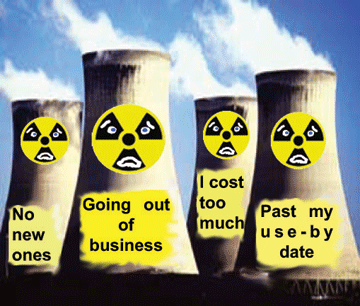 Nuclear power’s last chance in California?, San Diego Union Tribune The industry hopes for a new look, opponents still dug in By Rob Nikolewski . June 4, 2016
For critics who have long insisted that nuclear power is inherently dangerous and too expensive, the prospect of delivering a death blow to Diablo is something to relish.
“They try to get people to take a look at them ‘one more time’ just about every other year,” said Phillips. “We don’t consider (nuclear power) as a clean source of energy.”
Nuclear’s critics say the solution is boosting the storage of renewable sources like wind and solar.
The California Public Utilities Commission requires the state’s big three investor-owned utilities to add 1.3 gigawatts of energy storage to their grids by the end of the decade.
“The storage industry is just booming,” said Phillips, adding that greater energy efficiency and conservation can replace nuclear. “You can get to a point where you don’t need to create new, giant energy plants, new, big gas plants or new, big nuclear plants.”
For example, Diablo Canyon sucks in billions of gallons of seawater for its cooling system. Estimates to retrofit the plant to meet state rules implemented after Diablo Canyon was built range anywherefrom $1.6 billion to $14 billion.
“You cannot afford nuclear plants,” said Rochelle Becker, executive director of the Alliance for Nuclear Responsibility, based in San Luis Obispo, not far from Diablo Canyon. “If you look at the cost overruns from any new nuclear plant … they are billions of dollars over budget and years behind schedule.”
In Georgia, two brand new Westinghouse reactors being built at the Vogtle Generating Plant by Southern Co. were estimated to cost $14 billion.
The industry is trying to blunt criticism about costs by pointing to the growing — but still nascent — sector that concentrates on small, modular reactors, or SMRs, that can be transported by truck or rail…..
However, SMRs across the country are still in the design phase.
Waste issues won’t go away
A nagging issue remains: what to do with spent fuel.
With the federal government scrapping the proposed nuclear waste facility at Yucca Mountain in Nevada, spent fuel is being stored at various sites across the country on an indefinite basis.
On a practical level, the 1976 law has resulted in a moratorium on building nuclear plants in the state. No new facilities have been built in almost 40 years.
Exemptions were made for existing plants but with Yucca Mountain off the table, sites like Diablo Canyon and San Onofre have had to keep their waste on site, prompting worries and protests. The decommissioned plant at Rancho Seco stores 22 metric tons of uranium, costing $5 million a year.
“We may never be able to move these,” said Gary Headrick, co-founder of San Clemente Green, said in a March public meeting about the 3.6 million pounds of nuclear waste stored in casks at San Onofre.
“These canisters could start leaking before you could even get it out of here,” said Donna Gilmore, who writes a website sharply critical of San Onofre’s management……..http://www.sandiegouniontribune.com/news/2016/jun/04/calfiornia-nuclear-future/
Outlandish claims being made about ‘Hitler’s Secret Nuclear Bombs’
Nazi History Hunters Say Hitler’s Secret Nuclear Bombs Lie Under Thuringian Forest NBC News by ANDY ECKARDT, 5 June 16 ARNSTADT, Germany — They hunt for jewels and gold, the long-hidden plunder of Nazi lore. Now hobby historians in Germany believe they have an urgent case of potentially catastrophic proportions — secret nuclear bombs.
Deep inside the Thuringian Forest, 70-year-old Peter Lohr and two friends have been scanning the surface with “earth radar” and “geomagnetic” technology after one of Lohr’s companions found Allied aerial surveillance photos of what they believe is a Nazi storage facility.
“What did the Nazis really do here? There are so many unanswered questions,” said 67-year-old Walter Boegenhold, a local resident interested in military history who has heard stories about Hitler’s secret projects in the region since his teenage years.
The team’s initial surface scans produced colorful images of what appears to be bomb-shaped metal housing, which led Lohr and Boegenhold to partner with explosive ordnance disposal expert Ralf Ehmann, 60.
“After conducting geomagnetic scans and carefully looking at all the images, I believe that we have Fat Man bombs buried below the surface,” Ehmann told NBC News.
“Fat Man” was the name for the plutonium bomb dropped by U.S. planes on the Japanese city of Nagasaki in 1945. Ehmann believes a similar nuclear bomb was developed by the Nazis.
Local authorities, however, think that’s hogwash……….
the nuke hunters of Thuringia have vowed not to give up. They recently presented their findings in a formal letter to the governor of the eastern German state. http://www.nbcnews.com/news/world/nazi-loot-hunters-say-hitler-s-secret-nuclear-bombs-lie-n583186
Macau environmentalists warn on dangers for Taishan nuclear power plant
ENVIRONMENTALIST RAISES RED FLAGS ON NUCLEAR PLANT Macao Daily Times , MAY 31, 2016 – Sammie Lun, chairman of Green Environment Protection Association of Macau, is concerned about safety issues surrounding the upcoming Taishan nuclear power plant. The plant, located approximately 80 kilometers west of Macau, is currently under construction and has been surrounded by controversies….
Lun told the Times “I am personally totally against nuclear power plants.” Furthermore, he added that he maintains his opposition to the plant simply because of the pollution risks that are known to come with all nuclear power plants. “Even if the nuclear power plant is clean, if problems arise, they will be catastrophic, pollution will exist forever,” said Lun…..
Energy storage favours the renewable revolution, not outdated nuclear power
“…….Berkeley Energy Professor Daniel Kammen ably defended energy storage, ……. Energy storage is cost competitive already in some markets—unlike new nuclear, Kammen said, and its price is dropping on a steeper curve than the dramatic reductions seen in solar costs. Storage will be more effective in the decentralized energy grid that’s emerging, he continued, than nuclear could be.
“The dramatic ramp up in solar resulted in the dramatic realization that a diverse, decentralized system can provide the same critical features that we think about with a baseload highly centralized system,” said Kammen. “Not tomorrow, but in the time frame that we need it, it’s absolutely there.”….
Ball summarized: ”So the argument is that rather than having yesterday’s no-carbon technology, which is a very centralized big generation technology, you think the world now has tomorrow’s no-carbon technology, which looks like a ballet of lots of different sources ready to go.”
In addition to batteries, compressed air storage is cost competitive, Kammen said, and flywheel storage can deliver power in sub-milliseconds. And in time, electric cars, buses and other vehicles will be used as a storage resource, he said. That’s a strategy China is pursuing and that Kammen has suggested the rest of the world consider, not in the next five years, but a bit later as these technologies develop and proliferate.
Meanwhile, small modular nuclear reactors won’t be ready in time to meet the grid’s needs, he said, and conventional reactors are too expensive.
“If you want to bet on a robust-basic-research to an applied-research-deployment category,” Kammen said, “that far favors the storage revolution than it does the nuclear revolution.”…… Silicon Valley Energy Summit , Forbes 5 June 16
Finland’s Fennovoima nuclear station dependent on Russia for all the finance
“……the extraordinary problems at Olkiluoto have cast doubts over Finland’s ability to manage such projects, while Fennovoima was hit by a farcical hunt for European investors for Hanhikivi.
Worries about Russian involvement almost brought down the previous Finnish coalition government. The Green party left the administration, accusing its former partners, some of whom are still in power, of pursuing a policy of “Finlandisation” — an extremely loaded term locally meaning the accommodation of Russian views in Finnish policy. …..
The deal is also of huge importance to Rosatom and its international ambitions to play a leading role in any revival of nuclear power outside the former Soviet Union…..” Finland raises its bet on nuclear power, Ft.com 5 June 16
Stop Taxpayer Funded Nuclear Backdoor Deal – Petition for Monday European Commission Meeting

From Bankwatch.org:
“Nuclear financing through the backdoor
The movement for a nuclear-free Europe is gaining momentum, and we need your support – will you add your voice to the groundswell and help power down dangerous reactors?
We’re partnering with friends at WeMove to petition the European Commission to drop a backdoor deal that could enable more public money for dangerous nukes. Let’s make clear we don’t agree to pay for a dangerous technology.
SIGN THE PETITION NOW
https://act.wemove.eu/campaigns/nuclear-subsidies
On Monday energy ministers will meet in Luxembourg to discuss a proposal that could pave the way for our taxpayer money to be diverted away from clean energy sources towards a nuclear future for Europe.
These types of plans are an example of the thinking that has kept the outdated reactor fleet in Ukraine on life support. And plans to give old nuclear reactors a new lease on life exist…
View original post 192 more words
1 This Month

Chernobyl: The Lost Tapes – A good documentary on Chernobyl on SBS available On Demand for the next 3 weeks– https://www.sbs.com.au/ondemand/tv-program/chernobyl-the-lost-tapes/2352741955560

of the week–London Campaign for Nuclear Disarmament

Tell the Ukrainian Government to Drop Prosecution of Peace Activist Yurii Sheliazhenko
To see nuclear-related stories in greater depth and intensity – go to https://nuclearinformation.wordpress.com
-
Archives
- April 2026 (189)
- March 2026 (251)
- February 2026 (268)
- January 2026 (308)
- December 2025 (358)
- November 2025 (359)
- October 2025 (376)
- September 2025 (257)
- August 2025 (319)
- July 2025 (230)
- June 2025 (348)
- May 2025 (261)
-
Categories
- 1
- 1 NUCLEAR ISSUES
- business and costs
- climate change
- culture and arts
- ENERGY
- environment
- health
- history
- indigenous issues
- Legal
- marketing of nuclear
- media
- opposition to nuclear
- PERSONAL STORIES
- politics
- politics international
- Religion and ethics
- safety
- secrets,lies and civil liberties
- spinbuster
- technology
- Uranium
- wastes
- weapons and war
- Women
- 2 WORLD
- ACTION
- AFRICA
- Atrocities
- AUSTRALIA
- Christina's notes
- Christina's themes
- culture and arts
- Events
- Fuk 2022
- Fuk 2023
- Fukushima 2017
- Fukushima 2018
- fukushima 2019
- Fukushima 2020
- Fukushima 2021
- general
- global warming
- Humour (God we need it)
- Nuclear
- RARE EARTHS
- Reference
- resources – print
- Resources -audiovicual
- Weekly Newsletter
- World
- World Nuclear
- YouTube
-
RSS
Entries RSS
Comments RSS
 nuclear-news