Radioactive material at popular UK beach near Sizewell nuclear station
 NUCLEAR LEAK ALERT Traces of radioactive material found at seaside beauty spot near decommissioned nuclear site Suffolk’s Southwold beach is the second to be hit by contamination in two months, The Sun UK BY CHARLIE PARKER 17th June 2016
The contamination on the idyllic Southwold beach is feared to be linked to the Sizewell A nuclear plant, which is located on coast not far from the popular seaside spot.
The nuclear factory is in the process of being decommissioned at a cost of £1.2 billion after shutting down ten years ago.
The coastal spot is nicknamed Hampstead-on-Sea because of the all the celebrities who flock there for the holidays.
Chris Evans, Dame Judi Dench and Stephen Fry and other big names regularly visit the beach spot.
Alarmingly, Southwold is the second Suffolk beach to be hit by the contamination in just two months.
In April, scientists monitoring the area around Sizewell revealed that a ‘small amount’ of an particularly dangerous and ‘unusual’ radioactive isotope had been found at Aldeburgh, eighteen miles from Southwold.
The Sizewell plant, which houses two outdated magnox nuclear reactors, is on the coast between the two resorts.
The Environment Agency insisted today that there are ‘no safety or environmental concerns and no risk to members of the public’……
Sizewell A is in the midst of its own investigations over the discovery of Strontium-90, produced by nuclear fission, at Aldeburgh beach – one of five coastal areas monitored by the site…….
Sizewell A power station was shut down on 31 December 2006, with the Nuclear Decommissioning Authority placing the contracts at a budgeted cost of £1.2 billion.
On 7 January 2007 a contractor working on the decommissioning of the station noticed water leaking on to the floor of the laundry where he was washing his clothes……..
The water was found to be cooling water from the pond that holds the reactor’s spent nuclear fuel which had dropped more than 1 foot (0.30 m) without activating any of the alarms.
It was feared that up to 40,000 gallons (151,500 litres) of radioactive water had leaked from a 15ft (4.6 m) split in a pipe, with some spilling into the North Sea where it could wash along the Suffolk coast.
Had the exposed irradiated fuel had caught fire, it would have resulted in the release of radiation into the air.
Southwold is popular with holidaymakers – the town’s populations is typically less than 2,000 but this figure swells to almost 10,000 in summer………https://www.thesun.co.uk/news/1298270/traces-of-radioactive-material-found-at-seaside-beauty-spot-near-decommissioned-nuclear-site/
US govt funding universities for nuclear power development
 USU engineering faculty receive $5.8 million in nuclear energy research grants Award is largest of nationwide Nuclear Energy University Program grants
UTAH STATE UNIVERSITY LOGAN, UTAH – Two professors of mechanical engineering at Utah State University will receive grants from the U.S. Department of Energy totaling $5.8 million for nuclear energy research. The news came in a Tuesday announcement from DOE officials who awarded more than $35 million to 48 university-led nuclear research and development projects around the country through the Nuclear Energy University Program, or NEUP…….http://www.eurekalert.org/pub_releases/2016-06/usu-uef061616.php
Japan Lawmaker Denies Pressuring TEPCO Not to Say ‘Meltdown’

Yasuhisa Tanaka, center, chairman of an outside investigation team appointed by the operator of Japan’s damaged Fukushima nuclear plant, speaks during a press conference in Tokyo Thursday. Two other lawyers of the team are: Zenzo Sasaki, left, and Toshiki Nagasaki.
A Japanese opposition leader who was a senior official during the 2011 Fukushima nuclear plant crisis denied Friday that he or the prime minister at the time pressured the president of Tokyo Electric Power Co. not to use the term “meltdown.”
Democratic Party Secretary-General Yukio Edano called a special news conference to refute a finding in a new report that then-TEPCO President Masataka Shimizu apparently came under political pressure not to use the word. The report did not find direct evidence of that.
“The fact that I or then-Prime Minister (Naoto) Kan ordered or requested then-President Shimizu to avoid using the term ‘meltdown’ under any circumstance does not exist,” Edano said. He said the timing of the report was suspicious ahead of an Upper House election next month.
The report released Thursday by a team of three lawyers appointed by TEPCO found that an instruction from Shimizu to avoid using the term “meltdown” delayed full public disclosure of the status of the nuclear plant, which suffered three reactor meltdowns after a major earthquake and tsunami hit the northeastern Japanese coast on March 11, 2011.
The utility used the less serious phrase “core damage” for two months after the disaster.
TEPCO reported to authorities three days after the tsunami that the damage, based on a computer simulation, involved 25 to 55 percent of the fuel but did not say it constituted a “meltdown,” the report said. Yet the company’s internal manual defined a meltdown as damage to more than 5 percent of the fuel.
In May 2011, TEPCO finally used “meltdown” after another computer simulation showed fuel in one reactor had almost entirely melted and fallen to the bottom of the primary containment chamber, and that the two other reactor cores had melted significantly.
TEPCO has been accused of softening its language to cover up the seriousness of the disaster, though the investigation found TEPCO’s delayed acknowledgement did not break any law.
In the 70-page report, the lawyers said Shimizu instructed his deputy not to use the word “meltdown” during news conferences immediately after the crisis. TEPCO’s vice president at the time, Sakae Muto, used the phrase “possibility of meltdown” until March 14, 2011.
Video of a news conference that day shows a company official rushing over to Muto when he was about to respond to a question, showing him a memo and hissing into his ear, “The prime minister’s office says never to use this word.”
Yasuhisa Tanaka, the lawyer who headed the investigation, said interviews of 70 former and current TEPCO officials, including Muto and Shimizu, showed that Muto had planned to use the word “meltdown” until he saw the memo, which has not been found.
“Mr. Shimizu’s understanding was the term ‘meltdown’ could not be used without permission from the prime minister’s office,” Tanaka said at a news conference at TEPCO headquarters. “The notion that the word should be avoided was shared company-wide. But we don’t believe it was a cover-up.”
Edano criticized the report as “inadequate and unilateral,” and said the team didn’t talk to him or Kan.
Tanaka said his investigation, which did not interview any government officials, could not track down what exactly happened between Shimizu and the prime minister’s office.
The Nuclear and Industrial Safety Agency, Japan’s nuclear regulatory unit at the time, was also reluctant to use the word. Two spokesmen were replaced between March 12 and 13, 2011, after suggesting meltdowns had occurred.
TEPCO has said the delay in confirming the meltdowns didn’t affect the company’s response to the emergency.
The issue surfaced earlier this year in a separate investigation in which TEPCO acknowledged that a company manual had been overlooked, reversing its earlier position that it had no internal criteria for a meltdown. TEPCO has eliminated the definition of a meltdown from the manual in revisions after the Fukushima disaster.
Russia Forces Bulgaria to Pay for Part of Unwanted Nuclear Power Station

The International Chamber of Commerce just ruled that Bulgaria’s state energy firm NEK must pay around 550 million euros ($620 million) to Russian State owned-controlled Atomstroyexport for equipment supposedly already produced for the cancelled Belene nuclear power project (See Reuters 16 Jun 2016). This is about 0.5% of Bulgaria’s GDP ($123.9 billion 2014 https://en.wikipedia.org/wiki/Economy_of_Bulgaria) And, it will eventually be paid for by the taxpayer. To complete the power station would have a cost estimated at 10 billion euros seven years ago or almost 10% of GDP.
What it probably really means is that Bulgaria’s being pushed to buy an updated Soviet VVER, possibly for Kozloduy instead of Belene. Russia had asked for $1.2 billion probably knowing that they would get half of what they asked for as a “compromise”. Russia is already leveraged into the “market” because now Bulgaria must decide what to do with whatever reactor parts Russia alleges…
View original post 2,460 more words
Seven climate records set so far in 2016 | Environment | The Guardian

GR.–When national emergencies arise, we expect our leaders to guide us to an effective response. The global-warming disaster illustrated in this article is thundering down upon us, but our leaders offer little guidance or, worse, they lie to obfuscate the emergency. I believe that this shows the venal weakness of our leaders and the lack of social intelligence of our people.
Adam Vaughan.–“From soaring temperatures in Alaska and India to Arctic sea ice melting and CO2 concentrations rising, this year is smashing records around the world”
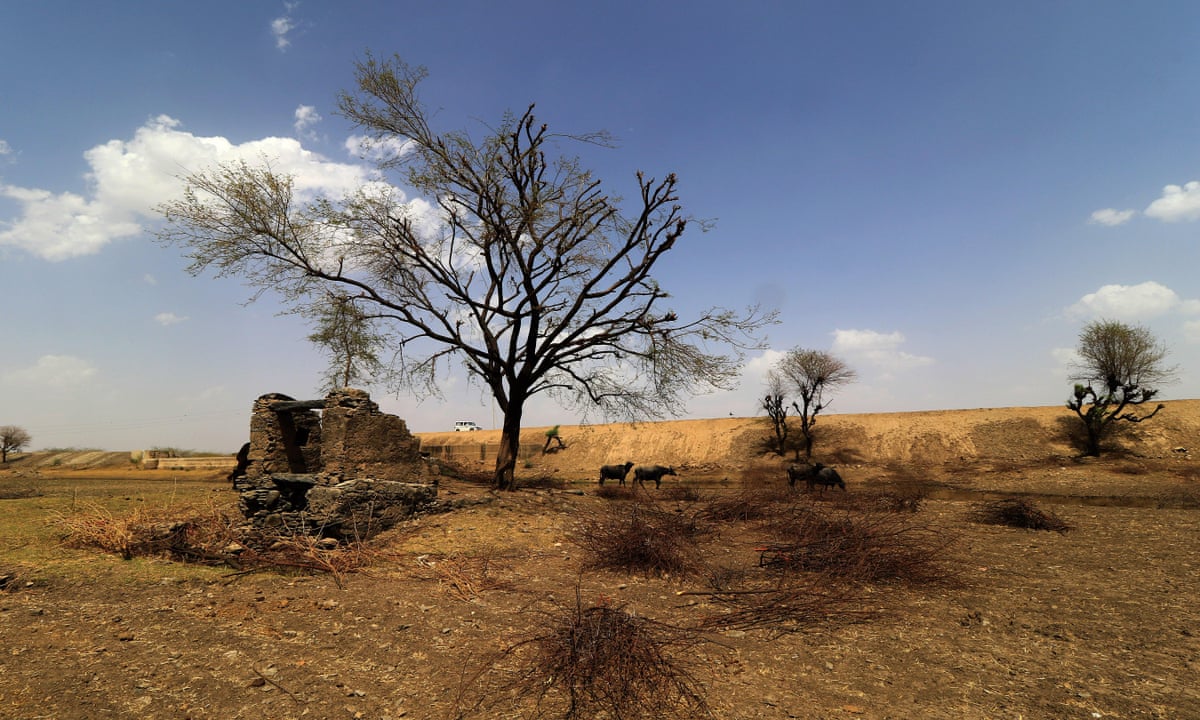 Scorched land on the outskirts of Jaipur, Rajasthan. The desert state recorded India’s hottest ever temperature of 51C on 19 May. Photograph: Alamy Stock Photo
“1) Arctic sea ice is melting at a rate that by September could see it beat the record low set in 2012. The maximum extent of sea ice in winter was at a record low, and the…
View original post 80 more words
13 state AGs pen letter calling for end to climate change probe | Fuel Fix
GR.–These public employees have chosen to aid the oil companies in their efforts to deceive the public. This action demonstrates the power of money over truth. Dump ’em!
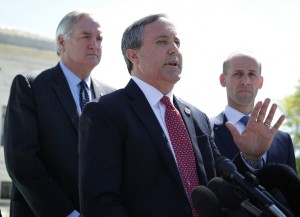 Texas Attorney General Kenneth Paxton, center, speaks to the media in Washington in April. (Photo by Alex Wong/Getty Images)
James Osborne.–“A campaign by Texas Attorney General Ken Paxton to end the investigation into ExxonMobil and other fossil fuel companies over false statements on climate change is gaining support among other state law enforcement officials.
“Attorneys general from 13 states signed an open letter Wednesday, arguing that climate change is a public policy debate, not a criminal matter, and urging law enforcement officials in other states to “stop policing viewpoints.”
“We all understand the need for a healthy environment, but we represent a wide range of viewpoints regarding the extent to which man contributes to climate change and the costs and…
View original post 63 more words
June 17 Energy News

World:
¶ Stockholm, the capital of Sweden, has announced it will divest from investments in coal, oil, and gas, following a one-and-a-half year citizen-led campaign. The city declared that it would withdraw investments in coal, oil, and gas companies, amounting to about $3.5 million. [CleanTechnica]
 Stockholm
¶ The Indian Ministry of New and Renewable Energy has floated a draft policy for large-scale development of geothermal power projects in the country. The policy calls for installed geothermal power capacity of 1 GW by 2022, which will then be increased to 10 GW by 2030. [Planetsave]
¶ The energy and climate change select committee has called on the UK government to split up National Grid to radically change the way power transmission and distribution is operated. Their inquiry report recommends transferring system operation from National Grid to a more distributed system. [reNews]
 T pylon (National Grid)
View original post 663 more words
Radioactive Dust Vacuumed in Iwaki House
Cs 137 4440 Bq/kg
Cs 134 718 Bq/kg
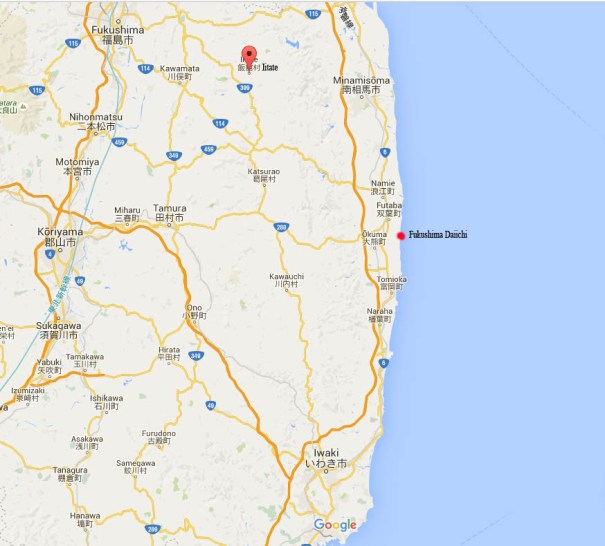
40,26 km from Fukushima Daiichi to Iwaki city

State to lift evacuation order for most of Fukushima village of Iitate from March 31
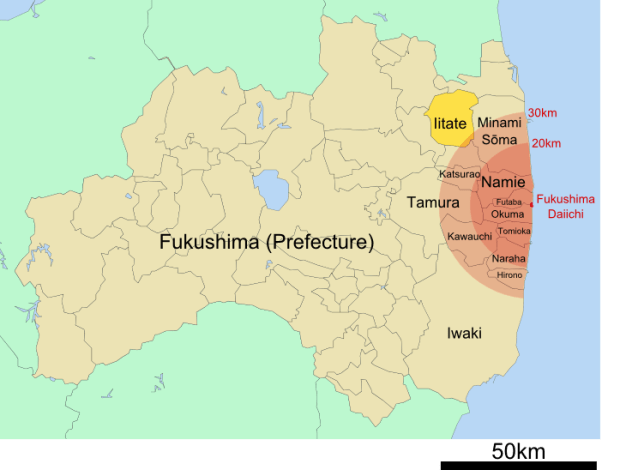
FUKUSHIMA – The central government has said it is considering plans to lift its evacuation order for most of the village of Iitate, Fukushima Prefecture, effective March 31.
The village is nearby the Fukushima No. 1 nuclear power plant, which experienced a meltdown disaster in 2011.
Yosuke Takagi, state minister of economy, trade and industry, conveyed the plan to Mayor Norio Kanno and other officials of the Fukushima Prefecture village at a meeting on Wednesday.
The government plans to make an official decision on the lifting shortly, along with a program to be launched in July to allow residents to stay overnight at their homes as part of preparations for permanent returns.
The evacuation order will be lifted for areas with less radiation from the three reactor meltdowns at the Tokyo Electric Power Co. Holdings Inc. plant, which was damaged in the March 2011 earthquake and tsunami.
As of the end of May, 5,917 residents in 1,770 households, or over 90 percent of the overall population of the village, were registered as citizens of such areas.
The government plans to finish decontamination work on houses by the end of this month and on farmland, roads and other facilities by the end of this year.
Visiting the village’s temporary office in the city of Fukushima on Wednesday, Takagi said the government aims to get the residents to return home by “resolving a series of challenges one by one.”
Kanno said, “We still have a long way to go and have to rebuild our village in a new form.”
The evacuation order will remain in place for highly contaminated areas, where 268 residents in 75 households are registered as local citizens.
DPJ leaders deny urging cover-up of Fukushima meltdown

Naomi Hirose, president of Tokyo Electric Power Co., speaks in Tokyo on June 16 after an investigation team released its report on the 2011 Fukushima nuclear disaster.
Former government leaders vehemently rejected suggestions in a report that they were pulling the strings behind a suspected meltdown cover-up when the Fukushima nuclear disaster was unfolding in 2011.
The report, compiled by an investigation panel commissioned by Tokyo Electric Power Co., operator of the crippled nuclear power plant, said Masataka Shimizu, who was TEPCO president at the time of the accident, instructed employees not to use the term “meltdown,” leading to a delay in the official announcement.
But the report also implied that Shimizu was acting on orders from high up in the government.
Yukio Edano, who was chief Cabinet secretary of the Democratic Party of Japan-led government when the Great East Japan Earthquake and tsunami triggered the nuclear crisis on March 11, 2011, described the report as preposterous.
“As far as I know, it is unthinkable for government officials back then to ask TEPCO to do such a thing,” Edano, now the secretary-general of the opposition Democratic Party, told reporters on June 16.
He accused the panel of merely skimming the surface of the matter and sidestepping the truth behind the instructions to avoid using the term “meltdown.”
“It is utterly irresponsible for the panel to say that it did not uncover that (Shimizu) was instructed by who and what,” he said.
The third-party panel of legal experts said in the report released on June 16 that it can be assumed that Shimizu understood that he was requested by the prime minister’s office to seek its approval beforehand if the company were to announce the “meltdown.”
The panel also said it would be difficult to conclude that TEPCO’s delay in declaring the meltdown was a “deliberate cover-up.”
“Since TEPCO released information on radiation levels inside the reactors and other related data at that time, just not using the term meltdown cannot be described as an act of a deliberate cover-up,” the panel said.
TEPCO declared the meltdown at three reactors at the Fukushima No. 1 plant in May 2011, two months after it occurred.
According to the report, Shimizu entered the chief Cabinet secretary’s office, which is located at the prime minister’s office building, by himself on March 13, 2011. The following day, Sakae Muto, vice president of TEPCO, explained the conditions of the reactors at the plant.
During the news conference, Shimizu handed a memo to Muto through a TEPCO public relations official, telling him not to use the word “meltdown” on the instructions of the prime minister’s office, according to the panel.
Naoto Kan, who was prime minister at the time of the disaster, denied giving the instruction to TEPCO.
“I myself have never given directions to TEPCO not to use the expression ‘meltdown,’” Kan, a member of the Democratic Party, said in a statement.
One reason for the lack of clarity in the report is that Shimizu, who was interviewed twice for a total of four hours, said, “I do not remember very well” with regard to who gave what instructions.
Another TEPCO employee interviewed by the panel said Shimizu “was under tremendous pressure and must not have a detailed recollection.”
The panel interviewed about 60 former and current TEPCO officials but no government officials and bureaucrats who were involved in dealing with the crisis.
“Our authority to investigate is limited, and it is difficult (to uncover the entire truth) in such a short time,” said Yasuhisa Tanaka, the lawyer who headed the investigation.
Tanaka and another panel member, Zenzo Sasaki, a former prosecutor at the Tokyo District Public Prosecutors Office, were also in charge of the third-party investigation into the accident conducted in 2013.
That investigation, based on interviews of TEPCO officials, came under fire for “only arbitrarily presenting TEPCO’s argument that is convenient to the company.”
The findings by the latest panel showed TEPCO officials looking into the nuclear disaster were aware of Shimizu’s order not to use “meltdown,” but TEPCO’s in-house investigation team did not include it in its report in 2012, apparently believing it was not significant enough to mention.
“TEPCO’s efforts to share information inside the company were insufficient,” Tanaka said. “It lacked consideration for local governments, which should have been top priority.”
The revelation that Shimizu ordered the avoidance of “meltdown” fueled feelings of distrust toward TEPCO among local governments hosting TEPCO nuclear power plants.
“We are still in this stage of the investigation even five years after the accident,” said Toshitsuna Watanabe, mayor of Okuma, which co-hosts the crippled Fukushima plant.
Hirohiko Izumida, governor of Niigata Prefecture, home to TEPCO’s Kashiwazaki-Kariwa nuclear power plant, called for a further investigation to reveal the whole picture of the Fukushima disaster.
“We need to step up efforts to uncover what has not been sufficiently investigated before,” he said. “TEPCO, as an organization, should make a sincere response without hiding anything.”
The latest panel was established in March at the request of the Niigata prefectural government’s technology committee, which aims to determine why TEPCO waited until May 2011 to announce the triple meltdown.
TEPCO initially said it did not have the criteria for defining and determining a meltdown.
But it announced in February this year that the company “found” an in-house manual that explained whether a meltdown was taking place.
TEPCO’s nuclear commercials draw disgust from evacuees

A TV commercial about the Kashiwazaki-Kariwa nuclear power plant (Provided by Tokyo Electric Power Co.)
The narration over uplifting music boasts of repeated safety drills and enhanced capabilities to judge and act in nuclear plant emergencies.
Workers in blue uniforms and hard hats appear, declaring: “We will devote our entire energy to drills so that we can deal with any circumstance.”
This TV commercial in Niigata Prefecture never fails to draw a look of disgust from a 41-year-old woman.
The woman and her two children, then aged 1 and 3, were forced to flee their home in Fukushima Prefecture to Niigata Prefecture after the 2011 triple meltdown at the Fukushima No. 1 nuclear power plant.
The crippled plant is operated by Tokyo Electric Power Co., the producer of that commercial.
“The mess caused by the nuclear accident has yet to be cleaned up,” she said. “There are still evacuees facing hardships because they have no prospects for the future. If TEPCO has money to use for commercials, it should use it to support the evacuees.”
TEPCO, in fact, created six different commercials for an advertising campaign that started in June last year. The commercials have been aired a total of 320 times a month on four private broadcasting stations based in Niigata Prefecture, according to the utility.
By promoting the safety of nuclear power through the commercials, TEPCO hopes to gain support for its plan to resume operations at some of the seven reactors of its now-idle Kashiwazaki-Kariwa nuclear power plant in the prefecture.
The commercials have drawn the opposite reaction from many of about 3,000 evacuees from Fukushima Prefecture who currently live in Niigata Prefecture.
In April this year, residents and evacuees in Niigata Prefecture visited TEPCO’s head office in Tokyo and submitted a letter of protest along with about 1,900 signatures. They demanded the company suspend the commercials and disclose the costs for the campaign.
Complaints have also been directed at Chubu Electric Power Co.’s TV commercials for nuclear power generation in Shizuoka Prefecture.
The company’s first post-3/11 commercial started airing on four private broadcasting stations in 2012, mainly explaining the company’s safety measures.
In July 2015, the utility began to air an eight-part series of commercials, in which employees working at a nuclear power plant appear with the lovely voice of a female vocalist in the background.
“In order to protect this place even at midnight,” and “We will engage in a drill again today” are among the captions shown in one part titled, “Nighttime training.”
After the Fukushima nuclear disaster unfolded, Nagoya-based Chubu Electric Power suspended all reactors at its Hamaoka nuclear power plant in Omaezaki, Shizuoka Prefecture, under the request of the then Democratic Party of Japan-led government headed by Prime Minister Naoto Kan.
The utility is preparing to resume operations at some of the Hamaoka reactors, despite anxieties about the safety of the nuclear plant. The plant has been described as the most dangerous in Japan, given its proximity to a long-expected huge earthquake off the prefecture.
In 2012, a civic group made a request to Shizuoka Governor Heita Kawakatsu to hold a referendum on whether the Hamaoka plant should be restarted.
The group also presented about 165,000 signatures.
“The commercials on nuclear power plants are a unilateral strategy to improve image they project,” Shigeki Nishihara, mayor of Makinohara, located next to Omaezaki, said. “It is necessary for Chubu Electric Power to repeatedly hold dialogue and discussions with the people who have anxieties and doubts about nuclear power plants in order to educate itself.”
Japan court rejects appeal, keeps ban on restarting 2 nuclear reactors
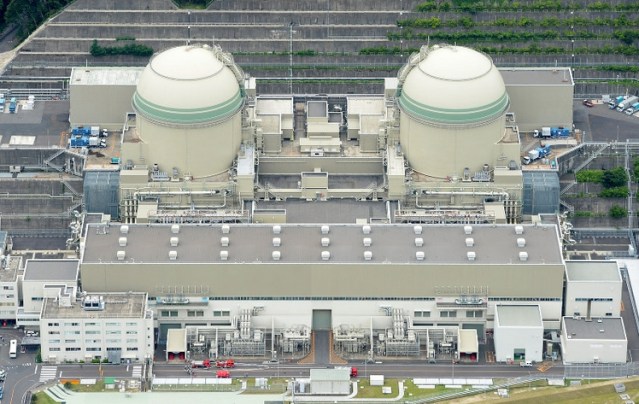
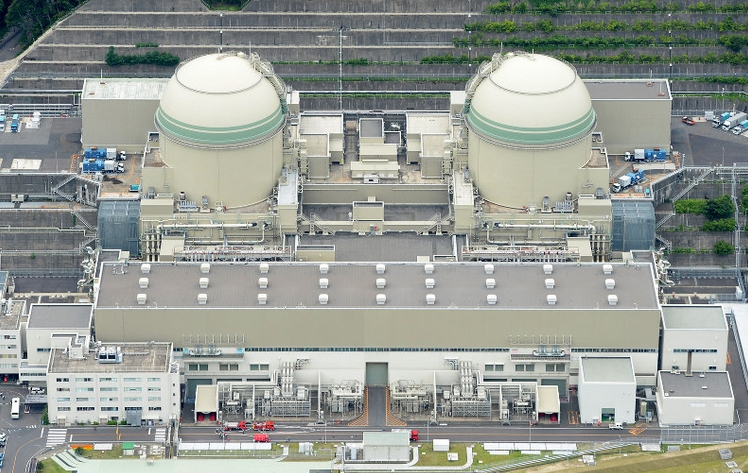
The No. 3 and No. 4 reactors at the Takahama Nuclear Power Plant, from left to right, are pictured in this photo taken from a Mainichi helicopter in Takahama, Fukui Prefecture, on June 15, 2016.
OTSU, Japan (Kyodo) — A Japanese court kept its ban on operation of two nuclear reactors at the Takahama power plant in Fukui Prefecture on Friday by rejecting the plant operator’s request to suspend an injunction it had issued over the reactivated reactors.
The Otsu District Court’s decision concerns the injunction issued in March over the Nos. 3 and 4 units at the Kansai Electric Power Co. plant that marked a major setback for the government’s push to ramp up nuclear power generation. Local residents had filed for the injunction on safety concerns.
In Friday’s decision, the court said it “cannot conclude that (the reactors) are safe, merely because they have met new regulatory standards on nuclear power plants.” New, more stringent safety rules were introduced in 2013 in the wake of the meltdowns at the Fukushima Daiichi nuclear power plant in 2011.
“Kansai Electric should at least explain how the regulations on operation and designs of nuclear power plants were toughened and how it responded to them,” the decision said.
The decision, issued under the same presiding judge, Yoshihiko Yamamoto, as the injunction in March, marks the final word on one process regarding the injunction because Kansai Electric cannot take further action on it.
The two reactors will remain offline as long as the injunction is not invalidated through a separate track examining an objection filed by Kansai Electric when the court issued the injunction. This track is also being presided over by the same judge.
The March 9 injunction was the first of its kind affecting operating reactors. One of the reactors was taken offline one day after the order. The other reactor was already offline.
The court said then there are “problematic points” in planned responses for major accidents and “questions” on tsunami countermeasures and evacuation planning, in light of the 2011 Fukushima disaster.
The Osaka-based utility subsequently sought to suspend the injunction, saying its safety measures are thoroughly proven and the court’s decision was scientifically and technologically groundless. It also said the suspension of the reactors has cost the company 300 million yen ($2.88 million) in losses daily.
The Takahama plant had cleared the post-Fukushima safety regulations in February last year, allowing Kansai Electric to reactivate the Nos. 3 and 4 reactors on Jan. 29 and Feb. 26, respectively. But their operations were beset with problems, with the No. 4 unit shutting down automatically due to a trouble just three days after it was rebooted.
The residents of Shiga Prefecture living within 70 kilometers of the four-reactor plant had filed the injunction as they worried about their safety in the event of a nuclear accident or disaster.
The plaintiffs argued that safety measures are insufficient and feared residents’ exposure to radiation in case of a severe accident.
A part of Shiga falls within a 30-kilometer radius of the plant, which is set by the central government as an evacuation preparedness zone.
http://mainichi.jp/english/articles/20160617/p2g/00m/0dm/039000c
Wrap up of week’s nuclear news
 CLIMATE. May Marks 8th Consecutive Record Hot Month in NASA’s Global Temperature Measure. Dozens of USA climate denial groups funded by biggest US coal company. Parts of Philippines May Submerge Due to Global Warming.
NUCLEAR. Nuclear disasters and “normalization” of contaminated areas
UKRAINE‘s very dangerous nuclear waste storage situation. The media ignored the fiasco of AREVA’s nuclear waste storage facility at Chernobyl.
INDIA. Nuclear marketers see India as a saviour of nuclear industry.
USA.
- Orlando gunman a security guard, for a firm that guards US nuclear sites.
- Donald Trump’s strange nuclear negotiating ideas.
- Former NATO Commander calls for nuclear negotiations with Russia.
- US Congress only just failed to pass law to defund a new nuclear cruise missile program.
- Watts Bar-2 nuclear reactor – 43 years to build – shut down after 2 days.
- Fort Calhoun nuclear plant too expensive to run.
- Entergy’s Pilgrim Nuclear Power Station – decrepit facility with radioactive waste problem.
- USA’s Pro Nuclear Energy Secretary Moniz announces $82 Million for Nuclear Energy Research.
- U.S. Court of Appeals rules nuclear waste can stay on indigenous land.
JAPAN. Fukushima: 173 Children Thyroid Cancers in Fukushima Prefecture Another evacuation order lifted. Tepco chief likely banned use of ‘meltdown’ under government pressure: report. Tepco to inject cement instead of frozen water wall. Japan report on Chernobyl disaster’s health effects to be publicly released.
SOUTH KOREA‘s nuclear waste dilemma: will have to build waste dump
RUSSIA. Government Against Rights Groups (Includes Environmental Groups). Russia’s powerful new nuclear icebreaker.
TAIWAN’s nuclear waste problem – sees overseas reprocessing as the answer.
IRAN. US agencies and prosecutors influence Europe’s banks to impede Iran nuclear deal. Time that USA government backed its Iran nuclear deal and promoted investment.
KUWAIT. Kuwaitis (KIA) Want Out of French State Owned Nuclear Group Areva
Ukraine’s very dangerous nuclear waste storage situation

 Nuclear waste stored in ‘shocking’ way 120 miles from Ukrainian front line, Guardian, Arthur Neslen, 13 May 2015, Experts raise concerns over waste stored in the open air at Europe’s largest nuclear power station, as the conflict increases Ukraine’s reliance on power from its ageing plants C
oncerns have been raised by environmentalists and atomic power experts over the way waste is being stored at Europe’s largest nuclear power station, in crisis-ridden Ukraine.
More than 3,000 spent nuclear fuel rods are kept inside metal casks within towering concrete containers in an open-air yard close to a perimeter fence at Zaporizhia, the Guardian discovered on a recent visit to the plant, which is 124 miles (200km) from the current front line.
“With a war around the corner, it is shocking that the spent fuel rod containers are standing under the open sky, with just a metal gate and some security guards waltzing up and down for protection,” said Patricia Lorenz, a Friends of the Earth nuclear spokeswoman who visited the plant on a fact-finding mission.
“I have never seen anything like it,” she added. “It is unheard of when, in Germany, interim storage operators have been ordered by the court to terror-proof their casks with roofs and reinforced walls.”
Industry experts said that ideally the waste store would have a secondary containment system such as a roof…….
Plant security at Zaporizhia is now at a ‘high readiness’ level, while air force protection and training exercises have been stepped up. Officials say that if fighting reaches the plant, there are plans for the closure of access roads and deployment of soldiers.
But they say that no containment design could take the stresses of military conflict into account. “Given the current state of warfare, I cannot say what could be done to completely protect installations from attack, except to build them on Mars,” Sergiy Bozhko, the chairman of the State Nuclear Regulatory Inspectorate of Ukraine (SNRIU) told the Guardian……
Antony Froggatt, a senior research fellow and European nuclear specialist at Chatham House agreed that a secondary containment system would offer greater protection from internal or external explosions.
“It is obvious that if you do not have an array of dry cast [interim] stores with secondary containment around it, then that will have a greater risk of release of radioactive material,” he said…..
Sources at the European Bank of Reconstruction and Development (EBRD) told the Guardian that any funding request from Ukraine for such a structure would be seriously considered. The bank has already made €300m available for nuclear lifetime extension programmes in Ukraine, before the regulators have even signed off on them.
We know about the weak links in the plant [security]… But I doubt that that these should be disclosed
A pall was cast over security arrangements at Zaporizhia last May when the plant was the scene of an armed confrontation between security guards and paramilitaries from the ultra-nationalist ‘right sector’, which is allied with neo-Nazi groups. The gunmen reportedly wanted to ‘protect’ the plant from pro-Russian forces, but were stopped by guards at a checkpoint…….
Westinghouse has lobbied the Ukrainian government at ministerial level to commit to buying their fuel for at least five reactors. Plant managers say that it will be used in Zaporizhia by 2017.
But local people in the reactor’s shadow say they fear the consequences of a patched up Soviet-era plant cranking up to generate electricity into the 2020s.
“History teaches us that history doesn’t teach us anything,” Ivanovic said. “Another catastrophe could happen again.” https://www.theguardian.com/environment/2015/may/06/nuclear-waste-stored-in-shocking-way-120-miles-from-ukraine-front-line
The media ignored the fiasco of AREVA’s nuclear waste storage facility at Chernobyl
 Areva’s Incredible Fiasco in Chernobyl http://journaldelenergie.com/nucleaire/arevas-incredible-fiasco-in-chernobyl/
Le 17 février 2016 par Martin Leers INVESTIGATION. The EPR reactor is not Areva’s first failure in the field of nuclear engineering. The French nuclear company was involved in another disgraceful fiasco in Chernobyl, which the press has not wasted any time exposing.
In the heart of the exclusion zone, just 2.5 kilometers from the ruins of Chernobyl’s reactor no. 4, lies a strange pile of concrete boxes, and two horizontal beams with multiple oval holes drilled into them extending for hundreds of meters. This unusual assemblage is called ISF2, which stands for “Interim Spent Fuel Storage Facility 2”. It is a nuclear waste storage facility, which Ukraine commissioned Areva to build. The French nuclear group made a major design error in the facility, which has rendered it inoperable. This facility, considered by the international community to be as vital to the nuclear safety of Chernobyl as the giant arch over the damaged reactor, is still not functioning to this day, largely because of Areva’s initial errors.
After the explosion of Chernobyl’s reactor no. 4, 29 years ago, the nuclear power plant, which housed three additional units, continued to operate for more than 14 years.[1] The dismantling of these three reactors and the management of their nuclear waste is the other major project for Chernobyl’s nuclear safety, concurrent with the giant arch meant to cover the “sarcophagus” of the ruined reactor.
Areva pledged to produce a « turnkey » installation where spent nuclear fuel from Chernobyl’s reactors no. 1, 2 and 3 would be stored for at least 100 years
In 1999, Areva’s branch devoted to nuclear reactors and engineering (Areva NP then Framatome) signed a contract with the Ukrainian government corporation Energoatom to build ISF2, a center for dry cask storage where the spent nuclear fuel from Chernobyl’s reactors no. 1, 2 and 3 would be stored for at least 100 years. This marked a first for storing fuel from Soviet-designed RBMK nuclear reactors.[2] Areva pledged to produce a « turnkey facility » by the Summer of 2005 and began construction in the Spring of 2000. This storage facility was financed mainly by 16 donor countries from a fund reserved for “urgent nuclear safety improvements” managed by the European Bank for Reconstruction and Development (EBRD), which also contributed to it. The European Union (EU) and nine EU member countries have been major contributors to this fund, which is separate from the fund earmarked for financing works on the containment of reactor no. 4. Continue reading
1 This Month

of the week – Shut Down Drone Warfare!


Tell the Ukrainian Government to Drop Prosecution of Peace Activist Yurii Sheliazhenko

Petition to revoke the licensing of the Near Surface Nuclear Disposal Facility (NSDF) at Chalk River. https://www.ourcommons.ca/petitions/en/Petition/Details?Petition=e-7247
To see nuclear-related stories in greater depth and intensity – go to https://nuclearinformation.wordpress.com
-
Archives
- April 2026 (114)
- March 2026 (251)
- February 2026 (268)
- January 2026 (308)
- December 2025 (358)
- November 2025 (359)
- October 2025 (376)
- September 2025 (257)
- August 2025 (319)
- July 2025 (230)
- June 2025 (348)
- May 2025 (261)
-
Categories
- 1
- 1 NUCLEAR ISSUES
- business and costs
- climate change
- culture and arts
- ENERGY
- environment
- health
- history
- indigenous issues
- Legal
- marketing of nuclear
- media
- opposition to nuclear
- PERSONAL STORIES
- politics
- politics international
- Religion and ethics
- safety
- secrets,lies and civil liberties
- spinbuster
- technology
- Uranium
- wastes
- weapons and war
- Women
- 2 WORLD
- ACTION
- AFRICA
- Atrocities
- AUSTRALIA
- Christina's notes
- Christina's themes
- culture and arts
- Events
- Fuk 2022
- Fuk 2023
- Fukushima 2017
- Fukushima 2018
- fukushima 2019
- Fukushima 2020
- Fukushima 2021
- general
- global warming
- Humour (God we need it)
- Nuclear
- RARE EARTHS
- Reference
- resources – print
- Resources -audiovicual
- Weekly Newsletter
- World
- World Nuclear
- YouTube
-
RSS
Entries RSS
Comments RSS
 nuclear-news