Lawyer Hiroyuki Kawai continues his lifelong fight to stop the nuclear industry
Lawyer continues 20-year campaign against nuclear power, Japan Today, By YURI KAGEYAMA and MARI YAMAGUCHI
NATIONAL APR. 08, 2016 TOKYO —
Lawyer Hiroyuki Kawai stands out in Japan, a nation dominated by somber dark suits: When not in a courtroom, he often wears colorful shirts and crystal-covered animal pins. He is a Noh dancer, a tenor and, of late, a filmmaker. His motorbike is a Harley.
Some of it is just for fun, but much of the flamboyance is meant to draw attention to his cause: shutting down all nuclear plants in Japan. His more than two-decade-long legal battle is gaining momentum after the multiple meltdowns in Fukushima five years ago led to all plants being idled for safety checks.
In March, Kawai helped set up an organization to support Fukushima residents whose children have developed thyroid cancer since the 2011 disaster — 166 among 380,000 people 18 years and under who were tested, including suspected cases. That’s up to 50 times higher than on average, according to Toshihide Tsuda, a professor at Okayama University.
The Japanese government denies any link, saying the increase reflects more rigorous screening. Thyroid cancer, rare among children at two or three in a million, soared after the 1986 Chernobyl nuclear disaster.
Also last month, Kawai’s team won a court injunction to stop two nuclear reactors in western Japan that had recently restarted. The district court cited concerns about safety, emergency planning and environmental contamination. One of the reactors was shut down shortly after its restart because of glitches. Both had met stricter standards upgraded after the 2011 disaster.
Kawai’s team is pursuing damage compensation for those evacuated from Fukushima, and criminal charges against former executives of Tokyo Electric Power Co., which operates the Fukushima plant. His ultimate goal is to banish nuclear power.
“If another nuclear accident ever happens in Japan, everything will be destroyed — turning upside down our politics, our economy, our education, our culture, our love, our law,” Kawai told The Associated Press, sitting at a desk overflowing with files and papers in his Tokyo office.
Born in 1944 in Manchuria, northeastern China, Kawaii has built a reputation as a champion of humanitarian causes, helping out Japanese abandoned as children in China after World War II, and Filipinos of Japanese descent in the Philippines. His compassion is driven partly by his own experience: A baby brother died of starvation during his family’s perilous journey back to Japan.
After graduating from prestigious Tokyo University, Kawai represented major corporations as a lawyer during the “bubble era” of the 1980s. In the mid-1990s he began taking on lawsuits against nuclear power.
Until 2011, he was fighting a losing battle………
“I think he is fantastic,” said Yurika Ayukawa, a professor of policy at Chiba University of Commerce. She attended at a recent screening where Kawai spoke and surprised the crowd by breaking into a song on Iitate, one of rural Fukushima’s most radiated areas.
Radiation is a sensitive issue in Japan, the only country to suffer atomic bomb attacks, and the Fukushima thyroid cancer patients and their families mostly have kept silent, fearing a social backlash. They face pressure from the hospital treating their children not to speak to media or to question the official view that the illnesses are unrelated to radiation.
Two of the patients’ families appeared recently with Kawai before reporters, although in a video-call with their faces not shown. They said they felt doubtful, afraid and isolated. Kawai believes they are entitled to compensation, though they have not yet filed a lawsuit.
George Fujita, an attorney who specializes in environmental issues, says Kawai is Japan’s top lawyer on nuclear lawsuits.
“It’s unusual for judges to watch a whole movie entered as evidence. It’s because the people are putting pressure on the courts,” he said.
Kawai admits that at times he been tempted to give up.
“I should never walk away. I must fight it out,” he said………..Online site for Kawai’s movie: http://www.nihontogenpatsu.com/english http://www.japantoday.com/category/national/view/lawyer-continues-20-year-campaign-against-nuclear-power
Renewable energy and new technologies undercutting price of nuclear power
Unable To Compete On Price, Nuclear Power On The Decline In The U.S. npr, 8 Apr 16 Renewable energy and new technologies that are making low-carbon power more reliable are growing rapidly in the U.S. Renewables are so cheap in some parts of the country that they’re undercutting the price of older sources of electricity such as nuclear power.
The impact has been significant on the nuclear industry, and a growing number of unprofitable reactors are shutting down……….
right from the start, people in the nuclear industry struggled with a big problem: cost. Making nuclear power cheap was the Holy Grail.
It never panned out. Nuclear plants keep coming in over-budget. And after the Fukushima disaster in Japan in 2011 — when three nuclear reactors melted down after an earthquake and tsunami hit — companies were forced to spend millions of dollars more on safety equipment to keep older plants operating.
“It would be very difficult for any company to make a decision to try to build a new nuclear plant,” says Mike Twomey, a spokesman for Entergy Nuclear,which runs nuclear power plants.Entergy has already taken one unprofitable reactor offline in Vermont and plans to close two more plants that are losing money in upstate New York and Massachusetts.
In all, 19 nuclear reactors are undergoing decommissioning, of which five have been shut down in the past decade, according to the U.S. Nuclear Regulatory Commission.
The main reason behind the wave of closures is a new generation of cheap, gas-fired power plants that has pushed the wholesale price of electricity into the basement.
But Mycle Schneider, a nuclear industry analyst, says nuclear also faces growing price pressure from wind and solar. Renewable energy is so cheap in some parts of the U.S. that it’s even undercutting coal and natural gas.
“We are seeing really a radical shift in the competitive markets which leave nuclear power pretty much out in the rain,” Schneider says……..
even within the nuclear industry itself, a growing number of experts agree that the U.S. has reached a pivot point, where new nuclear power plants are just too expensive.
“We think that the costs of new nuclear right now are not competitive with other zero-carbon technologies, renewables and storage that we see in the marketplace,” says Joe Dominguez, executive vice president for governmental and regulatory affairs and public policy at Exelon, a nuclear power company that has announced plans to close one of its existing reactors in New Jersey.
Three other plants that are losing money in Illinois and upstate New York are also being reviewed for possible closure, Dominguez says.
“Right now we just don’t have any plans on the board to build any new reactors,” he says.
Companies like Exelon and Entergy hope state governments will agree to subsidize their existing reactors…….http://www.npr.org/2016/04/07/473379564/unable-to-compete-on-price-nuclear-power-on-the-decline-in-the-u-s
Nuclear split between Clinton and Sanders
 New York nuclear plant’s future further divides Sanders and Clinton
Sanders says Indian Point facility is ‘a catastrophe waiting to happen’, but former New York senator says he’s late to the issue and site simply needs more oversight, Guardian, Alan Yuhas 8 Apr 16. The Indian Point Energy Center, a controversial and ageing nuclear plant near New York City, has split the Democratic presidential candidates .
As campaigning continued before the New York primary on 19 April, Bernie Sanders called the facility “a catastrophe waiting to happen”. Hillary Clinton said only that it needed more oversight.
A senior member of the Union of Concerned Scientists told the Guardian “the whole New York metropolitan area is potentially imperiled by an accident at Indian Point”.
Last week, the company that runs Indian Point revealed that 227 bolts holding the interior of a nuclear reactor at the site have “degraded” or gone missing. In February, the plant reported that a radioactive material, tritium, had leaked into groundwater.
The plant, about 40 miles north of midtown Manhattan on the eastern bank of the Hudson river, has a 40-year history of accidents, fires and complaints. Governor Andrew Cuomo ordered an investigation into February’s “unacceptable” leak. He has called for the plant to close.
“In my view, we cannot sit idly by and hope that the unthinkable will never happen,” Sanders said in a statement. “It makes no sense to me to continue to operate a decaying nuclear reactor within 25 miles of New York City where nearly 10 million people live.”
The Vermont senator elaborated on his stance, calling for the US to phase out nuclear plants along with more polluting resources such as fossil fuels.
“Nuclear power is and always has been a dangerous idea because there is no good way to store nuclear waste,” he said………
The disagreement between Sanders and Clinton mirrors their stances on fracking for natural gas. The senator has called for a ban, citing growing evidence that drilling causes earthquakes. The former secretary of state has called for intense regulation of the industry.
“I want the federal government to regulate much more toughly than we have in the past,” she said on Monday.
In 2014 Cuomo signed a law that banned fracking in New York. http://www.theguardian.com/environment/2016/apr/07/bernie-sanders-hillary-clinton-indian-point-nuclear-plant
Steam generator dropped at French reactor
04 April 2016 A used steam generator was dropped within the reactor building of unit 2 of the Paluel nuclear power plant in France, operator EDF has informed the country’s nuclear regulator. The plant is currently offline for a maintenance outage, including replacement of all four steam generators……..http://www.world-nuclear-news.org/RS-Steam-generator-dropped-at-French-reactor-0404165.html
Australian companies BHP Billiton and Wilson Security linked to Panama corruption papers
BHP Billiton And Wilson Security Linked To Panama Papers
04/04/2016. BHP Billiton, Wilson Security and a major electricity company in Australia are now targets of the Australian Tax Office, after leaked documents linked all three companies to a law firm in Panama and the British Virgin Islands.
http://www.huffingtonpost.com.au/2016/04/04/bhp-biliton-wilson-security-panama-papers_n_9607990.html
Panama Papers: Australian companies BHP, Wilson security caught up in tax probe
April 5, 2016. More than 800 wealthy Australians are being investigated by the Australian Taxation Office over their dealings with a secretive Panama-based law firm used by the rich to hide money.
BHP Billiton and a security firm that guards major government buildings are among hundreds of Australian names linked to a Panama law firm that helps the rich hide money. …
Four Corners claimed that BHP used Mossack Fonseca offices in the British Virgin Islands to register five companies linked to its aluminium, diamonds, steel and finance arms.
Panama Papers Update: Law Firm Mossack Fonseca Listed BHP Billiton’s Two British Virgin Islands Companies As ‘Mandatory High Risk’
April 4, 2016. Panama-based law firm Mossack Fonseca, which is at the center of a massive leak, assessed BHP Billiton Ltd.’s two companies in British Virgin Islands as “mandatory high risk” after the Anglo-Australian mining giant authorized the businesses to receive huge sums of money, the Guardian reported Monday. The exposé related to Mossack FonsecaSunday revealed widespread international corruption connected to offshore tax shelters.
The Panama Papers: BHP Billiton’s face-off with Mossack Fonseca
April 4, 2016. A financial representative for BHP Billiton threatened to fire notorious Panamanian law firm Mossack Fonseca if it went ahead with a due diligence investigation.
BHP-owned companies triggered ‘high risk’ alert at Panama law firm
April 4, 2016. Mossack Fonseca flagged concerns about two of mining giant’s companies in British Virgin Islands because ‘authorised capital is higher than the norm’
Panama Papers: ATO investigating more than 800 Australian clients of Mossack Fonseca
April 4, 2016. The Australian Taxation Office is investigating more than 800 high net wealth Australian clients of the controversial Panama law firm Mossack Fonseca, which is the focus of an unprecedented leak of tax haven records released globally.
More than 11.5 million documents have been leaked from Mossack Fonseca’s files, revealing the secrets of hundreds of thousands of clients – including several thousand Australians – covering a period over almost 40 years, from 1977 until as recently as last December.
The release of the documents on Monday follows a 12-month investigation by media groups including The Australian Financial Review, led by the International Consortium of Investigative Journalists (ICIJ) in Washington.
Australian companies, taxpayers exposed after Panama Papers leak
April 5, 2016. Australian companies BHP Billiton and Wilson Security are among those named in the massive document leak, detailing tax dealings of companies and people from around the world.
The cases are part of a leak of 11.5 million documents from Panama-based firm Mossack Fonseca, which reveals how the rich, including political leaders such as Russian President Vladimir Putin, hide their money.
Australian companies BHP Bilton and Wilson Security among those named in Panama papers leak exposing the use of offshore tax havens
- Australian Tax Office is investigating dealings of 800 high net individuals
- It follows massive leak of Panama papers from law firm Mossack Fonseca
- Secret documents show how law firm allegedly helped clients evade tax
- Treasurer Scott Morrison says government is cracking on tax avoidance
The Australian Taxation Office is investigating more than 800 Australians after a massive leak of financial data revealed how 12 current or former world leaders, a host of celebrities and the global rich are using offshore tax havens to hide their wealth.
Australian-linked organisations and business leaders named in the huge leaks include BHP Billiton, Wilson Security, Gold Coast based company director Ian Taylor, and Hong Kong’s richest man and Australian energy market owner Li Ka-Shing, ABC’s Four Corners reports.
April 8 Energy News

World:
¶ Britain will have too much electricity this summer due to the growth in wind and solar farms, National Grid has forecast. It could be forced to issue orders to power plants to switch off. Businesses will also be paid to shift their power demand to times when there is surplus electricity. [Telegraph.co.uk]
 National Grid said it was likely to have to pay wind farms to switch off at times of low power demand. Credit: Charlotte Graham/Rex
¶ Mercom Capital Group reported that corporate funding for the global solar sector has dropped to $2.8 billion in the first quarter of 2016, compared to $6.9 billion in the previous quarter. Residential and commercial solar funds for lease and Power Purchase Agreements remained strong. [CleanTechnica]
¶ Uruguay reduced power generation costs by 52% between 2013 and this year, saving $500 million at a time when demand for…
View original post 685 more words
The Panama files


The revelations from the Panama files of the law firmMossack Fonseca have been on the one hand shocking, yet on the other oh so predictable. It is a well known fact that a large chunk of the world’s capital exists in a sort of “dark matter” like state. We know its there, we can see its effects when the rich flaunt their wealth, but nobody can pin down where it is, so its widely assumed to be tied up in tax havens.
 Note the data above based on a 2008 estimate, actual numbers may be much higher now.
Details are sketchy, but the estimate is that between $11.5 trillion and $20 trillion dollars is squirrelled away in tax havens, about 15% to 25% of the entire net worth of the global economy. That equals (or exceeds) the annual economic output of China. Its estimated that…
View original post 1,266 more words
Massive amounts of radiation continue daily to enter Japan’s water and air, and the Pacific Ocean
Nuclear engineer Arnie Gundersen on Fukushima@5, Mar 7, 2016 (emphasis added): Massive amounts of radiation continue to enter Japan’s water and air, and the Pacific Ocean, daily… Due to its triple meltdowns and the unmitigable radioactive releases, Fukushima Daiichi will continue to bleed radiation into the Pacific Ocean for more than a century… There is no road map to follow with directions to stop the ongoing debacle…
Nuclear engineer Arnie Gundersen on KPFA, Mar 30, 2016: [Univ. of California] Berkeley’s nuclear program has been in the forefront of the pro-nuclear propaganda for decades, and since Fukushima has been aggressively downplaying the significance of it. So, whatever comes out of Berkeley, I just attribute to a very pro-nuclear faculty… [Woods Hole Oceanographic Institution is] measuring 1,000 miles offshore [of the US West Coast] and… picking up 10 becquerels per cubic meter [Bq/m3]. At my point, that’s when my alarm bells go off is 10 [Bq/m3]… That plume is still coming, the Pacific is a huge place and to think that a disaster on the opposite side of the world can be detected and begin to contaminate California, I think that the monumental shattering conclusion [is] radiation knows no borders… So this ‘dilution is the solution to pollution’ is what I think Berkeley believes in. What you can be sure of is that somebody’s going to die from the radiation that’s in the Pacific, but you just won’t know who it is – and they’re counting on that. The nuclear establishment is saying, ‘Well, we can smear that out in a broader epidemiological study.’
Nuclear engineer Arnie Gundersen on CCTV, Apr 5, 2016: We’re looking at newspaper coverage from the last couple of weeks and it’s clear that the plant continues to hemorrhage.
Fairewinds Japan Speaking Tour Series No. 1, Feb 12, 2016:
- Nuclear engineer Arnie Gundersen: [T]he Fukushima power plants… continues to bleed into the Pacific every day. But what no one is paying any attention to is that the entire mountain range that runs 100 miles up and down this coast is also contaminated. And as much radiation is pouring out… into the Pacific from the mountain range because it’s so contaminated, as from the Fukushima site… in fact, they’ve got an entire state pouring radiation into the Pacific. So what’s in the Pacific? Off of California, they’re finding radiation at what I would consider significant levels… in a cubic meter of ocean water, they’re finding 10 radioactive decays every second… So a cubic meter of water, if you’re in a dark room, would have 10 flashes of light every second, and that’s going to go on for 300 years. So we have contaminated the biggest source of water on the planet, and there’s no way to stop it.
- Maggie Gundersen, founder of Fairewinds: So are you saying that the contaminated water problem is hopeless? Is there nothing we can do to slow it down?
- Arnie Gundersen: It used to be that scientists believed dilution is the solution to pollution. But I think we’re finding with the biggest body of water on the planet, that you can’t dilute this stuff. And we’re going to begin to see this bio-accumulation, which is all the fish that are in the ocean are going to uptake the cesium and the strontium and become more and more and more radioactive…
Radioactivity at buried tank up in Daiichi plant

The operator of the crippled Fukushima Daiichi nuclear plant says the level of radioactivity near one underground wastewater tank at the plant is more than 100 times earlier readings.
Tokyo Electric Power Company says the tanks were built 3 years ago to store highly radioactive wastewater produced within the crippled plant. But all of the tanks soon went out of use due to repeated leaks of contaminated water.
The utility pumped most of the water out of them, but has been checking radioactivity levels of groundwater near the tanks.
On Wednesday, equipment detected 8,100 becquerels of beta-ray-emitting radioactive substances per liter of water. On Thursday, it went up to 9,300 becquerels.
A week ago, the level was only 87 becquerels.
TEPCO says it doesn’t know why the sharp rise took place. It says some highly radioactive water remains in the tank, but it is isolated with waterproof measures.
TEPCO says it will continue to analyze groundwater samples around the tank, and also compare them with data on the contaminated water left in part of the tank.
http://www3.nhk.or.jp/nhkworld/en/news/20160408_03/
Very pertinent comments and photos from Ray Masalas regarding the said “buried tank”:
I see the Japanese media is once again lying to protect Tepco. These were not tanks. They were in ground pools with sloped sides that were dug on site, lined with thin poly and filled with highly radioactive water. {See pic below} With a lining as thick as 2 garbage bags they leaked into the ground fast. Whether they transfered these tons of radioactive water to steel tanks or not, I’ll leave up to you to believe or not believe. At the same time they were building enclosed concrete ditches running down the west hill to sea. From the flyover footage I’d guess that there were about a dozen of these pits up on the west hill.

Sept 013. One of the “tanks” they spoke of.
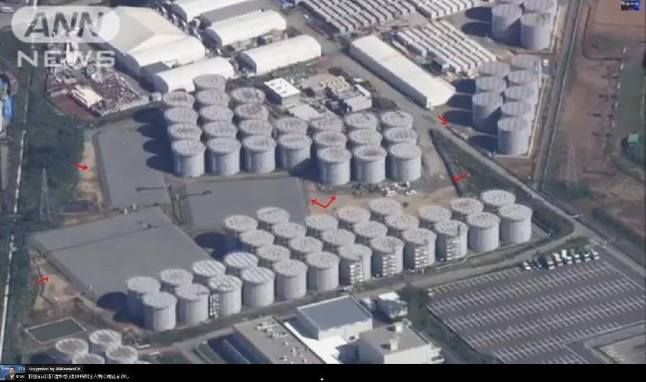
After they said that the transferred the radioactive water to steel tanks these empty pits magically got lids. My guess is that they dumped then refilled.

The enclosed concrete ditches running down to the sea were built at the same time. Dec 013
Children’s book connects stories of Fukushima and Chernobyl

A page from Shoko Nakazawa’s latest work depicts Natsuko about to part
with her pet piglet Momo.
Inspired by a letter sent to her by a young reader, author Shoko Nakazawa revived a past work and penned an entirely new illustrated children’s book on nuclear disasters in Fukushima and Chernobyl.
In 1988, Nakazawa’s “Ashita wa Hareta Sora no Shita de Bokutachi no Chernobyl” (Tomorrow, under a fair sky, our Chernobyl) was released by Choubunsha Publishing Co.
In the letter, a junior high school student in Yokohama who read the book after the triple meltdown at the Fukushima No. 1 nuclear power plant wanted to know how such an incident occurred when humans had surely learned of nuclear horrors from the Chernobyl accident in Ukraine in 1986.
The student asked what adults had done to prevent the Fukushima disaster. Because her 1988 book had long been out of print, Nakazawa, 63, first went about having it republished in summer 2011.
She also wrote a new work, recently published by Iwasaki Publishing Co., titled “Kobuta Monogatari Chernobyl kara Fukushima e” (A tale of piglets, from Chernobyl to Fukushima). The book sells for 1,300 yen, tax exclusive.
The two parts of the book involve little girls living in Chernobyl and Fukushima. Tanya lives in Chernobyl and has a pet piglet named Marumaru. Their peaceful life is turned upside down by the nuclear accident that forces all residents to evacuate.
Marumaru is left behind on the farm and time passes as the piglet waits for Tanya and her family to return. They never do.
The Fukushima portion involves a girl named Natsuko and her pet piglet Momo. They are also separated by the Fukushima nuclear accident.
A temporary lifting of the evacuation order allows Natsuko and her mother to return home. However, the mother does not recognize Momo, who is now filthy because no one was around to take care of the animal. The mother shooes the piglet away in a harsh voice.
The two parts of the book are connected because Natsuko’s mother had come to know Tanya when she visited Japan more than 20 years ago. Tanya even sent a letter to Natsuko’s mother in which she wrote, “Please do not forget us.”
During their short stay at home, the mother comes across that letter again and breaks down crying.
“I forgot everything.”
A key turning point in Nakazawa’s life was moving to Hiroshima from Nagoya before she entered junior high school. Most of her friends had parents who were hibakusha. Nakazawa herself was shocked when she saw the exhibit about the horrors of the atomic bombing at the Hiroshima Peace Memorial Museum.
She is concerned about recent moves to resume operations at nuclear power plants around Japan.
“We are once again trying to forget,” she said. “I hope the book becomes a catalyst to rethink a civilization that exists upon something like ‘nuclear power’ that simply cannot co-exist with humans and nature.”
How low can they go? Hansen, Shellenberger now shilling for Exelon

 Exelon’s Clinton reactor nearly bankrupted the small utility and rural co-ops that originally built it. Despite being bought for a few cents on the dollar by Exelon, it still isn’t economic and Exelon is “threatening” to close it. Photo by cryptome.org.
While some potential legal challenges remain, the approval of the Exelon-Pepco merger by the Washington, D.C. Public Service Commission means that Exelon is now not only the largest nuclear powered utility in the U.S., it is the largest electric utility period. And with that steady stream of regulated, and non-nuclear, Pepco money filling its coffers, you’d think that Exelon’s continuing “threats” to close up to three of its Illinois reactor sites unless it obtains more bailouts from beleaguered Illinois taxpayers and ratepayers would fall on deaf ears. Or maybe Exelon is now trying to achieve “too big to fail” status?
That Exelon’s “threats” to close these reactors are considered…
View original post 1,809 more words
USNRC: High High Radiation Condition at Browns Ferry Nuclear Power Station

They repeat “high high” twice, so it must not be a typo and must be or have been very bad.
Browns Ferry, USNRC:
“UNUSUAL EVENT DECLARED DUE TO MAIN STEAMLINE HIGH HIGH RADIATION CONDITION
At 1545 CDT on 04/06/16 Browns Ferry Unit 3 declared and exited the declaration of an unusual event due to a main steam line high high radiation condition. Power to Unit 3 was reduced to 91 percent power. The high radiation condition alarm cleared at 1526 CDT. Browns Ferry Unit 3 reported that the high radiation conditions were due to resin intrusion from the condensate demineralizers into the reactor and hydrogen water chemistry was a potential contributor to the event. The cause is still under investigation.
The NRC Resident Inspector has been notified.
State and Local notifications were made.
Notified DHS SWO, FEMA Ops Center, NICC Watch Officer, FEMA NWC and Nuclear SSA (email)
View original post 72 more words
NASA’s new sea level site puts climate change papers, data, and tools online

 NASA took the wraps off a new website on Monday dedicated to tracking global changes in the sea level. It’s packed full of free online resources that will..
Sourced through Scoop.it from: techcrunch.com
See on Scoop.it – GarryRogers Biosphere News
No planet for optimists: Coastal flooding may come sooner than we fear

When it comes to global warming, what else don’t we know? What science does know, and what it can infer from studying archeological records, already makes anybody who thinks the long-term habitability of Earth is more important than short-term profits very worried.
One detail that may have been under-appreciated is meltwater. Melting ice sheets, especially in Greenland and Antarctica, is well understood to raise the sea level. But the effects might not be simply the additional water added to the oceans. In this scenario, the melted freshwater will additionally increase warming, thereby creating a feedback loop that will accelerate the loss of polar ice sheets, thus accelerating the rate of sea-level rise. How fast? Fast enough that the sea level could rise “several meters,” possibly six to nine meters, in 50 to 150 years.
This sobering prediction of what might happen without a drastic reduction in greenhouse-gas emissions is the…
View original post 1,098 more words
April 7 Energy News
Opinion:
¶ Wind and solar are crushing fossil fuels • Recent auctions in Mexico and Morocco ended with winning bids that show solar and wind will soon be least expensive sources, worldwide, said Michael Liebreich, chairman of the advisory board for Bloomberg New Energy Finance. [Sydney Morning Herald]
 Investment in renewables is outpacing fossil fuel investment by a significant margin. Photo: Supplied
World:
¶ Since 2000, more than 20 countries have successfully curbed greenhouse gas emissions while boosting their gross domestic product, according to World Resources Institute analyst Nate Aden. No single trend has driven GDP-GHG decoupling across all countries. [CleanTechnica]
¶ After a seven-year delay, the New South Wales Government approved a wind farm project for the southern part of the state. Epuron Project’s $670 million project across the Harden and Yass Valley shires it will be around one-third of the size originally proposed in…
View original post 582 more words
1 This Month
Chernobyl: The Lost Tapes – A good documentary on Chernobyl on SBS available On Demand for the next 3 weeks– https://www.sbs.com.au/ondemand/tv-program/chernobyl-the-lost-tapes/2352741955560

of the week–London Campaign for Nuclear Disarmament

Tell the Ukrainian Government to Drop Prosecution of Peace Activist Yurii Sheliazhenko
To see nuclear-related stories in greater depth and intensity – go to https://nuclearinformation.wordpress.com
-
Archives
- April 2026 (114)
- March 2026 (251)
- February 2026 (268)
- January 2026 (308)
- December 2025 (358)
- November 2025 (359)
- October 2025 (376)
- September 2025 (257)
- August 2025 (319)
- July 2025 (230)
- June 2025 (348)
- May 2025 (261)
-
Categories
- 1
- 1 NUCLEAR ISSUES
- business and costs
- climate change
- culture and arts
- ENERGY
- environment
- health
- history
- indigenous issues
- Legal
- marketing of nuclear
- media
- opposition to nuclear
- PERSONAL STORIES
- politics
- politics international
- Religion and ethics
- safety
- secrets,lies and civil liberties
- spinbuster
- technology
- Uranium
- wastes
- weapons and war
- Women
- 2 WORLD
- ACTION
- AFRICA
- Atrocities
- AUSTRALIA
- Christina's notes
- Christina's themes
- culture and arts
- Events
- Fuk 2022
- Fuk 2023
- Fukushima 2017
- Fukushima 2018
- fukushima 2019
- Fukushima 2020
- Fukushima 2021
- general
- global warming
- Humour (God we need it)
- Nuclear
- RARE EARTHS
- Reference
- resources – print
- Resources -audiovicual
- Weekly Newsletter
- World
- World Nuclear
- YouTube
-
RSS
Entries RSS
Comments RSS
 nuclear-news