This is not the first time that India is facing safety issues regarding its nuclear program. In historical context one can generate a list of leaks, fires and structural damages that have been faced by India’s civilian nuclear power sector. There are abundant examples of oil leaks, hydrogen leaks, fires and high bearing vibrations which often shut down numbers of nuclear reactors in India.
Lack Of Nuclear Sanity In India Anaya ShahidMar 20 16, http://www.eurasiareview.com/19032016-lack-of-nuclear-sanity-in-india-oped/Ironically on March 14, 2011 after the Japan’s nuclear disaster, India was the first country to announce that Fukushima reactors were safe. Top officials of the Department of Atomic Energy (DAE) were of the view that Indian nuclear reactors will continue to work as they are safe and also claimed that what happened in Fukushima was not a “nuclear accident”.
S.K. Jain, the Chairman and Managing Director of Nuclear Power Corporation was propagating on Fukushima accident that, “There is no nuclear accident or incident in the Japan’s Fukushima plants. It is a well-planned emergency preparedness program which the nuclear operators of the Tokyo Electric Power company are carrying out to contain the residual heat after the plants had an automatic shutdown following a major earthquake.”
Now it is really scary that on the 5th anniversary of Fukushima, an emergency has been declared at the Kakrapar nuclear plant in Gujarat near Surat after a major heavy water leak in a nuclear reactor. The authorities are disseminating the situation by saying that all safety systems worked fine and the technicians has successfully been able to shut down the unit. The declaration of an on-site emergency and the fact that the heavy water leak affected the reactor’s cooling system, which also has high radioactivity, raises many questions on Indian nuclear expertise.
The Fukushima disaster forced Indian nuclear establishment to initiate a safety audit process and it was conducted within by NPCIL. After the extensive review, Indian auditor general informed that the nuclear program of the country is insecure and unregulated with many disorders. Furthermore the parliamentary report on nuclear safety regulation in India had pointed out serious organizational flaws and numerous failings relative to international norms.
When in opposition, the Bharatiya Janata Party was the major contrasting party to civil nuclear expansion and had strong reservations on limiting nuclear liability. It was also supporting the just protests in Kudankulam and wanted environmental clearance for Jaitapur nuclear power plants. Now in government, it has taken a complete U-turn and seeks to bring same old vine in new bottles. This year, Dr. A Gopalakrishnan labeled the Indian government plans punier than the existing regulatory framework and despite this the government is introducing the Nuclear Safety Regulatory Authority bill in Parliament.
This is not the first time that India is facing safety issues regarding its nuclear program. In historical context one can generate a list of leaks, fires and structural damages that have been faced by India’s civilian nuclear power sector. There are abundant examples of oil leaks, hydrogen leaks, fires and high bearing vibrations which often shut down numbers of nuclear reactors in India.
March 1991: Heavy water leak at Madras Atomic Power Station takes four days to clean up.
July 1991: A contracted laborer mistakenly paints the walls of Rajasthan Atomic Power Station (RAPS) with heavy water before applying a coat of whitewash.
December 1991: A leak from pipelines in the vicinity of CIRUS and Dhruva research reactors at the Bhabha Atomic Research Centre (BARC) in Trombay, Maharashtra, results in severe Cs-137 soil contamination of thousands of times the acceptable limit.
January 1992: Four tons of heavy water spilt at RAPS.
May 1992: Tube leak causes a radioactive release of 12 Curies of radioactivity from Tarapur Atomic Power Station.
March 1993: Two blades of the turbine in Narora Atomic Power Station’s (NAPS) Unit I break off, slicing through other blades and indirectly causing a raging fire, which catches onto leaked oil and spreads through the turbine building. The smoke sensors fail to detect the fire, which is only noticed once workers see the flames.
February 1994: Helium gas and heavy water leak in Unit 1 of RAPS. The plant is shut down until March 1997.
May 1994: The inner surface of the containment dome of Unit I of Kaiga Generating Stationcollapses (delaminates) while the plant is under construction.
March 1999: Somewhere between four and fourteen tons of heavy water leaks from the pipes at MAPS at Kalpakkam, Tamil Nadu, during a test process. The pipes have a history of cracks and vibration problems. Forty-two people are reportedly involved in mopping up the radioactive liquid.
April 2000: A leak of about seven tons of heavy water from the moderator system at NAPS Unit II.
November 2001: A leak of 1.4 tons of heavy water at the NAPS I reactor, resulting in one worker receiving an internal radiation dose of 18.49 mSv.
May 2002: Tritiated water leaks from a downgraded heavy water storage tank at the tank farm of RAPS 1&2 into a common dyke area.
January 2003: The failure of a valve in the Kalpakkam Atomic Reprocessing Plant in Tamil Nadu results in the release of high-level waste, exposing six workers to high doses of radiation.
April 2003: Six tons leak of heavy water at reactor II of the NAPS in Uttar Pradesh.
November 2009: Fifty-five employees consumed radioactive material after tritiated water finds its way into the drinking water cooler in Kaiga Generating Station.
April 2011: Fire alarms blare in the control room of the Kaiga Generating Station in Karnataka.
India’s nuclear establishment is hasting for nuclear energy though it has obstinately missed targets and delivered a portion of the promised electricity with uncertain safety. The Indian government is irrationally pursuing for nuclear power without explaining its destructive potential and answering critiques. Nowadays, the U.S. and major powers are trying to “normalize” India’s nuclear weapons through special waivers and numerous nuclear deals. Therefore, France is using such normalizing strategy to bargain for cash-strapped Areva. Meanwhile, its complement is the disaster-in-waiting called Jaitapur. The secrecy shrouded to Indian nuclear program has subjugated its energy policy and budgets to an unaccountable, self-propagating, pampered technocracy and degrading their democracy.
*Anaya Shahid graduated from Defense & Diplomatic Studies, Fatima Jinnah Women University Rawalpindi.
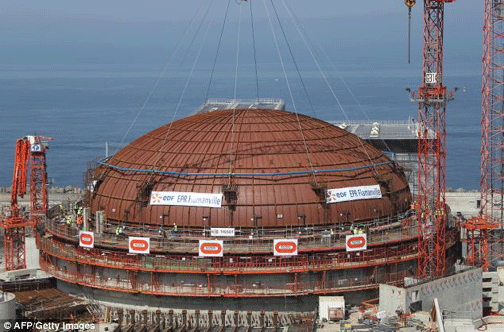
EDF’s French nuclear plant faces years of further delay,Ft.com, 20 Mar 16EDF’s new nuclear power station in France faces years of further delays if tests confirm that the steel used in its reactor is flawed, the country’s atomic watchdog has warned.
It is one of the clearest signals to date of the scale of the setback faced by the French utility. The flagship plant at Flamanville in Normandy has already been subject to years of delays and cost overruns, which have made it difficult for EDF to fund the identically designed £18bn reactor at Hinkley Point in the UK — a key element in Britain’s energy strategy.
Initially, Flamanville was expected to cost €3.3bn and start operations in 2012 — it is now planned to start in 2018 at a cost of €10.5bn.
But Julien Collet, the deputy director of France’s Nuclear Safety Authority, has said that it could be delayed further by several years, depending on the results of tests started last year and due to end this summer on the steel being used in the reactor core.
If the steel fails the tests, regulators could order EDF to rip out and replace the top and bottom of the reactor vessel. Mr Collet told the Financial Times: “It takes a lot of time to build new components like this — we’re talking years.”
The difficulties EDF is having with the steel at Flamanville have been caused by problems with the process of cooling and cutting a 450-tonne ingot of steel, which created an area the size of a dinner plate that was slightly more brittle than it should have been.
Areva, the French nuclear company in whose reactor business EDF is due to take a controlling stake, is working with regulators to test an identical piece to determine if it could lead to weakness in the reactor vessel.
The problem was discovered in late 2014 but EDF opted to push ahead with construction, potentially making it much more difficult to replace the faulty steel if needed……..
having agreed to fund 66.5 per cent of the [UK’s Hinkley Point C nuclear] project last year, EDF has delayed giving it final approval, with some at the top of the company arguing more investors should be brought in first.
Risk of nuclear war in Europe growing, warns Russian ex-minister, Reuters, BRUSSELS | BY ROBIN EMMOTT, 20 Mar 16, The East-West standoff over the Ukraine crisis has brought the threat of nuclear war in Europe closer than at any time since the 1980s, a former Russian foreign minister warned on Saturday.
“The risk of confrontation with the use of nuclear weapons in Europe is higher than in the 1980s,” said Igor Ivanov, Russia’s foreign minister from 1998 to 2004 and now head of a Moscow-based think-tank founded by the Russian government.
While Russia and the United States have cut their nuclear arsenals, the pace is slowing. As of January 2015, they had just over 7,000 nuclear warheads each, about 90 percent of world stocks, according to the Stockholm International Peace Research Institute.
“We have less nuclear warheads, but the risk of them being used is growing,” Ivanov said at a Brussels event with the foreign ministers of Ukraine and Poland and a U.S. lawmaker.
NATO’s secretary general Jens Stoltenberg has warned Russia of intimidating its neighbors with talk about nuclear weapons, publicly voicing concerns among Western officials.
MISSILE DEFENSE
Ivanov blamed a missile defense shield that the United States is setting up in Europe for raising the stakes. Part of that shield involves a site in Poland that is due to be operational in 2018. This is particularly sensitive for Moscow because it brings U.S. capabilities close to its border………http://www.reuters.com/article/us-ukraine-crisis-russia-idUSKCN0WL0EV
Environmentalists try to block nuclear growth in Texas, Victoria Advocate By Sara Sneath March 19, 2016 WADSWORTH – One of the largest nuclear power facilities in North America is set to double in size.
The Nuclear Regulatory Commission recently gave the South Texas Project the green light to build two new reactors at its plant between Bay City and Palacios. The company is holding off on building the reactors because of low natural gas prices and a lack of demand for new energy in Texas.
But state environmental groups want the company’s licenses yanked. They say the licenses violate the Atomic Energy Act, which prohibits foreign control or domination of a U.S. nuclear project.
The reason why foreign countries are not allowed to control a U.S. nuclear power plant is to ensure that the country’s power supply cannot be held hostage by a country that could become an enemy in the future, said Tom “Smitty” Smith, the director of the Public Citizen’s Texas office……
Robert Eye, an attorney representing Public Citizen, the Sustainable Energy and Economic Development Coalition and the South Texas Association for Responsible Energy, said Toshiba has been fully funding the pre-licensing proceedings for the new reactors since 2011.
Useless radiation tools installed for evacuations near Kagoshima plant THE ASAHI SHIMBUN, 20 Mar 16,
Nearly half of the radiation monitoring posts installed for issuing evacuation orders around the Sendai nuclear plant in Kagoshima Prefecture are actually useless for that purpose, The Asahi Shimbun has learned.
In the event of a nuclear accident, evacuation orders are issued immediately when airborne radiation levels reach 500 microsieverts per hour. But 22 of the 48 monitoring posts around the Sendai plant can only measure radiation levels up to 80 microsieverts per hour, according to a survey on the equipment……..http://ajw.asahi.com/article/behind_news/social_affairs/AJ201603140026
Xcel Energy faces more big investments to keep its nuclear units running Xcel faces $487 million in upgrades at its Prairie Island facility by 2020 By David Shaffer Star Tribune MARCH 19, 2016
The high cost of upgrading 40-year-old nuclear reactors is confronting Xcel Energy again.
Investments in the Prairie Island nuclear power plant in Red Wing, Minn., are projected to cost more than expected — $487 million by 2
20, with more spending needed in the next decade.
It’s not a replay of cost overruns at Xcel’s other reactor in Monticello, Minn. That 2013 surprise, which state regulators blamed on imprudent management, led Xcel to write off $125 million last year………
in a fresh surprise, Xcel also has offered to study shutting down Prairie Island years before the reactors’ operating licenses expire in 2033-34. Xcel isn’t pushing early retirement, which would accelerate the costly job of decommissioning. It’s an option being presented to the Minnesota Public Utilities Commission, which regulates Xcel’s rates and investments.
Two nuclear plants, including one in Wisconsin, have shut down for economic reasons since 2013. Four other nuclear plants in other states face similar challenges and are slated to close by 2019.
Even if Xcel retires its Prairie Island units in the 2020s, the Minneapolis-based utility said significant investment is needed just to keep them operating for a few years. One of the plant’s two generators is the original unit, and is to be replaced in 2018 if not sooner. Four cooling towers also need refurbishment or replacement, as do dozens of decades-old pumps, motors and controls, the utility said…….. the near-term investment in the Prairie Island plant isn’t the end of the story. Xcel said another $600 million to $900 million in additional work likely will be needed at Prairie Island in the 2020s………http://www.startribune.com/xcel-energy-faces-more-big-investments-to-keep-its-nuclear-units-running/372610701/
Japan says India’s nuclear MoU “legally binding” THE HINDU, KALLOL BHATTACHERJEE 20 Mar 16Nuclear experts describe the MoU as a backdoor attempt to draw India into the NPT
Days before Prime Minister Narendra Modi’s visit to Washington DC for the Nuclear Security Summit, a senior Japanese diplomat told The Hindu that India had committed to adhere to the “control of nuclear material, traceability [of nuclear fuel] and consequence in case of a nuclear accident” under the memorandum of understanding (MoU) on civil nuclear cooperation with Japan signed during Prime Minister Shinzo Abe’s visit to India in 2015.
Intrusive, feel experts
Though the bilateral agreement leaves out India’s military nuclear programme, experts warn that the agreed principles impinge on India’s independent nuclear programme as they imply intrusive inspection of civilian nuclear reactors as warranted under the Nuclear Non-proliferation Treaty (NPT).
The Japanese diplomat pointed out that so far, the world had to rely on India’s verbal commitments on nuclear non-proliferation, but the India-Japan MoU marked the first occasion when India came under legal obligation to uphold non-proliferation concerns.
“There were no tools to bind India, only India’s voluntary self-claimed policy existed, but now there is legally binding measures by the agreement between India and Japan,” said the diplomat, explaining that the commitments were proof of India’s peaceful and transparent intentions in using nuclear reactors solely for energy generation. He said India will be financially accountable if it is found to be violating the principles.
An Indian official who has been associated with the negotiations said the principles being cited by the Japanese were nothing extraordinary and were part of the “standard template for civil nuclear deal” that India had signed with several countries. However, he refused to address the Japanese assertion that India would have to financially compensate Japan if it violated the principles……..http://www.thehindu.com/news/national/japan-says-indias-nuclear-mou-legally-binding/article8377976.ece
Degussa took over the Auergesellschaft (Auer werke) in 1934. In 1939 Russian born Nikolaus Riehl, after reading a paper on the potential use of uranium for nuclear energy, approached the Nazi Army Ordnance office with the idea. With a Russian mother and German father one wonders if, after World War II, he did willingly go back with the Russians and work on their nuclear project for a decade before returning to Germany. CIA research from the period say that he volunteered. Pretending that he was forced appears a re-writing of history by him and/or the West German government to excuse his return from Russia. His colleague under the Nazis and Russians, Günter Wirths, also returned to Germany and formed Nukem, itself a co-founder of URENCO. Nukem bragged in 1985 that they went back to 1940, calling it their 25th anniversary! It is easy to suspect that Riehl and/or Wirths may…
¶ The Spanish utility company Endesa purchased 410 GWh of solar electricity, during a recent solar energy auction for Portugal and Spain, at a price of €39.6/MWh ($43.82/MWh). The quarterly auctions relate to roughly 500 GWh of generation, varying at the various times of year. [CleanTechnica]
(This is extremely important. In this case, the wholesale price of unsubsidized solar power has fallen below to 4.4¢/kWh. Even with the price of battery storage added, it competes with electricity from natural gas at a time when the price of gas fuel is low.)
PVs in El Paso, La Palma, Spain. Photo by Rufus46. CC BY-SA 3.0 unported. Wikimedia Commons.
¶ The province of Jujuy in Argentina will develop 700 MW of solar PV projects with the German company Photovoltaic Park, following the signing of letter of intent between the two. Three different projects, in different parts of the province, and will…
¶ Dispelling the nuclear ‘baseload’ myth: nothing renewables can’t do better! • The main claim used to justify nuclear is that it’s the only low carbon power source that can supply ‘reliable, base-load electricity. But renewables can match grid demand continuously in a way nuclear power cannot. [RenewEconomy]
Wind farm in Mecklenburg-Vorpommern. The state runs on 100% renewable energy. Photo: Clemens v. Vogelsang via Flickr (CC BY).
¶ Five ways to power the UK that are far better than Hinkley
Point • The planned £18 billion nuclear reactors at Hinkley Point in Somerset are derided by critics as “one of the worst deals ever” for Britain. One energy policy expert has come up with five better ways of powering the nation: [The Guardian]
World:
¶ The CEO of Canadian Pacific Railway was recently quoted as saying that people need to begin realizing and accepting that fossil fuels…
From the US DOJ:
“Department of Justice
Office of Public Affairs
FOR IMMEDIATE RELEASE
Friday, March 18, 2016
United States Files Suit Against Savannah River Nuclear Solutions LLC and Fluor Federal Services Inc. Related to Work at the Department of Energy Savannah River Site
The Justice Department announced today that the United States has filed a complaint under the False Claims Act in the U.S. District Court for the District of South Carolina against Savannah River Nuclear Solutions LLC (SRNS) and Fluor Federal Services Inc. (FFSI) for allegedly overcharging the Department of Energy under a management and operations contract at the Savannah River Nuclear Site in Aiken, South Carolina. SRNS is a joint venture of FFSI, Newport News Nuclear Inc. and Honeywell International.
The case is captioned United States v. Savannah River Nuclear Solutions and Fluor Federal Services, Inc., 1:16-825-JMC (D.S.C). The claims asserted in the United States’…
The First male Daichi nuclear site worker had an official total dose of 50mSv.
“I suffered damages to kidneys, heart, etc. — all important organs in my body.”
The second male Daichi nuclear site worker had an official total dose of 56mSv. He said
“I went to such a severe accident site and worked at the risk of my life, but all I’ve got was this cruel reality and treatment!”
I suffered thyroid damage, and had all my stomach removed.
The third male Daichi nuclear site worker had an official total dose of just 19.2mSv.
He was diagnosed as having acute myelogenous leukemia.
My doctor said that “70% of the cells in your bone marrow were occupied by cancer. Without any treatment, you will die for sure.”
I am Sharing information from a TV Program from the Yomiuri which looked at the issue of Health Hazards of Radioactivity from Mr. Kitagawa because it was so amazing. The contents of which, so far , have been shared widely on the internet. Alot of Government funded Scientists criticised the conclusions of it but the opposite is of this criticism are also being claimed. A program ends by the words to which Mr. Nishio says “It’s just plain murder.” – Saeko Uno
《速報》NNN(日テレ)が、王道に切り込む。
日テレ(ヨミウリ系)が、驚異のどんでん返し。
The following are the shared comments of Mr Kitagawa..
The NNN (Nippon Television Network) presses the government for honest answers.
The Nippon Television Network (YOMIURI http://www.yomiuri.co.jp/ ) show was an unexpected surprise.
Within the documentary were testimonies of 3 Labour force workers from the Fukushima Daichi Power Plant workers and some collected data concerning the supposed “safe” Low Dose allowable personal exposure limits of 10 to 50 mSv.
The health Hazards of these Low Dose limits were not negligible. The The Yomiuri team saw the reality when they asked the workers questions and they became concerned
In the documentary the three workers can be seen talking about their experiences and giving their official Doses
The First male Daichi nuclear site worker had an official total dose of 50mSv. He said; “I suffered damages to kidneys, heart, etc. — all important organs in my body.”
The second male Daichi nuclear site worker had an official total dose of 56mSv. He said “I went to such a severe accident site and worked at the risk of my life, but all I’ve got was this cruel reality and treatment!” “I suffered thyroid damage, and had all my stomach removed.”
The third male Daichi nuclear site worker had an official total dose of just 19.2mSv.
He was diagnosed as having acute myelogenous leukemia. He said “My doctor said that “70% of the cells in your bone marrow were occupied by cancer. Without any treatment, you will die for sure.”
Before the United States admitted it`s health hazard responsibility because of the human testing from the nuclear bombs were some 40 years.
Before thyroid cancer damage of Chernobyl children got fully admitted was some 20 years.
I checked the Yomiuri report carefully and it contradicts the official position on radiation and health within the first minutes of the show. There is a health hazard and the 3 above mentioned nuclear clean up workers are now taking actions based on advice from the doctors health checks,
A broadcast was at midnight, but 2 other rebroadcast are here.
Broadcast March 14 Monday 0:55-1:50 of date and time ()
* Rebroadcast:
March 20 Sunday 11:00- BS Nippon Television Network
March 20 Sunday 5:00-/24:00- CS “Nippon Television Network NEWS24”
And of course you can see the documentary (In Japanese) here immediately.
THE Radioactivity. (documentary just shown on NNN, Japanese only)) http://www.dailymotion.com/video/x3xkpox
おおよそ7万人の作業員が、このリスクに晒されている。
これは、あらゆるテレビ放映の中で、
最も強烈なものだ。
100mSv以下は安全など、瞬時に吹っ飛ぶ。
それほど、福島の原発作業員の供述、生の声は強烈だ。
ともあれ、他のキー局が決して出さなかった、
小出 裕章氏、
西尾 正道氏、
津田 俊秀氏、
このスリートップを、堂々と出し、語らせている。
津田氏も、「子供の甲状腺癌」=放射能影響の指標
であることを、はっきりと言っている。
このことを、はっきりと言った人を、初めて聞いた。
Approximately 70,000 workers are exposed to this risk.
This has been televised.
This challenges the official statements that radiation doses below 100mSv are insignificant.
The Testimonies of the Fukushima’s nuclear power plant workers and voices are very powerful.
And no other Major media stations took up the full story.
I’m talking out about these three top experts openly and squarely and am allowing their voices and findings to get out to the public. Mr. Hiroaki Koide. Mr. Masamichi Nishio, Mr. Toshihide Tsuda.
The fact that Mr. Tsuda`s “child’s thyroid cancer ” report shows that radioactivity influence is a causation (of radiation exposure)
It’s being talked about and it is clearly true.
The people who said these things were being heard heard for the first time on national television.
(They say at the present probability is low and that don’t occur frequently they ignore their own common sense that is known around the world.)
It’s usually say;
“The only non- stochastically (not using formula to find a problem) leading indicator is the one that the IAEA admits too” (Thyroid cancer).
Which means;
Of all health problems, there is the only the “leading indicator”.
“Leading indicator”.
Since putting it in the Japanese broadcasting circles, will it remain the leading indicator? The fact that Nippon Television Network (Yomiuri) does such a broadcast (but not the Asashi National Broadcasting, than TBS and NHK) shows that the obvious truth is actually stunning.
It is surprising that Mr. Hiroaki Koide appeared on Nippon Television Network.
Mr. Koide out of whom Asahi National Broadcasting and TBS will not allow him on air and NHK of course.
Nippon Television Network used to not allow Mr. Nishio and Mr. Tsuda either but they are in the documentary (Astounding).
This Translation is not completely accurate and some small parts are likely not an exact translation but the comments from the Nuclear clean up workers from the Fukushima Daichi plant have been carefully translated as it was important to show the illness and dose levels that were reported on the documentary and I thanks Saeko Uno for her time and effort making sure that that part is correct and detailed. I also want to thank Satsuki Goto for heads up and also Mr Kitagawa San for his comments describing the issues and summary concerning the Documentary. – Shaun McGee
Some other links here to some recent push back from the western community concerning the official nuclear position of “no health effects”
BBC Wrong on Fukushima, Again – GoddardsJournal
Stunning breakdown of the nuclear industry lying and ignoring even their own best practice (the comments section and description under this You Tube Channel page is most informative)
It’s not just cancer! Radiation, genomic instability and heritable genetic damage
Chris Busby – 17th March 2016 Cancer is just one of of the outcomes of the genetic damage inflicted by nuclear radiation, writes Chris Busby, and perhaps one of the least important. Of far greater long term significance is the broad-scale mutation of the human genome, and those of other species, and the resulting genomic instability that causes cascades of heritable mutations through the generations. [ 2065 more words. ]
Life after Fukushima and Chernobyl nuclear disasters with Prof. T. Mousseau
Discussing the lack of funding being given by this multi billion dollar industry and the actual health effects and environmental effects that have been found and peer reviewed
“All publicity is good publicity.” Nowhere does this specious PR maxim ring more hollow than in Fukushima Prefecture. As if the horrors of the 2011 Great East Japan Earthquake and the meltdown at the Fukushima No. 1 nuclear plant weren’t traumatic enough, the region’s economic and agricultural recovery has been severely hampered by the reputational damage it has suffered since 3/11. If you think that’s difficult, try farming organically in Fukushima.
Falling prices and an aging agrarian population have made things tough for farmers all over Japan, but the presence of the word “Fukushima” on a supermarket label is often enough to discourage shoppers from buying produce, organic or not, grown in the area. Regardless of how far from contaminated areas it was grown — Fukushima is Japan’s third-largest prefecture — the region’s produce can’t easily shake the stigma of radiation.
An important hub in the network of NGOs, government bodies and corporate benefactors trying to change the prefecture’s image has been Orgando, a cafe and mini-market in Tokyo’s Shimokitazawa neighborhood, run with the backing of the Fukushima Organic Agriculture Network. For the past three years, Orgando has built a devoted following by serving Tokyo residents the best of Fukushima’s seasonal organic produce, in particular the crops that Fukushima is perhaps most known for: peaches, apples and rice. The menu changes daily, making creative use of the ingredients that come in, and the walls are proudly decorated with profiles of the 30 or so farmers who have grown the food. Sadly, as with many post-3/11 schemes, Orgando was only guaranteed official financial support until the five-year post-disaster milestone and is set to close March 20.
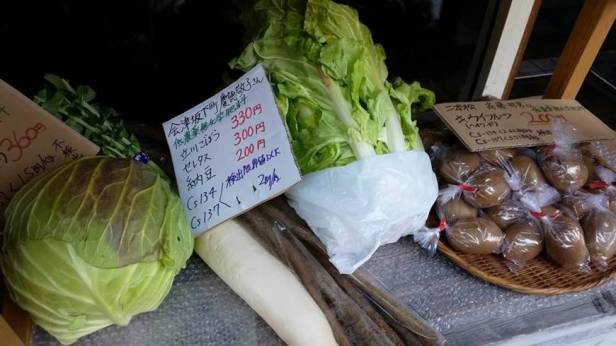
Orgando has played a valuable role in forging links between local producers and urban consumers, and dispelling the idea that all the region’s produce is dangerously contaminated — fruit and vegetables sold in the store are clearly labeled to show the levels of cesium isotopes they contain. Official food-safety guidelines stipulate 100 becquerels of radioactive isotopes per kilogram as the acceptable limit for adults, with 50 becquerels/kg for dairy produce and infant food, and 10 becquerels/kg for drinking water. The daikon, carrots and strawberries on offer this week contain no detectable cesium, while, according to their labels, bags of beans contained 6 becquerels/kg, a negligible dose of radiation compared to our daily exposure from soil and cosmic rays.
Allaying fears about contamination was one of the themes discussed during a February event in Tokyo focused on the role organic agriculture could play in Fukushima’s recovery, organized by Ryo Suzuki of Japan Civil Network.
“People mistakenly think that everything from Fukushima is dangerous,” Norio Honda of Genki ni Narou Fukushima — an NPO promoting local revival — said at the event.
Setsuko Maeda, of agricultural collective Tanemaki Project Network agrees.
“Fukushima isn’t only about radiation,” she says. “Our farming and fisheries are full of vitality, and it’s important not to forget that.”
The event gathered representatives from organizations such as Oxfam Japan, A Seed Japan and travel agency JTB, to speak about the challenges facing organic producers in the prefecture, along with some of the major success stories. The atmosphere was convivial, and the presentations were interspersed with opportunities to sample Fukushima produce, including octopus, meat, potatoes, peaches and apple juice, and high-grade junmai sake made from local organic rice, fittingly named Kiseki or “miracle.”
Another major theme was bioremediation, the use of crops to cleanse contaminated soil of radioactive isotopes. One plant that has previously been used to reduce levels of cesium and strontium isotopes in soils around Chernobyl is rapeseed. The Green Oil Project aims to re-create these results in the Futaba district around the Fukushima No. 1 nuclear plant. Water-soluble cesium isotopes are sequestered in the plant’s tissues, which are fermented to produce biogas methane. The canola oil extracted from the seeds has a cesium content below the detectable limit of 0.03 becquerels/kg. To promote the initiative, local high school students created Yuna-chan, a cute mascot whose name combines the kanji for oil and rapeseed to market the organic oil. U.K. cosmetics company Lush, a keen supporter of organic produce, has also agreed to take a portion of the oil for use in its beauty products.
Ultimately, though, human connections were seen as most crucial to giving Fukushima produce the audience it deserves, and to generating an interest in farming among young people.
“It’s about exchange,” says Akihiro Asami, secretary general of the Fukushima Organic Agriculture Network. “Producers can come to Tokyo, but I want consumers to visit Fukushima, and not just meet selected farmers but ordinary residents, too. If they sample rural life there, they’ll want to get more involved to support those communities.”
Event-organizer Suzuki is positive about what the future holds: “By 2020, I really think the knowledge accumulated through the activities of farmers and NPOs in Fukushima will be ready to benefit sustainability and rural development not just in Japan, but around the world.”
Last week marked the fifth anniversary of the disaster at the Fukushima-1 nuclear power plant which was triggered by a massive earthquake and tsunami that hit Japan five years ago.
The catastrophe left deep scars amongst Japanese people and there are fears that echoes of the tragedy will be heard for decades or maybe even for a hundred of years to come, as the terrible consequences are becoming clearer now.Hideyuki Ban, representative of the Japanese Information Center for Nuclear Energy, spoke to Sputnik in an interview talking about how profound the damage of nuclear radiation has been to the people, their lives and health.
“In Fukushima Prefecture at the time of the disaster around 360 thousand children under 18 years of age were residing in the area. Right now 166 children have been diagnosed with thyroid cancer (including cases of suspected malignancies). The percentage of thyroid cancer among residents of Fukushima is several times higher than the average percentage of incidences of thyroid cancer in the country,” Ban said.
The representative said that his organization studied the Chernobyl nuclear tragedy, and now they fear that the number of people with cancer could increase dramatically in the future.
After the Fukushima accident the experts said to the local people that it was safe and that the radiation leak was less than 100 millisieverts and that it would do no harm to the citizens. But it now seems that the experts may have underestimated the damage.
“Parents were very concerned about the impact of radiation on children’s health, but could not talk openly about their concerns, leading to a stressful situation.”
In October 2015, Toshihide Tsuda, professor of Okayama University, speaking to foreign correspondents in Tokyo held a press conference regarding the growth of thyroid cancer in children in Fukushima Prefecture and how the disease was related to radiation as a result of the nuclear accident.
According to Ban, the government does not recognize the link between these two phenomena. After all, it is very inconvenient for Japan’s energy policy. The Japanese government, during the rule of the Democratic Party, spoke against increasing nuclear power but the situation changed with the advent of LDPJ, who took the decision to increase the nuclear power in the country.
“In April 2014, the government of Japan approved a method to increase the production of nuclear energy in total by 20-22% by 2030, indicating intention to return to the policy of conservation of nuclear energy as it was previously.”
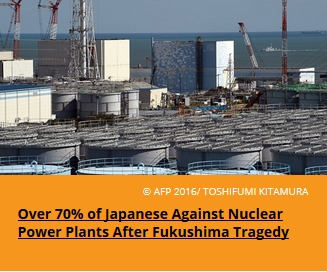
Ban also mentioned that this is happening against the fact that 80% of the population supports the desertion of nuclear power plants altogether.
“Only the government and nuclear industrialists are promoting nuclear power development. Right now we are seeing a distorted situation where the political reality does not reflect the public opinion.”
However, implementation of the Basic Energy Development Plan is already facing certain difficulties, as was evidenced by the issuance of a temporary decision to stop the Takahama nuclear power plant on March 9. According to Hideyuki Ban, the energy development plan is likely to be revised in the next year.










 nuclear-news
