New design nuclear reactors not happening for a long time (if at all)
“Our target is — can we really move the process forward and have a commercial option by 2030?” Mr. Kuczynski said. To do that, he and others say, the pace of the design process, and of the Nuclear Regulatory Commission’s review process, needs to be sped up.
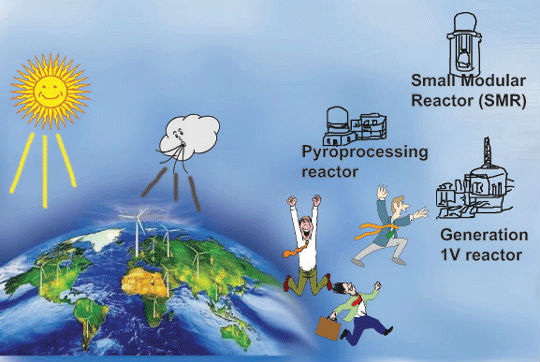
“It’s a 25-year process, no matter what,” said Michael McGough, the chief commercial officer of NuScale Power, which is the furthest along among companies working on less conventional reactors. NuScale’s design, called asmall modular reactor, uses water as a coolant, but the units are far smaller than current reactors and have advanced safety features. They could be built largely in a factory, saving money, and up to 12 of them could be installed at one site.
Mr. McGough knows all about long timetables; NuScale’s design has been under development since 2000……
Many in the industry hope that extending the licenses of existing reactors will forestall at least some closings. Nuclear plants were originally licensed for 40 years, but almost all have sought and received 20-year extensions.
The regulatory commission has begun researching what would be required to extend a plant’s life to 80 years. “We’re asking very basic questions, like how long can a reactor vessel remain acceptable since it’s being bombarded by neutrons,” said Scott Burnell, a spokesman………
Given the relatively poor economics of nuclear power, however, even if a plant could be licensed to operate up to 80 years, the question remains whether it would be financially worthwhile for it to do so, especially if expensive work is required. Skeptics cite two American plants that have been closed for economic reasons since 2012, after their licenses were extended to 60 years.
Similar economic uncertainties surround the latest generation of reactors, the Westinghouse AP1000……..
“What eventually happens with the four AP1000s will be very important,” said Matthew McKinzie, a senior scientist with the Natural Resources Defense Council. “If the economics of extending the lifetime of a plant to 80 years are poor, then what does that say about the economics of a new plant?”
Critics of nuclear power say that novel designs like molten salt reactors raise new issues, especially regarding safety, that will require much time to evaluate.
“A regulator can’t accept paper studies saying that a reactor is supersafe,” said Edwin Lyman of the Union of Concerned Scientists. “They need documentation, experimental data.”
“The industry and Department of Energy have this fantasy that you can have some general design-neutral licensing process,” he added………..http://www.nytimes.com/2016/03/22/science/nuclear-energy-power-plants-advanced-reactors.html?_r=0
Public opinion turning against nuclear power – important handicap to the nuclear industry
Nuclear power is losing popularity in the US. Here’s why. Vox, by Brad Plumer on March 21, 2016, T @bradplumer brad@vox.com “…….. Why public opinion on nuclear matters
So does this public opposition matter much? It matters quite a bit for many of the existing reactors around the country, which are currently facing brutal competition from cheap natural gas and wind power. In places like Vermont where nuclear power faces fierce local opposition, regulators have moved to shut down existing plants rather than pay for needed upgrades. (That’s typically bad news for climate change, since these reactors often get partly replaced by natural gas, which emits far more CO2.)
And, of course, if the United States is ever to build a new generation of nuclear reactors in order to help tackle global warming, then public opinion will prove even more important……..
Today, just five new reactors are under construction: two in Georgia, two in South Carolina, and one in Tennessee. These next-generation reactors are all being built at existing plant sites, which helps minimize public opposition. But these projects have also been plagued by delays and cost overruns: The two reactors at the Vogtle Plant in Georgia, for instance, are now estimated to cost $16 billion, some $3 billion over budget and three years behind schedule…….http://www.vox.com/2016/3/21/11277574/nuclear-power-public-opinion
Future for nuclear energy in South Africa is not looking good.
Future looks bleak for nuclear energy: expert, Times Live Matthew le Cordeur | 22 March, 2016 Nuclear power generation has turned into an expensive operation, even when the machines are amortised, said nuclear expert Mycle Schneider. Schneider, author of the World Nuclear Industry Status Report, told Fin24 on Monday that he questioned whether nuclear power can be seen as an alternative to a whole range of other energy options.
Schneider’s 2015 report, which was released in South Africa this month, concluded that “the promise that Generation III+ designs would be simpler and therefore easier to build appears not to have been fulfilled”.
“Real costs have increased significantly compared to their predecessors suggesting the attempt to reduce complexity was not a success.
“The ‘nuclear renaissance’ appears, in retrospect, to have been a last chance for light water reactor technology,” the report says. “Given the failure to reduce costs – and there are few who would forecast costs are going to go down at all, much less decline to the levels originally claimed – and the apparent failure to reduce the incidence of construction overruns, the future looks bleak for light water technology.”
South Africa is forging ahead to build 9.6 GW of nuclear energy, which critics believe will drain the country’s fiscus due to the large upfront infrastructure costs they say will experience time and budget overruns.
Request for proposals – which would focus on the Generation III+ designs – will be released before the end of the month, the Department of Energy said.
Nuclear for SA would only be ready by 2025
“Nuclear power has the longest lead time of any option to generate electricity,” Schneider told Fin24. “The average construction time of the 40 nuclear reactors that have been brought on line in the world in the past 10 years was about 9.5 years, to which one has to add several years of site preparation and licensing procedures.
“In other words, new nuclear would only be available in SA after 2025. Other options, especially efficiency and renewables, can be implemented within months,” he said.
Schneider said that nuclear energy’s high capital expenditure (capex), low operating expenditure (opex) paradigm is gone.
“Nuclear power generation has turned into an expensive operation, even when the machines are amortised,” he said. “As assessments by the French Energy Regulatory Commission (CRE) and the French Court of Accounts have shown, all of the cost items have increased significantly, to reach a 20.6% increase between 2010 and 2013 to reach about 60 €/MWh.
“The ‘base load’ concept is also rapidly outlived by reality in the market,” he said. “With increasing penetration of renewables, flexibility is the master word.”
Nuclear the least flexible power
“Nuclear power is the least flexible of all of the power generating technologies and is therefore hardly suitable for a future orientated power grid with high levels of decentralised renewables,” he said……..http://www.timeslive.co.za/local/2016/03/22/Future-looks-bleak-for-nuclear-energy-expert
New documentary showcases the promise of solar energy
http://ensia.com/videos/new-documentary-showcases-the-promise-of-solar-energy/ March 21, 2016 — What do an unemployed American worker, a Tea Party activist and a Chinese entrepreneur have in common? They’re all part of a new documentary film highlighting the growth of solar energy around the world.
Directed by award-winning filmmaker Shalini Kantayya and featuring stories from the U.S. and China, “Catching the Sun” focuses on the global race to lead the clean energy future.
According to a report late last year from the International Energy Agency, new renewable energy installations are predicted to outpace those for fossil fuels and nuclear globally over the next few years.
Some experts are even going so far as to predict that by 2050 solar photovoltaic and solar thermal combined could generate up to 27 percent of the world’s electricity. 
March 22 Energy News

World:
¶ TenneT delivered 7.4 TWh of electricity from offshore wind farms in the German North Sea to the grid, an almost six-fold increase compared with 2014. The transmission operator said offshore wind farms in the German North Sea accounted for about 9.6% of Germany’s overall wind energy generation. [reNews]
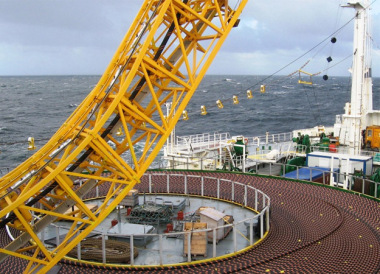 Laying a cable at sea. TenneT increased offshore capacity in
German North Sea to 4.3GW last year (TenneT)
¶ Australia has added 100 MW of rooftop solar in the first two months of 2016, as Victoria overtakes New South Wales to be the country’s second biggest market. The 55 MW added in February still represented a fall from a year ago, with Queensland, the biggest market,down nearly 20%. [CleanTechnica]
¶ Tidal energy projects in the UK can be developed for nearly half the price of the proposed Swansea Bay project, according to the founder of Ecotricity…
View original post 513 more words
World Water Day: Nuclear Power Contaminates Drinking Water with Long-Lived Lethal Radioactive Materials

With an ever-growing world population, how can we afford to let water resources be destroyed by radioactive materials, which remain deadly for decades, centuries and even millions of years?
“Water is of major importance to all living things; in some organisms, up to 90% of their body weight comes from water. Up to 60% of the human adult body is water“. http://water.usgs.gov/edu/propertyyou.html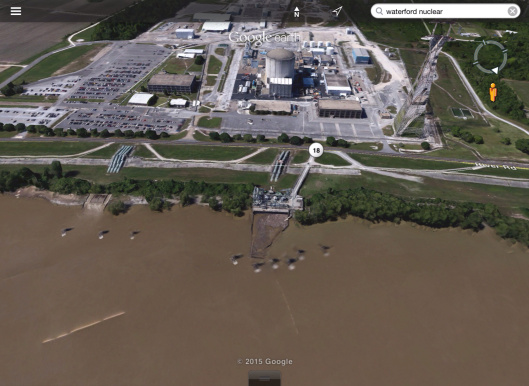
Waterford Nuclear Reactor on the Mississippi: New Orleans and some smaller communities get their drinking water from the Mississippi River.
“A typical 1000-megawatt pressurized-water reactor (with a cooling tower) takes in 20,000 gallons of river, lake or ocean water per minute for cooling, circulates it through a 50-mile maze of pipes, returns 5,000 gallons per MINUTE to the same body of water, and releases the remainder to the atmosphere as vapor. A 1000-megawatt reactor without a cooling tower takes in even more water–as much as…
View original post 852 more words
Accumulation of Sellafield-derived Radioactive Carbon (14C) in Irish Sea and West of Scotland Intertidal Shells and Sediments
Introduction-Background
Anyone who was a serious student of biological sciences is immediately alarmed to learn that nuclear reactors routinely emit radioactive carbon (14C) and radioactive hydrogen (tritium) into the environment. Carbon and hydrogen are the very foundations of life. And, most of the human body is comprised of water (H2O). Tritium makes tritiated water. Radioactive carbon (14C) has a half-life of over five thousand years (5,730 years). Even tritium, with a half-life of 12 years, will be in the environment for almost 200 years.
“Carbon forms the key component for all known life on Earth. Complex molecules are made up of carbon bonded with other elements, especially oxygen, hydrogen and nitrogen, and carbon is able to bond with all of these because of its four valence electrons.” https://en.wikipedia.org/wiki/Carbon-based_life
“Carbon-14 is formed in the fuel (UO2), in core structural materials, and in the cooling water of LWRs”…
View original post 819 more words
World Meteorological Organization — Dangerous Climate Future Has Arrived

The alarming rate of change we are now witnessing in our climate as a result of greenhouse gas emissions is unprecedented in modern records. — Petteri Taalas, Secretary General of the World Meteorological Organization
*****
It would be a bit of an understatement to say that the global scientific community is reeling. Sure, the various scientists and researchers knew that a massive accumulation of greenhouse gasses in the Earth’s atmosphere and oceans was beginning to take a serious toll. They knew that ocean heat content in the top 2,000 meters of the world ocean system (accounting for 93 percent of Earth System warming) was going through the roof. And they knew that this warmth was going to bleed out in a seriously big and bad way as a record El Nino swept through the global climate system during 2014, 2015 and 2016.

(Temperature averages for 2016 are…
View original post 1,006 more words
Secret nuclear negotiations: UK Hinkley, and Australia’s waste import plan

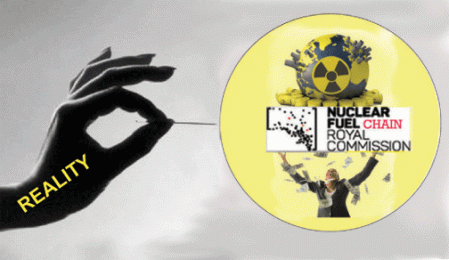 Secret deals: Australia’s nuclear waste plan and the UK’s Hinkley project, Independent Australia 21 March 2016, The South Australian Government scheme to import international nuclear waste has a major flaw in common with the UK’s Hinkley Point C project — secret contracts with foreign organisations, writes Noel Wauchope.
THESE TWO PLANS have something in common. Both the UK’s Hinkley Point C plan and South Australia’s nuclear waste plan are grandiose and very expensive to set up.
But, more than that, they both require the involvement of foreign governments and companies, in secret arrangements.
The South Australian Nuclear Royal Commission‘s plan for importing international wastes already involves confidential communications from foreign companies. Put into operation, the plan will mean secret contracts — South Australia being beholden to the provisions of foreign laws regarding disclosure, shipping and transport security, insurance and other matters relating to a client nation’s high level nuclear wastes (HLNW).
Plans have been suggested for foreign companies paying up…
View original post 417 more words
March 21 Energy News
Science and Technology:
¶ According to NASA, February 2016 was the most anomalously warm month in 135 years of record keeping – 1.35° C (2.43° F) warmer than the 1951 to 1980 average. While the recurring El Niño event certainly drives short-term oscillation, the long-term warming trend is quite apparent. [CleanTechnica]
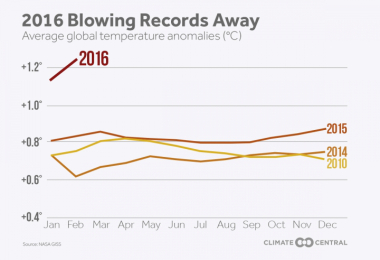 2010, 2014, and 2015 were all record-breaking years. Climate Central graph
World:
¶ The South African Energy Minister launched the Solar Capital De Aar 3 in the Northern Cape – the 17th solar photovoltaic plant in the province. She said the commercial operation of the 75-MW plant is a huge achievement in scaling up the deployment of renewable energy in South Africa. [AllAfrica.com]
¶ Last summer, the Mayor of London unveiled plans to test a fleet of double-decker electric buses to ply the tourist-friendly Route 16. Things must have gone swimmingly because just last week…
View original post 424 more words
Coal and nuclear – in it together promoting global warming. Theme for April 16
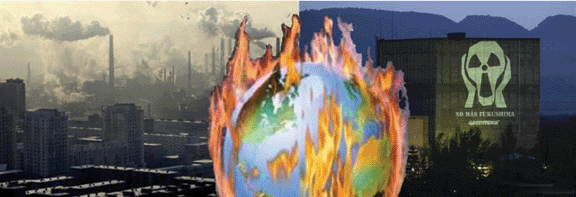
It’s really hard to estimate the full carbon footprint of the nuclear industry . Greenhouse gases are emitted in all stages of the lifecycle of a nuclear reactor: construction, operation, fuel production, dismantling and waste disposal. Leaving out any of these five stages will bias estimates towards lower values. The last two contributions, dismantling and waste disposal are particularly difficult to estimate. Not many commercial reactors have been fully decommissioned.
The ever repeated claim that nuclear power is emissions-free is simply not true.
Without subsidies for coal and nuclear The free market would choose the path to the most cost effective and cleanest sources of energy which would include wind, solar, small-scale hydro, geothermal, energy efficiency, tidal, and certainly not nuclear or “clean coal.”
The fossil fuel and nuclear industries are in this public deception together. Indeed, nuclear power is in itself a fossil fuel industry, depending on mining uranium (or thorium, which is then converted to uranium). The coal industry is confident of continuing for several decades, and then handing over to the nuclear industry, as coal runs out. The nuclear industry is happy about this, because it takes decades to get reactors set up and running.
Where these two toxic industries are also in agreement is in the aim to slow down, preferable stifle, the development of clean, and cheaper renewable energy sources, especially wind and solar power.
They also like the scenario promoted in the nuclear advertising film “Pandora’s Promise” – that is the endless growth of energy use. Coal and nuclear advocates do not like the idea of energy efficiency, energy conservation.
Renewable energy beating nuclear power in India
 Cheaper renewable energy has soared past nuclear power, Business Standard 18 Mar 16, Renewable energy in India has overtaken nuclear power as the country seeks carbon-free sources of energy to balance its reliance on coal. Such energy generation in India is higher than its nuclear power generation and is growing at a much faster pace because it is cheaper and quicker to install. The cost of renewable energy is now lower than the cost of nuclear power and does not come with attendant risks, such as this week’s radioactive fuel leak in Gujarat.
Renewable-energy generation in India was 61.8 billion units, versus 36.1 billion units of nuclear-power generation during the financial year (FY) 2014-15. Renewable energy accounted for 5.6 percent of electricity generated in India, against 3.2 percent for nuclear power.
Renewable energy has been growing at a faster pace than nuclear power over two years. During 2013-14 and 2014-15, renewable energy grew at 11.7 percent and 16.2 percent, respectively, while nuclear-power growth has been almost flat over the same period.
If the 2022 solar target is met, it will become India’s second largest energy source. The bulk of India’s renewable energy comes from wind, but solar energy is growing faster with installed capacity reaching 5,775 mega watts (MW) in February 2016. The national solar mission has set a target of 100,000 MW of solar power by 2022. If this target is met, renewable energy will become the second largest source of power for India after coal, and ahead of hydropower, natural gas and nuclear energy…….http://www.business-standard.com/article/news-ians/cheaper-renewable-energy-has-soared-past-nuclear-power-special-to-ians-116031800578_1.html
Bernie Sanders, Hillary Clinton agree on climate change, disagree on nuclear energy
 Clinton, Sanders united on global warming, divided on nuclear energy, Idaho Statesman. BY ROCKY BARKER rbarker@idahostatesman.com 20 Mar 16
Both Bernie Sanders and Hillary Clinton have ambitious plans to shift the nation’s economy away from fossil fuels to clean energy to combat the global warming caused by their burning.
But as the two Democratic presidential candidates campaign and compete in Idaho in the days before the Tuesday caucus, the largest contrast is their views of the role nuclear power will play in the clean-energy future.
Little polling has been done in the state, but the last poll in February by Dan Jones and Associates for Idaho Politics Weekly showed Sanders with a tiny 47-45 percent lead, within the margin of error. That was a rise of 12 points for the Vermont senator from a poll earlier this year.
“It was very close,” said Dan Jones, the Salt Lake City pollster. “My guess is it is still close.”……….
CLIMATE CHANGE, INL AND CLEAN ENERGY
Sanders has made climate change action one of the central platforms of his campaign, helping to energize many of his youthful supporters. He has called for ending leases for coal, oil and gas on public lands and in the Arctic, which could affect leasing for gas drilling in Southwest Idaho.
Sanders also has called for a tax on carbon and an end to subsidies for the oil and gas industry. But his biggest contrast with Clinton is on nuclear energy, the central mission at the Idaho National Laboratory headquartered in Idaho Falls, which employs thousands of Idahoans.
“Transitioning toward a completely nuclear-free clean-energy system for electricity, heating and transportation is not only possible and affordable, it will create millions of good jobs, clean up our air and water, and decrease our dependence on foreign oil,” Sanders said on his website.
Clinton Policy Director Jake Sullivan said the former secretary of state sees it differently.
She believes nuclear energy has an important role to play in our clean-energy future,” Sullivan said. “With that in mind, the Idaho National Laboratory would be an important institution to promote our clean-energy policy.”
Sanders introduced a bill to spend $41 million on clean energy and transition workers out of the fossil fuel and nuclear industries, said spokesman Karthik Ganapathy.
“He believes we can run an economy entirely on clean, safe energy,” Ganapathy said. “He’s aware of the risks of nuclear energy.”
Clinton shifted early in the campaign to agree with Sanders on an eventual ban on oil, gas and coal leasing on public lands, an issue important in many western states, although less so here………http://www.idahostatesman.com/news/local/news-columns-blogs/letters-from-the-west/article67181847.html
Rolls Royce touts “football fields” of mini nuclear reactors for Britain
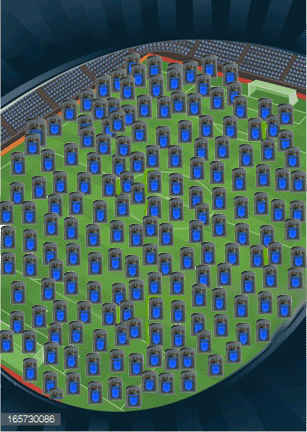
The UK’s current plans for a new wave of huge nuclear power stations is spinning out of control. The first, Hinkley Point in Somerset, was set to start generating in 2017 but questions over design and financing of the £18bn, 3,200 megawatt plant have put it years behind schedule.
The scheme was thrown into further doubt earlier this month when the finance director of EDF, the French company which will build Hinkley Point, quit over fears the company’s balance sheet could not withstand the huge costs.
Rolls Royce believes a series of mini reactors – known as “small modular reactors” (SMRs) – are a more viable medium-term solution to Britain’s looming energy crisis, although the first crop of new large reactors will still need to be deployed……..
New York looks to fees to save uneconomic nuclear power stations
NY eyes fee to save some nuclear plants Democrat and Chronicle March 20, 2016 ALBANY – New York’s energy regulators have a problem. ……… two of the state’s three upstate nuclear plants — the R.E. Ginna Nuclear Power Plant in Wayne County and the James A. FitzPatrick Nuclear Power Plant in Oswego County — are facing financial trouble and could close as soon as mid-2017. The third, Nine Mile Point, is also in Oswego County.
A fourth plant — the Indian Point Energy Center in Buchanan, Westchester County —is facing opposition from Gov. Andrew Cuomo as owner Entergy Corp. seeks new federal licenses.
The solution? Money……..

“Nuclear is one thing. Nuclear a stone’s throw from 20 million people when you have no evacuation plan is problematic,” Cuomo told reporters Wednesday in Rochester.
In December, Cuomo directed the Public Service Commission to install the state’s carbon-cutting goals into state regulations. As part of that, Cuomo — who appoints the commission’s members — directed the board to come up with a plan to help save the “upstate nuclear facilities,” but not Indian Point.
The commission outlined its plan in late January. And, as expected, the proposal excluded Indian Point: Only plants with valid federal licenses through 2029 would be eligible. And Indian Point’s licenses are technically expired, though it is awaiting federal approval.
The remaining three nuclear plants — Ginna, FitzPatrick and Nine Mile Point — would be eligible……
1 This Month

petition to oppose the rapid increase of space-military industry threatening Jeju Island and the region.
[Petition by April 19th (KST)] Stop the joint military-Hanwha Systems-Jeju Provincial Government Sea Launch!
Chernobyl: The Lost Tapes – A good documentary on Chernobyl on SBS available On Demand for the next 3 weeks– https://www.sbs.com.au/ondemand/tv-program/chernobyl-the-lost-tapes/2352741955560

of the week–London Campaign for Nuclear Disarmament

Tell the Ukrainian Government to Drop Prosecution of Peace Activist Yurii Sheliazhenko
To see nuclear-related stories in greater depth and intensity – go to https://nuclearinformation.wordpress.com
-
Archives
- April 2026 (194)
- March 2026 (251)
- February 2026 (268)
- January 2026 (308)
- December 2025 (358)
- November 2025 (359)
- October 2025 (376)
- September 2025 (257)
- August 2025 (319)
- July 2025 (230)
- June 2025 (348)
- May 2025 (261)
-
Categories
- 1
- 1 NUCLEAR ISSUES
- business and costs
- climate change
- culture and arts
- ENERGY
- environment
- health
- history
- indigenous issues
- Legal
- marketing of nuclear
- media
- opposition to nuclear
- PERSONAL STORIES
- politics
- politics international
- Religion and ethics
- safety
- secrets,lies and civil liberties
- spinbuster
- technology
- Uranium
- wastes
- weapons and war
- Women
- 2 WORLD
- ACTION
- AFRICA
- Atrocities
- AUSTRALIA
- Christina's notes
- Christina's themes
- culture and arts
- Events
- Fuk 2022
- Fuk 2023
- Fukushima 2017
- Fukushima 2018
- fukushima 2019
- Fukushima 2020
- Fukushima 2021
- general
- global warming
- Humour (God we need it)
- Nuclear
- RARE EARTHS
- Reference
- resources – print
- Resources -audiovicual
- Weekly Newsletter
- World
- World Nuclear
- YouTube
-
RSS
Entries RSS
Comments RSS
 nuclear-news