Taipei readies for big anti-nuclear protest in March
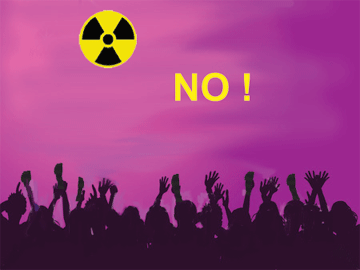
 Anti-nuclear protests are now planned for March 12 http://www.chinapost.com.tw/taiwan/local/taipei/2016/02/26/459275/Anti-nuclear-protests.htm TAIPEI--A national anti-nuclear alliance is scheduled to hold a protest march in Taipei March 12, demanding that the government make Taiwan nuclear-free by 2025 by decommissioning the nation’s three functioning nuclear plants and abolishing the mothballed fourth nuclear power plant in New Taipei’s Gongliao District.
They are also seeking the establishment of a mechanism that will allow public participation in policy-making regarding nuclear waste management.
Disastrous problem of nuclear waste just won’t go away
 A disaster waiting to happen: nuclear waste and Lake Huron, Michigan Radio, By JACK LESSENBERRY , 25 Feb 16 Michigan has been so preoccupied with our own environmental disaster in Flint that we may have missed the announcement that Canada last week indefinitely delayed a decision about whether to bury low-level nuclear waste near Lake Huron……..
Had the conservative government of Prime Minister Stephen Harper been reelected last fall, the decision announced last week would almost certainly have been to bury the waste here. But Harper’s party lost in an unexpected landslide to Justin Trudeau’s more environmentally conscious liberals.
The outcome may be especially welcome in poor, battered Flint. The city hopes to eventually switch to a new water provider using Lake Huron, and the last thing anyone wants to worry about is radioactive waste leaching into the water, as unlikely as that may be.
But this also means we still don’t have an answer to what is to be done with 200,000 cubic feet of nuclear waste, currently stored in above-ground containers near Ontario’s immense Bruce nuclear generating station.
Even more important is finding a permanent home for all those highly radioactive, spent nuclear fuel rods in both our nations. Scientific American estimated seven years ago that the United States alone had produced 64,000 metric tons of those rods.
There’s more now, and any effort to establish a permanent burial site has been killed by narrow, NIMBY, not-in-my-backyard thinking, as it has in Canada.
This is a disaster waiting to happen – there’s tons of this stuff in “temporary,” above-ground storage everywhere from Monroe to Charlevoix, where an old nuclear plant was torn down nearly twenty years ago.
If the apparent decision to not bury low-level waste near Lake Huron makes us forget this far bigger problem, then it is no kind of victory at all. http://michiganradio.org/post/disaster-waiting-happen-nuclear-waste-and-lake-huron#stream/0
CPS Energy writes off $millions from Texas nuclear expansion project
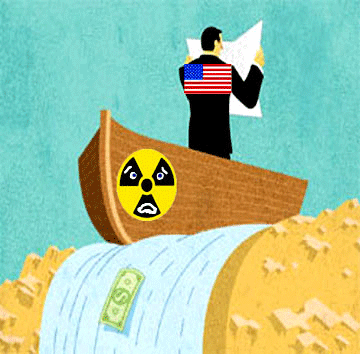 CPS Energy writes off $391.4 million from South Texas Project nuclear expansion San Antonio Express News, 24 Feb 16 CPS Energy revealed Wednesday it has written off $391.4 million in costs associated with its partnership of the unbuilt — and highly criticized — Units 3 and 4 of the South Texas Project nuclear plant……..
Longtime opponents of the nuclear expansion said CPS Energy made the correct move to write off its costs so far.
“CPS’ decision shows that proposed nuclear reactors are worthless. There’s no market for their rate raising, high-cost, high-risk power,” Tom “Smitty” Smith of Public Citizen’s Texas office in Austin said in an email. “The proposed reactor price tag rose from $5.9 billion to $18.2 billion, even before a license was ever issued. Delays, construction problems and lawsuits are the norm for nuclear reactors. They cost so much that even with all the federal subsidies, no bank will loan money to build them. CPS did the smart thing and wrote off this worthless investment.”
Controversy erupted in 2009 over the expansion project, which already had received intense opposition over concerns about storage of waste fuel and estimated cost of $13 billion.
It was revealed that a new cost estimate from partner Toshiba Inc. — $4 million higher than the previous one — had been withheld by utility executives from the CPS board and City Council while additional financing was under consideration……….
“The NRC (Nuclear Regulatory Commission) can license these reactors, but they won’t get built,” added Karen Hadden of the Sustainable Energy and Economic Development Coalition. “Renewable energy is cheaper these days and much safer. Nuclear power creates radioactive waste that remains deadly for hundreds of thousands of years.”…….. http://www.expressnews.com/business/local/article/CPS-Energy-writes-off-391-4-million-from-South-6852804.php
2016 Washington Summit on Nuclear Security
 The 2016 Washington Summit: Time to Open the Next Chapter in Nuclear Security Council of Councils, Artur Kacprzyk, Analyst, Polish Institute of International Affairs Feb 24, 2016 The fourth and almost certainly final Nuclear Security Summit (NSS) will take place from March 31 to April 1, 2016 in Washington, DC. Washington hosted the first such meeting of heads of states and government in 2010, followed by summits in Seoul (2012) and the Hague (2014). Though the NSS process is about to end, the struggle to prevent nuclear terrorism is not, and at present there is no vehicle with which to carry these efforts forward in a concerted manner. The NSS process has led to significant achievements in securing nuclear materials worldwide, but much more remains to be done.
As terrorist threats persist, nuclear and radioactive materials in numerous countries are still vulnerable, and the international nuclear security architecture continues to be fragmented and predominantly based on nonbinding measures. Although the last summit cannot conclusively resolve nuclear security problems, it presents leaders with an opportunity to chart a new direction of cooperation that would comprehensively address underlying challenges and ensure NSS’s enduring legacy.
Successes of the NSS Process
The NSS process was launched in the wake of U.S. President Barack Obama’s 2009 speech in Prague, in which he described the danger of terrorists acquiring nuclear weapons as “the most immediate and extreme threat to global security” and pledged to lead an initiative to lock down in four years worldwide stocks of highly enriched uranium (HEU) and plutonium—materials that could be stolen and used to construct a nuclear weapon. Both HEU and plutonium are used for both military and civilian purposes.
Falling short of reaching the four-year goal, the NSS has still enabled progress in multiple areas. ………
NSS Shortcomings and Flaws in Nuclear Security Architecture
Despite NSS accomplishments, the process has also suffered from a number of shortcomings, compounded by current adverse international factors. According to the recently published NTI Nuclear Security Index 2016, progress in the implementation of NSS goals has slowed. This is partially due to a series of crises distracting leaders’ attention and summit fatigue. This trend will likely worsen without an appropriate successor to the NSS. At the same time, twenty-four countries still hold nearly two thousand tons of weapons-usable nuclear materials.
So far, one of the most notable shortcomings of the NSS process has been the lack of fundamental changes to global nuclear security architecture. Despite a growing number of ratifications, membership in key international agreements remains limited. Ninety-three states are party to the International Convention on Suppression of Acts of Nuclear Terrorism, while the 2005 amendment to the Convention on Physical Protection of Nuclear Materials (CPPNM) requires twelve more ratifications to enter into force. Additionally, more specific security standards contained in IAEA guidelines are voluntary and not universally implemented. The same applies to IAEA review missions. Above all, there is no obligatory and comprehensive system that would hold states accountable for their nuclear security commitments and require them to share necessary information……….
Conclusions and Recommendations
The 2016 NSS in Washington faces two main tasks. First, participants should take new commitments on issues neglected in previous meetings, particularly related to military stocks and civilian minimization, and expand the endorsement of current gift baskets, especially the Trilateral Initiative. Second, the NSS must clearly determine the way forward for continued efforts.
There is an undeniable need for a new, broad legal instrument that would set the current nuclear security architecture in place and complement existing mechanisms by filling the gaps in terms of standards, transparency, and accountability. Nevertheless, the process of negotiating and ratifying such an agreement would be lengthy. Therefore, there is a need for an additional track of regular consultation to continue the momentum started by the NSS, energizing a wider group of countries, enabling incremental progress, and thus reinforcing parallel negotiations on a treaty………http://www.cfr.org/councilofcouncils/global_memos/p37574
TEPCO kept secret for 2 months that Fukushima nuclear meltdown occurred
Fukushima nuclear plant operator kept meltdown quiet for 2 months Company says officials were unaware meltdown defined as damage exceeding 5% of a reactor’s fuel CBC News, The Associated Press Feb 25, 2016 The operator of Japan’s damaged Fukushima nuclear plant acknowledged Thursday it failed for two months to announce that meltdowns had occurred in the cores of three of the reactors.
Tokyo Electric Power Co. said its officials were unaware of a company emergency manual that defined a meltdown as damage exceeding five per cent of a reactor’s fuel.
Instead, TEPCO described the condition of the reactors as less serious “core damage” for two months after the plant was hit by a massive earthquake and tsunami in March 2011, despite early damage estimates ranging from 25 to 55 per cent…….
In May 2011, TEPCO finally adopted the term “meltdown” after a computer simulation showed fuel in one reactor had almost entirely melted and fallen to the bottom of the primary containment chamber, and that two other reactor cores had melted significantly…… http://www.cbc.ca/news/world/japan-fukushima-meltdown-report-1.3463649
Radioactive contamination still a very real crisis for Fukushima fishermen
Nuclear water: Fukushima still faces contamination crisis, Phys Org, February 25, 2016 by Harumi Ozawa, Quentin Tyberghien Fish market vendor Satoshi Nakano knows which fish caught in the radiation tainted sea off the Fukushima coast should be kept away from dinner tables.
“It was the single largest release of radioactivity to the marine environment in history,” Greenpeace nuclear expert Shaun Burnie told AFP on the deck of the campaign group’s flagship Rainbow Warrior, which has sailed in to support a three-week marine survey of the area the environmental watchdog is conducting.
Fukushima is facing an “enormous nuclear water crisis,” Burnie warned. He added: “The whole idea that this accident happened five years ago and that Fukushima and Japan have moved on is completely wrong.”
Safe to eat?
Existing contamination means fishermen are banned from operating within a 20-kilometre (12.4-mile) radius from the plant……..http://phys.org/news/2016-02-nuclear-fukushima-contamination-crisis.html
Illegal dumping of nuclear waste in Kentucky
Drilling wastes containing concentrated but naturally occurring radio active materials made their way into Kentucky, state officials confirmed on Thursday. After learning in January that low-level nuclear waste from drilling operations had been dumped illegally in Kentucky last year, state officials are warning this week that all landfills be on the lookout and to not accept any of the radioactive material.
Kentucky Division of Waste Management Director Tony Hatton said officials have confirmed that low-level nuclear waste from drilling operations in Ohio, Pennsylvania and West Virginia was sent to a landfill in Estill County between July and November. Officials are also investigating possible illegal shipments of similar waste to a landfill in Greenup County……..http://www.courier-journal.com/story/tech/science/environment/2016/02/25/nuclear-waste-dumped-illegally-kentucky/80924622/
TEPCO-USNRC Knew Fukushima Was A Triple Meltdown (Units 1,2,3) Almost Immediately; Unit 4 Spent Fuel Pool Believed Failed


Photo of the 4 Fukushima Daiichi Reactors on Idaho National (Nuclear) Lab, INL, web site.
US NOAA model of dispersion, showing that it blew offshore and was mostly impacting North America: http://sos.noaa.gov/Datasets/dataset.php?id=332 Fukushima has continued to discharge radioactive materials into the air, and water, as even admitted by TEPCO last year. They probably wait until the wind is blowing offshore to vent.
According to the Japan Times, as of March 14, 2011, TEPCO “estimated that 55 percent of the fuel rod assemblies of the reactor No. 1 and 25 percent of those at reactor No. 3 were “damaged,” based on the levels of radiation detected, …” See article here: http://www.japantimes.co.jp/news/2016/02/24/national/tepco-admits-initial-assessments-fukushima-meltdowns-wrong/ Unit 2 meltdown was confirmed by 2014, by Muon scans: http://www.dailykos.com/stories/2015/3/23/1372742/-Second-Total-Meltdown-Confirmed-by-Muon-Scans-at-Fukushima However, it was apparently known almost immediately, according to US NRC documents.
The new news, as of Feb. 24, appears to be that TEPCO admitted to…
View original post 1,408 more words
February 26 Energy News

Opinion:
¶ The Myth About Renewable Energy Subsidies • Ever hear the story that renewable energy can’t compete without a subsidy? You hear it all the time from the fossil fuel industry. And the renewables’ response? Take away fossil fuel subsidies; they’d be glad to compete on level terms. [CleanTechnica]
 Cumulative historic federal subsidies.
Science and Technology:
¶ Greenpeace Japan announced it is conducting an underwater investigation into radiation contamination from the Fukushima Daiichi nuclear plant into the Pacific Ocean. The survey will be conducted from a Japanese research vessel using a one-of-a-kind Remotely Operated Vehicle. [Dominican Today]
World:
¶ Mainstream Renewable Power has grid-connected and started commissioning turbines at its 80-MW Noupoort wind farm in the Northern Cape of South Africa. This ZAR1.9 billion ($121.6 million) project is expected to start supplying electricity to the national grid by July 2016. [reNews]
 First turbine…
View original post 601 more words
Japan restarts fourth atomic reactor since 2012 moratorium
OSAKA – Kansai Electric Power Co.’s Takahama No. 4 reactor in Fukui Prefecture on Friday became the nation’s fourth to be restarted since 2012 and the first to burn MOX, a mixed-oxide fuel that contains plutonium.
In a statement released Friday afternoon, Kepco President Makoto Yagi said safety would remain the top priority and that the utility would continue to promote safety standards beyond what was legally required.
The startup came nearly a week after a radioactive water leak was discovered at the reactor’s auxiliary building on Feb. 20. Kepco halted restart preparations while it repaired the leak, saying it did not pose a danger to the environment.
The utility said earlier this week the leak was caused by a loose pipe valve and could be repaired without affecting the restart schedule, which called for rebooting the unit by the end of this month.
Under Kepco’s schedule for the restart process, the No. 4 reactor is expected to start generating electricity by Monday afternoon and reach full power a few days later. Once the Nuclear Regulation Authority gives final approval, and assuming there are no last-minute technical problems, the plan is to have it back online and selling electricity from late March, just before the end of fiscal 2015.
The restart of Takahama No. 4 comes about a month after the nuclear power plant’s No. 3 reactor was restarted. Along with two reactors at Kyushu Electric’s Sendai plant, which went back online last August, they comprise the four reactors that have been restarted since beefed-up nuclear safety standards took effect in 2012.
In addition to No. 3 and No. 4, which are at least 30 years old, Kepco also wants to restart Takahama Nos. 1 and 2, both of which are over 40. It hopes to run them for up to two decades. Despite concerns about the increased probability of accidents at the aged plants, their restart moved a step closer to reality on Wednesday, when the NRA said additional safety systems Kepco installed to extend the reactors’ life spans met its standards.
The next step will be soliciting public comment, and then further permission from the NRA is required for what would be the first-ever extensions in Japan of reactors over 40 years old.
Before that happens, Kepco will seek final permission from the mayor of Takahama and the governor of Fukui Prefecture for the restart, which could be a lengthy process. The utility may also find itself forced to deal with public and political concerns in surrounding Kansai prefectures like Shiga and Kyoto, where safety concerns about the aged reactors are strong.
2015 census 1st to confirm national population decline / Fukushima Pref. sees 5.7% fall since 2010

According to preliminary figures of a simplified 2015 census released Friday, Japan’s population dropped to 127.11 million — the first confirmed census decline since the government started conducting such surveys in 1920.
The Internal Affairs and Communications Ministry said the latest census shows that Japan’s population as of Oct. 1, 2015, was 127,110,047. This represents a decline of 947,305, or 0.7 percent, since the last census conducted in 2010. In the 2015 census, men accounted for 61,829,237 of the population, and women 65,280,810.
The population of Fukushima Prefecture, where many residents are still being forced to live away from home due to damage caused to their hometowns by the 2011 Great East Japan Earthquake, decreased by 115,458, a 5.7 percent decline from the last census. The two other prefectures hit hardest by the disaster — Iwate and Miyagi — also saw population declines.

The ministry had estimated that the nation’s population had been declining for four straight years since 2011. The latest results are the first confirmation via a census that the national population has gone down since the government began conducting them.
A ministry official said Japan’s population decline seems to be largely due to the natural factor of deaths outnumbering births. The government conducts a census every five years, and this is the first since the 2011 disaster.
Out of 47 prefectures nationwide, populations declined in 39, including Hokkaido and Aomori. Of the three prefectures hit hardest by the disaster, Miyagi’s population dropped by 13,950, or 0.6 percent; and Iwate’s by 50,333, or 3.8 percent. The decline in Miyagi Prefecture was small, probably due to the inflow of people working on reconstruction projects. The population increased in eight prefectures, including Okinawa, Tokyo and Aichi.
The census found the number of households in the country was a record high 53,403,226, but the average number of people per household was a record low of 2.38.
A large-scale census is conducted every 10 years, and a simplified census is carried out every five years after a large census. The 2015 census was a simplified one.
Disparity seen widening
The vote-value gap between the most and least populated single-seat constituencies of the House of Representatives is estimated to widen to 2.334-to-1, according to trial calculations based on preliminary figures from the latest census released Friday.
This represents an expansion of the disparity from 1.998-to-1 calculated based on the 2010 census.
Selected for comparison were Tokyo Constituency No. 1, which has the largest population per its lower house member, and Miyagi Constituency No. 5, which has the lowest such ratio.
The disparity when compared to the least-populated constituency is estimated to expand to 2-to-1 or more in 37 electoral districts.
The law on the establishment of the Council on the House of Representatives Electoral Districts calls for limiting the gap to less than 2-to-1.
Since 2011, the Supreme Court has ruled that three lower house elections, conducted when a national disparity of more than 2-to-1 existed, were held in a “state of unconstitutionality.”
A research council on the lower house electoral system also demanded that the gap be brought to within 2-to-1. The council is an advisory panel to the lower house speaker.
Up 9, down 15
The allocated number of seats in the lower house will increase by a total of nine across five prefectures, but one seat will be eliminated in each of 15 prefectures, according to an estimate made by The Yomiuri Shimbun based on the latest census results and using the Adams’ method, which is recommended by an advisory panel to the House of Representatives speaker.
Under the current allocation of lower house seats, vote-value disparities between prefectures are 1.885-to-1 or less. But if the increase of nine seats with a reduction of 15 seats is realized, the disparities will drop to 1.668-to-1 and remain lower than the current figure for a while, even if populations in prefectures change in the future.
Though the Democratic Party of Japan, Komeito, the Japan Innovation Party and others intend to accept a report made by the advisory panel recommending the Adams’ method, the Liberal Democratic Party is wary of introducing it. The LDP says vote-value disparities should initially be dealt with by trimming six seats and not adding any.
However, according to an estimate based on the latest census results made with the LDP reform plan to eliminate six seats, one seat each will be eliminated in six prefectures — Aomori, Iwate, Mie, Nara, Kumamoto and Kagoshima. But the largest vote-value disparity between prefectures will remain unchanged at 1.885-to-1. This might require complicated changes to the demarcation of electoral districts, observers said.
Prime Minister Shinzo Abe has already expressed his desire to enact a bill to revise the Public Offices Election Law and other legislation by the end of the current Diet session.
Five years on, Fukushima still faces contamination crisis: environmentalists

Crippled Fukushima Daiichi nuclear power plant in northeastern Japan.
Fish market vendor Satoshi Nakano knows which fish caught in the radiation tainted sea off the Fukushima coast should be kept away from dinner tables.
Yet five years after the worst nuclear accident since Chernobyl there is still no consensus on the true extent of the damage – exacerbating consumer fears about what is safe to eat.
Environmentalists are at odds with authorities, warning the huge amounts of radiation that seeped into coastal waters after a powerful tsunami caused a meltdown at the Fukushima Daiichi nuclear power plant on March 11, 2011, could cause problems for decades.
The Japanese government is confident it has stemmed the flow of radioactive water into the ocean, but campaigners insist contaminated ground water has continued to seep into the Pacific Ocean, and the situation needs further investigation.
“It was the single largest release of radioactivity to the marine environment in history,” Greenpeace nuclear expert Shaun Burnie said on the deck of the campaign group’s flagship Rainbow Warrior, which has sailed in to support a three-week marine survey of the area the environmental watchdog is conducting.
Fukushima is facing an “enormous nuclear water crisis,” Burnie warned.
He added: “The whole idea that this accident happened five years ago and that Fukushima and Japan have moved on is completely wrong.”
Existing contamination means fishermen are banned from operating within a 20-km radius from the plant.
Although there are no figures for attitudes on seafood alone, the latest official survey by the government’s Consumer Affairs Agency showed in September that more than 17 per cent of Japanese are reluctant to eat food from Fukushima.
Nakano knows it’s best for business to carefully consider the type of seafood he sells, in the hope it will quell consumer fears.
“High levels of radioactivity are usually detected in fish that move little and stick to the seabed. I am not an expert, but I think those kinds of fish suck up the dirt of the ocean floor,” he said from his hometown of Onahama by the sea.
Greenpeace is surveying waters near the Fukushima plant, dredging up sediment from the ocean floor to check both for radiation “hotspots” as well as places that are not contaminated.
On Monday, the Rainbow Warrior sailed within a 1.6km of the Fukushima coast as part of the project – the third such test it’s conducted but the closest to the plant since the nuclear accident.
Researchers on Tuesday sent down a remote-controlled vehicle attached with a camera and scoop, in order to take samples from the seabed, which will then be analysed in independent laboratories in Japan and France.
“It’s very important [to see] where is more contaminated and where is less or even almost not contaminated,” Greenpeace’s Jan Vande Putte said, stressing the importance of such findings for the fishing industry.
Local fishermen have put coastal catches on the market after thorough testing, which includes placing certain specimens seen as high risk through radiation screening – a programme Greenpeace lauds as one of the most advanced in the world.
The tests make sure no fish containing more than half of the government safety standard for radiation goes onto the market.
The 2011 disaster was caused by a magnitude 9.0 undersea earthquake off Japan’s northeastern coast which then sparked a massive tsunami that swamped cooling systems and triggered reactor meltdowns at the Fukushima Daiichi plant, run by operator Tokyo Electric Power (TEPCO).
Today, about 1,000 huge tanks for storing contaminated water occupy large parts of the site, but as 400 tonnes of groundwater a day flows into the damaged reactor buildings, many more will be needed.
TEPCO have said they are taking measures to stop water flowing into the site, including building an underground wall, freezing the land itself and siphoning underground water.
The government too insist the situation is under control.
“The impact of the contaminated water is completely contained inside the port of the Fukushima plant,” Tsuyoshi Takagi, the Cabinet minister in charge of disaster reconstruction, told reporters on Tuesday.
But Greenpeace’s Burnie says stopping the groundwater flow is crucial to protecting the region.
“What impact is this having on the local ecology and the marine life, which is going on over years, decades?”, Burnie asked.
He added: “We can come back in 50 years and still be talking about radiological problems” at the nuclear plant as well as along the coast, he said.

Storage site of contaminated soil generated by decontamination work in Fukushima Prefecture, home of the crippled Fukushima Daiichi complex
Fukushima plant begins testing waste incinerators
”The operator says it expects to burn up to 14 tons of waste per day. But the resulting ash will have a higher concentration of radioactive materials than the waste has before it is burned.”
Fukushima plant begins testing waste incinerators
The operator of Fukushima Daiichi has begun testing an incinerator facility at the damaged nuclear power plant. The facility will be used for burning used protective gear and other waste produced during the decommissioning of the plant’s reactors.
Tokyo Electric Power Company initially planned to start testing the two incinerators at the facility on February 10th. But a water leak forced a delay.
Workers on Thursday began testing one of the incinerators, which had been repaired.
At the end of last year, there were about 66,000 cubic meters of waste being stored at the plant after nearly five years of decommissioning work following the March 2011 accident. That is enough to fill more than 100 swimming pools 25 meters in length.
The incinerators are expected to reduce the volume of waste by about 90 percent. The waste includes used disposable protective gear, clothing, sheets, cardboard and timber.
The operator says it expects to burn up to 14 tons of waste per day. But the resulting ash will have a higher concentration of radioactive materials than the waste has before it is burned.
TEPCO says filters installed in the smokestack will prevent the release of radioactive substances. The ash will be stored in drums inside a secure building.
Tokyo Electric Power said it will dispose of some four tons of waste in Thursday’s test. It said it will start testing the other incinerator on Sunday.
http://www3.nhk.or.jp/nhkworld/en/news/20160225_25/
TEPCO begins burning radiation-tainted work clothes at Fukushima plant
OKUMA, Fukushima Prefecture–Tokyo Electric Power Co. has started to incinerate the thousands of boxes of lightly contaminated waste, including clothing used by workers, at the Fukushima No. 1 nuclear power plant to reduce the amount of tainted waste on the site.
TEPCO, the plant operator, fired up a special on-site incinerator on Feb. 25 to burn protective suits, gloves, socks and other work clothes worn by plant workers that became contaminated with low-level radiation.
The operation will reduce the amount of tainted work clothing accumulating at the plant during decommissioning operations since the nuclear disaster unfurled in March 2011. The garments cannot be processed outside the plant due to the radiation.
The clothing being incinerated are items with the lowest levels of contamination that have been stored in tens of thousands of 1 cubic-meter special boxes. The number of containers reached 66,000 at the end of last year.
The incinerator is equipped with two types of filters that can reduce the radioactive levels of the exhaust air to less than one-millionth, while reducing the capacity of the waste to about 2 percent.
The incinerator can burn a maximum of 14 tons of items per day when it is operated to capacity for 24 hours. The ash residue will be stored in metallic barrels on the plant compound.
The incineration project was authorized by the Nuclear Regulation Authority in July 2014. TEPCO began operational tests of the incinerator using untainted waste last fall.
http://ajw.asahi.com/article/0311disaster/fukushima/AJ201602260071
3 ex-TEPCO execs to be indicted Mon. over Fukushima nuclear disaster

Tsunehisa Katsumata, Ichiro Takekuro and Sakae Muto (from left to right)
TOKYO (Kyodo) — Three former executives of Tokyo Electric Power Co. will be indicted Monday for allegedly failing to take measures to prevent the tsunami-triggered crisis at the Fukushima Daiichi nuclear complex, a lawyer in charge of the case said Friday.
The three, who will face charges of professional negligence resulting in death and injury, are Tsunehisa Katsumata, 75, chairman of TEPCO at the time, and two former vice presidents — Sakae Muto, 65, and Ichiro Takekuro, 69.
Prosecutors decided not to indict the three in September 2013, but the decision was overturned in July 2015 by an independent committee of citizens that mandated the three be charged on the grounds they were able to foresee the risks of a major tsunami prior to the disaster.
Source close to the matter said the three will be indicted without being taken into custody.
But the trial to look into the criminal responsibility of the then key TEPCO figures is unlikely to start by the end of the year, as preparations to sort out evidence and points of issues apparently require a considerable amount of time, they said.
At the six-reactor plant located on the Pacific coast, tsunamis triggered by the massive earthquake on March 11, 2011, flooded power supply facilities and crippled reactor cooling systems. The Nos. 1 to 3 reactors suffered fuel meltdowns, while hydrogen explosions damaged the buildings housing the No. 1, 3 and 4 units.
The Committee for the Inquest of Prosecution has said the former executives received a report by June 2009 that the plant could be hit by tsunami as high as 15.7 meters and that they “failed to take pre-emptive measures knowing the risk of a major tsunami.”
It also blamed the three for the injuries of 13 people, including Self-Defense Forces members, when hydrogen explosions occurred at the plant and the death of 44 hospital patients who evacuated amid harsh conditions.
A group of Fukushima citizens and other people filed a criminal complaint in 2012 against dozens of government and TEPCO officials over their responsibility in connection with what became one of the world’s worst nuclear crises.
But as prosecutors decided not to file charges on them, including then Prime Minister Naoto Kan, the group narrowed down its target and asked the committee to examine whether the prosecutors’ decision was appropriate.
http://mainichi.jp/english/articles/20160226/p2a/00m/0na/005000c
See also:
http://ajw.asahi.com/article/0311disaster/fukushima/AJ20160226008
http://www3.nhk.or.jp/nhkworld/en/news/20160226_23/
http://www.reuters.com/article/us-japan-nuclear-prosecution-idUSKCN0Q50FJ20150731
Fukushima Nuclear Disaster Plaintiffs
http://www.save-children-from-radiation.org/pages/legal-actions/
Fukushima towns grudgingly realize survival again depends on TEPCO

Workers dismantle a tank that once contained water contaminated with radiation in Okuma, Fukushima Prefecture.
Futaba Mayor Shiro Izawa was taken aback when the president of Tokyo Electric Power Co. paid a visit in early January.
Izawa has been working out of a temporary government office in the town of Iwaki, Fukushima Prefecture, since the disaster at TEPCO’s Fukushima No. 1 nuclear plant forced all residents to evacuate Futaba in 2011.
“Have you perhaps forgotten that TEPCO is the perpetrator that has driven Futaba into the situation it finds itself?” Izawa grumbled at TEPCO President Naomi Hirose. “I am beyond furious.”
But within minutes, Izawa was peppering Hirose with requests to rebuild life in his community.
Residents and government leaders around the still stricken nuclear plant continue to vilify the plant’s operator, but they are increasingly aware that economic survival depends largely on the very entity that turned their communities upside down.
Before the 2011 Great East Japan Earthquake and tsunami caused the meltdowns at the Fukushima No. 1 nuclear plant, the host and surrounding communities depended largely on nuclear power plants for government subsidies and employment.
They are resigned to having again depend on TEPCO for the billions of yen that will be sunk into the prefecture for work to decommission the reactors at the utility’s No. 1 plant as well as its No. 2 plant in Fukushima Prefecture.
Every day, about 7,000 workers pass through the gates of the Fukushima No. 1 plant for the decommissioning process that is expected to take decades to complete.
Some say the nuclear plant has been a source of income than crosses generations.
A 61-year-old man who was part of the team that constructed the No. 6 reactor at the plant now dismantles tanks that once contained radiation-contaminated water there.
“The nuclear plant remains unchanged as a stable workplace from before the accident,” he said.
His father was also involved in construction of the nuclear plant, which started operating in 1971.
After the 2011 disaster, relatives beseeched the man to cut all ties with the plant. But he has no intention of ending his work there.
The effects of the accident indeed sparked anger and distrust of TEPCO and nuclear power in general.
The Fukushima prefectural government decided to end its dependence on nuclear plants and supply all electricity through renewable energy sources. It has asked for the decommissioning of all reactors in the prefecture.
However, the prefectural government faces the difficult task of revitalizing the local economy because about 70,000 residents remain in evacuation close to five years after the accident.
Decommissioning work is now one of the only realistic large-scale options to support the local economy.
The central and prefectural governments are placing high hopes on research and development related to decommissioning the reactors.
In September 2015, after the evacuation order was lifted for the town of Naraha, the Japan Atomic Energy Agency built a facility in the municipality to conduct experiments on remote-control use of robots in the decommissioning work.
An international joint research center is planned for Tomioka, which lies immediately north of Naraha.
“Community development will not proceed unless there is a core structure,” a government source said. “It would be perfectly all right if money was injected through the decommissioning business.”
TEPCO has been constructing bases for decommissioning work in municipalities where evacuation orders are still in place.
In Okuma, a community that co-hosts the Fukushima No. 1 nuclear plant, TEPCO has built a facility to prepare 2,000 meals a day for workers at the plant. There are also plans to construct dormitories that can house 750 employees.
By the end of March, TEPCO’s Fukushima Revitalization Headquarters, now based at the J-Village training center about 20 kilometers from the Fukushima No. 1 plant, will move to Tomioka.
“It is the responsibility of the central and other governments as well as TEPCO to create a situation where those who want to return can do so,” said Yoshiyuki Ishizaki, chief of the headquarters.
Kazuyuki Shima, 37, who has lived in temporary housing in Iwaki since evacuating from Okuma, believes that creating jobs will lead to a revitalized local community.
He now works at the TEPCO facility that prepares meals for workers.
“If people gather for decommissioning, the restart of supermarkets and hospitals will also be accelerated,” Shima said. “That will make it easier for local residents to return. If that happens, I believe this community will not be forgotten.”
At the same time, the decommissioning plans have led to unusual demographics.
Often, the number of workers involved in decommissioning exceeds the number of residents who have returned to their homes.
That is the case in Hirono, a town within a 30-kilometer radius of the Fukushima No. 1 plant. The town also has nearly twice as many men as women.
To prevent housing facilities from sprouting up all over the town, the local government plans to adopt an ordinance requiring prior notification of construction plans of such buildings.
About 1,300 workers involved in decommissioning and decontamination work around the plant now reside in Naraha, about triple the number of residents who have returned home.
The Naraha town government is encouraging the construction of housing for the workers at a golf course away from the residential area.
“Residents might be concerned about the large number of strangers in their community and will be hesitant about returning home,” a high-ranking town official said.
In Mayor Izawa’s deserted town of Futaba, there are no signs of when residents can return home.
After lambasting the TEPCO president, Izawa asked for help in persuading companies involved in decommissioning R&D to build offices in Futaba.
“I do feel the contradiction, and I am in quite a dilemma,” Izawa said. “But without that, can a local government that never had any other major industry ever think of surviving?”
http://ajw.asahi.com/article/0311disaster/recovery/AJ201602260069
1 This Month

of the week – Shut Down Drone Warfare!


Tell the Ukrainian Government to Drop Prosecution of Peace Activist Yurii Sheliazhenko

Petition to revoke the licensing of the Near Surface Nuclear Disposal Facility (NSDF) at Chalk River. https://www.ourcommons.ca/petitions/en/Petition/Details?Petition=e-7247
To see nuclear-related stories in greater depth and intensity – go to https://nuclearinformation.wordpress.com
-
Archives
- April 2026 (114)
- March 2026 (251)
- February 2026 (268)
- January 2026 (308)
- December 2025 (358)
- November 2025 (359)
- October 2025 (376)
- September 2025 (257)
- August 2025 (319)
- July 2025 (230)
- June 2025 (348)
- May 2025 (261)
-
Categories
- 1
- 1 NUCLEAR ISSUES
- business and costs
- climate change
- culture and arts
- ENERGY
- environment
- health
- history
- indigenous issues
- Legal
- marketing of nuclear
- media
- opposition to nuclear
- PERSONAL STORIES
- politics
- politics international
- Religion and ethics
- safety
- secrets,lies and civil liberties
- spinbuster
- technology
- Uranium
- wastes
- weapons and war
- Women
- 2 WORLD
- ACTION
- AFRICA
- Atrocities
- AUSTRALIA
- Christina's notes
- Christina's themes
- culture and arts
- Events
- Fuk 2022
- Fuk 2023
- Fukushima 2017
- Fukushima 2018
- fukushima 2019
- Fukushima 2020
- Fukushima 2021
- general
- global warming
- Humour (God we need it)
- Nuclear
- RARE EARTHS
- Reference
- resources – print
- Resources -audiovicual
- Weekly Newsletter
- World
- World Nuclear
- YouTube
-
RSS
Entries RSS
Comments RSS
 nuclear-news