Radiation research in children teeth in Japan
Prof. Chihiro Ichihara from Aichi Medical University, is an independent man.
He informed the audience about the children teeth project for measuring Strontium 90, with no government support, looking for funding.
Prof. Chihiro Ichihara collects children teeth and lets them measure for Strontium 90. He plans to build an own independent lab for parents.
Similar project was done until the1980s in the U.S. after the bomb tests. It was then supervised by Jay Gould. (STRONTIUM-90 IN BABY TEETH AS A FACTOR IN EARLY CHILDHOOD CANCER http://www.radiation.org/reading/ijhs/ijhs_9_2000.html)
To measure Sr90 is very difficult, because it emits only beta radiation. It causes bone marrow depression, destroys the stem cells and immune system, casuses bone cancer / sarcoma.
His project deserves more attention, because it is VITAL.
STRONTIUM-90 IN BABY TEETH AS A FACTOR IN EARLY CHILDHOOD CANCER
Jay M. Gould, Ernest J. Sternglass, Janette D. Sherman,
Jerry Brown, William McDonnell, Joseph J. Mangano
International Journal of Health Services
Volume 30, Number 3, Pages 515-539, 2000
Copyright Baywood Publishing Co., Inc
http://www.radiation.org/reading/ijhs/ijhs_9_2000.html
Kudos to Prof. Ichihara, wo worked at the research reactor in Kyoto: “He is a physicist specialising in Neutron transport experiments and their calculation as well as in gamma-ray spectrum measurement.
Currently, he teaches as a Visiting Professor at Aichi Medical University. He is a member of the Steering Committee of PDTN. Previously, Prof. Chihiro Ichihara was an Associate Professor at the Research Reactor Institute of Kyoto University.”
Special credits to Jan Hemmer for the pictures and the informations


Radiation research in children teeth in US
Radiation and Public Health Project
Tooth Donation Form/Kit
How to Send Teeth
- If not already clean, wash the teeth and let them dry.
- Wrap each tooth in paper and cushion with tissue or something similar.
- Print out the tooth donation form, fill it out, and send it with the teeth to:
Radiation and Public Health
P.O. Box 1260
Ocean City NJ 08226
Do not worry if you do not have all the information requested
There is some information we need in all cases:
- Where the mother lived when carrying the child.
- The child’s birthdate.
- Where the child lived the first year after birth.
If you can supply us with this information, don’t worry about the rest if you do not know the answers.
Important: If you have a tooth or teeth from more than one child, please fill out a separate form for each child and clearly mark which teeth came from which child. We cannot use teeth from more than one child when they are mixed together.
Would you like preprinted envelopes?
For envelopes with the teeth form pre-printed on them, email us (odiejoe@aol.com) with your name, address, and phone, and how many envelopes you need.
* For more than 10 envelopes and Group Networking, contact our Executive Director Joseph Mangano.(odiejoe@aol.com)
Tooth donation form: http://www.radiation.org/projects/tooth_donation_form.html
Source: http://www.radiation.org/projects/tooth_donation.html
Hot Spots in the 5th Year Over 20μSv h in Fukushima city Feb. 23, 2016
Here is the video made by Masa in Fukushima and his group. The video is available in English. This is the reality of 5 years after the nuclear accident. The area in the video is going to be “de-contaminated” in this coming spring, 2016.
Despite that there are numerous hot spots in school routes and parks, Masa says that in Fukushima, nobody talks about radiation anymore.
In the 5th year since the Fukushima nuclear accident, we found hotspots on the riverbed in Fukushima city. They exceeded 20μSv/h. We examine the present FUKUSHIMA which is facing the micro-hot-spots phenomena.
Greatest nuclear risk is that of accidental war
 The Top 10 Reasons to Reduce the Risk of Accidental Nuclear War, Huffington Post, 02/26/2016 Max Tegmark MIT physicist, author of “Our Mathematical Universe”
What’s the number one military threat to the U.S.?
- Terrorism
- A deliberate nuclear attack
- Accidental nuclear war with Russia
Based on the recent political debates, you’d think it would be 1 or 2, but if you do the numbers, 3 wins hands down. Here’s why. Let’s compare the expected number of Americans killed during the year ahead, i.e., the number of Americans who’d get killed if the threat comes true times the probability of this happening during the coming year. For terrorism, one of the worst-case scenarios is a nuclear explosion in downtown New York killing millions of people. If we very pessimistically multiply this by a 10% chance of happening in 2016 (it’s probably much less likely), the expected number of casualties is a few hundred thousand per year.
For an all-out nuclear war with Russia, there’s a huge uncertainty in casualties. If nuclear winter is as severe as some modern forecasts and ruins global food production with freezing summers for years, then it’s plausible that over 5 billion of the 7.4 people on Earth will perish. If for some poorly understood reason there’s no nuclear winter at all, we can use a 1979 report by the U.S. Government from before nuclear winter was discovered, estimating that 28%-88% of Americans and 22%-50% of Soviets (150-450 million people with today’s populations) would die.
What’s the chance of this happening during the year ahead? Before answering, please check out this timeline of near-misses when it almost happened by mistake (highlights below). John F. Kennedy estimated the probability of the Cuban Missile Crisis escalating to nuclear war between 33% and 50%, and near-misses keep occurring regularly. Even if the risk of accidental nuclear war is as low at 1% per year, the expected deaths are 1.5-50 million people per year depending on your nuclear winter assumptions, way more than for terrorism. It’s likely that the chance of a deliberate unprovoked all-out nuclear attack by the U.S. or Russia is much smaller than 1%, given that this entails national suicide with over 7,000 nuclear weapons on the opposing side, many on hair-trigger alert.
A robust defense against terrorism and belligerent adversaries is clearly crucial, but U.S. military strategy can’t afford to be soft against the greatest threat of all: accidental nuclear war. When you hear about the U.S. plan to spend about $1 trillion modernizing and upgrading our nuclear arsenal, it at first sounds like a step in the right direction, reducing this risk. Unfortunately, looking at what the money is actually for reveals that it instead increases the risk. Please check out the disturbing incidents below: Which of these risks would be reduced by the planned more accurate missile targeting, improving first-strike incentive? By the new nuclear-tipped cruise missile? By the new gravity bomb? None! We’re spending money to make ourselves less safe by fueling a destabilizing arms race. We’ll be safer if those 1 trillion dollars were spent on non-nuclear parts of the U.S. military and on strengthening our society in other ways.
Top-10 list of near-misses
(Sources and more incidents here.)
10) January 1, 1961: H-bombs Dropped on North Carolina……..
9) October 24, 1962: Soviet Satellite Explodes During Cuban Missile Crisis………
8) January 25 1995: Norwegian Rocket Mistaken for ICBM…….
7) October 26, 1962: US F102A Fighters vs. Soviet MIG interceptors……
6) June 6, 1980: Faulty Chip Signals Soviet Attack……..
5) November 11, 1983: Soviets Misinterpret U.S. Nuclear War Games ……..
4) November 9, 1979: Simulated Soviet Attack Mistaken for Real…….
3) September 9, 1983: Soviet Union Detects Incoming Missiles……
2) October 27, 1962: Soviet Sub Captain Decides to Fire Nuclear Torpedo During Cuban Missile Crisis……..
1) The incidents that keep happening
These are only a sample of over two dozen close calls that we’ve catalogued in this timeline, and there are almost certainly more, since some have been revealed only decades later. Also, although most nuclear incidents were reported by U.S. sources, there’s no reason to believe that the opposing superpower had fewer incidents, or that there have been zero incidents in China, the UK, France, Israel, India, Pakistan or North Korea. Moreover, near-misses keep happening. Although some argue that the superpowers should keep their current nuclear arsenals forever, simple mathematics shows that nuclear deterrence isn’t a viable long-term strategy unless the risk of accidental nuclear war can be reduced to zero: Even if the annual risk of global nuclear war is as low as 1%, we’ll probably have one within a century and almost certainly within a few hundred years. This future nuclear war would almost certainly take more lives than nuclear deterrence ever saved. If you want to reduce the risk of accidental nuclear war, please help raise awareness by sharing this timeline.
Increasing safety risks as nuclear reactors age

 Nuclear power in the future: risks of a lifetime http://thebulletin.org/nuclear-power-future-risks-lifetime9185 DAVID LOCHBAUM, 26 Feb 16, A nuclear safety engineer,Lochbaum is one of the nation’s top independent experts on nuclear power.
The chance of one reactor experiencing a meltdown among a fleet of 100 reactors operating within the NRC’s safety goal for 40 years is nearly one in three (32.97 percent), or slightly higher than the risk from taking two turns on a six-chamber revolver during Russian roulette. The chance of a meltdown from that fleet operating for 60 years rises to 45.12 percent, or slightly higher than taking three Russian roulette turns. And the meltdown risk from the fleet operating for 80 years is 55.07 percent, or roughly the risk from taking four and one-half Russian roulette turns.
The bathtub curve. The NRC’s safety goal is a constant number for all reactors at every point during their operation. In reality, the risk over a reactor’s lifetime varies by what is called the bathtub curve due to its shape.

A reactor begins operating with relatively high risk due to material imperfections, assembly errors, worker mistakes, and other break-in problems. The risk levels off during mid-life and then rises late in life due to age-related degradation.
The US fleet of reactors is heading toward, if not already in, the wear-out portion of the bathtub curve where risk increases. Continue reading
France’s nuclear giant AREVA in deep financial mess – again!
 Nuclear group Areva in the red again http://www.euronews.com/2016/02/26/nuclear-group-areva-in-the-red-again/ Nuclear power group Areva has reported a full-year net loss of 2.038 billion euros, its fifth consecutive annual loss.
The French state-controlled firm blamed extra costs at a reactor project in Finland for half of that.
The rest was due to restructuring expenses and other costs related to market conditions including reduced demand for uranium, nuclear fuel and services.
The group said it has enough funds for this year thanks to bank loans and will sell five billion euros worth of new shares by the first quarter of 2017 to stay afloat.
Areva is 87 percent state-owned and the French government has promised to subscribe to the new share issue.
‘uncontrollable radioactive flow’ from Indian Point nuclear station into the Hudson River
 New York City’s nuclear power plant leaking ‘uncontrollable radioactive flow’ into Hudson River, http://inhabitat.com/new-york-citys-nuclear-power-plant-leaking-uncontrollable-radioactive-flow-into-hudson-river/ Inhabitat, by Lacy Cooke, 27 Feb 16 New York governor Andrew Cuomo recently called for an investigation after Indian Point, a nuclear power plant on the Hudson River, reported a leak of radioactive material flowing into the groundwater. Now, new samples taken from the local groundwater show that contamination levels are 80% higher than previous samples, prompting experts to claim this leak is spreading in “a disaster waiting to happen” and calling for the plant to be shut down completely. The Indian Point nuclear power plant is located just 25 miles north of New York City, and it’s a crucial source of of power for over 23 million people living in the greater NYC metropolitan region.
Indian Point has experienced other leaks in the past, and the investigation may influence whether the power plant continues to operate in the future.
Via NY Daily News, CBS News, EcoWatch
No straightforward answers to nuclear waste – except to stop making it
More money and some jobs would be offset by the stigma inevitably attached to radioactivity and by the risks involved, including accidents, radioactive leaks to underground water systems, and radioactive emissions to the air.
Recent accidents at nuclear waste dumps in Germany, New Mexico and France are deeply concerning. It is difficult to credibly predict cumulative environmental effects should a radioactive incident occur underground.
There are no straightforward answers. Given the dangers of radioactive waste, McKenna should invoke the precautionary principle which is enshrined in environmental laws worldwide. It states projects should not be undertaken if they might have serious adverse consequences, even if we don’t know whether these consequences will happen.
 The next step would be to stop making more nuclear waste.
Dealing with nuclear waste is so difficult that phasing out nuclear power would be the best option http://www.lfpress.com/2016/02/26/dealing-with-nuclear-waste-is-so-difficult-that-phasing-out-nuclear-power-would-be-the-best-option Erika Simpson and Ian Fairlie, Special to Postmedia Network Environment Minister Catherine McKenna has dealt a setback to Ontario Power Generation’s plan for a nuclear waste burial site on the shores of Lake Huron. In a letter to interested parties last week,
McKenna delayed a decision on whether to approve the proposed deep geologic repository (DGR) for low- and intermediate-level radioactive waste and set a short April 18 deadline for OPG to furnish a timeframe within which it could provide an updated list of commitments to mitigate potential damage from the site.
Furthermore, she stated she will seek a further extension for the review from cabinet at a later date. We are probably in for long delays. Continue reading
As far away as Tokyo, highly radioactive black sand from Fukushima meltdowns is found
New Meltdown Byproduct Found Far From Fukushima Daiichi, Simply Info February 4th, 2016 Another type of material has been found by researchers that is tied to the meltdowns at Fukushima Daiichi. We have reported extensively over the years on the finding of “black stuff” around mainland Japan. This is a highly radioactive black sand like material that had gathered in gutters and roads as far away as Tokyo. Analysis of materials of that type has linked them to the meltdowns inside the reactors at Fukushima Daiichi. This new finding is also linked directly to the reactor meltdowns……..http://www.fukuleaks.org/web/?p=15283
Radioactive leak – but Japanese nuclear reactor still to restart
 Japan nuclear reactor to resume operations despite radioactive leak. UPI.com By Elizabeth Shim TOKYO, Feb. 25 –– A Japanese nuclear power plant reactor that had shown signs of radioactive leaks is to resume operations.
Takahama nuclear power plant’s No. 4 reactor is scheduled to return online Friday, the Asahi Shimbun reported, following the return of two reactors at the Sendai plant in southern Japan, and the resumption of operations at the Takahama plant of reactors No. 1, 2 and 3. The No. 4 reactor was suspended in July 2011 after a regular inspection and is returning online after four years and seven months.
But prior to the announcement, the plant’s parent company Kansai Electric Power had said 36 quarts of contaminated water had been found in a structure next to the No. 4 reactor……….Reactors No. 1 and 2 at Takahama have been operating for more than 40 years. http://www.upi.com/Top_News/World-News/2016/02/25/Japan-nuclear-reactor-to-resume-operations-despite-radioactive-leak/6581456422419/
For the Nobel Peace Prize – an anti nuclear recommendation – Professor Roger Clark
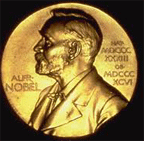 Anti-nuclear Nobel nomination ‘exciting’ http://www.radionz.co.nz/news/national/297588/anti-nuclear-nobel-nod-‘exciting‘ Alexa Cook, 26 Feb 16 – alexa.cook@radionz.co.nz
A New Zealander working on a lawsuit to hold nuclear powers to account is excited about the team’s nomination for a Nobel Peace Prize. Professor Roger Clark is part of an international team representing the Republic of the Marshall Islands, which includes Bikini Atoll.
Mr Clark said the team of eight lawyers had done a lot of hard work, and he was thrilled to be part of it.
“It’s an exciting thing. I think it’s a really important case and, of course, the nomination is for former RMI [Republic of the Marshall Islands] Foreign Minister [Tony] De Brum and the whole team that is working on the case.
“What we are arguing about in March is the quite technical question of jurisdiction.”
Between 1946 and 1958, the United States detonated 60 nuclear weapons on the islands, the equivalent of 1.7 Hiroshima bombs detonated daily for a dozen years.
Professor Clark, who began his law studies at Victoria University, and is now based at Rutgers University in New Jersey, said the case would be hard to win but he thought they had a shot.
The legal system in the court was quite different to others and there had been a lot of hard work, particularly in the past few weeks, he said.
“Co-ordinating eight lawyers from Italy, the UK, the US and Holland is an interesting feat and the most complicated piece of litigation I’ve ever engaged in.”
It was a strange court to argue in, he said. “You have to give them a written copy of your oral argument beforehand and then you basically read the oral argument.
“It’s not like in New Zealand or Australian court where you can have an interchange with judges.”
A statement from Rutgers University said if the team’s arguments were successful it could “further the cause of total nuclear disarmament”.
The case, which is being taken against the United Kingdom, India and Pakistan, accuses nuclear-armed states of breaching obligations under international law to negotiate in good faith to rid the world of weapons of mass destruction.
“The hearings in March explore whether these three states have properly accepted the jurisdiction of the court over the cases,” the statement said.
“The United States has declined to accept the court’s jurisdiction over these issues.”
Professor Clark had previously presented a case at the International Court of Justice on behalf of Samoa in 1995 and 1996 to outlaw nuclear weapons.
Hearings on the Marshall Islands case begin in March.
The Nobel Peace Prize Laureates will be announced in October, with a ceremony in Oslo in December.
New Canadian govt still backs nuclear industry
She was speaking on behalf of Minister of Natural Resources Jim Carr yesterday.
The federal government has asked for more information about the planned underground nuclear waste storage site in Kincardine before giving final approval…….https://blackburnnews.com/midwestern-ontario/midwestern-ontario-news/2016/02/26/federal-support-confirmed-for-nuclear-industry/
New USA nuclear missile test
 U.S. conducts nuclear missile test amid N. Korea tensions, CBS News, February 26, 2016, VANDENBERG AIR FORCE BASE, California — Like a giant pen stroke in the sky, an unarmed Minuteman 3 nuclear missile roared out of its underground bunker on the California coastline Thursday and soared over the Pacific, inscribing the signature of American power amid growing worry about North Korea’s pursuit of nuclear weapons capable of reaching U.S. soil.
India about to get a nuclear-armed submarine
India close to first nuclear-armed submarine, SMH, February 27, 2016 N.C. BipindraNew Delhi: India is close to becoming the world’s sixth country to put a nuclear-armed attack submarine into operation, a move that would give it a leg up on neighbouring Pakistan and intensify a race for more underwater weapons in Asia.
The 6000-tonne Arihant, developed over the past three decades under a secret government program, is completing its final trials in the Bay of Bengal, according to a senior navy officer who declined to be identified because he’s not authorised to speak about the program. The vessel will be operated by the navy yet remain under the direct control of India’s Nuclear Command Authority headed by Prime Minister Narendra Modi.
The deployment would complete India’s nuclear triad, allowing it to deliver atomic weapons from land, sea and air. Only the US and Russia are considered full-fledged nuclear triad powers now, with China and India’s capabilities still largely untested……… http://www.smh.com.au/world/india-close-to-first-nucleararmed-submarine-20160226-gn54ja.html#
International Atomic Energy Agency reports that Iran is abiding by nuclear agreement

 Iran Abiding by Nuclear Deal, UN Agency Says International Atomic Energy Agency’s report says Tehran keeping within limits of July agreement, WSJK By LAURENCE NORMAN Feb. 26, 2016 Iran has carried out most of its commitments under the nuclear agreement reached in July, the United Nations’ atomic agency said Friday, although for a time it exceeded the permitted amount of heavy water, which can be used to produce plutonium.
In its first report on Iran’s compliance deal since the agreement went into effect in mid-January, the International Atomic Energy Agency said Iran’s stock of heavy water had reached 130.9 tons, above the 130 tons limited permitted by the deal, the diplomats said.
However, the stockpile fell when Iran shipped 20 tons of heavy water out of the country on Wednesday. The IAEA verified the amount that was shipped, the report said.
One diplomat said the IAEA allows for a margin of error of 1 percentage point in such measurements, which means that Iran wasn’t technically over the limit…..
The nuclear deal saw Iran agree to scale back its nuclear activities and infrastructure in exchange for the lifting of tight, related sanctions imposed by the U.S., the European Union and the United Nations……. http://www.wsj.com/articles/iran-abiding-by-nuclear-deal-un-agency-says-1456515699
1 This Month

of the week – Shut Down Drone Warfare!


Tell the Ukrainian Government to Drop Prosecution of Peace Activist Yurii Sheliazhenko

Petition to revoke the licensing of the Near Surface Nuclear Disposal Facility (NSDF) at Chalk River. https://www.ourcommons.ca/petitions/en/Petition/Details?Petition=e-7247
To see nuclear-related stories in greater depth and intensity – go to https://nuclearinformation.wordpress.com
-
Archives
- April 2026 (114)
- March 2026 (251)
- February 2026 (268)
- January 2026 (308)
- December 2025 (358)
- November 2025 (359)
- October 2025 (376)
- September 2025 (257)
- August 2025 (319)
- July 2025 (230)
- June 2025 (348)
- May 2025 (261)
-
Categories
- 1
- 1 NUCLEAR ISSUES
- business and costs
- climate change
- culture and arts
- ENERGY
- environment
- health
- history
- indigenous issues
- Legal
- marketing of nuclear
- media
- opposition to nuclear
- PERSONAL STORIES
- politics
- politics international
- Religion and ethics
- safety
- secrets,lies and civil liberties
- spinbuster
- technology
- Uranium
- wastes
- weapons and war
- Women
- 2 WORLD
- ACTION
- AFRICA
- Atrocities
- AUSTRALIA
- Christina's notes
- Christina's themes
- culture and arts
- Events
- Fuk 2022
- Fuk 2023
- Fukushima 2017
- Fukushima 2018
- fukushima 2019
- Fukushima 2020
- Fukushima 2021
- general
- global warming
- Humour (God we need it)
- Nuclear
- RARE EARTHS
- Reference
- resources – print
- Resources -audiovicual
- Weekly Newsletter
- World
- World Nuclear
- YouTube
-
RSS
Entries RSS
Comments RSS
 nuclear-news