Decontamination of minds
A Japanese organization called “declaration of safety in Fukushima” (福島 安全 宣言) or something like that launched a campaign for the “decontamination of minds” (心 の 除 染) to convince that radioactivity is safe.
In a video taken in the twenty kilometers zone, sill evacuated, a person takes radiation readings and states that it is safe as it is well below 100 mSv. But the video avoids the most contaminated areas and confuses microsieverts and microsieverts / hour. When the Japanese authorities say there is no risk below 100 mSv, it is on the whole life span. To compare that value to microsieverts per hour or millisieverts per year is meaningless.
There are also videos of pseudo-scientific conferences to affirm that radiation in Fukushima is safe. The audience seems very small.
The group calls for the lifting of the evacuation orders and the return of inhabitants, and also for the restart of the declared safe nuclear reactors.
Another similar initiative, already presented by the Blog of Fukushima, has been to make children to pick up garbage along the highway 6 that passes thru the forbidden zone. This time, it was an organization called “Happy Road Net” which was the organizer. http://happyroad.net/wordpress/wp-content/uploads/2015/09/Image150915145225.pdf
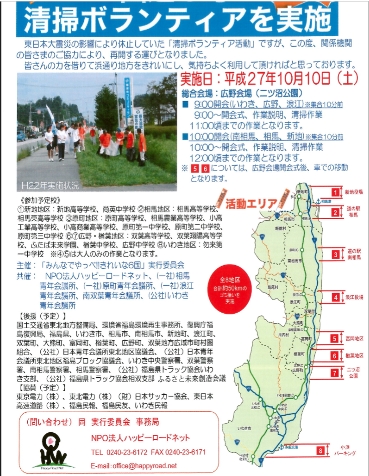
Let us remember that it is internationally recognized that there is no safe limit for radiation and that each radiation dose has an impact that is proportional to it. In such a context, it is recommended that the radiation exposure should be justified by a benefit. What was the benefit for these children?
It’s a safe bet to say that the decontamination of minds will be no more effective than the decontamination of the contaminated territories was …
Source: http://fukushima.eu.org/la-decontamination-de-lesprit/
1 Comment »
Leave a reply to naomidagenbloom Cancel reply
1 This Month

of the week – Shut Down Drone Warfare!


Tell the Ukrainian Government to Drop Prosecution of Peace Activist Yurii Sheliazhenko

Petition to revoke the licensing of the Near Surface Nuclear Disposal Facility (NSDF) at Chalk River. https://www.ourcommons.ca/petitions/en/Petition/Details?Petition=e-7247
To see nuclear-related stories in greater depth and intensity – go to https://nuclearinformation.wordpress.com
-
Archives
- April 2026 (79)
- March 2026 (251)
- February 2026 (268)
- January 2026 (308)
- December 2025 (358)
- November 2025 (359)
- October 2025 (376)
- September 2025 (257)
- August 2025 (319)
- July 2025 (230)
- June 2025 (348)
- May 2025 (261)
-
Categories
- 1
- 1 NUCLEAR ISSUES
- business and costs
- climate change
- culture and arts
- ENERGY
- environment
- health
- history
- indigenous issues
- Legal
- marketing of nuclear
- media
- opposition to nuclear
- PERSONAL STORIES
- politics
- politics international
- Religion and ethics
- safety
- secrets,lies and civil liberties
- spinbuster
- technology
- Uranium
- wastes
- weapons and war
- Women
- 2 WORLD
- ACTION
- AFRICA
- Atrocities
- AUSTRALIA
- Christina's notes
- Christina's themes
- culture and arts
- Events
- Fuk 2022
- Fuk 2023
- Fukushima 2017
- Fukushima 2018
- fukushima 2019
- Fukushima 2020
- Fukushima 2021
- general
- global warming
- Humour (God we need it)
- Nuclear
- RARE EARTHS
- Reference
- resources – print
- Resources -audiovicual
- Weekly Newsletter
- World
- World Nuclear
- YouTube
-
RSS
Entries RSS
Comments RSS
 nuclear-news
“But the video avoids the most contaminated areas and confuses microsieverts and microsieverts / hour. When the Japanese authorities say there is no risk below 100 mSv, it is on the whole life span. To compare that value to microsieverts per hour or millisieverts per year is meaningless.” There are educated Japanese: why would they buy this?