Gov’t model shows airborne radioactive plume covering entire west coast of US & Canada on Mar 22, 2011… 10 times more radioactive than plume coming from Fukushima plant on same day — Radiation levels in some plumes had no discernible decrease after crossing Pacific (VIDEO)
Published: April 8th, 2014 at 8:16 am ET
By ENENews
Fukushima Radioactive Aerosol Dispersion, NOAA: The [HYSPLIT] model was developed by NOAA to follow the transport and dispersion of pollutants in the atmosphere. In HYSPLIT, the computation is composed of four components: transport by the mean wind, turbulent dispersion, scavenging and decay. A large number of pollutant particles, which by convention are called “particles” but are just computational “points” (particles or gases), are released at the source location and passively follow the wind. […] March 11th […] by 16:36 a nuclear emergency was reported. By the early morning hours of March 12th, radioactive emissions were occurring […] the simulation from NOAA’s HYSPLIT model shows a continuous release of tracer
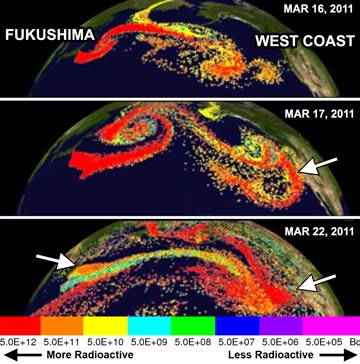
particles from 12-31 March at a rate of 100 per hour representing the Cesium-137 emitted from Fukushima Daiichi. Each change in particle color represents a decrease in radioactivity by a factor of 10.
Notable Features
- Particles with the highest radioactivity were released around March 15th [See also: UN: Fukushima Unit 2 reactor “burst” on March 15th after fuel melted — Radiation doses soon hit highest levels of crisis for many places across region]
- Particles caught in clockwise circulations are embedded in fair weather high pressure systems and their radioactivity will persist for longer periods
- In general, radioactivity reaching the United States showed air concentrations over 1000 times smaller than areas near Japan
The March 22, 2011 NOAA model (above right) shows the West Coast of US and Canada covered in red particles, while the Fukushima site — and all of Japan — are under orange particles. According to the NOAA above a “change in particle color represents a decrease in radioactivity by a factor of 10”
Evidence of Prime Minister Abe getting a sweet deal at expense of Japanese tax payers –
http://www.japan-press.co.jp/modules/news/index.php?id=7043
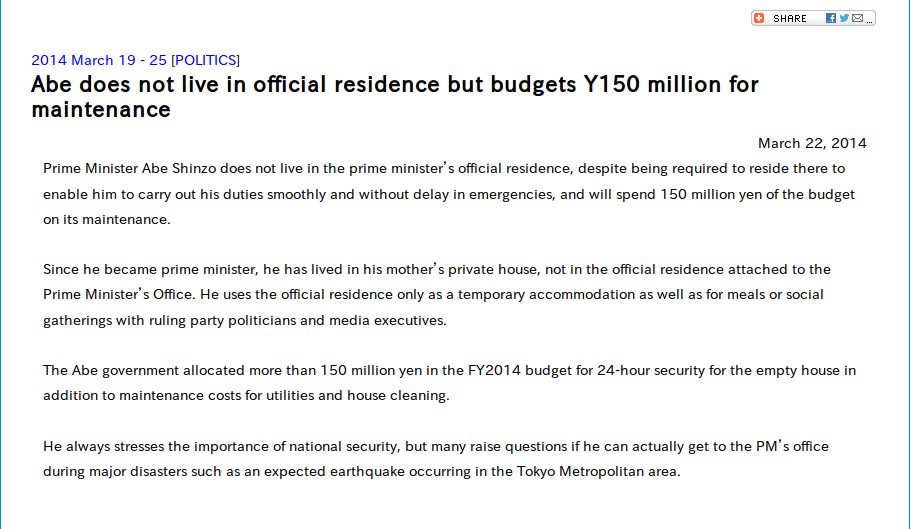
Nice Pad!!

Fukushima, nuclear censorship and attacks on activists
 13 April 2014
Op Ed by arclight 2011part2
Posted to nuclear-news.net
Times certainly have changed. I believe that our fight for human rights and justice has never been so threatened as it is today. Recent attacks are to support Japanese Prime minister Abes attempts to start ALL the reactors in Japan.
I am a UK citizen who has been shocked to find out of the lengths that the military industrial complex and associated corporations have been doing in stopping important human rights information getting to you, the public. There has been the targeting of human rights activists on a global scale using new technologies that effect the Internet and mobile communications that we take for granted as part of our everyday lives.
What happened to investigative journalism?
In recent months, if you may have been searching the Internet for information concerning human rights abuses you will have been slowly becoming aware of murmurings of state hacking and other attacks on the people who are trying to bring you information from many locations around the world on a variety of important topical situations.
The issues brought up are being clearly stated in the situation regarding Wikileaks and the Edward Snowden affair. Unfortunately, though, our brothers and sisters in the main stream medias around the world are largely unable to bring you this information because of personal and corporate threats of litigation and because of the governments and security services using various terror laws and state censorship rules to block any, what they consider, to be “dangerous information” .
In the course of my research I have been stunned to see that government departments within the UK, USA, Japan (To name but a few) being manipulated by what i believe to be the military industrial complex and connected industries and corporations. Also in the frame is large insurance investment and banking corporations.
This manipulation is far reaching and includes attacks on independent journalists, scientists, bloggers and politicians and is far reaching and pervasive.
The question of truth in Fukushima, Japan?
In 2011, I was stunned to see a large mushroom cloud appearing from Unit 3 Fukushima Daichi nuclear plant as well as the claimed “hydrogen” explosions from Units 1 and 2. The video evidence from a local Fukushima news outlet was quickly pulled from the web but not before bloggers had copied it and made it go viral. There was at least a fire in Unit 4 reactor building that was claimed to be the spent fuel pool but no video evidence supporting that has been released. Denials of any “meltdowns” of the reactor cores went on for some months in the face of obvious evidence.
My concerns for the people living in the region (some 20 million plus) caused me to investigate the cover up of the true situation. This situation has been well documented on the Internet and discussed with many posits being brought forward to describe the accident and its effects and I will not go into them fully here. The annals of blogs like www.enenews.com www.nuclear-news.net www.fukuleaks.org as well as a Japanese speaking bloggers such as tokyobrowntabby, exskf, and Fukushima Diaries to name but a few, show us a cover up of historic proportions.
Many of the Japanese translators have been shut down in many different ways and I have at least some anecdotal evidence of intimidation, violence and even murders associated with these campaigners and truth tellers.
A vicious circle.
At the end of the cold war with Russia, countries have expanded their security operations and investment instead of reigning them back. Blaming so called Muslim terrorists that they are presently supporting to attack regimes they deem as terrorist.
So whats the big deal?
I maintain that I and others have been targeted for at least a few of the posits that I have put forward and some of these are;
1) The support of Nuclear Test Veterans claims of health and genetic effects due to nuclear testing during the cold war
2) Supporting Japanese bloggers in their translations into English of the situation on the ground in Fukushima and Myiagi prefectures in Japan.
3) For uncovering military and security operations in stemming the flow of nuclear related information.
4) The censorship of media organisations by the use of litigation and terror legislation.
5) The attacks on scientists and researchers who claim health effects caused by various nuclear processes such as pollution from nuclear fuel processing and decommissioning of nuclear sites in the UK and beyond.
6) For highlighting the problems with nuclear fuel rods and high burn up techniques causing damage to the nuclear fuel rods and nuclear reactor vessels which could cause another Fukushima like disaster.
7) For supporting Professor Yablakovs and colleagues claims of high mortality and other undiscussed health effects as a result of the Chernobyl nuclear disaster.
8) For uncovering UK complicity in stifling the well proven genetic effects of the victims of the Russian nuclear tests in Semipalantisk in Kazakhstan.
9) In challenging the way in which contaminated food is being spread around the globe by corporations processing methods and the cover up/manipulation of some United Nations organisations.
10) For my findings of other nuclear related pollutions including NO2 and Lead (Pb) causing miscarriage, death and injury to UK citizens and wildlife.
11) For the suppression of genetic blood tests in Japan to hide the damage from radiation and the sidelining of geneticists in the UK and USA, by limiting funding to relevant radiation studies and research.
12) For supporting the efforts of Dr Chris Busby in bringing his years of research to the forefront of the battle against the lies being promoted by the nuclear industry.
We have fight on our hands!
I have been aided by a plethora of bloggers with a wide range interests and points of view and even encouraged by main stream media journalists and media outlets who have found that their public viewpoints have been limited by editorial concerns of litigation and personal threats and harassment of individual journalists.
Owing to the recent increase in attacks on certain key scientists, bloggers and researchers etc, I have wondered how we independent thinkers can overcome such attacks via the Internet, as have had been happening recently. How do we protect anonymity and our rights of discourse in the face of recent developments that highly encrypted services have been co-opted by various security organisations?
It was during the UK select committee investigation into the release of material stemming from the Edward Snowden affair that I caught a glimpse of one such way we could fight back against such a formidable hidden enemy.
The Editor of the Guardian was questioned by various MP`s and committee members as to the safety of the security services in light of the information that was publicly being revealed. The editor seemed to satisfy the committee as to the thoroughness of the checking procedure being used by the Guardian team assigned to extracting information that was relevant to the public good. However, one committee member, representing the UK security services threatened the editor with the new anti terrorist laws and his questioning was stopped by Timothy Yeo MP (the head of the committee). The Guardian editor responded to this threat by claiming that he was defending freedom of speech in the UK. The security services representative also seemed very distressed at the mention of TORBROWSER by the Guardian editor, a software program used by global activists and journalists to hide their IP addresses (location) and maintain their anonymity and safety. So maybe this is something that should be used?
There is also the co-operation of the USA and UK nuclear and military industries and their encouragement for Japan to militarise in line with these countries. this co-operation includes the denial of the human rights petition to the UNHCR by Anand Grover and and their support for the new Japanese “Secrets Law” that gives journalists the threat of 10 years imprisonment and bloggers the threat of 5 years in prison (if the normal litigation threats do not work) for talking about anything nuclear. The UK recently also quietly made more amendments to the UK official Secrets policy apparently to bring it in line with the Japanese and USA tact on secrecy of nuclear and health matters.
Japanese Bloggers, scientists, health proffesionals and journalists speak out!
Scientists, health professionals, media and bloggers in Japan and elsewhere have been highlighting issues with the effects of radioactive contamination in Japan and have brought to light the homeless and disabled workers of the Daichi nuclear site employed with lucrative contracts administered by the criminal Yakusa groups employed by TEPCO, the UK USA and French decommissioning specialists.
They have been also reporting on a plethora of health issues concerning people, animals and the environment that they claim are connected to the contamination in a wide area around the triple meltdown nuclear plant. And there is some peer reviewed evidence for this starting to come out.
Japanese translators are heroes.
This group I have the most admiration for. They are brave and conscientious individuals that seem to be driven by their natural compassion for life and their fellow countrymen. I have to also to include here those translators who are not of Japanese origin also. They are all the most harassed and targeted individuals, in my experience because of there on going on the ground, real time documentation of events and situations.
I need to preserve the anonymity of some of these wonderful, brave people who are so special because they are normal citizens who have taken up the job of the much beleaguered journalists and editors that would normally bring you this evidence. They are people who have been targeted by “unknown” and known forces and have done their best in the face of extreme adversity. So, my documenting of these affairs will be necessarily vague in places.
Topics covered by these translators include;
The dissemination of secretive technical issues to do with a very secretive nuclear industry, the health effects on the citizens of Fukushima and Myagi (reportedly as far away as Tokyo), the corruption within the Japanese government and Energy companies, the scandals of the Fukushima Medical Hospital and support of associated University professors throughout Japan, Corruption of voting procedures during the Japanese elections since the disaster to protect the Japanese nuclear industry from popular anti nuclear opposition and also the manipulation of any provable victims of the nuclear disaster are compensated with the addition of legal gagging orders to stop the information getting out. Indded this type of tactic was reported after the Deep water Horizon Gulf oil spill disaster (In fact Sir Martin Sorrel, CEO of Ogilvey and Maher – who are owned by WPP, are the actual company that “managed” both these disasters on behalf of BP and TEPCO, using very similar approaches to both disasters to mitigate damages to the corporations concerned)
Needless to say that many of these translators have fallen by the wayside as the forces that promote the nuclear lobby set there attentions on them.
International bloggers and You tube uploaders
This group has largely dug into the connections between military and corporate interference in how the news is managed and here the UK has excelled in promoting a little known charity called the UK Science Media Centre. This so called charity vastly increased its revenue in 2011 in the UK and also got funding to set up similar groups in Australia, Canada, Japan ( The Japan SMC web-site is not updated but is still manipulating the news behind the scenes) and the USA to manage the news coming from Japan to the world at large (as well as other topics). And these bloggers have countered this disinformation.
Fionna Fox, one of the founders of the UK Science Media Centre (who was a witness at the Leveson inquiry in the UK) wants only the “right science” to be given to the worlds public. She is strongly supported by a myriad of corporations who want their version of the “right science” to be promoted.
The topics covered by the Science media Centres worldwide also include fracking, GMO, Climate science and weather modification and she uses mainly cherry picked industry connected scientists and specialists largely ignoring the dissenting voices. And specifically this has had a profound effect on the situation in Japan and how the perception of the nuclear disaster and its aftermath is delivered to the public at large in many countries.
Of course the media also has the pressure from the likes of the WPP, the vast global PR corporation to pressure media outlets with the threat of the withdrawal of advertising revenue from any dissenting media corporation outlets.
These bloggers and you tube activists have also disseminated the information from our brothers and sisters in Japan and tried to get it out to the citizens of the world to give them warning of what might happen if a nuclear disaster should happen in another country.
The corporation that said enough is enough! A fresh start?
Considering that Yahoo has recently relocated its servers to Ireland in an attempt to protect peoples data and because they are aware of a global manipulation of the internet to stop embarrassing and possibly costly information (for politicians and corporations) reaching the eyes and ears of the public at large, it would give some credence to – at least – some of the so called conspiracy claims that can be found on the Internet. The evidence to support Yahoo`s position can also be seen in the way that the establishment are acting in relation to both Julian Assange (Wikileaks) and the Edward Snowden release of data to the Guardian, New York Times and associated blogs (ie. The interceptor – Glen Greenwald).
Finally, I would like to explain that some of these conspiracy claims are being promulgated to hide and create confusion to the real conspiracies that are happening and this is backed up by the release of intelligence training manuals showing how JTRIG manipulates discourse on the Internet.
I believe that the time has come to save the Internet or face the results of ignoring this threat to freedom of expression and thought. It is may also be our last chance to save the people of Fukushima and Myagi from a long future of experimentation, ill health and even death.
I hope that whoever receives this article will share and discuss the issues that I have outlined. I am only touching the tip of the iceberg in this article and therefore only touching on some of the issues raised by my findings and posits.
Will you stand back and allow the powerful interests to destroy centuries of social, judicial and human rights development? I hope not, for the children of Japan and other radioactively contaminated regions and for your children. if we do not make a stand concerning the environmental catastrophes that loom before us, what sort of fate awaits will us all?
Arclight
Thank you to all those that have informed my findings and have challenged my posits and have allowed me to put together all the above (you know who you are).
Lets hope for a better future and a kinder world, if not……….?
Sources for some relevant information
Japan risks public outcry as it brings back nuclear power – 48 NPP`s to restart!
Plant operators have already paid out hundreds of millions of pounds on replacement fossil fuels, with media reports estimating that more than £9 billion will need to be spent on facility upgrades to meet required safety standards.
“I think it is unavoidable that the Japanese utilities will write off most of their nuclear ‘assets’ and move on,” said Mycle Schneider, an independent energy consultant based in Paris.
12:15PM BST 11 Apr 2014
The Japanese government approved a new energy policy backing nuclear power on Friday despite widespread public wariness in the aftermath of the Fukushima disaster.
The new policy highlighted nuclear energy as an “important baseload power source”, marking a clear U-turn from the previous government’s plans to phase out atomic energy.
The new plans are expected to pave the way for the government to restart the nation’s 48 viable nuclear reactors, all of which are currently off-line as a result of safety checks prompted by the 2011 disaster in Fukushima.
The new plan is also believed to include a strong focus on renewable energy generation, such as solar, wind and hydropower, with a ministerial level group established in order to boost such energy sources.
“We aim to opt for an energy supply system which is realistic, pragmatic and well balanced,” Toshimitsu Motegi, Japan’s trade and industry minister, told reporters.
The decision is likely to be unpopular among the Japanese public, which has been unusually vociferous in its widespread opposition to the use of nuclear energy as a result of the Fukushima incident.
The nuclear disaster, the world’s worst since the 1986 Chernobyl accident, triggered a widespread anti-nuclear backlash among the public and a surge in renewable energy projects.
The government’s new policy was approved just days after the first evacuees from Fukushima were permitted to return to their homes inside the exclusion zone more than three years after the disaster.
Against public opinion Japanese government goes for nuclear power
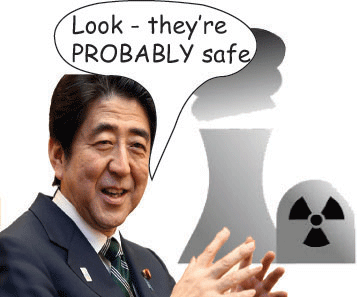 Japanese govt. abandons nuclear-free future in face of public opposition RT.com: April 11, 2014 The Japanese government has overturned its predecessor’s energy plan that would see all of the country’s nuclear power plants closed by 2030. The move – which has been opposed by the public – has been forced by spiraling energy costs.
Approved by the Liberal Democratic Party, which was not in power in 2011 when the Fukushima nuclear accident occurred, nuclear power has been described in the 20-year-plan as an “important baseload power source” – meaning its steady output will be fundamentally relied on for steady electricity generation.
“We aim to opt for an energy supply system which is realistic, pragmatic and well balanced,” Trade and Industry Minister Toshimitsu Motegi told the media on Friday.
Motegi said that the exact role of nuclear power in the energy mix would be decided once the state of its beleaguered energy industry would become clear in three or four years, but stressed that nuclear energy offered “security”.
A March survey showed that 59 percent of Japanese opposed the re-start of nuclear reactors, and only 12 percent had “no” or “minimal concerns” about the potential for another serious nuclear accident in Japan.
All 48 of Japan’s nuclear reactors are currently offline.
The government has ordered energy companies to spend over $16 billion upgrading its outdated and seismically vulnerable facilities to avoid a repeat of the worst nuclear accident since the Chernobyl accident in 1986.
This comes on top of the projected $100 billion cost of clearing-up the pollution and radioactive remains of the damaged Fukushima facility itself. …….
he reintroduction of nuclear may be too costly to solve the country’s energy shortfall.
Reuters recently compiled a report saying that it would make no economic sense to revive two-thirds of the country’s plants under the current stringent operating criteria.
“I think it is unavoidable that the Japanese utilities will write off most of their nuclear ‘assets’ and move on. Given the slim realistic prospects for a major nuclear share, the challenge will be flexibility and the whole baseload concept flies out of the window,” Mycle Schneider, a Paris-based energy consultant told the news agency.
The government’s energy plan also reserves a bigger role for renewable sources, which it says will double from the current 10 percent of the overall energy mix in the next sixteen years.
While green energy has widespread public support, this may be another plan that will require extra subsidy from government coffers flushed out by the 2011 natural disaster and the subsequent attempts to rectify previous mismanagement of the energy industry. http://rt.com/news/japan-nuclear-plan-fukushima-992/
Terrorism risk ignored, as Japan plans to produce plutonium
Japan reaffirms its plan to produce plutonium, Center for Public Integrity
The Abe government’s new energy plan calls for completing the Rokkasho plutonium fuel factory despite U.S. concern it poses terrorism risks By Douglas BirchemailJake Adelstein 12 April 14
Just weeks after Japan pledged to return hundreds of pounds of plutonium to the United States for disposal, the Japanese government on April 11 formally endorsed the completion of a factory designed to produce as much as eight tons of the nuclear explosive annually.
The plant is among the key elements of a long-range energy plan approved by Prime Minister Shinzo Abe’s cabinet, reversing the previous government’s efforts to phase out nuclear power in the wake of the March 2011 Fukushima disaster. The move is generally viewed in Japan as unpopular with the public but has been welcomed by Japan’s utilities, which are struggling with massive debts.
 The mammoth plant in the village of Rokkasho, scheduled to be completed in October, is meant to extract plutonium from spent commercial reactor fuel so it can be used in fresh fuel to be burned in the country’s reactors. “With safety first in mind always, Japan will promote…the completion of Rokkasho,” the energy plan states.
Publicly, the Obama administration has said little about Rokkasho, located on the Pacific Coast about 1,000 miles north of Tokyo. But privately, U.S. officials and experts say they are worried that Japan’s operation of the $22 billion facility – in the wake of the country’s closure of most of its nuclear power plants — will add unnecessarily to its existing stockpile of 44 tons of plutonium, some of which is stored in Japan and some in Europe.
U.S. officials have complained to their Japanese counterparts that the plant lacks an adequate security force, making it a potential target for terrorists. They have also urged Japan to subject the plants’ workers to stringent background checks, a move the Japanese see as being at odds with privacy traditions. U.S. experts also have expressed concern that the plant’s operation will encourage other countries, including South Korea, to constructsimilar plutonium factories.
Japan’s stockpile of plutonium today ranks fifth in the world, behind four nuclear-weapons states. The Chinese government in recent weeks has repeatedly expressed concern about Japan’s plans to produce plutonium “far exceeding its normal needs.”
Tokyo’s decision to proceed follows a joint announcement on March 24 by Abe and President Obama and Abe, at the Nuclear Security Summit in the Netherlands, that Japan would return hundreds of pounds of plutonium and weapons-grade uranium it received under the U.S. Atoms for Peace program in the 1960s and 1970s.
The two leaders said the transfer would further “our mutual goal” of keeping global stocks of nuclear explosive materials to a minimum, to keep them out of the hands of terrorists.
But critics say Rokkasho’s operation would violate that goal……..
Many communities in Japan are dependent on a stream of payments by the federal government to promote the siting of nuclear power plants, but a few have recently expressed concerns about the burning of plutonium-laced reactor fuels.
In early April, the city of Hakodate sued to halt work on a reactor that would be the first to burn such fuel. Hakodate’s Mayor Toshiki Kudo told reporters in Tokyo Thursday that the government and utility had ignored a plea from the municipality to suspend work on the Ohma plant and made “a unilateral announcement that it would go ahead with construction.”
Kudo called the plant “a terrorist target,” and said it could pose a greater safety risk than reactors fueled in other ways.
Angela Erika Kubo contributed to this article from Tokyo. http://www.publicintegrity.org/2014/04/11/14582/japan-reaffirms-its-plan-produce-plutonium
The “ethics” of expenditure on nuclear weapons
Budgets as Moral Documents Nuclear Weapons and the Fate of Life http://www.counterpunch.org/2014/04/11/nuclear-weapons-and-the-fate-of-life/by ROBERT DODGE
 April 15th, Tax Day, our nation funds our national budget. On this day we fund the nation’s business and provide a proclamation to the world of the U.S. priorities for the next year. Ultimately, because they reveal our choices, budgets are moral documents and are supposed to represent the people’s priorities.
What are those priorities? Surveys show them to be education, economic security, environmental protection, healthcare, climate change, peace and security. With so many challenges facing us as a nation and planet how will we wisely provide for our future and spend our finite treasure on infinite need? We must ask, are there opportunities to reallocate funds to more pressing needs?
 Unfortunately, in our current dysfunctional national body politic, there lacks the leadership and courage to address and answer these questions.
Nuclear weapons programs provide an obvious example of the misallocation of resources. This year the United States will spend roughly $57 billion on nuclear weapons programs. Weapons that must never be used, are militarily purposeless, and threaten our very survival every moment of their existence. These illegal, immoral weapons are an example of the disconnect between rhetoric and reality.
The dollars diverted from communities to finance these programs literally rob communities of precious funds that could be spent on urgent needs. Examples of community nuclear weapons programs expenditures for tax year 2013 range from Ventura County, California spending $176 million to Seattle wasting $172 million, Los Angeles misspending $1.7 billion and New York City throwing away $1.69 billion. To find other examples or calculate your personal contribution go to www.c-p-r.net. Each of us must ask ourselves if this is acceptable.
The impossibility of using these weapons was shown in a report by the International Physicians for Social Responsibility this past year on the humanitarian consequences of nuclear war. It demonstrated that 2 billion people are at risk of death from catastrophic climate change following a limited nuclear exchange using less than ½ of 1 percent of the global nuclear arsenals.
The world’s nuclear arsenals contain 17,000 nuclear weapons and a full scale nuclear war between the nuclear super powers would end life as we know it.
Last year’s important book by Eric Schlosser, Command and Control, combined with our own military’s recent revelations of compromised nuclear missile officers highlight how sheer luck continues to be an important component preventing the unleashing of these apocalyptic weapons.
The use, threat of use, and even the possession of these weapons was declared virtually entirely illegal by the International Court of Justice in 1996. The United States and P5 nuclear states are in breach of Article VI of the Nuclear Non-Proliferation Treaty that commits us to good faith efforts to work toward nuclear disarmament. Here is the disconnect between rhetoric and reality. While professing the vision of a world without nuclear weapons we continue to ‘modernize’ our B-61 nuclear gravity bomb and work on our entire nuclear stockpile and delivery systems projected to cost $1 trillion over the next 30 years.
Fortunately the non-P5 nuclear nations of the world are taking matters into their own hands. In meetings this year in Germany, Norway and Mexico, approximately 150 nations met to discuss the humanitarian consequences of nuclear war and are moving toward a nuclear weapons convention, a ban on nuclear weapons similar to previous conventions on chemical and biological weapons and landmines.
So ultimately this tax season as so often in the past, we will pay out of our pockets for something most of us abhor, financing our own instruments of national suicide. As a people, the choice is ours—or in the end there may be no choice. Will we stand on the right side of history or will we continue down our present course?
Robert Dodge is a family physician in Ventura, California. He serves on the board of Physicians for Social Responsibility Los Angeles (www.psr-la.org) and on the board of the Nuclear Age Peace Foundation (www.wagingpeace.org). He writes for PeaceVoice (www.PeaceVoice.info).
PRISM an ugly magic trick from the nuclear lobby
http://www.no2nuclearpower.org.uk/nuclearnews/NuClearNewsNo61.pdf
 The U.S. corporation GE Hitachi (GEH) is promoting a reactor design called the PRISM (Power Reactor Innovative Small Modular) that its chief consulting engineer and fast-breeder guru, Eric Loewen, says is a safe and secure way to power the world using yesterday’s nuclear waste – he means plutonium which hasn’t officially been classified as waste in the UK. The Nuclear Decommissioning Authority has declared PRISM to be a “credible option” for managing the UK’s plutonium stockpile.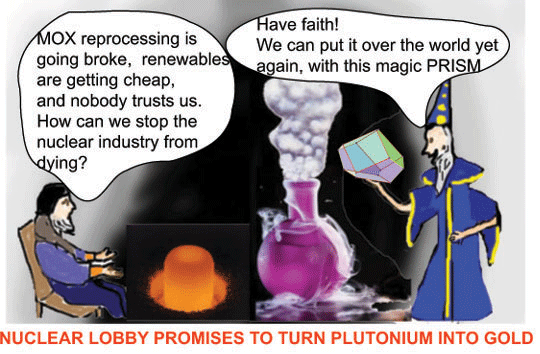
Failure of Waste Isolation Pilot Plant (WIPP) has global implications
NuClear News No.61 April 2014 WIPP failure has global implications WIPP has played a crucial part in the history of nuclear waste proposals in the UK. In 1989, in the run-up to a referendum in Caithness in November of that year on whether or not to allow Nirex to search for a deep disposal site in the County, the Head of Information Services at Dounreay used WIPP as an example of a successful waste disposal site in an article he wrote for the John ‘O Groat Journal. In response a letter from the US Radioactive Waste Campaign described the article as “an outright lie”. McRoberts had claimed that WIPP was already receiving shipments and that the repository was dry. In fact the repository remained unopened at the time because in 1987 salt-laden water was fund to be seeping inside. One State Senator told the New Mexico press that:
 “Given that long-lived nuclear wastes are dangerous for thousands of generations, emplacing them deep underground is a possible ‘solution,’ but it certainly isn’t ‘guaranteed,’ ” he said. “Neither WIPP, nor the proposed Yucca Mountain site in Nevada, are ‘ideal’ and meet publicly accepted standards. Both sites were picked for political, not technical, reasons, so it is not surprising that they are inadequate.”
Small Modular Nuclear Reactors a dodgy dream
 But the safety of the proposed compact designs is unproven—for instance, most of the designs call for weaker containment structures. And the arguments in favour of lower overall costs for SMRs depend on convincing Nuclear Regulators to relax existing safety regulations.
Nuclear lobby’s new gimmick -thorium reactors, does not impress
 NuClear News No.61 April 2014 There’s a modern mythology that suggests that thorium might be able to replace uranium and deliver a safer and cheaper nuclear reactor with more abundant fuel. In March press reports suggested that Chinese scientists have been told to accelerate plans to build the first fully-functioning thorium reactor within ten years, instead of 25 years as originally planned. The Telegraph said they “may do the world a big favour. They may even help to close the era of fossil fuel hegemony.” (1)
Jan Beránek, leader of Greenpeace International’s Energy Campaign says we’ve heard all this before. Thorium technology is in principal based on nuclear fission and therefore keeps fission’s inherent problems. While it partially addresses some of the downsides of current commercial reactors based on uranium (plutonium) fuel, such as limited reserves of uranium and unwanted production of plutonium and transuranic isotopes, it still has significant issues related to fuel mining and fabrication, reactor safety, production of dangerous waste, and the hazards of the proliferation of nuclear weapons. (2)
The Union of Concerned Scientists point out that thorium cannot be used by itself to sustain a nuclear chain reaction: it must be used together with a fissile material such as enriched uranium, uranium-233, or plutonium. The U.S. Department of Energy has concluded after a review that “the choice between uranium-based fuel and thorium-based fuel is seen basically as one of preference, with no fundamental difference in addressing the nuclear power issues [of waste management, proliferation risk, safety, security, economics, and sustainability].” (3)
UCS continues some people believe that liquid fluoride thorium reactors, which would use a high-temperature liquid fuel made of molten salt, would be significantly safer than current-generation reactors. However, such reactors have major flaws. There are serious safety issues associated with the retention of fission products in the fuel, and it is not clear these problems can be effectively resolved. Such reactors also present proliferation and nuclear terrorism risks because they involve the continuous separation, or “reprocessing,” of the fuel to remove fission products and to efficiently produce U-233, which is a nuclear weapon-usable material. Moreover, disposal of the used fuel has turned out to be a major challenge.
Even the UK Department of Energy and Climate Change commissioned a report which concluded in 2012 that the claims by thorium proponents who say that the radioactive chemical element makes it impossible to build a bomb from nuclear waste, leaves less hazardous waste than uranium reactors, and that it runs more efficiently, are “overstated“.http://www.no2nuclearpower.org.uk/nuclearnews/NuClearNewsNo61.pdf
Fukushima radioactive leak was much worse than first stated by TEPCO
 TEPCO says Aug. water leak from tank was far more contaminated http://www.globalpost.com/dispatch/news/kyodo-news-international/140411/tepco-says-aug-water-leak-tank-was-far-more-contaminat Kyodo News International April 11, 2014 Tokyo Electric Power Co. said Friday that toxic water found to have leaked last August at one of the huge tanks at the accident-hit Fukushima Daiichi nuclear power plant was far more contaminated than initially announced.
After recalculating the radiation level, TEPCO said the water contained 280 million becquerels per liter of beta ray-emitting radioactive materials such as strontium-90, instead of 80 million becquerels.
A total of 300 tons of toxic water was found to have leaked at that time, part of which is believed to have flowed into the adjacent Pacific Ocean. The Nuclear Regulation Authority assessed the severity of the incident to be level 3 on an eight-point international scale.
TEPCO decided to review data on 173 water samples it took until last October, as it found readings may be lower than actual figures due to improper measurement.
As for 104 samples, TEPCO analyzed them again as it had kept them. But the utility did not have the remaining 69 samples, including the water that leaked, so it calculated the radiation level by using a theoretical formula.
History of Peace Ships on the oceans
 A Peace Ship’s Challenge to Nukes, Consortium News.com April 10, 2014In the 1950s, as the United States obliterated Pacific islands to test hydrogen bombs, anti-nuclear activists challenged this devastation by trying to sail a ship, The Golden Rule, into the test zone, a protest that helped create political pressure for a nuclear test ban, as Lawrence S. Wittner recalls. By Lawrence S. Wittner
Is there an emotional connection between the oceans and the pursuit of peace? For whatever reason, peace ships have been increasing in number over the past century. Probably the first of these maritime vessels was the notorious Ford Peace Ship of 1915, which stirred up more ridicule than peace during World War I.
Almost 40 years later, another peace ship appeared ― the Lucky Dragon, a Japanese fishing boat showered with radioactive fallout from an enormous U.S. H-bomb explosion on March 1, 1954, in the Marshall Islands. By the time the stricken vessel reached its home port in Japan, the 23 crew members were in advanced stages of radiation poisoning. One of them died.
This “Lucky Dragon incident” set off a vast wave of popular revulsion at nuclear weapons testing, and mass nuclear disarmament organizations were established in Japan and, later, around the world. Thus, the Lucky Dragon became a peace ship, and today is exhibited as such in Tokyo in a Lucky Dragon Museum, built and maintained by Japanese peace activists.
Later voyages forged an even closer link between ocean-going vessels and peace. In 1971, Canadian activists, departing from Vancouver, sailed a rusting fishing trawler, the Phyllis Cormack, toward the Aleutians in an effort to disrupt plans for a U.S. nuclear weapons explosion on Amchitka Island. Although arrested by the U.S. Coast Guard before they could reach the test site, the crew members not only mobilized thousands of supporters, but laid the basis for a new organization, Greenpeace.
Authorized by Greenpeace, another Canadian, David McTaggart, sailed his yacht, the Vega, into the French nuclear testing zone in the Pacific, where the French navy deliberately rammed and crippled this peace ship. In 1973, when McTaggart and the Vega returned with a new crew, French sailors, dispatched by their government, stormed aboard and beat them savagely with truncheons.
During the late 1970s and early 1980s, peace ships multiplied. At major ports in New Zealand and Australia, peace squadrons of sailboats and other small craft blocked the entry of U.S. nuclear warships into the harbors. Also, Greenpeace used the Rainbow Warrior to spark resistance to nuclear testing throughout the Pacific.
Even after 1985, when French secret service agents attached underwater mines to this Greenpeace flagship as it lay in the harbor of Auckland, New Zealand, blowing it up and murdering a Greenpeace photographer in the process, the peace ships kept coming.
Much of this maritime assault upon nuclear testing and nuclear war was inspired by an American peace ship, the Golden Rule. The remarkable story of the Golden Rule began with Albert Bigelow, a retired World War II U.S. naval commander. Appalled by the atomic bombing of Hiroshima, he became a Quaker and, in 1955, working with the American Friends Service Committee, sought to deliver a petition against nuclear testing to the White House……..
Even as test ban negotiations proceeded fitfully, leading to the Partial Test Ban Treaty of 1963 and, ultimately, to the Comprehensive Test Ban Treaty of 1996, the Golden Rule dropped out of sight. Then, in early 2010, the vessel was discovered, wrecked and sunk in northern California’s Humboldt Bay.
Contacted by historians about preserving the Golden Rule for posterity, officials at the Smithsonian Museum proved uninterested. But peace activists recognized the vessel’s significance. Within a short time, local chapters of Veterans for Peace established the Golden Rule Project to restore the battered ketch.
Thanks to volunteer labor and financial contributions from these U.S. veterans and other supporters, the ship has been largely rebuilt, and funds are currently being raised for the final stage of the project. Veterans for Peace hope to take the ship back to sea in 2014 on its new mission: “educating future generations on the importance of the ocean environment, the risks of nuclear technology, and the need for world peace.”
As a result, the Golden Rule will sail again, restored to its role as America’s most important peace ship.
Lawrence Wittner (http://lawrenceswittner.com), syndicated by PeaceVoice, is Professor of History emeritus at SUNY/Albany. His latest book is What’s Going On at UAardvark? (Solidarity Press), a satirical novel about campus life. http://consortiumnews.com/2014/04/10/a-peace-ships-challenge-to-nukes/
Health danger from electromagnetic radiation, as well as from ionising radiation
New Studies Show Health Risks from Wireless Tech: Warnings from the BioInitiative Working Group http://www.businesswire.com/news/home/20140411005708/en/Studies-Show-Health-Risks-Wireless-Tech-Warnings April 11, 2014 RENSSELAER, N.Y.–(BUSINESS WIRE)--The BioInitiative Working Group says evidence for health risk from wireless tech is growing stronger and warrants immediate action. The Group released a mid-year update covering new science studies from 2012 to 2014.
New studies intensify medical concerns about malignant brain tumors from cell phone use. “There is a consistent pattern of increased risk for glioma (a malignant brain tumor) and acoustic neuroma with use of mobile and cordless phones,” says Lennart Hardell, MD, PhD at Orebro University, Sweden, according to studies released in 2012 and 2013. “Epidemiological evidence shows that radiofrequency should be classified as a known human carcinogen. The existing FCC/IEEE and ICNIRP public safety limits are not adequate to protect public health.”
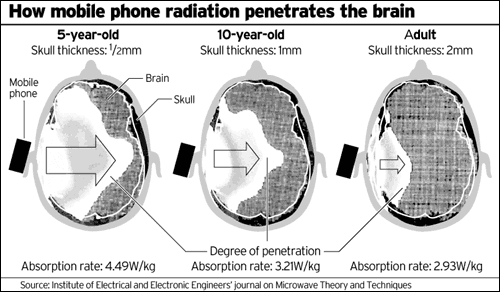
The BioInitiative reports nervous system effects in 68% of studies on radiofrequency radiation (144 of 211 studies) in 2014. This has increased from 63% in 2012 (93 of 150 studies) in 2012. Studies of extremely-low frequency radiation are reported to cause nervous system effects in 90% of the 105 studies available in 2014. Genetic effects (damage to DNA) from radiofrequency radiation is reported in 65% (74 of 114 studies); and 83% (49 of 59 studies) of extremely-low frequency studies.
Mobile wireless devices like phones and tablets are big sources of unnecessary biological stress to the mind and body that can chip away at resilience over time. The Report warns against wireless in schools. Schools should provide internet access without Wi-FI.
“It is essentially an unregulated experiment on childrens’ health and learning. Microwave from wireless tech disrupts thinking – what could be worse for learning? Technology can be used more safely with wired devices that do not produce these biologically-disruptive levels of microwave radiation,” said Cindy Sage, Co-Editor of the BioInitiative Report.
Federal programs like ConnectED and E-Rate are calling for wireless classrooms while ignoring the health evidence. Hyperactivity, concentration problems, anxiety, irritability, disorientation, distracted behavior, sleep disorders, and headaches are reported in clinical studies.
Government reviews on health impacts of wireless radiofrequency radiation from the European Union and Australia continue to be inconclusive largely because they require certainty before issuing warnings. The FCC review of health impacts from wireless technologies is still underway, but has not affected the federal push for wireless classrooms.
Contacts
BioInitiative Working Group
David O. Carpenter, MD
(518) 525-2660
dcarpenter@albany.edu
info@bioinitiative.org
www.bioinitiative.org
Fire on ship carrying uranium – news covered up
 There is new information about what the Atlantic Cartier had on board when it caught fire in Hamburg last year. http://atlanticcartier.info/ April 10, 2014
A news report in the HAMBURG taz dated April 3rd states: –
‘The Atlantic Cartier that caught fire May 1st, close to the opening of the 34th EvangelicalChurch Day, which had attracted thousands of people. (The first report said ‘onethousand’.)
Only two weeks later was the true situation revealed. It contained 3.8 tonnes ofammunition, 180 tons of explosive ethanol, as well as 8.9 tons of uranium hexafloride andeleven tons of unused, fresh uranium fuel rods.’
This is the first report which we have seen which mentions that the ship was carrying fresh uranium fuel rods.
In the middle of March another Atlantic Container Line (ACL) ship, the Atlantic Companion, was involved in an ‘accident’ at the Halifax, Nova Scotia, north-end Ceres terminal. On this occasion four containers of uranium hexafluoride were dropped while being loaded aboard the ship.
Bibby Reply
In reply to our recent open letter to Bibby Ship Management we received the following from the company:-
‘ It is Bibby Ship Management’s policy not to discuss individual vessels or cargo detailshowever all of our vessels are managed and operated in line with the highest internationally agreed standards of vessel safety and pollution prevention.’
This is the full extent of the companies willingness to answer any of the many questionswhich we would like to put to them.
1 This Month
26 April – Chernobyl: Inside the Meltdown airs on National Geographic on Sunday 26th April from 4pm

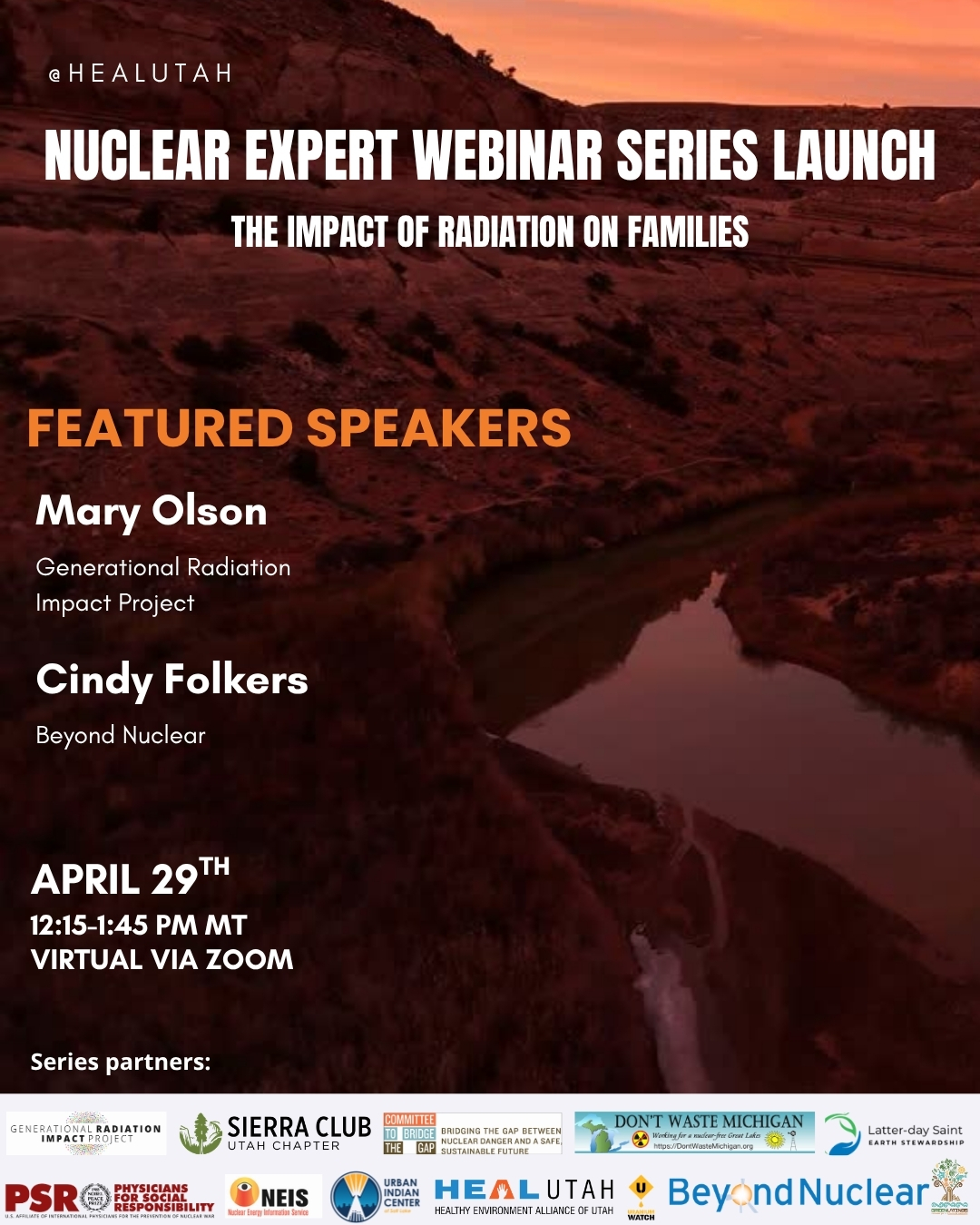
29 April – Nuclear Expert Webinar #1 – Radiation Impacts on Families with Mary Olson and Cindy Folkers
- 12:15 PM MT – 1:45 PM MT
- Location: Virtual – REGISTER TODAY

4 May -West Suburban Peace Coalition to discuss Iran war at May Educational Forum
Monday, May 4, 7:00 – 8:00 PM Central Standard Time
Title: : How Trump’s Narrative Tries to Shape the Reality of the War on Iran.
Contact Walt Zlotow, zlotow@hotmail.com 630 442 3045 for further information
14 May – online event From Bombs to Data Centres: the Face of Nuclear Colonialism

Pine Ridge Uranium is the real threat, not Tehran- Tell Burgum: Stop the Extraction.
Chernobyl: The Lost Tapes – A good documentary on Chernobyl on SBS available On Demand for the next 3 weeks– https://www.sbs.com.au/ondemand/tv-program/chernobyl-the-lost-tapes/2352741955560
To see nuclear-related stories in greater depth and intensity – go to https://nuclearinformation.wordpress.com
-
Archives
- April 2026 (288)
- March 2026 (251)
- February 2026 (268)
- January 2026 (308)
- December 2025 (358)
- November 2025 (359)
- October 2025 (376)
- September 2025 (257)
- August 2025 (319)
- July 2025 (230)
- June 2025 (348)
- May 2025 (261)
-
Categories
- 1
- 1 NUCLEAR ISSUES
- business and costs
- climate change
- culture and arts
- ENERGY
- environment
- health
- history
- indigenous issues
- Legal
- marketing of nuclear
- media
- opposition to nuclear
- PERSONAL STORIES
- politics
- politics international
- Religion and ethics
- safety
- secrets,lies and civil liberties
- spinbuster
- technology
- Uranium
- wastes
- weapons and war
- Women
- 2 WORLD
- ACTION
- AFRICA
- Atrocities
- AUSTRALIA
- Christina's notes
- Christina's themes
- culture and arts
- Events
- Fuk 2022
- Fuk 2023
- Fukushima 2017
- Fukushima 2018
- fukushima 2019
- Fukushima 2020
- Fukushima 2021
- general
- global warming
- Humour (God we need it)
- Nuclear
- RARE EARTHS
- Reference
- resources – print
- Resources -audiovicual
- Weekly Newsletter
- World
- World Nuclear
- YouTube
-
RSS
Entries RSS
Comments RSS
 nuclear-news