No shortage of uranium: economics will kill nuclear power before that’s any concern
Enough Uranium, but Nuclear Power Is Still Shrinking http://www.truthdig.com/report/item/enough_uranium_but_nuclear_power_is_still_shrinking_20140412 By Paul Brown, Climate News Network This piece first appeared at Climate News Network.
LONDON—There is enough uranium available on the planet to keep the world’s nuclear industry going for as long as it is needed. But it will grow steadily more expensive to extract, because the quality of the ore is getting poorer, according to new research.
Years of work in compiling information from around the world has led Gavin M. Mudd from Monash University in Clayton, Australia to believe that it is economic and political restraints that will kill off nuclear power and not any shortage of uranium, as some have claimed.
Writing in the journal Environmental Science & Technology that renewables do not have the disadvantages of nuclear power, which needs large uranium mines that are hard to rehabilitate and which generates waste that remains dangerous for more than 100,000 years.
In addition, research shows that renewable technologies are expanding very fast and could produce all the energy needs of advanced economies, phasing out both fossil fuels and nuclear.
Mudd, who is a lecturer in the department of civil engineering at Monash, has compiled decades of data on the availability and quality of uranium ore. He concludes that, while uranium is plentiful, mining the ore is very damaging to the environment and the landscape.
It is expensive to rehabilitate former mines, not least because of the dangerous levels of radiation left behind. As a result many of the potential sources of uranium will not be exploited because of opposition from people who live in the area.
‘Too cheap to meter’
His paper examines the history of uranium mining and its wild fluctuations in price. These have little to do with supply, but rather with demand that is badly affected by nuclear accidents like Chernobyl and Fukushima, and by the political decisions by governments to embark on new nuclear building programmes, or to abandon them.
“Despite the utopian promise of electricity ‘too cheap to meter’, nuclear power remains a minor source of electricity worldwide”, Mudd writes. In 2010 it accounted for 5.65% of total primary energy supply and was responsible for 12.87% of global electricity supply. Both contributions have effectively been declining through the 2000s.
“Concerns about hazards and unfavourable economics have effectively slowed or stopped the growth of nuclear energy in many Western countries since the 1980s.”
The Fukushima accident in Japan has accelerated the trend away from nuclear power. The growth in projects in some countries, notably China, Russia and India, does not offset the fact that many more nuclear power stations will reach retirement age over the next 15-20 years than will be constructed.
Among the factors Mudd considered in the fluctuation of supply was the conversion of Russian and American nuclear weapons into power station fuel supplying 50% of American needs since the mid-1990s, and 20% of global uranium supply. This has not materially affected the long-term supply of uranium.
Mining blighted
Another issue that is more politically contentious is the high cost of rehabilitating mines, notably in Germany and the US. In many of the countries where uranium has been mined and no rehabilitation attempted, the prospect of further mining is blighted. Mudd gives the examples of Niger, Gabon, Argentina and Brazil, where there has been considerable public opposition to opening up fresh deposits as a result.
If these resources and other uranium deposits elsewhere in the world are to be exploited, Mudd argues, the issue of rehabilitating existing and future mines needs to be addressed.
“There is a critical need for a thorough and comprehensive review of the success (or otherwise) of global U mine rehabilitation efforts and programmes; such a review could help synthesise best practices and highlight common problems and possible solutions,” he says.
The paper also examines in detail the quality of the ore and the difficulty of extracting uranium from various rocks. Mudd concludes that as time passes the richer ores in the rocks that are easiest to extract are becoming scarce.
As a result, for each pound of uranium extracted more greenhouse gases are generated, adding to the CO2 emissions of nuclear power. However, he believes, in the overall comparisons of various energy systems the increase is only marginal.
“The future of nuclear power clearly remains contested and contentious — and therefore difficult to forecast accurately. While some optimists remain eternally hopeful, reality appears to be relegating nuclear power to the uneconomic category of history.
“Overall, there is a strong case for the abundance of already known U resources, whether currently reported as formal mineral resources or even more speculative U sources, to meet the foreseeable future of nuclear power. The actual U supply into the market is, effectively, more an economic and political issue than a resource constraint issue,” Mudd says.
Risks of uranium tailings to Las Vegas water in floods
A flood through Moab uranium tailings could poison Las Vegas drinking water An unseasonable flood through a 17 million ton uraniam tailing pile 500 miles upstream in Moab, Utah could spell the end of Las Vegas valley’s drinking water supply. Isn’t it about time mainstream science started paying attention to radiation remediation methods? by Sterling D. Allan Pure Energy Systems News , 13 April 14
Fukushima saw a situation in which the engineers who built the facility did not properly anticipate the magnitude of storm that ended up hitting the facility on March 11, 2011. Their having put the emergency pumps in the basement further shows their total denial about what mother nature could do.
Such a catastrophe actually hangs over Las Vegas as well, and the extend of mother nature’s unleashing wouldn’t be that high above normal. Ninety percent of Vegas valley’s drinking water comes from the Lake Mead reservoir, which is in the Colorado River drainage (source) — about 500 miles downstream from a 17 million ton uranium tailing pile in Moab, Utah. There is no containment berm protecting the pile from an unseasonably flooding Colorado River. Below is an email I received today from my New Energy Congress associate, Gary Vesperman, who lives in Boulder City, Nevada, neighboring Lake Mead. I share this for two reasons. One, to hopefully prevent such a thing from unfolding by spurring remedial measures; and second, to get you scientists among us thinking more about how we can remediate radiation in general.
It’s an email Gary wrote to John Hutchison, who has working on nuclear remediation for several years, and is coming up with some promising results……..http://pesn.com/2014/04/13/9602470_Flood-through-Moab-Uranium-tailings_could-poison-Vegas-drinking-water/
UK defence chiefs angry over Scotland’s ‘no nuclear’ policy
Defence chiefs go on attack over Nats’ ‘no nuclear’ policyALEX Salmond’s plan to scrap Trident after Scottish independence would put the UK’s nuclear deterrent in jeopardy, senior defence figures have warned. http://www.express.co.uk/news/uk/470464/Defence-chiefs-go-on-attack-over-Nats-no-nuclear-policy
Japan Government malfeasance regarding the nuclear crisis is criminal
Japan’s Radioactive Potemkin Village: The Government’s Double-Dealing Data, rense.com. By Richard Wilcox, PhD, 4-12-14 “……..Plume Of Doom
Government malfeasance regarding the nuclear crisis is beyond the pale, criminal, diabolically evil, in fact. Was it stupidity, bureaucratic intransigence or an intentional plan to genocide the population that kept the government from protecting people at the time of the accident?
As scholar Kyle Cleveland notes in an important research paper which covers “Radiation Plume Politics and the SPEEDI disaster”:
“Despite having elaborate evacuation plans that previously had been coordinated with TEPCO, Baba Tomatsu, the mayor of Namie, initially learned of the nuclear disaster by watching it on TV and was bitterly resentful of the lack of consideration that put his village at risk: There was no coordination with the Japanese Government. Nothing. Baba Tomatsu: ‘They didn’t tell us where to evacuate. Nothing. Namie machi did everything by ourselves. And, disappointingly, because we didn’t hear anything from the government no advisories we used anything that we had—school buses and such—to move people out of the area. People’s cars were destroyed by the tsunami so we placed those people in those buses. At that time, the people who had ways to evacuate had already evacuated, to Miyagi, or Yamagata prefecture. So the 21,000 population were all scattered like a bee’s hive. Because we had no information we were unwittingly evacuating to an area where the radiation level was high so I’m very worried about the people’s health. I feel pain in my heart but also rage over the poor actions of the government… It’s not nice language but I still think it was an act of murder. What were they thinking when it came to the people’s dignity and lives? I doubt that they even thought about our existence’ ” (.
Many people have fled Fukushima specifically to protect their children’s health . Of course, Fukushima prefecture was not the only place to be doused with radiation. One researcher found that highly radioactive hot particles emitted from the accident landed 300 miles from the FNPP#1 and that people not only in Japan, but even in North America were breathing these particles into their lungs for a month after the accident …….”
* Richard Wilcox is a Tokyo-based teacher and writer who holds a Ph.D. in environmental studies and is a regular contributor to the world’s leading website exposing the Fukushima nuclear disaster, Rense.com. He is also a contributor to Activist Post. His radio interviews and articles are archived at http://wilcoxrb99.wordpress.com and he can be reached by email for radio or internet podcast interviews to discuss the Fukushima crisis at wilcoxrb2013@gmail.com. http://www.rense.com/general96/jpsradioctv.html
Israel’s 300 nuclear warhead arsenal
 Israel possesses at least 300 nuclear warheads: Carter, Tehran Times,13 April 14, Former U.S. President Jimmy Carter says that Israel has at least 300 nuclear warheads which is far more dangerous than estimates that are being hypothetically made about Iran’s potential access to nuclear weapons.
Non nuclear States represented in Hiroshima, aim to eliminate nuclear weapons
Foreign ministers at nuclear summit urge world leaders to learn lessons from Japan atomic bombings Australia Network news, 13 Apr 2014,
Foreign ministers from a coalition of non-nuclear weapons states have urged world leaders to visit the Japanese cities of Hiroshima and Nagasaki to learn about the “catastrophic” effects of atomic bombing.
Australian Foreign Minister Julie Bishop represented Australia at a 12-nation summit in Hiroshima to discuss global efforts to eliminate nuclear weapons…..http://www.abc.net.au/news/2014-04-13/an-ministers-attend-nuclear-disarmament-talks-in-hiroshima/5386940
How many people would die instantly if an H-bomb hit a city?
1-megaton H-bomb would kill 370,000 instantly: Japanese research http://www.globalpost.com/dispatch/news/kyodo-news-international/140412/1-megaton-h-bomb-would-kill-370000-instantly-japanese- An estimated 370,000 people would die instantly if a one-megaton hydrogen bomb were dropped on a city with one million residents, according to a report compiled by a Japanese research group.
The report was distributed Saturday at a meeting in Hiroshima of foreign ministers from 12 non-nuclear weapons states belonging to the Non-Proliferation and Disarmament Initiative.
The NPDI consists of Australia, Canada, Chile, Germany, Japan, Mexico, the Netherlands, Nigeria, the Philippines, Poland, Turkey and the United Arab Emirates.
A one-megaton hydrogen bomb is about 50 times as powerful as the atomic bomb dropped on Nagasaki on Aug. 9, 1945.
Some 66,000 people would be killed instantly in a city with one million residents if hit by a 16-kiloton atomic bomb, the same scale as the bomb dropped on Hiroshima on Aug. 6, 1945, the report said.
The group of researchers, including Masao Tomonaga, president of the Japanese Red Cross Nagasaki Genbaku Hospital, compiled the report aimed at looking into the inhuman nature of nuclear weapons, at the request of the Japanese Foreign Ministry.
As the blast from a one-megaton hydrogen bomb radiates for 18 kilometers, another 460,000 people would be injured in addition to the 370,000 killed, and 36,000 people within 3 kilometers of the center of the explosion would be affected by radiation, the report said.
“We found such a bomb would inflict heavy damage on even a modern-day city,” Tomonaga said. “The Foreign Ministry will be using our report as a scientific basis to show the inhuman nature” of nuclear weapons.
Chiho Takahashi: a volunteer reflects on the Fukushima nuclear tragedy
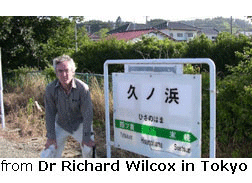 Japan’s Radioactive Potemkin Village: The Government’s Double-Dealing Data, rense.com. By Richard Wilcox, PhD, 4-12-14 A Volunteer Speaks
“………My colleague, Chiho Takahashi, a student at Tsuda College, recently wrote of her experiences as a volunteer to support the folks at the Adachi temporary housing facility:
“In November of 2012, I went to the Adachi temporary housing in Nihonmatsu for the first time. Almost all of the children that participated in our event were shorter than me, my height is 148 cm. But as I visited periodically during the next year and a half I noticed the children growing in height. In that way I could measure the passage of time and see that the victims’ lives were not “temporary” at all but taking place over a long period.
Children who were first grade students of elementary school became third grade students. Children who were first grade students of junior high school became high schoolers. I asked myself, ‘do you think that it is a temporary life?’ I could not think so.
In February of 2013 I had an experience where an elderly man let me into his house at the Adachi temporary housing. He lives in the house all alone. I went up his steps into his small quarters. There are four rooms in the house: kitchen, living room, bed room and bath. He showed me into the living room where there was akotatsu (Japanese foot warmer) and suggested that I warm myself in the kotatsu because it was very cold that day. We talked for about 30 minutes in afternoon and he told me about his children and grandchildren but he rarely sees them because they live in Tokyo and Miyagi prefectures. He was proud that he had done forestry and farming work using his big truck before he was forced to move to Nihonmatsu from Namie town because of the 3.11. disaster. Since then, he has lost everything and has nothing to do every day but drink in broad daylight. There were some bottles of rice wine and potato liquor on the table in the living room.
When I was heard his sad story I could only say to him that ‘that’s too bad.’ Although I felt I was not useful to him I tell people this story to people in Tokyo so they will know what a hard life it is in the temporary housing of Nihonmatsu.
I want many people to know the experience which I saw and heard and felt in Tohoku. I can’t carry out expensive projects like government, but I have always felt that I should try to do important things with my precious friends even if they might seem ‘small.’ In this way, maybe I can inspire more people from Tokyo to assist the refugees of the Tohoku and Fukushima disasters, even if it is just one person at a time. Our small volunteer made the singular effort to go to Nihonmatsu to assist the temporary housing residents, so too if each person made a small but sincere effort it might create a larger effect.”
* Richard Wilcox is a Tokyo-based teacher and writer who holds a Ph.D. in environmental studies and is a regular contributor to the world’s leading website exposing the Fukushima nuclear disaster, Rense.com. He is also a contributor to Activist Post. His radio interviews and articles are archived athttp://wilcoxrb99.wordpress.com and he can be reached by email for radio or internet podcast interviews to discuss the Fukushima crisisat wilcoxrb2013@gmail.com. http://www.rense.com/general96/jpsradioctv.html
Dwindling group of Hiroshima survivors bear witness to the nuclear horror
Hiroshima survivors offer peace and hope for nuclear disarmament April 13, 2014 SMH, Daniel Flitton The two young brothers looked into the bright blue sky and waved happily at the shiny plane flying far above.
Their sister, Emiko Okada, eight years old at the time, remembers an intense flash of light and her mother suddenly rushing into the yard to the children, bleeding from where shards of glass had lodged in her head.
Next came the fire – and people running, hair standing on end, white bones exposed, skin and flesh burning. People were vomiting, not just blood but black ooze from their nose and mouth.
Mito Kosei, in his mother’s womb at the time of the atomic attack, guides tourists around the memorial peace park in Hiroshima.
This was the day the A-bomb fell on Hiroshima.
Ms Okada is one of a dwindling group of survivors from that morning in 1945, determined never to let the terrible human cost of nuclear war be forgotten, even after they are gone.
”Frightening is not the world I can use, it was something much worse,” she said via a translator, still upset by the memory.
Emiko Okada who as an eight-year-old survived the atomic attack on Hiroshima.
Stories from the survivors, known in Japan as hibakusha, were told to foreign ministers of a 12-nation group, including Australia, gathered in Hiroshima at the weekend to kickstart global talks on nuclear disarmament.
Survivors’ stories are being preserved in an online archive by the Tokyo Metropolitan University………http://www.smh.com.au/world/hiroshima-survivors-offer-peace-and-hope-for-nuclear-disarmament-20140412-36k3t.html
Finnish Fault at Olkiluoto: Seawater leaks into nuclear condenser
http://yle.fi/uutiset/fault_at_olkiluoto_seawater_leaks_into_nuclear_condenser/7189387?origin=rss
Seawater has been leaking into the nuclear condenser at the Olkiluoto 1 nuclear power plant in Eurajoki, western Finland. The plant’s output is limited as Voima undergoes fault identification and repair.
Energy production at Eurajoki’s Olkiluoto 1 reactor has fallen due to small volumes of seawater leaking into the nuclear condenser. The plant’s owner, Teollisuuden Voima Oyj (TVO), says that it is working to locate the fault.

The task of locating the leak and initiating subsequent troubleshooting and repair means that the plant’s output is limited to 300 megawatts. The plant is estimated to return to full production by Tuesday morning.
Not a safety risk
The leakage was found when the nuclear reactor’s electrical conductivity was measured. The leaky condenser block has already been separated from the production process. The leak is said to be quite small, letting in a trickle of some two litres per hour.
The role of the condenser is to cool the steam generated in the nuclear reactor, a process which involves the use of seawater.
It’s expected to take around 8 hours to repair the fault. According to TVO the leak does not pose a safety risk.
Sizewell: New book imagines terror attack on Suffolk’s nuclear plant
David Green Sunday, April 13, 2014
12:10 PM
A former nuclear industry safety official has written a novel based on his fears that it would become easier for terrorists to cripple the UK if the Government gives the go-ahead to big infrastructure projects such as Sizewell C.

Barrie Skelcher was head of the health physics department at Sizewell A during the 1960s and 70s and went on to become technical officer at Sizewell B.
His novel, The Day England Died, is due to be published by the Book Guild on April 24.
It tells the story of a group of terrorists planning an attack on a nuclear power complex – by blowing up the pylons connecting it to the grid and disabling emergency generators which could be used to help cool the reactors and prevent a Fukushima-scale disaster..
Although the name Sizewell is not mentioned in the novel, the terrorists base themselves in Suffolk 20 miles from a former fishing village where there is a nuclear site.
In the novel it is called Deephole and is close to a town of 7,000 inhabitants called Munchington.
Mr Skelcher, who lives in Leiston and is a sailing enthusiast, started his nuclear industry career working for the UK Atomic Energy Authority at Dounreay in Scotland in 1954 and took early retirement from Sizewell B in 1987.
Mr Skelcher, who has three children and four grandchildren, said he was opposing the construction of Sizewell C because he believed the power should be generated where it is needed – in London and the Thames Valley – and that concentrating so much generating capacity on one site would make it easier for terrorists to cripple the UK
“As power is being imported at Sizewell from offshore wind farms another power station there would be putting too much power in one place,” Mr Skelcher said.
“My guess is that terrorists will try to better the Twin Towers attack but deploy different methods.
“In this context, the power stations, whatever type they may be, could be targets.”
An EDF Energy spokeswoman said the company could not discuss security but acted on all recommendations and instructions from the Office for Nuclear Regulation.
“The Civil Nuclear Constabulary is deployed at all EDF Energy nuclear sites to further enhance the already robust security arrangements. These officers work alongside existing security teams at each station,” she added.
Kiev crisis halts Chernobyl charity’s €3m surgery plan – Children at risk!
Alyson Henry – Published 14 April 2014 02:30 AM
AN IRISH humanitarian aid agency has been forced to cut its €3m heart surgery programme for the children in Chernobyl due to increasing riots and violent demonstrations in Ukraine.
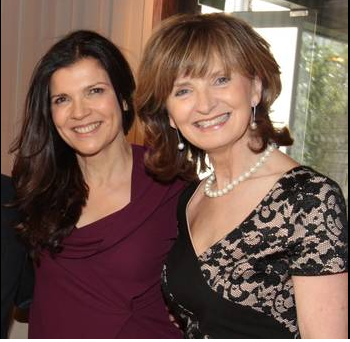
Adi Roche (right), pictured with Ali Hewson, said it broke her heart to put her charity’s heart surgery programme on hold due to violence in the Ukraine
CEO of Chernobyl Children International (CCI), Adi Roche, said the decision to put the programme on hold was “deeply distressing”, and that the impact of this may mean even longer waiting lists for vital-life saving operations.
Ahead of today’s EU Foreign Affairs Council meeting in Luxemburg, Ms Roche, has spoken with EU officials to see whether or not humanitarian funding can be made available to the programme at this time of crisis.
The €3m spent so far on establishing and maintaining the programme has been raised entirely in Ireland by CCI donors and volunteer fundraising activities.
All operations that had been scheduled for the next month at the “open heart” surgery programme in the Regional Hospital in Kharkiv have been suspended until the situation stabilises.
RACE
Ms Roche said the reality is that one in every four children diagnosed with the ‘Chernobyl heart’ will die before they reach the age of six. She said this means the “programmes we organise and fund each year are really a race against time”.
She stressed that the situation between Russia and Ukraine was so serious the surgery programme had no choice but to temporarily suspend all procedures, but that “teams of surgeons” are standing by in the US and Canada “waiting to travel”.
For the past 10 years, the programme has been treating a significant portion of the 6,000 Ukrainian children born with genetic heart diseases every year. Many of these conditions, known as the ‘Chernobyl heart’, have been linked to the radiation leaks from the Chernobyl nuclear plant accident in 1986.
Dr Novick, whose pioneering surgery featured in the 2003 Academy Award-winning film ‘Chernobyl Heart’, said: “It is a shame that politics is once again negatively impacting on the medical care of children to the point where lives may be lost not because of bullets but simply because nationalistic ego’s prevent these children from receiving adequate care.”
Irish Independent
Ambiguities of Japan’s Nuclear Policy
…At the same time, the government is finding it increasingly difficult to explain why Japan should maintain its fuel-cycle policy. In the wake of the Fukushima disaster in 2011, none of Japan’s 48 commercial nuclear reactors is currently in operation, and popular opinion is mounting against the idea of developing more special fast-breeder reactors…
http://www.worlddaily.co/contributing-op-ed-writer-ambiguities-of-japans-nuclear-policy/
13 April 2014
TOKYO — When Yasunari Kawabata became the first Japanese to receive the Nobel Prize for Literature in 1968, he gave a speech called “Japan, the Beautiful, and Myself” that presented a benignly aesthetic portrait of the so-called Japanese spirit larded with references to classical poetry, the tea ceremony and ikebana. When Kenzaburo Oe received the prize in 1994, he titled his lecture, “Japan, the Ambiguous, and Myself,” and offered a critical take on the country’s ambiguities, starting its being part of Asia and simultaneously aligned with the West.
I was reminded of the contrast between Japan the Beautiful and Japan the Ambiguous late last month when, during the third Nuclear Security Summit in the Hague, the Japanese government announced that it would hand over to the United States more than 700 pounds of weapons-grade plutonium and a vast supply of highly enriched uranium. It struck me then that the ambiguities of Japan’s policy on nuclear weapons might be coming up against the nationalist agenda of Prime Minister Shinzo Abe, also the author of “Towards a Beautiful Country: My Vision for Japan.”
Although Japan does not have nuclear weapons, it has a nuclear weapons policy. The strategy was set out by the Ministry of Foreign Affairs in 1969 in an internal document whose existence was kept secret until the daily Mainichi Shimbun published it in 1994. That paper states that “for the time being we will maintain the policy of not possessing nuclear weapons” but also “keep the economic and technical potential for the production of nuclear weapons, while seeing to it that Japan will not be interfered with in this regard.” Known as “technological deterrence,” this posture is inherently ambiguous, and has been made more so still by the ministry’s insistence that the document was a research paper rather than a statement of policy.
In a 2000 essay about the future of the Nuclear Nonproliferation Treaty, the disarmament advocate Jonathan Schell drew a distinction between capacity and intention in describing the range of positions states may adopt on nuclear weapons. At the time, Sweden had the capacity to produce such weapons but not the intention; Libya had the intention but not the capacity. Japan, by contrast, stands out as the only nation that has both the capacity and the intention to produce nuclear weapons but does not act on its intention. It has pioneered a type of nuclear deterrence that relies not on any overt threat, but on the mere suggestion of a latent possibility.
The radlab on wheels: a mobile radiochemistry laboratory
[ Arclight note ; This could be used in Fukushima and Myagi prefectures ]
http://www.neimagazine.com/features/featurethe-radlab-on-wheels-a-mobile-radiochemistry-lab-4203717/
14 April 2014
UK National Physical Laboratory (NPL) and Loughborough University are setting up a demonstration mobile radiochemistry laboratory that can be driven onto a nuclear site. Field tests are expected later this year.

Work to decommission plant, buildings and contaminated land on legacy nuclear sites relies on accurately determining the activity concentrations of specific radioisotopes in the materials, so that demolition and waste disposal can be carried out safely and in compliance with site licence conditions.
Equipment and expertise for the complex measurements needed for decommissioning samples are the province of a small number of specialist analytical laboratories. As a result, these laboratories can be over-burdened with work, leading to long turnaround times of up to several months. The laboratories are also off-site, so radioactive samples often have to negotiate a time-consuming permitting and administrative process before they can be sent off for analysis.

As measurement results lie on the critical path for decommissioning projects this can lead to long delays, with the project team waiting for the results from the analysis before work can start on demolition or disposal.
The UK National Physical Laboratory (NPL) at Teddington has joined forces with Loughborough University’s radiochemistry section to develop a solution to this problem. Thanks to support from the Department for Business, Innovation and Skills and the EC, NPL and Loughborough are setting up a demonstration mobile radiochemistry laboratory that can be driven onto a nuclear site. Samples can be taken directly to the laboratory and the results from the analysis will be in the hands of the project manager within hours rather than weeks. If the results show that further samples are needed, they can be arranged immediately, which is far preferable to repeating a long cycle. A mobile laboratory also has the advantage that it can carry out essential measurements of routine discharges in the event that a site’s own laboratory is out of action.
Design of the mobile radiochemical laboratory
The vehicle was designed by the British Geological Society and is the property of Loughborough University. The vehicle itself is reconfigurable and has its own independent power supply and utilities. Equipment needed for a particular analysis campaign can be rapidly installed, and removed or replaced as required. Two technicians are needed to operate the installed analysis and measurement systems, with wireless data transfer to the NPL-Loughborough support team for further analysis and reporting.
The mobile laboratory has two distinct areas: one for sample preparation and the other for analysis and measurement equipment. The latter may include a high-resolution gamma spectrometer, a bench-top scintillation detector, portable radon gas detectors and non-nuclear measuring equipment such as balances and x-ray fluorescence (XRF), x-ray diffraction (XRD), SEM or GC-MS.
Automated radiochemistry
The mobile laboratory has become a realistic proposition only in the last five to ten years, due to technological developments such as automated radiochemistry.
Sellafield’s Radioactive Pollution from The Irish Sea to The Arctic – Omnicide knows no bounds between wildlife and humans.
By on April 9, 2014
Yesterday at Cumbria Wildlife Trust’s Irish Sea Conference, Radiation Free Lakeland handed out over 100 leaflets to delegates. The venue was the beautiful Netherwood Hotel in Grange over Sands. The front door looks out on to Morecambe Bay and Heysham Nuclear plant ( see photo above ). From Heysham spent fuel trundles across the train viaduct to Sellafield to be reprocessed making it even more dangerous.
The leaflets handed out yesterday by volunteers and supporters of a Radiation Free Lakeland describe just a few of the impacts of existing and proposed nuclear developments on the Irish Sea. This is to counter the non engagement of Cumbria Wildlife Trust in nuclear impacts ( happy to engage in the impact of wind turbines!)
The ever charming Sir Martin Holdgate Trustee of CWT came over to speak to us and interestingly told us that he favours above ground storage and monitoring of nuclear waste.
We agreed and suggested that the first step to looking after existing nuclear waste must be to STOP PRODUCING ANY MORE.
He replied “there is something to be said for that point of view.”
Rather worrying the equally charming Director of Cumbria Wildlife Trust Peter Bullard appears to assume that damage from nuclear ‘only’ affects humans and that the Trust “is not about people but is concerned with wildlife.”
Humans are at the top of the food chain and as studies, including studies by Lancaster University, have shown even chronic low level radiation is damaging to all wildlife including the game changing 100% sterility of fish “Severe effect on reproduction hatching and abnormal larvae (100%).”
These test studies are backed up by findings in the real world. Many universities worldwide have been studying evidence from nuclear accidents:
“Low-dose radiation has been known to have negative consequences for (all) living beings for almost 100 years. Indeed, background radiation causes the death of tens of thousands of humans annually. These ‘natural’ effects may be exacerbated by the 23 nuclear accidents recorded during the last century”.
Radiation Free Lakeland know Sellafield to be the equivalent of an ongoing accident with routine releases of radiation to sea, air and groundwaters. On May 13th Cumbria Wildlife Trust are inviting families to spend hours on beautiful St Bees beach making sand sculptures. This is the same beach where increasing numbers of radioactive particles from Sellafield’s insane reprocessing programme are being found. Not really surprising as the headland of St Bees acts as a catchment area for Sellafield discharges. The same particles take just 4 years to reach the Arctic and bioaccumulate in all life there. As a result of these finds there are no warning signs on the beaches, rather the monitoring and retrieval of radioactive particles has been stepped down dramatically. If you don’t look you don’t find? If you don’t mention the ‘N’ word people will be blind to the diabolic plan for ever more radioactive and chemical pollution from nuclear?
Leaflet handed out to delegates:
CUMBRIA WILDLIFE TRUST : IRISH SEA CONFERENCE 2014
Do Not Mention the ‘N’ word?
1 This Month
26 April – Chernobyl: Inside the Meltdown airs on National Geographic on Sunday 26th April from 4pm

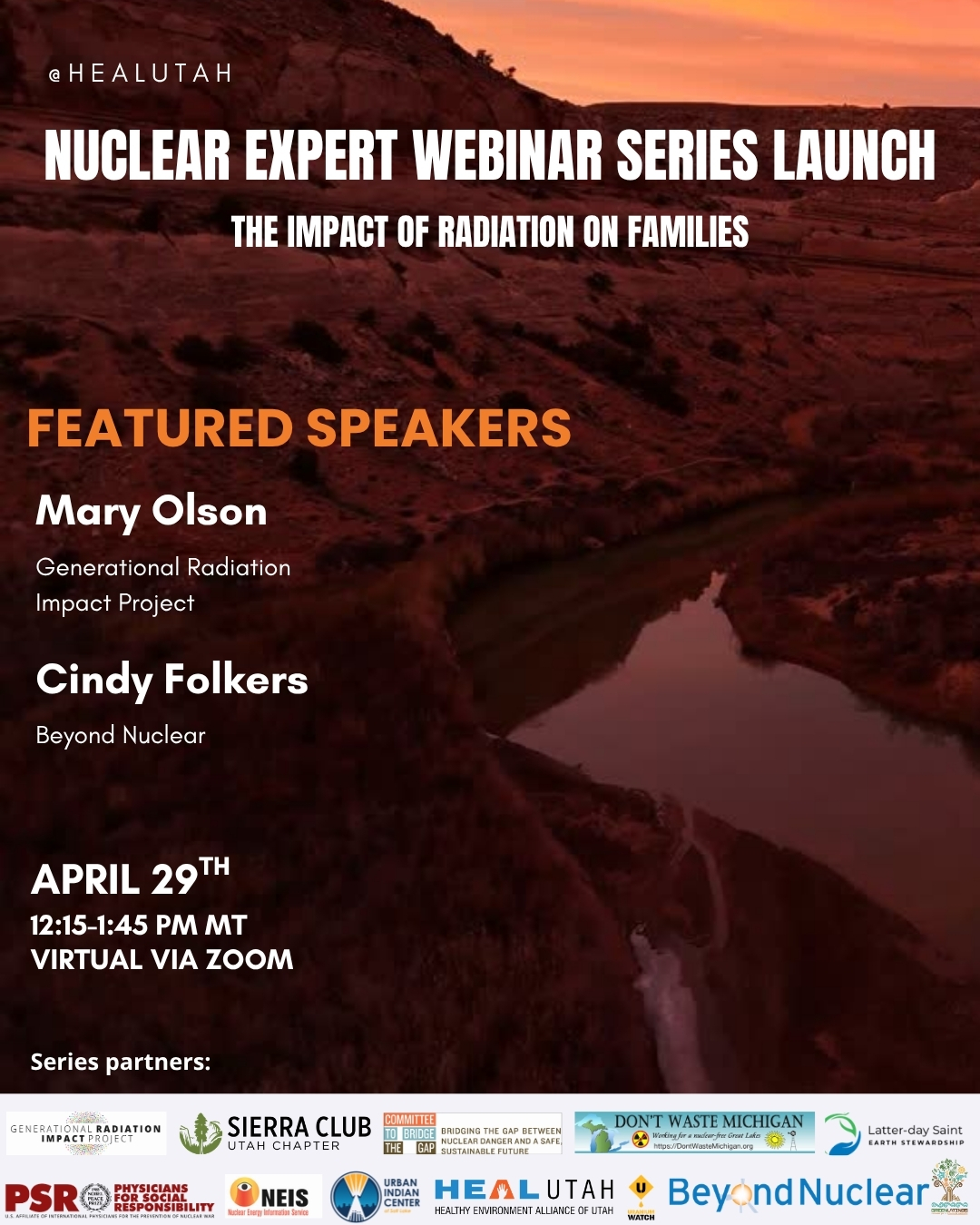
29 April – Nuclear Expert Webinar #1 – Radiation Impacts on Families with Mary Olson and Cindy Folkers
- 12:15 PM MT – 1:45 PM MT
- Location: Virtual – REGISTER TODAY

4 May -West Suburban Peace Coalition to discuss Iran war at May Educational Forum
Monday, May 4, 7:00 – 8:00 PM Central Standard Time
Title: : How Trump’s Narrative Tries to Shape the Reality of the War on Iran.
Contact Walt Zlotow, zlotow@hotmail.com 630 442 3045 for further information
14 May – online event From Bombs to Data Centres: the Face of Nuclear Colonialism

Pine Ridge Uranium is the real threat, not Tehran- Tell Burgum: Stop the Extraction.
Chernobyl: The Lost Tapes – A good documentary on Chernobyl on SBS available On Demand for the next 3 weeks– https://www.sbs.com.au/ondemand/tv-program/chernobyl-the-lost-tapes/2352741955560
To see nuclear-related stories in greater depth and intensity – go to https://nuclearinformation.wordpress.com
-
Archives
- April 2026 (288)
- March 2026 (251)
- February 2026 (268)
- January 2026 (308)
- December 2025 (358)
- November 2025 (359)
- October 2025 (376)
- September 2025 (257)
- August 2025 (319)
- July 2025 (230)
- June 2025 (348)
- May 2025 (261)
-
Categories
- 1
- 1 NUCLEAR ISSUES
- business and costs
- climate change
- culture and arts
- ENERGY
- environment
- health
- history
- indigenous issues
- Legal
- marketing of nuclear
- media
- opposition to nuclear
- PERSONAL STORIES
- politics
- politics international
- Religion and ethics
- safety
- secrets,lies and civil liberties
- spinbuster
- technology
- Uranium
- wastes
- weapons and war
- Women
- 2 WORLD
- ACTION
- AFRICA
- Atrocities
- AUSTRALIA
- Christina's notes
- Christina's themes
- culture and arts
- Events
- Fuk 2022
- Fuk 2023
- Fukushima 2017
- Fukushima 2018
- fukushima 2019
- Fukushima 2020
- Fukushima 2021
- general
- global warming
- Humour (God we need it)
- Nuclear
- RARE EARTHS
- Reference
- resources – print
- Resources -audiovicual
- Weekly Newsletter
- World
- World Nuclear
- YouTube
-
RSS
Entries RSS
Comments RSS
 nuclear-news