The exposure of US sailors to radiation, near Fukushima
 Navy Sailors: Frozen Fukushima steam blanketed ship; Crew suffered massive radiation doses, dozens have cancer — Calls for it to be sunk… still too radioactive; Navy: There’s some contamination, but it’s ok — Tepco: No way US officials would rely on information we were telling to public http://enenews.com/navy-sailors-frozen-fukushima-steam-blanketed-uss-reagan-crew-suffered-massive-radiation-doses-dozens-now-have-cancer-report-calls-for-ship-to-be-sunk-still-too-radioactive-navy-says-contam
AP, Apr 7, 2014: Nearly 80 U.S. sailors are […] alleging [Tepco] lied about the high level of radiation in the area [and] repeatedly said there was no danger to the crew when they were actually being blanketed with radiation that has since led to dozens of cancer cases and a child being born with birth defects [Tepco] said that there was no way the commanders of the aircraft carrier would have relied on the utility […] “It’s wholly implausible… military commanders in charge of thousands of personnel and armed with some of the world’s most sophisticated equipment, relied instead only on the press releases and public statements of a foreign electric utility co.”
Orange County Register, Apr. 6, 2014: Sailors on the flight deck said they felt a warm gust of air, followed by a sudden snow storm: radioactive steam. Freezing in the cold Pacific air. Blanketing their ship. And there they remained for two days, until […] aircrews returning [from] near Sendai identified levels of radioactivity [and] the Navy ordered the carrier to reposition much farther away […] the lawsuit contends, the crew had already suffered massive doses of radiation. […] dozens have developed cancers, at least one has borne a child with birth defects [Their lawsuit is] raising very strange and disturbing questions: Could the Reagan – one of the most advanced nuclear aircraft carriers in the U.S. fleet – really not know that it was being showered with massive doses of radiation? […] Some critics on the ecological front say the Reagan, now stationed in San Diego, is still so radioactive that it needs to be sunk. It floated around the Pacific for many weeks after the Fukushima humanitarian mission ended, as no Pacific Rim country would give it permission to dock. [It’s] slated to move to a new home port this year. In Japan.
Navy spokesman Lt. Greg D. Raelson: “Low levels of radioactive contamination did enter ventilation systems, which have numerous inaccessible areas difficult to perform radiological surveys and decontamination […] there is no indication that any remaining minimal levels of radiation pose any adverse health concern. Radiological controls are in place to survey, control and remove remaining contamination”
U.S. sailors’ lawsuit: “[Those exposed to radioactive releases from Fukushima Daiichi] must now endure a lifetime of radiation poisoning and suffering which could have and should have been avoided” [TEPCO] lied through its teeth, knowing all along the plant was in full-scale meltdown […] “rendered the plaintiffs infirm and poisoned their bodies.”
Low level ionising radiation could be even worse than we thought
In addition to the detection of statistically significant levels of certain illnesses among the liquidator cohort, they have made the argument that, instead of being linear, radiation health effects are “bi-modal” at certain low dose levels i.e. more harmful than the linear model predicts.
 Radiation and the Ronald Reagan, China Matters, 10 April 14, “….. I address the tendency of governments to minimize/mislead/suppress information concerning radiation releases from nuclear accidents and the overall uncertainty pervading their efforts. ….
The biggest minefield in the issue of nuclear accidents is the issue of the health effects of radiation exposure. The international standard for nuclear safety is the “Linear No Threshold” or LNT model, which argues that the negative health impacts of low-level radiation exposure are, well, low. People who give credence to claims of extensive radiation-related illness as a result of nuclear accidents are frequently dismissed as cranks.Interestingly, the only place that is serious about emphasizing the health hazards of radiation is a country very much in the news today, Ukraine. Doing the right thing by Ukrainian citizens after the injustices inflicted by the Soviet Union on the Chernobyl front has been an important part of Ukrainian national identity, and claims of radiation-related illness are given a hearing largely denied to them in the West, Japan, or Russia.

The international pushback against academics trying to make the statistical and biomedical case for extensive Chernobyl-related illnesses has been intense, including the attempt to explain any statistically significant health effects as a combination of “radiophobia” (the debilitating fear occasioned by radiation exposure) and the overall decline in public health in Ukraine following the collapse of the Soviet Union.
In 2005 a symposium conducted by the IAEA, WHO, and UN concluded that only 50 people had died because of radiation exposure from the Chernobyl accident; that’s quite a distance from estimates of critics who think the toll might be as high as 50,000.In response, scientists such as Russia’s Elena Burlakova have carefully monitored the health of the sizable cohort of Chernobyl “liquidators” (the hundreds of thousands of workers who were exposed to high levels of radiation during cleanup at the plant and in the Chernobyl district) and conducted research to attempt to qualify the LNT standard for measuring the health effects of radiation exposure.
In addition to the detection of statistically significant levels of certain illnesses among the liquidator cohort, they have made the argument that, instead of being linear, radiation health effects are “bi-modal” at certain low dose levels i.e. more harmful than the linear model predicts.
Backhanded support for this challenge to the LNT model comes from a school of thought—“radiation hormesis”—now enjoying a certain vogue in the pro-nuclear crowd in Japan, that draws on the experience of inhabitants of Ramsar, a community of the Caspian Sea with high background radiation levels and low cancer rates, to argue that low levels of radiation are beneficial.
Challengers to the LNT model seem to be making some headway—the Bulletin of Atomic Scientists recently devoted a special issue to the subject—but there is considerable resistance to qualifying LNT and thereby admitting the possibility of rethinking and perhaps acknowledging the likelihood of extensive health problems from the release of low-level radiation by a nuclear accident.
Cleanup for a nuclear accident is expensive. In an ironic recapitulation of the uncertainty surrounding the magnitude and destination of Fukushima’s radiation releases, the total cleanup bill has been estimated in a range from $10 billion to $50 billion to $250 billion.
To paraphrase Everett Dirksen, ten billion here, ten billion there, pretty soon you’re talking about real money and the possibility that even rare and occasional nuclear accidents will push up the total cost of nuclear power to unacceptable levels.
Understandably, the nuclear industry and people who have staked their hopes on nuclear power as a greenhouse-gas free alternative to carbon-based electricity generation resist the idea of expanding the accepted definition of significant radiation-related health effects, and with it the cost of any accident.
There is also, perhaps, the temptation to let the radiation illness problem take care of itself i.e. shy away from investigations of radiation sickness that might yield inconvenient or perhaps politically or financially catastrophic conclusions while demographics does its grim work of culling the irradiated herd…… http://chinamatters.blogspot.com.au/2014/04/radiation-and-ronald-reagan.html
TV broadcast on sickness among nuclear waste workers
 TV: “Far more serious than Feds letting on” at US nuclear site — Many workers in much worse shape than reported — Week-long nosebleeds, intense headaches, shaking, burning lungs, vomiting — Worker: Now I’m worrying… after two weeks I feel worse, not better (VIDEO) #Hanford http://enenews.com/tv-situation-nuclear-site-serious-feds-letting-many-workers-symptoms-worse-reported-week-long-nosebleeds-intense-headaches-shaking-burning-lungs-vomiting-worker-yesterday-worst-day-ive-worrie?utm_source=feedburner&utm_medium=email&utm_campaign=Feed%3A+ENENews+%28Energy+News%29
KING5 News Seattle,Apr. 8, 2014: An unprecedented string of unknown chemical vapor exposures has sent more than 2 dozen workers to the hospital of doctor since mid-March. […] We found the situation is far more serious than the Feds and the contractors are letting on. All of the employees were not and still are not back to work. And many have symptoms far worse than irritation. […] Right before coming to the interview, a doctor cauterized Becky’s nose to stop a week’s worth of nosebleeds. And Steve spent all of the day before throwing up. […] Her symptoms [have been] nosebleeds, intense headaches, sweats and shaking […] Steve deals with burning lungs and non-stop coughing — using inhalers and narcotics to cope. […] He’s still struggling to breathe […] Becky still has a really bad headache, but her biggest concern, this is a scary one, she’s not thinking clearly. She says she’s forgetting a lot of things and that’s really frightening to her. […] They aren’t the only ones. I’ve talked to others who say their lungs are burning, they don’t feel right, but they’ve been cleared to work, so they’re out on the job.
Becky Holland, health physics technician and 28-year veteran of the Hanford Site: “I felt kind of dizzy like I couldn’t walk. […] It was hard for me to get my nose to stop bleeding”
Steve Ellingson, health physics technician at Hanford: “Now I’m getting worried because this is two weeks and it’s not better. Yesterday was the worst day I’ve had. I’m getting worried that this may be the way that I am the rest of my life.”
USA, Westinghouse, Toshiba distressed as Czech Republic cancels nuclear project
 CEZ Cancels $10 Billion Nuclear Tender on Unfavorable Economics, EU Policy, WSJ Company Targets New Expansion, Modernization Strategy by Year-End By SEAN CARNEY April 10, 2014 PRAGUE—Czech power company CEZ AS BAACEZ.PR +2.93% Thursday abruptly canceled its $10 billion tender for two new nuclear reactors one year ahead of the planned 2015 deadline to pick the winner, leaving the U.S. and Russian companies that had made it to the final round of bidding empty-handed…….It said plans to double the size of its Temelin nuclear power plant didn’t now make sense economically…..
 Czech Prime Minister Bohuslav Sobotka and the country’s President Milos Zeman both described CEZ’s decision as logical.
The cancellation of the tender is a blow to the companies that had made it into the final round of bidding—Russia’s state-owned Rosatom and Pennsylvania-based Westinghouse Electric Co, a unit of Japan’s Toshiba Corp.
France’s Areva SA was originally in the final round but in 2012 was excluded from the bidding due to commercial and legal flaws in its offer, according to CEZ…….
Westinghouse officials said they were unhappy with the decision, a sentiment echoed by the U.S. government.
“[We are] deeply disappointed by the decision to cancel the tender,” said American Ambassador to the Czech Republic Norman Eisen. “As close friends and allies we also have fears what signals this could send to American and international investors.” …….http://online.wsj.com/news/articles/SB10001424052702303603904579493122292748700
Fukushima Renewable Energy Institute opened
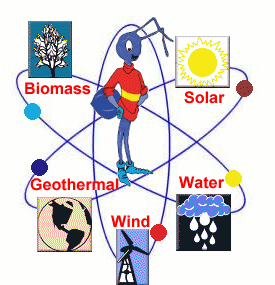 Fukushima embracing renewable energy research http://japandailypress.com/fukushima-embracing-renewable-energy-research-1047080/ Apr 10, 2014 John Hofilena Fukushima, the area in Japan which felt the brunt of what is now one of the world’s worst nuclear crisis since Chernobyl, is now hopefully turning over a new leaf amidst the struggle to rebuild and start the process of renewing that which was destroyed by the Great East Japan Earthquake and tsunami. It is now giving renewable energy a chance. On April 1, Japan’s National Institute of Advanced Industrial Science and Technology has just launched a renewable energy research and development center in Koriyama, Fukushima Prefecture.
The Fukushima Renewable Energy Institute, as it is called, opens three years after the Fukushima nuclear power plant suffered catastrophic meltdowns after the massive earthquake and tsunami that hit east Japan in March 2011. Much of Japan took a negative view of nuclear power starting from that time, and it is a testament to that negativity that 48 of Japan’s commercial nuclear reactors are offline at the moment. In the meantime, renewable energy sources such as solar and wind power have been in vogue in Japan. All of Japan’s renewable power sources are supplemental to fossil fuel-driven thermal energy at this point, but the situation may start to change.
Fukushima’s new R&D center will be at the center of a major project to develop the world’s most advanced energy technologies and make renewable energy Japan’s primary power source. Aside from the two new buildings, a solar power and wind power generation facilities also sit within the site. Major Japanese technology companies such as Hitachi, Sharp and Panasonic have jumped into the project and will conduct R&D at the center. The goal of the center is to develop state-of-the-art renewable technologies for implementation in various areas of the country. These new technologies will include new solar power innovations that improve energy conversion efficiency and a wind power generation system using laser lights — all of it exciting for Japan if all goes according to plan.
Japan’s energy efficiency success
 How Japan Replaced Half Its Nuclear Capacity With Efficiency https://www.greentechmedia.com/articles/read/how-japan-replaced-half-its-nuclear-capacity-with-efficiency
 Is new coal really necessary in Japan? Lauri Myllyvirta and Justin Guay April 10, 2014 After the Tohoku earthquake in March 2011, Japan was in a seemingly impossible situation. A tremendous amount of conventional generation capacity, including the entire nuclear fleet, was unavailable, and the country faced the risk of power cuts during summer consumption peaks.
But miraculously, or seemingly so, in just a few short weeks Japan managed to avert the rolling power cuts that many believed inevitable. Even more impressive, the Japanese have turned these emergency measures into lasting solutions.
So how’d they do it without forcing people back to the Stone Age? Japan overcame this daunting task by tapping the cheapest and most widely available source of energy: energy efficiency and conservation. Much of the electricity savings were initially driven by a popular movement known as “Setsuden” (“saving electricity”). This movement emerged to encourage people and companies to conserve energy and prevent rolling power cuts. Simple measures such as increasing temperatures in homes and offices, “thinning” lighting by removing some of the bulbs and tubes, shutting down big screens and cutting exterior lighting enabled Japan to dramatically reduce power demand almost overnight (albeit at the cost of a small amount of personal comfort).
In addition to these measures, the dress code in offices was eased to reduce the need for AC, while commercial facilities were audited to identify potential savings.
These temporary measures have proven to have long-term impact. Continue reading
IKEA to produce nearly twice as much energy as it needs, from Illinois Wind Farm
Ikea’s Wind Farm to Produce More Energy Than Total US Footprint http://www.sustainablebusiness.com/index.cfm/go/news.display/id/25640 SustainableBusiness.com News, 10 April 14, Ikea has bought its first US wind farm, as it steadily moves toward running its stores completely on renewable energy.
At 98 megawatts (MW), Illinois’ Hoopeston Wind Farm is the companies biggest, single renewable energy investment to date. Currently under construction, it comes online early next year.
Impressively, it will produce 165% of the electricity consumed by all of IKEA US – 38 stores, five distribution centers, two service centers and one factory).
Located about 110 miles south of Chicago, the project will consist of 49 Vestas 2 MW wind turbines. “This investment is great for jobs, great for energy security, and
great for our business. Importantly, it’s great for the future of our
climate,” says Steve Howard, Chief Sustainability Officer of Ikea Group.
“We are committed to renewable energy and to running our business in a way that minimizes our carbon emissions, not only because of the environmental impact, but because it makes good financial sense,” says Rob Olson, Chief Financial Officer of IKEA US. “We invest in our own renewable energy sources so that we can control our exposure to fluctuating electricity costs and continue providing great value to our
customers.”
Apex Clean Energy is building the wind farm and will manage it after it comes online. “This project is an opportunity for Apex to work with a new type of investor and partner to expand wind energy development in this country,” says Mark Goodwin, President of Apex.
Worldwide, Ikea owns 206 wind turbines through its wind farm
investments in nine countries: US, Canada, UK, Ireland, Denmark, Sweden, France, Germany and Poland.
Ikea is also very active in solar. In the US, 90% of its buildings have rooftop systems, for a total of 38 MW across 20 states. A Colorado store incorporates geothermal and another is planned for a Kansas City-area store that opens this Fall.
And in Britain, Ikea will sell solar systems at all its stores in addition to furniture and housewares.
The company is investing $2 billion in wind and solar by 2015 and has invested $55 million over the past few years on efficiency upgrades. Worldwide, renewables provide 37% of the its total energy footprint right now – 305 stores in 26 countries.
Ikea’s goal is to generate as much renewable energy as the total energy it consumes by 2020.
Last year, corporate leaders added over 445 MW of solar on 1000 buildings in 30 states, up 48% from 2012. Ikea came in 5th place for total solar installed, after Walmart, Costco, Kohl’s and Apple.
Energy use could drop by 73% with Energy Efficiency
Japan Replaced Half Its Nuclear Power With Energy Efficiency. Could The U.S. Do Something Similar? Climate Progress,
BY ARI PHILLIPS ON APRIL 10, 2014
“………Several years ago a team of researchers at Cambridge University estimated that the world could save 73 percent of its energy through efficiency measures. Changes like using thicker building installation, installing triple-paned windows, and lowering washing machine temperatures could help demand-side efficiency efforts supplant the slower pace of supply-side implementation of clean energy sources.

The U.S. residential sector consumes about 37 percent of the total electricity production in the country, at a per-household rate of more than double the U.K. does. Andrew Tarantola at Gizmodo recently published a thorough breakdown of why we’re so much more inefficient than our British counterparts:
It’s not just clothes dryers and A/C units. British appliances are also quickly outpacing their U.S. counterparts in terms of efficiency. In the U.K., chest freezers now consume 66 percent less energy than they did in 1990, upright freezers use 59 percent less, and new freezers use 55 percent less. Similarly, wet appliances like dishwashers and washing machines consume 39 percent and 32 percent less power, respectively, than they did in the 1990s.
U.S. appliances, while certainly more efficient than they were in the 1990s, cannot match these gains. Energy Star certified refrigerators, for example, only have to be 15 percent more efficient than non-qualified models or 20 percent more efficient than models that simply meet the federal minimum energy efficiency standard.
We live in bigger houses, we use more air conditioning and, a surprisingly significant factor — our cable boxes are always on. According to Gizmodo, a cable box and standalone DVR can use as much as 446 kilowatt hours a year, far more than those in the U.K. which go into sleep mode for the two-thirds of the day they’re not being used. However at a certain point the issue is not energy efficient options, but a will to utilize them. Studies have shown that when services get less expensive via gains in efficiency, Americans use more of them, offsetting much of the electricity savings. It took a natural disaster of epic proportions in Japan to change habits. What will it take here?http://thinkprogress.org/climate/2014/04/10/3425406/japan-energy-efficiency-replacement/
Every USA State could move to 100% renewable energy
 Visualizing What Would Happen If Every State Transitioned To Renewable Energy, Co-Exist, 10 April 14 Imagine a world where we could get past the politics and have clean energy. These maps show what that would mean for each state. Just for a minute, forget the administrative headache and upfront costs of switching entire states–or even countries–to 100% renewable energy. How would a world of renewable energy-powered homes and businesses be different? If Michigan switched to wind, water, and solar, the state would see annual energy savings of $4,300 per person, 64,300 long-term construction jobs, and 46,200 operations jobs. Health costs would drop dramatically. It’s a similar story throughout the U.S.
In a new interactive map, The Solutions Project shows off all the potential upsides of a country operating solely on renewables. An organization made up of prominent scientists, business leaders, and cultural ambassadors (like actor Mark Ruffalo), the Solutions Project aims to explain the benefits of transitioning to renewables from both a business and science perspective.
Ruffalo, the most public-facing leader of the Solutions Project–and a long-time environmental advocate–first became interested in creating a comprehensive renewable energy plan because of frustrations about the way people talk about the energy space, focusing more on problems than potential fixes……..
The Solutions Project is doing more than just nice-looking maps and infographics. According to Jacobson, the group is building renewable energy transition plans for each state, identifying the states most likely to adopt those plans, and then talking to relevant policymakers. In California, there is a measure inside the Democratic Party to integrate that state’s renewable energy plan into the party platform. “We’re just getting off the ground in terms of implementation,” says Jacobson.
Check out the interactive renewable energy map here. http://www.fastcoexist.com/3027734/visualized/visualizing-what-would-happen-if-every-state-transitioned-to-renewable-energy
USA’s Republicans’ hawkish bluster endangers the world
Thankfully, US-Russia cooperation on nuclear security will continue—for now. Since 1993, the United States has spent $1.6 billion on Cooperative Threat Reduction (known as the Nunn-Lugar pact), a program designed to increase safety and security at nuclear and chemical-weapons facilities of former Cold War antagonists. But last June, the pact expired after twenty years, and despite pledges from the Obama administration that work would continue “unfettered,” recent events in Ukraine have introduced enough friction into the relationship to cause alarm.
France’s prosecutor examining AREVA’s finances
French prosecutor probes Areva buy of Canadian miner https://au.finance.yahoo.com/news/french-prosecutor-probes-areva-buy-084747257.html France’s financial prosecutor has opened a preliminary probe into state-controlled nuclear giant Areva’s controversial 2007 purchase of a Canadian uranium miner, a judicial source said Thursday.
The probe focuses on the $2.5 billion (1.8 billion euro) purchase by Areva of UraMin at a height of demand for enriched uranium.
Areva was later forced to revalue its UraMin uranium mines to only 410 million euros.
Canadian media reports have suggested the sale was preceded by suspicious stock trades.
French newspaper Le Monde said France’s Cour des Comptes, which oversees state accounts, had referred the case to prosecutors. It said the Cour des Comptes is to release a report into Areva’s 2006-2012 finances later this month.
Areva’s chief from that period, Anne Lauvergeon, said in a statement Thursday that the deal was “strategic at the time”, noting that it was “submitted and approved by the group’s decision-making bodies”.
This week in nuclear news
I am struggling to keep up with news of the various machinations going on globally, in

Christina Macpherson’s websites & blogs
regard to nuclear power and nuclear weapons.
There’s the Iran – West talks – many points of view on this. I like Jimmy Carter’s idea – don’t bomb Iran.
There’s – most worrying – this global phenomenon – this spectrum of pressure, harassment, discrimination, ill-treatment, imprisonment, murder – of independent journalists and whistleblowers. Anti nuclear journalists are a frequent target, for example Mari Takenouchi , in Japan.
As existing nuclear reactors age, and need expensive safety upgrades, and new nuclear reactors can’t get going, much angst is going on . in USA, UK, and especially Japan. Nuclear corporations and their obedient governments are in a bit of a panic about this. USA – always the leader, is panicking most about what to do with nuclear wastes.
But – there’s a brighter side to all this, for the nuclear industry. Cleaning up radioactive trash, or “decommissioning’ (that’s a nicer word) is becoming a bonanza for the nuclear corporations. Westinghouse has just dumped its plans for making Small Modular Nuclear Reactors (SMRs – they left out the word ‘nuclear’ because it put people off even more than people were off already) Westinghouse is instead going to do decommissioning. Other nuclear companies are turning in that direction, too.
India soon to have elections. Despite pro nuclear major parties, there’s a growing young Aam Aadmi Party uniting in opposition to nuclear power
Renewable energy forges ahead, world-wide, – especially in China
Canada narrows list of possible locations for nuclear waste facility
Some were also drawn by the fact that for taking part in the selection process, they’ll get $400,000 even if they’re not chosen, providing they advance far enough in the process and a DGR is ultimately approved.

7 of 22 municipalities dropped from list of potential sites
By Rick MacInnes-Rae, CBC News Posted: Apr 09, 2014
(Interactive map showing locations of possible nuclear dump sites on link)
Canada is a step closer to picking a place to store spent nuclear fuel underground for the next 100,000 years, a project that’s backfired on some of the world’s other nuclear economies.
Despite the stigma of radioactivity, 22 Canadian municipalities expressed interest in hosting such a facility. Four have now been moved up the list for further evaluation, while seven have been rejected as not suitable. The other 11 are still in the initial assessment phase.
Final approval could take another couple of decades, but if a site is found and approval given to build a Deep Geologic Repository (DGR), the project will generate thousands of jobs, some lasting generations.
Billions would be spent constructing a vast warehouse over 500 metres underground to contain some of the most radioactive waste in the world.
Deadly byproduct
Nuclear energy has helped meet Canada’s electricity needs for more than 40 years, but a deadly byproduct has been steadily building up as a result.
There’s a growing inventory of spent uranium pellets. The radioactive pellets are stored inside long silver tubes bundled together like 24-kilogram logs.

Spent uranium pellets from nuclear reactors are stored inside long silver tubes that are bundled together like 24-kilogram logs.
Heading the search for a secure place to store those tubes is the Nuclear Waste Management Organisation (NWMO), funded by Canada’s four nuclear agencies, which describes the situation this way: “If Canada’s entire current inventory of just over two million used fuel bundles could be stacked end-to-end, like cordwood, it would fit into six NHL-sized hockey rinks from the ice surface to the top of the boards.”
At present, spent fuel is stored at seven different sites across Canada, including at the reactors it once powered. But that’s not a long-term solution, because in time those reactors will be decommissioned and dismantled.
In its quest for a site, the NWMO took the novel step of asking Canadian communities if they’d think about hosting the highly-radioactive payload.
“Well, we didn’t know what to expect” said Jo-Ann Facella, director of social research and dialogue at the NWMO.
“We put out the plan that Canadians had come forward with and the government had selected as Canada’s plan. And an important part of that plan, it emerged from Canadians, is that these facilities only be implemented in a willing host.”
What also came back were expressions of interest from 22 different municipalities, tempted in part by the promise of employment if they’re chosen. Some were also drawn by the fact that for taking part in the selection process, they’ll get $400,000 even if they’re not chosen, providing they advance far enough in the process and a DGR is ultimately approved.
Danger of Fukushima radiation kept secret, as US navymen were exposed
 US service members claim they were misled about Fukushima radiation dangers RT, 9 April 14, US service members who took part in cleanup efforts after the Fukushima nuclear disaster have since been diagnosed with ailments like cancer. Now, in a class action lawsuit, they allege they were misled about radiation risks, RT’s Ameera David reports.
Dozens of US sailors and marines who provided humanitarian assistance following the meltdown of three reactors at the Fukushima Daiichi nuclear plant in Japan in March 2011 have been diagnosed with illnesses such as leukemia, testicular cancer, and thyroid disease.
The service members – many of whom were aboard the aircraft carrier USS Reagan – are now part of a class action lawsuit against the plant’s operator, Tokyo Electric Power Company (TEPCO). They allege TEPCO provided false information to the US Navy about the extent of radioactive contamination in the surrounding air and water.
While TEPCO is the main focus of suspicions, the service members are also pressing the US Navy to reveal whether or not it knew about the radiation, particularly considering the kind of equipment aboard the USS Reagan, a nuclear-powered ship.
There are “lots of radiation detectors both fixed in position to monitor the radioactivity from the reactor itself and also lots of Geiger counters,” said Paul Gunter, Director of the Reactor Oversight Project with Beyond Nuclear, an anti-nuclear advocacy organization.
“So we’re quite sure that the Navy was aware of the radioactivity but that was not being communicated to the sailors that were in harm’s way.”
The Navy denies the allegations, saying that the Pentagon and an independent group analyzed available radioactive data of that period.
“The worst-case radiation exposure for a crew member on [the] USS Ronald Reagan is less than 25 percent of the annual radiation exposure to a member of the US public from natural sources of background radiation, such as the sun, rocks, and soil,” a spokesperson for the Navy told RT.
But the Navy’s claims do not make sense, says Michael Sebourn, a former US Navy officer who was part of the Fukushima cleanup. In fact, he was responsible for measuring radiation exposure to equipment and US personnel.
“That was my job,” Sebourn told RT. “So to say that it is normal day-to-day radiation is 100-percent bogus……http://rt.com/usa/navy-fukushima-nuclear-radiation-504/
The historic peace ship, the Golden Rule, will sail again

 World War II U.S. naval commander. Appalled by the atomic bombing of Hiroshima, he became a Quaker and, in 1955, working with the American Friends Service Committee, sought to deliver a petition against nuclear testing to the White House. Rebuffed by government officials, Bigelow and other pacifists organized a small group, Non-Violent Action Against Nuclear Weapons, to employ nonviolent resistance in the struggle against the Bomb. After the U.S. government announced plans to set off nuclear bomb blasts near Eniwetok in the Marshall Islands―an island chain governed by the United States as a “trust territory” for the native people―Bigelow and other pacifists decided to sail a 30-foot protest vessel, the Golden Rule, into the nuclear testing zone. Explaining their decision, Bigelow declared: “All nuclear explosions are monstrous, evil, unworthy of human beings.”
1 This Month
26 April – Chernobyl: Inside the Meltdown airs on National Geographic on Sunday 26th April from 4pm

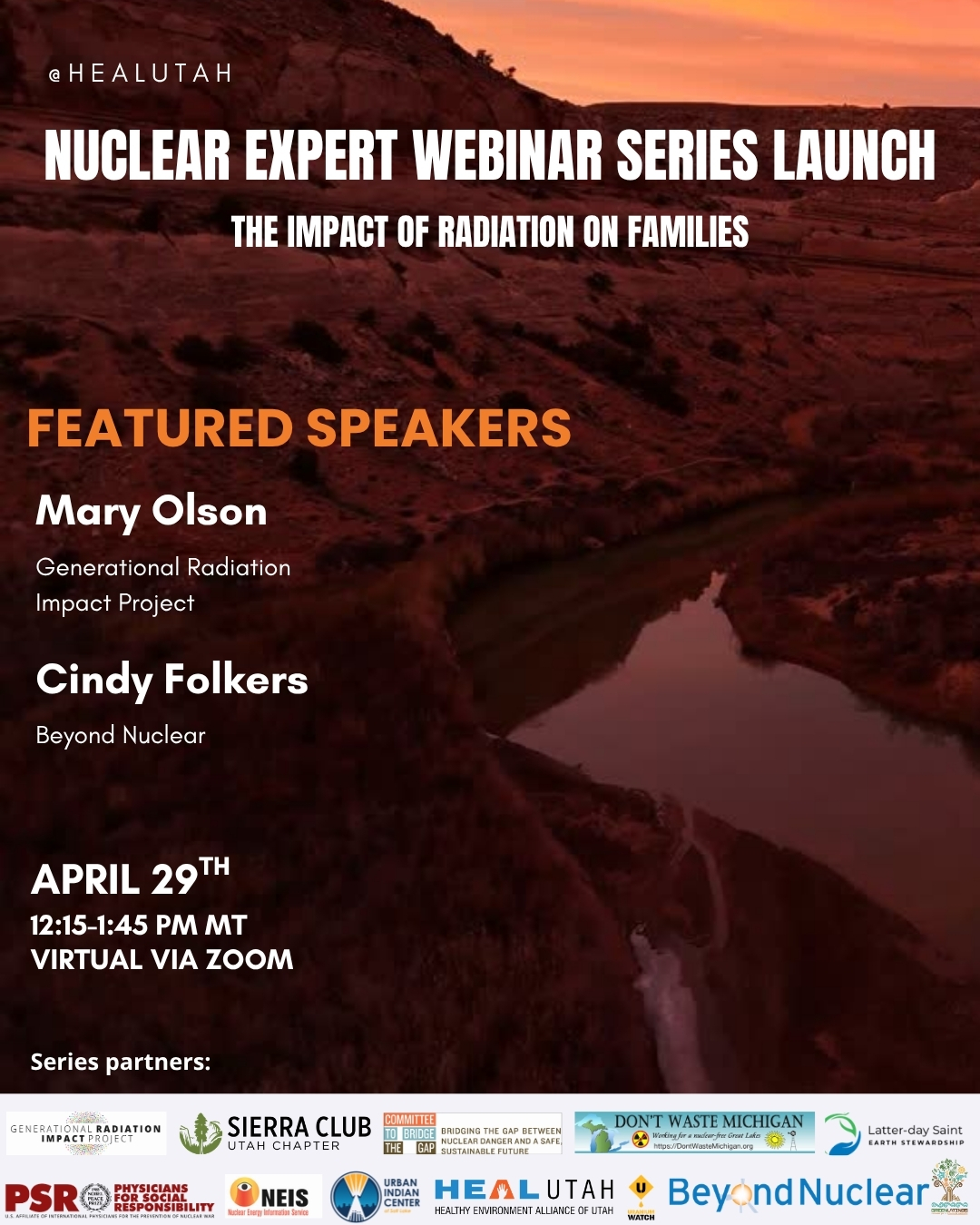
29 April – Nuclear Expert Webinar #1 – Radiation Impacts on Families with Mary Olson and Cindy Folkers
- 12:15 PM MT – 1:45 PM MT
- Location: Virtual – REGISTER TODAY

4 May -West Suburban Peace Coalition to discuss Iran war at May Educational Forum
Monday, May 4, 7:00 – 8:00 PM Central Standard Time
Title: : How Trump’s Narrative Tries to Shape the Reality of the War on Iran.
Contact Walt Zlotow, zlotow@hotmail.com 630 442 3045 for further information
14 May – online event From Bombs to Data Centres: the Face of Nuclear Colonialism

Pine Ridge Uranium is the real threat, not Tehran- Tell Burgum: Stop the Extraction.
Chernobyl: The Lost Tapes – A good documentary on Chernobyl on SBS available On Demand for the next 3 weeks– https://www.sbs.com.au/ondemand/tv-program/chernobyl-the-lost-tapes/2352741955560
To see nuclear-related stories in greater depth and intensity – go to https://nuclearinformation.wordpress.com
-
Archives
- April 2026 (288)
- March 2026 (251)
- February 2026 (268)
- January 2026 (308)
- December 2025 (358)
- November 2025 (359)
- October 2025 (376)
- September 2025 (257)
- August 2025 (319)
- July 2025 (230)
- June 2025 (348)
- May 2025 (261)
-
Categories
- 1
- 1 NUCLEAR ISSUES
- business and costs
- climate change
- culture and arts
- ENERGY
- environment
- health
- history
- indigenous issues
- Legal
- marketing of nuclear
- media
- opposition to nuclear
- PERSONAL STORIES
- politics
- politics international
- Religion and ethics
- safety
- secrets,lies and civil liberties
- spinbuster
- technology
- Uranium
- wastes
- weapons and war
- Women
- 2 WORLD
- ACTION
- AFRICA
- Atrocities
- AUSTRALIA
- Christina's notes
- Christina's themes
- culture and arts
- Events
- Fuk 2022
- Fuk 2023
- Fukushima 2017
- Fukushima 2018
- fukushima 2019
- Fukushima 2020
- Fukushima 2021
- general
- global warming
- Humour (God we need it)
- Nuclear
- RARE EARTHS
- Reference
- resources – print
- Resources -audiovicual
- Weekly Newsletter
- World
- World Nuclear
- YouTube
-
RSS
Entries RSS
Comments RSS
 nuclear-news