World Baseball Chief Plays Down Fukushima Olympic Fears
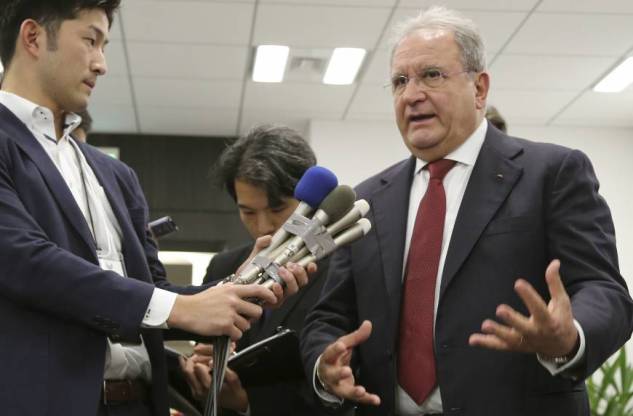
The president of the World Baseball Softball Confederation Ricardo Fraccari at press conference in Tokyo on Friday.
World baseball chief plays down Fukushima Olympic fears
The president of world baseball’s governing body on Friday played down fears that the sport’s top stars will refuse to play in Fukushima if the nuclear disaster-hit prefecture hosts games at the 2020 Olympics.
Olympic chiefs are currently considering a proposal to play part of the Tokyo 2020 baseball and softball competition in Fukushima Prefecture, which in 2011 suffered the world’s worst nuclear accident in 25 years when the Great East Japan Earthquake triggered a meltdown at the Fukushima No. 1 nuclear power plant.
The prefecture successfully hosted games at the Under-15 Baseball World Cup in the city of Iwaki this summer, and World Baseball Softball Confederation President Riccardo Fraccari believes senior teams will not be deterred from playing there in 2020 should its bid to host games be accepted.
“This can be an issue, but from the data I received, the situation at this moment is not dangerous in Fukushima,” said Fraccari, who held talks with Tokyo 2020 organizers in Tokyo on Friday and will visit the prefecture on Saturday to inspect potential venues.
“Even at the last Under-15 World Cup, only one country refused to come. But the rest were there. In three years — just now the situation is good, so I think from this point there won’t be any problem for countries to come to Fukushima.”
Fraccari must give his consent to the prefecture’s bid before it can be put before the International Olympic Committee, which will make a final decision when it holds its executive board meeting from Dec. 6 to 8.
Three venues in the prefecture are under consideration — Iwaki Green Stadium in Iwaki, Azuma Baseball Stadium of the city of Fukushima and Koriyama Kaiseizan Baseball Stadium in Koriyama.
“From the perspective of the WBSC, I know the importance of baseball and softball in Japan, and I know how we can facilitate the recovery from the disaster,” said Italian Fraccari. “If the field in Fukushima has all the requirements, we can take it into consideration and analyze internally the possibility.
“But I repeat, we have to check many things because we have to see how it’s possible to include it in the schedule, the distance, the fields. There are many issues and we won’t take any decision yet.”
Baseball and softball were voted onto the 2020 program as a joint bid after an absence of 12 years at an IOC session in Rio de Janeiro in August ahead of the Summer Games. The format of the competitions has yet to be decided.
Nippon Professional Baseball has agreed to suspend play for the duration of the July 24 to Aug. 9 Tokyo Olympics, but Major League Baseball has yet to say whether it will cooperate.
“There is, even from the major leagues, a desire to be more international,” said Fraccari. “Now we are discussing, but before we discuss we need to have the details of the tournament, the details of the schedule. I think that we can find a solution to have the best games possible.”
Fraccari also played down suggestions that pressure to agree to Fukushima’s proposal, which was floated by IOC President Thomas Bach during a visit to Tokyo last month, will affect his decision.
“I used to be an umpire, so I know what it means to be under pressure,” he said.
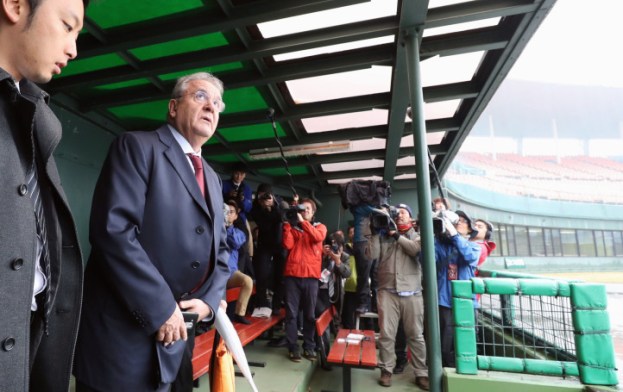
Olympics: No decision yet as world baseball-softball chief inspects Fukushima
World Baseball Softball Confederation President Riccardo Fraccari stopped short of issuing a verdict after inspecting Fukushima Prefecture as a potential host site of the 2020 Olympic baseball and softball competitions Saturday.
Fraccari scouted Azuma Stadium in Fukushima City and Koriyama’s Kaiseizan Stadium but insisted the purpose of his visit this time was to gather intelligence and not to reach a decision of any kind. The third city being considered is Iwaki, whose Green Stadium Fraccari has already visited.
“At the moment, I’m just collecting information of the stadiums,” said Fraccari, who met Fukushima Gov. Masao Uchibori ahead of his stadium tours.
“The problem for Fukushima is not just the stadium. We have to check about the transportation, the facility for the teams and the schedule.”
The 2020 organizing committee is looking to open the baseball and softball tournaments in the prefecture, with Japan set to play in the first game of both competitions.
Fraccari did not mention a deadline on when the competition format and the overall schedule would be made, but did say all the stakeholders would have to work fast, with the organizing committee aiming to finalize details at the Dec. 6-8 executive board meeting of the International Olympic Committee.
“Yesterday, it was a good meeting with Tokyo 2020,” he said. “We work very close with them, we cooperate a lot because both of us have the best interests in the Games in 2020.”
“We have to work very fast because we don’t have too much time. We don’t yet have a fixed deadline, for sure but we have to work very, very soon towards the entire Games (plan).”
Uchibori reiterated Fukushima’s willingness to stage the two sports.
“We want to express our strong desire to organize the events in Fukushima Prefecture,” Uchibori said to Fraccari in his native Italian.
“It will help unite the people of Fukushima, and help unite the prefecture and the world. They’re fantastic sports.”
Uchibori reassured Fraccari that the radiation levels in Fukushima, which was devastated by the March 2011 earthquake and the nuclear power plant crisis that followed, are no different to that of major cities around the world.
“In almost all areas in the prefecture, the figures are the same as any of the world’s major cities,” Uchibori said.
Fukushima Facility to Become Soccer Training Camp for 2020 Olympics
Tepco to end operations at the J-Village complex by March
Facility to be used as training camp for 2020 Tokyo Olympics
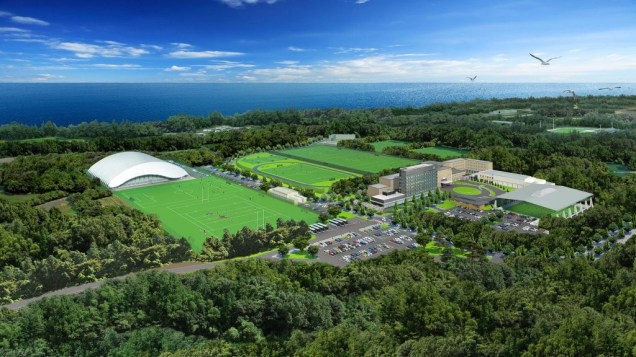
The base for the cleanup of the Fukushima nuclear plant will be returned by March to its original use: the training camp for the Japanese national soccer team.
In a symbolic step in the struggle to contain one of the worst nuclear disasters, Tokyo Electric Power Co. Holdings Inc. will return the J-Village facility — about 20 kilometers (12 miles) from the crippled Dai-Ichi plant and just 7 kilometers from the current exclusion zone — to the prefectural government during the current fiscal year, company spokesman Tatsuhiro Yamagishi said Tuesday. It’s also a boon for soccer players who will use the complex as their training base for the 2020 Tokyo Olympics.
The complex, opened in 1997 and shut down after March 2011 meltdown, will be fully reopened for players of “The Beautiful Game” in April 2019. It boasts 11 soccer pitches, a 1,200 square-meter gymnasium and a four-lane pool.
The hand-over is a shot in the arm for Prime Minister Shinzo Abe, who has vowed the nuclear disaster will not impede the nation’s plans to host the 2020 Games. In September, the premier said the situation at Fukushima is “under control” and that there doesn’t need to be a review of measures to prevent contamination.
“This promised handover of J-village would serve as a symbol of progress,” Daniel Aldrich, professor and director of the security and resilience studies program at Northeastern University in Boston, said by e-mail.
“Tepco clearly hopes that this will show the nation that it is on track in the Fukushima accident clean up process,” Aldrich said. “However, a number of obstacles, including expanding costs for decommissioning, a lack of physical control over the contaminated groundwater at the site, and complaints about the decontamination process nearby will no doubt hinder the process.”
As Tepco begins in coming years to remove melted fuel at Fukushima, clean-up costs may rise to several hundred billion yen annually from the current 80 billion yen ($763 million), Japan’s industry ministry said in October. About 300 metric tons of water — partly from the nearby hills — flow into the reactor building daily, mixing with melted fuel and becoming contaminated, according to the company.
The utility used the soccer facility as a make-shift base for tasks from corporate communications to measuring the radiation exposure of employees. It even built temporary dormitories there.
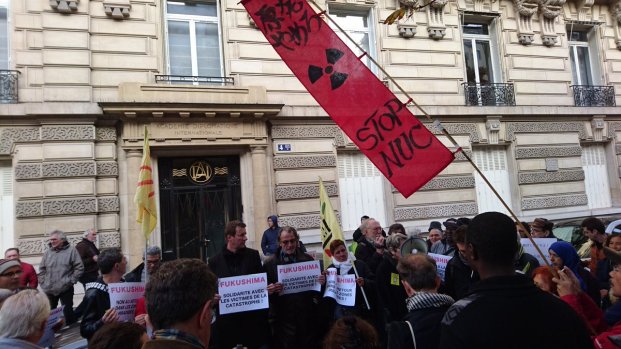
Protest at Japanese Embassy in Paris Against Fukushima Evacuees Forced Return and the 2020 Tokyo Olympics

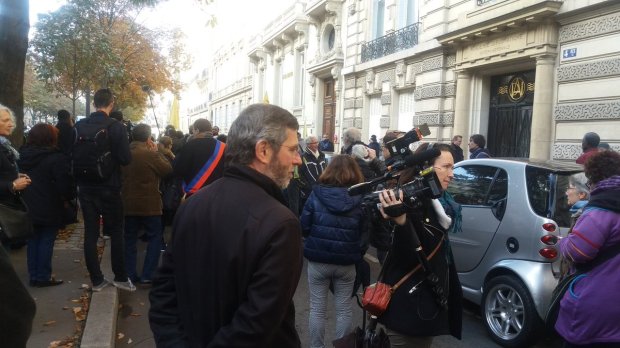
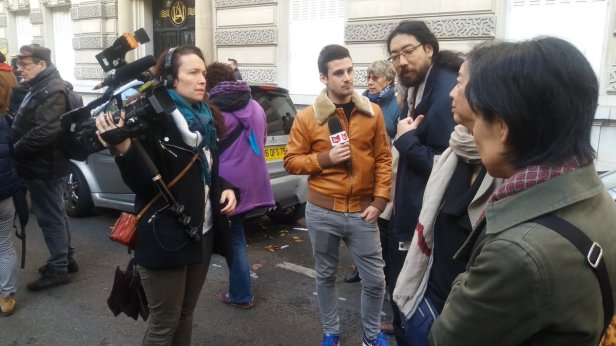
Today October 22, 2016, in Paris, the French Green Ecology Party (EELV), Green Peace France and Réseau Sortir du Nucléaire, joined together to organize a Fukushima protest in front of the Japanese Embassy.
They denounced the Fukushima evacuees forced return by the Japanese government, and insisted that no one should be compelled to live in irradiated town with high level of radiation. That it is plainly criminal on the part of the Japanese Government.
Since Eastern Japan and Tokyo included, have been contaminated by the now five years and a half ongoing nuclear catastrophe at Tepco’s Fukushima Daiichi nuclear plant, a catastrophe yet neither under control nor resolved, the 2020 Olympics should be relocated somewhere else.
Some officials of the French Green Ecology Party (EELV) and personalities of Green Peace France and Réseau Sortir du Nucléaire attended the protest. Among those were also present Yannick Jadot and Michele Rivasi, both Europe Ecology deputies at the European Parliament, one of the two to be the French Ecology Party presidential candidate at the coming French presidential election in 2017. Were also present members of the Japanese community.
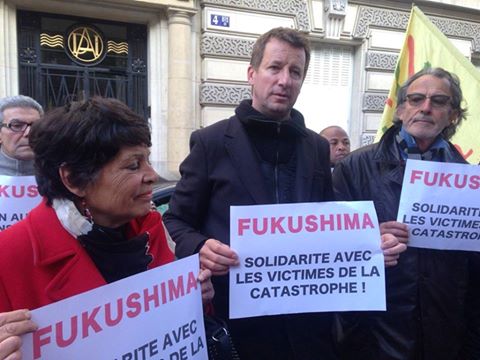
Michele Rivasi and Yannick Jadot
Tokyo 2020: Japan earthquake and nuclear disaster site could host Olympic events
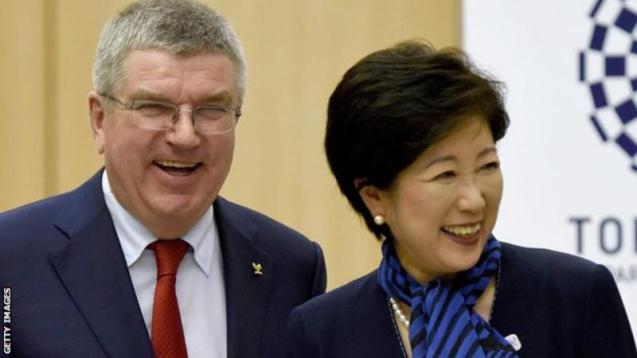
IOC president Thomas Bach is holding talks with Tokyo Governor Yuriko Koike in the city
Tokyo 2020: Japan earthquake and nuclear disaster site could host Olympic events
Tokyo 2020 Olympic events could be held in part of Japan hit by the 2011 Fukushima earthquake, tsunami and nuclear disaster in a bid to cut costs.
Rowing canoe/kayak sprint events and baseball/softball are among sports that could be moved 400km north of Tokyo.
The International Olympic Committee is holding talks with organisers after a review showed costs could exceed £23bn ($28bn) – four times the estimate.
But IOC president Thomas Bach said “we have to respect” athletes.
“The athletes are the heart and soul of the Olympic Games,” Bach emphasised.
The IOC began four-party discussions with the city government, Tokyo organisers and Japan’s central government on Tuesday in a bid to reduce spending on the Games.
The proposal to move some sports to the north-eastern area of Japan devastated by the earthquake was made in a review of expenses commissioned by Tokyo Governor Yuriko Koike.
The review recommends moving some sports from planned new venues to existing ones.
Several events have already been moved outside of Tokyo, with cycling now due to take place 200km from the village in the Shizuoka district.
Bach said he was confident cost reductions could be made, but suggested Tokyo should try to stay close to its original bid proposal of keeping the majority of venues within 8km of the athlete’s village in the city’s downtown.
He said moving events to the earthquake-hit area was one of several cost-cutting options being discussed, and that it could “contribute to the regeneration” of the region.
The most expensive Games to date are the London Games at £12bn and the Sochi 2014 Winter Games in Russia which cost £17.7bn.
The Rio Olympic Games cost £9.7bn, coming in 51% over budget despite cuts to ceremonies, venues and staff.
According to a recent study, no Games since 1960 has come in under budget.
http://www.bbc.com/sport/olympics/37703005
Bach: Events could be held in northeast Japan
The head of the International Olympic Committee has suggested holding some events of the 2020 Tokyo Games in areas of northeastern Japan that were devastated by the earthquake and tsunami of 2011.
IOC President Thomas Bach, now visiting Japan, met Prime Minister Shinzo Abe in Tokyo on Wednesday.
Bach told Abe the IOC is thinking of holding some Olympic events in the disaster zone to contribute to revival efforts. He said this could show the world how the areas have recovered. Abe welcomed the idea.
Abe also promised the government’s participation in talks to cut costs for the games.
Bach had proposed 4-way talks by the Tokyo Metropolitan Government, the IOC, Tokyo 2020 organizers and Japan’s government.
Reporters later asked Bach if baseball and softball will be held in Fukushima City. Bach said it’s an option under consideration. He added that since the sports are very popular in Japan, having the country’s team play in the disaster zone would send a strong message.
High-school Students Continuously Put at Risk for Propaganda Use
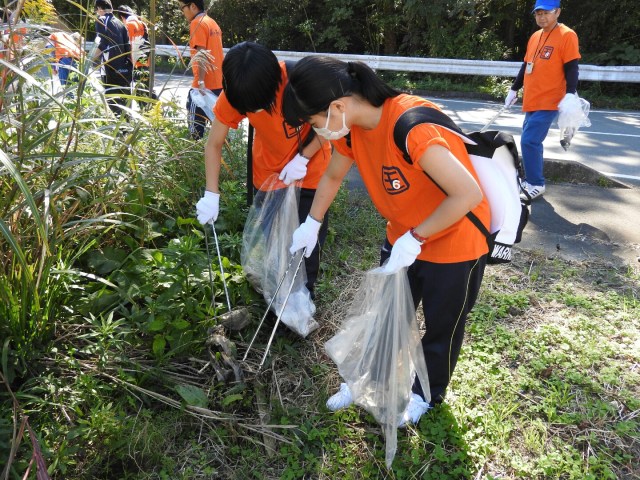
National route 6 which runs only a few km parallel to the coast where stands what is left of Daiichi Nuclear power plant, high-school students are cleaning up radiation.
14 high school students were picking up trash. 0.7μSv / h radiation measured by some citizens’ group at some of the places. With dust being blown, many high school students were walking still without a mask.
The criticism that it could endanger the children, was ignored by Yumiko Nishimoto, president of the NPO “Happy load net” which organized that acttion, answering “we are living here every day.” .
Clean-up activities with an eye to the torch relay of the Tokyo Olympics. The priority is the “reconstruction”, and the health of children is secondary, completely neglected.
The NPO responsible for such insanity argues that it helps them studying about radiation, that they do that every year.
Children are continuously being used to help the propaganda that everything is back to normal. But it’s a lie and it is borderline criminal. Shame on you Japan.
http://taminokoeshimbun.blog.fc2.com/blog-entry-61.html
Tokyo governor visits alternative site in Miyagi Prefecture for 2020 Games’ rowing and canoe sprint
We are many to think that it is shocking, disgusting and very sad that after over5 & a half years they are still putting their greed above the health of those people who would participate and go to watch these games, not to mention their own people. They should have relinquished as soon as they knew that the Fukushima Daiichi nuclear disaster had contaminated a good third of the country.

Tokyo Gov. Yuriko Koike (left front) and Miyagi Gov. Yoshihiro Murai (left back) wave to the press as they inspect the Naganuma rowing course in the city of Tome, Miyagi Prefecture, on Saturday.
Tokyo Gov. Yuriko Koike on Saturday visited a boat race course in Miyagi Prefecture, a facility emerging as an alternative venue for the rowing and canoe sprint events at the 2020 Tokyo Olympic games.
“Based on this visit, I will start considering venues,” Koike told reporters after inspecting facilities at the Naganuma rowing course in the city of Tome, more than 400 kilometers from Tokyo. Miyagi is one of the prefectures in northeastern Japan hit hardest by the March 2011 earthquake and tsunami.
Games organizers and the International Rowing Federation had already approved the Sea Forest Waterway venue to be constructed on Tokyo Bay, but a metropolitan government cost review panel recommended last month that plan be reconsidered.
The Tokyo Olympic and Paralympic organizing committee has raised concerns that costs could top ¥35.1 billion ($337 million) even if the rowing and canoe sprint events were held at the Naganuma rowing course. But Miyagi Prefecture Gov. Yoshihiro Murai argued Saturday in a television appearance that the overall cost is “estimated at around ¥15 to ¥20 billion.”
On the TV program, Murai also emphasized that most of the costs will be for “permanent facilities” after the Olympic Games, and that the prefectural government would shoulder the cost to remove temporary housing.
Last Wednesday, Murai visited Koike in Tokyo to convey his wish to hold the rowing and canoe events in Miyagi to show the world the recovery Japan has made since the 2011 quake and tsunami disaster.
Koike had told Murai that the Naganuma boat course was an option and she would “make a comprehensive decision” after visiting the site.
The organizing committee, however, has questioned the feasibility of holding those events at the Miyagi site, raising what they said are “nine problems,” including transportation, infrastructure and costs.
Saitama Gov. Kiyoshi Ueda has also said his prefecture is ready to host the rowing and canoe sprint events at Saiko Doman Green Park in the city of Toda.
Fukushima Backlash Hits Japan Prime Minister
Nuclear power may never recover its cachet as a clean energy source, irrespective of safety concerns, because of the ongoing saga of meltdown 3/11/11 at Fukushima Daiichi Nuclear Power Plant. Over time, the story only grows more horrific, painful, deceitful. It’s a story that will continue for generations to come.
Here’s why it holds pertinence: As a result of total 100% meltdown, TEPCO (Tokyo Electric Power Company) cannot locate or remove the radioactive molten core or corium from the reactors. Nobody knows where it is. It is missing. If it is missing from within the reactor structures, has it burrowed into the ground? There are no ready answers.
And, the destroyed nuclear plants are way too radioactive for humans to get close enough for inspection. And, robotic cameras get zapped! Corium is highly radioactive material, begging the question: If it has burrowed thru the containment vessel, does it spread underground, contaminating farmland and water resources and if so, how far away? Nobody knows?
According to TEPCO, removing the melted cores from reactors 1,2 and 3 will take upwards of 20 years, or more, again who knows.
But still, Japan will hold Olympic events in Fukushima in 2020 whilst out-of-control radioactive masses of goo are nowhere to be found. TEPCO expects decades before the cleanup is complete, if ever. Fortunately, for Tokyo 2020 (the Olympic designation) radiation’s impact has a latency effect, i.e., it takes a few years to show up as cancer in the human body.
A week ago on September 7th, Former PM Junichiro Koizumi, one of Japan’s most revered former prime ministers, lambasted the current Abe administration, as well as recovery efforts by TEPCO. At a news conference he said PM Shinzō Abe lied to the Olympic committee in 2013 in order to host the 2020 Summer Olympics in Japan.
“That was a lie,” Mr Koizumi told reporters when asked about Mr Abe’s remark that Fukushima was “under control,” Abe Lied to IOC About Nuke Plant, ex-PM Says, The Straits Times, Sep 8, 2016. The former PM also went on to explain TEPCO, after 5 years of struggling, still has not been able to effectively control contaminated water at the plant.
According to The Straits Times article: “Speaking to the IOC in September 2013, before the Olympic vote, PM Abe acknowledged concerns but stressed there was no need to worry: “Let me assure you, the situation is under control.”
PM Abe’s irresponsible statement before the world community essentially puts a dagger into the heart of nuclear advocacy and former PM Koizumi deepens the insertion. After all, who can be truthfully trusted? Mr Koizumi was a supporter of nuclear power while in office from 2001-2006, but he has since turned into a vocal opponent.
Speaking at the Foreign Correspondents Club of Japan in Tokyo, Mr Koizumi said: “The nuclear power industry says safety is their top priority, but profit is in fact what comes first… Japan can grow if the country relies on more renewable energy,” (Ayako Mie, staff writer, Despite Dwindling Momentum, Koizumi Pursues Anti-Nuclear Goals, The Japan Times, Sept. 7, 2016).
Mr Koizumi makes a good point. There have been no blackouts in Japan sans nuclear power. The country functioned well without nuclear.
Further to the point of nuclear versus nonnuclear, Katsunobu Sakurai, mayor of Minamisoma, a city of 70,000 located 25 km north of Fukushima No. 1 nuclear plant, at a news conference in Tokyo, said: “As a citizen and as a resident of an area affected by the nuclear power plant disaster, I must express great anger at this act… it is necessary for all of Japan to change its way of thinking, and its way of life too – to move to become a society like Germany, which is no longer reliant on nuclear power,” (Sarai Flores, Minamisoma Mayor Sees Future for Fukushima ‘Nonnuclear’ City in Energy Independence, The Japan Times, March 9, 2016).
In March of 2015, Minamisoma declared as a Nonnuclear City, turning to solar and wind power in tandem with energy-saving measures.
Meanwhile, at the insistence of the Abe administration, seven nuclear reactors could restart by the end of FY2016 followed by a total of 19 units over the next 12 months (Source: Japanese Institute Sees 19 Reactor Restarts by March 2018, World Nuclear News, July 28, 2016).
Greenpeace/Japan Discovers Widespread Radioactivity
One of the issues surrounding the Fukushima incident and the upcoming Olympics is whom to trust. Already TEPCO has admitted to misleading the public about reports on the status of the nuclear meltdown, and PM Abe has been caught with his hand in the proverbial cookie jar, but even much worse, lying to a major international sports tribunal. His credibility is down the drain.
As such, maybe third party sources can be trusted to tell the truth. In that regard, Greenpeace/Japan, which does not have a vested interest in nuclear power, may be one of the only reliable sources, especially since it has boots on the ground, testing for radiation. Since 2011, Greenpeace has conducted over 25 extensive surveys for radiation throughout Fukushima Prefecture.
In which case, the Japanese people should take heed because PM Abe is pushing hard to reopen nuclear plants and pushing hard to repopulate Fukushima, of course, well ahead of the 2020 Tokyo Olympics since there will be events held in Fukushima Prefecture. After all, how can one expect Olympians to populate Fukushima if Japan’s own citizens do not? But, as of now to a certain extent citizens are pushing back. Maybe they instinctively do not trust their own government’s assurances.
But, more chilling yet, after extensive boots-on-the-ground analyses, Greenpeace issued the following statement in March 2016: “Unfortunately, the crux of the nuclear contamination issue – from Kyshtym to Chernobyl to Fukushima- is this: When a major radiological disaster happens and impacts vast tracts of land, it cannot be ‘cleaned up’ or ‘fixed’.” (Source: Hanis Maketab, Environmental Impacts of Fukushima Nuclear Disaster Will Last ‘decades to centuries’ – Greenpeace, Asia Correspondent, March 4, 2016).
That is a blunt way of saying sayonara to habitation on radioactive contaminated land. That’s why Chernobyl is a permanently closed restricted zone for the past 30 years.
As far as “returning home” goes, if Greenpeace/Japan ran the show rather than PM Abe, it appears they would say ‘no’. Greenpeace does not believe it is safe. Greenpeace International issued a press release a little over one month ago with the headline: Radiation Along Fukushima Rivers up to 200 Times Higher Than Pacific Ocean Seabed – Greenpeace Press Release, July 21, 2016.
Here’s what they discovered: “The extremely high levels of radioactivity we found along the river systems highlights the enormity and longevity of both the environmental contamination and the public health risks resulting from the Fukushima disaster,” says Ai Kashiwagi, Energy Campaigner at Greenpeace Japan.
“These river samples were taken in areas where the Abe government is stating it is safe for people to live. But the results show there is no return to normal after this nuclear catastrophe,” claims Kashiwagi.
“Riverbank sediment samples taken along the Niida River in Minami Soma, measured as high as 29,800 Bq/kg for radiocaesium (Cs-134 and 137). The Niida samples were taken where there are no restrictions on people living, as were other river samples. At the estuary of the Abukuma River in Miyagi prefecture, which lies more than 90km north of the Fukushima Daiichi plant, levels measured in sediment samples were as high as 6,500 Bq/kg” (Greenpeace).
The prescribed safe limit of radioactive cesium for drinking water is 200 Bq/kg. A Becquerel (“Bq”) is a gauge of strength of radioactivity in materials such as Iodine-131 and Cesium-137 (Source: Safe Limits for Consuming Radiation-Contaminated Food, Bloomberg, March 20, 2011).
“The lifting of evacuation orders in March 2017 for areas that remain highly contaminated is a looming human rights crisis and cannot be permitted to stand. The vast expanses of contaminated forests and freshwater systems will remain a perennial source of radioactivity for the foreseeable future, as these ecosystems cannot simply be decontaminated” (Greenpeace).
Still, the Abe administration is to be commended for its herculean effort to try to clean up radioactivity throughout Fukushima Prefecture, but at the end of the day, it may be for naught. A massive cleanup effort is impossible in the hills, in the mountains, in the valleys, in the vast forests, along riverbeds and lakes, across extensive meadows in the wild where radiation levels remain deadly dangerous. Over time, it leaches back into decontaminated areas.
And as significantly, if not more so, what happens to the out-of-control radioactive blobs of corium? Nobody knows where those are, or what to do about it. It’s kinda like the mystery surrounding black holes in outer space, but nobody dares go there.
Fukushima is a story for the ages because radiation doesn’t quit. Still, the Olympics must go on, but where?
http://www.counterpunch.org/2016/09/12/fukushima-backlash-hits-japan-prime-minister/
Iwaki mayor makes formal request for city to host baseball, softball games during 2020 Olympics
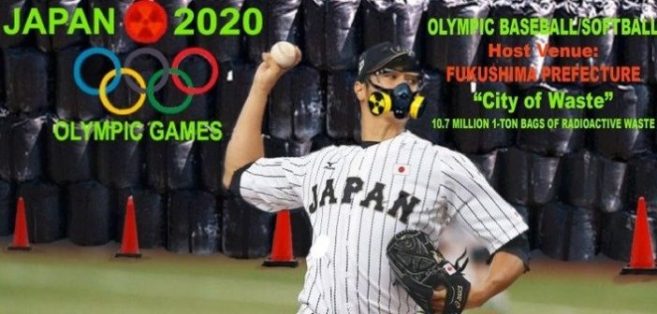
Iwaki Mayor Toshio Shimizu on Friday presented a request to 2020 Tokyo Olympic organizers, seeking to host a baseball game and a softball game in the city in Fukushima Prefecture.
Shimizu submitted the request to Yoshiro Mori, president of the Tokyo Olympic and Paralympic organizing committee, and Toshiei Mizuochi, senior vice minister of both the sports ministry and the Cabinet Office.
The request comes as Tokyo Olympic organizers are arranging to stage one first-round game each for baseball and softball in Fukushima Prefecture, one of the areas hardest hit by the 2011 earthquake and tsunami disaster, as part of reconstruction efforts.
They are said to be considering Iwaki, Fukushima and Koriyama cities as candidate sites.
The Iwaki municipal government wants the games played at Iwaki Green Stadium, which is occasionally used for Japanese professional baseball games and was the venue of the Under-15 World Cup baseball competition in July and August.
Shimizu expressed hope that the stadium will be chosen as an Olympic venue as that would “give hope and courage” to survivors of the quake and tsunami which also triggered a nuclear accident in the prefecture.
The main ballpark for the 2020 Summer Games is set to be Yokohama Stadium in Kanagawa Prefecture.
In the request, Shimizu and the mayors of eight nearby towns and villages are also requesting that the Olympic torch relay run on National Route 6 in the coastal area of Fukushima Prefecture.
Fukushima could host 2020 events

Organizers of the 2020 Tokyo Olympics are working toward staging a baseball and softball game in the 2011 earthquake and tsunami struck Fukushima Prefecture, a source close to the matter said Friday.
Baseball and softball were among the five sports approved last month by the International Olympic Committee to be added to the Tokyo Games program, and the 2020 organizers will look to get approval for the plan from the IOC executive board in December.
The organizers are working to present the idea to IOC president Thomas Bach in October when he visits Japan for a meeting.
Three baseball parks inside the prefecture — all previous hosts of NPB games — are on the shortlist, and organizers are likely to argue accessibility from Tokyo and the possibility of installing fixed seats in the outfield stands as to why the idea is feasible.
The main ballpark for the 2020 Games is set to be Yokohama Stadium, home of the Yokohama BayStars.
Former Olympic minister Toshiaki Endo reiterated on March 11 — the fifth anniversary of the disaster — that the prefecture could host some games in order to demonstrate the revitalization of the Tohoku region, most affected by the disaster.
Fukushima Gov. Masao Uchibori met Yoshiro Mori, the Tokyo 2020 organizing committee president, on Wednesday to request his region be given the opportunity to host the two games in the baseball and softball tournaments’ first round.
http://www.japantimes.co.jp/sports/2016/09/03/olympics/fukushima-host-2020-events/#.V8rqwa3KO-c

Tokyo 2020 Games prep beset with problems
“Some officials even suggested they were hoping Fukushima prefecture could host the first rounds of softball and baseball, which have been added to the program for the 2020 Olympics.
The northeastern prefecture hosts the Fukushima Daiichi nuclear power station which suffered a triple meltdown in March 2011 after it was hit by an earthquake and resulting tsunami.
About 100,000 residents have still been unable to return home because of radioactive contamination near the complex.”
Tokyo’s preparations for the 2020 Games have been beset by problems from soaring costs to a stadium designed without the Olympic cauldron.
In less than four years, the final torch bearer will light the cauldron in the opening ceremony to start the 2020 Tokyo Olympic Games.
But where was the cauldron in the newly selected design for the Olympic main stadium, Japanese officials asked in March.
It was just the latest in a series of controversies involving Tokyo’s second Olympics.
Tokyo organising committee president Yoshiro Mori blamed the new main stadium operator, the Japan Sports Council, and then-sports minister Hiroshi Hase for the missing cauldron.
“It would make no sense not to think about the cauldron if the stadium was getting built for the Olympic Games,” Mori said.
Japanese architect Kengo Kuma, whose proposal was picked in December as the new design for the venue, said the placement of the cauldron was not even on the agenda during the bidding.
His design has spectators’ stands covered by wooden materials, therefore there are concerns that a cauldron in the stadium could infringe the country’s Fire Service Act.
But Kuma has tried to allay such concerns, saying there’s no need to worry as he is considering various methods to install it.
Kuma’s design was adopted after Prime Minister Shinzo Abe decided in July 2015 to abandon the initial design by late Iraqi-British architect Zaha Hadid amid a public outcry over its surging cost.
The Japanese architect’s plan indicates a total construction cost of Y149 billion ($A1.94 billion), far below the estimated Y252 billion for the controversial scrapped design by Hadid, which almost doubled from an initially projected Y130 billion.
Kuma’s office says the construction will start in December and it will be completed in November 2019, two months earlier than the deadline imposed by the International Olympic Committee, seven months before the opening of the 32nd Olympics.
The changes, however, will make it impossible to use the new stadium for the rugby World Cup in the (northern) autumn of 2019 as scheduled.
Japan also withdrew its original Tokyo Olympics logo a year ago after its designer Kenjiro Sano was accused of copying it.
A Belgian designer sued the IOC, saying the logo was similar to one of his works produced for a theatre in Belgium.
The new official emblem was picked in April.
More than three years ago, then-candidate city Tokyo promised a compact Olympics with most venues close to the centre of the Japanese capital. That was a main selling point to win the bid to host the 2020 Games against Istanbul and Madrid.
Tokyo, however, backed down on such promises as some venues have moved out of the Japanese capital.
Some officials even suggested they were hoping Fukushima prefecture could host the first rounds of softball and baseball, which have been added to the program for the 2020 Olympics.
The northeastern prefecture hosts the Fukushima Daiichi nuclear power station which suffered a triple meltdown in March 2011 after it was hit by an earthquake and resulting tsunami.
About 100,000 residents have still been unable to return home because of radioactive contamination near the complex.
The organising committee has been criticised for soaring costs.
Former defence minister Yuriko Koike became governor of Tokyo in a landslide victory in late July, the first woman to head the Japanese capital. A ruling Liberal Democratic Party MP who speaks fluent Arabic and English, she has pledged to review the ballooning costs of the 2020 Games.
Koike is in Rio de Janeiro to attend the closing ceremony to accept the Olympic flag as a representative of the next host city.
https://www.sbs.com.au/news/article/2016/08/19/tokyo-2020-games-prep-beset-problems
Japan vows to cooperate in French Olympic probe

Japan vowed to cooperate with a French probe into $2 million allegedly paid to help Tokyo secure the 2020 Olympics on Monday, as the son of ex-world athletics chief Lamine Diack denied receiving the money.

Prime Minister Shinzo Abe said he had ordered full cooperation with the French investigation into the payments, sent to a Singapore bank account which has been linked to Diack’s son, Papa Massata Diack.
Japanese officials have been swift to deny wrongdoing in what is the most serious in a series of problems to affect the 2020 Games, including over the main stadium’s design and the event’s official logo.
French prosecutors said last week they suspect the payments were intended to help secure the 2020 Olympics for Tokyo, which beat out competition from Istanbul and Madrid.
Japan’s Olympic chief last week insisted the payments were a “legitimate consultant’s fee”, while the top government spokesman insisted the bid was “clean”.
And Prime Minister Abe told parliament on Monday: “I have instructed the education and sports minister to fully cooperate in the investigation.”
“Education and sports minister Hiroshi Hase told the Japanese Olympic Committee and the former bid committee to cooperate in the investigation,” he added, according to Jiji Press.
French prosecutors said some 2.8 million Singapore dollars (1.8 million euros, $2 million) were paid to the now defunct Black Tidings consulting company, which Britain’s Guardian newspaper has linked to Papa Massata Diack.
Lamine Diack was an International Olympic Committee member in 2013 when Tokyo won the hosting rights for 2020. Diack and his son already face corruption charges in France.
– ‘Let them investigate’ –
The payments were discovered as part of an inquiry into allegations the Diacks organised bribes to cover up failed dope tests by Russian athletes, French prosecutors said. France became involved as the money may have been laundered in Paris.
But Diack’s son, Papa Massata Diack, speaking to Kyodo News agency in his native Senegal, insisted he hadn’t received any money from the Tokyo bid team.
“I haven’t got any money,” he said in Dakar. “Let them investigate… I have nothing to hide,” he added.
He added that he had been friends with Ian Tan Tong Han, formerly the sole proprietor of Black Tidings, since the 2008 Beijing Olympics. But he said he didn’t know Tan’s company was contracted by the Japanese bid team.
“I’ve been in this sports business for 25 years. I know the rules,” Diack said, adding that Tokyo’s bid “shouldn’t be tarnished” and had been done “very fairly”.
Tsunekazu Takeda, the Japanese Olympic Committee president who led Tokyo’s bid, said the money was for “professional services” for consulting work.
“I never knew there was a link (between the company and Papa Massata Diack),” Takeda told lawmakers in parliament on Monday. “Anyway, if it is in the realm of acquaintance there is no problem,” he added.
“Internationally it is quite common” to have a contract with an international consultant, Takeda added.
The controversy comes after Tokyo had to scrap its original main stadium design due to its eye-watering price tag, and also had to weather plagiarism accusations over the Games’ initial logo.

Suspicions grow over Tokyo 2020 Olympic bid team’s payment for ‘consulting fees’
Suspicions have been raised over the credibility of the Tokyo 2020 Olympic bid team’s decision to pay about 230 million yen to the “Black Tidings” company in Singapore for “consulting fees” as part of efforts to win the right to host the Games.
Japanese Olympic Committee (JOC) Chairman Tsunekazu Takeda, who headed the bid team in 2013, was hard-pressed to explain the deal during a meeting on May 16 of the House of Representatives Budget Committee. While the total cost of hosting the 2020 Tokyo Olympic and Paralympic Games is expected to swell, facts about the Olympic bid team going to extremes to win its bid to host the Games have been exposed one after another.
Takeda, the top figure in the Japanese sports world, was grilled as an unsworn witness during the lower house budget committee meeting. Takeda emphasized, “It is a common practice to have contracts with overseas consultants and there will be no success without them. Their consultations were crucial for our last-minute vote counting and winning votes.” He made the statement when he was questioned by Democratic Party (DP) legislator Yuichiro Tamaki.
Each candidate city for hosting Olympic events signs contracts with multiple consulting firms at home and abroad in order to receive guidance on bidding campaign speeches and advice on lobbying activities aimed at collecting votes from International Olympic Committee (IOC) members. In its bid to host the 2020 Tokyo Olympic and Paralympic Games, the bid committee signed contracts with about 10 consulting firms, sources said.
According to the bid committee’s report on its activities, the Tokyo Metropolitan Government and the bid committee footed the bill for bidding activities and spent about 8.9 billion yen between September 2011 and September 2013. Still, that figure is about 60 percent of about 14.9 billion yen spent on Tokyo’s unsuccessful bid for the 2016 Summer Olympics and Paralympics.
Of the 8.9 billion yen, about 4.1 billion yen was used for overseas activities to try to win the bid to host the Games. The “consulting fees” in question were included in expenses for overseas public relations activities — part of international bidding activities. The bid committee, which had collected contributions from the private sector and support money, shouldered the expenses for the “consulting fees.” The Tokyo Metropolitan Government did not directly pay the consulting fees. Furthermore, Takeda insisted that the payment was legitimate because it was audited by a Tokyo-based audit company and approved by the IOC.
Nonetheless, suspicions have been raised about the personal connections of Ian Tan Tong Han, who represented the “Black Tidings” company. The French financial prosecutor’s office has been investigating disgraced former International Association of Athletics Federations President Lamine Diack and his son Papa Massata Diack on suspicion of receiving cash in return for giving silent approval to doping by Russian athletes. The French prosecutors focused their attention on the fact that Papa Massata Diack is a close friend of Ian Tan Tong Han. Allegations have emerged that money aimed at colleting votes was funneled to Papa Massata Diack, who had a voice in the decision on which country would host the games.
Takeda emphasized that he was not aware of the connection between Ian Tan Tong Han and Papa Massata Diack. However, Ian Tan Tong Han has not been reached since the allegations came to light and the flow of the consulting fees has not been confirmed. Sources abroad who have been long involved in Olympic events say that Ian Tan Tong Han is not well known. Ian Tan Tong Han’s Singapore office was in an apartment room. The fact that the Tokyo bid committee paid the massive amount of funds to a company that looked like a shell company has led to a sense of public distrust in the Tokyo Olympic bidding campaign.
In the final round of voting at the IOC general meeting in September 2013, Tokyo won 60 votes against 36 for Istanbul. The result showed a landslide victory for Tokyo, but the competition between the three cities including Madrid had been so keen that it was hard to predict the winner. Before the opening of the IOC general meeting, people linked to the race for the right to host the 2020 Games gathered at a lobby of a Buenos Aires hotel where IOC members were staying. Rumors were swirling that people related to Istanbul were apparently calling in IOC members to try to persuade them to vote for their city. Suspicion was stoking idle fears among people there.
At that time, Tokyo was fighting an uphill battle. Then Tokyo Gov. Naoki Inose, who was chairman of Tokyo’s Olympic bid committee, came under fire for saying in April 2013 that Islamic countries were “fighting with each other.” In July that year, Tokyo’s bid to host the Games was viewed with anxiety as news spread of a leakage of contaminated water at the Fukushima No.1 nuclear power plant.
The Tokyo bid committee regarded the IAAF World Championships in Athletics that opened in Moscow in August 2013 as a major highlight of its activities. That’s because many IOC members, mainly those related to athletic sports, would gather there. Ian Tan Tong Han had already promoted himself. Through Dentsu Inc., a major Japanese international advertising and public relations company, the Tokyo bid committee confirmed that Ian Tan Tong Han had played a role in helping Beijing win the right to host the 2015 IAAF World Championships in Athletics. The bid committee abandoned its pride to pay the consulting fees of 230 million yen.
The murky payment of consulting fees is not the only step taken by the bid committee to win the right to host the Games that sparked public distrust. Although the bid committee changed itself into an organizing committee tasked with preparing and operating the Games in January 2014, it was revealed that the total cost of hosting the world event was underestimated when the bid committee was campaigning for its bid.
Above all, the construction plan for a new Olympic stadium — the main venue for the Games — raised havoc. The construction cost for the new national stadium was estimated at 130 billion yen at the time of the bidding campaign. But after looking into details of the plan, the total cost was expected to soar to about 300 billion yen, forcing the scrapping of the construction plan in July 2015. Meanwhile, the total cost of building temporary venues that are to be dismantled after the Games is likely to rise to about 300 billion yen — about four times the 72.3 billion yen estimated at the time of the bidding campaign. Tokyo 2020 Olympic Organizing Committee President Yoshiro Mori said in July 2015 that the total cost of hosting the Games could exceed 2 trillion yen. It was earlier estimated at 734 billion yen at the time of the bidding campaign.
Why did the Tokyo Olympic committee have to bite off more than it could chew? The root cause of this stems from their eagerness to overcome Tokyo’s weakness shown when it miserably lost its bid to host the 2016 Games. The bid committee set aside hefty funds for overseas consulting fees this time because it had the bitter lesson that it was weak in lobbying activities abroad. Another weakness stems from low support ratings at home for hosting the Games. As compared with Rio de Janeiro, which received a support rate of 84.5 percent for hosting the 2016 Summer Games, Tokyo had only a 55.5 percent support rate for the same event. Tokyo received a support rate of 70 percent for hosting the 2020 Games in a survey conducted in January 2013 by the IOC, but there were persistent views in Japan that priority should be placed on efforts to rebuild the regions battered by the 2011 Great East Japan Earthquake. If the government were to spend huge amounts of money on the Games, it could see public support declining. Holding the estimated cost of hosting the Games down to the minimum was a desperate measure.
A senior official of the organizing committee said the situation looks hopeless. “If we simulated everything at the very outset, we would not be able to host the Olympic Games.” The organizing committee is under pressure to make adjustments to meet realities.
http://mainichi.jp/english/articles/20160517/p2a/00m/0na/019000c
French prosecutors launch probe into Tokyo’s 2020 Olympic bid
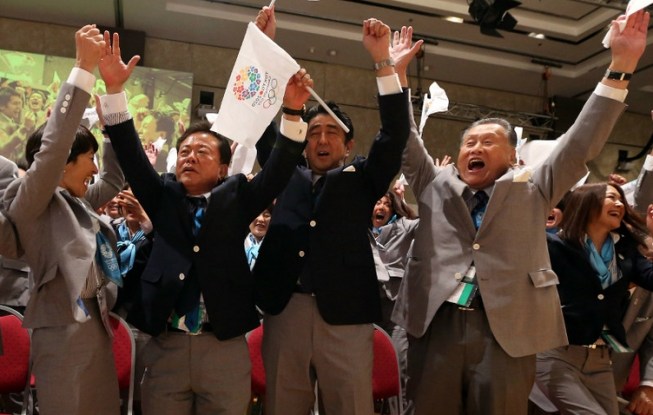
In this Sept. 7, 2013, file photo, Japan’s Prime Minister Shinzo Abe, center, Governor of Tokyo and Chairman of Tokyo 2020, Naoki Inose, second from left, and other members of the Japanese delegation celebrate as International Olympic Committee (IOC) President Jacques Rogge announces that Tokyo will host the 2020 Olympic Games during the 125th IOC session in Buenos Aires, Argentina.
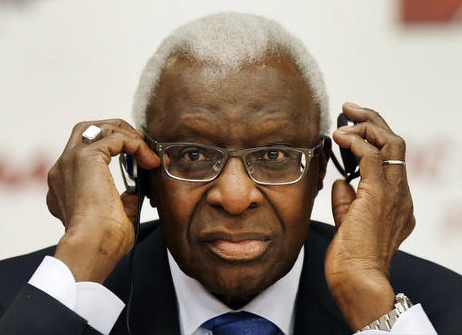
In this Aug. 21, 2015, file photo, then-IAAF president Lamine Diack adjusts his headphones during a joint IOC and IAAF news conference on the site of the World Athletic Championships in Beijing. French prosecutors say $2 million associated with Tokyo’s bid for the 2020 Olympics was apparently paid to an account linked to the son of the disgraced former IAAF president Diack in the months immediately before and after the Japanese capital won the games.
PARIS/TOKYO (Kyodo) — French prosecutors announced Thursday they have launched an investigation into Tokyo’s campaign to host the 2020 Olympics for alleged corruption and money laundering.
A statement from the prosecutors said a total of 2.8 million Singapore dollars ($2.04 million) has been transferred from a Japanese bank to one in Singapore related to Papa Massata Diack, the son of former International Association of Athletics Federations President Lamine Diack, in July and October 2013 under the name of “Tokyo 2020 Olympic Games Bid.”
The prosecutors said they have confirmed there were huge outlays by Diack’s side during the same time in Paris. Tokyo was awarded the Games in September 2013 when Diack was an International Olympic Committee member and was known as an influential power broker in the committee.
“How much influence the former president could have had on other committee members will be the focal point of the investigation,” a French judicial authority member told reporters.
“We carried out our bidding campaign fairly. There’s no issue or things to get worried about,” said Japanese Olympic Committee President Tsunekazu Takeda, who was the chief of the bidding team. “We’ll reply properly if we get asked (by the IOC).”
Olympic minister Toshiaki Endo also said in a TV program he takes pride in Tokyo making a clean bid and denied the allegations.
Japan’s top government spokesman earlier Thursday denied allegations of bribery, saying the government understands the organizing committee conducted the campaign in an appropriate manner.
“We understand the campaign for the 2020 Tokyo Games was conducted in a clean way,” Chief Cabinet Secretary Yoshihide Suga said at a news conference after British newspaper the Guardian reported the Tokyo Olympics organizing committee paid 1.3 million euros ($1.48 million) to the account of Diack’s son.
Suga said he was “not aware of” the report, which also said French authorities were investigating the allegations. “If we receive a request (for investigation) from French judicial authorities, our country will respond appropriately,” he added.
Suga said the Japanese government has no plan to question the Tokyo Organizing Committee of the Olympic and Paralympic Games or conduct its own investigation into the allegations.
The account in question became a vital piece of the puzzle related to what has been alleged as being institutional corruption at athletics’ governing body.
Complicating the scandal further, the report said Japanese marketing and advertising behemoth Dentsu Inc. has previously been linked to the Diack clan through its long-running sponsorship contract with the IAAF, a deal that was extended by Diack just months before his presidency ended. Dentsu has been previously linked to scandals at both the IAAF and world soccer’s governing body FIFA.
The prosecutors launched an investigation into corruption in the IAAF and Diack was arrested in December, accused of accepting bribes to cover up doping offenses.
A report in January from the prosecutors claimed that Diack did not support the bid from Tokyo’s rival Istanbul as Turkey didn’t pay similar sponsorship money to the IAAF.
http://mainichi.jp/english/articles/20160513/p2g/00m/0dm/002000c
Nothing Resolved at Fukushima, Japan Must Not Sponsor the Olympic Games

I strongly support “an honorable retreat from the 2020 Olympic Games” which is called for by former PM Hatoyama and a former Japanese Ambassador to Switzerland Mitsuhei Murata.
Hatoyama says, in an interview with the Japan Times, “In a situation in which nothing has been resolved at #Fukushima, Japan must not sponsor something like the Olympic Games.”
Hatoyama also said “There are still many inhabitants of the Tohoku region living in temporary housing. Moreover, the government has yet to admit the truth about the accident despite its having been more severe than Chernobyl. It is regrettable that the government has failed in its duty to inform both the people of Japan and the world about the true situation. The government even goes so far as to deny the increased incidents of thyroid cancer in the Fukushima region are connected to radiation releases from the multiple meltdowns.”
Hatoyama believes the government claimed the situation at nuclear plant was “under control” in order to lure the 2020 Olympic Games to Tokyo. “The government was successful in this ploy,” he says, “but this was a complete lie. Far from having been under control then, it is still not under control even now. This is a grave situation.”
He also shared interesting comments about Okinawa and the US base issues in the following exclusive interview with the Japan Times.
Hatoyama dreams of a Japan anchored within a united Asia
“I wish to apologize to the Japanese people for having betrayed their expectations,” says Yukio Hatoyama halfway through our interview, lowering his head and bowing deeply.
Hatoyama, prime minister for nine months of the Democratic Party of Japan’s three years in power between 2009 and 2012, is discussing the reasons behind his resignation in June 2010 — specifically, his failure to live up to his party’s promise to block the contentious U.S. Marine Corps base construction now underway at Henoko in Okinawa.
Recently, the former DPJ leader has been in the news for other mea culpas in Nanjing and Seoul — apologies made, he says, on behalf of Japanese for colonial-era crimes in Asia. These unsanctioned trips have incensed the ruling Liberal Democratic Party, which has painted Hatoyama as a charlatan and even a traitor for his foreign escapades.
For those having trouble placing Hatoyama among the three DPJ figures who served as prime minister in that brief, heady period when power in postwar Japan changed hands, he is the one who led the DPJ to that historic victory. You know — the “alien.”
Hatoyama, now 68 and retired from politics, has never been able to shake that nickname. Coined by the domestic media in 2001 during his first stint as DPJ leader, the foreign press had a field day with Hatoyama’s extraterrestrial appellation, rejoicing in the fact that they finally had a Japanese leader who stood out from the crowd.
But what was it that made Hatoyama appear so otherworldly? True, his saucer-like eyes did give him a vague resemblance to E.T., but his nickname was not just the product of his looks and his manner; it also owed much to his proposals — proposals that were and remain anathema to Japan’s conservative establishment.
But how did Hatoyama, who came from a well-known, politically conservative family, become a maverick? In an exclusive interview with The Japan Times, Hatoyama discussed a range of issues, including Okinawa, the relationship between the Fukushima No. 1 disaster and the 2020 Tokyo Olympic Games, and his proposal for the creation of an “East Asian EU.” He began by explaining the circumstances that led him to resign the prime minister’s post in 2010 after only nine months in office.
“The DPJ, of which I was leader, proposed a revision of the Japan-U.S. Status of Forces Agreement in our manifesto for the 2009 House of Representatives election. We also proposed the realignment of the U.S. military in Japan, including a review of the state of U.S. bases,” he explains. “As for the relocation of the U.S. Marine base to Henoko, I personally said that at the very least, it should be moved outside (Okinawa) Prefecture. However, as soon as the DPJ took power, bureaucrats close to the U.S. in the Foreign Ministry and Defense Ministry moved to crush my proposal.”
In the end, Hatoyama’s idea went nowhere, and Henoko was confirmed as the proposed site for the new base. Many Okinawans — and DPJ voters — felt betrayed, and the party began to fear defeat in the Upper House elections of July 2010. “So I decided to resign,” Hatoyama confesses. “There was no excuse.”
During his time in office, Hatoyama also emphasized the need for a less lopsided Japan-U.S. relationship.
“I thought that as prime minister, it was only natural for me to seek an equal relationship with the United States. However, there are many (Japanese) politicians and bureaucrats who believe that because Japan is dependent on the U.S. in so many ways, it isn’t appropriate to seek an equal relationship. Once again, my proposal ended in failure.”
This was the first time in the postwar period that a Japanese prime minister had made such a demand. Hatoyama even dared suggest that Japan’s security could be achieved without a permanent U.S. troop presence. None of this was welcomed by those, on both sides of the Pacific, long accustomed to Japan’s subservience to U.S. interests.
Hatoyama was born in 1947 and graduated from the University of Tokyo before going to earn a Ph.D. in industrial engineering at Stanford. Upon graduation, he initially pursued an academic career, but later decided to run for the House of Representatives in 1986.
His lofty aim was to “restore sovereign power to the people, breaking from a system dependent on the bureaucracy,” he says, and to “transform Japan from a centralized state to one of regional and local sovereignty, and from an insular island to an open maritime state.”
During his campaign, Hatoyama took advantage of his experience as a researcher and garnered public attention with his unique appeal for “a scientific approach to politics.” Following his election, he quickly became a controversial figure for, among other things, revealing the huge scale of political campaign funding the LDP was receiving from business interests — even though he was a member of the party at the time.
“I eventually left the Liberal Democratic Party because of repeated incidents involving money and politics, such as the Recruit insider-trading and corruption scandal of 1988 and Shin Kanemaru’s huge tax evasion affair of 1992,” Hatoyama says. “Political reform was urgently called for, but the LDP was unwilling to act.”
A messy political realignment soon followed, eventually leading to the creation of the current iteration of the Democratic Party of Japan in 1998. Hatoyama went on to lead the party between 1999 and 2002, and again from May 2009. The DPJ grew steadily until finally, in September 2009, it succeeded in ousting the scandal-tainted LDP.
Hatoyama became Japan’s 93rd prime minister, though he would not remain so for long. Government bureaucrats, long accustomed to running the country behind the scenes, acted quickly to undermine his administration and hasten its demise.
Hatoyama says that Defense Ministry officials attempted to scuttle his plan to relocate the U.S. Marine Corps’ Futenma air base outside of Okinawa by claiming that any replacement facility must be located within 65 miles (105 km) of the marines’ Northern Okinawa Training Area. “The bureaucrats and ministers who should have been doing their best to support me were in fact attempting to resolve the matter by supporting the U.S.,” Hatoyama says.
The 65-mile requirement effectively precluded moving the base off the main island of Okinawa, which is a convenient 70 miles long. Yet the source of this apparent requirement remains elusive. Hatoyama says the Defense Ministry simply claimed that this figure was included in a U.S. military document. “Whether or not this requirement was expressly stated in the document remains unclear even now,” he notes.
But what about the U.S.? Were American officials also involved in the attempt to derail Hatoyama’s base relocation plans? Apparently not, Hatoyama says.
“No documents on the U.S. side support the claim of Defense Ministry officials. Thus, it can be said their claim was groundless,” he explains. “It’s possible it was just their way of forcing me to abandon my proposal. However, when we consider the feelings of the Okinawan people, there’s no way they would grant permission for the base to be relocated within Okinawa.”
At this point in the interview, Hatoyama bowed and offered his apology.
Another blow to the fledgling DPJ administration came in December 2009, when it was revealed that Hatoyama had received some ¥1.2 billion in political donations that had been improperly reported. Most of the money came from his mother, the wealthy heiress to the Bridgestone empire, though ¥400 million of this was listed as coming from fictitious donors — including some who were deceased.
While Hatoyama denied personal knowledge of the donations, he later apologized to the nation for the scandal and promised to pay more than ¥600 million in gift taxes on donations made to him by his mother that were first deemed as “loans.” Hatoyama recognizes the major impact this issue had on his tenure as prime minister, admitting, “The political donations I received from my mother were the second major reason I had to resign.”
Prosecutors declined to bring charges against Hatoyama, citing insufficient evidence of criminal activity. They did, however, indict two of his former secretaries, resulting in a ¥300,000 fine for one and a suspended sentence for the other. While no question of corporate bribery or political favors was involved, the incident nevertheless served to raise questions in the public’s mind about just how different the DPJ was from the money-tainted politics of the long-ruling LDP.
The media was unforgiving. After all, Hatoyama had already managed to upset both the establishment media and their new-media competitors. The former fought against his proposal to open up the prime minister’s news conferences to journalists from outside the cozy “press club,” and the latter were angry after he failed to follow through on that pledge.
“When I became prime minister, I tried to abolish the press-club system, which had become a vested interest for its members,” Hatoyama explains. “However, I was subject to a fierce counterattack.”
One club-affiliated reporter told Hatoyama that the prime minister’s press conferences were not something he was in charge of but, rather, something the press club sponsored.
Although by March 11, 2011, Naoto Kan was prime minister, Hatoyama was still a member of the House of Representatives, and the multiple disasters — especially the nuclear meltdowns at Fukushima No. 1 plant — affected him deeply. In the December 2011 issue of the magazine Nature, Hatoyama co-authored an article expressing his concerns about both the radioactive and political fallout from the accident.
Titled “Nationalize the Fukushima Daiichi atomic plant,” Hatoyama first pointed out the need “to know precisely what happened (on March 11, 2011) and what is continuing to happen now.” He further argued that only when all the evidence relating to the accident had been gathered and made public “will the world be able to have faith in the containment plan developed by Tepco or be able to judge how it should be modified.”
Hatoyama and two fellow Diet members formed a committee to conduct an independent investigation of the accident. The group reached two major conclusions, outlined in the Nature article. First: “The Fukushima Daiichi nuclear power plant must be nationalized so that information can be gathered openly. Even the most troubling facts should be released to the public.” Second: “A special science council should be created to help scientists from various disciplines work together on the analyses. That should help to overcome the dangerous optimism of some of the engineers who work within the nuclear industry.”
Although Hatoyama is no longer a Diet member, he has not lost interest in this issue. Recently, he joined former Japanese Ambassador to Switzerland Mitsuhei Murata in calling for “an honorable retreat from the 2020 Olympic Games.” Echoing Murata, who was also present at the interview, Hatoyama says, “In a situation in which nothing has been resolved at Fukushima, Japan must not sponsor something like the Olympic Games.”
Hatoyama elaborates: “There are still many inhabitants of the Tohoku region living in temporary housing. Moreover, the government has yet to admit the truth about the accident despite its having been more severe than Chernobyl. It is regrettable that the government has failed in its duty to inform both the people of Japan and the world about the true situation. The government even goes so far as to deny the increased incidents of thyroid cancer in the Fukushima region are connected to radiation releases from the multiple meltdowns.”
Hatoyama believes the government claimed the situation at nuclear plant was “under control” in order to lure the 2020 Olympic Games to Tokyo. “The government was successful in this ploy,” he says, “but this was a complete lie. Far from having been under control then, it is still not under control even now. This is a grave situation.”
Hatoyama’s change of mind is significant because as prime minister in October 2009 he had given a speech in Copenhagen in support of Tokyo’s failed bid for the 2016 Games. At the time, he sought to promote a new image of the Olympics centered on environmental protection, held in harmony with nature and celebrating simplicity.
March 11, 2011, however, changed everything. Again, like Murata, Hatoyama stresses that he is not opposed to the Olympics per se, but asks: Why now, and why Tokyo — especially in the absence of any pressing need to do so? Hatoyama nods in assent when Murata states: “At this point there is no other solution than to stage an honorable retreat from the games. Failure to do so will ultimately lead to a disgraceful retreat, dishonoring our country. The time to act is now!”
Hatoyama’s reservations about Japan’s future are not limited to either Fukushima or the Olympics. Politically and militarily, Hatoyama believes Japan is moving in an ever more dangerous direction.
“Prime Minister (Shinzo) Abe’s recent passage of the collective security bills has made it possible for America to call upon Japan to participate in its wars,” he says. “However, the Constitution states that Japan will never again wage war and, accordingly, rejects the threat or use of force as means of settling international disputes.”
He continues: “Given this, I deeply regret that the road to our participation in war has been opened once again. It may be presumptuous of me to say this now that I am no longer a politician, but in light of the wrong direction our country is currently heading in, I earnestly hope for an end to the Abe regime.”
Just as relations between Tokyo and Beijing were sinking to new lows over historical and territorial issues, Hatoyama infuriated the Abe government with his decision to visit Nanjing in January 2013. At the Nanjing Massacre Memorial Hall, he bowed and offered a silent prayer, later explaining, “As a Japanese, I feel responsible for the tragedy, and I am here expressing my sincere apology.”
While in Nanjing, Hatoyama also urged the Japanese government to acknowledge the dispute between the two countries concerning sovereignty of the islands known the Senkakus in Japanese and Diaoyu in China. “The Japanese government says there are no territorial disputes, but if you look at history, there is a dispute,” he says.
Hatoyama’s comments led Japanese government officials to criticize him for admitting the existence of a territorial dispute with China, something they adamantly deny. The defense minister at the time went so far as to use the word “traitor.”
“If his remarks have been politically used by China, I’m unhappy,” said Itsunori Onodera. “At that moment, the word ‘traitor’ arose in my mind.”
In March 2015, Hatoyama made another controversial trip, this time to Crimea, where he expressed his belief that Japan should “normalize” relations with Russia by lifting sanctions imposed after Moscow’s annexation of the Ukrainian territory. Hatoyama defended the referendum in the region as constitutional, stating, “Crimea wasn’t annexed unilaterally under pressure from Russia. In fact, people reached a conclusion based on their own strong will.”
Once again, Hatoyama’s remarks earned him the condemnation of the Japanese government. “It’s unthinkable that such action and comments came from a person who was once prime minister,” said Chief Cabinet Secretary Yoshihide Suga. Suga also described Hatoyama’s behavior as “extremely imprudent.”
In August 2015, just prior to Prime Minister Abe’s statement commemorating the 70th anniversary of the end of World War II, Hatoyama visited the Seodaemun Prison History Hall in Seoul. He knelt down in front of a memorial stone to apologize to Korean independence activists jailed, tortured and executed during Japan’s colonial control of Korea from 1910 to 1945.
“In the hope that no such mistake is made in the future, I regard, in a spirit of humility, these irrefutable facts of history, and express here once again my feelings of deep remorse and state my heartfelt apology,” he said.
Though Hatoyama’s actions may seem quixotic or even deliberately provocative to some, they are best understood through the prism of his world view, which stands in stark contrast to one of the guiding principles of modern Japan in the years following the Meiji Restoration. Promoted by the famous Meiji educator Yukichi Fukuzawa, this principle is known as Datsu-A Ron or the “Goodbye Asia doctrine.” Fukuzawa maintained, “It is better for us to leave the ranks of Asian nations and cast our lot with the civilized nations of the West.”
While not turning his back on the West, Hatoyama nevertheless seeks to redirect Japan’s focus away from the U.S. and back to its geographical location in Asia. He imagines a Japan at peace with its neighbors — from Russia in the north to China and South Korea — and at ease with its position on the edge of the continent.
With this dream in mind, Hatoyama created the East Asian Community Research Institute in March 2013, with the ultimate goal of creating something resembling an East Asian EU. With membership open to the general public, the institute, through its educational arm, Sekai Yuai Forum, holds lectures and other events to promote Hatoyama’s vision.
All of which brings us back to the issue of the U.S. military presence on Okinawa. Hatoyama continues to be concerned about the struggle of the Okinawan people against the construction of the new U.S. base at Henoko. This led to a series of trips to Okinawa seeking a solution to this intractable problem. As recently as November, Hatoyama visited the island to encourage the anti-base demonstrators at Henoko.
Hatoyama envisions a future for Okinawa not as a “keystone of the Pacific” for the U.S. military but as a “keystone of peace” for the countries of Asia. He has called for the creation of an “East Asian Community” headquartered in Okinawa and composed of the 10 members of the Association of Southeast Asian Nations plus Japan, China and South Korea.
“It is important for the countries of East Asia to become self-reliant, helping one another by developing win-win relationships,” he explains. “Should, however, they engage in a military arms race, it would only lead to a decline in deterrent power.”
“If Europe can do it,” says Hatoyama, pointing to the continent’s postwar integration, “there is no reason East Asia can’t.”
Source : Japan Times
http://www.japantimes.co.jp/community/2016/01/20/our-lives/hatoyama-dreams-japan-anchored-within-united-asia/#.VqFRnFLzN_k
Special credits to Mari Inoue & Libbe Halevy
1 This Month


18 March Webinar @ 1 PM EST: An Assessment of SMR Projects: The Case of Canada
register for the zoom:
https://us02web.zoom.us/webinar/register/WN_o8BIIOUvQ2ONJR1nta65DQ#/registration


of the week – STOP SMALL MODULAR REACTORS IN CANADA
To see nuclear-related stories in greater depth and intensity – go to https://nuclearinformation.wordpress.com
-
Archives
- March 2026 (129)
- February 2026 (268)
- January 2026 (308)
- December 2025 (358)
- November 2025 (359)
- October 2025 (376)
- September 2025 (258)
- August 2025 (319)
- July 2025 (230)
- June 2025 (348)
- May 2025 (261)
- April 2025 (305)
-
Categories
- 1
- 1 NUCLEAR ISSUES
- business and costs
- climate change
- culture and arts
- ENERGY
- environment
- health
- history
- indigenous issues
- Legal
- marketing of nuclear
- media
- opposition to nuclear
- PERSONAL STORIES
- politics
- politics international
- Religion and ethics
- safety
- secrets,lies and civil liberties
- spinbuster
- technology
- Uranium
- wastes
- weapons and war
- Women
- 2 WORLD
- ACTION
- AFRICA
- Atrocities
- AUSTRALIA
- Christina's notes
- Christina's themes
- culture and arts
- Events
- Fuk 2022
- Fuk 2023
- Fukushima 2017
- Fukushima 2018
- fukushima 2019
- Fukushima 2020
- Fukushima 2021
- general
- global warming
- Humour (God we need it)
- Nuclear
- RARE EARTHS
- Reference
- resources – print
- Resources -audiovicual
- Weekly Newsletter
- World
- World Nuclear
- YouTube
-
RSS
Entries RSS
Comments RSS
 nuclear-news