Fukushima Daiichi nuclear power plant
1 Jul, 2018
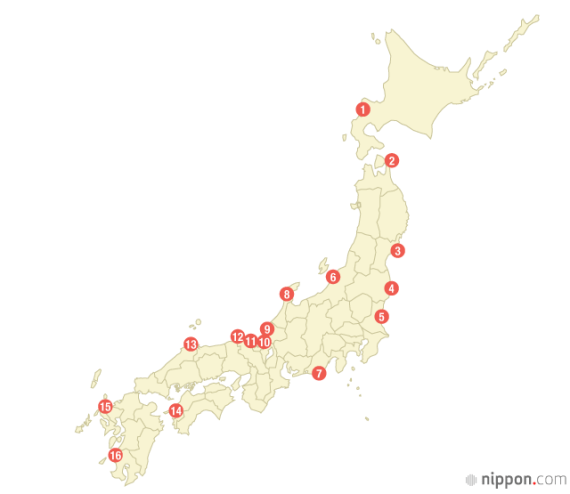
TEPCO is conducting an independent geological survey to confirm the absence of active faults in Aomori Prefecture, where it wants to resume the construction of a Fukushima-type nuclear plant, frozen following the 2011 disaster.
“It’s necessary to form a consortium for building a nuclear plant that is excellent in safety, technology and economy,” TEPCO President Tomoaki Kobayakawa said in Tokyo, announcing the decision to conduct a survey of the Aomori Prefecture nuclear site.
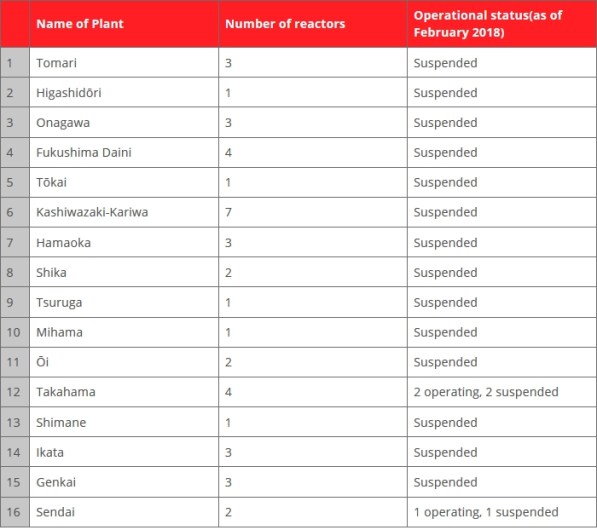
The Higashidori Nuclear Power Plant hosts two adjoining sites administered by Tohoku Electric Power Company and Tokyo Electric Power Company (TEPCO). While Tohoku Unit 1 began commercial operations in December 2005, TEPCO never got a chance to finish their unit, the construction of which began only in January 2011. All activity at the site has ceased since the March 2011 Fukushima nuclear meltdown.
TEPCO’s survey, scheduled for completion by 2020, will check the fault structure under the site using a two-kilometer-long tunnel, Kobayakawa said on Friday. Previous studies of terrain beneath the area by the Nuclear Regulation Authority (NRA) found the likely presence of multiple active, seismogenic faults. However, both TEPCO and the Tohoku Electric Power Company decided to conduct further ‘independent’ investigations to review the validity of the NRA findings.
The energy company wants to build two reactors at the site and is exploring ways to meet the stricter government regulations introduced following the Fukushima disaster. Higashidori units, however, would still use the same type of boiling-water, light-water reactors that suffered meltdown at the Fukushima plant, Japan Times noted.
“As we restart the (Higashidori) project, I want to make sure that a new plant would excel in safety,” Kobayakawa told a press conference. “The geological survey is a very significant step to move forward on the joint development of Higashidori,” he noted, adding that TEPCO has asked major utility companies in the country to contribute to the construction and operation of the Higashidori plant.
Three of the Fukushima plant’s six reactors were hit by meltdowns in 2011, after a 9.0-magnitude earthquake and subsequent tsunami struck the facility, resulting in the world’s worst nuclear disaster since Chernobyl in 1986.
July 1, 2018
Posted by dunrenard |
Japan | Construction, Higashidori NPP, Tepco |
Leave a comment
Niigata Gov. Ryuichi Yoneyama bows during a press conference at the Niigata Prefectural Government office on April 18, 2018.
Governor quits over sex scandal, affects nuclear reactor restart
NIIGATA (Kyodo) — Niigata Gov. Ryuichi Yoneyama said Wednesday he will resign after admitting to a sex scandal in a move affecting the approval process for the restart of Tokyo Electric Power Company Holdings Inc.’s nuclear reactors in the central Japan prefecture.
“I sincerely offer apologies for betraying the trust of many people,” Yoneyama told a press conference, admitting that his relationship with a woman, as described in a weekly magazine due out Thursday, may “look to some as prostitution.”
Shukan Bunshun magazine alleged in an online teaser article Wednesday that the 50-year-old governor has been paying money to have sex with a 22-year-old college student. At a news conference Wednesday, the governor said he gave a woman he met online “presents and money so she would like me more.”
Since being elected governor in 2016, Yoneyama has refrained from approving the restart of the No. 6 and 7 reactors at the Kashiwazaki-Kariwa nuclear complex.
The governor has said he cannot make the decision until the prefectural government completes its own assessment of what caused the Fukushima Daiichi nuclear disaster in 2011.
All seven Kashiwazaki-Kariwa units are boiling water reactors, the same as those at the Fukushima Daiichi nuclear plant where three of six reactors melted down in the days after a massive earthquake and tsunami in March 2011. Last December, two reactors at the Kashiwazaki-Kariwa complex cleared safety reviews under the stricter, post-Fukushima regulations.
On Tuesday, Yoneyama said he would consider whether to quit over a forthcoming magazine article about a “woman issue.” Calls for his resignation were growing in the Niigata prefectural assembly.
The gubernatorial election to pick Yoneyama’s successor is expected to be held in early June. Yoneyama will resign with two and a half years of his term remaining.
The seven-reactor Kashiwazaki-Kariwa complex is one of the world’s largest nuclear power plants with a combined output capacity of 8.2 million kilowatts.
Facing huge compensation payments and other costs stemming from the Fukushima disaster, Tepco is keen to resume operation of its reactors to improve its financial performance.
The Japanese government of Prime Minister Shinzo Abe also supports restarting nuclear reactors that have cleared post-Fukushima safety reviews.
Yoneyama won the Niigata governorship in October 2016 with the support of the Japanese Communist Party and the Social Democratic Party, which are both opposed to nuclear power. He defeated contenders including a candidate backed by Abe’s Liberal Democratic Party and its junior coalition partner Komeito.
Governor of Japan’s Niigata resigns to avoid ‘turmoil’ over magazine article
April 18, 2018
TOKYO (Reuters) – The governor of Japan’s Niigata prefecture, home to the world’s largest nuclear power plant, resigned on Wednesday, saying he hoped to avoid political turmoil over an impending magazine article about his relations with women.
News that the governor, Ryuichi Yoneyama, intended to resign sent shares of Tokyo Electric Power Company Holdings Inc (Tepco) surging as investors bet his departure could make it easier for the utility to restart its Kashiwazaki-Kariwa nuclear power plant, which is in Niigata prefecture.
Japan has had few reported “#MeToo” cases about sexual harassment involving public figures but Yoneyama’s resignation came on the same day Japan’s top finance bureaucrat resigned on after a magazine said he had sexually harassed several female reporters. The official denied the allegation.
Yoneyama, like his predecessor, is opposed to a restart of the Kashiwazaki-Kariwa plant and has been a block to attempts to get the station going by the utility, which also owns the wrecked Fukushima Daiichi nuclear station.
April 22, 2018
Posted by dunrenard |
Japan | Kashiwazaki-Kariwa NPP, Nuclear Plant Restart, Tepco |
Leave a comment
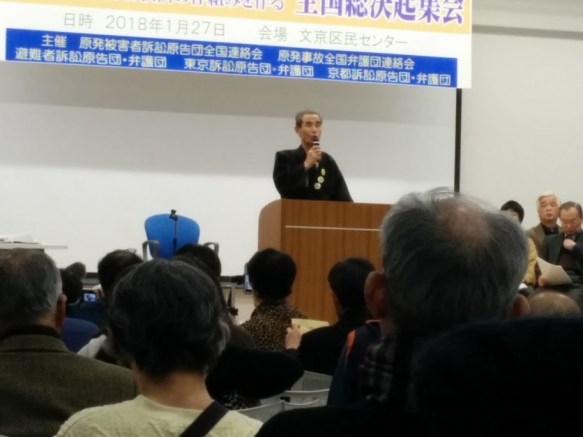 Tokuo Hayakawa at the rally in Tokyo in January, 2018.
JIJI PRESS’s article
TEPCO Ordered to Pay 600 M. Yen to Fukushima Evacuees
The statement below is translated by Yoshihiro Kaneda. If it has mistakes, Yoshihiro Kaneda has responsibility for that.
Statement
2017 October 6th
To The Iwaki branch of the Fukushima District Court
Plaintiff: Tokuo Hayakawa
1 I am the thirtieth chief priest of a mountain temple which has a history of over 600 years, but the temple will pass into nothingness in my lifetime. Ten parishioners already severed our relationship. I became a chief priest in 1977 and the temple was desolated even 30 years after the end of the World War 2 because we had about 100 parishioners.
I planed reviving original religious activities and events and improvement for the environment of the temple and was satisfied with its achievement that I did most of it for three decades and several years until March 11th. Especially, the improvement of the precincts, I exerted myself and I overlapped it with my thought which I wanted to live my late life with enjoying the beauty of nature. After retirement, I was comfortable and enjoyed the nature.
I was deprived of this achievement, satisfaction and enjoyment. I was deprived of happiness which I could earn by living for it. I lost my spiritual support to live the rest of my life. What was my life?
2 I am living this way now, but there were evacuees abandoned themselves to grief and then, they comitted suicide.
I heard about a married couple who lost their jobs due to the nuclear accident and heaved sighs repeatedly in Aizuwakamatsu. They strangled their disabled son and they hanged themselves along at the railroad of the Tadami Line.
There was a man,102 years old, who said “Do I have to move from here? I want to live here. I have lived too long.” The man had a rope around his neck and hanged himself.
A cattle farmer who was a 54-year-old man committed suicide, left a message on the wall of the cattle shed in Souma “if there was no nuclear power plant.”
The nuclear accident took a job from a person who was a hundred kilometers away and took an old man’s home, who has lived a hundred-year life and forced a man to kill himself, who had no idea how to pay back his debt because he could not earn money due to a ban on the shipment of milk.
There are many other people who committed suicide.
Our defense counsel won two epochal decisions by suing for the people who killed themselves at the Fukushima District Court.
The appeal of the man whose wife burnt herself to death was admitted. After the ruling, Tokyo Electric Power Company (TEPCO) officials came to his house to apologize but they lost words because the husband rejected point-blank and said “But my wife will never return,” on the scene.
The wife lost her husband by suicide. Her appeal was admitted and officials of TEPCO went to her home to apologize. But she said “I don’t accept,” and the officials were amazed and silent.
One of the plaintiff’s statements stated that he barely stopped his suicide. I listened to all of the statements by the plaintiffs. While listening to each statement, I always presumed regrets of those who committed suicide.
3 The nuclear accident deprived all of regions and societies we lived, people’s lives and existences. We cannot ever fully recover from this problem again. We lost the places where we were born. The judges witnessed this themselves.
“If only there was no nuclear power plant,” “If only the nuclear accident did not happen.” Those words cannot pierce the heart of the officials of TEPCO. That is the true nature of TEPCO that has not changed after the accident. If they were human, these words would reach them.
Did our statements touch TEPCO? Or their hearts? I will continue to appeal until our victims’ lodgment reach the hearts of TEPCO officials. That is our regretful thought.
4 Through the trial, it became clear that the bottom cause of the accident was a top priority of profit seeking.
However, TEPCO does not admit their responsibility of the accident and, regarding our compensation, they said: “Go to law.” Can we forgive this injustice?
Originally, why did TEPCO build a nuclear plant in Fukushima? Can they explain? They cannot.
We are not only ones who are victims and evacuees by the nuclear accident and our regions are not the only victimized regions. Victims are struggling at the various regions and the evacuation areas. Among them, our plaintiffs are only forced evacuees and what rules the trial is the local Iwaki branch which is nearest court from the nuclear power plant which caused the accident. Those who will rule are the judges who live in Iwaki and have chances to meet the evacuees. We were facing the trial with feeling the significance of that. Our lawyers were aware of this profoundly.
5 “Due to the geographical and social conditions, a location of a nuclear power plant must be the place which does not have a big city in its neighboring region and the place which is sparsely populated.” (The Development Vision of the Futatba Atomic Energy District) “We confirmed that both towns of Okuma and Futaba were the best place to build the nuclear power plant. In the background that the confirmation went along well, there were facts such as that EPCO manipulated carefully after asking to build the nuclear power plant. (Coexistence and Co-evolution-With the Region-The Course of Fukushima Daiichi Nuclear Power Plant 45 years, A History of the first thirty years of Tokyo Electric Power Company)
These are the reason and the circumstance but “why must the location of the nuclear power plant be the place which is sparsely populated?” “why do they manipulate carefully?”
These questions suggest that TEPCO expects a danger and severe accident. If they explained the danger and severe accident to residents, there would be no sacrifices and victims who said if only there was no nuclear power plant.
6 TEPCO had various big and small accidents one after the other immediately after the Fukushima Daiichi Nuclear Power Plant started business operation and they hid the accident which might become a huge accident. Whenever the accident happened, they were designated their slow report and, furthermore, they falsified and fabricated the data and so on. That situation became normal and worsen. It was no wonder that a huge accident could happen at anytime without the earthquake and tsunami. That situation lasted 40 years. That was the Fukushima Daiichi Nuclear Power Plant.
On the other hand, TEPCO circulated an enormous quantity of various handouts and brochures, providing “safety myth” as the measure to local residents. Among those, there was a brochure, titled Calm and Lively Way. Support for Futaba Vigor Life! Futaba with ties: In order to tie strongly between the power plant and residents of Futaba County forever.
They ignored the safety measure we asked whenever strange things happened to the nuclear power plant. In the same breath, they distributed the handouts like that.
7 In 1972, the Association of Naraha Town Residents was formed with the resolution: “We protect beautiful natural mountains and rivers and peaceful lives of townspeople and lives of us and our posterity.” In 1973, the same associations were formed in Tomioka and Okuma. On September in the same year the prefecture association was formed with the agreement: “We are against nuclear and thermal power plants because we cannot obtain the confirmation of safety and those plants are not true regional development and those are against people’s will.” So we, both town and prefecture people were appealing its risk.
One year after the Chernobyl nuclear accident, the organizations of anti-nuclear residents all over Japan took a leading part and they formed “The Nuclear Power Plant Problem Residential Movement National Contact Center.” Since then, in order to establish measures for safety and emergency, we proposed and negotiated with the government and each electric power company every year.
We continued to warn them with publishing a pamphlet titled “Next Huge Accident Will Be in Japan” in 1992.
8 On February, 2005, TEPCO admitted the nuclear power plants in Fukushima could not be withstood by a tsunami in the Chilean Tsunami class becuase we had accused them. But they neglected one and all of our frequented drastic measure claims. Then, the huge accident happened. The Fukushima nuclear accident was an accident that was waiting to happen. Can we deny it?
9 According to “The Result of the Root Cause Analysis” in Summary of the Fukushima Nuclear Power Plant Accident and Nuclear Safety Reform Plan, published after the accident, on March 3, 2013, by TEPCO, TEPCO says “the fact of admitting a need of tsunami protection measures leads that the power plant at that time is not safe. As a result, we were convinced that we would be required nimious measures by Nuclear Regulatory Commission and local residents.”
These things like this are TEPCO’s 40 years history. In consequence, what a huge damage we got! This is our one word “if only there was no nuclear accident.”
10 On August 5th, 2015, Naomi Hirose, CEO of TEPCO was asked the question “Do you acknowledge that the accident was a man-made disaster as a perpetrator?” He answered firmly “Honestly, I have never thought seriously whether the accident was a man-made disaster or natural disaster until now.” On December 8th, 2016, Yoshiyuki Ishizaki, the president of TEPCO Fukushima Revital Headquarter, said to one victim “the nuclear power plant is a necessary evil.” They made incautious remarks that they have not understood the calamity of victims and the stricken area at all four and five years after the accident.
11 We dare to bring a case before the Iwaki branch which is the closest local court from the location of the stricken area and the nuclear power plant. It is because we assure only this local court can understand suffering of victims and also they can hand down the decision which will take the part of the victims.
If this local court will hand down a decision which overlooks our actual conditions of damage and the situations of the hometown, we, victims, will not be relieved. All the more, please, the court, according to the facts and truth, hand down a decision for which we are able to hold a hope to live. We and many victims are suffering the damage that “it is impossible to verbalize.”
The Mainichi’s article is below.
Another court orders TEPCO to pay damages to Fukushima evacuees
Source: http://www.absurdity.asia/2018/03/22/a-representative-of-plaintiffs-tokuo-hayakawas-statement-in-the-court/
March 23, 2018
Posted by dunrenard |
Fukushima 2018 | Court Case, Plaintiff Statement, Tepco |
Leave a comment
TEPCO, state told to pay 3/11 evacuees who left on their own
The legal team for evacuees of the 2011 Fukushima nuclear disaster hold signs stating partial victory at the Kyoto District Court on March 15.
KYOTO–The district court here ordered the government and the operator of the Fukushima No. 1 nuclear plant on March 15 to pay a combined 110 million yen ($1 million) to 110 evacuees who fled voluntarily after the 2011 nuclear disaster.
Presiding Judge Nobuyoshi Asami at the Kyoto District Court ruled that the government and plant operator Tokyo Electric Power Co. were liable on grounds that they failed to take adequate measures to protect the plant from the tsunami that inundated the facility after the Great East Japan Earthquake.
The court noted the government’s “long-term assessment” for possible earthquakes unleashing tsunami compiled in 2002. The report pointed to the possibility of a powerful earthquake and tsunami striking the plant.
All of the 174 plaintiffs from 57 families had evacuated to Kyoto Prefecture without an evacuation order except for one individual from Tomioka, Fukushima Prefecture.
Tomioka was within the 20-kilometer radius from the plant ordered to evacuate after the crisis unfolded on March 11, 2011, triggered by the magnitude-9.0 quake and tsunami.
Apart from Fukushima, the plaintiffs were from Miyagi, Ibaraki, Tochigi and Chiba prefectures.
The plaintiffs plan to appeal the court decision, as 64 were not awarded compensation.
The plaintiffs sought 846.6 million yen collectively in damages from the government and the utility.
The district court ruling marked the fifth in a series of similar lawsuits brought across the nation.
In all five cases, the respective courts acknowledged TEPCO’s responsibility to pay damages to the plaintiffs.
The Kyoto District Court’s decision was the third to acknowledge the government’s responsibility.
The key issues in the Kyoto case were if the towering tsunami that swamped the plant was foreseen, if the government had authority to force TEPCO to take countermeasures against such an event, and if the amount of compensation paid by TEPCO to voluntary evacuees based on the government’s guidelines was appropriate.
Most of the plaintiffs sought 5.5 million yen each in damages.
In the ruling, the district court determined that TEPCO should pay additional compensation on top of the amount set in the government guidelines to 109 plaintiffs who fled voluntarily despite not being subject to evacuation orders.
The criteria for extra payment are distance from the plant, radiation levels around homes, and family members who require medical attention due to the exposure to radiation.
Among the plaintiffs who were awarded additional compensation were those from Chiba Prefecture, just east of Tokyo and roughly 240 km from Fukushima Prefecture.
The court stated that the extra payment should be based on damage they suffered over two years after they began evacuating.
In the lawsuits filed at three other districts, some of the plaintiffs who evacuated voluntarily were awarded additional compensation, ranging from 10,000 yen to 730,000 yen per person.
Third court rules Tepco, govt liable over Fukushima disaster-media
TOKYO, March 15 (Reuters) –
* Kyoto district court on Thursday ruled that Tokyo Electric Power (Tepco) and the Japanese government were liable for damages arising from the Fukushima nuclear disaster of 2011, the Asahi newspaper said
* The ruling is the third court decision assigning liability to both Tepco and the government for the disaster that led to the evacuation of around 160,000 people
* A group of 174 claimants sought 850 million yen ($8 million)in damages arising from the disaster
* The court in western Japan did not accept that all plaintiffs should be awarded damages ($1 = 105.9900 yen) (Reporting by Aaron Sheldrick Editing by Shri Navaratnam)
Court orders Japan government to pay new Fukushima damages
TOKYO (AFP)-A Japanese court on Thursday ordered the government to pay one million dollars in new damages over the 2011 Fukushima nuclear disaster, ruling it should have predicted and avoided the meltdown.
The Kyoto district court ordered the government and power plant operator Tokyo Electric Power Co (TEPCO) to pay 110 million yen in damages to 110 local residents who had to leave the Fukushima region, a court official and local media said.
Thursday’s verdict was the third time the government has been ruled liable for the meltdown in eastern Japan, the world’s most serious nuclear accident since Chernobyl in 1986.
In October, a court in Fukushima city ruled that both the government and TEPCO were responsible, following a similar ruling in March in the eastern city of Maebashi.
However, another court, in Chiba near Tokyo, ruled in September that only the operator was liable.
On Thursday, presiding judge Nobuyoshi Asami ordered that 110 plaintiffs who saw their lives ruined and their property destroyed by the disaster be awarded compensation, Jiji Press and other media reported.
Contacted by AFP, a court spokesman confirmed the reports, adding that the ruling denied damages to several dozen additional plaintiffs.
“That damages for 64 people were not recognised was unexpected and regrettable,” a lawyer for the plaintiffs said, adding that they would appeal, according to public broadcaster NHK.
Around 12,000 people who fled after the disaster due to radiation fears have filed various lawsuits against the government and TEPCO.
Cases have revolved around whether the government and TEPCO, both of whom are responsible for disaster prevention measures, could have foreseen the scale of the tsunami and subsequent meltdown.
Dozens of class-action lawsuits have been filed seeking compensation from the government.
In June, former TEPCO executives went on trial in the only criminal case in connection with the disaster.
The hearing is continuing.
Triggered by a 9.1-magnitude earthquake, the tsunami overwhelmed reactor cooling systems, sending three into meltdown and sending radiation over a large area.
March 16, 2018
Posted by dunrenard |
Fukushima 2018 | Court Decision, Damages, Fukushima Evacuees, Japanese Government, Liability, Tepco |
Leave a comment
The No. 3 reactor at the Fukushima No. 1 Nuclear Power Plant is seen from a Mainichi Shimbun helicopter on Nov. 21, 2017
Tokyo Electric Power Co. (TEPCO), operator of the disaster-stricken Fukushima No. 1 Nuclear Power Plant, refused in 2002 to calculate the potential effects of tsunami in case of an earthquake off Fukushima Prefecture when a now-defunct nuclear watchdog told the utility to conduct an evaluation, the Mainichi Shimbun has learned.
A former safety screening division official of the Ministry of Economy, Trade and Industry’s Nuclear and Industrial Safety Agency (NISA) told the Mainichi Shimbun on Jan. 29 that TEPCO did not accept the agency’s request even though the latter tried to convince the utility after the government released a long-term assessment report that a major earthquake could hit off the Pacific coast including areas off Fukushima Prefecture, possibly triggering massive tsunami. This is the first time that exchanges between the then nuclear agency and TEPCO following the release of the government report have come to light.
In July 2002, the government’s Headquarters for Earthquake Research Promotion released the long-term assessment report saying that an earthquake similar to the 1896 Sanriku Earthquake could hit off the Pacific from the northern Sanriku to Boso areas. The official held a hearing on TEPCO the following month as to whether the report would affect safety measures at the Fukushima No. 1 plant.
According to the official as well as the statement submitted by the government to the trial of a lawsuit filed by Fukushima nuclear evacuees against TEPCO and the state, NISA told the utility to calculate a possible earthquake-tsunami disaster off the coast from Fukushima to Ibaraki prefectures, pointing out that Tohoku Electric Power Co. had been considering conducting an assessment on areas quite far south. In response, TEPCO representatives showed reluctance, saying that the calculation would “take time and cost money” and that there was no reliable scientific basis in the assessment report. The TEPCO officials reportedly resisted for about 40 minutes on the matter. In the end, the agency accepted the utility’s decision to shelve the earthquake-tsunami estimate.
In 2006, NISA again requested TEPCO to prepare its nuclear plants for massive tsunami exceeding envisioned levels, but the company did not comply, before finally conducting a calculation in 2008. The utility concluded that waves up to a height of 15.7 meters could hit the Fukushima plant, but did not take measures according to the estimate.
The former nuclear agency official said as someone involved in the screening of earthquake resistant measures it was very unfortunate that the accident at the Fukushima plant occurred, but stopped short of commenting on the legitimacy of the agency’s handling of the matter, saying, “I can’t put it in words casually.”
The attorney representing Fukushima nuclear evacuees in the redress suit commented that the finding exposes the maliciousness of TEPCO, while also pointing to the responsibility of the central government. A TEPCO public relations official, meanwhile, said that the company would not comment on the matter because the trial was ongoing.
January 31, 2018
Posted by dunrenard |
Fukushima 2018 | Fukushima Daiichi, Nuclear Disaster, Responsibility, Tepco, Tsunami |
Leave a comment
Are we stupid enough to forget that Tepco has always been lying since day one and that for now 7 years ?
Yesterday I was amazed to see a website which has been covering the Fukushima disaster for the past 7 years, suddenly for the first time complaining that Tepco is withholding some of the meltdown data collected during Tepco’s recent probe inside Fukushima reactor 2.
Amazed because that particular website has been posting now for the past 7 years only reposts of Tepco’s official reports as if those were the holy truth, never before questioning Tepco’s data to be reliable or not…
Come on where have you been ? All the serious Fukushima watchers who followed closely this ongoing disaster since its beginning know one sure fact:
Tepco has always been lying, that since day one. Lying twisting the facts and numbers, lying by omission, sometimes photoshopping their released photos and editing their video footages.
Those Tepco’s released reports have always been just the sweetened B.S. version that Tepco feeds us, wants us to swallow hook and sinker.
Their damage control, hired advertising and P.R. company, Dentsu corporation, coaching them to write and schedule those B.S. reports to cover-up the hard facts and numbers and to cushion the unsettled ongoing disaster facts to the eyes of the general public, locally, nationwide and internationally.
The nuclear industry has always been a lying business, covering up the hard facts and lying to the public. In that Tepco is no different than the other corporations involved in that harmful business. But since Tepco has been lying abundantly non-stop for now 7 years, it has developed it to an art form level, and for that Tepco rightly deserves the Pinocchio award of the nuclear industry.
A reminder, there is no independent commission on location, all the data coming out of the Fukushima Daiichi nuclear plant site are what they agree to feed us, after being properly vetoed by Tepco, the IAEA, the Japanese government, and Dentsu. So all the main stream media articles have the same one and unique source : Tepco.
So any information released by Tepco should be considered tainted and biased.
Tepco cannot successfully filter the accumulated radioactive water on site but it does efficiently filter all informations coming out from there, diluting the truth with lies so as to cover up the real gravity of the situation on location.
Right from the beginning Tepco always lied, and still does, and I believe that Tepco will not change its modus operandi.
Only a fool would fully believe those Tepco’s B.S. reports to be true, as if they were Holy Bible, and keep reposting them helping thus to build Tepco’s credibility.
That website has been wasting 7 years helping Tepco to spread its B.S.
Such time would have been more usefully spent if used to spread the voices of the Fukushima victims on location and of the Tohoku residents organizing themselves to measure the radiation that they have now to live with.
It took that blogger on that website 7 years to finally notice that Tepco was witholding data ? Come on, stop being a moron !
January 24, 2018
Posted by dunrenard |
Fukushima 2018 | Fukushima Daiichi, Lies & Cover-up, Tepco |
Leave a comment
The nuclear operator has been granted permission to restart two of its reactors on the Sea of Japan coast, revenues from which it needs to offset massive compensation payments stemming from the Fukushima disaster
Kashiwazaki-Kariwa Nuclear Power Station.
At a quiet end-of-year meeting, Japan’s nuclear power regulators recently gave the Tokyo Electric Power Co. (Tepco) official permission to restart two of its nuclear reactors on the Sea of Japan coast – reactors which have been idle for the better part of ten years.
This was not the first time the Nuclear Regulation Authority (NRA) had approved a restart – it has okayed 12 reactors, owned by four utilities, since coming into being in 2013. But it was the first time the authorities had openly questioned a utility’s competence to operate a reactor – any reactor.
The authority added “eligibility” to its list of concerns – meaning Tepco’s eligibility to run a nuclear plant. “Tepco is different from other power companies,” said former chairman Shunichi Tanaka.
Tepco isn’t just any utility. It owned and operated the four reactors destroyed in the March 11, 2011 “triple disaster” of earthquake, tsunami and nuclear meltdown in Fukushima prefecture. It also owns seven undamaged reactors on the opposite side of Japan, which it desperately wants to begin producing power – and revenue – to offset its enormous liabilities.
The nuclear authority’s actions are the first approvals it has extended to operators of boiling water reactors, or BWRs – the same type of reactor that suffered multiple meltdowns in the Fukushima accident. BWRs also have some safety concerns that are unique to them. About half of Japan’s 40-odd currently-operable nuclear power plants are BWRs.
The seven Kashiwazaki-Kariwa nuclear power plants on the Sea of Japan coast constitute the largest commercial nuclear power complex in the world. Each is capable of producing enough electricity to light up a small city. They were shut down after the 2007 earthquake and then shut down again after 3/11.
Signs from an anti-nuclear protest against the Japanese government in Tokyo.
Tepco’s management is eager – to say the least – to get at least the two reactors (Units 6 and 7) approved and on-line in order to produce revenues that will offset the massive compensation payments stemming from the disaster, and to cover the cost of imported fossil fuels.
Returning at least two reactors to operations would yield about 200 billion yen (US$1.8 billion) in added revenues. It has been a part of the utility’s business plan almost from the time of the accident, without much expectation – until late last month – that it could be realized.
Tepco’s President Tomoaki Kobayakawa testified before the authority several times last summer, reassuring the commissioners of Tepco’s commitment to safety. He also said he would see the decommissioning of the Fukushima plants “through to the end.”
He turned the question of competence around by insisting that his utility needs the revenue from operating the two K-K plants so that it can fulfill its responsibilities to the Fukushima safety and decommissioning project.
“It seems Tepco’s response on competency is to shift the focus to ‘financial competency,’” said Caitlin Stronell of the Citizens Nuclear Information Center. In any event, the authority seemed persuaded enough to give a green light to a restart, despite the lingering fears from the Fukushima disaster.
Tepco says approximately 6,000 staff and contract workers are laboring at the Kashiwazaki plant, or almost as many workers as are employed in the decommissioning activities at Fukushima. Among other safety features, they have erected a 50 meter-high seawall to guard against future tsunamis.
Hydrogen re-combiners have been installed to prevent a repeat of the hydrogen explosions that rocked the Fukushima Daiichi units. They have also stored 20,000 tons of water in a nearby hilltop reservoir to provide cooling water using gravity, rather than diesel pumps, to keep cores from melting in any loss-of-coolant accident.
Tepco’s operations on the Sea of Japan were compromised in 2007, when the site was hit by the Chuetsu Earthquake measuring 6.7 on the Richter Scale.
That earthquake caused relatively little structural damage and never came close to a Fukushima-style meltdown. However, it was discovered that the severity of the quake exceeded the design criteria, which resulted in a lengthy shutdown for all seven reactors as Tepco struggled to meet stricter rules.
The utility was in the process of bringing three reactors back on-line when the Great East Japan Earthquake struck in March 2011, putting the big seven out of operation once again and eventually shutting down all of Japan’s commercial reactors.
Successive governors of Niigata prefecture have taken a very cautious position on restarting any of the K-K plants. Three-term Governor Hirohiko Izumida always maintained that he would not approve any restart until the exact causes of the Fukushima disaster are fully known. His recently elected successor, Ryuichi Yomeyama, has the same policy.
This will continue to be an issue for Tepco, for in this area of policy, the national government follows the advice of the governor.
January 18, 2018
Posted by dunrenard |
Fukushima 2018 | Fukushima Daiichi, Kashiwazaki-Kariwa NPP, Tepco |
Leave a comment








 nuclear-news