TEPCO blunders raise doubts on ability as nuke plant operator

Niigata Governor Ryuichi Yoneyama, center, is briefed by the chief of the Kashiwazaki-Kariwa nuclear power plant in the No. 6 reactor building in February, while TEPCO President Naomi Hirose, right, looks on.
Recent revelations concerning Tokyo Electric Power Co. raised fundamental doubts about whether the utility has done sufficient soul-searching over the accident at its Fukushima No. 1 nuclear power plant in 2011.
The revelations concern the Kashiwazaki-Kariwa nuclear power plant in Niigata Prefecture, where the company is seeking to restart the No. 6 and No. 7 reactors as soon as possible. In one instance, a key facility has been found to be lacking an adequate level of earthquake resistance.
TEPCO’s latest blunders emerged during the final stages of the Nuclear Regulation Authority’s screening of the two reactors, based on stricter safety standards introduced after the Fukushima nuclear disaster.
The NRA summoned TEPCO President Naomi Hirose. It should come as no surprise that the NRA’s chairman, Shunichi Tanaka, instructed Hirose to re-submit documents in the application for the restarts after ensuring their accuracy as a matter of his responsibility.
The new standards are nothing but the NRA’s minimum requirements for safe reactor operations.
Utilities have the primary responsibility for keeping track of the latest scientific knowledge and improving the safety of nuclear power plants.
A company that fails to pay appropriate attention to developments it finds inconvenient or cannot make swift decisions when faced with such a situation is not qualified to operate a nuclear reactor.
The NRA summoned Hirose over the earthquake resistance of a key building that is designed to serve as an on-site emergency response headquarters at the Kashiwazaki-Kariwa plant in the event of a severe accident.
TEPCO had said the building could withstand an earthquake with a maximum intensity of seven on the Japanese seismic scale. In the process of the NRA’s screening, however, the company acknowledged that it may not be able to withstand even half of the assumed strongest seismic shaking.
TEPCO said it learned about the inadequate level of earthquake resistance in 2014. The utility said the information was not shared within the company due to poor communications among different divisions. But that explanation should not be allowed to let it off the hook.
TEPCO also failed to disclose until recently other pieces of information about the Kashiwazaki-Kariwa plant, such as the possibility that an earthquake could cause liquefaction of the ground under a seawall built to protect the plant from tsunami.
NRA officials have criticized TEPCO for its reluctance to disclose problems in a straightforward manner.
Local governments around the plant are similarly aghast.
Niigata Governor Ryuichi Yoneyama, who has been cautious about endorsing TEPCO’s plan to restart the reactors, has stated that he does not trust the utility.
TEPCO also appears to be losing the trust of Kashiwazaki Mayor Masahiro Sakurai, who had shown some understanding to the idea of restarts. He said anxiety about TEPCO’s nature has “heightened” due to the latest revelations, combined with the disclosure last year that the company tried to cover up the core meltdowns at the Fukushima plant.
“There is now the possibility that I may not give my consent” to the restarts, he said.
The 2007 Chuetsu offshore earthquake destroyed an administrative building at the Kashiwazaki-Kariwa plant.
Learning lessons from the disaster, TEPCO started constructing base-isolated buildings designed to serve as on-site emergency response headquarters at its nuclear power plants.
During the 2011 nuclear disaster, such a building at the Fukushima No. 1 plant was used as the on-site command post.
But the NRA’s screenings of reactors operated by other utilities had revealed that there are cases where buildings constructed with base isolation technology do not meet the new safety standards.
Critics say TEPCO is not eager to incorporate new findings.
It has been repeatedly pointed out that TEPCO first needs to thoroughly reform its organization and corporate culture, among other aspects.
We feel compelled to state again that the company must confront its problems.
Govt. to keep control over TEPCO for longer period

The Japanese government has decided to maintain control over the operator of the damaged Fukushima Daiichi nuclear power plant for an extended period.
Officials made the decision due to rising costs from the recovery of the 2011 nuclear accident.
The government acquired a 50.1 percent stake in Tokyo Electric Power Company through a state-backed bailout fund after the accident. This put the utility under effective state control.
Under the current plan, the government was to gradually reduce its control after April by selling TEPCO stocks in phases, while monitoring the company’s management.
But the government estimates that it will cost a total of about 188 billion dollars to clean up the soil, pay compensation, and decommission reactors. That’s about twice as much as an earlier estimate.
The extension of state control over TEPCO means that the government has to give up the current plan to cover the clean-up cost of about 35 billion dollars by selling the utility’s shares.
The government is now considering listing a joint venture set up by TEPCO, and Chubu Electric Power Company, and selling its stocks. It is also looking into selling some shares of a TEPCO group company that operates a power transmission business.
The government intends to include these financial alternatives in the utility’s business plan which will be renewed for the first time in 3 years in spring.
The hidden costs households must pay for nuclear disaster in 2011

There’s more to monthly electricity charges than meets the eye. For one thing, there’s a hidden cost.
This is charged to help Tokyo Electric Power Co. and other utilities meet costs for damages arising from the Fukushima nuclear disaster.
Annual amounts range from an estimated 587 yen ($5.25) to 1,484 yen, and although paltry, may raise eyebrows as the utilities offer no breakdown in their monthly charges.
The utilities are obliged by the government to pitch in on grounds that a kitty is needed in case of future nuclear accidents. But in reality, the money is being swallowed up to help TEPCO pay compensation.
Of the 7.9 trillion yen in estimated compensation costs for the triple meltdown at TEPCO’s Fukushima No. 1 nuclear plant in 2011, as calculated by the government, 5.5 trillion yen is being borne by the company and six other utilities across the nation as “general contribution” costs.
The other utilities are those based in Hokkaido; the Tohoku region; the Chubu region; the Kansai region; Shikoku; and Kyushu.
The amount of compensation each utility bears depends on the overall capacity of the nuclear power plants they operate, and other factors.
The Asahi Shimbun estimated that these general contributions, which are included in regular household electricity bills, range between 0.11 yen and 0.26 yen per kilowatt-hour, depending on the utility. These figures were then multiplied with the average amount of annual household electricity consumption, as based on a national survey, to ascertain how much each household was paying into the compensation program in a given year.
Households supplied by Shikoku Electric Power Co. bear the heaviest annual burden at 1,484 yen. They were followed by residents supplied by Kansai Electric Power Co. at 1,212 yen and TEPCO at 1,159 yen. Users of Kyushu Electric Power Co. pay 1,127 yen per household, while those using Hokkaido Electric Power Co. pay 1,034 yen. The smallest amounts were charged by Tohoku Electric Power Co. and Chubu Electric Power Co., at 774 yen and 587 yen per household, respectively.
The majority of household residents may be unaware of the hidden fee, or at least how much is being charged, as electricity bills basically just state the amount to be paid each month by a given date.
Utilities generally calculate electricity rates via what is known as the fully-distributed cost method, which means that all expenses necessary in generating and delivering power to households are implemented in the price.
Household electricity payments proved to be a direct source of funding for Fukushima compensation payouts when expenses toward the general contribution program were included in basic cost for calculating electricity rates after the seven utilities increased their charges in fiscal 2012-2014.
The Asahi Shimbun calculated annual general contributions paid by households by figuring out how much of the overall generation cost of utilities was covered by regular households. In the case of TEPCO, ordinary households were responsible for paying 26.9 billion yen, or 47.25 percent of the overall 56.74 billion yen.
Dividing this figure by the estimated amount of electricity that will be consumed by these households in a year reveals how much it costs to generate 1 kWh of electricity.
Representatives of the Kansai and Chubu utilities told The Asahi Shimbun that they make estimates on how much it costs to do this.
Applying the approach used by the two companies, The Asahi Shimbun estimated the costs for the five remaining utilities, all of which confirmed that the methodology was correct.
In the case with TEPCO, the cost was 0.25 yen, after the 26.9 billion yen that households paid was divided by 105.7 billion kWh.
The figure was then multiplied by the amount of electricity annually used by each household with two or more people, information that was obtained through the government’s household financial survey. With Tokyo residents consuming an average of 4,568 kWh in 2016, the amount of compensation paid by each household supplied by TEPCO was calculated to be 1,159 yen.
Hokuriku Electric Power Co. and Chugoku Electric Power Co. are also paying for the general contributions, meaning that all nine utilities in mainland Japan are participating in the compensation effort. However, the two companies have neither raised their rates following the nuclear crisis nor included compensation costs in their monthly bills to households.
Utilities will soon be scrambling to find more money, as the government plans to include an additional 2.4 trillion yen worth of compensation costs in fees to use power lines starting in 2020.
The government estimates expenses in dealing with the aftermath of the nuclear disaster six years ago, which include compensation, as well as costs to decommission reactors and decontaminate vast areas of land, at 21.5 trillion yen. These costs will be covered not only by TEPCO, which had paid a “special contribution” fee of up to 180 billion yen by the end of fiscal 2015, but taxes as well.
Tepco to issue $612 million bond in first bond sale since Fukushima

Visitors look at the logo of Tokyo Electric Power Co (TEPCO) at the Energy Market Liberalisation Expo in Tokyo, Japan March 2, 2016
Tokyo Electric Power Co (Tepco) submitted plans on Wednesday to sell a total of 70 billion yen ($612 million) of bonds, its first sale since the 2011 Fukushima nuclear disaster.
Tepco unit, Tepco Power Grid Inc, which is in charge of power transmission and distribution, said in a filing with the Kanto Local Finance Bureau it will sell a 30 billion yen three-year bond and a 40 billion yen five-year bond. The coupon will be set between March 3 and 17.
The sale will mark the return of the company to Japan’s corporate bond market, which it dominated before the 2011 earthquake and tsunami triggered the world’s worst nuclear crisis since Chernobyl in 1986, bringing Tepco to its knees.
The utility, once Asia’s largest, was essentially nationalized after Fukushima. It currently faces billions of dollars in costs to dismantle the crippled Fukushima-Daiichi nuclear power plant, decontaminate the area and compensate victims after the meltdown of three reactors.
Tepco, which has 650 billion yen worth of bonds maturing in the year ending March 2018, wants to restart regular bond issuance to ensure stable refinancing. It said the planned issue was to pay for “equipment, pay back debt and bond redemption.”
Investors, who were initially skeptical about the bond issuance plan, have become more comfortable with the utility’s outlook after the government last year provided more details on decommissioning and compensation costs.
The government owns 50.1 percent of the company following its bailout, seen by some investors as an implicit state guarantee for the company.
Six firms have been hired to manage the sale: SMBC Nikko Securities, a unit of Sumitomo Mitsui Financial Group; Nomura Securities; Mitsubishi UFJ Morgan Stanley Securities, a unit of Mitsubishi UFJ Financial Group Inc; Mizuho Securities, a unit of Mizuho Financial Group Inc; Daiwa Securities; and Shinkin Securities, a unit of Shinkin Central Bank.
http://www.reuters.com/article/us-tepco-bonds-sale-idUSKBN15U06Z
Fukushima Crisis Management Center

By Pierre Fetet, translation Hervé Courtois
Difficult to be innovative on the subject of Fukushima. Would we have already said everything for the last six years that the catastrophe is going on?
Well, no, with the film of Linda Bendali, “From Paris to Fukushima, the secrets of a catastrophe”, the subject of the attitude of nuclear France in March 2011 had never been approached from this angle: while Japanese Prime Minister Naoto Kan faced with nuclear fire became anti-nuclear, the Fillon government launched the heavy artillery to counter any vehemence of debate on this subject in France.
For the french Minister of Industry, Eric Besson, it was an just incident. Nicolas Sarkozy invited himself to Japan while he was not expected, to promote nuclear in the midst of the atomic crisis. And France pretended to help Japan by sending unusable or outdated products.
Therefore a good documentary pointing both Japanese and French dysfunctions that we can see in replay here again a few days. http://pluzz.francetv.fr/videos/cellule_de_crise_,153344813.html
And a good synthesis by Arnaud Vaulerin there. http://www.liberation.fr/planete/2017/02/12/fukushima-la-bataille-de-la-france-au-nom-de-l-atome_1547304
That said, this report has awakened in me an old anger, never really extinct since 1986, and you will not escape the comments that inspires me this report.
Pierre Fetet
At the beginning of the documentary, Tepco, champion of the lie and the unspoken is expressed by the voice of his spokesman Yuichi Okamura: “We never imagined that such an accident could happen. From the statistics, we calculated that the tsunami should not exceed 5 meters. Our forecasts were exceeded. “
He is then contradicted by the film director. I very much thank Linda Bendali for insisting that the report of the parliamentary inquiry commission on Fukushima gave as first conclusion that the Fukushima disaster was of human origin. Because few people understand the sequence of events and it is too often heard that “the Fukushima disaster was caused by the tsunami”.
Now, the real logical chain of events was this:
1) Irresponsibility: Tepco decides to build a nuclear power plant at sea level.
2) Stupidity: While seven tsunamis of 12 to 28 meters in height took place in Japan in the twentieth century, they decided to construct a protective dike of 5 m.
3) Corruption: Japan Nuclear Safety Organizations accept the construction project.
4) A natural event: a 15 m tsunami falls on the east coast of Honshu, and therefore on the Fukushima Daiichi power plant.
The IRSN is advertising its own self
The IRSN is always taken as an example and looks after its image. Normal, it is the official reference body. Yet I have already taken this institute several times in flagrante delicto of lie: Assurance that the evacuees would return within three months in 2011, http://fukushima.over-blog.fr/article-le-nouveau-pellerin-est-arrive-71748502.html
Assurance that there was no discharge of strontium and plutonium into Japan, http://www.fukushima-blog.com/2016/05/pourquoi-l-irsn-ment.html
Assurance that a nuclear power plant cannot explode in France … http://www.fukushima-blog.com/2016/05/pourquoi-l-irsn-ment.html
Thierry Charles even recently claimed to know where the corium is, even though Tepco itself does not know … http://www.lefigaro.fr/sciences/2017/02/10/01008-20170210ARTFIG00213–fukushima-tepco-evalue-peu-a-peu-l-ampleur-des-degats.php
In the documentary, the narrator assures that “IRSN is the first organization in the world to announce that the molten core has escaped from its confinement”. Indeed, listening to Jacques Repussard we get the impression that his institute communicated on this subject in March 2011.
However, six months after the catastrophe began, the IRSN still was writing: “It remains unclear whether molten fuel could be relocated to the bottom of the enclosure and in what quantity. “ (Communiqué of 25 August 2011) http://www.irsn.fr/FR/connaissances/Installations_nucleaires/Les-accidents-nucleaires/accident-fukushima-2011/crise-2011/impact-japon/Documents/IRSN_Seisme-Japon_25082011.pdf
Yet the Japanese government had already received a report from the IAEA on June 7 recognizing the possibility of perforations in the tanks of reactors 1 to 3 …
No seriously. The first organization that announced the me of the three cores is Tepco, on 24 May 2011. And the IRSN announced it the next day. Previously, IRSN never wrote anything else, for reactors 1, 2 and 3, that “The injection of fresh water continues. The flow rate of the water injection is adjusted in order to ensure the cooling of the core, which remains partially depleted. “
In 2011, the first person who dared to break the omerta of the nuclear lobby is Mishio Ishikawa, founder of Japan Nuclear Technology Institute (JANTI): During a Japanese TV show on April 29, 2011, he stated that the hearts of Fukushima Daiichi reactors 1, 2 and 3 were 100% melted. http://www.fukushima-blog.com/article-les-coeurs-des-reacteurs-1-2-et-3-de-fukushima-dai-ichi-auraient-fondu-a-100-73003947.html
That’s the story, that’s how it happened. IRSN never said that before anyone. The IRSN respected the omerta on the total meltdown of the three hearts like all the actors of the nuclear world and obediently waited for Tepco to announce the reality to acquiesce, no matter what Jacques Repussard is saying now six years later.
The image of the then Prime Minister of Japan is to be nuanced. After seeing the documentary, it seems as though Naoto Kan acted as hero. It must also be admitted that he made several errors:
– Naoto Kan went to the Fukushima Daiichi plant in full crisis and greatly disturbed the ongoing management of the ongoing crisis. Director Masao Yoshida was asked to explain and explain what he was doing, wasting precious time on those who tried to solve problems one by one (It was just before the explosions of No. 2 and No. 4!). The documentary suggests that Masao Yoshida was going to leave the nuclear plant with all the workers, and that through Kan’s intervention they were forced to stay. It’s not true. Tepco may have intended to leave the ship, but the plant’s director denied any plan to abandon the site.
– The documentary shows Naoto Kan kneeling before Nicolas Sarkozy. Politeness or industrial pressures? It is not known why he did not dare to counter the French nuclear VRP.
– Naoto Kan will remain for all inhabitants of evacuated areas the one who decided to raise the standard from 1 to 20 mSv / year. On the one hand, he was ready to evacuate Tokyo, but on the other he made a whole region irradiated with a very high radiation rate. Something is bizarre in these contradictory attitudes.
Pierre Pellerin, even disappeared, is still doing damages … Between the two parts of the documentary, Frédéric Boisset, editor-in-chief of Brainworks Press, presents the story of Chernobyl in this way: “In 1986, the radioactive cloud spread throughout Europe. The authorities do not have the technical means to measure the fallout, to give instructions to the French. Can we eat fruit and vegetables? Should we caulk indoors? It was to avoid this type of failure that this institute was created [the IRSN]. “
But this is not an interview taken on the spot, it is a carefully prepared text before the recording. Frédéric Boisset therefore pretends without blushing that the SCPRI of 1986, the ancestor of the IRSN, did not have the means to alert the French of the dangers of radioactivity! What an enormity! In Germany, they had the means to prohibit the sale of spinach and salads, to confine the students inside but not in France. Frédéric Boisset refeeds us the story of the Chernobyl radioactive plume that stops at the border? It is unbelievable that still in 2017 a journalist perpetuates the disinformation lie that began in 1986.
However, the IRSN, worthy successor of SCPRI, made this statement on March 15, 2011, the day when the radioactive cloud of Fukushima arrived in Tokyo: “A slight increase in ambient radioactivity in Tokyo is noted by a few measures. This elevation is not significant in terms of radiological impact. “ Pierre Pellerin would not have said better! At the same time, Olivier Isnard, an IRSN expert sent to Tokyo, advocated caulking the premises of the French embassy. Fortunately, Philippe Faure, the French ambassador to Japan, communicated to his expatriates at 10 am: “Stay in your houses, making sure to caulk them to the maximum, this effectively protects against the low-intensity radioactive elements that could pass through Tokyo. ” But at 8 pm, he changed his tone and resumed the official speech dictated by the IRSN: “The situation remains at this time quite safe in Tokyo. A very slight increase in radioactivity was recorded. It represents no danger for human health. “ 100 Bq / m3 would pose no health hazard for a radioactive cloud coming directly from a nuclear reactor? I am feeling not any more safe than in 1986 unfortunately.
The taboo of the steam explosion
One last deception. The IRSN has purposedly mistranslated the words of Masao Yoshida, director of the Fukushima Daiichi power station. Immediately after the explosion of Unit 3, the latter, distraught, called the headquarters to inform them of the situation. Tepco released this recording and the IRSN broadcasted it in a video in 2013. I do not know Japanese but I have Japanese friends who have assured me of the translation of his words. I give you both versions, that of my friends and that of the IRSN. The people knowing japanese will be able to check for themselves.

The Japanese TV version : https://youtu.be/OWCLXjEdwJM
The IRNS version : https://youtu.be/tjEHCGUx9JQ
The documentary gives another version: “HQ, HQ, it’s terrible! This is very serious ! “Yes, here HQ.” “It seems there was an explosion on reactor 3, which looks like a hydrogen explosion.” Who recommended this text to journalists? Even though Yoshida himself said “suijôki” (steam) and not “suiso” (hydrogen). The IRSN’s translation therefore censures the hypothesis put forward by the director of the nuclear plant: the steam explosion. This is normal, it is the official version of the Japanese government and the IRSN can not go against it.
The steam explosion is a taboo issue among nuclear communicators. Experts talk about it to each other, carry out studies about it, write theses about it, but never talk about it to the public because the subject of a nuclear power plant explosion is too anxiogenic. If we ever learned that a steam explosion had arrived in Fukushima, it would undermine the image of nuclear power worldwide.
http://www.fukushima-blog.com/2014/09/unite-3-de-fukushima-la-theorie-de-l-explosion-de-vapeur.html
In France, the political-industrial lobby has axed its communication on the control of hydrogen: All French power plants have hydrogen recombiners to avoid hydrogen explosions. But against an steam explosion, nothing can be done. When the containment vessel is full of water and the corium at 3000 ° C falls in it, it’s boom, whether in Japan or in France, whether it be a boiling water reactor or a pressurized water reactor.
http://www.fukushima-blog.com/2015/08/l-explosion-de-l-unite-3-de-fukushima-daiichi-1.html
New gov’t bill would make TEPCO reserve funds for Fukushima plant decommissioning

The government on Feb. 7 submitted a legal revision bill to the Diet to stabilize funding for the decommissioning of the Fukushima No. 1 nuclear plant.
The subject of the revisions is the law establishing the Nuclear Damage Compensation and Decommissioning Facilitation Corp. (NDF), which manages the flow of funds to nuclear accident victims and the long process of dismantling the disaster-stricken Fukushima No. 1 plant.
The revisions will require plant operator Tokyo Electric Power Co. (TEPCO) to set aside funds secured through corporate restructuring with the NDF. The revisions will also give the Ministry of Economy, Trade and Industry the right to perform spot inspections of TEPCO offices to make sure the utility is making appropriate deposits.
Furthermore, the revision bill states that TEPCO must submit a reactor decommissioning plan and a financing scheme to fund that plan to the industry ministry every fiscal year. The NDF and the industry ministry will examine the utility’s decommissioning project structure, and judge if it is being properly implemented.
The government is looking to have the revisions enter force within the year, with TEPCO capital transfers to the NDF to commence as early as next fiscal year, which starts on April 1, 2017.
Last year, the industry ministry increased the total estimated cost for Fukushima No. 1 plant decommissioning from 2 trillion yen to 8 trillion yen, in preparation for the difficult work of removing the melted fuel from three of the power station’s reactors.
TEPCO’s annual revenues currently stand at about 400 billion yen, while reactor decommissioning alone is expected to cost some 300 billion yen per year. Nevertheless, the industry ministry believes the utility should be able to cover its obligations if it can improve its earning power through management restructuring and the restart of the Kashiwazaki-Kariwa Nuclear Power Plant in Niigata Prefecture.
However, the governor of Niigata Prefecture has been reluctant to green-light the restart of the Kashiwazaki-Kariwa reactors, and there is no projected schedule to bring the plant back on line. In addition, it is possible that the cost of decommissioning the Fukushima No. 1 plant reactors will continue to swell.
http://mainichi.jp/english/articles/20170208/p2a/00m/0na/007000c
Cameco to lose $1.3bn as Japan’s TEPCO cancels uranium contract
The writing is on the wall. Ban uranium mining now: “Tepco’s termination of the contract would affect about 9.3 million pounds of uranium deliveries through 2028, worth about $1.3 billion in revenue.”
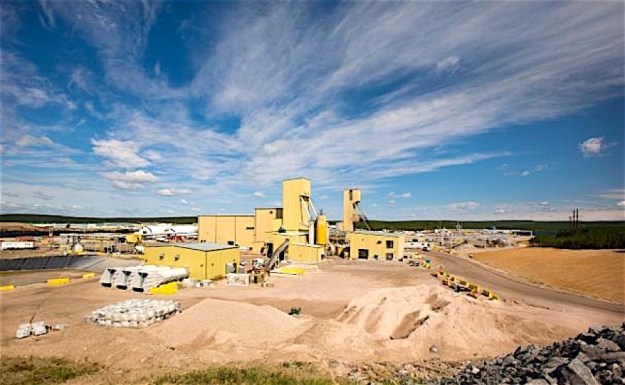
Cigar Lake, in northern Saskatchewan, Canada, is the world’s highest-grade uranium mine.
Uranium miner Cameco (TSX:CCO; NYSE:CCJ) is weighing its options after a key Japanese customer attempted to cancel its contract, which would mean $1.3 billion in lost revenue for the Canadian company.
Tokyo Electric Power Company Holdings (TEPCO), the operator of Japan’s wrecked Fukushima nuclear plant, issued a termination notice for a uranium supply contract on Jan. 24 and, earlier this week, it said it would not accept a delivery that was scheduled for Feb.1.
Such contract cancellation would affect about 9.3 million pounds of uranium deliveries through 2028, including about 855,000 pounds annually in 2017, 2018 and 2019, Cameco said.
Shares collapsed on the news. They were trading down 12.5% to Cdn$14.50 in Toronto at 1:00 pm, and 13.3% down in New York to $11.06 at 1:26 pm ET.
Cameco said the Japanese power company has cited forces beyond its control — specifically government regulations arising from the 2011 Fukushima nuclear accident — that have prevented the operation of its nuclear plants.
The Canadian firm insisted that there’s no basis for terminating the contract and considers TEPCO to be in default. It said it will pursue its rights — including binding arbitration.
“We are surprised and disappointed that TEPCO is seeking to terminate its contract given all the past productive discussions we have had to date,” Cameco’s president and CEO Tim Gitzel said in the statement.
The company noted it has sufficient financial capacity to manage any loss of revenue in 2017 as a result of the dispute.
Including income coming from TEPCO, Cameco expects 2017 earnings will range between $2.1 billion to $2.2 billion. More information on the uranium miner’s financial position will be released next week.
http://www.mining.com/cameco-to-lose-1-3bn-as-japans-tepco-cancels-uranium-contract/
Fukushima nuclear disaster: Worker sues Tepco over cancer

The plaintiff helped build scaffolding to repair the damaged No 4 reactor at the Fukushima plant
A Japanese court has begun hearing the case of a man who developed leukaemia after working as a welder at the damaged Fukushima nuclear site.
The plaintiff, 42, is the first person to be recognised by labour authorities as having an illness linked to clean-up work at the plant.
He is suing Tokyo Electric Power Company, which operates the complex.
The nuclear site was hit by the earthquake and tsunami in 2011, causing a triple meltdown.
It was the world’s worst nuclear disaster since Chernobyl in 1986. An exclusion zone remains in place around the site as thousands of workers continue clean-up efforts.
‘Expendable labourer’
The man, from Japan’s Fukuoka prefecture, was a welder for a sub-contractor.
He spent six months working at Genkai and Fukushima No 2 nuclear plants before moving to the quake-hit Fukushima No 1 plant, where he build scaffolding for repair work at the No 4 reactor building. His cumulative radiation exposure was 19.78 millisieverts.
This is lower than official limits – Japan currently allows workers at the damaged plant to accumulate a maximum of 100 millisieverts over five years. A dose of 100 millisieverts over a year is seen as enough to raise the risk of cancer.
But in October 2015, a health ministry panel ruled that the man’s illness was workplace-related and that he was eligible for compensation.
“While the causal link between his exposure to radiation and his illness is unclear, we certified him from the standpoint of worker compensation,” a health ministry official said at the time.

There has been heated debate about the dangers of radiation from the plant
The man is now suing Tepco and the Kyushu Electric Power Company, which operated the Genkai plant, for JPY59m ($526,000, £417,000).
“I worked there [Fukushima No 1 plant] because of my ardent desire to help bring the disaster under control but I was treated as if I was a mere expendable labourer,” Kyodo news agency quoted him as saying.
“I want Tokyo Electric to thoroughly face up to its responsibility.”
When he filed the suit late last year, his lawyers said he had been “forced to undergo unnecessary radiation exposure because of the utilities’ slipshod on-site radiation management”.
Tepco and Kyushu Electric have asked the court to reject the suit, questioning the link between his radiation exposure and leukaemia, Kyodo reported.
Tens of thousands of workers have been employed at the Fukushima site since the disaster in March 2011. Late last year the government said estimates of clean-up costs had doubled to JPY21.5 trillion ($188bn, £150bn).
http://www.bbc.com/news/world-asia-38843691
Ex-worker during Fukushima disaster sues Tepco, Kyushu Electric over leukemia
A former nuclear worker who developed leukemia after combating the 2011 Fukushima nuclear crisis demanded ¥59 million (around $524,000) in damages from two utilities Thursday at his first trial hearing at the Tokyo District Court.
The 42-year-old man from Fukuoka Prefecture is the first person to be recognized by labor authorities as having an illness linked to workplace radiation exposure since the triple core meltdown at the Fukushima No. 1 nuclear power plant.
The man-made disaster was triggered by the huge earthquake and tsunami on March 11, 2011.
“I worked there because of my ardent desire to help bring the disaster under control but I was treated as if I was a mere expendable laborer,” the plaintiff said.
“I want Tokyo Electric to thoroughly face up to its responsibility,” he said.
The defendants, Tokyo Electric Power Company Holdings Inc., which runs Fukushima No. 1, and Kyushu Electric Power Co., whose Genkai nuclear plant also employed the plaintiff, asked the court to reject the claim, questioning the connection between his radiation exposure and leukemia.
The man was engaged in welding operations at the Fukushima Nos. 1 and 2 plants and the Genkai complex in Saga Prefecture from October 2011 to December 2013. His exposure in operations subcontracted by the utilities consisted of at least 19.8 millisieverts, according to his written complaint.
The man was diagnosed with acute myeloid leukemia in January 2014 and later went into depression. Both ailments are recognized as work-related illnesses by the Health, Labor and Welfare Ministry.
He said he has been unable to go back to work and is therefore seeking compensation from the utilities.
Tepco’s termination of supply contract contested by Canada-based uranium producer Cameco
Cameco to contest Tepco’s termination of supply contract
Cameco announced today that Tokyo Electric Power Company Holdings (Tepco) has issued a termination notice for a uranium supply contract with Cameco Inc that it does not accept. “Cameco Inc sees no basis for terminating the contract, considers Tepco to be in default, and will pursue all its legal rights and remedies,” the Saskatchewan, Canada-based uranium producer said.
The Japanese utility confirmed yesterday it would not accept a uranium delivery scheduled for 1 February and would not withdraw the contract termination notice it provided to Cameco on 24 January, according to Cameco’s statement. Tepco alleges that an event of ‘force majeure’ has occurred because it has been unable to operate its nuclear generating plants for 18 consecutive months due to government regulations arising from the Fukushima nuclear accident in March 2011.
“We are surprised and disappointed that Tepco is seeking to terminate its contract given all the past productive discussions we have had to date,” said Tim Gitzel, president and CEO of Cameco. “For the past six years we have worked in good faith with Tepco to restructure this contract, and would continue to do so if there was any basis for a commercial resolution. During the past week we tried to engage Tepco to obtain clarification given conflicting information we had received previously from them and only received confirmation of their intent to terminate the contract yesterday.”
Cameco will “vigorously pursue” remedies to recover value for its shareholders and other stakeholders, Gitzel added.
Under the contract, Tepco has already received and paid for 2.2 million pounds of uranium since 2014. The termination would affect about 9.3 million pounds of uranium deliveries through 2028, worth about $1.3 billion in revenue to Cameco, including about $126 million in each of 2017, 2018 and 2019 based on 855,000 pounds of deliveries in each of those years. In 2017, Cameco’s consolidated revenue, including the Tepco volume, is expected to range between $2.1 billion to $2.2 billion.
Cameco said it will be “moving expeditiously” to enforce its rights under the uranium supply contract to recover losses arising from Tepco’s actions.
“As with any commercial dispute, it will take some time for a resolution to be achieved, particularly if it proceeds all the way to arbitration,” Cameco said.
The company, which is scheduled to release its annual results after markets close on 9 February, said it has “sufficient financial capacity” to manage any loss of revenue in 2017 as a result of the dispute.
A spokesman for Tepco said: “We have terminated the uranium concentrate supply agreement with Cameco by giving written notice to Cameco in accordance with the terms and conditions of the agreement. We are aware that Cameco is showing their objection to our assertion of termination. However, our notice complies with the agreement and we will take appropriate action.”
http://www.freep.com/story/news/2017/02/01/trump–nuclear-waste-lake-huron/97346178
Tepco scraps uranium supply contract with Canada’s Cameco
Feb 1 Canadian uranium producer Cameco Corp said on Wednesday that Tokyo Electric Power (Tepco) , the operator of Japan’s wrecked Fukushima nuclear plant, had scrapped its uranium supply contract with the company.
Shares of Cameco slid 12.2 percent to C$14.55 in early trading on Wednesday.
The company, one of the world’s largest uranium producers, said it considered Tepco’s move to terminate the contract unfair and that it would pursue legal action.
Cameco said Tepco cited a force majeure for ending the contract as it had been unable to operate its nuclear plants for 18 straight months due to Japanese regulations arising from the 2011 Fukushima nuclear accident.
The company said it was notified of the contract termination by Tepco last week.
Tepco’s termination of the contract would affect about 9.3 million pounds of uranium deliveries through 2028, worth about C$1.3 billion ($995.41 million) in revenue to Cameco, the Saskatoon, Canada-based company said.
Cameco’s earnings before interest, taxes, depreciation and amortization could take a 10-15 percent hit in the near-term as a result of the Tepco dispute, said Edward Sterck, an analyst at BMO Capital Markets.
Tepco’s move comes amid a fall in demand for uranium that is largely a result of the Fukushima nuclear plant meltdown, which led to shutdowns of all of Japan’s nuclear reactors.
Some reactors have since come back online, but global inventories of the radioactive metal remain high.
Cameco warned late last year that the uranium market would remain depressed until Japan’s nuclear reactors were restarted and excess supply was depleted.
Cameco also said it expected 2017 revenue of C$2.1 billion to C$2.2 billion, inclusive of Tepco’s volume, adding that it could withstand any potential loss of revenue this year from the dispute.
http://www.reuters.com/article/cameco-contract-tep-hldg-idUSL4N1FM35I
Tepco Recognizes only 15 Workers’ Cancers at Fukushima Daiichi

A new report was released by TEPCO stating that 15 workers from Fukushima Daiichi nuclear plant have develop cancer so far : 8 cases of leukemia, 5 cases of malignant lymphoma, 2 cases of multiple myeloma.
These cancers are recognized sufficiently linked to their work at the nuclear plant and caused by their radiation exposure . Their exposure dose superior to 100 mSv or more and the period from their radiation exposure to their onset of cancer is more than 5 years. Those 15 workers eligible to receive compensation.
These counts does not include the SDF and Tokyo Fire Department workers who responded to the disaster at Fukushima daiichi on March 2011.
Source : http://www.tepco.co.jp/nu/fukushima-np/roadmap/2017/images1/l170117_09-j.pdf
Tepco to name underwriters this month for landmark bond sale: DealWatch

Tokyo Electric Power Co (9501.T) will select underwriters this month for its first bond sale since the 2011 Fukushima nuclear reactor disaster, people close to the deal told Thomson Reuters DealWatch.
The issue is expected to be worth at least $1 billion according to one of the people.
The deal is being closely watched by Japan’s corporate bond market, which Tepco dominated before the March 2011 earthquake and tsunami triggered the world’s worst nuclear accident since Chernobyl in 1986, bringing the company to its knees.
Tepco has been gauging demand for the landmark bond offering, as once-skeptical investors become more comfortable with the utility’s outlook after the government provided more details on decommissioning and compensation costs, sources said last week.
Tepco, which is looking to sell the bond by the end of March, will hold meetings next week with several brokerages, who will make pitches to the company for a mandate to sell the bonds, said the people close to the deal, who asked not to be identified because the discussions are private.
A Tepco spokesman on Friday said there was no change to the utility company’s previously announced plans to sell the bond by the end of March but that he was unaware of any plans to meet brokers next week.
The utility, once Asia’s largest, was essentially nationalized after Fukushima. It has struggled to contain radiation at the site and compensate victims of the accident while preparing to decommission the crippled power station.
The meeting will discuss investor demand, the likely size of the issue, the premium over government-bond yields Tepco will need to pay and the feasibility of selling the bond by Tepco’s target date, they said.
Tepco is considering a multi-tranche issue with maturities of three-, five- and 10-years, they said.
“At the very least, it will be worth 100 billion yen,” said one source. In the year leading up to the Fukushima disaster, Tepco sold 235 billion yen of bonds.
Sources have said Tepco will likely need to pay investors about 1 percentage point above the corresponding Japanese government bonds yields. This would be a rich premium considering other electric utilities pay about a third of that spread for their debt funding.
The government also owns 50.1 percent of the company following its bailout, seen by some investors as an implicit state guarantee on the company.
There are, however, some potential snags to Tepco’s plans to issue by the end of March. According to one person familiar with the government’s thinking, the government wants Tepco to delay the bond sale until after April, when legal changes allowing more financial support to the utility are enacted.
Niigata governor rejects restarts in 1st meet with TEPCO execs
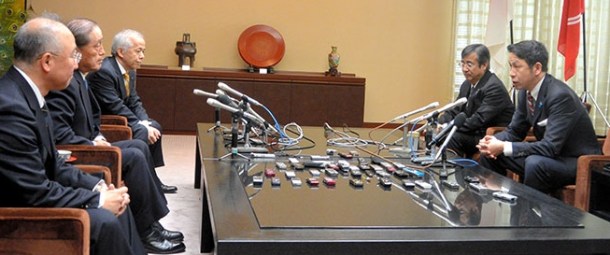
Niigata Governor Ryuichi Yoneyama, far right, holds talks with executives of Tokyo Electric Power Co. in the Niigata prefectural government office on Jan. 5.
Niigata governor rejects restarts in 1st meet with TEPCO execs
NIIGATA–Niigata Governor Ryuichi Yoneyama met Jan. 5 with top executives of Tokyo Electric Power Co. (TEPCO) for the first time, reiterating his opposition to restarting the Kashiwazaki-Kariwa nuclear power plant.
“It will be difficult to approve the restart as long as (the causes of) the accident at the Fukushima No. 1 nuclear power plant are not verified. In the present circumstances, I cannot accept the restart,” Yoneyama told Fumio Sudo, chairman of Tokyo Electric Power Co. Holdings Inc., and Naomi Hirose, president of the company.
It was the first time for Yoneyama to meet with TEPCO executives since he assumed the post of Niigata governor last October. The talks were held in the Niigata prefectural government office.
Yoneyama, noting that it will take several years for the Niigata prefectural government to verify the causes of the 2011 nuclear disaster, asked the TEPCO executives to provide more information and other forms of cooperation.
In response, Sudo said, “The priority is to hear voices of local residents.”
This seemed to suggest that TEPCO will not restart the Kashiwazaki-Kariwa nuclear power plant as long as the Niigata governor continues to resist the move.
A council of experts of the Ministry of Economy, Trade and Industry announced late last year that the costs for dealing with the aftermath of the Fukushima nuclear disaster will almost double to 21.5 trillion yen ($185 billion) from 11 trillion yen initially estimated in 2013.
To help cover the amount, TEPCO planned to restart two reactors at the Kashiwazaki-Kariwa to generate 100 billion yen in annual profits. But that now looks difficult, given Yoneyama’s firm stance on the issue of restarts.
http://www.asahi.com/ajw/articles/AJ201701050067.html
Gov. says restart of nuclear plant in Niigata to take “several years”
The restart of a nuclear power plant operated by Tokyo Electric Power Company Holdings Inc. on the Sea of Japan coast will likely take “several years,” the governor of Niigata Prefecture said Thursday, highlighting the difficulty in concluding post-2011 nuclear disaster reviews.
The utility known as TEPCO has been seeking to reactivate the Kashiwazaki-Kariwa nuclear plant, the world’s largest by generation capacity, as soon as possible to boost revenue, as it grapples with ballooning costs stemming from the 2011 nuclear disaster in Japan’s northeast.
“There can be no discussions about a restart without reviewing” factors including the cause of the Fukushima nuclear accident and evacuation plans for residents, Niigata Gov. Ryuichi Yoneyama said in his first talks with TEPCO executives since assuming office in October.
http://english.kyodonews.jp/news/2017/01/452300.html
Japan governor tells Tepco bosses nuclear plant to stay shut
The governor of Japan’s Niigata prefecture reiterated his opposition to the restart of Tokyo Electric Power’s (Tepco) Kashiwazaki-Kariwa nuclear plant, adding it may take a few years to review the pre-conditions for restart.
During a meeting on Thursday with Tepco Chairman Fumio Sudo and President Naomi Hirose, Governor Ryuichi Yoneyama, who was elected in October on his anti-nuclear platform, repeated his pledge to keep the plant shut unless a fuller explanation of the 2011 Fukushima nuclear disaster was provided.
He also said that evacuation plans for people in Niigata in case of a nuclear accident and the health impacts that the Fukushima accident have had would need to be reviewed before discussing the nuclear plant’s restart.
The restart of the Kashiwazaki-Kariwa plant, the world’s largest, is key to helping Tepco rebound from the aftermath of the 2011 disaster at its Fukushima-Daiichi plant.
The Japanese government last month nearly doubled its projections for costs related to the disaster to 21.5 trillion yen ($185 billion), increasing the pressure on Tepco to step up reform and improve its performance.
Many of Japan’s reactors are still going through a relicensing process by a new regulator set up after the Fukushima disaster, the world’s worst since Chernobyl in 1986.
Shutting the Kashiwazaki-Kariwa plant for additional years would mean that the company would have to continue relying heavily on fossil fuel-fired power generation such as natural gas.
Governors do not have the legal authority to prevent restarts but their agreement is usually required before a plant can resume operations.
Three reactors at Tepco’s Fukushima-Daiichi nuclear plant melted down after a magnitude 9 earthquake struck Japan in March 2011, triggering a tsunami that devastated a swathe of Japan’s northeastern coastline and killed more than 15,000 people.
http://www.reuters.com/article/us-japan-tepco-idUSKBN14P0IK?il=0
Contaminated Glove, Jacket, pants worn by a Fukushima Daiichi worker
By Marco Kaltofen
Activity is 0.7 to 240 kBq/kg, surface rad to 59 uR/hr.
http://bostonchemicaldata.com/data.html

35.5 kBq/kg

0.11 to 0.24 kBq/kg

ND (<0.01) to 17.1 kBq/kg
Gov’t mulls ’roundtable’ meetings to spur power industry reorganization

The Economy, Trade and Industry Ministry is considering holding “roundtable” discussions with top executives of major power companies on measures to restructure their business ties with beleaguered Tokyo Electric Power Co. (TEPCO) and set up operations overseas, it has been learned.
The industry ministry wants to help pave the way for the power industry to restructure and consolidate by setting up a forum in which major utilities can exchange views on the realities of domestic and overseas markets as well as management reforms. The move will effectively have the government play mediator in the reorganization of the power industry.
The move comes after a ministry expert committee on reforming TEPCO and issues related to the tsunami-hit Fukushima No. 1 nuclear plant proposed on Dec. 20 that the government play a “catalytic” role in the realignment of the power industry. In response, TEPCO plans to hash out a new management restructuring plan this month or later. The roundtable is expected to be set up around the time that TEPCO comes up with its new restructuring scheme.
One of the expert panel’s proposals is for TEPCO to establish a “consortium” with other utilities on its power transmission and nuclear power projects at an early date. The proposal is intended to facilitate the realignment and consolidation of the power industry as part of moves to rationalize TEPCO’s measures to cover the costs of dealing with the Fukushima nuclear accident. The expert panel projected that these costs would swell to 21.5 trillion yen from an earlier estimate of 11 trillion yen. The proposal also draws on TEPCO’s plan to move its thermal power business to JERA Co., a joint venture with Chubu Electric Power Co.
The industry ministry is considering plans including publicly soliciting prospective partners for TEPCO. However, major power companies remain cautious, with a senior official at one major utility saying, “Our own company’s profits will be used to deal with the nuclear accident.” The utility roundtable meeting is the industry ministry’s attempt to help resolve this and other issue. The roundtable idea is also in line with the TEPCO’s opinion that “as long as TEPCO is aiming to reorganize at a national level, we want to have an opportunity for all companies to meet and discuss things,” as a TEPCO executive said.
While domestic power demand has stagnated due to energy-saving efforts and the declining birthrate, the industry is faced with a shifting market overseas, where demand continues to rise. According to an International Energy Agency (IEA) forecast, while Japan’s domestic electricity consumption will rise only slightly from 950 billion kilowatt-hours in 2014 to 980 billion kilowatt-hours in 2030, overall global consumption will rise from 19.8 trillion kilowatt-hours to 27.9 trillion kilowatt-hours.
Through the roundtable, the industry ministry is keen to help boost utilities’ entry into overseas markets by facilitating industry rationalization to strengthen their businesses at home. However, as the power industry may not respond well to having reorganization foisted on it by the government, the ministry plans to flesh out the scheme carefully. As a senior utility official said, “It is essential to set up a contact point for private entities first and leave the matter to them thereafter.”
http://mainichi.jp/english/articles/20170103/p2a/00m/0na/012000c

Court denies disclosure of Tepco officials’ testimony about Fukushima disaster

The Tokyo District Court has dismissed an appeal by Tepco shareholders calling for disclosure of a government panel’s records of questioning of executives over the March 2011 crisis at the Fukushima No. 1 nuclear power plant.
“The decision accepted all of what the government claimed and therefore is regrettable,” the shareholders said in a statement following the ruling Tuesday. They said they would file an immediate appeal.
The Fukushima Nuclear Accident Independent Investigation Commission was formed in 2011 to investigate the causes of the nuclear disaster by questioning executives of the utility, now called Tokyo Electric Power Company Holdings Inc., including Tsunehisa Katsumata, former chairman of the utility, and others.
The questioning was conducted on condition that it would not be used to assign blame.
Only the records of the interviews of those who agreed that their answers would be made public have been disclosed, including Masao Yoshida, the late former chief of Fukushima No. 1.
The shareholders are seeking disclosure of the records on 11 Tepco officials and three officials of the now-defunct Nuclear and Industrial Safety Agency.
“If the records are disclosed, it would be extremely difficult to gain cooperation from related parties in future investigations,” presiding Judge Akihiko Otake said, deciding that the disclosure could disrupt the execution of official duties.
The court also concluded that the undisclosed portion of the records that was not revealed in previous disclosures should be kept confidential.
Initially, the records of questioning of some 770 Tepco and government officials in 2011 and 2012 were all kept under wraps. But following media reports on the Yoshida interview, the government decided to change its policy and disclose them with interviewees’ consent.
Since September 2014, the government has disclosed the records of some 240 interviewees.
1 This Month

of the week – Shut Down Drone Warfare!


Tell the Ukrainian Government to Drop Prosecution of Peace Activist Yurii Sheliazhenko

Petition to revoke the licensing of the Near Surface Nuclear Disposal Facility (NSDF) at Chalk River. https://www.ourcommons.ca/petitions/en/Petition/Details?Petition=e-7247
To see nuclear-related stories in greater depth and intensity – go to https://nuclearinformation.wordpress.com
-
Archives
- March 2026 (251)
- February 2026 (268)
- January 2026 (308)
- December 2025 (358)
- November 2025 (359)
- October 2025 (376)
- September 2025 (257)
- August 2025 (319)
- July 2025 (230)
- June 2025 (348)
- May 2025 (261)
- April 2025 (305)
-
Categories
- 1
- 1 NUCLEAR ISSUES
- business and costs
- climate change
- culture and arts
- ENERGY
- environment
- health
- history
- indigenous issues
- Legal
- marketing of nuclear
- media
- opposition to nuclear
- PERSONAL STORIES
- politics
- politics international
- Religion and ethics
- safety
- secrets,lies and civil liberties
- spinbuster
- technology
- Uranium
- wastes
- weapons and war
- Women
- 2 WORLD
- ACTION
- AFRICA
- Atrocities
- AUSTRALIA
- Christina's notes
- Christina's themes
- culture and arts
- Events
- Fuk 2022
- Fuk 2023
- Fukushima 2017
- Fukushima 2018
- fukushima 2019
- Fukushima 2020
- Fukushima 2021
- general
- global warming
- Humour (God we need it)
- Nuclear
- RARE EARTHS
- Reference
- resources – print
- Resources -audiovicual
- Weekly Newsletter
- World
- World Nuclear
- YouTube
-
RSS
Entries RSS
Comments RSS
 nuclear-news