“Possible” melted fuel seen for first time at Fukushima plant


Scaffolding at No.3 Fukushima reactor missing

Underwater Robot Probe of Reactor 3 Begins
Underwater Robot Begins Probing Fukushima Daiichi’s No. 3 reactor


Tepco Prepares the Reactor 3 New Cover

It is a Japanese project. That’s what it will give, It’s not a sarcophagus, just a structure to carry the cranes that will empty the pool.

They have already tried ground construction in Iwaki


Credits to Pierre Fetet.
Takahama N°3 Reactor Restarted
Kepco restarts second Takahama reactor as Greenpeace warns of French MOX fuel shipment
 Security guards stand near a gate at the Takahama nuclear power plant in Takahama, Fukui Prefecture, on Tuesday, prior to the restart of a reactor at the facility.
OSAKA – Kansai Electric Power Co. restarted its Takahama No. 3 reactor Tuesday afternoon, bringing to five the number of nuclear reactors nationwide that have come back online since the March 11, 2011, triple meltdown at the Fukushima No. 1 power plant.
“Today marks an important step in the process to restart Japan’s nuclear reactors. It does not mark the end of efforts to ensure the safety of nuclear power, and we’ll continue to make safety our top priority,” said Kepco President Shigeki Iwane shortly after the 2 p.m. restart.
The No. 3 restart comes less than a month after Kepco turned its No. 4 reactor back on. It also came on the heels of reports that a shipment of uranium-plutonium mixed oxide (MOX) fuel will arrive in Takahama, Fukui Prefecture, in a few months from France for use in the No. 4 reactor next year.
Kepco’s push to fire up the 32-year-old Takahama reactors came with promises it would reduce electricity bills. Electricity from the No. 4 reactor, which went back online last month, will go on sale late next week. Electricity from the No. 3 reactor is expected to be sold from early July, during the hottest part of the summer when electricity demand peaks.
Kepco’s return to nuclear power generation, which accounted for nearly half of its electricity prior to March 11, 2011, takes place as renewable energy sources slowly gain ground.
According to one recent expert tally, renewable energy, including large-scale hydropower, accounted for 14.5 percent of total domestic power generation capacity in fiscal 2015 through March 2016.
In “Sustainable Zone 2016,” a joint analysis of Japan’s renewable energy situation by Chiba University professor Hidefumi Kurasaka and the Institute for Sustainable Energy Policies, it was also noted that during the first half of fiscal 2016, the average ratio of renewable energy produced by the nation’s 10 utilities increased to 15.7 percent of total electricity demand. But the ratio of renewable energy, including large-scale hydropower, at Hokkaido Electric Power Co. and Hokuriku Electric Power Co. reached 32 percent during that same period.
The government’s official energy policy calls for renewables to account for between 22 and 24 percent of the country’s electricity by 2030 and for nuclear power to generate between 20 and 22 percent, on average.
On Tuesday, Greenpeace revealed that plans are moving forward to ship at least 496 kg of plutonium from France in the form of 16 MOX fuel assemblies to Japan for use in the Takahama No. 4 reactor when it is reloaded next year. Greenpeace estimates the shipment will depart Cherbourg, France, early next month and — assuming there are no delays — arrive in Takahama sometime between mid-August and early September.
“Kepco’s unjustified restart of the Takahama 3 reactor is made worse by the fact that they are planning a secret plutonium shipment which will increase the amount of dangerous plutonium MOX in their reactors,” said Shaun Burnie, a Japan-based senior nuclear specialist with Greenpeace Germany. “The Takahama reactors already pose an unacceptable threat to the people of Fukui and Kansai region. This will be compounded by the even greater usage of plutonium MOX fuel.”
Japan restarts reactor No 3 at Takahama nuclear plant
Only a handful of reactors have come back online, due to public opposition, since the Fukushima disaster in 2011. Tuesday’s move comes after court clearance.
 Japan’s coast guard patrols in front of the No 3 reactor at the nuclear plant in Takahama, Fukui prefecture, some 350 kilometres west of Tokyo on June 6, 2017
In a small victory for the government’s pro-atomic push, a Japanese utility switched on another nuclear reactor on Tuesday, despite strong public opposition after the 2011 Fukushima meltdown.
The restart of the No 3 reactor at the Takahama nuclear plant brings the number of operational atomic reactors in Japan to five, while dozens more remain offline. Located in Fukui prefecture, the plant which is operated by Kansai Electric Power (KEPCO) is some 350 kilometres (215 miles) west of Tokyo.
Tuesday’s move comes after the utility switched on Takahama’s No 4 reactor last month with the court’s go-ahead, in spite of complaints from local residents over safety concerns. The court also gave the green light to switch on the No 3 reactor.
Japan shut down all of its atomic reactors after a powerful earthquake in March 2011 spawned a huge tsunami that led to meltdowns at the Fukushima nuclear plant.
Fukushima became the worst nuclear accident since Chernobyl in 1986.
Since then, just a handful of reactors have come back online due to public opposition and as legal cases work their way through the courts.
However, Prime Minister Shinzo Abe has aggressively promoted nuclear energy, calling it essential to powering the world’s third-largest economy.
Much of the public remains wary of nuclear power after the disaster at Fukushima spewed radiation over a large area and forced tens of thousands to leave their homes, with some unlikely to ever return.
http://trtworld.com/asia/japan-restarts-reactor-no-3-at-takahama-nuclear-plant-373118
Submersible Crawling Robot to Examine Interior of Fukushima Daiichi-3 PCV before Fuel Debris Is Removed

On May 25, the Tokyo Electric Power Co. (TEPCO) released a status report on the ongoing decommissioning work at the Fukushima Daiichi Nuclear Power Plants, which suffered a tsunami-caused meltdown in March 2011.
Starting two months ago, in March, a self-propelled robot has been used to investigate the interior of the primary containment vessel (PCV) of Unit 1 at Fukushima Daiichi—a necessary step before fuel debris can be removed. As of April 6, the robot had sampled deposits twice.
Fluorescent X-ray spectroscopy has now confirmed the presence of elements that had originally existed in the PCV, such as iron and nickel within the reactor core internals, stainless steel in the heat-insulating materials, zinc in the paint, and lead in the shielding materials.
Although uranium was confirmed as the primary radioactive nuclide within Unit 1, it is not necessarily part of the fuel debris there, given that that element exists naturally. TEPCO said that it would carry out more detailed analyses to confirm the uranium’s source.
As the water level in the PCV of Unit 3 is higher than that in Units 1 and 2, its so-called “X-6 penetration”—which would give easier access to the inside of the pedestal (under the reactor pressure vessel)—is submerged. TEPCO plans to investigate the interior of that unit’s PCV at an undetermined date this summer using a submersible robot that can both crawl and swim. Earlier this month, the power utility began taking measurements using muon observation technology to determine the location of fuel debris.
Under the “Mid-and-Long-Term Roadmap” toward decommissioning, TEPCO will determine policies on fuel debris removal at each Fukushima Daiichi unit this summer. According to its May 22 report to an expert panel of the Nuclear Regulation Authority (NRA), the power company has already made investigations to determine general conditions inside the individual PCVs.
TEPCO will continue to focus on gathering information during the current fiscal year (ended March 31, 2018), including that on the forms and distribution of fuel debris—necessary to determine the means to remove it—and safety measures for the actual removal work.
TEPCO to look inside Fukushima reactor 3

Plans to remove nuclear fuel at Fukushima N° 3 reactor delayed again

A member of the media, wearing a protective suit and a mask, looks at the No. 3 reactor building at Tokyo Electric Power Co’s (TEPCO) tsunami-crippled Fukushima Daiichi nuclear power plant in Okuma town, Fukushima prefecture, Japan February 10, 2016.
A plan to remove spent nuclear fuel from Tokyo Electric Power Co Holdings Inc’s Fukushima Daiichi nuclear plant hit by the March 2011 tsunami has been postponed again due to delays in preparation, the Nikkei business daily reported on Thursday.
Work is now set to begin in fiscal 2018 at the earliest, the Nikkei said.
Removal of the spent fuel from the No. 3 reactor was originally scheduled in the first half of fiscal 2015, and later revised to fiscal 2017 due to high levels of radioactivity around the facilities, the Japanese business daily reported.
The timeline has been changed again as it was taking longer than expected to decontaminate buildings and clean up debris, the news agency reported.
The report comes a few months after the Japanese government said in October the cost of cleaning up the Fukushima plant may rise to several billion dollars a year, adding that it would look into a possible separation of the nuclear business from the utility.
http://uk.reuters.com/article/uk-japan-fukushima-idUKKBN1592WI
Construction of a New Cover Building Installation for Spent Fuel Removal at Unit 3

This installation will enable robotic removal of spent fuel removal to begin at Fukushima Daiichi Unit 3. Plans to remove this fuel have been complicated by high radiation levels.
To install the cover building’s cylindrical portion workers will have to enter the area to manually bolt the cover to the deck structure.
Installation of the “stopper” by a crane near the spent fuel pool began on January 17 as the first step to construct a new roof for the Unit 3 spent fuel removal. Over the pool some additional structural equipment has also been installed.
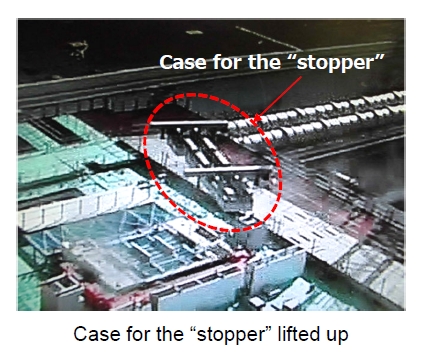
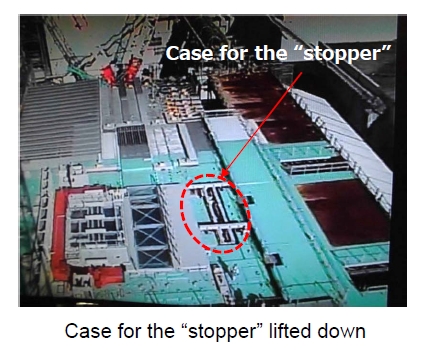
Tepco will proceed with the roof construction toward eventual fuel removal with safety as a top priority.
Source : http://www.tepco.co.jp/en/nu/fukushima-np/handouts/2017/images/handouts_170117_01-e.pdf
Debris Removal at Reactor # 3 Delayed, but Arrival of the First Elements of the New Building for its Spent Fuel Removal
Transportation of the supporting part of a new roof for the Unit 3 fuel removal at Fukushima Daiichi Nuclear Power Station
The clearing of debris from reactor # 3 is delayed, delaying the construction of the new building to remove spent fuel from the pool. The debris removal was to be done in order to build a new workshop to remove the fuels from the pool.
The removal of the spent fuel should have started in January 2018. In the beginning, TEPCo was to start in 2015. We do not know their new schedule yet.
On the other hand, TEPCO communicated on the arrival of the first elements of the new building, with photos and video.

The dose rates on the site are here. There is up to 2.6 mSv / h in the vicinity of reactor No.3.

Links from TEPCO:
Photos of the new building
Click to access handouts_161220_01-e.pdf
Video
http://photo.tepco.co.jp/en/date/2016/201612-e/161220-01e.html
Dose rates in Reactor 3 vicinity
http://www.tepco.co.jp/en/nu/fukushima-np/f1/surveymap/images/f1-sv-20161219-e.pdf
Fuel removal at Fukushima reactor again faces delay
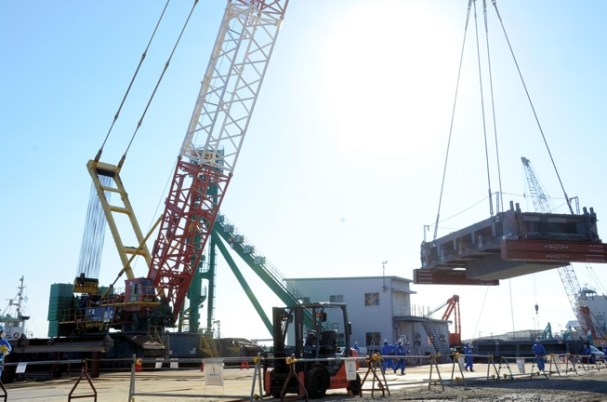
Steel frames are transported at the Fukushima No. 1 nuclear power plant on Dec. 20 to prepare for work to retrieve spent nuclear fuel from the storage pool of the damaged No. 3 reactor building.
Work to retrieve spent nuclear fuel in the No. 3 reactor building storage pool of the crippled Fukushima No. 1 nuclear power plant will again be postponed due to a delay in clearing radioactive debris at the site.
TEPCO planned to begin removing 566 spent nuclear fuel assemblies in the storage pool in January 2018. However, the government and the plant operator, Tokyo Electric Power Co., decided on the postponement, sources said on Dec. 22. They will decide on a new timetable in a few weeks.
The work was initially scheduled for fiscal 2015, but had been pushed back because of high radiation readings in and around the No. 3 reactor building. The building was heavily damaged by a hydrogen explosion in the days following the disaster, triggered by the 2011 Great East Japan Earthquake and tsunami.
TEPCO had attempted to lower radiation levels by clearing the radioactive debris remaining at the site.
But the clearing work took longer than expected due to contamination being more widespread than previously thought, forcing TEPCO and the government to again put off the retrieval.
Radiation levels have now dropped as almost all of wreckage at the site has been cleared, TEPCO said. The government and TEPCO have said fuel retrieval at the No. 1 and No. 2 reactor buildings will start in fiscal 2020 or later.
Human Error Stopped Reactor 3 Cooling System
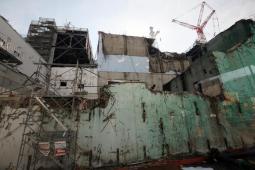
Cooling water briefly stopped at Fukushima plant
Injections of water to cool melted fuel in a reactor at the Fukushima Daiichi nuclear power plant stopped briefly due to human error on Monday.
The plant’s operator, Tokyo Electric Power Company, says an alarm system was activated at around 10 AM when a water pump at the No. 3 reactor shut down.
An internal investigation by the utility found that a worker had mistakenly hit the pump’s switch with his elbow while checking instruments. TEPCO resumed the water injections using a different pump about 1 hour later.
The utility notified local prefectural authorities and nearby areas of the problem just one minute before it resumed the water injections.
TEPCO officials say they detected no changes in the temperature at the bottom of the reactor or in radiation levels at monitoring posts around the plant.
Also on Sunday night, cooling operations temporarily stopped in the spent nuclear fuel pool at the plant’s numbers 1, 2 and 3 reactors when some valves inexplicably opened.
TEPCO says it takes these human errors seriously and will do it best to prevent recurrences.
http://www3.nhk.or.jp/nhkworld/en/news/20161205_27/
Fukushima reactor briefly loses cooling during inspection
One of the melted reactors at tsunami-hit Fukushima nuclear power plant had a temporary loss of cooling when a worker accidentally bumped a switch while passing through a narrow aisle of switch panels during an inspection and turned off the pumping system.
The plant operator, Tokyo Electric Power Co., said cooling for the No. 3 reactor, one of the three reactors that melted following the 2011 earthquake and tsunami, was out for nearly one hour Monday until a backup pump kicked in.
TEPCO said the reactor had enough water left inside and there was no temperature increase or radiation leak from the incident.
TEPCO acknowledged some other key switches are in similarly tight locations.
Fukushima reactor N° 3 briefly loses cooling during inspection
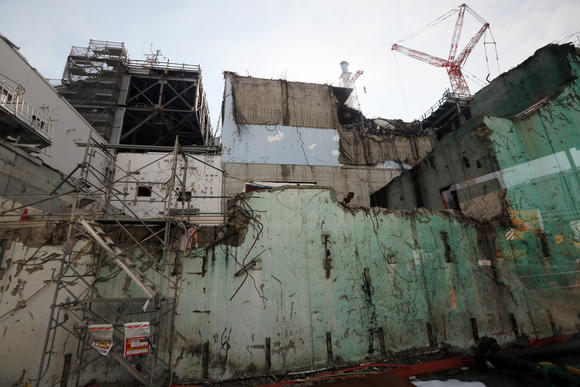
TOKYO — One of the melted reactors at the tsunami-hit Fukushima nuclear power plant had a temporary loss of cooling Monday when a worker accidentally bumped a switch while passing through a narrow isle of switch panels during an inspection and turned off the pumping system.
The plant’s operator, Tokyo Electric Power Co., said cooling for the No. 3 reactor, one of the three that melted following the 2011 earthquake and tsunami, was out for nearly an hour before a backup pump kicked in.
The reactor had enough water left inside and there was no temperature increase or radiation leak from the incident, TEPCO spokesman Yuichi Okamura said at a news conference.
Even though there was no radiation leak or overheating of the core, or any injuries, the incident was a reminder that Fukushima’s decommissioning work is running on a very fragile system.
The plant was largely running on makeshift pipes, wiring and other equipment in the first two to three years following the 2011 disasters, suffering a series of minor blackouts – including those caused by rats chewing cables – cooling stoppages and other problems.
The plant has since largely stabilized, but it remains vulnerable to unanticipated incidents as it continues to struggle with decommissioning work, which is expected to last decades.
Monday’s incident occurred when the worker was passing by a dimly lit isle that was only 85 centimeters (2.8 feet) wide, flanked by tall switch panels on both sides, Okamura said. With radiation levels still high, the worker was wearing a full-face mask and hazmat suit when he lost his balance while carrying equipment. His elbow jammed into the switch, breaking off its safety cover and inadvertently turning the lever to turn off the water injection pump to the No. 3 reactor.
Okamura acknowledged the lack of space at the site and said that the plant will seek ways to eliminate human errors like one on Monday.
Probe of Fukushima Daini’s N°3 Reactor Cooling System Knocked Offline After Earthquake
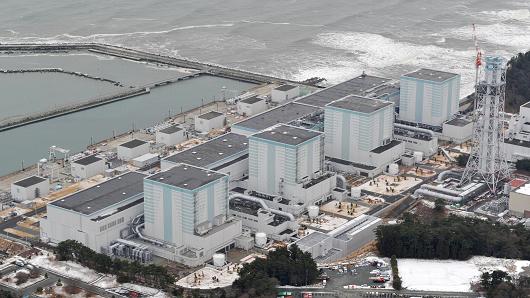
Fukushima Daini
Japan Probes Nuclear Cooling System Shutdown After Earthquake
Japan is investigating why a cooling system used to store nuclear fuel rods was temporarily knocked offline at Tokyo Electric Power Co. Holdings Inc.’s shuttered Fukushima Dai-Ni atomic plant after a 7.4 magnitude earthquake struck the same region devastated by a tsunami in March 2011.
The temblor early Tuesday caused water in the pool at the plant northeast of Tokyo to move, according to the utility known as Tepco. Sensors registered the motion as a decline in water levels, triggering an automatic shutdown, the utility said.
One of at least two cooling pumps supplying water to the spent fuel pool at Dai-Ni’s No. 3 reactor was shut around 6:10 a.m. Tokyo time, according to Tepco. The utility started another pump to resume cooling the fuel rods around 7:47 a.m., it said in an e-mailed statement.
More than five years after the Fukushima earthquake and tsunami that wrecked the utility’s Dai-Ichi nuclear plant and resulted in the shutdown of Japan’s atomic fleet for safety checks, just two of the country’s 42 reactors are back in operation. Returning the plants to service is a goal of Prime Minister Shinzo Abe’s government and is critical to Japan’s aim for nuclear to account for as much as 22 percent of its energy mix by 2030.
“The fact that today’s earthquake caused the pumps at the Fukushima nuclear plant to shut down temporarily will certainly not help the government in its goal to restart the reactors,” Daniel Aldrich, a professor and director of the Security and Resilience Studies Program at Northeastern University in Boston, said by e-mail. “Perhaps one interesting change has been Tepco’s transparency about the ongoing problems at the site, including those that occurred during today’s earthquake.”
Government Response
Fifty-seven percent of the Japanese public oppose resuming operations of the country’s nuclear reactors, while 29 percent approve, according to an Asahi newspaper poll conducted in October.
Japan’s government quickly moved to allay any concerns following Tuesday’s earthquake, which was an aftershock of the magnitude 9 quake five years ago.
Safety is the top priority of Japan’s nuclear industry and the country has the world’s strictest rules for atomic plants, Japanese Chief Cabinet Secretary Yoshihide Suga told reporters in Tokyo Tuesday.
The stoppage of the system wouldn’t immediately have led to a release of radiation, Suga said. Earthquakes and tsunamis are among possibilities envisaged under new safety standards for nuclear plants issued by Japan’s Nuclear Regulation Authority since the 2011 disaster, he said.
Power would need to be cut for about a week before temperatures in the spent-fuel cooling system would reach the upper safety limit, according to Yutaka Ikoma, a spokesman at the regulator. Temperatures would rise about 0.2 degrees Celsius per hour without the cooling system, reaching 65 degrees Celsius in about seven days, according to the spokesman.
1 This Month
10 March A LIVE WEBINAR THE REAL EFFECTS OF NUCLEAR POWER
What the Industry Isn’t Telling Us
1:00 PM Mountain, 2 pm Central, 3 pm Eastern. Live on the Keepers of the Water Facebook page



18 March Webinar @ 1 PM EST: An Assessment of SMR Projects: The Case of Canada
register for the zoom:
https://us02web.zoom.us/webinar/register/WN_o8BIIOUvQ2ONJR1nta65DQ#/registration


of the week – STOP SMALL MODULAR REACTORS IN CANADA
To see nuclear-related stories in greater depth and intensity – go to https://nuclearinformation.wordpress.com
-
Archives
- March 2026 (109)
- February 2026 (268)
- January 2026 (308)
- December 2025 (358)
- November 2025 (359)
- October 2025 (376)
- September 2025 (258)
- August 2025 (319)
- July 2025 (230)
- June 2025 (348)
- May 2025 (261)
- April 2025 (305)
-
Categories
- 1
- 1 NUCLEAR ISSUES
- business and costs
- climate change
- culture and arts
- ENERGY
- environment
- health
- history
- indigenous issues
- Legal
- marketing of nuclear
- media
- opposition to nuclear
- PERSONAL STORIES
- politics
- politics international
- Religion and ethics
- safety
- secrets,lies and civil liberties
- spinbuster
- technology
- Uranium
- wastes
- weapons and war
- Women
- 2 WORLD
- ACTION
- AFRICA
- Atrocities
- AUSTRALIA
- Christina's notes
- Christina's themes
- culture and arts
- Events
- Fuk 2022
- Fuk 2023
- Fukushima 2017
- Fukushima 2018
- fukushima 2019
- Fukushima 2020
- Fukushima 2021
- general
- global warming
- Humour (God we need it)
- Nuclear
- RARE EARTHS
- Reference
- resources – print
- Resources -audiovicual
- Weekly Newsletter
- World
- World Nuclear
- YouTube
-
RSS
Entries RSS
Comments RSS
 nuclear-news