TEPCO failed to spot leak of contaminated water
Greenpeace slams Japan’s plan to dump radioactive Fukushima water into the ocean

Technical failures increase risk of contaminated Fukushima water discharge into Pacific – Greenpeace

Is Fukushima Daiichi’s Continuous Stream of Contaminated Radioactive Water in the Kuroshio Current Causing Strange Disjuncture Between Warming Water and Land Temperatures in Alaska and Bering Sea

IAEA Urges TEPCO on Fukushima Daiichi Radioactive Water Disposal
LIES: ‘Treatment of contaminated water can remove all radioactive substances except tritium, which also exists in nature. As things stand, other radioactive substances also remain because the purification process is premised on the water being stored. In the event of this water being released into the ocean, or disposed of in another way, the tritium would of course be diluted and the other substances brought to or below allowable levels by purifying the water again.’
1. Radioactive tritium does not exist in nature.
2. Other radioactive substances remain in the radioactive water because both of their radionuclides removal systems failed to do fully the job.
3. In the event of this radioactive water being released into the ocean those radionuclides would not be “diluted’ but only scattered through the ocean, affecting all marine life and contaminating our food chain.

IAEA’s report sensible on Fukushima N-plant contaminated water disposal
November 18, 2018
An international organization has provided some sensible advice. The government and Tokyo Electric Power Company Holdings Inc. must act quickly to move ahead with decommissioning reactors at the Fukushima No. 1 nuclear power plant.
A review team of the International Atomic Energy Agency has compiled a preliminary summary report that urges a quick decision on the disposal method for the massive volume of water being stored at the power plant. The report warns that storage tanks will reach capacity in three to four years.
Groundwater enters the damaged nuclear plant buildings, where it becomes contaminated by radioactive substances. TEPCO purifies this water and stores it in tanks that stand in vast rows on the nuclear plant’s premises. There is little space available for more tanks.
The IAEA team hit the nail on the head with its concern that getting stuck on this problem could slow down the entire decommissioning process.
The review team came to Japan at the request of the Japanese government. The team is expected to objectively evaluate the current status of the decommissioning process, and to convey information about this situation to the world. The team will soon write a report containing its findings and advice, based on information including that gleaned from a visit to the site.
Given its role is to provide advice, the team’s report did not mention in detail any specific water disposal methods. However, at a press conference, the team’s leader pointed out that releasing such water into the ocean — an option under consideration by the government — is commonly done by many nuclear power facilities.
It also has been made clear that gaining the support of the Fukushima prefectural government and others will be a major precondition for any water disposal option.
Explain clearly to public
All steps need to be taken to keep the negative effects of harmful rumors about radiation to a minimum. The government and TEPCO should painstakingly continue to hold dialogue with local communities.
The review team also recommended how information about the disposal of treated water should be provided to the public.
Treatment of contaminated water can remove all radioactive substances except tritium, which also exists in nature. As things stand, other radioactive substances also remain because the purification process is premised on the water being stored. In the event of this water being released into the ocean, or disposed of in another way, the tritium would of course be diluted and the other substances brought to or below allowable levels by purifying the water again.
Distrust of the government and TEPCO has heightened because this fact has not been well-publicized.
On its website, TEPCO has posted information about the quality of water that has been treated. The review team said TEPCO should work to provide relevant information “in an easy-to-understand manner.”
Technical information delivered without proper explanations also will not be understood among the general public. Ingenuity will be required.
The decommissioning process has shifted from the emergency response immediately after the accident to a more stable situation and a phase in which work should be steadily implemented. The review team expressed awareness of this point, but also showed concern over ongoing problems, such as difficulty in removing fuel from reactor No. 3’s storage pool.
Difficult challenges lie ahead, including removing fuel debris. This will be a long process that takes 40 years. The technology and human resources development called for by the preliminary summary report must not be neglected.
http://the-japan-news.com/news/article/0005357348
IAEA urges quick plan on Fukushima radioactive water cleanup
November 18, 2018
TOKYO (AP) — Experts from the International Atomic Energy Agency urged the operator of Japan’s tsunami-wrecked Fukushima nuclear plant on Tuesday to urgently decide on a plan to dispose of massive amounts of treated but still radioactive water stored in tanks on the compound.
A 13-member IAEA team told reporters in Tokyo after a weeklong review that managing nearly 1 million tons of radioactive water is critical to the plant’s safe and sustainable decommissioning.
The IAEA team said in a preliminary report that hundreds of tanks currently used to store the water over large areas of the plant’s compound can only be a temporary solution and must be removed “urgently.”
The cores of three reactors at the plant suffered meltdowns following a massive 2011 earthquake and tsunami that devastated parts of northeastern Japan.
Radioactive water has leaked from the damaged reactors and mixed with groundwater and rainwater at the plant. The water is treated and stored in large tanks.
More than 7 ½ years since the accident, officials have yet to agree on what to do with the radioactive water. A government-commissioned panel has picked five alternatives, including the controlled release of the water into the Pacific Ocean, which nuclear experts say is the only realistic option. Fishermen and residents, however, strongly oppose the proposal.
That option faced a major setback this summer when the plant’s operator, Tokyo Electric Power Co., acknowledged that the water, which it said had been carefully treated, was not clean enough. It said the water contains cancer-causing cesium and other elements in excess of allowable limits for release into the environment.
The IAEA interim report said TEPCO could run out of space for tanks in a few years, and the water storage adds to safety risks and could hamper the decommissioning of the plant, which is already an unprecedented challenge.
It said the water problem has improved recently because of measures such as an underground frozen wall installed around the reactor buildings to keep the radioactive water from mixing with groundwater. It suggested that TEPCO could further reduce the amount of contaminated water by cutting back on the use of cooling water injected into the reactors because the temperature of the melted fuel has fallen significantly.
IAEA mission leader Christophe Xerri told reporters that it is uncertain whether all of the melted fuel can ever be successfully removed because too little is known about the damage to the cores of the three reactors.
TEPCO and government officials plan to start removing the melted fuel in 2021. Robotic probes inside the reactors have detected traces of damaged fuel but its exact location, contents and other details remain largely unknown.
“If you don’t have the information it’s very difficult to say it’s possible or not” to remove all the fuel, Xerri said.
The team’s final report from its review is expected in late January.
https://www.statesmanjournal.com/story/news/2018/11/18/iaea-urges-quick-plan-fukushima-radioactive-water-cleanup/2049924002/?fbclid=IwAR2YaM-t-dDeHcjfbdttTho4j1t4v-89qz5zrRwSPABOKrUmk1g-Sa-kBlo
IAEA urges Japan to reach decision soon on handling of radioactive water at crippled Fukushima nuke plant
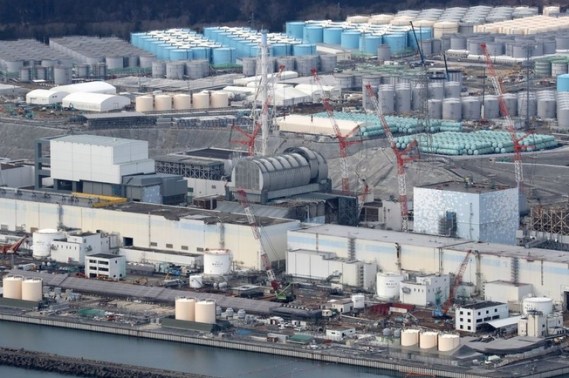
 The growing number of tanks storing radioactive water at the Fukushima No. 1 plant can be seen in February.
November 14, 2018
The growing number of tanks storing radioactive water at the Fukushima No. 1 plant can be seen in February.
A team of nuclear experts from the International Atomic Energy Agency urged Japan this week to reach a decision quickly on what to do with treated water that contains low toxicity radioactive tritium, which is accumulating at the crippled Fukushima No. 1 nuclear plant.
“We advised the Japanese government that … (a) decision should be taken very rapidly for the disposition path for water which is stored in these tanks,” said Christophe Xerri, leader of the 13-member team, on Tuesday following a nine-day review of progress on scrapping the Fukushima No. 1 plant.
The facility was damaged in the March 2011 earthquake and tsunami.
“There is space limitation, so some solution has to be decided and implemented,” Xerri said, adding that the volume of treated water containing tritium in tanks is expected to reach the planned capacity within the “coming three to four years.”
As of last Thursday around 970,000 tons of tritium-containing water was stored on the premises of the plant, according to Tokyo Electric Power Company Holdings Inc.
The government has studied options for the tritium-containing water, including releasing it into the sea, as it is regarded as not harmful to humans.
The tainted water has been stored in tanks after being produced as a byproduct of cooling the plant’s reactors, which suffered core meltdowns following the 2011 disaster.
But local fishermen and residents have expressed concern about discharging the water, fearing the potential impact on food.
“Controlled discharge to the sea is something which is applied in many nuclear facilities, so it’s not something which is new,” Xerri said.
“Our review was not to advise the Japanese government on one solution or another one,” he added.
“It is up to the Japanese government to decide — in engaging with stakeholders, of course — on the option Japan wants to implement,” he said.
Toyoshi Fuketa, who heads the Nuclear Regulation Authority, has described discharging the water into the sea as the “only” solution.
Tepco has been running the Advanced Liquid Processing System, said to be capable of removing almost all radioactive materials from the toxic water except tritium.
It was the fourth such review conducted by a team of experts from the Vienna-based agency, following two in 2013 and one in 2015.
The IAEA will issue its final report by the end of January 2019.
Xerri said his team was impressed by the progress that has been made at the plant since the previous review, including the full operation of a frozen soil wall around the reactors that has reduced the volume of groundwater that enters the reactor buildings.
But he acknowledged many challenges in the decommissioning process, which is set to take “30 to 40 years or even more,” including the removal of melted fuel from the reactors — seen as the hardest part.
When asked about the possibility of discarding the fuel — the location and volume of which remaining within the reactors is yet to be grasped due to high levels of radiation — Xerri said, “We don’t have enough information to tell you yes or no.”
https://www.japantimes.co.jp/news/2018/11/14/national/iaea-urges-japan-make-decision-treated-radioactive-water-crippled-fukushima-nuke-plant/?fbclid=IwAR10h4F1walNk1hOujMjrwNbnuqm7xhkl4Ri91mmLZ6pk-igVMa-TYXvOdE#.W-2FBPZFzIW
Local Fury and Health Concerns as Japan Plans to Dump a Million Tons of Radioactive Fukushima Water Into Ocean

Fukushima nuclear plant owner apologizes for still-radioactive water


TEPCO bungles it again in dealing with Fukushima tainted water

S. Korean activists demand Japan not dump Fukushima’s radioactive water into the sea
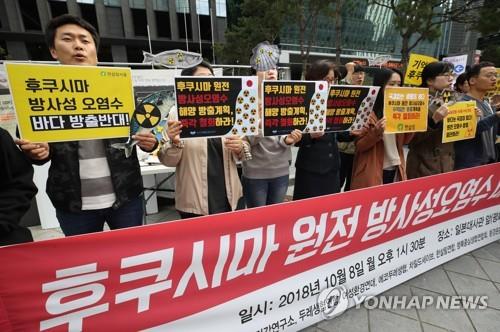
South Korean Prime Minister Expresses Concern about Tokyo’s Plan to Release Fukushima Nuclear Plant Radioactive Water
PM Lee calls for prudent decision by Japan on water from Fukushima plant
Seoul to Express Concern over Tokyo’s Plan to Release Fukushima Plant Water
Japan tries to dilute tritium danger
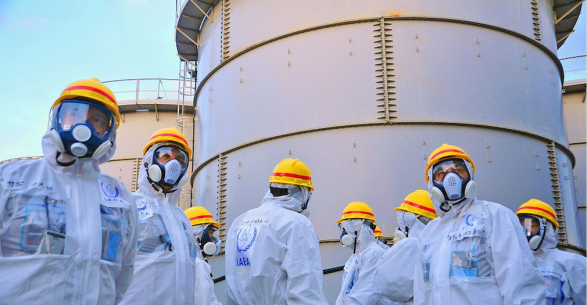
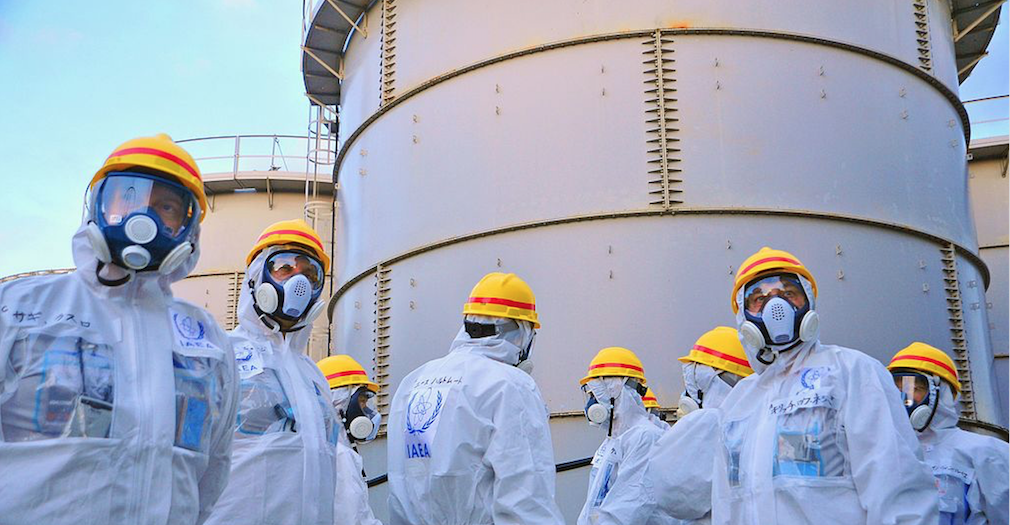
What is tritium and why is its disposal difficult?

All options need to be weighed for Fukushima plant tainted water
B.S. Propaganda Explaining that Radioactive Water Sea Dumping in Fukushima is Essential

‘Carefully explaining treated water discharge in Fukushima essential’
1 This Month

of the week – Shut Down Drone Warfare!


Tell the Ukrainian Government to Drop Prosecution of Peace Activist Yurii Sheliazhenko

Petition to revoke the licensing of the Near Surface Nuclear Disposal Facility (NSDF) at Chalk River. https://www.ourcommons.ca/petitions/en/Petition/Details?Petition=e-7247
To see nuclear-related stories in greater depth and intensity – go to https://nuclearinformation.wordpress.com
-
Archives
- April 2026 (79)
- March 2026 (251)
- February 2026 (268)
- January 2026 (308)
- December 2025 (358)
- November 2025 (359)
- October 2025 (376)
- September 2025 (257)
- August 2025 (319)
- July 2025 (230)
- June 2025 (348)
- May 2025 (261)
-
Categories
- 1
- 1 NUCLEAR ISSUES
- business and costs
- climate change
- culture and arts
- ENERGY
- environment
- health
- history
- indigenous issues
- Legal
- marketing of nuclear
- media
- opposition to nuclear
- PERSONAL STORIES
- politics
- politics international
- Religion and ethics
- safety
- secrets,lies and civil liberties
- spinbuster
- technology
- Uranium
- wastes
- weapons and war
- Women
- 2 WORLD
- ACTION
- AFRICA
- Atrocities
- AUSTRALIA
- Christina's notes
- Christina's themes
- culture and arts
- Events
- Fuk 2022
- Fuk 2023
- Fukushima 2017
- Fukushima 2018
- fukushima 2019
- Fukushima 2020
- Fukushima 2021
- general
- global warming
- Humour (God we need it)
- Nuclear
- RARE EARTHS
- Reference
- resources – print
- Resources -audiovicual
- Weekly Newsletter
- World
- World Nuclear
- YouTube
-
RSS
Entries RSS
Comments RSS
 nuclear-news