Non-disclosure of official documents related to treated water from nuclear power plants: Fukushima Prefecture releases history

February 16, 2022
The Fukushima prefectural government has announced the series of events that led to the non-disclosure of official documents related to the treated water at the Fukushima Daiichi Nuclear Power Plant, saying that there was insufficient confirmation.
In this issue, 24 official documents from briefings and government meetings held for fishermen since April last year were uniformly not disclosed.
On April 15, the prefectural government reversed its decision of nondisclosure and indicated that it would disclose some of the official documents.
On the 16th, the prefecture announced the series of events and explained that the reason for the non-disclosure was “because the decision was made uniformly without sufficient confirmation of whether the documents should be open or closed.
The prefectural government also confirmed that there were other documents that should have been disclosed, and said it would disclose them additionally.
UN to review Japan’s plan to release Fukushima water into Pacific
Transparency coming from Tepco is an oxymoron…

Taskforce will ‘listen to local people’s concerns’, as government plans to release more than 1m tonnes
February 18, 2022
A UN nuclear taskforce has promised to prioritise safety as it launches a review of controversial plans by Japan to release more than 1m tonnes of contaminated water into the ocean from the wrecked Fukushima Daiichi nuclear plant.
Japan’s government announced last April that it had decided to release the water over several decades into the Pacific Ocean, despite strong opposition from local fishers and neighbouring China and South Korea.
Lydie Evrard, the deputy director general of the International Atomic Energy Agency [IAEA], speaking after a team of experts visited the plant to collect water samples, said on Friday: “We listen very carefully to local people’s concerns and the inspection is designed to provide answers about safety in a transparent manner.” .
The controversy comes almost 11 years after a magnitude 9.0 earthquake triggered a huge tsunami that killed more than 18,000 people along Japan’s north-east coast.
Tsunami waves crashed into Fukushima Daiichi, knocking out its backup electricity supply, triggering meltdowns in three of its reactors and sending large quantities of radiation into the atmosphere. More than 150,000 people were forced to flee their homes, and evacuation orders in communities closest to the plant have only recently been partially lifted.
The Tokyo Electric Power company (Tepco) says its treatment technology can remove all radioactive materials from water except tritium, which is harmless in small amounts. It said the gradual release of the water, diluted with seawater, would not pose a threat to human health or the marine environment. In 2020, however, Greenpeace said the water still contained contaminants beside tritium and would have to be treated again.
The wastewater is being stored in about 1,000 tanks that officials say need to be removed so the plant can be decommissioned, an operation expected to take several decades. The tanks are expected to reach their capacity of 1.37m tonnes this summer.
The liquid includes water used to cool the damaged reactors, as well as rain and groundwater that seeps into the area.
Shaun Burnie, a senior nuclear specialist for Greenpeace East Asia, said he did not believe the IAEA would fully investigate and address safety and environmental concerns in its report.
Noting that the agency had welcomed the discharge option when it was announced last year, Burnie said: “The IAEA is not an independent agency in nuclear affairs – under statute its mission is to promote nuclear power. It has sought to justify radioactive marine pollution as having no impact and safe. But the IAEA is incapable of protecting the environment, human health or human rights from radiation risks – that’s not its job.
“The IAEA taskforce should be investigating the root cause of the contaminated water crisis and exploring the option of long-term storage and the best available processing technology as an alternative to the deliberate contamination of the Pacific.”
The IAEA team, which includes experts from South Korea and China, will report its findings at the end of April.
South Korea, which has yet to lift an import ban on Fukushima seafood introduced in 2013, has said that discharging the water would pose a “grave threat” to the marine environment. Pacific peoples have challenged Japan to prove the water is safe by dumping it in Tokyo.
Local fishers also oppose the water’s release, saying it would undo a decade’s work to rebuild their industry and reassure nervous consumers their seafood is safe.
Junichi Matsumoto, a Tepco official overseeing management of the treated water, said the utility was prioritising safety and the effect on the Fukushima region’s reputation. “Ensuring transparency and objectivity is crucial to the project,” he said this week. “We hope to further improve the objectivity and transparency of the process based on the review.”
Fresh pressure on Japan to reverse Fukushima discharge plan

February 17, 2022
Japan’s proposal to release contaminated water from the crippled Fukushima Daiichi nuclear power plant into the ocean was condemned again as a team from the International Atomic Energy Agency arrived in the country to review the plan.
The Northern Mariana Islands, a US territory that is located some 2,500 kilometers southeast of Japan, said Japan’s plan, officially announced last year, is unacceptable.
“The expectation is that the discharge will not happen until 2023. There is time to overturn this decision,” said Sheila Babauta, a member of the Northern Mariana Islands’ House of Representatives. In December, its government adopted a joint resolution opposing any nation’s decision to dispose of nuclear waste in the Pacific Ocean.
“The effort that went into the creation of the joint resolution exposed research and reports from Greenpeace East Asia highlighting alternatives for the storage of Japan’s nuclear waste, including the only acceptable option, long-term storage and processing using the best technology available,” Babauta added.
Under Japan’s proposal, the Japanese government will gradually dump the still-contaminated water in spring 2023. The water has been used to cool highly radioactive damaged reactor cores as the massive earthquake and tsunami in 2011 destroyed the Fukushima plant’s cooling systems, triggering the meltdown of three reactors and the release of large amounts of radiation.
The plan has provoked concerns since its first day by local fishers, coastal communities, neighboring countries and Pacific Island countries. Foreign ministries of China and South Korea had vocally expressed opposition and the Pacific Islands Forum, the intergovernmental organization for the region, said that “Japan has not taken sufficient steps to address the potential harm to the Pacific”.
Haruo Ono, a 69-year-old fisherman in Fukushima, told China Daily in December that the discharge will completely ruin the reputation of fishing industry of Fukushima.
“The (Japanese) government and Tokyo Electric Power Company (the plant’s operator) have been hiding information since the 2011 accident,” Ono said, adding that he and his fellow fishermen “can’t trust them for a second”.
On Monday, a team from the IAEA including experts from Argentina, China, France, South Korea, Russia, the United States, Vietnam, and the United Kingdom arrived in Tokyo to review Japan’s plan. They will hold a news conference on Friday after their five-day mission of visiting the site and observing the handling of the contaminated water.
Gustavo Caruso, director-coordinator of the IAEA’s nuclear safety and security department that heads the team, said the review would be carried out in an “objective, credible and science-based manner and help send a message of transparency and confidence to the people in Japan and beyond”.
Chinese Foreign Ministry spokesperson Wang Wenbin said on Tuesday: “Japan should face up to the international community’s concerns, revoke the erroneous decision on ocean discharge, and stop advancing relevant preparatory work. Unless consensus is reached with stakeholders including neighboring countries and relevant international organizations through full consultation, the Japanese side mustn’t wantonly start the ocean discharge.”
http://global.chinadaily.com.cn/a/202202/17/WS620daf49a310cdd39bc872b7.html
Japan’s decision to release over 1.2 mil. tons of wastewater from nuclear plant under review
The IAEA promotes the nuclear industry, it is the accomplice of the nuclear industry. How in the hell could we ever expect of fair impartial review of Tepco’s radioactive water sea dumping plan? They are partners in crime, so it’s all B.S. play for the general public eyes….
February 16, 2022
Japan’s decision to release nuclear wastewater into the Pacific alarmed the international community last year. The International Atomic Energy Agency (IAEA) travelled to Japan this month to carry out another review of the safety of this plan.
Once discharged, the nuclear contaminated water never goes back

15-Feb-2022
It has been almost 10 months since Japan initially announced its plan to discharge the contaminated water from the Fukushima Daiichi power station into the Pacific Ocean. Amid the roaring criticism and anger from across the globe, Japan chose to close its eyes and ears while stubbornly wading to the end of the cliff.
When this article goes to press, a delegation from International Atomic Energy Association (IAEA) is now visiting the Fukushima Daiichi power plant to review Japan’s discharge plan, which is the result of long and tiresome international bargain since it is always a tough job asking the Japanese government to correct its mistakes.
The 2011 Fukushima earthquake was an inevitably tragic accident, but the irresponsible treatment of the contaminated water is tantamount to a man-made disaster, setting the worst precedent of human response to nuclear threat.
By releasing the contaminated water into the Pacific Ocean, Japan is spreading the risk of nuclear exposure to every coast of the ocean and eventually the whole maritime system potentially poisoning creatures off-shore and under the sea alike.
A barely discussed issue about Japan’s decision is what a grave international human right abuse it could be. It deprived people both in Japan and beyond of the very basic human need – to live and thrive in a sound and healthy environment.
This is literally of everyone’s concern – the water we drink, the seafood we consume, the beaches on which we relax, and we don’t want all those things bright and beautiful screwed up by the enduring threats of nuclear radiation. Not a chance.
Releasing the nuclear contaminated water into the ocean is by no means a responsible solution. Many other options that are more scientific and eco-friendly are actually on the table. However, the Japanese government has chosen the least time-consuming and expensive one, i.e. to dump it into ocean, citing a crappy explanation such as a lack of storage space. And that is why the ceaseless and furious protests from local communities in Fukushima and neighboring countries have all been met with a deaf ear in Tokyo.
The act of Japanese government has not only disgraced itself internationally, but also stained Fukushima’s reputation and stigmatized the local people and food, for whom it should be most responsible. Historically, Hiroshima paid for the imperialist government’s evildoing and, sadly, became almost an acronym for nuclear destruction.
Now, Fukushima has paid for the current government’s irresponsibility and, sadly, has to risk becoming the acronym for man-made disastrous nuclear exposure. From Hiroshima to Fukushima, Japanese politicians sacrificed the fundamental interests of the Japanese people for their own mistakes.
According to the data released by Ministry of Health, Labour and Welfare of Japan recently, the radioactivity of cesium detected in Schlegel’s rockfish captured off the coast of Fukushima Prefecture reached 1400 Bq/kg, way exceeding the national standard of 100 Bq/kg. It is merely the tip of the iceberg.
Tremendously proud of its booming fishery industry, Fukushima feels stabbed in the back by its national government. But that surely won’t take one yen away from the pockets of the Japanese decision-makers, while those expensive but responsible and eco-friendly solutions will.
Fukushima residents rally against plan to discharge nuclear-contaminated water into sea

16 February 2022
Protests have been held in Japan’s Fukushima Prefecture against the government’s controversial plan to release contaminated water from the wrecked Fukushima Daiichi nuclear power plant into the Pacific Ocean.
Dozens of local residents gatheredin front of the Fukushima prefectural government office building on Tuesday, calling for the cancellation of the move, while also demanding protection for the ocean, as they waved banners with slogans written in several languages in a bid to bring international attention to their concerns.
The Fukushima Daiichi nuclear plant, located on Japan’s northeast coast, was crippled after going into meltdown following an earthquake and tsunami in 2011.
Around 1.25 million tons of water, used to cool the reactors after the meltdown, are currently stored in tanks in and around the plant.
Local polls have shown that more than 70 percent of non-governmental organizations in Fukushima object to the plan of releasing the radioactive water into the ocean. Many people worry the plan will cause great harm to their health.
“If nuclear contaminated water is discharged into the sea, people may be affected by eating fish or other sea food. This may bring sustained harm to people’s health. Since the release plan will take a long time to complete, I am worried the harm will increase day by day,” said a local resident.
“I want to protect the health and future of younger generations, so I oppose dumping the contaminated water into the ocean,” said another local resident.
The protesters also voiced concern that Tokyo Electric Power Company (TEPCO), the operator of the nuclear power plant, had failed to fully disclose information about the Fukushima nuclear disaster or verify the data about the nuclear contaminated water.
“Although the release plan says the radioactive water will be diluted before being discharged into the sea, the total amount of nuclear elements in the water will not change at all. So I think it’s not right to dump the wastewater into the ocean and spread contamination,” said a local resident.
Tuesday’s protest took place as a team from the International Atomic Energy Agency (IAEA) was slated to conduct safety reviews at the plant.
The 15-member team arrived in Japan on Monday to review the government’s plan to release the treated radioactive water into the ocean from the destroyed Fukushima nuclear plant — a review that Tokyo hopes will instill confidence in the plan, which is opposed by neighboring countries.
The task force, headed by Gustavo Caruso, director of the IAEA’s Office of Safety and Security Coordination, is due to stay in Japan through Friday.
Japan and the IAEA have agreed to compile an interim report on the review later this year.
Last April, the then-Japanese Prime Minister Yoshihide Suga said TEPCO would be allowed to release nuclear contaminated water from Fukushima into the Pacific Ocean starting in 2023, leading to a massive outcry from both local residents and the international community.
Local fishing communities expressed opposition as well, saying that the water discharge would undermine years of work to restore confidence in seafood from the region.
The radioactive water, which increases in quantity by about 140 tons a day, is now being stored in more than 1,000 tanks, and space at the site is expected to run out around next autumn.
To meet international standards before disposal, the nuclear wastewater, however, needs to be filtered to remove harmful isotopes. The process, however, cannot remove tritium, an isotope of hydrogen that experts say will be harmful to human health in large doses.
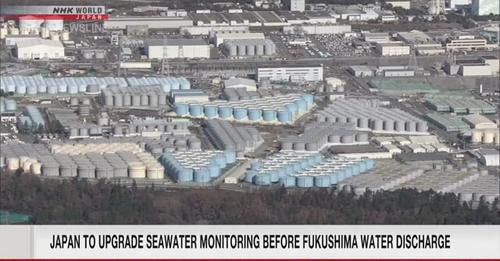
Japan nuclear watchdog to boost monitoring spots for TEPCO ‘treated’ water release
Smooth propaganda spinning from NHK, ‘treated’ water instead of the reality: radioactive water!
February 16, 2022
Japan’s nuclear watchdog has decided to boost maritime monitoring spots in anticipation of the release of treated water from the damaged Fukushima Daiichi nuclear plant.
The plant operator, Tokyo Electric Power Company, or TEPCO, plans to release treated water into the sea, starting from around spring next year.
Water, which has either been used to cool molten fuel or seeped into damaged reactor buildings, has become contaminated with radioactive materials.
TEPCO is treating the water by filtering out most of the radioactive substances. But the filtered water still contains tritium.
The utility plans to discharge the treated water after diluting the tritium level to well below national standards.
The Nuclear Regulation Authority on Wednesday discussed ways to measure levels of radioactive substances in the seawater, based on advice from an expert panel of the Environment Ministry.
The authority decided to increase its tritium monitoring locations from 12 to 20, and to lower the minimum detectible level to enable more precise measurements.
It will adopt these enhancements this spring. This would allow for comparison of water before and after release.
The total of tritium monitoring locations, including those of the Environment Ministry, will be increased to around 50, mainly within 10 kilometers of the release spot.
The head of the authority, Fuketa Toyoshi, called for sufficient confirmation to prevent substandard measurements and errors, noting that analysis of tritium takes time and analytic laboratories are limited.
TEPCO claims that impacts from exposure to treated water are minimal, but fears of damage based on rumors remain strong, especially among local residents.
The government and the plant operator hope that stepped-up monitoring would help ease such concerns.
Japan Federation of Bar Associations writes to Prime Minister Kishida, urging him to consider other ways to release treated water into the ocean

February 15, 2022
The Japan Federation of Bar Associations (JFBA) submitted an opinion letter to Prime Minister Fumio Kishida and others opposing the release of treated water from the TEPCO’s Fukushima Daiichi Nuclear Power Plant into the ocean, arguing that the procedures for obtaining social consensus are insufficient. The letter urges that other methods be considered instead of discharging the water into the sea.
The letter emphasizes the fact that the Nuclear Citizens’ Committee, made up of engineers and researchers, has proposed a method of storing the treated water by mixing it with cement or sand and hardening it. The report emphasized the fact that the Citizens’ Committee on Nuclear Energy, made up of engineers and researchers, proposed a method of storing treated water by mixing it with cement and sand.
It was a ritualistic meeting.
The government held seven meetings the year before last to hear opinions from agriculture, forestry, and fisheries groups, as well as chiefs from within and outside the prefecture, attended by the vice ministers of the relevant ministries. However, since there were almost no questions, the opinion piece criticizes the meetings as “ritualistic. The government and TEPCO only held the briefings with the conclusion that the waste would be released into the ocean. It cannot be said that they are listening to the voices of many citizens and reflecting them in their measures.
The Japan Federation of Bar Associations also sent the letter to the Minister of Economy, Trade and Industry, the Minister of the Environment, and the Chairman of the Nuclear Regulation Authority. (Keitaro Fukuchi)
https://news.yahoo.co.jp/articles/bd482f91d45a9db5f2b2d04511218a2c2f4ed15b?fbclid=IwAR3SZtUKj56m67BgLNp-7HQ9ESo6d1WuwDUQXh0YW4pJHLzkoU88UF4e1LQ
IAEA promises ‘objective review’ of Fukushima treated water discharge
Objective review from a partner in crime!

Feb 14, 2022
An International Atomic Energy Agency mission to Japan pledged Monday to conduct an objective and science-based safety review of a plan to discharge treated low-level radioactive water into the sea from the crippled Fukushima No. 1 nuclear plant.
The IAEA task force made the pledge in a meeting with government officials in Tokyo, a day before visiting the plant severely damaged by the 2011 earthquake and tsunami for inspection, as the discharge plan has drawn opposition from China and South Korea, as well as local fishing communities.
The task force will conduct the five-day review in Japan in an “objective, credible and science-based manner and help send a message of transparency and confidence to the people in Japan and beyond,” said Gustavo Caruso, director and coordinator at the IAEA’s Department of Nuclear Safety and Security.
The inspection is aimed at helping ensure the discharge plan proceeds in line with international safety standards and without harming public health or the environment, according to the Vienna-based agency.
Monday’s meeting involved the IAEA team and officials from the economy ministry, the Foreign Ministry and plant operator Tokyo Electric Power Company Holdings Inc.
Caruso said the government needs to find the best way to handle the treated water from the standpoint of safety and sustainability, as Tokyo’s efforts will be vital for further promoting international understanding on the issue.
Keiichi Yumoto, director general for nuclear accident disaster response at the economy ministry, said the government will fully cooperate with the IAEA review.
Tokyo considers it extremely important to have safety evaluations from the IAEA, Yumoto said.
The task force, established last year, is made up of independent and highly recognized experts with diverse technical backgrounds from various countries including China and South Korea, as well as personnel from IAEA departments and laboratories, according to the agency.
The findings from the mission will be compiled into a report by the end of the year, according to the IAEA.
The review will also be reflected in deliberations over the discharge plan, submitted by Tepco, carried out by the Nuclear Regulation Authority, according to Yumoto.
Water that has become contaminated after being pumped in to cool melted reactor fuel at the plant has been accumulating at the complex, also mixing with rainwater and groundwater at the site.
Tokyo decided last April to gradually discharge the water, treated through an advanced liquid processing system that removes radionuclides except tritium, into the Pacific Ocean after dilution starting next year.
Through an undersea tunnel, treated water is to be released into the sea about 1 kilometer away from the Fukushima plant from around spring 2023.
IAEA task force members are not expected to work in a national capacity but serve in their individual professional roles and report to Director General Rafael Mariano Grossi.
In response to the government’s request for assistance, Grossi said the IAEA will support Japan before, during and after the release of the water.
The safety review had been initially scheduled for mid-December but was postponed due to the rapid spread of the highly contagious omicron variant of the coronavirus.
https://www.japantimes.co.jp/news/2022/02/14/national/fukushima-water-iaea/
‘Not a dumping ground’: Pacific condemns Fukushima water plan
Northern Mariana Islands says proposal for wastewater from stricken plant to be stored on site must be considered urgently.

By Catherine Wilson – 14 Feb 2022
The Commonwealth of the Northern Mariana Islands says there is a viable alternative to Japan’s plan to dump more than 1 million tonnes of treated water from the crippled Fukushima nuclear power station into the Pacific Ocean, and it requires urgent consideration.
The wastewater is a product of efforts to cool the nuclear reactors at Fukushima that were badly damaged in the March 2011 earthquake and tsunami.
The Northern Mariana Islands, a United States territory with a population of about 51,659 people, is located only 2,500km (1,553 miles) southeast of Japan. The islands’ leaders have declared that Japan’s plan, officially announced last year, is unacceptable.
“The expectation is that the discharge will not happen until 2023. There is time to overturn this decision,” Sheila J Babauta, a member of the Northern Mariana Islands’s House of Representatives, told Al Jazeera in an interview last month. In December, its government adopted a joint resolution opposing any nation’s decision to dispose of nuclear waste in the Pacific Ocean.
“The effort that went into the creation of the joint resolution exposed research and reports from Greenpeace East Asia highlighting alternatives for the storage of Japan’s nuclear waste, including the only acceptable option, long-term storage and processing using the best technology available,” Babauta said.
Currently, Japan intends to dispose of all the wastewater, which will be treated, over a period of about 30 years.
Anxiety is high among local Japanese fishers and coastal communities. And its plan has met with vocal opposition from neighbouring countries, including China, South Korea and Taiwan, as well as Pacific Island countries and the Pacific Islands Forum, the intergovernmental organisation for the region.
“This water adds to the already nuclear polluted ocean. This threatens the lives and livelihoods of islanders heavily reliant on marine resources. These include inshore fisheries as well as pelagic fishes such as tuna. The former provides daily sustenance and food security, and the latter much needed foreign exchange via fishing licences for distant water fishing nation fleets,” Vijay Naidu, adjunct professor at the School of Law and Social Sciences at the University of the South Pacific in Fiji, told Al Jazeera.
It was the use of the Pacific Islands for nuclear weapons testing by the US, the United Kingdom and France from the 1940s to late last century which has driven heated opposition among islanders to any nuclear-related activities in the region.
Radioactive contamination from more than 300 atmospheric and underwater nuclear tests rendered many locations, especially in the Republic of the Marshall Islands and French Polynesia, uninhabitable and led to irreversible long-term health disorders in affected communities.
Satyendra Prasad, the Chair of Pacific Islands Forum Ambassadors at the United Nations, reminded the world in September last year of the Pacific’s “ongoing struggle with the legacy of nuclear testing from the transboundary contamination of homes and habitats to higher numbers of birth defects and cancers”.
In 1985, regional leaders established the South Pacific Nuclear Free Zone Treaty, prohibiting the testing and use of nuclear explosive devices and the dumping of radioactive wastes in the sea by member states, including Australia, New Zealand and Pacific Island nations.
“For us in the Pacific, the Pacific Ocean has become a proving ground, a theatre of war, a highway for nuclear submarines and waste. The Pacific is not a dumping ground for radioactive waste water,” Maureen Penjueli, Co-ordinator of the Pacific Network on Globalisation, added.
Running out of space
When the earthquake and tsunami struck the Fukushima power plant, three nuclear reactors went into meltdown.
The process of decommissioning the disaster-hit site, which could take up to four decades, includes pumping cooling water through the affected infrastructure to prevent overheating. About 170 cubic metres of treated wastewater is accumulating every day and now fills at least 1,000 tanks around the site.
The Japanese government says it needs to release the water because it is running out of space to store it all.
It says it consulted with other countries in the region after announcing its plan in April last year, conducting briefings with Pacific Island Forum countries and the organisation’s secretariat. It adds that it will cooperate with the international community and adhere to relevant international standards.
“In November last year, experts from laboratories of the IAEA [International Atomic Energy Agency], France, Germany, and the Republic of Korea visited Japan to collect samples such as fish. These samples will be divided and sent to these laboratories for analysis,” a spokesperson for Japan’s Ministry of Foreign Affairs told Al Jazeera.
“The sea area monitoring will be strengthened from one year before the discharge, which is expected to start in spring 2022 under the current plan. The concentration measurement of the nuclides regulated by law, including tritium and carbon-14, will be measured prior to the discharge into the sea, and reports of the results will be made public.”
Last year, Rafael Mariano Grossi, the director-general of the IAEA, expressed support for Japan’s decision.
“We will work closely with Japan before, during and after the discharge of the water,” Grossi said. “Our co-operation and our presence will help build confidence, in Japan and beyond, that the water disposal is carried out without an adverse impact on human health and the environment.”
The US has also given its backing to Japan.
Babauta believes storage space is available at the Fukushima Daiichi site and on nearby land in Japan’s Futaba and Okuma districts.
In a report published in 2020, Greenpeace argued that “the only acceptable solution” was for Japan to continue the long term storage and processing of the contaminated water.
“This is logistically possible and it will allow time for more efficient processing technology to be deployed as well as allowing the threat from radioactive tritium to diminish naturally,” the environmental group said. Greenpeace said that while the Japanese government had considered allocating land for storage in Okuma and Futaba, ocean discharge was seen as easier and less time-consuming.
The wastewater storage option is also favoured by the expert civil society organisation, the Citizens Committee on Nuclear Energy (CCNE), which is supported by Tilman Ruff, associate professor at the Institute for Global Health at the University of Melbourne in Australia.
“Their [CCNE’s] recommendation for the management of the water is that, the first thing to do would be to store it in properly built secure long-lived large tanks similar to the ones that Japan uses for its national oil and petroleum reserves … The argument that they make, which, I think, is really very valid, is that, if this water was stored not for an indeterminant period, but even for a period of about 50-60 years, then, by then, the tritium will have decayed to a tiny fraction of what it is today and hardly be an issue,” Ruff told Al Jazeera.
The Japanese government insists the effect of the radiation on human health as a result of the discharge is small, specifying that it will amount to 0.00081 mSv/year (millisievert of radiation per year), a fraction of the natural radiation exposure level, estimated at 2.1 mSv/year. But medical experts have serious concerns about the enormous volume of wastewater and the potential fallout of even minimal amounts of Tritium, a radioactive isotope that will not be removed during treatment.
“Tritium is a normal contaminant from the discharges, the cooling water from normal reactor operations, but this is the equivalent of several centuries worth of normal production of tritium that’s in this water, so it is a very large amount,” Ruff said.
“The government says that it will dilute the water so that it doesn’t exceed the concentration limits that are regulated … It might allow you to tick a regulatory requirement, but it doesn’t actually reduce the amount of radioactivity going into the environment and the amount of radioactivity that is being released here is really critical,” added Ruff, who is a Nobel laureate and co-president of the International Physicians for the Prevention of Nuclear War.
He says that the human and environmental consequences of even very low levels of radiation exposure cannot be discounted.
“Obviously, the higher the level of exposure [to radiation], the greater the risk, but there is no level below which there is no effect,” Ruff said. “That is now really fairly conclusively proven, because in the last decade or so there have been impressive very large studies of large numbers of people exposed to low doses of radiation. At levels even a fraction of those that we receive from normal background [radiation] exposure from the rocks, from cosmic radiation. At even those very low levels, harmful effects have been demonstrated.”
For Babauta and other Pacific Islanders, any effect is untenable.
For now, she says that it is vital that the Northern Mariana Islands have “a seat at the decision-making table. Major decisions such as these impact the core of our lives as Pacific Islanders, thus impacting our children’s future and generations to come.”
https://www.aljazeera.com/news/2022/2/14/not-a-dumping-ground-pacific-condemns-fukushima-water-plan
IAEA team to visit Fukushima next week to review water release plan

February 7, 2022
TOKYO (Kyodo) — A team of International Atomic Energy Agency experts will visit the crippled Fukushima Daiichi nuclear power plant next week to review Japan’s plan to discharge treated radioactive water into the sea, the government said Monday.
During their stay in the country from Feb. 14 to 18, the experts will evaluate the safety of releasing the treated water, with their visit to the Fukushima plant slated for Feb. 15, according to Japan’s foreign and industry ministries.
The planned release, slated to begin in the spring of 2023, has been opposed by China and South Korea, as well as local fishing communities.
The on-site assessment by the experts led by Gustavo Caruso, director and coordinator of the IAEA’s Department of Nuclear Safety and Security, was initially scheduled for mid-December but postponed due to the rapid spread of the highly contagious Omicron variant of the coronavirus.
The team will also exchange views with the Japanese government and Tokyo Electric Power Company Holdings Inc., the operator of the Fukushima plant, on cooperation in dealing with the treated water, the industry ministry said, adding the IAEA will hold an online press conference on Feb. 18.
Water pumped in to cool melted fuel at the plant, crippled by the 2011 massive earthquake and tsunami in northeast Japan, has been accumulating at the complex. It has mixed with rain and groundwater at the site, becoming contaminated.
The water is treated using an advanced liquid processing system. The process removes most radioactive material except for tritium, which is said to pose few health risks. Tokyo decided in April last year to release the treated water into the Pacific Ocean.
To improve the transparency of the water discharge project, Japan’s industry ministry and the IAEA have agreed that the international body will compile an interim safety evaluation report in 2022.
Experts to visit Fukushima plant to check water release plan

By MARI YAMAGUCHI February 7, 2022
TOKYO (AP) — A team of experts from the International Atomic Energy Agency will visit Japan’s wrecked Fukushima nuclear power plant next week to review plans to begin releasing more than a million tons of treated radioactive water into the sea, a mission the government hopes will assure people of the plans’ safety.
The team of about 15 experts will meet with government and utility officials during their Feb. 14-18 mission, which includes a visit to the Fukushima Daiichi plant, industry ministry officials said Monday.
The government and Tokyo Electric Power Company Holdings announced plans last year to begin gradually releasing the still-contaminated water in spring 2023 after further treatment and dilution. The water is being stored in about 1,000 tanks at the plant which need to be removed to allow for the wrecked plant’s decades-long decommissioning. The tanks are expected to reach their capacity of 1.37 million tons later this year.
The plan has been fiercely opposed by fishermen, local residents and Japan’s neighbors, including China and South Korea.
Japan has sought IAEA’s assistance to ensure the release meets international safety standards and gain the understanding of other countries. The team is expected to include several IAEA officials and an expert from each of 11 countries including South Korea and China, officials said.
A massive earthquake and tsunami in 2011 destroyed the Fukushima plant’s cooling systems, triggering the meltdown of three reactors and the release of large amounts of radiation, and causing more than 160,000 people to evacuate. Water used to cool the highly radioactive reactor cores has since leaked extensively, mixing with groundwater seeping into reactor buildings.
Japanese officials say the only realistic option is to slowly release the contaminated water, diluted with sea water, into the ocean. The discharge is expected to take decades to finish.
Officials say all isotopes selected for treatment can be reduced to low levels except for tritium, which is inseparable from the water but is harmless in small amounts.
The IAEA mission was originally scheduled for December but was delayed due to the global surge of the omicron coronavirus variant. Japan’s industry ministry and the IAEA have agreed to compile an interim report on the water discharge plan in 2022.
Officials say it is now safe to live in most areas around the plant except for its immediate surroundings after extensive decontamination work. They blame “reputational damage,” or incorrect information about the impact of radiation, for delaying the recovery of Fukushima’s agricultural and fisheries industries.
Six people recently filed a lawsuit seeking compensation from TEPCO for thyroid cancers that they believe were caused by radiation from the accident. About 300 people who were children at the time have since developed the illness.
On Jan. 27, five former Japanese prime ministers issued a joint statement urging the European Commission to reverse its decision to include nuclear power as an “environmentally sustainable economic activity” under EU taxonomy, noting the Fukushima tragedy and thyroid cancer in many children there.
Government officials have repeatedly denied links between thyroid cancer in Fukushima and the accident and accused the former leaders of spreading “false information and wrongful discrimination and prejudice.”
Japan’s Bid to Dump Tons of Radioactive Water From Fukushima Into Sea Hits Snag
‘most contaminants’? Not all radionuclides were filtered successfully, the ALPS filtering system failing to remove fully the radionuclides, not only tritium!

January 31, 2022
Japan’s controversial plan to dump a large amount of radioactive water from the damaged Fukushima nuclear power plant into the Pacific Ocean could be forced into a delay due to a series of recent roadblocks.
Japanese officials doubt that millions of tons of the contaminated water will begin to be dumped into the ocean as planned in spring 2023, according to a Monday report from The Asahi Shimbun. The digging of special ditches intended to hold the water just before it is released into the ocean began this month. However, the digging of a critical undersea tunnel, which was also expected to start this month, has been delayed until June.
The water has been treated to remove most contaminants before being stored in 1,061 holding tanks. Environmental concerns about the project have remained significant since the treatment process cannot filter out the radioactive hydrogen isotope tritium, a contaminant that experts say could be harmful in large amounts.
The effort to get rid of the water is an essential precursor to the decommissioning of the Fukushima plant, which experienced a triple meltdown in 2011 following a tsunami triggered by a massive Pacific Ocean earthquake.
Despite opposition from environmentalists, the fishing industry, local residents and neighboring countries, Japanese Prime Minister Fumio Kishida insisted that the water dumping plan “should not be pushed back” after touring the damaged power plant last October.
The amount of contaminated water at the plant continues to increase due to rainwater and groundwater entering the facilities and mixing with radioactive cooling water. Last year, an average of 150 tons of new contaminated water accumulated each day. Storage tanks were reportedly at 94 percent capacity as of January 20.
The plan could also be postponed due to the delay of a planned inspection by experts from the International Atomic Energy Agency. The Japanese government has invited the agency’s researchers to determine the safety of the treated water.
A visit from the researchers that had been expected to take place in December was canceled due to the recent Omicron-fueled surge of COVID-19. The Japanese government is reportedly in negotiations to reschedule the inspection for spring but no new date has been announced.
The water is expected to be released into the ocean gradually, with the entire process taking decades to complete. The plant’s operator, Tokyo Electric Power Company Holdings, has argued that the environmental impact will be minimal due to contaminated water being treated and heavily diluted in seawater. A simulation that the company released in November found that radiation levels would temporarily increase in the ocean before quickly returning to normal levels.
Safety assurances from the power company and the Japanese government have done little to change the opinions of people opposed to the water dump. Those in the fishing industry have been particularly outspoken in opposing the plan, since any contamination of the waters they fish could be disastrous to their livelihoods in addition to the environment.
“If you insist on the safety of treated water, why don’t you spray it in your garden or dump it in a river flowing into Tokyo Bay?” local fisherman Toru Takahashi told officials during a recent government question-and-answer session, according to The Asahi Shimbun. “I will never ever drop my opposition.”
https://www.newsweek.com/japans-bid-dump-tons-radioactive-water-fukushima-sea-hits-snag-1674774
Doubts grow on water-release schedule at Fukushima plant

January 31, 2022
Shovel loaders digging pits at the Fukushima No. 1 nuclear power plant on Jan. 17 were a rare sign of progress in the government’s contentious water-discharge plan at the stricken site.
Under the plan, millions of tons of treated but still contaminated water stored at the plant will be released into the sea over decades starting in spring 2023.
However, opposition to the plan remains fierce among local residents, the fishing industry and even overseas governments.
The pits being dug will temporarily hold radioactive water right before the release. But other preparatory work has already been stalled.
The government plans to create an undersea tunnel through which the treated and diluted radioactive water will be released into the sea about 1 kilometer from the plant.
Drilling work for the tunnel was initially scheduled to start early this year, but it was delayed to June.
Some government officials now doubt that the tunnel can be completed in time for the planned water release.
“It would be impossible to construct the underwater tunnel in less than a year,” one official said.
The government in April last year decided to discharge the contaminated water stored at the plant to move forward the decades-long process of decommissioning of the plant.
The accumulation of highly contaminated water has been a serious problem for the government and plant operator Tokyo Electric Power Co. since the Great East Japan Earthquake and tsunami in March 2011 caused the triple meltdown there.
An average of 150 tons of such water was produced each day last year as rainwater and groundwater keeps flowing into the damaged reactor buildings and mixing with water used to cool the melted nuclear fuel.
The contaminated water is treated by a multi-nuclide removal facility, known as ALPS, and stored in tanks. ALPS, however, cannot remove tritium, a beta-emitting radioactive isotope of hydrogen, and others.
The pits are being built to ensure that tritium levels in the treated water after dilution with a large amount of seawater are low enough to be sent to the planned tunnel for discharge into the sea.
Disposal of the contaminated water has become an urgent matter.
TEPCO said the existing 1,061 tanks at the plant are capable of holding a total of 1.37 million tons of water and would be full by around spring next year.
As of Jan. 20, the plant had reached 94 percent of capacity.
The government fears that continuing to add more storage tanks at the plant could jeopardize the overall decommissioning work.
EFFORTS TO EASE CONCERNS DELAYED
The government asked the International Atomic Energy Agency to send an inspection team to examine the safety of the treated radioactive water.
A seal of approval from a credible international body could go a long way in easing domestic and international opposition about the water release plan.
The IAEA team of researchers from 11 countries, including China and South Korea, which are opposed to the water release, was expected to visit Japan in December to begin its on-site inspection.
But that trip was scrapped after a new wave of novel coronavirus infections hit the global community.
Government officials are negotiating with the IAEA for a visit in spring by the team. But it remains unclear when the trip will finally materialize.
The government and TEPCO have also made little progress in gaining support from fishermen and the public, despite holding numerous briefings about the water release plan.
Distrust of the government and the utility remain high in Fukushima Prefecture over their series of mishandling of the nuclear disaster.
Fishermen, in particular, are adamantly opposed to the release of the water into areas where they make their living.
“If you insist on the safety of treated water, why don’t you spray it in your garden or dump it in a river flowing into Tokyo Bay?” Toru Takahashi, a fisherman in Soma, asked government officials at a recent briefing session.
The officials brought with them a huge stack of documents to emphasize the safety of the treated water.
But they lowered their eyes and clammed up when Takahashi and other opponents challenged their view.
“I will never ever drop my opposition,” Takahashi said.
Such opposition has created a headache for leaders of the towns hosting the plant.
They are eager to see progress in the decommissioning work, and getting rid of the huge amount of contaminated water at the plant would be a big step toward rebuilding their affected communities.
After the government’s decision to release the water, Shiro Izawa, mayor of Futaba, a town that co-hosts the plant along with Okuma, called on then industry minister Hiroshi Kajiyama to gain support for the water discharge plan from the public and fisheries to advance the decommissioning process.
Futaba, a town with a population of nearly 7,000 before the nuclear disaster, is the only municipality in Fukushima Prefecture that remains entirely under an evacuation order.
In 2015, Futaba grudgingly became the storage site of contaminated soil and debris gathered in the cleanup of municipalities in the prefecture on the pretext of “moving forward rebuilding.”
If the planned water release is further delayed because of opposition from other municipalities, the future of rebuilding Futaba will remain in doubt.
Fukushima Takes a Turn for the Worse.

January 10, 2022by Robert Hunziker
Tokyo Electric Power Company-TEPCO- has been attempting to decommission three nuclear meltdowns in reactors No. 1 No. 2, and No. 3 for 11 years now. Over time, impossible issues grow and glow, putting one assertion after another into the anti-nuke coffers.
The problems, issues, enormous danger, and ill timing of deconstruction of a nuclear disaster is always unexpectedly complicated by something new. That’s the nature of nuclear meltdowns, aka: China Syndrome debacles.
As of today, TEPCO is suffering some very serious setbacks that have “impossible to deal with” written all over the issues.
Making all matters nuclear even worse, which applies to the current mess at Fukushima’s highly toxic scenario, Gordon Edwards’ following statement becomes more and more embedded in nuclear lore: “It’s impossible to dispose of nuclear waste.” (Gordon Edwards in The Age of Nuclear Waste From Fukushima to Indian Point)
Disposing of nuclear waste is like “running in place” to complete a marathon. There’s no end in sight.
As a quickie aside from the horrendous details of the current TEPCO debacle, news from Europe brings forth the issue of nuclear power emboldened as somehow suitable to help the EU transition to “cleaner power,” as described by EU sources. France supports the crazed nuke proposal but Germany is holding its nose. According to German Environment Minister Steffi Lemke: “Nuclear energy could lead to environmental disasters and large amounts of nuclear waste. (Source: EU Plans to Label Gas and Nuclear Energy ‘Green’ Prompts Row, BBC News, Jan. 2, 2022) Duh!
Minister Lemke nailed it. And, TEPCO is living proof (barely) of the unthinkable becoming thinkable and disastrous for humanity. Of course, meltdowns are never supposed to happen, but they do.
One meltdown is like thousands of industrial accidents in succession over generations of lifetimes. What a mess to leave for children’s children’s children over several generations. They’ll hate you for this!
In Fukushima’s case, regarding three nuclear power plants that melted all-the-way (China Syndrome), TEPCO still does not know how to handle the enormously radioactive nuclear fuel debris, or corium, sizzling hot radioactive lumps of melted fuel rods and container material in No. 1, No 2 and No.3, They’re not even 100% sure where all of the corium is and whether it’s getting into underground water resources. What a disaster that would be… what if it is already… Never mind.
The newest wrinkle at TEPCO involves the continuous flow of water necessary to keep the destroyed reactors’ hot stuff from exposure to air, thus spreading explosively red-hot radioactivity across the countryside. That constant flow of water is an absolute necessity to prevent an explosion of all explosions, likely emptying the streets of Tokyo in a mass of screaming, kicking, and trampling event to “get out of town” ASAP, commonly known as “mass evacuation.”
The cooling water continuously poured over the creakily dilapidated ruins itself turns radioactive, almost instantaneously, and must be processed via an Advanced Liquid Processing System (ALPS) to remove most radioactive materials (???) housed in a 17-meter (56 feet) tall building on the grounds of the disaster zone.
Here’s the new big danger, as it processes radioactive contaminated water, it flushes out “slurry” of highly concentrated radioactive material that has to go somewhere. But where to put it?
How to handle and dispose of the radioactive slurry from the ALPS is almost, and in fact may be, an impossible quagmire. It’s a big one as the storage containers for the tainted slurry quickly degrade because of the high concentration of radioactive slurry. These storage containers of highly radioactive slurry, in turn, have to be constantly replaced as the radioactivity slurry eats away at the containers’ liners.
Radioactive slurry is muddy and resembles a shampoo in appearance, and it contains highly radioactive Strontium readings that reach tens of millions of Becquerel’s per cubic centimeter. Whereas, according to the EPA, 148 Becquerel’s per cubic meter, not centimeter, is the safe level for human exposure. Thus, tens of millions per cubic centimeter is “off the charts” dangerous! Instant death, as one cubic meter equals one million cubic centimeters. Ahem!
Since March 2013, TEPCO has accumulated 3,373 special vessels that hold these highly toxic radioactive slurry concentrations. But, because the integrity of the vessels deteriorates so quickly, the durability of the containers reaches a limit, meaning the vessels will need replacement by mid-2025.
Making matters ever worse, if that is possible, the NRA has actually accused TEPCO of “underestimating the impact issue of the radioactivity on the containers linings,” claiming TEPCO improperly measured the slurry density when conducting dose evaluations. Whereas, the density level is always highest at the bottom, not the top where TEPCO did the evaluations, thus failing to measure and report the most radioactive of the slurry. Not a small error.
As of June 2021, NRA’s own assessment of the containers concluded that 31 radioactive super hot containers had already reached the end of operating life. And, another 56 would need replacement within the next 2 years.
Transferring slurry is a time-consuming highly dangerous horrific job, which exposes yet a second issue of unacceptable risks of radioactive substances released into the air during transfer of slurry. TEPCO expects to open and close the transfers remotely (no surprise there). But, TEPCO, as of January 2, 2022, has not yet revealed acceptable plans for dealing with the necessary transfer of slurry from weakening, almost deteriorated containers, into fresh, new containers. (Source: TEPCO Slow to Respond to Growing Crisis at Fukushima Plant, The Asahi Shimbun, January 2, 2022)
Meanwhile, additional batches of a massive succession of containers that must be transferred to new containers will be reaching the end of shelf life, shortly.
Another nightmarish problem has surfaced for TEPCO. Yes, another one. In the aftermath of the 2011 blowup, TEPCO stored radioactive water in underground spaces below two buildings near reactor No.4. Bags of a mineral known as zeolite were placed to absorb cesium. Twenty-six tons (52,000 lbs.) of bags are still immersed with radiation readings of 4 Sieverts per hour, enough to kill half of all workers in the immediate vicinity within one hour. The bags need to be removed.
TEPCO intends to robotically start removing the highly radioactive bags, starting in 2023, but does not know where the bags should be stored. Where do you store radioactive bags containing enough radioactive power to kill someone within one hour of exposure?
Additionally (there’s more) the amount of radioactive rubble, soil, and felled trees at the plant site totals 480,000 cubic meters, as of 2021. TEPCO is setting up a special incinerator to dispose of this. Where to dispose of the incinerated waste is unknown. This is one more add-on to the horrors of what to do with radioactive material that stays hot for centuries upon centuries. Where to put it?
Where to put it? Which is the bane of the nuclear power industry. For example, America’s nuke plants are full of huge open pools of water containing tons of spent nuclear fuel rods. If exposed to open air, spent fuel rods erupt into a sizzling zirconium fire followed by massive radiation bursts of the most toxic material known to humanity. It can upend an entire countryside and force evacuation of major cities.
According to the widely recognized nuclear expert Paul Blanch: “Continual storage in spent fuel pools is the most unsafe thing you could do.” (see- Nuclear Fuel Buried 108 Feet from the Sea, March 19, 2021)
It’s not just Fukushima that rattles the nerves of people who understand the high-risk game of nuclear power. America is loaded with nuclear power plants with open pools of water that hold highly radioactive spent fuel rods.
What to do with it?
1 This Month

of the week – Shut Down Drone Warfare!


Tell the Ukrainian Government to Drop Prosecution of Peace Activist Yurii Sheliazhenko

Petition to revoke the licensing of the Near Surface Nuclear Disposal Facility (NSDF) at Chalk River. https://www.ourcommons.ca/petitions/en/Petition/Details?Petition=e-7247
To see nuclear-related stories in greater depth and intensity – go to https://nuclearinformation.wordpress.com
-
Archives
- April 2026 (44)
- March 2026 (251)
- February 2026 (268)
- January 2026 (308)
- December 2025 (358)
- November 2025 (359)
- October 2025 (376)
- September 2025 (257)
- August 2025 (319)
- July 2025 (230)
- June 2025 (348)
- May 2025 (261)
-
Categories
- 1
- 1 NUCLEAR ISSUES
- business and costs
- climate change
- culture and arts
- ENERGY
- environment
- health
- history
- indigenous issues
- Legal
- marketing of nuclear
- media
- opposition to nuclear
- PERSONAL STORIES
- politics
- politics international
- Religion and ethics
- safety
- secrets,lies and civil liberties
- spinbuster
- technology
- Uranium
- wastes
- weapons and war
- Women
- 2 WORLD
- ACTION
- AFRICA
- Atrocities
- AUSTRALIA
- Christina's notes
- Christina's themes
- culture and arts
- Events
- Fuk 2022
- Fuk 2023
- Fukushima 2017
- Fukushima 2018
- fukushima 2019
- Fukushima 2020
- Fukushima 2021
- general
- global warming
- Humour (God we need it)
- Nuclear
- RARE EARTHS
- Reference
- resources – print
- Resources -audiovicual
- Weekly Newsletter
- World
- World Nuclear
- YouTube
-
RSS
Entries RSS
Comments RSS
 nuclear-news