Mammogram screening unwise for healthy young women
The American Cancer Society ..this study strongly supports their recommendation that screening mammography should begin at age 40 and not earlier.
Mammograms in your 30s: – Paging Dr. Gupta – CNN.com Blogs ‘A needle in a haystack’ By Sabriya Rice CNN Medical Producer May 3, 201 0An estimated 29 percent of U.S. women in their 30s undergo mammograms each year, but false-positives and callbacks for additional screenings are frequent, and few breast cancers are detected in women of this age group, a new study finds. Continue reading
USA’s Blue Ribbon Panel on Nuclear Wastes More of a Nuclear Power Promoter
National Grassroots Summit and Forum
on Radioactive Waste Policy, Chicago, June 4-6
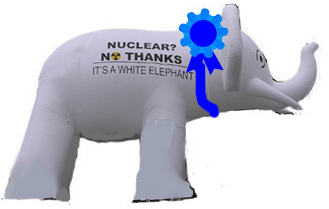 In January, the Obama Administration’s Dept. of Energy announced the creation of its “Blue Ribbon Commission (BRC) on the Future of Nuclear Power in America“, ostensibly to “study and recommend” what the U.S. should do about its radioactive waste problems, especially in light of the wise cancellation of the dangerous Yucca Mountain, Nevada dumpsite proposal. Many of us watched or attended the first meeting of the Commission in April — and are deeply disturbed by what we saw and heard. The panel seems much more devoted to expanding atomic energy than it is to addressing our nation’s unsolved radioactive waste crisis. Risky “illusions of solutions” for radioactive waste, such as reprocessing, also seem high on the Commission’s agenda.
As a response a number of organizations have come together to create a National Grassroots Summit and Forum on Radioactive Waste Policy — to articulate a national radioactive waste policy for the other 300 million Americans the DOE panel seems intent on ignoring. This event will be held in Chicago from Friday, June 4th to Sunday, June 6th.
Radioactive dust from Australia’s uranium mines found in Antarctica
Australian uranium dust found in Antarctic ice ABC News (Australian Broadcasting Corporation) 3 May, 2010, An ice core from the Antarctic bears traces of uranium that may have been carried by the wind from Australian mines in 1995, a glacier expert has told a Chilean newspaper.The minuscule amounts of the radioactive element “correspond to a year (1995) when Australia increased its uranium production,” Ricardo Jana, who participates in an international research effort in the frozen continent, told El Mercurio daily.He said scientists theorise the uranium particles were carried by the wind from Australia and deposited in the northern part of the Antarctic’s Detroit peninsula. Australian uranium dust found in Antarctic ice – ABC News (Australian Broadcasting Corporati

Pervasive radioactive risks in India
The radioactive risk society , Indian Express, by Neha Sinha, 3 May 2010, On April 10, 2007, a uranium pipeline burst in Jaduguda, causing a spill of the fuel that keeps our nuclear energy schemes running. Further, adds Half Life, a report on radioactivity in India by environmental group Toxic Links, on August 16, 2008, another uranium pipe burst, spewing houses near the village of Dungridih in Jaduguda with uranium waste. Continue reading
New study on nuclear plants and cancer
“…..the 1990 study as limited to cancer deaths and not covering a wide enough area, and he also said it did not factor in nuclear plant workers nor take into account weather or geography…..”
New US study on nuclear plant health risks hailed, CNBC: The Associated Press | 02 May 2010 Pennsylvania officials and activists say they are glad the federal government is taking another look at whether people who live near nuclear plants have a higher risk of getting cancer. Continue reading
Risks to pregnant women in airline flight – ionising radiation
“Pregnant women are flying through solar storms all the time, and they have no idea,”
Solar storms will make airline radiation hot issue The Province, By Josh Noel, MCTMay 2, 2010 Passengers may be suspicious of the low-level radiation doses coming from full-body scanners being deployed at airports, but a far greater threat comes from the radiation that creeps into airliners while in flight. Continue reading
Dr. Richard Meserve serving pro nuclear interests in USA’s radiation cancer research?
 1 May 2010, Beyond Nuclear has requested that the National Academies of Science (NAS) conduct a review for conflict of interest on Dr. Richard Meserve who currently chairs the NAS Nuclear and Radiation Study Board. This is the board tasked to shape and supervise the new cancer study around US nuclear power facilities.
Beyond Nuclear notes that Dr. Meserve also currently serves as Senior to Counsel of DC law firm catering to nuclear industry interests, on the Boards of Directors for two nuclear power companies headquartered in Texas and California, as a member of the Board of Advisors to the French-US nuclear conglomerate looking to construct new reactors in the United States and also recently contributed to a Congressional lobbying effort by the nuclear industry which used a special advertising supplement in the Washington Post asking for increased federal loans for new reactor construction.
Strong opposition to importing radioactive wastes to Hanford
Groups demand DOE end plans to send waste to Hanford By Annette Cary, Tri City Herald 30 April 2010, A coalition of Northwest environmental groups is demanding that Energy Secretary Steven Chu end any plans to import radioactive waste to Hanford.The Department of Energy agreed as part of a proposed settlement with the state of Washington not to send most types of radioactive waste to Hanford for disposal until the vitrification plant is in full operation to treat the worst waste now stored in underground tanks. That’s scheduled for 2022. Continue reading
New cancer study of Three Mile Island nuclear reactor area
New cancer study of areas around U.S. nuclear facilities brings relief in TMI area, PennLive.com, By DAVID WENNER, The Patriot-NewsApril 29, 2010, “……..The new study won’t focus specifically on TMI nor is its purpose to gauge the impact of the 1979 accident…….Rather, the study will look at decades of cancer cases surrounding each of the nation’s 65 nuclear facilities, including TMI, to assess the cancer risk of living near a normally operating nuclear facility. Continue reading
Anxiety over U.S. nuclear wastes, as “Blue Ribbon” Commission struggles for a solution
the Departme
nt of Energy convened a commission led by former lawmakers and regulators to study what to do next
SRS communities angered by nuclear waste decision | ajc.com By Bob KeefeThe Atlanta Journal, April 28, 2010 -Constitution, WASHINGTON — For decades now, workers and local residents have fully expected that giant canisters of nuclear waste put into temporary storage at the Savannah River Site would eventually be relocated from their backyards to a permanent nuclear repository at Yucca Mountain in Nevada. Continue reading
Like USA, Europe worried about unsolved problem of nuclear waste
EU Health: Vast Majority Of Europeans Want EU Wide Radioactive Waste Management Legislation, eGov monitorSource: European Commission, 29 April, 2010 – The European Commission has published today a Eurobarometer survey showing that an overwhelming majority of Europeans would find it useful to have European legislation on radioactive waste management. The concern for the safety risk related to radioactive waste is shared both in countries with nuclear power plants and those with no nuclear energy.
High levels of uranium in Palestinian victims of Gaza bombings
Disturbing Findings of Toxic Uranium Levels in Gaza, palestinefreevoice, March 22 2010 Studies conducted by a group of Italian researchers have revealed the presence of dangerous levels of toxins in the bodies of Palestinian victims of Israeli bombings during operation Cast Lead in 2008-2009. The results of tests conducted on a sample of 15 dead and wounded victims of the war on Gaza, in addition to another sample of 95 citizens, showed the presence of 30 toxic components, notably high levels of uranium. Continue reading
Impact of uranium mining on Grand Canyon’s watersheds
Ecoflight Grand Canyon Trust YouTube – Ecoflight Grand Canyon Trust

Aerial view of uranium mines threatening Grand Canyon watersheds, Grand Canyon Trust News, April 29, 2010 by gctrust Roger Clark, Grand Canyon Trust’s Air and Energy program director, recently flew with EcoFlight over uranium mining sites situated around the Grand Canyon and its watersheds that supply water for 25 million people. This bird’s eye view will allow you to understand the potential impact of uranium mining on the water supply for Arizona, southern California and Nevada. Click here to view the video. Aerial view of uranium mines threatening Grand Canyon watersheds « Grand Canyon Trust News
Community action brings about stopping of uranium exploration in National Park
Search for uranium deferred, The Telegraph – Calcutta (Kolkata), Shillong, April 29: The Meghalaya government today decided to keep “in abeyance” the proposed exploratory drilling of uranium in Balpakram National Park in South Garo Hills district in view of stiff opposition from various quarters. Continue reading

Source of ionising radiation exposure in India

AERB’s directive to Delhi University on radiation sources The Hindu, 29 April 2010, NEW DELHI: The Atomic Energy Regulatory Board (AERB) has asked the Delhi University to suspend all activities involving the use of radiation sources.The directive follows the tracing of a radioactive material that caused the death of a person of a scrap shop and injuries to several others at Mayapuri here to the university’s Chemistry Department.
The Hindu : Front Page : AERB’s directive to Delhi University on radiation sources
1 This Month

of the week – Shut Down Drone Warfare!


Tell the Ukrainian Government to Drop Prosecution of Peace Activist Yurii Sheliazhenko

Petition to revoke the licensing of the Near Surface Nuclear Disposal Facility (NSDF) at Chalk River. https://www.ourcommons.ca/petitions/en/Petition/Details?Petition=e-7247
To see nuclear-related stories in greater depth and intensity – go to https://nuclearinformation.wordpress.com
-
Archives
- March 2026 (251)
- February 2026 (268)
- January 2026 (308)
- December 2025 (358)
- November 2025 (359)
- October 2025 (376)
- September 2025 (257)
- August 2025 (319)
- July 2025 (230)
- June 2025 (348)
- May 2025 (261)
- April 2025 (305)
-
Categories
- 1
- 1 NUCLEAR ISSUES
- business and costs
- climate change
- culture and arts
- ENERGY
- environment
- health
- history
- indigenous issues
- Legal
- marketing of nuclear
- media
- opposition to nuclear
- PERSONAL STORIES
- politics
- politics international
- Religion and ethics
- safety
- secrets,lies and civil liberties
- spinbuster
- technology
- Uranium
- wastes
- weapons and war
- Women
- 2 WORLD
- ACTION
- AFRICA
- Atrocities
- AUSTRALIA
- Christina's notes
- Christina's themes
- culture and arts
- Events
- Fuk 2022
- Fuk 2023
- Fukushima 2017
- Fukushima 2018
- fukushima 2019
- Fukushima 2020
- Fukushima 2021
- general
- global warming
- Humour (God we need it)
- Nuclear
- RARE EARTHS
- Reference
- resources – print
- Resources -audiovicual
- Weekly Newsletter
- World
- World Nuclear
- YouTube
-
RSS
Entries RSS
Comments RSS
 nuclear-news