Japanese imports lead to charges
Two business executives on Tuesday were charged with illegally importing and falsely labeling food from areas of Japan affected by its 2011 nuclear disaster.
Each a manager of a local food importer, they are accused of importing snacks and soy sauce to Taiwan from the affected areas.
Authorities said one has done so since last year, while the other began the imports this year.
Neither reported their imports to the Food and Drug Administration or Keelung Customs officials, as legally required, authorities added.
Prosecutors said the defendants knew that they were not allowed to import food products from Japan’s Fukushima, Ibaraki, Tochigi, Gunma and Chiba prefectures, and intentionally hid the origin of their products from downstream firms.
Food products from those prefectures have been banned in Taiwan since the areas are suspected of radiation contamination as a result of a meltdown at the Fukushima Dai-ichi nuclear power plant in March 2011 after an earthquake and tsunami on March 11.
In March this year, authorities found that products from the five restricted areas had made their way into Taiwan under false labels.
The two managers, surnamed Teng (鄧) and Cho (卓), were charged with falsifying documents and making profits by false pretenses respectively, prosecutors said.
As for potential Japanese accomplices, prosecutors said that they have asked Japan to assist the investigation, but have not yet received a reply.
Prosecutors called on Japan to assist with the investigation to jointly protect customers’ food safety.
Source: Taipei Times
http://www.taipeitimes.com/News/taiwan/archives/2015/06/18/2003620995
Japan pushes its contaminated food products to neighbor countries
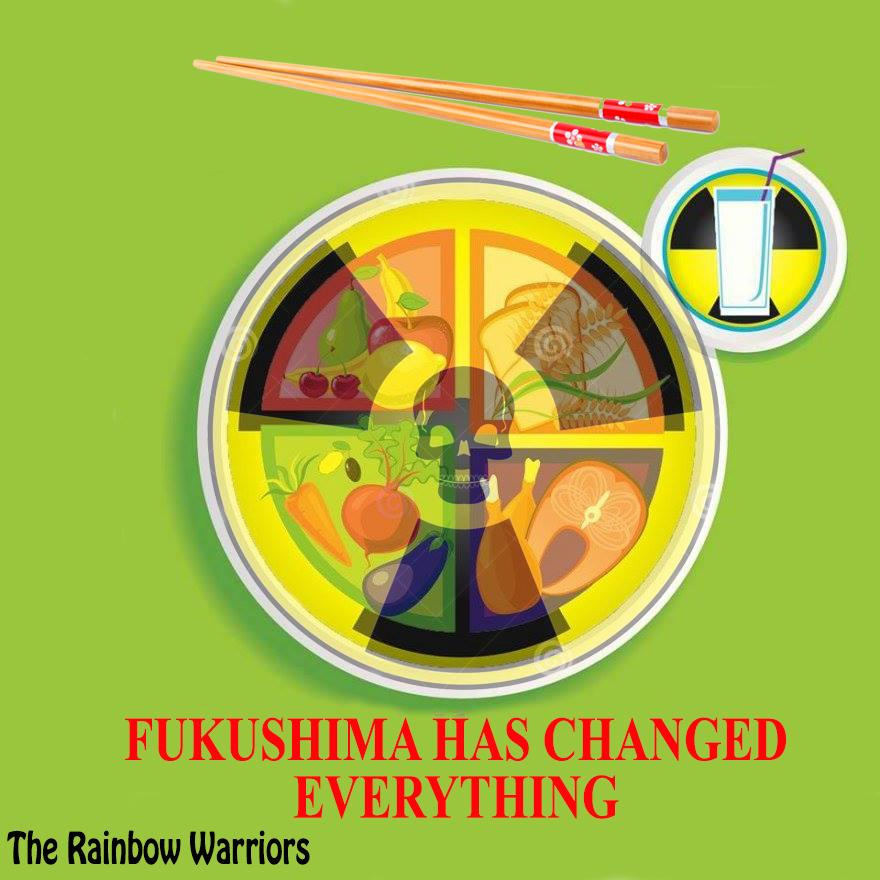
Japan food exports to Taiwan contain cesium
In the wake of the continuing Fukushima catastrophe, countries such as Korea and China are concerned that contaminated food is being exported from Japan. In a recent report by SimplyInfo.org, data from Taiwan showing food imports (primarily green tea) from Japan have contained radioactive cesium levels below Taiwan’s limit of 370 Bq/kg, but above Japan’s limit of 100 Bq/kg. The monitoring program in Taiwan is spot-checking these imports, so this contaminated tea was discovered in only a fraction of food coming from Japan, meaning additionally contaminated food could have been missed. In addition, Taiwan had already banned food from areas in Japan considered most contaminated, so this food was imported from areas in Japan considered “safe”. Taiwan tested teas that were harvested after the Fukushima catastrophe began. However, in 2011 and 2012, the US Food Drug Administration only tested tea varieties that would have been harvested in 2010, thereby having escaped contamination, making the FDA tea tests completely meaningless.
This unsettling discovery demonstrates that people in other countries are being sold food that is contaminated above Japan’s allowable limit, but below that of the receiving country—a concern that has been expressed time-and-again by Fukushima Fallout Awareness Network (FFAN) of which Beyond Nuclear is a coalition partner. While the allowable limit of radioactive cesium in Japan is 100 Bq/kg, in Taiwan it is 370 Bq/kg, and in the U.S. it is 1200 Bq/kg with no real explanation as to why, say, a pregnant woman in the U.S. should be allowed to ingest 12 times the radioactive poison of a pregnant woman in Japan. These inconsistent limits may not make biological sense, but they do make sense when taken in context of this statement by ICRP (International Commission on Radiological Protection–the body which generates statements governments rely on to set radiation exposure standards.) “There may be a situation where a sustainable agricultural economy is not possible without placing contaminated food on the market. As such foods will be subject to market forces, this will necessitate an effective communication strategy to overcome the negative reactions from consumers outside the affected areas.” This is the price of the continued use and catastrophic meltdowns of nuclear power.
Japan has filed a complaint with the WTO over Korean Fukushima-related import bans and additional testing requirements, demonstrating that countries trying to protect themselves from contaminated food could be facing international adjudication through the WTO. Japan told the WTO in October 2014 “more than 99 percent of food items were below standard limits, and strict measures prevented the sale or export of any food exceeding those limits.” But since measurement of food is so spotty, both from the importer and exporter, a statement like this is not only meaningless, but deceptive. Further, if every country’s contamination limits are different, in reality, there are no standard limits, no matter what the WTO or Japan contends.
If the Trans-Pacific Partnership is approved, these penalties could get a lot worse (link to Part 1 of a 5 part FFAN series on the TPP and contaminated food from Japan) and could include taxpayer compensation for corporate lost revenue due to such disputes.
But the radioisotope cesium isn’t the only concern. There is also strontium. Strontium-90 is much more difficult to measure than cesium-137. To avoid this inconvenience, strontium is often assumed or calculated to be in a ratio with cesium-137 such that a certain amount of measurable cesium would have a known accompanying smaller amount of strontium-90. Originally for contamination in Japan, strontium content was thought to be 10% of whatever the cesium-137 content was. However, after testing food in Japan, researchers have discovered that the initial ratio of strontium to cesium-137 is more than two times the amount of cesium-137. More importantly, it also means that the various country limits set for radioactive cesium in food may no longer protect from the increased health impact of the strontium-90 that may be lurking in imports from Japan.
Source : Beyond Nuclear
http://www.beyondnuclear.org/food/2015/5/21/japan-food-exports-to-taiwan-contain-cesium.html
Japan takes South Korea to WTO over Fukushima-related food import restrictions
GENEVA – The central government launched a trade complaint at the World Trade Organization on Thursday to challenge South Korea’s import bans and additional testing requirements for Japanese food after the 2011 Fukushima nuclear disaster.
South Korea expressed regret at Japan’s action and said its ban on some Japanese seafood was necessary and reflected safety concerns.
Japan says several measures taken by South Korea violate the WTO’s sanitary and phyto-sanitary (SPS) agreement and Seoul has failed to justify its trade restrictions as required, the WTO said in a statement.
Under WTO rules, South Korea has 60 days in which to deal with Japan’s concerns in bilateral talks. After that Japan could ask the WTO to adjudicate on the matter.
“In upcoming talks with Japan, we plan to explain fully that the import ban is necessary for people’s safety, and actively deal with Japan over the issue they raised based upon WTO’s dispute settlement procedures,” South Korea’s trade, agriculture, foreign affairs and other related ministries said in a joint statement.
Details of Japan’s complaint were not immediately available, but Japan has repeatedly raised the issue in committee meetings at the WTO, where it has also voiced concerns about Fukushima-related trade restrictions imposed by Taiwan and China.
Japan’s representative told the WTO’s SPS committee in March that radioactive levels in Japanese food had declined substantially since the nuclear crisis began at Tepco’s crippled Fukushima No. 1 plant. It noted that the United States, Australia, the European Union, Singapore and Vietnam had all lifted or eased their Fukushima-related restrictions.
“We’ve urged the South Korean government to lift the ban, but we expect it is unlikely to be dropped quickly,” Agriculture, Forestry and Fisheries Minister Yoshimasa Hayashi said in a statement on Thursday.
South Korea extended its ban on Japanese fishery imports in September 2013 to cover imports from eight Japanese prefectures, including Fukushima.
Last October, the Japanese representative at the WTO committee said contamination levels in more than 99 percent of food items were below standard limits, and strict measures prevented the sale or export of any food exceeding those limits.
South Korea’s representative told the same meeting that its restrictions were in line with WTO rules, but Japan had not provided it with sufficient data for an objective and science-based risk assessment.
Japan’s representative also cited an assessment from the International Atomic Energy Agency in September 2014, which found its measures to deal with contamination were appropriate, according to minutes of the WTO committee.
The average annual value of South Korean imports of Japanese fish and seafood was $96 million in 2012-2014, less than half the average of $213 million in 2006 through 2010, according to data from the International Trade Center in Geneva.
Source : Japan Times
http://www.japantimes.co.jp/news/2015/05/22/business/japan-takes-south-korea-to-wto-over-fukushima-related-food-import-restrictions/#.VV-d1kZZNBQ
North Burnaby, British Columbia, Canada – Debris Analysis
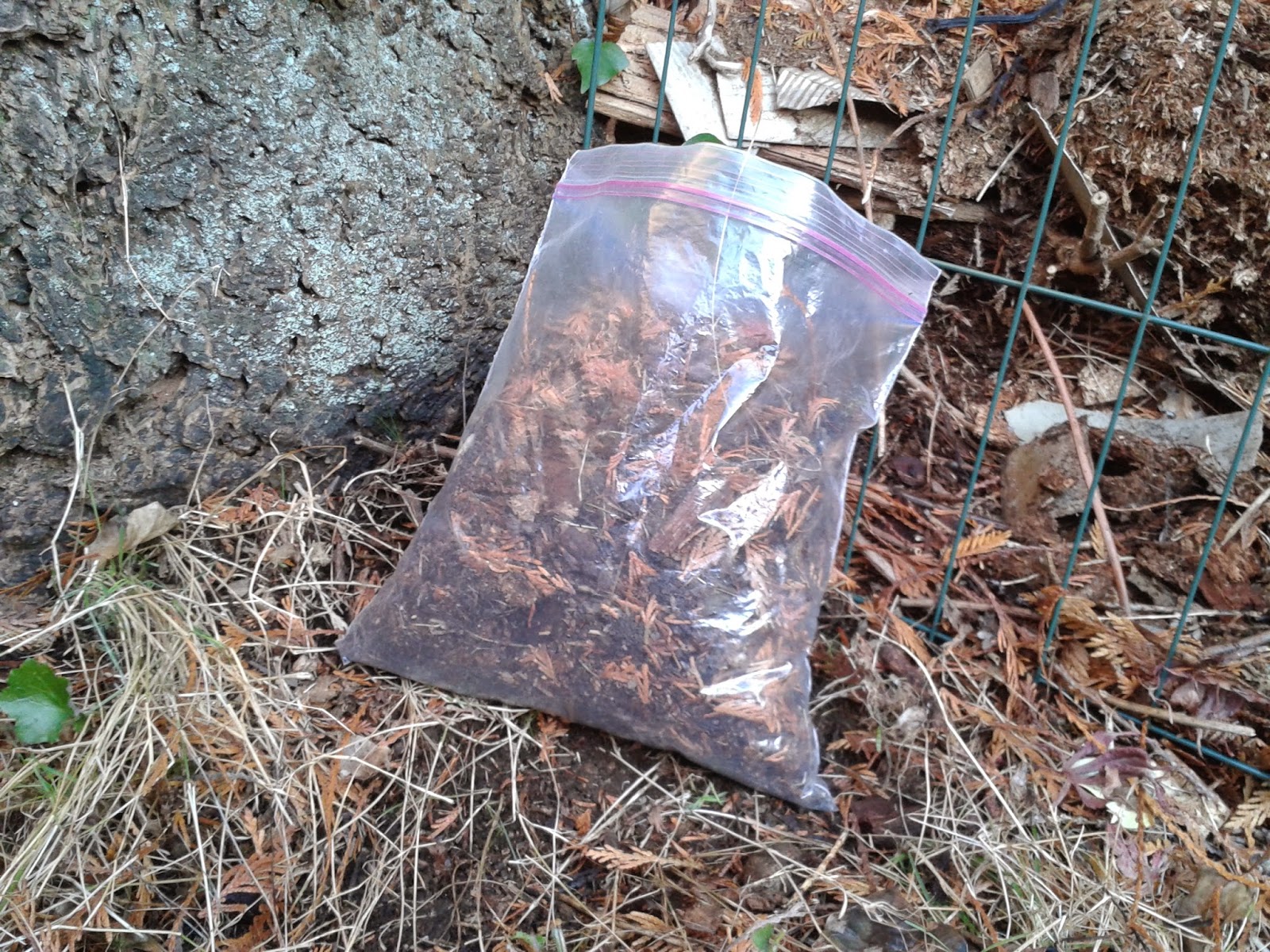 Friday, January 2, 2015
カナダBC州ノースバーナビー堆積物 BC North Burnaby Debris
試料 名 Sample: 堆積物 Debris
採取 場所 Origin:
BC州 ノースバーナビー
North Burnaby, B.C. Canada
Dehydrated ↓
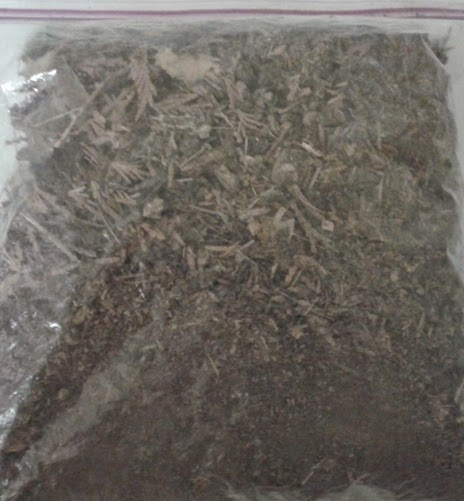
採取年月 Sampling date:
2014 年 11 月 (November, 2014)
測定日時 Date Tested :
2014 年12月10 日 (December 10, 2014)
測定時間 Duration : 57,600 秒(seconds)
試料容器 Container: 2 Lマリ ネリ容器(Marinelli)
試料重量 Sample weight: 502.2g
乾燥前 Before dehydration: 1380g
乾燥後 After dehydration: 710g

 Be-7 = Beryllium 7
Tl-208 = Thallium 208
Bi-212 = Bismuth-212
Bi-214 = Bismith-214
Pb-212 = Lead-212
Pb-214 = Lead-214
Ac-228 = Actinium-228
U-235 = Uranium-235
Source: Vancover Food Radiation Monitoring
http://vancouvermonitoring.blogspot.ca/2015/01/bc-north-burnaby-debris.html
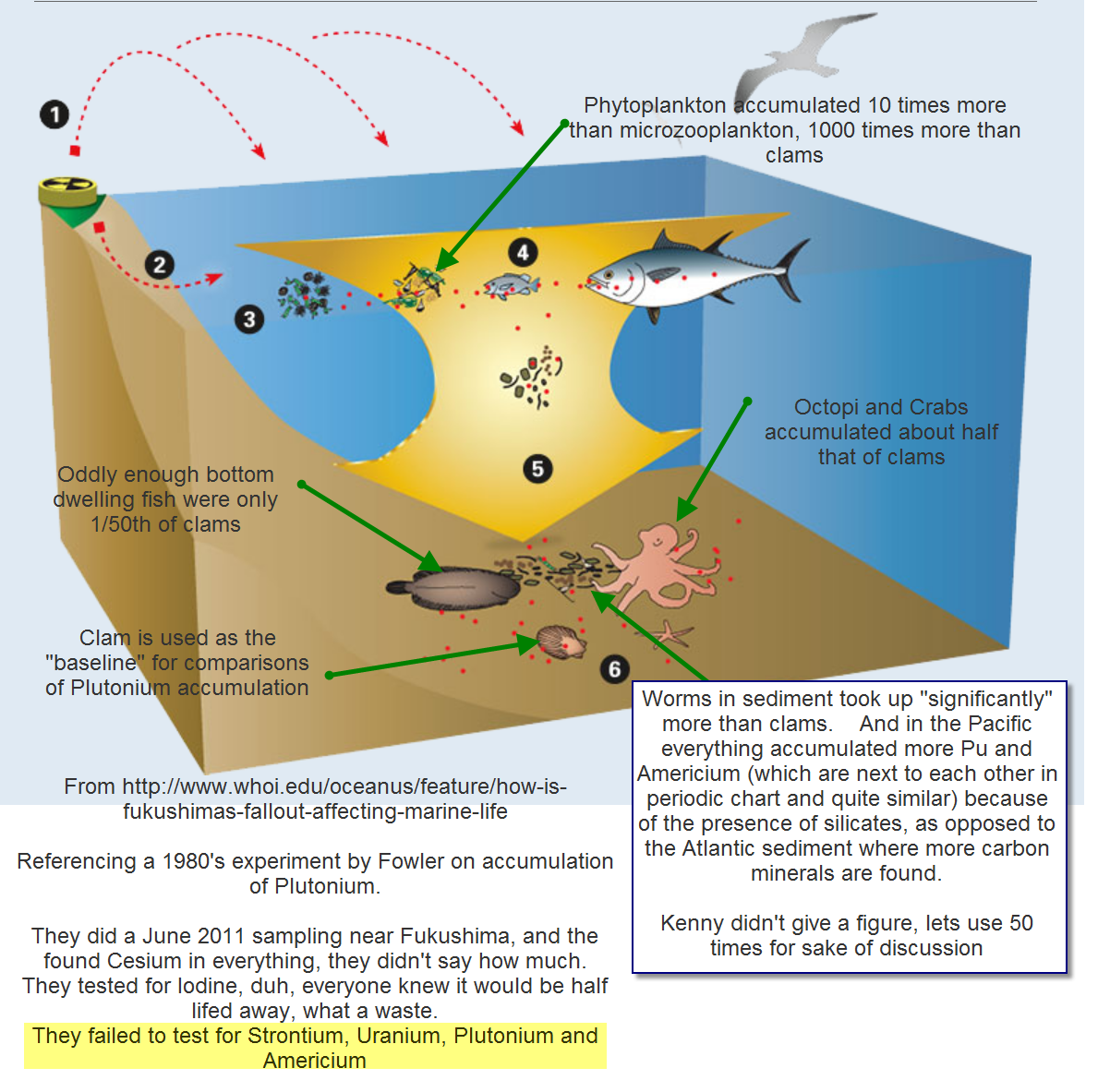
Radiation in the Ocean Food Chain, An Assessment of BioMagnification
Sunday, January 4, 2015
This chart is from Woods Hole. I annotated it, since their description of different rates of plutonium absorption was verbal and very hard to track, seems intentionally so.
Then I tried to come up with actual radiation measurements in the water and the animal life. The link below has decent water data, and some limited fish and ocean biota.
==============================
This report from Woods Hole Oceangraphic Institute is interesting to read. Of course they always end with “Further research is needed”, LOL as giving them more money is their prime objective.
Interesting though….rather then doing testing on Marine Life, they do a lot of testing on water and they do modeling of ocean flows, and it seems a prime objective is to calculate the “source term” of what came out of Fukushima. This Source Term is an estimate of what and how many radionuclides left the buildings. Is seems odd but I guess that is what scientists do….calculate things.
But since they are in the ocean on a boat equipped with advanced radiation analysis equipment, and the ability to catch fish. It sure seems like my prime focus would be to test the fish! And the bait crops.
http://www.pnas.org/content/suppl/2012/03/27/1120794109.DCSupplemental/pnas.201120794SI.pdf#nameddest=SF1
————————————————————–
http://www.pnas.org/content/109/16/5984.full#F1
The above is the main article. You need to do quite a bit of bouncing around to get to the meat of that data.
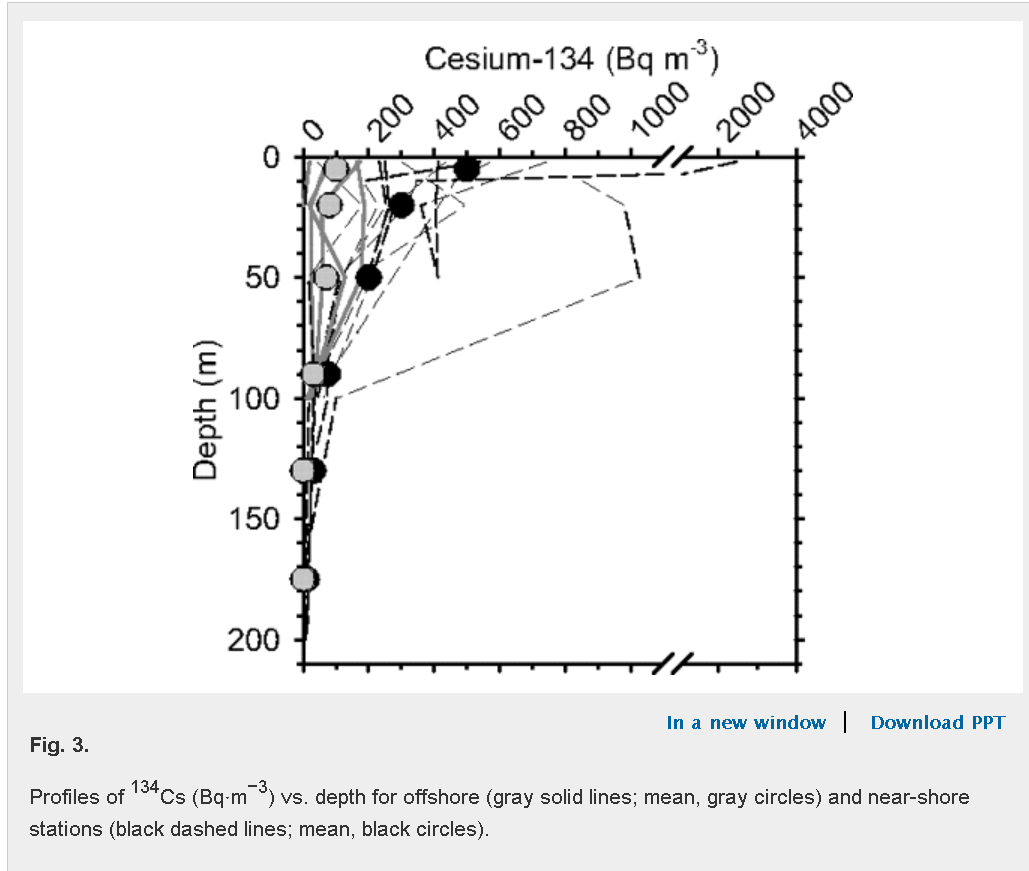
Chart below shows that contaminated water does not mix vertically much. The radiation stays in the top 300 feet primarily. It stays where 95% of the fish and critters stay. It stays where it can do the most damage.
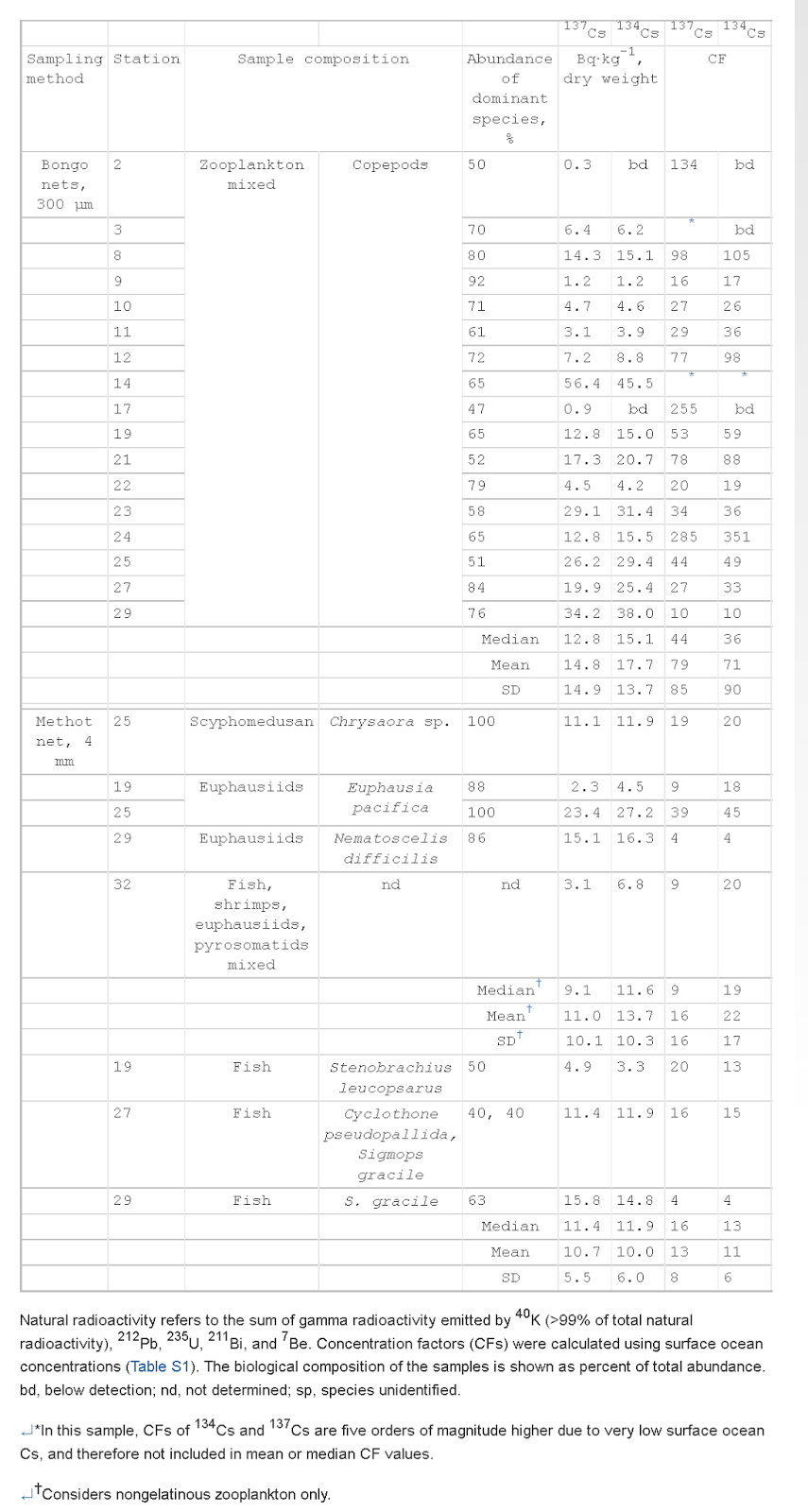 Finally, the bogeyman that no one wishes to speak of. Strontium. Strontium goes into bones and becomes a permanent part of the food chain.
This article states that the Strontium can be present in same levels or more, than the Cesium.
Radiostrontium in the western North Pacific: characteristics, behavior, and the Fukushima impact.
Abstract
- PMID:
- 22873743
- [PubMed – indexed for MEDLINE]
- ————————————————————————————————–
We also know this from our work on estimating the overall source term of all the nuke waste at Fukushima. The strontium is about equal to the cesium.
———————————————————–
Finally a link to some prior work I had done on the bioaccumulation, aka biomagnification on sea life in Alaska. Alaska was hit particularly hard by the Fukushima fallout, in fact, Fukushima increased the radiation in sea life the same way a direct nuclear bomb test did at point blank range.
Wrap your head around that.
From Alaska 2011 June
The soil and lichens have VERY high radioactivity. 6000 Bq /kG!
Here is the full report you can download.
https://app.box.com/s/rt4g13nxvqyljfqxmdxt
“…* Uranium-234 — 3.854 pCi/kg Dolly Varden
* Uranium-234 — 5.312 pCi/kg Goose Egg no shell
* Uranium-234 — 3.466 Ci/kg Gull egg
* Uranium-234 — 4.96 pCi/kg Chiton
* Uranium-234 — 9.344 pCi/kg Dragon Kelp
* Uranium-234 — 7.885 pCi/kg Rockweed
* Uranium-234 — 4.906 pCi/kg Greenling
* Uranium-234 — 2.304 pCi/kg Halibut
* Uranium-234 — 58.721 pCi/kg Horse Mussel tissue
* Uranium-234 — 8.86 pCi/kg Irish Lord
* Uranium-234 — 7.127 pCi/kg Octopus
* Uranium-234 — 4.976 pCi/kg Pacific Cod
* Uranium-234 — 4.644 pCi/kg Rockfish
* Uranium-234 — 3.032 pCi/kg Reindeer Lichen
* Uranium-234 — 3.906 pCi/kg Sea Urchin
* Plutonium-239 — .039 pCi/kg Dolly Varden
* Plutonium-239 — .186 pCi/kg Goose Egg no shell
* Plutonium-239 — .104 pCi/kg Gull egg
* Plutonium-239 — .298 pCi/kg Chiton
* Plutonium-239 — .093 pCi/kg Dragon Kelp
* Plutonium-239 — .084 pCi/kg Rockweed
* Plutonium-239 — .379 pCi/kg Greeling
* Plutonium-239 — .038 pCi/kg Halibut
* Plutonium-239 — 4.194 pCi/kg Horse Mussel tissue
* Plutonium-239 — .378 pCi/kg Irish Lord
* Plutonium-239 — .036 pCi/kg Octopus
* Plutonium-239 — .05 pCi/kg Pacific Cod
* Plutonium-239 — .279 pCi/kg Rockfish
* Plutonium-239 — .152 pCi/kg Reindeer Lichen
* Plutonium-239 — .195 pCi/kg Sea Urchin
* Plutonium-240 — .039 pCi/kg Dolly Varden
* Plutonium-240 — .106 pCi/kg Goose Egg no shell
* Plutonium-240 — .069 pCi/kg Gull egg
Source: Nuke Pro
http://nukeprofessional.blogspot.fr/2015/01/radiation-in-ocean-food-chain.html
* Plutonium-240 — .149 pCi/kg Chiton
* Plutonium-240 — .037 pCi/kg Dragon Kelp
* Plutonium-240 — .02 pCi/kg Rockweed
* Plutonium-240 — .189 pCi/kg Greeling
* Plutonium-240 — .012 pCi/kg Halibut
* Plutonium-240 — 2.097 pCi/kg Horse Mussel tissue
* Plutonium-240 — .189 pCi/kg Irish Lord
* Plutonium-240 — .021 pCi/kg Octopus
* Plutonium-240 — .015 pCi/kg Pacific Cod
* Plutonium-240 — .139 pCi/kg Rockfish
* Plutonium-240 — .091 pCi/kg Reindeer Lichen
* Plutonium-240 — .117 pCi/kg Sea Urchin
Fukushima Radioactivity Detected Off West Coast

November 10, 2014
Monitoring efforts along the Pacific Coast of the U.S. and Canada have detected the presence of small amounts of radioactivity from the 2011 Fukushima Dai-ichi Nuclear Power Plant accident 100 miles (150 km) due west of Eureka, California. Scientists at the Woods Hole Oceanographic Institution (WHOI) found the trace amounts of telltale radioactive compounds as part of their ongoing monitoring of natural and human sources of radioactivity in the ocean.
In the aftermath of the 2011 tsunami off Japan, the Fukushima Dai-ichi Nuclear Power Plant released cesium-134 and other radioactive elements into the ocean at unprecedented levels. Since then, the radioactive plume has traveled west across the Pacific, propelled largely by ocean currents and being diluted along the way. At their highest near the damaged nuclear power plant in 2011, radioactivity levels peaked at more than 10 million times the levels recently detected near North America.
“We detected cesium-134, a contaminant from Fukushima, off the northern California coast. The levels are only detectable by sophisticated equipment able to discern minute quantities of radioactivity,” said Ken Buesseler, a WHOI marine chemist, who is leading the monitoring effort. “Most people don’t realize that there was already cesium in Pacific waters prior to Fukushima, but only the cesium-137 isotope. Cesium-137 undergoes radioactive decay with a 30-year half-life and was introduced to the environment during atmospheric weapons testing in the 1950s and ’60s. Along with cesium-137, we detected cesium-134 – which also does not occur naturally in the environment and has a half-life of just two years. Therefore the only source of this cesium-134 in the Pacific today is from Fukushima.”
The amount of cesium-134 reported in these new offshore data is less than 2 Becquerels per cubic meter (the number of decay events per second per 260 gallons of water). This Fukushima-derived cesium is far below where one might expect any measurable risk to human health or marine life, according to international health agencies. And it is more than 1000 times lower than acceptable limits in drinking water set by US EPA.
Scientists have used models to predict when and how much cesium-134 from Fukushima would appear off shore of Alaska and the coast of Canada. They forecast that detectable amounts will move south along the coast of North America and eventually back towards Hawaii, but models differ greatly on when and how much would be found.
“We don’t know exactly when the Fukushima isotopes will be detectable closer to shore because the mixing of offshore surface waters and coastal waters is hard to predict. Mixing is hindered by coastal currents and near-shore upwelling of colder deep water,” said Buesseler. “We stand to learn more from samples taken this winter when there is generally less upwelling, and exchange between coastal and offshore waters maybe enhanced.”
Because no U.S. federal agency is currently funding monitoring of ocean radioactivity in coastal waters, Buesseler launched a crowd-funded, citizen-science program to engage the public in gathering samples and to provide up-to-date scientific data on the levels of cesium isotopes along the west coast of North America and Hawaii. Since January 2014, when Buesseler launched the program, individuals and groups have collected more than 50 seawater samples and raised funds to have them analyzed. The results of samples collected from Alaska to San Diego and on the North Shore of Hawaii are posted on the website http://OurRadioactiveOcean.org. To date, all of the coastal samples tested in Buesseler’s lab have shown no sign of cesium-134 from Fukushima (all are less than their detection limit of 0.2 Becquerel per cubic meter).
The offshore radioactivity reported this week came from water samples collected and sent to Buesseler’s lab for analysis in August by a group of volunteers on the research vessel Point Sur sailing between Dutch Harbor, Alaska, and Eureka, California. These results confirm prior data described at a scientific meeting in Honolulu in Feb. 2014 by John Smith, a scientist at Fisheries and Oceans Canada in Dartmouth, Nova Scotia, who found similar levels on earlier research cruises off shore of Canada. Buesseler and Smith are now working together on a new project, led by Jay Cullen at the University of Victoria, Canada, called InFORM (http://fukushimainform.wordpress.com/) that involves Canadian academic, government and NGO partners to determine and communicate the environmental risks posed by Fukushima for Canada’s Pacific and Arctic coasts and their inhabitants.
Buesseler believes the spread of radioactivity across the Pacific is an evolving situation that demands careful, consistent monitoring of the sort conducted from the Point Sur.
“Crowd-sourced funding continues to be an important way to engage the public and reveal what is going on near the coast. But ocean scientists need to do more work offshore to understand how ocean currents will be transporting cesium on shore. The models predict cesium levels to increase over the next two to three years, but do a poor job describing how much more dilution will take place and where those waters will reach the shore line first,” said Buesseler. “So we need both citizen scientists to keep up the coastal monitoring network, but also research vessels and comprehensive studies offshore like this one, that are too expensive for the average citizen to support,” said Buesseler.
Buesseler will be presenting his results on Nov. 13, 2014, at the SETAC conference in Vancouver (http://meetings.setac.org/frontend.php/presentation/listForPublic ). He is also responding to questions from the public on the “Ask Me Anything” forum on Reddit at 1 p.m. EST on Nov. 10 (http://www.reddit.com/r/science).
Ken Buesseler is a senior scientist at the Woods Hole Oceanographic Institution (WHOI) who specializes in the study of natural and man-made radionuclides in the ocean. His work includes studies of fallout from atmospheric nuclear weapons testing, assessments of Chernobyl impacts on the Black Sea, and examination of radionuclide contaminants in the Pacific resulting from the Fukushima nuclear power plants. Dr. Buesseler has served as Chair of the Marine Chemistry and Geochemistry Department at WHOI, as Executive Scientist of the U.S. Joint Global Ocean Fluxes Planning and Data Management Office, and two years as an Associate Program Director at the U.S. National Science Foundation, Chemical Oceanography Program. In 2009, he was elected Fellow of the American Geophysical Union and in 2011 he was noted as the top-cited ocean scientist by the Times Higher Education for the decade 2000-2010. He is currently Director of the Center for Marine and Environmental Radioactivity at WHOI. For more info, visit his lab, Café Thorium.
Funding for the citizen monitoring effort at ourradioactiveocean.org comes from close to 400 individuals and sponsoring organizations including Alaska Ocean Observing System, Alaska SeaGrant, Bamfield Marine Science Centre, Cook Inlet Keepers, David Suzuki Foundation, Deerbrook Charitable Trust, Dominical Real Estate, Fukushima Response Campaign, Gordon and Betty Moore Foundation, Gwaii Haanas National Park Reserve, Parks Canada, Humboldt State University Marine Lab, Idaho Section of the American Nuclear Society, Integrated Fukushima Ocean Radionuclide Monitoring (InFORM) Network, International Medcom, KUSP Santa Cruz, Lush Cosmetics, Norton Sound Economic Development Corporation, Nuxalk Nation, Onset Computer, Pacific Blue Foundation, Peaceroots Alliance, PFx, a Picture Farm Company, Point Blue Conservation Science, Prince William Sound Science Center, Resurrection Bay Conservation Alliance, San Luis Obispo Mothers for Peace, Santa Barbara Channel Keeper, Say Yes! to Life Swims LLC, Scripps Institution of Oceanography, Southwest Alaska Inventory and Monitoring Program National Park Service, St. Mary’s School, The Guacamole Fund, The Institute for Building Biology and Ecology, Tillamook Estuaries Partnership, Ucluelet Aquarium, Umpqua Soil & Water Conservation District, University of California Davis Marine Pollution Studies Lab, University of Hawaii, Woods Hole Oceanographic Institution.
The Woods Hole Oceanographic Institution is a private, independent organization on Cape Cod, Mass., dedicated to marine research, engineering, and higher education. Established in 1930 on a recommendation from the National Academy of Sciences, its primary mission is to understand the ocean and its interaction with the Earth as a whole, and to communicate a basic understanding of the ocean’s role in the changing global environment. For more information, please visit www.whoi.edu.
Originally published: November 10, 2014
Source: http://www.whoi.edu/news-release/Fukushima-detection
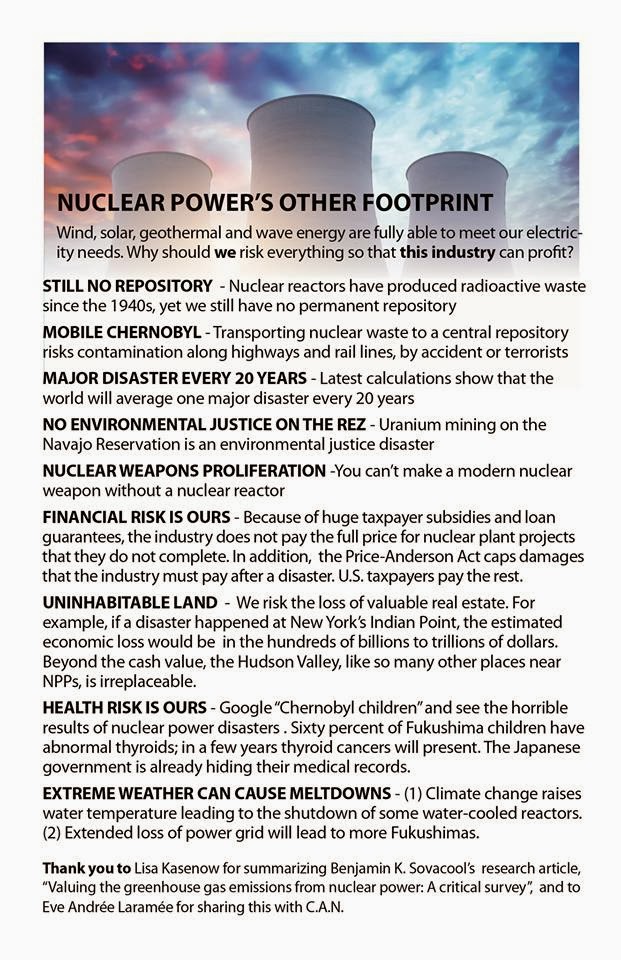
Two great charts about Nuclear ☢ that everyone should share!
Two great charts about Nuclear ☢ that everyone should study!
http://4.bp.blogspot.com/-DoEMx-2GXzc/UoF2CfVXqfI/AAAAAAAAHeo/y71numWymTo/s1600/nuclear+power’s+carbon+footprint.jpg …
and
http://4.bp.blogspot.com/-JqrhjgHn48A/UoF2HYSntRI/AAAAAAAAHew/7yjr7E4F-Ic/s1600/nuclear+power’s+other+footprint.jpg …
Nuclear Repression, not Nuclear Renaissance, in Jaitapur, India
Jaitapur’s people are more concerned about being treated as sub-humans by the state, which has unleashed savage repression, including hundreds of arrests, illegal detentions and orders prohibiting peaceful assemblies. Eminent citizens keen to express solidarity with protesters were banned, including a former supreme court judge, the Communist party’s secretary and a former Navy chief. Gadgil too was prevented. A former high court judge was detained illegally for five days. Worse, a Maharashtra minister recently threatened that “outsiders” who visit Jaitapur wouldn’t be “allowed to come out” (alive).
This hasn’t broken the people’s resolve or resistance.

The truth behind India’s nuclear renaissance Jaitapur’s French-built nuclear plant is a disaster in waiting, jeopardising biodiversity and local livelihoods Praful Bidwai guardian.co.uk, 8 February 2011 The global “nuclear renaissance” touted a decade ago has not materialised. Continue reading


Excessive radiation from airport scanners not properly scrutinised
The TSA and its contractors had failed to identify the machines that were emitting excessive radiation — a failure that continues to leave TSA workers and some lawmakers uneasy, especially as the agency continues to deploy hundreds of controversial radiation-emitting machines to help screen passengers……
TSA workers, experts worry about radiation exposure
By Alison Young, USA TODAY, 6 Dec 10,When investigators with the Centers for Disease Control and Prevention‘s workplace safety team visited a dozen airports in 2003 and 2004, what they found was disturbing — at least to federal airport workers. Continue reading
Doubts on need for airport radiation scanning, with its skin cancer risk
Full-body airport scanners ‘as likely to kill you as terrorist bombs’ By Kate Schneider news.com.au , November 26, 2010 CONTROVERSIAL full-body airport scanners are just as likely to kill you as a terrorist’s bomb exploding on your plane, a leading scientist says.Peter Rez, a physics professor at Arizona State University, US, said the probability of dying from cancer caused by radiation from a body scanner and that of being killed in a terror attack are both approximately one in 30 million. Continue reading
Medical radiation risks must be explained to patients
CT imaging, though, can produce as much as as 500 times the radiation of an X-ray, and experts have estimated that as many as 20% in Canada are ordered needlessly. U.S. studies suggest the risk of cancer from a single CT scan ranges from one in 2,000 to one in 300, depending on the dose and other factors.

Patients must be told of CT-scan dangers: doctors, Tom Blackwell, National Post , Nov. 26, 2010 As CT scans and similar procedures are ordered increasingly often, doctors should be forced to tell patients about the potential radiation-based cancer risk, two Canadian physicians have urged in a major U.S. medical journal. Continue reading
Near German nuclear waste dump – higher cancer rates
Higher rates of cancer found in area near dilapidated nuclear waste dump Deutsche Welle | 26.11.2010 by Matt Zuvela, Holly Fox The Lower Saxony government has said those living near a dilapidated nuclear waste storage facility have higher rates of cancer. Men have twice the rate of leukemia and women have three times the rate of thyroid cancer. Continue reading
Human error the biggest danger in nuclear technology
In 2007, six nuclear warheads were transported from Minot Air Force Base in North Dakota, to Louisiana’s Barksdale Air Force Base – by mistake. It’s a pattern of mistakes where there’s zero room for error.
When We’re Our Own Biggest Nuclear Threat Gizmodo Australia, By Brian Barrett November 23, 2010 Continue reading
‘Act of mischief’ irradiated 50 nuclear workers in India
Asserting that investigations are still on, police officials admit it’s a difficult case to crack since it was an act of mischief……No breakthrough yet in Kaiga radiation case – The Times of India

UK used atomic test soldiers as radiation ‘guinea pigs’
The Government of the day had to discover the effects a nuclear bomb would have, not only on the infrastructure but the effects it would have for the human race over a prolonged period of time. It was decided the Armed Forces would be used as ‘Human Guinea Pigs’ in order to discover the effects radiation would have on the Human Body.
THE TRUTH ABOUT THE BRITISH NUCLEAR TESTS, Paul Langley’s Nuclear History Blog, by Dave Whyte One of the ‘Human Guinea Pigs’ 26 Nov 10, After WWII the British Government decided they would develop their own nuclear deterrent and made plans to conduct the tests at remote areas in Australia and the Pacific as they were not fully aware of the devastating power these devices were capable of producing. Continue reading
1 This Month

of the week – Shut Down Drone Warfare!


Tell the Ukrainian Government to Drop Prosecution of Peace Activist Yurii Sheliazhenko

Petition to revoke the licensing of the Near Surface Nuclear Disposal Facility (NSDF) at Chalk River. https://www.ourcommons.ca/petitions/en/Petition/Details?Petition=e-7247
To see nuclear-related stories in greater depth and intensity – go to https://nuclearinformation.wordpress.com
-
Archives
- April 2026 (79)
- March 2026 (251)
- February 2026 (268)
- January 2026 (308)
- December 2025 (358)
- November 2025 (359)
- October 2025 (376)
- September 2025 (257)
- August 2025 (319)
- July 2025 (230)
- June 2025 (348)
- May 2025 (261)
-
Categories
- 1
- 1 NUCLEAR ISSUES
- business and costs
- climate change
- culture and arts
- ENERGY
- environment
- health
- history
- indigenous issues
- Legal
- marketing of nuclear
- media
- opposition to nuclear
- PERSONAL STORIES
- politics
- politics international
- Religion and ethics
- safety
- secrets,lies and civil liberties
- spinbuster
- technology
- Uranium
- wastes
- weapons and war
- Women
- 2 WORLD
- ACTION
- AFRICA
- Atrocities
- AUSTRALIA
- Christina's notes
- Christina's themes
- culture and arts
- Events
- Fuk 2022
- Fuk 2023
- Fukushima 2017
- Fukushima 2018
- fukushima 2019
- Fukushima 2020
- Fukushima 2021
- general
- global warming
- Humour (God we need it)
- Nuclear
- RARE EARTHS
- Reference
- resources – print
- Resources -audiovicual
- Weekly Newsletter
- World
- World Nuclear
- YouTube
-
RSS
Entries RSS
Comments RSS
 nuclear-news